
Reciprocity, Black Solidarity, and Reconnection: A Conversation on Amefricanidade and Quilombo with Professor Camila Daniel and Runnie Exuma
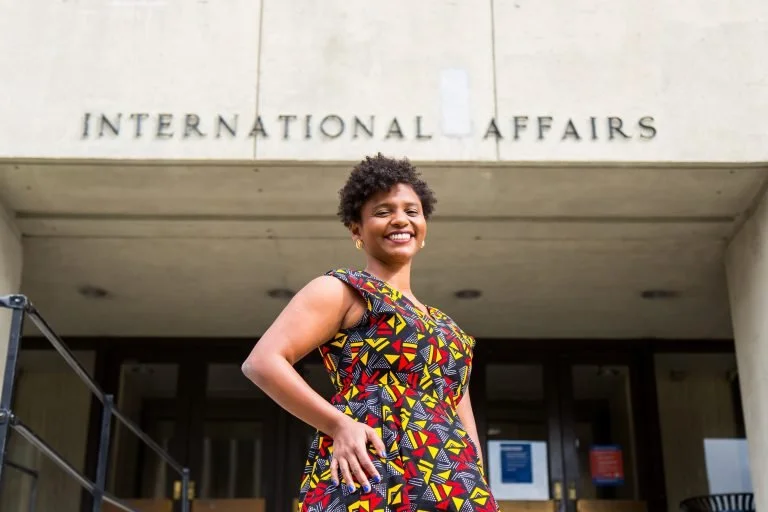
This is an excerpt from a July 29, 2022 interview between Columbia University student Runnie Exuma, CSSD staff member Tomoki Fukui, and Professor Camila Daniel around topics of anticolonial epistemology, Black feminist practices, quilombo, Amefricanidade, dance, and Black solidarity. It has been edited and condensed for brevity. You can view the full interview here.
Tomoki Fukui (Tommy): I was really struck by all of the examples that Runnie provided me with of your work and of the way that you're thinking about how migration and moving between different racial epistemic landscapes impacts people's bodily experiences, and the ways that they form connections and solidarities with each other. I wanted to know a little bit more about what your current work is, what directions it's been taking this summer. The last thing that I saw that you had made was from 2021, the Detrás de la Puerta. I’m curious to hear more about where you're going these days?
Professor Camila Daniel (Professor Daniel): Yeah, I started collaborating with Latin American immigrants in Rio in 2011. In 2016, I expanded the collaboration to Latin American immigrants in Baltimore. This experience made me realize that I also needed to understand my positionality as a Black Brazilian anthropologist. I am currently changing my perspective in a way that I'm looking at myself and Brazil more now than I used to. I am transitioning to be more connected with Black communities in Brazil, and finding a way to do what I've been doing in the US, which is conducting research that is strongly connected with community organizing. I was doing that in Baltimore, and this is what I've been doing in Brazil, especially from the pandemic to now.
Tommy: I remember when I was speaking with Runnie about your work early on, she seemed very excited about the way that you think about dance as part of a Black feminist practice or part of an anticolonial epistemology. I wonder if you wanted to talk more about that because it seems like that must relate to why it has helped sustain you as well.
Professor Daniel: Definitely. Yeah, I do believe that. That makes me think about Victoria Santa Cruz. She was an Afro-Peruvian, dancer, choreographer, and intellectual. And even though she has a very philosophical way of understanding dance, she says that we should dance instead of talking and writing about dance. The more we talk or write about dancing, the less we are living the experience of dancing itself. Dancing completely changed my way of seeing myself as a Black woman, my connection with other people and the way I am in academia.
I just realized talking to Runnie and introducing Runnie to my world in Rio that all my close friends dance. All of them, all in different ways. And most of them are Black women. At some point in our lives, we all understood that we needed to nurture life despite the expectations of society. Moving our body in dance is our way of existing, not accepting the limitations that society puts on Black women.
Society is always requiring us, Black women, to do things for them, to help them, to take care of them, to give them answers. And we have very few moments that we can just concentrate on ourselves, be ourselves, and exist. So I think we all understand dancing is a space for us to exist. We are not producing anything, we are not going to get any money out of it. We are just gonna 'be'. I do believe that dance is anticolonial for me and my Black friends. It is a way of not surrendering to the capitalist demand on Black women to be productive for someone else.
Tommy: Thank you.
Professor Daniel: I don't know if Runnie would like to say [something], because she met me at Columbia and I’m sure she was there when I said in class that I dance [in Harlem] at least once a week to survive. Dancing in Black spaces is really core to me.
This dialogues with Lélia Gonzalez, who is a Black Brazilian intellectual, is her concept of Amefricanidade. Lélia analyzes the connections in Latin America made through Black people and Black cultures. They construct a continental sense of belonging not centered in whiteness. In Latin America, people spend so much of our time denying racism and supporting white supremacy. I just feel white spaces anywhere in the world are very tiring for me. So I prefer dancing and moving my body in Black spaces. [...]
Tommy: Yeah. I don’t know Runnie if you wanted to say anything.
Runnie Exuma (Runnie): I wanted to just chime in and ask Professor Daniel a few more questions, having spent time with her the past couple of weeks. My first question was related to the work that you were doing on Lélia Gonzalez and Beatriz Nascimento in Columbia, and the conferences that you held at Columbia related to those two thinkers, and how you were able to bring in so many other Black women, Brazilian intellectuals to think with you, and present at the conferences. I first had a question about the story of how you discovered both Nascimento and Gonzalez, and the significance that they hold in your work. And also the significance of holding those conferences at Columbia, and the reason that you decided to plan it and make it happen.
So that's the first set of questions, and then the second set of questions would have to be in relation to the work we've been doing with the community of Horto with Emília, and also working with the Quilombo (Boa Esperança) here in Rio, and why that's work that you decide to participate in, too.
Professor Daniel: Okay, that is nice, because Runnie is my connection with Columbia and Brazil. When I went to Columbia, I was really aware that it was a really important opportunity for me as a scholar. But I wanted it not to be important only for me, but also for other Black women in Latin America. [...]
Black women were in the forefront of everything that I did at Columbia. They were also the forefront of the syllabus that I taught there. The first time I read Lélia Gonzalez and heard her concept of Amefricanidade was in 2015. It really blew my mind. I had been collaborating with Peruvians since 2011. Thinking about connections in Latin America, and how the continent is constructed, was really important to me. But I was like, Wow! My dissertation could have been so different if I had heard about Amefricanidade and Lélia Gonzalez before. Lélia Gonzalez published a paper about Amefricanidade in 1988. I was born in 1984. I went to university in 2002. From 1988 to 2002 was a long process. There is no reason why I never heard about Lélia Gonzalez during my whole university life. I pursued my Ph.D. in the same university that Gonzalez was working at when she passed. She was the head of the Sociology Department. The same department that I went to for my Ph.D. Even there, people didn't talk about her. Up to now, not only Lélia Gonzalez, but also so many other Black intellectuals, are still taken for granted. The work of learning about them is really an activist work: not reproducing the mainstream social sciences, or any other science in Brazil still committed to white supremacy. [...] I took so long to learn about Black Brazilian intellectuals, […] And the reason why I didn't know them was because I was still focused on mainstream academia, which means white.
But there are lots of Black students and professors all over Brazil, and even abroad, doing so much with her name and her concept. When I was at Columbia, I thought: "Okay, I'm going to have resources at Columbia. So everything that I'm going to do there will be Black women", as a means to making Amefricanidade not only a theory, but a political strategy of fostering Black women’s connections in the world.
[...] I wanted the audience abroad to learn that there are a lot of Black women producing knowledge in different dimensions of life. I wanted to explore the resources that Columbia had. […]
The conference was the possibility of putting in dialogue Black Brazilian women who are living in the U.S. and who are inside the U.S. community, and also Black Brazilians who are still here in Brazil, whose knowledge is still not incorporated into white universities in Brazil.
Columbia plays a very important role in giving visibility to Brazilian intellectuals. For example, one of the main ideologies to silence racism in Brazil is "racial democracy”. One of the intellectuals who constructed the “racial democracy” framework was Gilberto Freyre. He was a Master’s student in Anthropology at Columbia. He took classes with Franz Boas. He wrote Casa-Grande & Senzala in 1932. He went to Columbia in the twenties.
Tommy: Hmm!
Professor Daniel: So I felt that Columbia has this debt with Brazil because we are still struggling so much with the myth of racial democracy. I felt, Well, I'm gonna be at Columbia, […] I can explore a little bit of these resources to open up this platform to other people to hear these Latin Black women who are producing knowledge. [...]
I hosted several events, and all of them - yeah - all of the events I hosted at Columbia was with Black women. Most of them were Black Brazilian women, but also we had a panel with an Afro-Venezuelan and an Afro-Peruvian scholar.
Tommy: [...] When I was looking at Detrás de la Puerta, I really noticed that it was a way of dancing that you could feel the sense of joy that was being shared, you could feel a sense of freedom, and mutual encouragement, and it seemed very reciprocal. And so everything connects back to dancing, but within these relationships that are based on reciprocity instead of on trying to consume Black women in different ways.
Professor Daniel: Yeah, I think one thing I've been talking to Runnie, is to me to be a Black anthropologist is reciprocity. […] If Peruvian immigrants decided that they didn’t want me to be part of the community, I wouldn’t have my dissertation, I wouldn’t have learned how to dance Afro-Peruvian dances, and maybe I would have taken longer to learn Spanish. […]
Most of what I constructed in my career comes from the relationship I constructed with [Peruvian immigrants in Rio] since 2011. I wouldn't be a Columbia professor if I didn't have this very particular trajectory, which is a Black Brazilian anthropologist studying race from Peruvian immigrants’ perspective. This is something very unusual and was only possible because Peruvians accepted me as part of the community…
Sometimes, scholars forget that first, most of the knowledge that we learn and write about comes from the community. Especially in anthropology. Even the concepts. Lots of the concepts are native concepts. They are not ours. And secondly, we need to listen to people in order to give them back what they want, what they believe is useful for them. As a Black woman, people are always trying to extract things from me. As a Black scholar, I don't wanna do the same. That's why I believe that Black women's standpoint can be very powerful. My experience in life is strongly related to the experience of communities who are dealing with anthropologists who are expecting to extract things from them. So I don't want to do to them what people try to do to me very often.
[…] I should explain why I’m talking a lot about myself. … I understand being decolonial is acknowledging the place that I am in the world, that things are not casual… there are relations, there are forces, there are networks that make things possible. That's why I'm always talking in the first person. Just to make things clear. I don't want to sound like because I'm a Black Brazilian who taught at Columbia that I am a superwoman. I'm definitely not a superwoman. I was blessed enough to have lots of people supporting me…
Professor Daniel: Tommy, there is another question that Runnie asked me about the work that I'm doing now in Rio. [...]
One of the panels I hosted (at Columbia), the Amefrican dialogues, was about environmental racism in Brazil with two Black women who are community leaders in two favelas in Rio. Actually one of them's a community, it’s not specifically a favela. And a Black scholar, who is also a friend of mine, who is writing her Ph.D. dissertation on environmental racism in Brazil with these two communities… We hosted this panel, and this is how Runnie heard about Comunidade do Horto. […] when Runnie told me that she was thinking about coming to Rio, I told her, “Well Communidade do Horto is needing help to reopen their Facebook account… So that would be a way to support their struggle.”
So my work with the community, I feel like I'm not doing research with them. I am supporting a community that is struggling. …I’m doing activist work. […] the things that I read and my ethical practice as a Black scholar makes me committed with this community.
And the other work that I was invited to support is with a Quilombo community… There is one Quilombo community near Areal, Rio de Janeiro. They have the project of constructing their own museum. So they are in the process of creating the collective awareness of their own history, and elaborate their archives… they also want to develop a specific school curriculum for the quilombola children.
I have a student who is working there. She invited me to go to the Quilombo. Since that, I’ve been talking to the Quilombo, and asking them how I can support. I am in this process of learning about them and learning about their struggle.
Several other people has been doing research there. I am trying to understand what happened to all this research. The community has been making the same demands for many, many years. What happened to all this research? […] I'm now trying to understand the relations between the scholars who have been there, the local politicians who understood that the quilombo is important and are trying to make the quilombo more visible, and the community - what they really want. And also the internal conflicts they have. I am in the process of understanding the community and asking them. I'm constantly doing that, asking them, “How can I support? What can I do?”
And one thing that I've been thinking: connections are very important. Nobody does anything alone, especially if we are people of color. We are not gonna do anything alone. This is the modern society ideal that doesn't make any sense for people of color. [...] One thing that I always remember is that when Runnie told her parents—Runnie, you can tell it better than I.
Runnie: Yeah, I can talk about it. One of the reasons why I was really excited about visiting the quilombo was because of the process that they have of making rapadura. Rapadura is basically condensed, unrefined sugar. I was asking them how long it takes them to make, and the whole process of cutting down the sugar and milling it, and everything takes about the whole day, but the full process can take up to a week.
And I remember telling my parents that, especially as I was planning to go to Rio. I'm Haitian, and my parents are Haitian migrants, and our whole history, from my great-grandmother and my great-grandfather on both sides, they have always been farm workers and doing farm work has always been a part of my family. It's something that my mom grew up with, which is why, to this day, we can be walking somewhere, and she's able to identify all these different plant types, and the season that they grow. Things like that that I've always been really curious about.
So once I said the word rapadura, because the word is so similar to the word in Haitian Creole, which is rapadou, my dad got really excited, and he was like, “My grandfather used to make this on his farm, and he used to teach me the whole process of making it.” He grew up with that. And so when I was coming here, he just gave me the message that once I go visit the quilombo I should just learn as much as I can. That's what he told me. “Go and learn. Learn everything; learn as much as you can,” and also to bring some back for him, because I guess that's one of the things of migrant experiences. There are certain foods that you haven't had in years, but they cultivate so much memory and knowledge for you, and they bring up so much for you.
So that was my plan number one when I got to the quilombo, and I told the people there the story, and they were like, “Wow, I didn't know.” Even just the similarity between the words and the two languages. You know, it was really cool but it's also, the experience of going and realizing the similarity and practices of this one place in Rio compared to Haiti, and how all of this is just kind of Blackness and diaspora in effect, and we're all connected by this terrible history, but, and there's this beauty, and in the in the spirit of Amefricanidade, seeing certain practices repeat throughout the Americas, connected by this [inaudible] Blackness, it's been cool. That was a really top experience for me.
Professor Daniel: [...] This amazing possibility of learning different experiences of Blackness, and learning about the diasporic connection of Blackness. I didn't know about Haiti so I am learning too, through Runnie. I really had no idea about that, and also for them [the quilombolas] to realize that what they are doing is important for them. There is a connection with other Black people, so they learn how great this connection is. … I’m not romanticizing. [...] They have lots of struggles. But despite the struggles, they are cultivating ancestral connections that make them part of the diaspora, and that is really life-affirming.
Tommy: I notice this recurring theme of learning about the connections that were already there? They are coming into more and more awareness. That seems like such a central and important part of what is being produced by your work and the way that you are both forming these relationships to people, to communities. [...]
Runnie: That's a huge part of having worked with you the past couple of weeks. I think I've seen, even in visiting the Quilombo, and posting the performances of capoeira and whatnot. There are a lot of people who reached out to me who were like, “Oh, my gosh! This looks like Puerto Rican Bomba,” which is another style of dance and performance, and, all these other people being like, “I'm from x country in Latin America, and this is something that we have here, too,” and being able to make the connections.
And also with the rapadura, I started looking it up more, and it has different names in different parts of Latin America. I think it's called piloncillo in Mexico, and then in Colombia it's called panela, and it's all these Black Latin American Caribbean people having their own practices for making it, and different words. It’s really cool.
Professor Daniel: And that is exactly what the concept of Amefricanidade is. Being able to see this Black connections despite—despite violence, despite the project of erasing everything that is Black. We still have these connections even though we might not be aware of. So for me it’s so powerful, because the work of trying to make Black people fit into a white world in Latin America and in the Caribbean and in the diaspora is so oppressive. But there are still resistances.
Tommy: [...] Are there final thoughts that you or Runnie wanted to share?
Professor Daniel: I do believe we are able to construct connections that are not centered in whiteness, and that are life-affirming. And academia, even though it causes a lot of problems, can also be a means of constructing alternatives of living, of being together, of… creating reciprocity and alternatives of life that are not centered on coloniality and capitalism and individualism… My process of claiming my humanity and my existence is also what moves me to do my work as a researcher, and question the centrality of whiteness in academia and in the political world, and use academia as a resource to other possibilities of life.
Tommy: [Reading from chat] Runnie says, talk about what you see yourself doing next.
Professor Daniel: …I do wanna do more activist research in Brazil and Rio… This week I hosted an event at my university, for the international day of Black Latin American Caribbean women. I talked, Runnie talked, and one of the speakers was a student of mine. …she started a samba space, a space to preserve the samba in Três Rios, in the town where I work. [...]
One thing that Runnie has been asking too and I forgot to relate to, is the concept of Quilombo from the Black Brazilian historian Beatriz Nascimento. In the eighties she constructed a different meaning for Quilombo. Before Beatriz Nascimento, Quilombo was considered any community of enslaved people who escaped from slavery. Nascimento defined quilombo not as a specific place encapsulated in the colonial horizon. But Quilombo is a way that Black people develop a different philosophy of living which is centered in Black solidarity. Quilombo is a philosophy real not only in the Quilombo itself, but also in other Black spaces, such as the favelas and the samba schools. Sambas are these Black connections that Black people support each other. For example, if someone has no food, then that person who has more will give to the other one. And one person takes care of the other person's kid. So all this Black solidarity is what she calls Quilombo… Thinking about this concept, I want to study the samba schools in Três Rios as a Quilombo, as an ethical philosophical way of living Black lives. This is what I’m doing now. At some point, I want to connect the samba schools in Três Rios with the Quilombo, the actual quilombo. Well, everything is actual quilombo, but Quilombo Boa Esperança, the Black rural community I am collaborating with.
These are my goals by now. But I also have an artistic political goal […] to start a Black dance collective.
Tommy: I feel like there's so much more to talk about, even with just the expectations around ethnography and the like amount of work that that is, and how the model of colonial ethnography really sets that up. But yeah. I also wanna be respectful of your time, for both of you. I really appreciate you both taking time to be here and Runnie like, thank you so much for you know, facilitating this and doing all of that work. I really appreciate it.
Professor Daniel: Thank you so much. Thank you, Runnie, for so supporting Tomoki in their process of organizing this interview, and also Tomoki for not giving up even though I’m not in Columbia anymore. This interview is also a reminder for myself that I'm doing a nice work.
Prison Education and Teaching Incarcerated Students
Over the 2021-2022 academic year, the Prison Education and Social Justice Curricula working group—comprised of Columbia University faculty, graduate student workers, members of the Justice-in-Education (JIE) initiative, and local prison education workers—has been meeting regularly to develop courses to be taught in prison contexts and to prepare for the challenges involved in this new kind of teaching.
Since 2015, Columbia faculty who want to teach as part of the JIE initiative can offer Columbia courses to students at various city, state, and federal facilities in New York, such as Rikers, MDC Brooklyn, Sing Sing, Taconic, Queenboro, and Edgecomb. Some of our working group participants—including Jean Howard, Kate Suffern, Julie Crawford, Julie Peters, Jeremy Dodd, and Jason Resnikoff—already have experience teaching in prison contexts.
But this was not true of all our participants. Indeed, the majority joined the group with a desire to teach in prisons but without detailed knowledge of what the process entailed. In our initial meetings, we spent time listening to and learning from those who have experience dealing with the unique circumstances of prison education. While we want to offer the same kind of education in prison contexts that we offer on Columbia’s main campuses, it is important to remember that prison education has its own challenges—for instance, there are specific procedures for the clearance of instructors and their syllabi, as well as limited resources in terms of libraries and classroom equipment. To prepare Columbia faculty and graduate instructors for prison education, we hope to codify our learning in the form of a training guide in the coming year.
With the input of formerly incarcerated students and experts in prison education, the group learned about the kinds of classes that students most enjoyed and the disciplines in which there is the greatest need for courses. From our discussion, it became clear that students are eager to engage with the intellectual content of courses from across the whole spectrum of academic disciplines, from Astronomy to Music, from Physics to English. At the moment, more courses are offered in the humanities than in the sciences and social sciences. While Professors Jeremy Dodd (Physics), Jennifer Middleton (Earth Studies), Geraldine Downey (Psychology), and Caroline Marvin (Psychology) have or will be offering courses in these areas, there remains strong demand for courses in biology and chemistry, as well as in sociology, political science, history, economics, and other disciplines.
This is an imbalance we would like to address going forward. One difficulty is the necessity of preliminary mathematics instruction in order take many classes in a discipline such as Astronomy, but a science subgroup, including Professor Marcel Agüeros, is working on a solution to this issue. In terms of the social sciences, we hope in the coming year to recruit more faculty and graduate workers to develop courses in these disciplines for the prison context.
Looking ahead to this summer, fall, and spring, participants in our working group have developed an exciting array of courses that will be taught at a variety of prisons. Professors Jack Halberstam, Tey Meadows, Rebecca Jordan Young, and Mia Florin-Sefton have been designing an introductory-level Gender and Sexuality course, and Mia will be teaching a version of this over the summer. Professor Middleton is teaching an introductory-level Earth Studies course; Professor Frances Negrón-Muntaner is teaching a course on “Latino Culture and the Global City”; Professor Dodd is teaching a course in Physics; Professor Howard is teaching a course on “Shakespeare and Global Adaptations”; Professor Peters is teaching a course on “Law and Literature”; and Professor Marvin is teaching a course in Cognitive Science.
In addition to formalizing training processes, expanding graduate worker involvement in prison education, and broadening course offerings in prisons, we plan in the coming year to continue developing an undergraduate concentration in “Frontiers of Justice,” which will allow undergraduates on Columbia’s main campuses to engage in social justice projects in the local community. We are excited about all of these developments and look forward to the work ahead.
Patrick Anson is a PhD Candidate in English and Comparative Literature. He is writing a part-ethnographic, part-literary-critical dissertation about programs that propose reading groups focused on 20th and 21st century narrative literature as a means to address a range of social problems, from mass incarceration, where a reading group functions as an alternative sentence for people convicted of an offense, to military trauma, where a reading group helps to establish social connections among veterans.
Jean E. Howard is George Delacorte Professor in the Humanities at Columbia University where she teaches early modern literature, Shakespeare, feminist studies, prison literature, and theater history.
Reflecting on the Body in George & Maria’s Workshops
The central focus of George Sanchez and Maria Jose Contreras’ workshops (in October and November respectively) was the body: the body that “keeps the score” of its habits, desires, and accumulated traumas, whether or not that score ever makes its way into verbal expression or outward acknowledgement. The goal of these workshops was to explicitly offer that acknowledgement: to make the score visible, legible, and communal, rather than burying it in the rush of “going back to normal life” after a year of COVID lockdown, precarity, illness, and death. The goal was also to find expressions for it that were not entirely linguistic: to use the body itself, and its myriad senses, to bring out the body’s aches and sores. As such, two central activities from the workshop stood out the most to me: George’s “Image of Covid” activity (adapted from Augusto Boal’s image-theatre) and Maria’s “Body Maps.”
The “Images of Covid” activity was powerful because it came on the heels of “Images of Power,” in which we were encouraged to set up three chairs, a table, and a water bottle in such a way that gave one of the chairs ultimate power over the rest. It was only after interrogating various permutations of these objects and analyzing what power meant to us as a group that George prompted us to create a similar “image” to capture the Covid experience. One participant, Thomonique, took the lead, and the “image” wound up being a woman feeling the temperature of a reclining (and potentially dying) man, while a couple held hands at a distance and wept. On the face of it, this image was less “impressive” than the inanimate and highly imaginative images of power that preceded it. But what it allowed the participants to do was share their experiences organically as prompted by the image before them. This organic story-telling that emerged from the group was worlds apart from more stilted variations of “processing the pandemic” that I have experienced in the past, in which folks go around in a circle and confess their suffering to strangers. Though I had experienced George’s workshop once before among only ZCMP fellows in September, this moment had not taken place the first time, largely because we inadvertently settled into the more familiar sharing-in-a-circle structure at the time. This, however, was far more moving. The stories participants shared were unprompted, and all used the image as a jumping-off point for their personal lives.
Maria’s “Body Maps” succeeded in an entirely different way: rather than encouraging us to focus on the events of the past year (the “plot points” within the monotony, as it were), it gave us sounds, shapes, and colors through which to narrate our body’s unique journey through the pandemic—a story we otherwise would have no space to really tell. We were asked to trace outlines of one another on large canvases and then draw within those outlines where the pandemic had left its marks on our bodies and how. Each map turned out completely unique. For some folks, the body was loud: ambulance sirens blaring within the mind, fires engulfing the heart and lungs, shackles chaining the arms and legs. For others, it was silent: empty spaces, vines winding through the legs and arms, an astronaut’s glass shell surrounding the head, or the head transforming into a luminous laptop screen. The stories we told through the artworks then manifested in speech. Maria asked us to explain the effect on our bodies to one another through a match exercise—we had to speak for as long as the match was burning, then pass a match to the next person in the circle. The maps we had just drawn seeped into our stories, and the focus on the match’s weak light took pressure away from the verbal constructions themselves. It was a magical moment, much like the one with Thomonique’s image in George’s workshop. Some folks cried in the small window of time their match gave them; others expressed their gratitude for the bodies they had come to find themselves in. In that way, the workshops completed one another, moving between visual and embodied stories, and transforming the most private and intimate memories into elements of collective experience.
Author Bio: Aya Labanieh is a Ph.D. candidate in the English and Comparative Literature Department, where she works on imperial conspiracies and their conspiracy-theory afterlives in 20th and 21st century Middle Eastern literature and politics. Her broader interests include conspiratorial thinking within a global digital context, and how conspiracy theories function as alternate histories, heretical discourses, popular critiques, epistemic injuries, and modern enchantments.
The Zip Code Memory Project seeks to find community-based ways to memorialize the devastating losses resulting from the Coronavirus pandemic while also acknowledging its radically differential effects on Upper New York City neighborhoods. Through a series of art-based workshops, public events, social media platforms, and a final performance/exhibition at the Cathedral of St John the Divine, community members participate in building networks of shared responsibility and belonging.
Representing Covid through Boal’s Image-Theater
Images of “Covid:”
#1. A person lies on a bench with both hands resting on their stomach and eyes half-closed. Another person stands with one of their hands placed on the forehead of the person lying down. The person lying down does not see the person who has a hand on their forehead. At a certain distance, two people stand behind some chairs holding hands and looking in the direction of the person lying down.
#2. A person sits on the ground with their legs outstretched. Another person lies on the ground with their upper body rested on the other person’s lap. The person sitting on the ground embraces the person lying on their lap with both arms and holds them.
#3. A group of people sit cross-legged on the ground in a circle. They all face the outside of the circle, with their backs turned to the center of the circle. Everyone in the circle holds their head down with both hands over their head. No one sees or touches another person.
These three images of “Covid” were created in the “Rehearsals for Change” workshops that took place in the past three weekends. We were asked to use the bodies of other participants to build a “sculpture” of “Covid” (Boal 143). As in Boal’s Image-Theater, we were “not allowed to speak under any circumstances” (144). Instead of verbally expressing our opinions about “Covid,” we had to come up with a “physical representation” of it (144).
Boal’s Image-Theater (like his Poetics of the Oppressed more broadly) focuses on the body as a means of theatrical production. “The means of production of the theater are constituted by [people] . . . the first word in the theatrical vocabulary is the body, the main source of sound and movement” (131). To get to know one’s own body and to make it “more expressive” are arguably the most important steps in Boal’s Poetics of the Oppressed and its goal of transforming “spectators” into “actors” who “assume the protagonist role, change the dramatic action, rehearse possible solutions, [and] discuss plans for change,” thus “preparing themselves for real action” (126).
In his discussion of Image-Theater, Boal mentions themes like “imperialism” or more “local problems, like the lack of access to running water” (143). Reading Boal’s TO in the context of the ongoing global pandemic, we think of “Covid,” and the focus of Image-Theater on non-verbal physical expression seems particularly conducive to representing “Covid” if we consider the ways in which many experiences and emotions associated with the pandemic seem to defy verbal articulation. As Bessel van der Kolk writes in The Body Keeps the Score, the “imprint” of painful experiences are often “organized not as coherent logical narratives but in fragmented sensory and emotional traces: images, sounds, and physical sensations” (211). In our workshops, many of us mentioned the sound of ambulance sirens and the image of refrigerator trucks parked at the entrance of hospitals — two “traces” (one sonic, one visual) that powerfully express something about our experience of the pandemic. If many “imprints” of the ongoing pandemic are organized in “traces” such as images, Boal’s Image-Theater offers us a tool to use our bodies (the same bodies that “keep the score” of what we’ve been going through) to express and share these “traces.”
In Image-Theater, a participant is asked to build a “physical representation of the proposed theme,” and, subsequently, “another image showing how they would like the proposed theme to be. In other words: the first grouping shows the real image, while the second shows the ideal image. With these two images, a participant is asked to show what would be, for them, the transitional image. We have a reality that we want to transform; how do we transform it?” (Boal 144). Using the example of a young woman who lived in a “small pueblo, called Otuzco,” in Peru, Boal describes an image in which leaders of a peasant revolt were publicly tortured in the town’s central square (144). Boal describes this image as “terrible, tragic, pessimistic, defeatist, but, at the same time, an image of something that really happened” (145). The young woman transformed this real image into an ideal image in which “people worked in peace and loved each other . . . in short, [the image of] a happy Otuzco” (145).
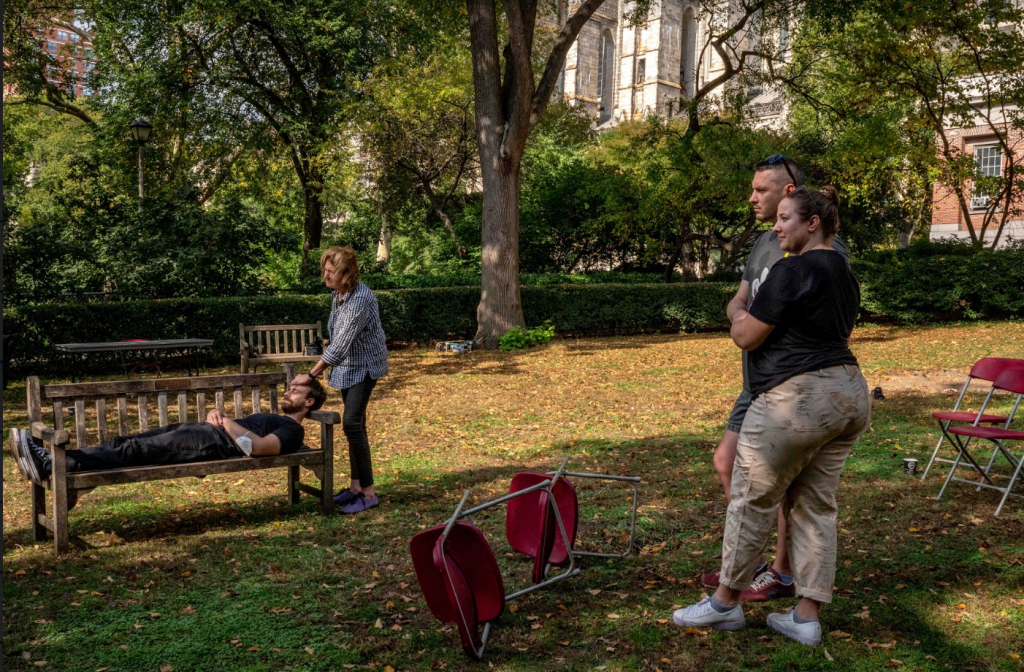
#1. A person lies on a bench with both hands resting on their stomach and eyes half-closed. Another person stands with one of their hands placed on the forehead of the person lying down. The person lying down does not see the person who has a hand on their forehead. At a certain distance, two people stand behind some chairs holding hands and looking in the direction of the person lying down.
What happens when you have a real image that isn’t only “terrible, tragic, pessimistic, defeatist”? The image of “Covid” that Thomonique created in our first workshop has things we would probably like to change. We would like to see health workers (the person with one of their hands placed on the forehead of the person lying down) also cared for and comforted, and justly compensated for their essential labor. We would like to see family members (the two people standing behind the barricade of chairs) not totally isolated from their loved ones, somehow feeling like they too are caring for and comforting each other in a difficult moment. And yet, as the person lying down in this particular image, I felt the warmth of Susan’s hand on my forehead. Similarly, Julie, who was embraced and held in Image #2 (created by Nazia), expressed feeling comforted and protected. “Gestures of comfort” like touching or holding “makes us feel intact, safe, protected, and in charge” (Kolk 253). Touch, when “attuned” (253) and “mindful” (254), is “the most elementary tool that we have to calm down” (253). Such “gestures of comfort” and the affection and hope they elicit are things we would like to keep as we struggle to transform our reality into something closer to what we want it to be.
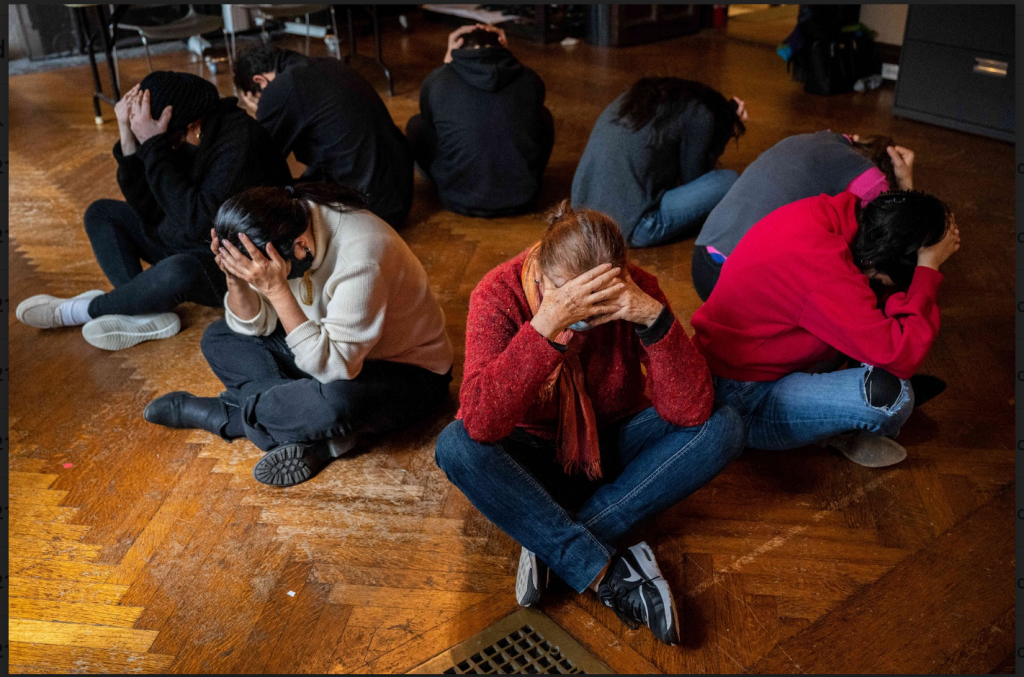
#2. A person sits on the ground with their legs outstretched. Another person lies on the ground with their upper body rested on the other person’s lap. The person sitting on the ground embraces the person lying on their lap with both arms and holds them.
Perhaps the real image of “Covid” in most need of transformation is Image #3 (created by Leah). The gestures in this image seem to be gestures not of comfort but of distress, especially the gesture of holding one’s head down with both hands. This is the only image in which people touch themselves, but not others. They are in the same circle, yet deeply alone. Maybe we would like each person in the circle to place one of their hands on someone else’s forehead, and to have another person’s hand placed on their forehead. Maybe we would like each person in the circle to hold someone else, and to be held. If this is the real image of “Covid,” maybe the ideal image would not be that different from the circle with which we closed each of the workshops — one where everyone stands turned to the center of the circle with arms interlocked with those of the people next to them. If this is the ideal image, what would be the transitional image? How do we get from the circle in Image #3 to the circle at the end of the workshops? Maybe the workshop is the transition, the circle of chairs where we first meet at the start of the day, and the circle of chairs where we later discuss the images of “Covid” and what it means to us before standing up for the final circle.
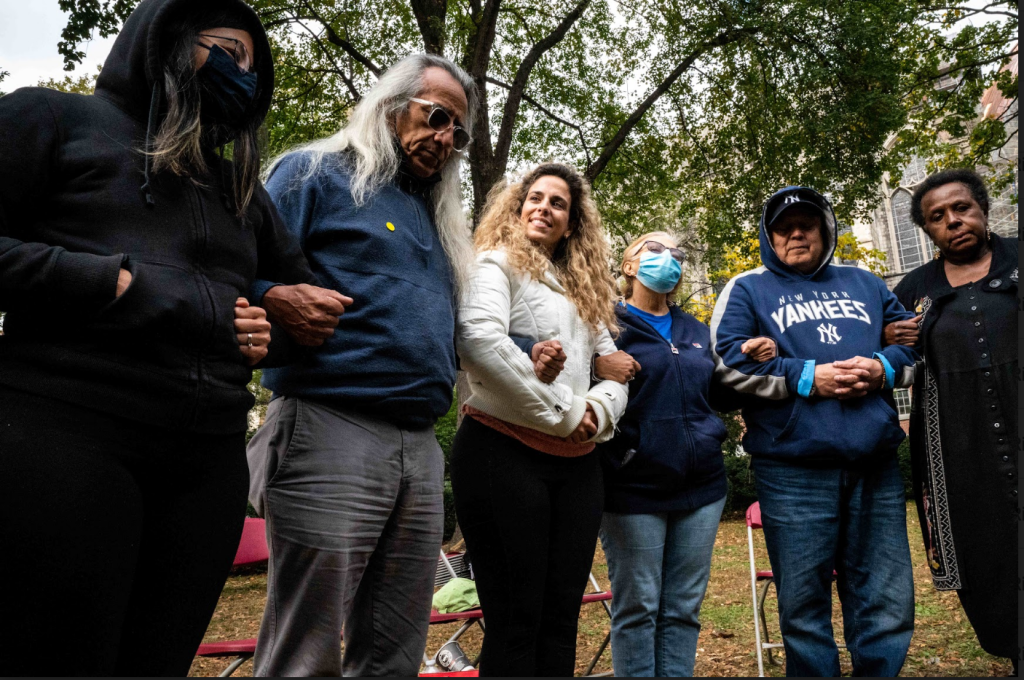
#3. A group of people sit cross-legged on the ground in a circle. They all face the outside of the circle, with their backs turned to the center of the circle. Everyone in the circle holds their head down with both hands over their head. No one sees or touches another person.
Image-Theater is “one of the most stimulating [forms]” of the Poetics of the Oppressed (147). It stimulates the “desire” to practice what was rehearsed in the workshops, a “certain lack of satisfaction” that Boal calls “ímpeto revolucionário” — a moving force that seeks “fulfillment” through political struggle (152). Together, the three images of “Covid” that came out of our workshops suggest that gestures of comfort and the feelings they elicit are key to any “ímpeto revolucionário” and to our struggles to change the unjust realities that have been exacerbated by the ongoing pandemic.
Boal, Augusto. Teatro do oprimido e outras poéticas políticas. Civilização brasileira, 1991.
Kolk, Bessel van der. The Body Keeps the Score: Brain, Mind, and Body in the Healing of Trauma. Viking, 2014.
Author Bio: Guilherme Meyer is a PhD candidate and teaching assistant in the Department of English at New York University. My dissertation project deals with prophetic utopianism, which is a mode of utopianism that engages in prophetic denunciation-annunciation as a means to sustain revolutionary praxis. He is a co-chair of the Marxism working group in the Department of English and an organizer in the union for graduate workers at NYU, GSOC-UAW Local 2110.
The Zip Code Memory Project seeks to find community-based ways to memorialize the devastating losses resulting from the Coronavirus pandemic while also acknowledging its radically differential effects on Upper New York City neighborhoods. Through a series of art-based workshops, public events, social media platforms, and a final performance/exhibition at the Cathedral of St John the Divine, community members participate in building networks of shared responsibility and belonging.
An email after a visit to La Morada
This post contains an email that I shared with Diana Taylor, Marianne Hirsch, and Lee Xie after visiting La Morada in the Bronx with Aya Labanieh on September 7th, 2021.
Dear all,
As I said in my previous email, the experience today was amazing and fulfilling. We spent many hours peeling beets and carrots and getting to talk with the members of La Morada. We made hand corrections on the date of the call and left a note next to the fliers saying that there were workshops available for kids. Unfortunately, families weren’t picking up veggies today. That will happen next Monday. I plan to go back there to volunteer a few more hours next week, and I can then distribute fliers to these families.
Photographer Camila Falquez, who did a project for El Pais (Spain) titled Queens of New York in which Natalia Mendez (main chef and organizer at La Morada) was included, came with us to volunteer. We had the chance to spend some time in the kitchen talking to Natalia and Marco, thanks to Camila, and also get a sense of the mutual aid work they undertake, how much work they do, and how vital it is for them to get people to help. We also went with Yajaira and Angeles to the community garden they started back in the spring. It’s an incredible space where they teach people to grow their own food and do workshops on medicinal plants for people in the neighborhood. The beauty and amount of work they do, which I got to know about while working at Hemi, is overwhelming. The level to which they take care and conversation made me wish that they could be taken as a model for public humanities, and I am absolutely serious about this.
Aya and I had a beautiful chance to talk and discuss the intended target for the workshops and thought that volunteers would be interested in applying and could also be the ones with time to apply and commit to attending workshops. We talked to Marco and Jacob (a regular volunteer) so that they can distribute the fliers among them as well as the regular families who come in search of mutual aid support.
At some point at the end of the afternoon, a basketball player (a famous one) showed up. He and his media team came to take a series of pictures for his social media. The pictures were supposed to show him doing some social justice/community work. Natalia was joking back in the kitchen about how these celebrities come over to “help” but end up making all the work more difficult and slow. That’s how it happened today, and as Natalia had predicted, the guy peeled a few potatoes, made a donation, and left. His media team, a bunch of white men, basically stopped the cooking process for almost 30 mins because, for them taking the picture was more important than the work that was taking place there.
That moment made me think of the Lorraine O’Grady retrospective organized by the Brooklyn Museum recently, in particular the piece “Art is…” which is one of my favorite works of art (obviously because it is a carnival-inspired work). Here is a summary of the work: Art is. A fascinating aspect of this work is that instead of creating more artworks, O’Grady finds a way of framing the people of Harlem themselves as works of art. I would be more than happy to share more reflections about this piece at a meeting and also some of her writing about it. But I wanted to bring this up because it seems to me like a great example of how documenting/registering what is already happening could be more powerful and “artistic” than coming as outsiders to execute a new project. While peeling beets with Aya, we got to talk briefly about Saidiya Hartman’s “The Anarchy of Colored Girls Assembled in a Riotous Manner,” so I would like to pull out a fragment from it as it has helped me to see the artistic and unseen potential of mutual aid efforts and somehow it also makes me think of O’Grady’s and the potential that the ZCMP holds:
“The mutual aid society survived the Middle Passage, and its origins might be traced to traditions of collectivity, which nourished in the stateless societies that preceded the breach of the Atlantic and perdured in its wake. This form of mutual assistance was remade in the hold of the slave ship, the plantation, and the ghetto. It made good the ideals of the collective, the ensemble, the always-more-than-one of existing in the world. The mutual aid society was a resource of black survival. The ongoing and open-ended creation of new conditions of existence and improvisation of life-enhancing and free association was a practice crafted in social clubs, tenements, taverns, dance halls, disorderly houses, and the streets.”
It seems to me that the re-emergence of mutual aid projects in NYC and around the globe during the current pandemic deserves attention. They might not work as memorials themselves, but, as Hartman points out, they constitute themselves a practice that we did not forget. And in not forgetting this collective practice resides a powerful potential for remembrance as these people have been in direct contact with those who lost jobs, family members, etc.
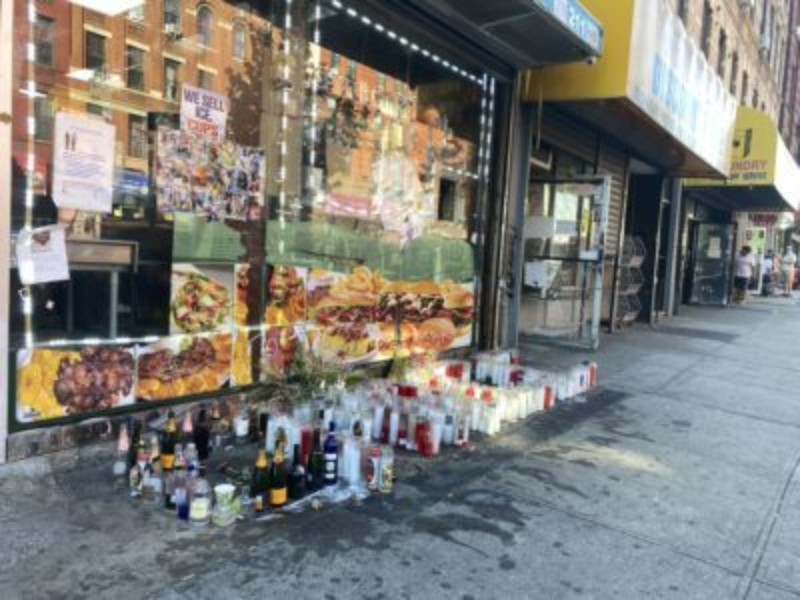
I’m attaching a few photographs of the community garden and some “memorials” I came across while walking around the neighborhood. The candle memorials, which are also very popular in Brooklyn and the LES, have always attracted me as they stand to serve many social functions in these communities when someone dies violently. They are placed in the spot where the person has been killed and are composed primarily of candles, spirits (liquors), food, cigars, coffee, photographs, and personal objects. I’m curious to know if someone has written about them. I’ll check out and let you know if I find something.
Sorry for my messy thoughts and writing. It’s late and I’m tired but excited for the opportunity you have created for us to do something meaningful. Thanks, Marianne and Diana!
Best,
Luis Rincón Alba
Mapping Out
November 20, 2021 Group Workshop with Maria
We as a collective attempted to connect through body movement. Like molecules we bumped and diverged, spreading in all directions at different speeds. After a while we were asked to trace ourselves to the past. So we made body maps. Laid them out flat and traced the outline of our present selves while filling the bodies with loss, fears, memories, thoughts and even hope.
I traveled through the incessant cries and frustrations of my children and through my own memories of feeling trapped, scared and in pain from the sickness.
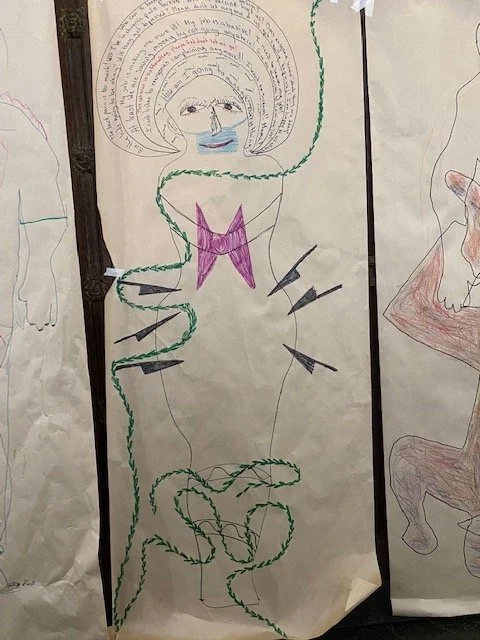
As I drew the inside of my body map I began to outline green vines, wrapping my body, circling around my feet, protecting me from myself? I wasn’t sure, but I kept going with it. I had to see how the vines were going to get me out of my own head. And they did.
Even though my hands were tied in a pink bow and I felt helpless, even though knives like death were threatening me from all sides, I felt the green vines were going to bring me back.
When I stood up and looked at my body map from a distance I was overwhelmed by the image of my own body, “is that my body?” I asked myself, “who am I?”
People who walked by commented but I stood there and tried to capture the feeling. I was sad by how quickly I forgot or rather got used to the pain brought on by the pandemic without even giving it a breath of release.
After everyone was done we hung up our bodies on the back walls of the auditorium. We walked circles around the hung bodies and we mourned together. We shared stories inside the bodies. We commemorated the bodies we had hoped were left behind for good. Some bodies didn’t want to be left behind, they were the lucky ones.
Once we attempted at peace with ourselves, we were asked to now mark our neighborhood maps, maps of our physical space during COVID, maps of our stagnation. That wasn’t hard. I had a hard time finding myself on the map, where did I live? Where did I go during this time? Why couldn’t I find my street. So I went to another group’s map because I didn’t want to be alone. There I found three spots that situated me on the map and I suddenly felt at ease. I told some people about the places I marked. Hudson River path near my home where I walked regularly and let kids ride their bikes while cursing unmasked runners under my mask. I marked my block where I spent almost a year in isolation with my family. I also made a mark where I work, far from home but a place where I was told I had to be even if I was afraid. When I tried to look for a place where we would go to escape, near Bear Mountain, it wasn’t on the map. It was not part of the map that was handed to me. I guess the escape is just not part of the big picture but a distant place, hidden and off the radar. It’s better that way, less chance of it getting contaminated.
After the Workshop I somehow felt closer to myself, like I got to know myself a bit better. The workshop allowed me the time and space to feel and be with my thoughts and memories and that was enough to begin the journey of healing from the past COVID to the present COVID. And even though the pandemic is still in full swing, I now know where I can be found.
Author Bio: Leah Kogen-Elimeliah is a poet, essayist, short story and nonfiction writer from Moscow, currently living in New York City. She is an MFA candidate at City College of New York, is the Founder and Director of WordShedNYC Reading Series and an Editorial Associate for Fiction literary magazine. Her writing focuses on immigration, identity, language, sexuality and culture. She is a member of the ZIP Code Memory Project.
The Zip Code Memory Project seeks to find community-based ways to memorialize the devastating losses resulting from the Coronavirus pandemic while also acknowledging its radically differential effects on Upper New York City neighborhoods. Through a series of art-based workshops, public events, social media platforms, and a final performance/exhibition at the Cathedral of St John the Divine, community members participate in building networks of shared responsibility and belonging.
Music and the (re)making of territory: A commentary on the Silvio Luiz de Almeida and MC Carol Panel
What is the role of music in (re)definitions of space? What is the role of humor?
In the fourth event of the “Reconstructing History” series, CSSD Geographies of Injustice working group members joined singer and activist MC Carol and professor and attorney Silvio Luiz de Almeida for a conversation on the meanings of territory, experience, theory, and humor in musical production. The working group, led by Professors Ana Paulina Lee and Anupama Rao, recently launched a podcast, titled Music and Migration in Rio and Mumbai’s Favelas. It can be accessed via Rádio Batuta or Spotify.
The guest speakers challenged normative understandings of “territory” by illuminating links between geographical space and conceptualizations of gender, race and class, and thus amplified diverse perspectives on the everyday and its inequalities in Brazil. Diverse not because of the speakers’ neat correspondence to idealized social “types”—the feminist, the Black activist, the favelada, or the academic—but because of their distinct relationship to these categories, their impositions and their possibilities, and the common ground found in the multiplicity of experiences characteristic of the human condition.
Potent. That is how Observatório de Favelas’ Júnior Pimentel characterized MC Carol. Carol has consistently explored music’s potential to open new avenues of thought and self-expression—from her early disagreements with relatives and partners who did not understand her aspirations to sing proudly about the pleasures and pains that made her independent, to her persistence against efforts to subvert her feminist stance. Her deliberate deployment of humor, dismissed by some as unpolished, bridges content and form, allowing Carol to pose difficult and serious questions so that her audience can relate and identify with them.
Carol is a troubadour and a chronicler of Rio’s suburban lives, with a keen sensitivity to everyday favela dynamics. At a first glance, her lyrics may seem like extrapolations, affording the element of dissonance that activates humor. But this exercise of discursive exaggeration is also an act of epistemic expansion, welcoming others to visualize parts of their experiences in the every-day that is Carol’s primary source. As Silvio de Almeida put it, it is in evoking the “absurdities of quotidian life” under a newly legible light that Carol combats individuals’ longstanding alienation from the perception of those absurdities. Political action through affect.
Silvio defined the event’s theme as an observation of “the political construction of the spaces where this affect is produced.” While the affect evoked by MC Carol’s lyrics exposes structures of race, gender, and class-based discrimination, Silvio draws attention to their role in forging cultural and geographic space. What makes a favela? Steep hills, bare-brick houses, “overpopulated” areas? One is sure to find that most if not all favelas challenge neat physical and geographic categorization. Yet the category stands. As territory, favela is more affective than physical. It constitutes itself by the quotidian absurdities, the ways people find around the everyday, their relationship to action and alienation, the presence and absence of the “outside,” which even the state seems part of at times. “Territory is a physical space that is signified,” Silvio affirms, “and what gives meaning to this space are the relationships developed there.” MC Carol’s music and Silvio de Almeida’s teaching meditate on these relationships, how they are produced and resignified through performance, thus paving the way to uncharted territories.
Author Bio: Gabriel A. D. Franco is a PhD student in the History Department at the University of Chicago, studying the intersections of criminal legislation, race, citizenship, and class formation in late-nineteenth and early-twentieth-century Brazil. As a Geographies of Injustice fellow, between 2019 and 2021 he contributed to the production of the podcast Música e migração.