
VIDEO: "Creating Alternative Archives"
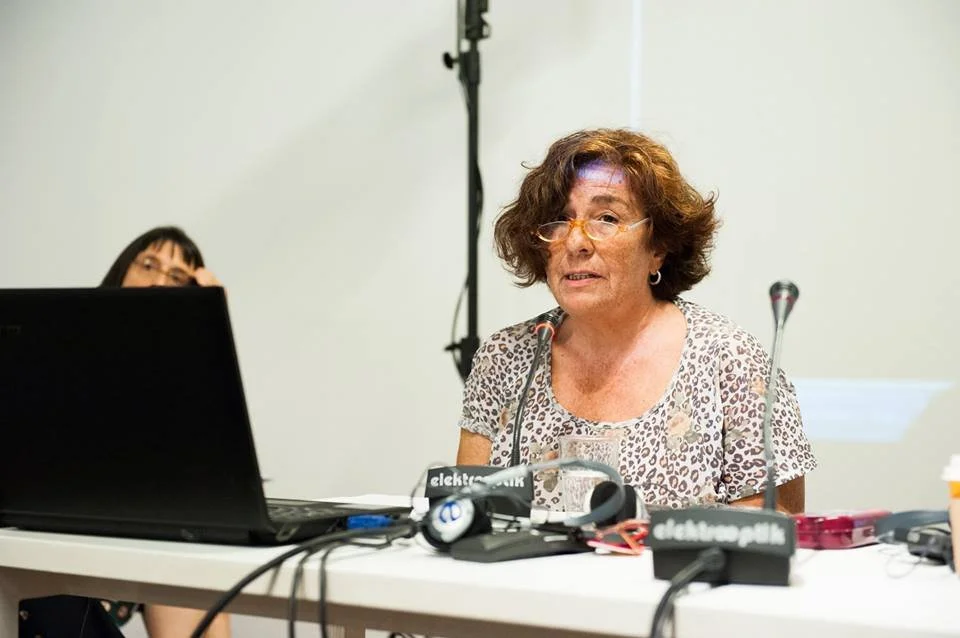
Women Mobilizing Memory workshop: “‘Coming to Terms’ with Gendered Memories of Genocide, War, and Political Repression,” featuring Leyla Neyzi, Susan Meiselas, and Silvina der Meguerditchian. Istanbul, Turkey, September 2014.
"Mobilizing Memory: Women Witnessing" EXHIBITION CATALOGUE
Opening Reception: September 5, Friday, 18:30
Venue: DEPO Istanbul (Lüleci Hendek Cad. 12, Tophane - Istanbul)
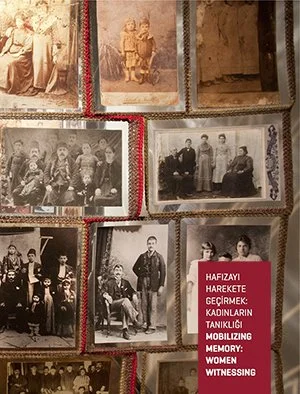
Artists: Gülçin Aksoy, Hera Büyüktaşçıyan, Silvina Der-Meguerditchian, Hakikat Adalet Hafıza Merkezi (Truth Justice Memory Center), Gülsün Karamustafa, Susan Meiselas, Nar Photos (Serra Akcan, Fatma Çelik, Gülşin Ketenci, Aylin Kızıl, Serpil Polat), Lorie Novak, Emine Gözde Sevim, Aylin Tekiner
View exhibit catalog here (PDF)
Curated by: Ayşe Gül Altınay, Işın Önol
What is the role of witnessing in practices of resistance: resistance to enforced silence and forgetting, to state power, and to inaction? What role do the arts play in combatting the erasure of past violence from current memory and in creating new visions and new histories for future generations? In particular, what unique strategies have women devised to reveal and redress the violence directed at woman and at other disempowered social groups?
The feminist art work displayed in this exhibit imagines memory as part of a larger politics of resistance. It mobilizes memories of past and present violence precisely to create the conditions and the motivations for social change. Bringing together women artists many of whom are themselves direct witnesses to oppression and terror, the exhibit also reveals moments of resilience, resistance, and creative survival. The artists gathered here use memory in innovative ways. They foreground unofficial acts of witness and forms of commemoration--embodied practices, performances, photography, testimony, street actions—that provide alternative histories and different political imaginaries than do official archives, memorials, museums, and state commemorations. They make visible not only violent crimes and their gendered dimensions, but also the intimate texture of lives and communities that have survived or are fighting to survive immense destruction. In honoring those lives and bringing them out of oblivion, the artists also reclaim women’s practices—dance, song, embroidery, for example—and show their political resonances. As a group, these artists resist monumentality in favor of intimacy, featuring individual stories of the quotidian. They use official archives to document and contextualize those lives, but they also create new archives and alternative interpretations, reframing how we understand the past and pointing to what has been excluded from authoritative histories. They thus imagine alternative social and political trajectories and more open and progressive futures.
This exhibit occurs in the context of a five-day workshop on “Mobilizing Memory for Action” that brings together an international group of scholars, artists, and activists to analyze the activist work memory practices can enable. The art works comprising this exhibit and the broadly comparative panels and roundtables on September 17 invite us to ask how our acts of witness can motivate social change. What do images and accounts of past and present violence demand of spectators, listeners, and readers? How can we modulate proximity with distance, empathy with solidarity? Indeed feminist practices of witness have fostered solidarity that demands not only collaboration and commitment, but also a respect for what is historically specific to particular acts of violence and oppression. In bringing diverse events of state violence—the Holocaust, the dictatorships in Latin American, American slavery—to the Armenian genocide, the persecution of Kurdish and Palestinian communities, and the oppressive acts of authoritarian power featured in this exhibit, the “Women Mobilizing Memory” workshop invites participants both to see where connections lie and also to recognize what cannot be generalized or translated across linguistic, national, or religious borders. In resisting silence, forgetting and erasure, progressive acts of memory also resist easy understanding, appropriation and straightforward comparison.
The collaborations among the participants in the working group, and between the artists and their subjects, aim to create a space of solidarity and connection. We invite you to enter into this larger collaborative project of responding to the memories recorded here, and to join us in the work of shaping memories for more hopeful futures.
Co-hosted by Columbia Global Centers | Turkey, DEPO Istanbul and Sabancı University Gender and Women's Studies Forum, the exhibition and parallel activities have been supported by the the Center for the Study of Social Difference, Blinken European Institute, Sabancı University, Hemispheric Institute of Performance and Politics, the Truth Justice Memory Center and Friedrich-Ebert-Stiftung Turkey Office.
For more information about the project please visit: http://socialdifference.columbia.edu/projects/women-mobilizing-memory
Women Mobilizing Memory Workshop II
Working group:
Women Mobilizing Memory
Hemispheric Institute for Performance and Politics Encuentro
Montreal, June 2014
Conveners: Marianne Hirsch, Jean Howard, Diana Taylor
Description:
Bringing together artists, writers, theater practitioners, museologists, social activists, and scholars of memory and memorialization, “Women Mobilizing Memory” focuses on the political stakes and consequences of witnessing and testimony as responses to socially imposed vulnerabilities and historical trauma. The working group will probe how individual and collective testimony and performance can establish new forms of cultural memory and facilitate social repair. Using gender as an analytic lens, this project explicitly explores women's acts of witness and the gendered forms and consequences of political repression and persecution. It asks what strategies of memorialization and re-imagining are most effective in calling attention to past and present wrongs and in creating possibilities of redress through protest and other forms of action and resistance.
Participants:
Pilar Riano, ‘Afro-Colombian Singing as Testimonial Practice.’
Giselle Ruiz, ‘A Poetic Corporeality’
Victoria Fortuna, ‘Dance Based Memory Practice’
Ausonia Bernardes, Memory in Contemporary Dance Practice.
Monika Gagnon, "What is Posthumous Cinema?"
Barbara Sutton, "Women Mobilizing Body Narratives of State Terrorism in Argentina (1976-1983)"
Julie Okotbitek
Milena Grass, “Women who collaborated with the dictatorship”
Raúl Diego Rivera Hernandez, “Performative strategies of Central American Caravan of women searching their missing relatives in Mexico”
Nuria Carton de Grammont —narco trafico
Leticia Robles, “Antigonas”
Carolyn Vera, Guatemalan performance artists
Leyneuf Tines Villarraga, TBA
activistas / desafíos políticos.
Shahrzad Arshadi
Lorie Novak, “Photographic Interference”
Jenny James, "Bricolage Memories: Gender, Refugee Life and Narrative Repair in the fiction of Dionne Brand and Kim Thuy"
Magdalena Olszanowski, ‘Between Mother and Daughter: The belly button as scar of separation’
María José Contreras, ‘Teatro testimonial de mujeres ancianas mapuches’
Methodology:
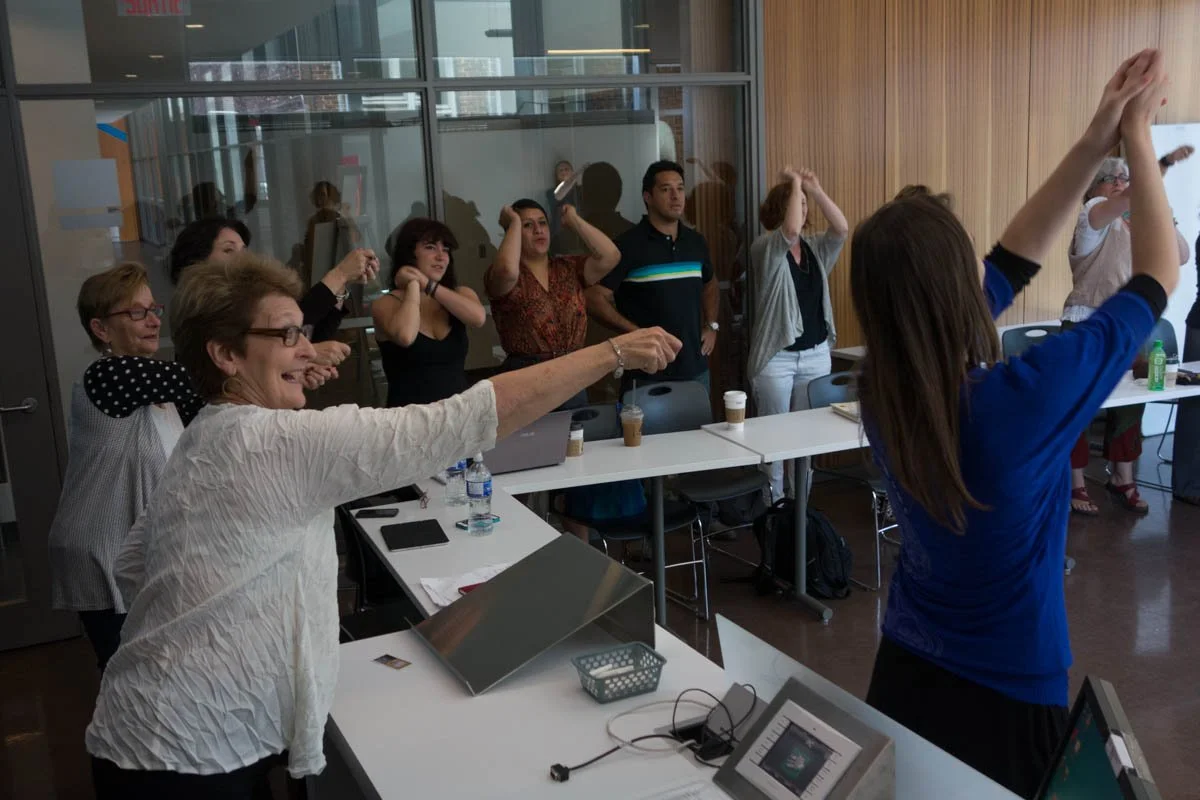
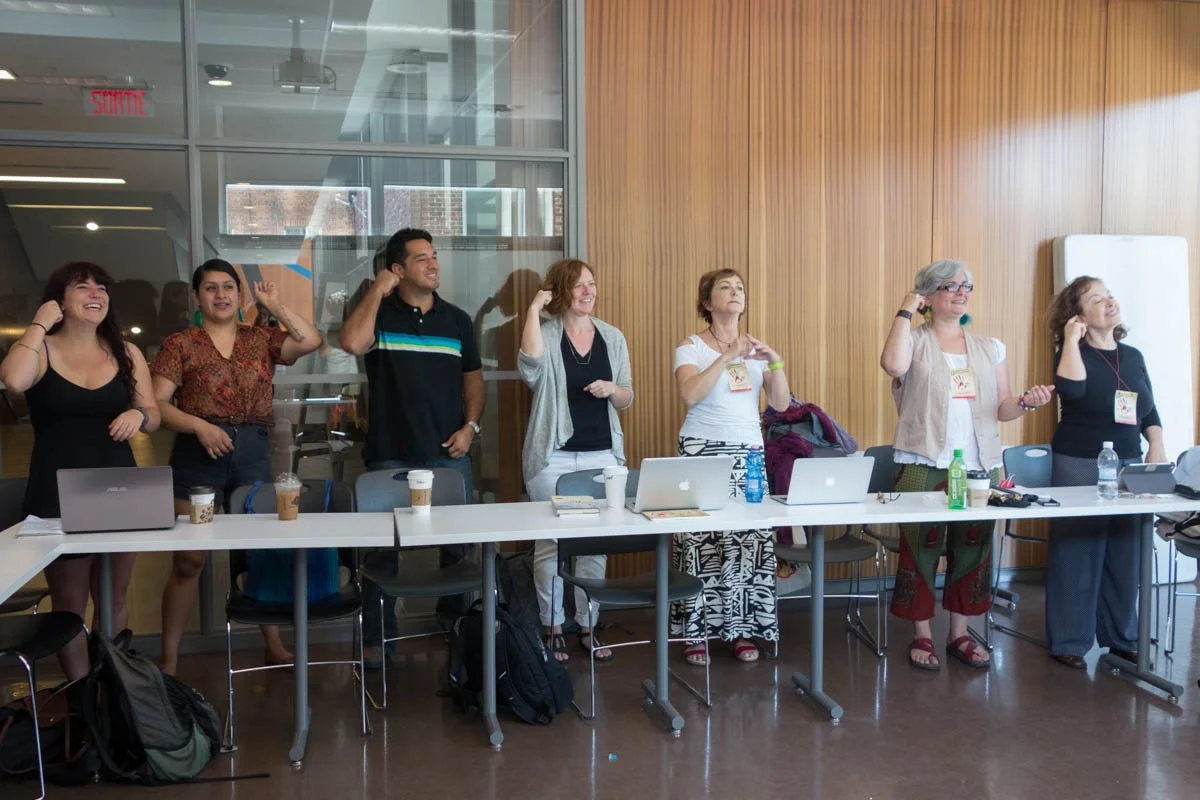
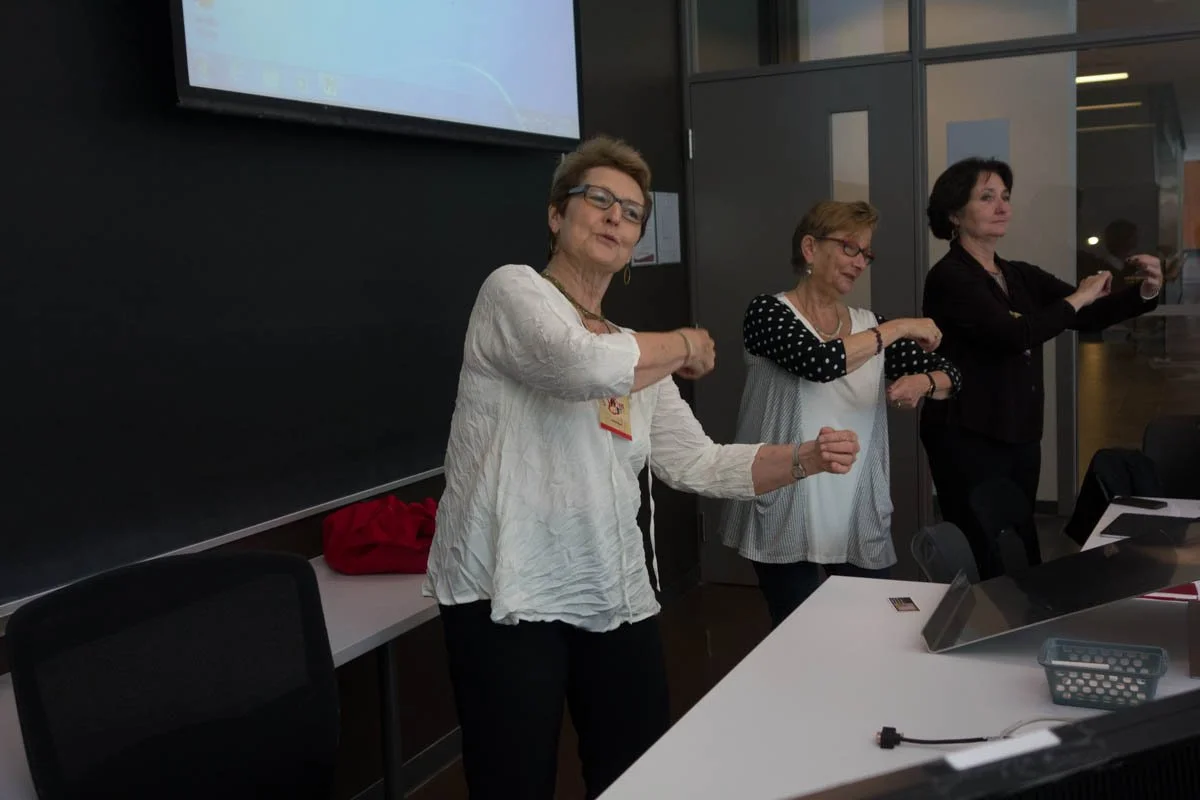
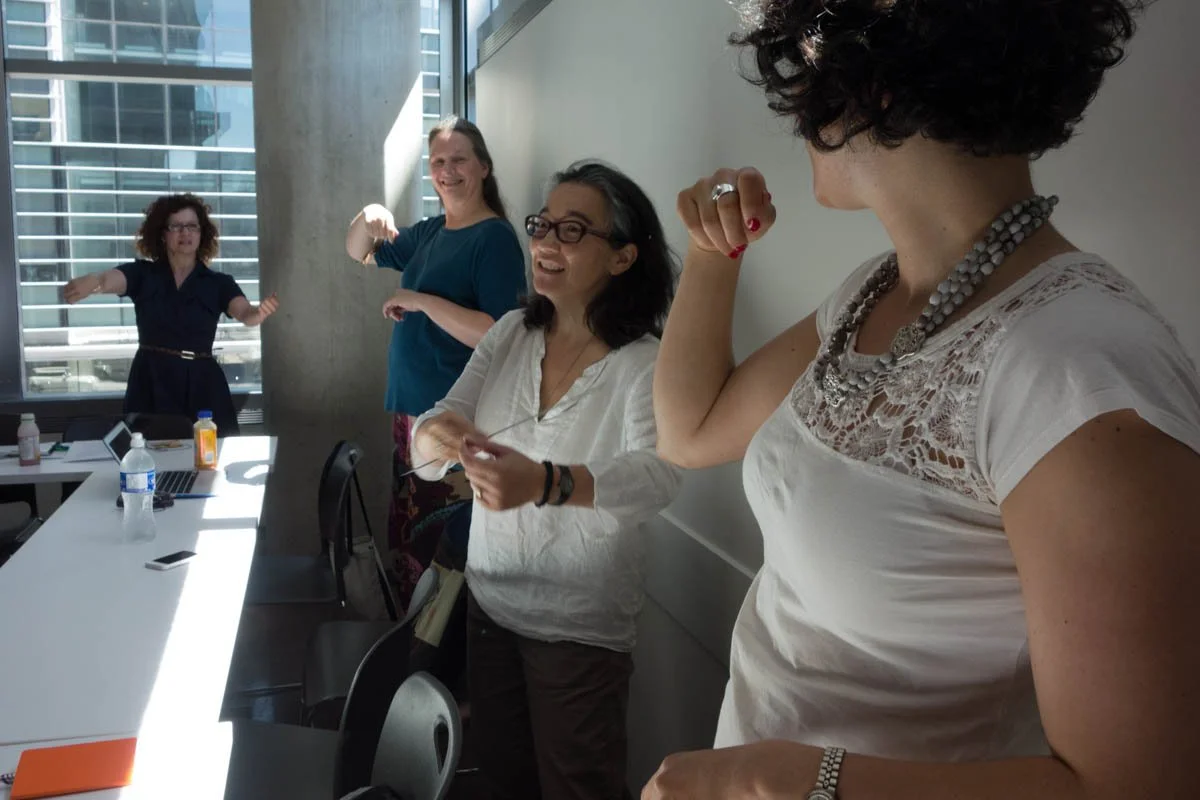
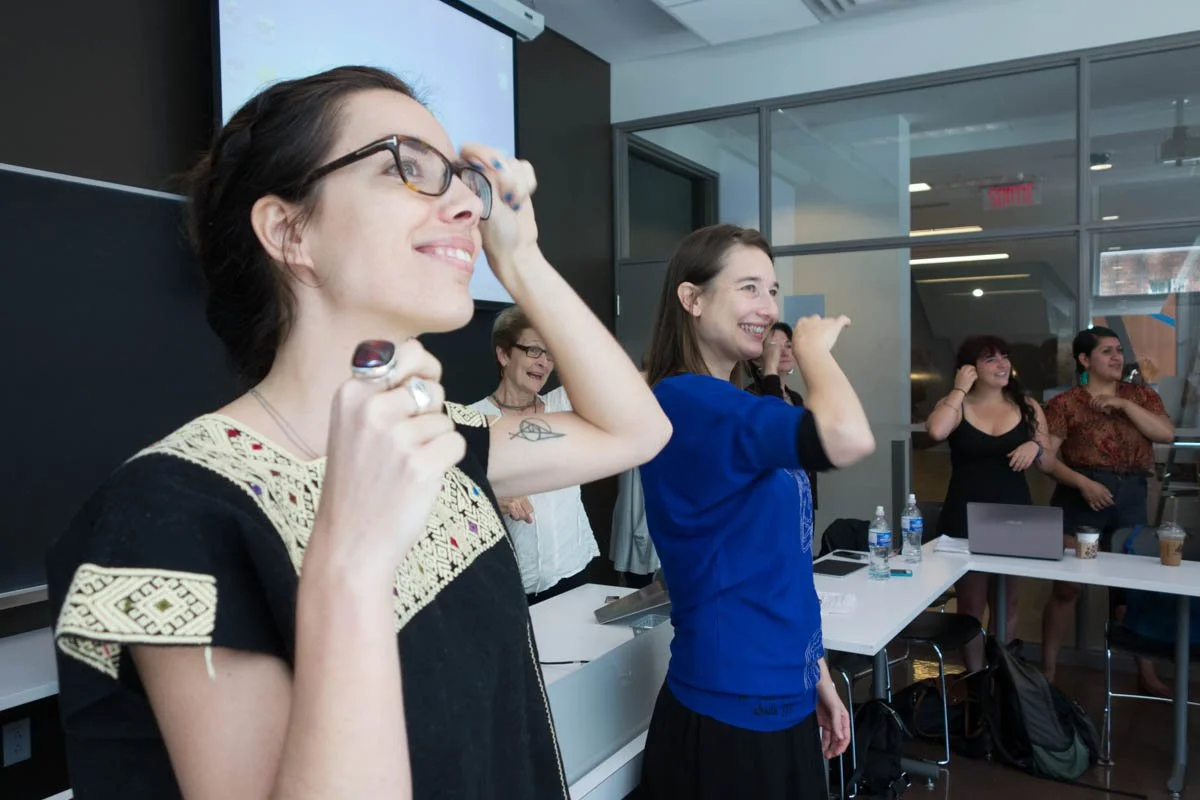
We spent each of the sessions on a particular topic arising from the participants’ interests. Beforehand we circulated by internet brief background readings for each session and for the group. Each session we had a warm up exercise in order to create a collectivity that could think and be in presence together Then, each participant presented a 6 minute presentation that ended with questions for a 3 minute discussion. Each session concluded with an extended 45 minute discussion.
Some notes about our discussions:
As said in the call, the group discussed about the role women in the circulation, recovery, reshaping and mobilization of memory.
Some of the most important issues that emerged during our work was COLLABORATION. Collaboration was seen in different levels: between women that had suffered violence, but also between women artists and/or activists and/or researchers with women that had survived to violent pasts. Women’s memory practices may enable transnational memory networks, both at a local and global dimension.
We also considered posthumous collaboration, as a way to connect the living and the death. Some of the case studies discussed evidenced how the dead spoke to us through their traces. In a sense, when studying memory of violent pasts, all collaborations are somehow posthumous, they are about what remains and what may survive.
MEMORY was defined as a practice that sometimes allowed the cultural renewal of traditions and sometimes functioned as resistance to narratives of disposability or vulnerability. Memory practices appeared as crucial strategy of resistance for women who have endured continued forms of physical erasure (from genocides to current femicides),
Art and cultural performances recuperate and reshape memories. Memory is not just about bringing stories, is about creating a collective history. In that sense, memory is always intervening in the present creating new forms of identity and collaboration. The mobilization of memory allow different possibilities for an engagement that triggers multiple plural ways of seeing the past, challenging dominant or status quo versions of the past. The artistic work with memory activate and animate archives and by allowing them to travel and migrate, they create networks of connectivity that challenge the monumentalization of memory.
One of the crucial concepts raised was that of POSITIONALITY: were are we respect to past violence or slow ongoing violence of neoliberalism? What kind of memory work advances political engagement and responsibility?
When coping with trauma and horror embedded pasts, memory practices become critical to render visible the violence. Memory practices as studied by the group articulate different forms of visibility and invisibility. Art and cultural memory practices enable/encourage/make possible different forms of efficacy, mobilizing action for the future in different levels.
Efficacy may be considered from different perspectives, as a political efficacy that mobilizes social change, but also as a communicative efficacy that by contagion, empathetic connection and affect circulation create collective identities and networks and may subtly transform materials and perceptions. The group discussed to what extent the circulation of affect alone may cause social change.
Another issue discussed in the group was the distinction between empathy, identification and solidarity (between people and networks). We could realize how in acts of scholarship and artistic creation there are various uses of empathy, distance, identification, alienation, solidarity and witnessing. Each of them portrait different sorts of efficacy
When discussing about efficacy we questioned ethical issues regarding for instance the risk of appropriation of artists of painful memories and again the question of positionality: were are we, what is our political and ethical engagement regarding past or present violence?
The different case studies displayed a range of memory practices in different SCALES. From micropractices and intimate memory actions to larger actions, sometimes even monumental actions. All of these cases advanced different sorts of efficacy.
The type of efficacy of these practices relate to the media considered as different ways to address memory: the human body, images, sounds, voices, writing. Analyzing these various media we could better understand how memory is transmitted across bodies and generations.
The body appeared in several presentations as a living dynamic archive, both in the generation that suffered violence and in the later generations. Bodies serve to mobilize the horror that cannot be said and also allows us to learn about other’s experiences when we were not there. The body always transmit, so the relation between memory and body is complex and dynamic: memory of the body / memory in the body / the body as memory. One of the critical aspects specially when working with testimonies was the continuity of presence that prefigured the importance of being there, present and presenciando collaboratively.
We also discussed the potentiality of images as mobilizing devices. Images are powerful transmitters/creators of memory and this is something that mass media seem to understand well since they banalize images as a political strategies. Other than the images the sound and voice are also power media to mobilize memories. The voice for instance immediately mark the presence of who’s speaking. Literature, theatre, photography, internet all portray different ways to approach to memories.
By the end of the work group we highlighted the importance of hope. The mobilization of memory always seem to have a hope component, the desire to share, to render visible and to share experiences to enable us to respond to past and present slow violence.
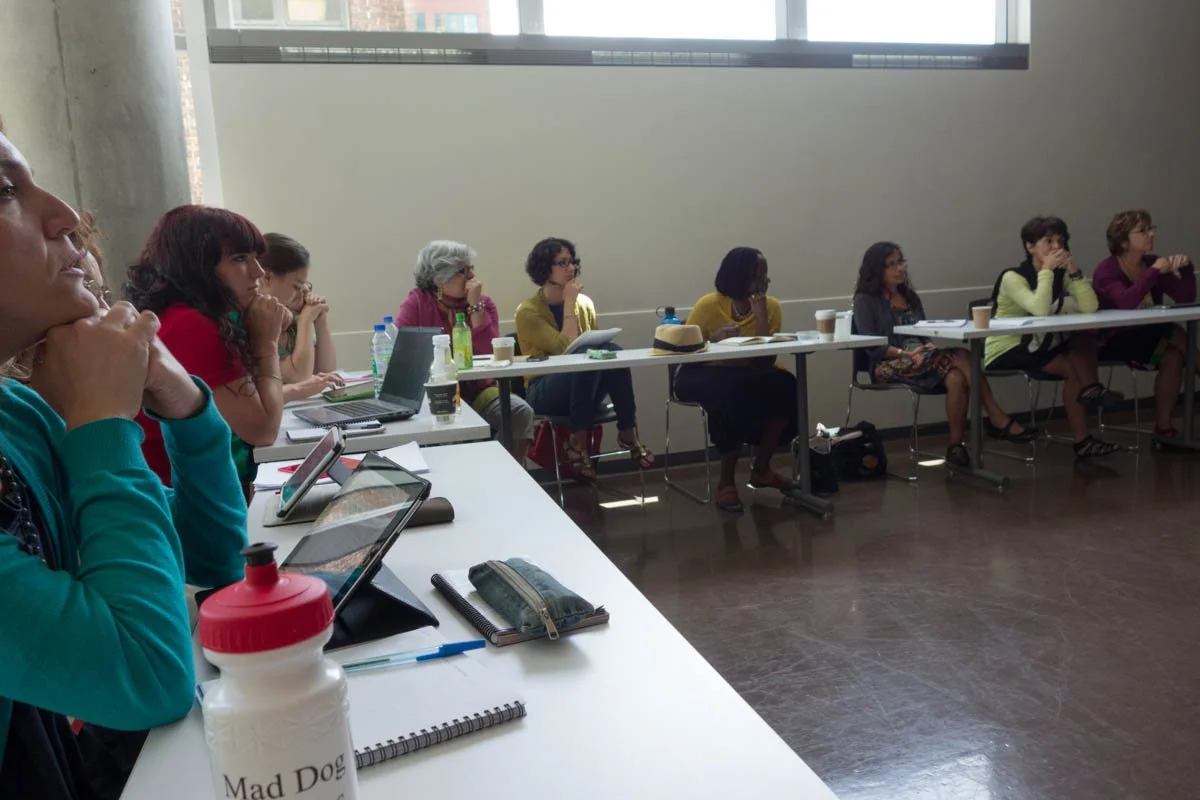
Photos from the Women Mobilizing Memory Workshop II at the 2014 Hemispheric Institute Encuentro held in Montreal, June 21–28.
Memory for the Future: Collaborative Witnessing in Post- Dictatorship Chile
In December 2013, a transnational group of scholars, artists, and activists came together at Columbia’s Global Center in Santiago de Chile to reflect on the manifold ways in which cultural memory of the Pinochet dictatorship has been and can be mobilized in the service of different visions for Chile’s social and political future.
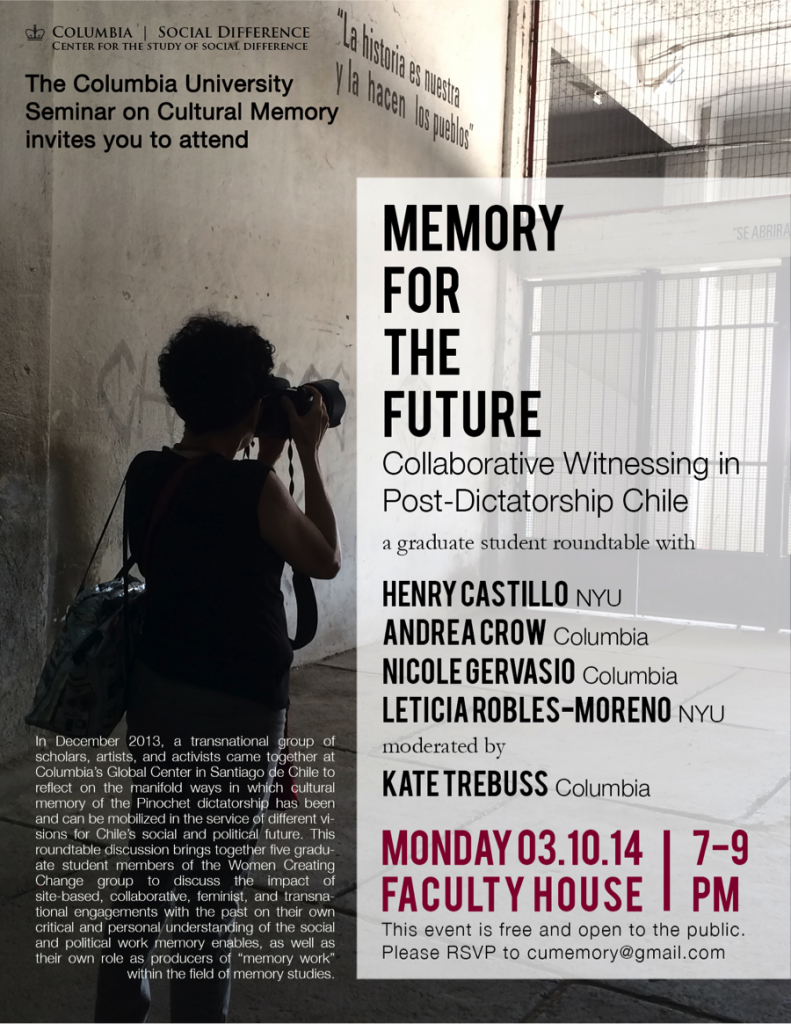
This “workshop,” sponsored by Columbia University’s Center for the Study of Social Difference’s “Women Creating Change: Mobilizing Memory” project, incited all members of the group to think not only about the politics and performances of memory in Chile and beyond, but also about their own scholarly practices and methods for engaging with sites of memory and the complex connective histories of which such spaces are a part.
This roundtable discussion brought together five graduate student members of the Women Creating Change group to discuss the impact of site-based, collaborative, feminist, and transnational engagements with the past on their own critical and personal understanding of the social and political work memory enables, as well as their own role as producers of “memory work” within the field of memory studies.
Graduate student roundtable discussion with:
Henry Castillo (NYU)
Andrea Crow (Columbia)
Nicole Gervasio (Columbia)
Leticia Robles-Moreno (NYU)
and moderated by Kate Trebuss (Columbia)