
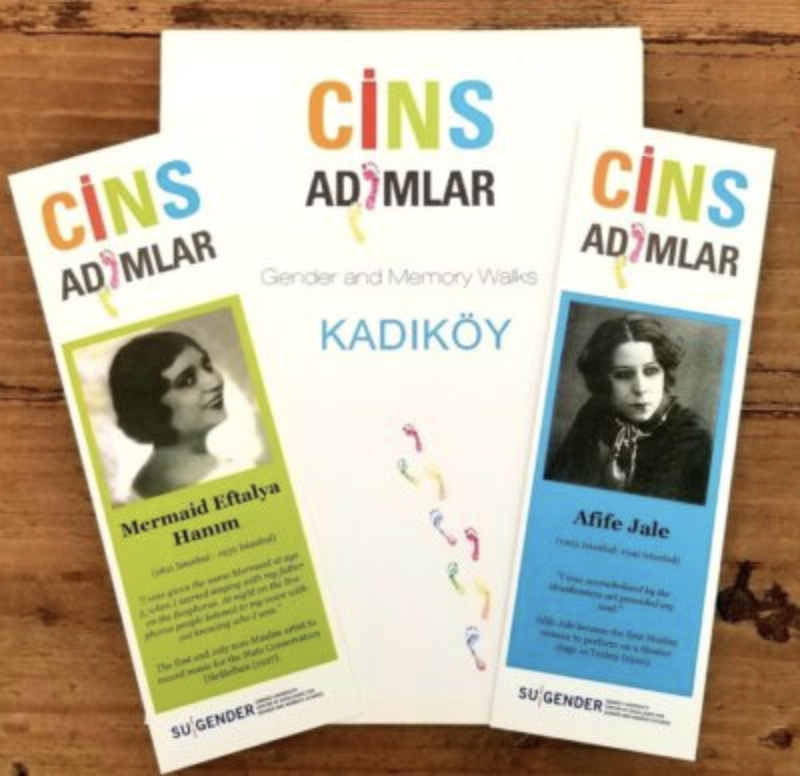
Feminist Curious Steps Through History: Illumination in Dark Times
March 8, International Women’s Day, marks a global moment when feminists walk, chant, sing, and dance together in celebration of the transformative power of solidarity and collective action. In 2020, Istanbul is witnessing a new version of this celebration in the form of a “women’s run” organized by the sports section of the Istanbul Municipality, which recently changed hands into feminist-friendly leadership. Dark times call for creative politics: with feminist marches and other forms of political demonstrations in urban public space being suppressed by the government, women will run on a feminist path! And, much to our delight, the path of this women’s run has partially been inspired by the Curious Steps: Gender and Memory Walks of Istanbul.
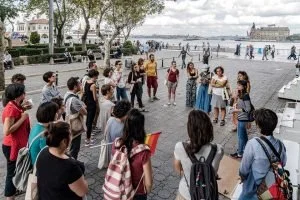
Curious Steps in Kadıköy (photo courtesy of Murat Germen)
Feminists inspire each other! A group of us took our first steps toward designing Istanbul’s first feminist memory walk as part of our preparation for the Women Mobilizing Memory working group meeting in September 2014. Inspired by the feminist tour of Budapest (organized by the historian Andrea Petö of Central European University); the feminist walk of Bochum (hosted by Linda Unger of the feminist archive collective ausZeiten); and the informal memory walk that Soledad Falabella offered the Women Mobilizing Memory group in Santiago, Chile, in 2013, a group of us at SU Gender (Sabancı University Gender and Women’s Studies Center of Excellence) came together to imagine what it would mean to walk the streets of Istanbul with feminist curious steps. Another source of inspiration was the Militourism festival (2004–2006), organized by an antimilitarist group of conscientious objectors (including women objectors), drawing attention to the “militarist” sites of Istanbul, Ankara, and Izmir with creative “antimilitarist” performances. With decades of feminist scholarship on women’s history writing and the amazing (online) Women’s Museum Istanbul, which brought to light the complex intersectional layers of Istanbul’s gendered history, we felt well equipped to take our first steps in exploring the possibilities of feminist and queer re-rootings in our beloved city. At a time when we felt “uprooted,” with bombs exploding and the democratic space shrinking, exploring our feminist and queer roots as resources of inspiration and empowerment, and doing so through collective walking and storytelling, felt healing and transformative.
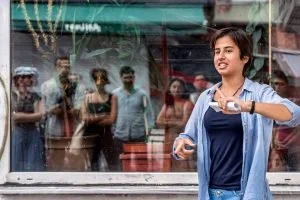
Ebrar Nefes telling the story of Afife Jale in Kadıköy (photo courtesy of Murat Germen)
In our contribution to the volume Women Mobilizing Memory, my coauthors, Bürge Abiral, Dilara Çalışkan, and Armanc Yıldız, and I argue that a feminist city walk offers the possibility to engage in “situated feminist storytelling” for mobilizing silenced memories, on the one hand, and making visible creative mobilizations of memory, on the other. Currently organized in three Istanbul neighborhoods, Curious Steps brings together diverse groups of people for collective walks through streets and sites that come to new life with hidden women’s and LGBTI+ stories, unmarked on site but researched and creatively told by young volunteers. As such, the walks enact what Cynthia Enloe calls “feminist curiosity” in urban space with an ever-growing and ever-changing repertoire of stories that merge public and intimate archives.
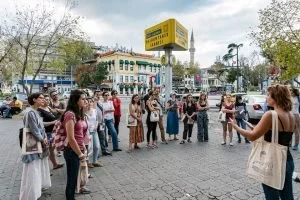
Selen Bayhan telling the story of Kınar Sıvacıyan (photo courtesy of Murat Germen)
After five years of walking in small groups, it is very exciting that we will soon be running with thousands of women to collectively witness some of these sites and stories of struggle along the path of the March 8 women’s run in the Asian neighborhood of Kadıköy. Right where the Kadıköy Women’s Run will start this March 8, we have our first Curious Steps stop in front of the State Conservatory, marking the outstanding legacy of artist Mermaid Eftalya (Atanasia Yeorgiadu, 1891–1939) who sang fifty-six of the one hundred recordings of the State Conservatory published by Columbia Records in 1927, without a single one mentioning her (Greek) name. On the other side of the State Conservatory, by the City Theater, we stop again to remember Kınar Sıvacıyan (1876–1950), one of the leading theater artists of the late-Ottoman and early-Republican period, who performed in numerous plays in the Darülbedayi (the precursor of the State Theaters) and other theaters across Istanbul. Despite her fame in the 1910s and 1920s, the Armenian actor Kınar Sıvacıyan has since been written out of all historical records, including theater history texts, while her Muslim contemporaries, such as Muhsin Ertuğrul and, later, Afife Jale, are remembered through theaters and awards named after them.

Curious Steps in Kadıköy, January 2016 (hearing Kınar Sıvacıyan’s story with a play on Afife Jale in the background)
Along the route of the Women’s Run another stop marks the Rexx Cinema, which used to house one of the oldest theaters in Kadıköy, the Apollon. This is where Afife Jale, the first Muslim woman actor to take public stage, performed her first plays. As we stop to talk about Afife Jale’s breaking all gender norms with her passion for theater and performance and facing serious challenges from her own family and the police, we also explore the intersectional layers of her struggle. In our narration, the story of Kınar Sıvacıyan’s helping Afife escape from the police, who regularly raided the theater upon receiving complaints that a Muslim woman was on stage, is a story of women’s solidarity in the background of ethnicized, patriarchal nationalism.
Another site of feminist and queer solidarity along the run is Yoğurtçu Park. Here, our Curious Steps stories focus on the significance of the park for feminist and LGBTI+ histories of activism, focusing particularly on the first march against domestic violence in 1987, after which the first women’s shelters were established, and the ongoing weekly Yoğurtçu Women’s Forum, a vibrant site of feminist debate and exchange since the Gezi protests of 2013.
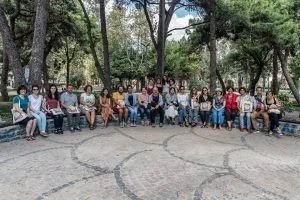
Curious Steps at Yoğurtçu Park (photo courtesy of Murat Germen)
“Even in the darkest of times,” Hannah Arendt wrote, “we have the right to expect some illumination.” These are certainly dark times for Turkey, and the planet at large. Yet it is also a time in which we are witnessing new forms of creative, life-enhancing, transformative politics everywhere. From Black Lives Matter, which has shaken up the “normalcy” of white privilege and supremacy through an intersectional lens rooted in feminist and queer politics, to the global #metoo movement that is challenging the systematic workings of masculinist privilege and from the mass demonstrations of women in India cutting across religious, ethnic and caste lines to the viral Las Tesis movement against sexual violence and impunity initiated by women in Chile, we are facing a time of revolutionary reimaginings of gender and sexuality everywhere. The Kadıköy Women’s Run is only one among many March 8 activities planned in Istanbul this year, but a particularly inspiring one in the connections it is establishing with the city’s rich history of feminist activism. When feminist activism meets imaginative memory politics, new histories are made! And, as the Women Mobilizing Memory volume shows with many inspiring examples, they are being made everywhere.
As we walk, dance and run this March 8 in Istanbul, it’s heartening to know that millions across the globe will be coming together on International Women’s Day, and throughout Women’s History Month, illuminating these dark times with feminist activism and wisdom.
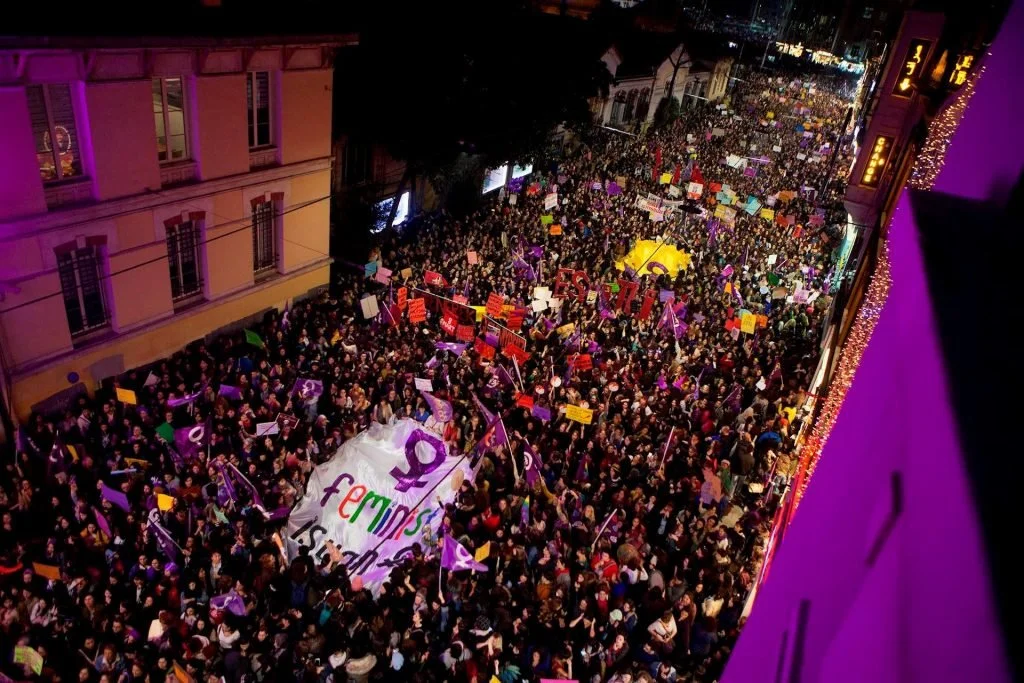
Annual Feminist Night March in Taksim, 2019.(photo courtesy of Çiğdem Üçüncü/NarPhotos)
Contributed by Ayşe Gül Altınay*, Women Mobilizing Memory working group
* Ayşe Gül Altınay is professor of anthropology at Sabancı University, former director of SU Gender (Sabancı University Gender and Women’s Studies Center of Excellence), and coeditor (with Maria Jose Contreras, Marianne Hirsch, Jean Howard, Banu Karaca, and Alisa Solomon) of Women Mobilizing Memory (Columbia University Press, 2019). The book, a transnational exploration of the intersection of feminism, history, and memory, shows how the recollection of violent histories can generate possibilities for progressive futures. It emerges from a multiyear feminist collaboration bringing together an interdisciplinary group of scholars, artists, and activists.
Note: This blog post was written before the killing of at least 36 Turkish soldiers in a massive attack near Idlib, Syria on February 28, and Turkey opening its borders soon after to allow refugees and migrants to pass, which has created a devastating humanitarian crisis at the borders and the Aegean Sea with Greek and Bulgarian authorities not allowing passage and suspending asylum applications. After the recent announcement from the Governorship of Istanbul that all political actions and demonstrations “against war” are banned until March 10th, it is not clear which March 8 activities will take place, and how they will be received by the security forces.
Women Mobilizing Memory in Harlem
In September 2014, vendors hawked mussels and shoppers slipped into H&M while Women Mobilizing Memory moved with a different purpose through Istanbul’s Istiklal Street. Our CSSD working group was embarking on a “gendered memory walk,” an activist-scholar intervention coined by our counterparts in Turkey. Ayşe Gül Altınay, anthropology professor and Director of SU Gender at Sabancı University, and several graduate fellows, including Bürge Abiral, Armanc Yildiz, and Dilara Çalışkan, organized the walk as part of the Curious Steps Program. Their goal was to highlight memory sites central to political movements towards feminist and queer liberation that risked being subsumed in history and the changing face of the city.
They led us through the bustling foot traffic on Istiklal and up steep medieval side streets to recognize landmarks we would have missed otherwise. Contemplating the ghosts behind these sites of social change, we beheld spaces like an independent bookstore known for selling radical literature and an LGBTQI organization persisting in human rights work despite being virtually illegal under President Recep Tayyip Erdoğan’s regime. In the essay titled “Curious Steps: Mobilizing Memory through Collective Walking and Storytelling in Istanbul” in our new anthology, Women Mobilizing Memory, our counterparts scrutinize their conception of this public humanities project in their own words.
As we prepared to bring these colleagues from Chile and Turkey to New York for the first time in 2015, the gendered memory walk in Istanbul stood out as one of the most inspiring events we had shared. The walk not only brought us together to bear witness to marginalized histories at risk for cultural amnesia; it also democratized academic knowledge as an activity that could be simultaneously interesting and freely available to the public sphere.
When we decided to stage our own walk in New York, we navigated some difficult questions. Whose history was most threatened by erasure in New York City? To what extent did we, as a group of highly educated, middle-class and predominantly white activist-scholars, have the right to represent that history? And which neighborhood was best positioned to address these questions?
Because our transnational peers had rooted their public interventions in critiques of the collective traumas that most deeply affected their nation’s histories, we aimed to do the same. Although the 9/11 terrorist attack is the trauma most readily associated with New York, we felt a more persistent and insidious history deserved a spotlight: the founding of America in the transatlantic slave trade, and the long history of racial animus that has instigated wide-ranging injustices from police brutality to gentrification in the present.
In this light, Harlem emerged as an important choice for many reasons— not the least of which was our own university’s ongoing colonization of one of the most famous Black neighborhoods in the U.S. Historically, Harlem has also been a contested zone for cross-cultural contact, influenced by an exceptionally wide range of competing desires, claims, and identities. Before gaining its international reputation as “Black Mecca,” Harlem was an entertainment epicenter where many performers were Black at venues that only served whites. An emphasis on entertainment also made the area a vibrant hub for queer nightlife in an era when homosexuality was strictly policed. The “Harlem Renaissance” started with the Renaissance Theater, also known as the Rennie, where Black patrons were allowed access for the first time; as time wore on, this theater hosted not only films and plays but also sports events and grassroots political meetings.
Collaboration in Harlem was historically intersectional, too. Women of color helped each other across social classes at Utopia Children’s House. White and Black book collectors desegregated libraries starting with the Schomburg Center for Research in Black Culture. Artists across the sexual identity spectrum, like Zora Neale Hurston and Langston Hughes, threw rent parties to keep each other solvent at community living spaces like 267 House. Thus the neighborhood was a vital center of intellectual, cultural and artistic creativity in New York City long before becoming stigmatized for criminal activity through the crack epidemic of the 1980s.
Our team of graduate students from Columbia University and New York University, including Henry Castillo, Andrea Crow, Alyssa Greene, Rüstem Ertuğ Altınay, Leticia Robles-Moreno, and myself, spearheaded the project. We strove to juxtapose well-known landmarks like the Apollo Theater alongside long-ago demolished businesses, like the row of queer-friendly bars that once occupied the block where a massive luxury condominium complex now stands. We also connected the stories of spaces on our route to broader national crises surrounding race relations, like the accelerating rise of white supremacy and white nationalism, the ongoing problem of police brutality disproportionately affecting Black men and transwomen of color, and the pervasiveness of gentrification pushing lifelong residents out of their homes.
We are thrilled to re-release the Harlem Memory Walk as an independent digital experience in anticipation of the debut of Women Mobilizing Memory. The walk is now available to anyone in the public sphere via PocketSights, a free mobile app on Apple and Android. Download the app, and search for the walk (if it doesn’t appear automatically) by searching for Columbia’s zipcode (10025 or 10027). For those who do not have smartphones, an updated version of the walk can also be accessed via Google Docs. We hope you will share the memory walk widely and thank you in advance for joining us on our journey.
Submitted by Nicole Marie, Gervasio, Ph.D.
August 30, 2019
WOMEN MOBILIZING MEMORY: Patricia Ariza on Culture as a "form of resistance"
TRANSFORMING TRAUMA WITH THEATRE
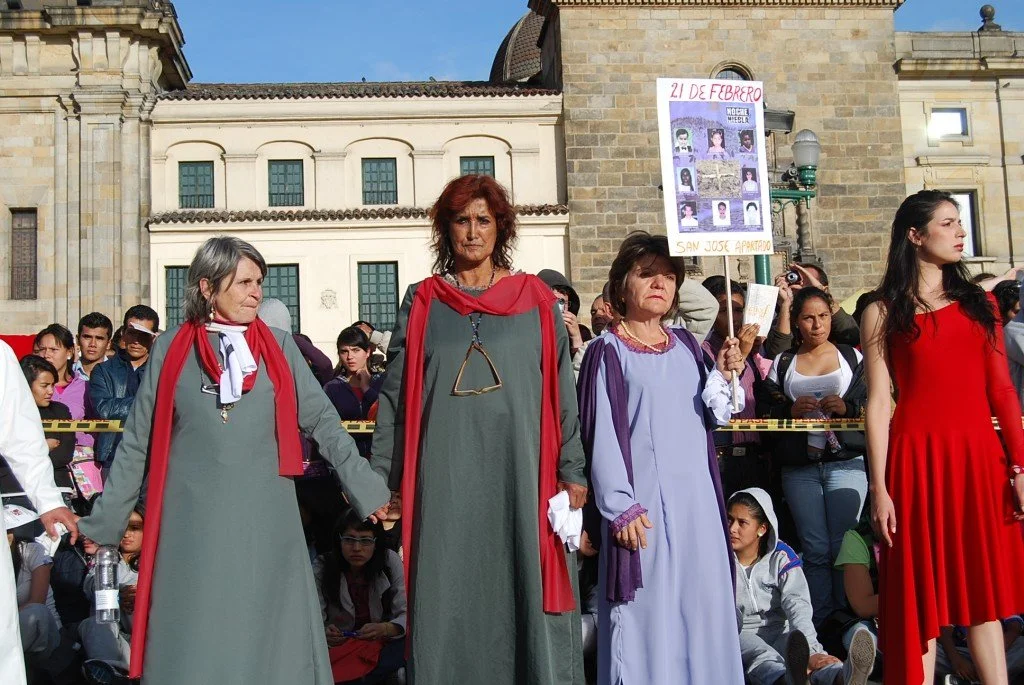
“Culture is a form of resistance,” asserted Colombian playwright, director, producer, and actor Patricia Ariza as she met with twelve members of the Center for the Study of Social Difference's Women Mobilizing Memory working group at the Hemispheric Institute in New York City.
Ariza was recently in town to accept the 2014 Gilder/Coigney International Theatre Award from the League of Professional Theatre Women but she took time to discuss with the group her near fifty years of work employing theatre to promote social justice, particularly as it applies to Colombian politics, political violence, and women. Ariza is co-founder of the highly influential Teatro La Candelaria, Colombia’s first independent, experimental theater, and for the past 25 years has focused primarily on women and social justice, empowering traumatized citizens to express through public performance their experiences during the massive violent conflicts that have rocked Colombia for decades. These performances help transform pain into something socially constructive, she said.
Ariza showed a video of an encuentro, or action, she orchestrated in 2009 at Plaza de Bolívar in Bogotá where 300 women, mostly survivors of political violence and family members of deceased/disappeared victims, grieved and memorialized for a whole day the systematic assassinations of political leaders throughout the country. Civilian demonstrators joined by theatrical performers chanted “Dónde están?” (“Where are they?) as they carried photos of their missing and murdered relatives. Ritualistic choreography accompanied by fandango drummers and piano culminated in one dancer climbing atop the statue of patriarch Simon Bolívar. Participants stepped through life-sized silhouettes of the bodies of the victims as a song instructed the mourners, “If you want to sing, sing/If you want to cry, cry.” Many did just that.
A DIFFERENT WAY OF INHABITING PUBLIC SPACES
Speaking through a translator, Ariza said that originally she did not intend to devote the last quarter-century to doing memory work with victims groups. “At first, I thought it was an act of generosity,” she said, “but then little by little it came to me that they provide a special, deep knowledge—a different way of doing political actions…and inhabiting public spaces.”
Ariza told the group that only recently have women been permitted to politically inhabit public spaces like town squares, which have historically been reserved for male-oriented political and military purposes.
“Art can help a lot,” said Ariza, who said cultural actions and celebrations are important sites of resistance against political oppression and violence. “It can get people to stop thinking war is the solution. You can’t do that through laws—only through culture,” she said.
With a slightly bowed head and limited eye contact, Ariza discussed another action that memorialized the government-approved murders of approximately 4,000 members of the left-wing U.P. (Patriotic Union) party in the 1980’s. In the action, 1,050 U.P. survivors stood at 1,000 candlelit tables in Plaza de Bolívar wearing the clothes of the deceased and placing their possessions on the tables. She said people came from all over Bogotá to see the performance, which was repeated for three years.
A spirited discussion ensued after Melody Brooks, co-chair of the Gilder/Coigney Award, inquired about the U.S. “Plan Colombia” that funds military missions against drug cartels and left-wing insurgents. Ariza said that the Colombian military has provided ersatz results by perpetrating approximately 4,000 murders of “false positives”—innocent citizens falsely characterized as drug traffickers or insurgents.
Ariza said that in an effort to aid Colombia’s compromised peace process, she hoped to plan an international peace summit of women in theatre in New York in April 2015.
Contributed by Terry Roethlein, Communications Manager, Center for the Study of Social Difference
Image of Patricia Ariza, center, at the Hemispheric Institute Encuentro in Bogotá, Colombia, 2009, by Cristhian Ávila.
VIDEO: "Gender, Memory, Activism"
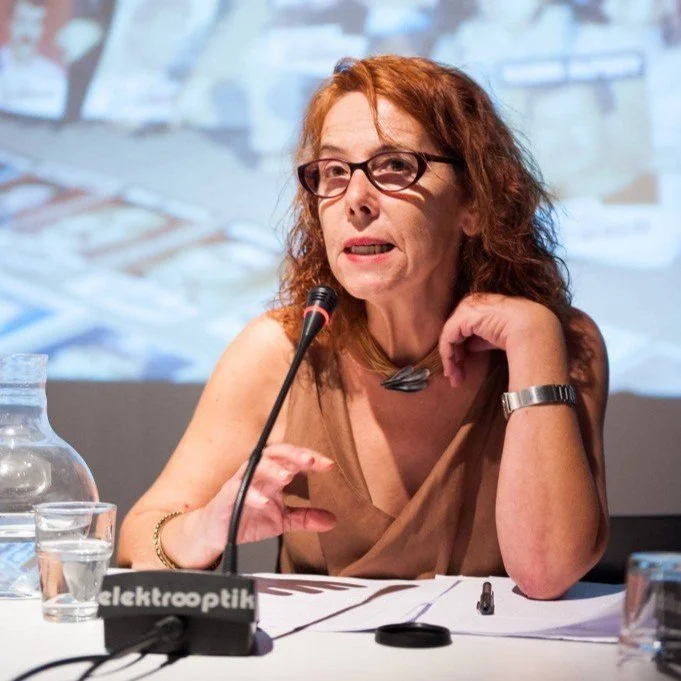
Women Mobilizing Memory workshop: "'Coming to Terms' with Gendered Memories of Genocide, War, and Political Repression," featuring Marita Sturken, Marianne Hirsch, Nükhet Sirman, Meltem Ahıska, and Nancy Kricorian. Istanbul, Turkey, September 2014.
VIDEO: "Art, Performance, and Memory"

Women Mobilizing Memory workshop: “‘Coming to Terms’ with Gendered Memories of Genocide, War, and Political Repression,” featuring Andreas Huyssen, Alissa Solomon, Carol Becker, Diana Taylor, and Maria José Contreras. Istanbul, Turkey, September 2014.
VIDEO: "Creating Alternative Archives"
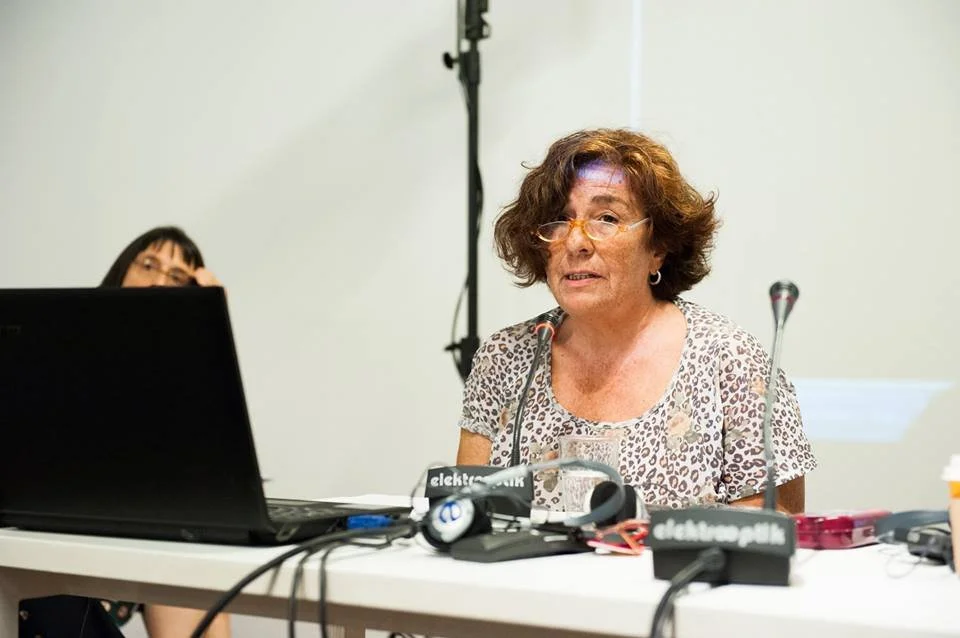
Women Mobilizing Memory workshop: “‘Coming to Terms’ with Gendered Memories of Genocide, War, and Political Repression,” featuring Leyla Neyzi, Susan Meiselas, and Silvina der Meguerditchian. Istanbul, Turkey, September 2014.
"Mobilizing Memory: Women Witnessing" EXHIBITION CATALOGUE
Opening Reception: September 5, Friday, 18:30
Venue: DEPO Istanbul (Lüleci Hendek Cad. 12, Tophane - Istanbul)
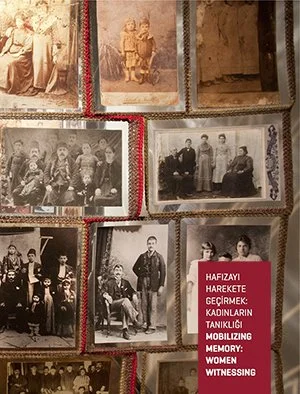
Artists: Gülçin Aksoy, Hera Büyüktaşçıyan, Silvina Der-Meguerditchian, Hakikat Adalet Hafıza Merkezi (Truth Justice Memory Center), Gülsün Karamustafa, Susan Meiselas, Nar Photos (Serra Akcan, Fatma Çelik, Gülşin Ketenci, Aylin Kızıl, Serpil Polat), Lorie Novak, Emine Gözde Sevim, Aylin Tekiner
View exhibit catalog here (PDF)
Curated by: Ayşe Gül Altınay, Işın Önol
What is the role of witnessing in practices of resistance: resistance to enforced silence and forgetting, to state power, and to inaction? What role do the arts play in combatting the erasure of past violence from current memory and in creating new visions and new histories for future generations? In particular, what unique strategies have women devised to reveal and redress the violence directed at woman and at other disempowered social groups?
The feminist art work displayed in this exhibit imagines memory as part of a larger politics of resistance. It mobilizes memories of past and present violence precisely to create the conditions and the motivations for social change. Bringing together women artists many of whom are themselves direct witnesses to oppression and terror, the exhibit also reveals moments of resilience, resistance, and creative survival. The artists gathered here use memory in innovative ways. They foreground unofficial acts of witness and forms of commemoration--embodied practices, performances, photography, testimony, street actions—that provide alternative histories and different political imaginaries than do official archives, memorials, museums, and state commemorations. They make visible not only violent crimes and their gendered dimensions, but also the intimate texture of lives and communities that have survived or are fighting to survive immense destruction. In honoring those lives and bringing them out of oblivion, the artists also reclaim women’s practices—dance, song, embroidery, for example—and show their political resonances. As a group, these artists resist monumentality in favor of intimacy, featuring individual stories of the quotidian. They use official archives to document and contextualize those lives, but they also create new archives and alternative interpretations, reframing how we understand the past and pointing to what has been excluded from authoritative histories. They thus imagine alternative social and political trajectories and more open and progressive futures.
This exhibit occurs in the context of a five-day workshop on “Mobilizing Memory for Action” that brings together an international group of scholars, artists, and activists to analyze the activist work memory practices can enable. The art works comprising this exhibit and the broadly comparative panels and roundtables on September 17 invite us to ask how our acts of witness can motivate social change. What do images and accounts of past and present violence demand of spectators, listeners, and readers? How can we modulate proximity with distance, empathy with solidarity? Indeed feminist practices of witness have fostered solidarity that demands not only collaboration and commitment, but also a respect for what is historically specific to particular acts of violence and oppression. In bringing diverse events of state violence—the Holocaust, the dictatorships in Latin American, American slavery—to the Armenian genocide, the persecution of Kurdish and Palestinian communities, and the oppressive acts of authoritarian power featured in this exhibit, the “Women Mobilizing Memory” workshop invites participants both to see where connections lie and also to recognize what cannot be generalized or translated across linguistic, national, or religious borders. In resisting silence, forgetting and erasure, progressive acts of memory also resist easy understanding, appropriation and straightforward comparison.
The collaborations among the participants in the working group, and between the artists and their subjects, aim to create a space of solidarity and connection. We invite you to enter into this larger collaborative project of responding to the memories recorded here, and to join us in the work of shaping memories for more hopeful futures.
Co-hosted by Columbia Global Centers | Turkey, DEPO Istanbul and Sabancı University Gender and Women's Studies Forum, the exhibition and parallel activities have been supported by the the Center for the Study of Social Difference, Blinken European Institute, Sabancı University, Hemispheric Institute of Performance and Politics, the Truth Justice Memory Center and Friedrich-Ebert-Stiftung Turkey Office.
For more information about the project please visit: http://socialdifference.columbia.edu/projects/women-mobilizing-memory
Women Mobilizing Memory Workshop II
Working group:
Women Mobilizing Memory
Hemispheric Institute for Performance and Politics Encuentro
Montreal, June 2014
Conveners: Marianne Hirsch, Jean Howard, Diana Taylor
Description:
Bringing together artists, writers, theater practitioners, museologists, social activists, and scholars of memory and memorialization, “Women Mobilizing Memory” focuses on the political stakes and consequences of witnessing and testimony as responses to socially imposed vulnerabilities and historical trauma. The working group will probe how individual and collective testimony and performance can establish new forms of cultural memory and facilitate social repair. Using gender as an analytic lens, this project explicitly explores women's acts of witness and the gendered forms and consequences of political repression and persecution. It asks what strategies of memorialization and re-imagining are most effective in calling attention to past and present wrongs and in creating possibilities of redress through protest and other forms of action and resistance.
Participants:
Pilar Riano, ‘Afro-Colombian Singing as Testimonial Practice.’
Giselle Ruiz, ‘A Poetic Corporeality’
Victoria Fortuna, ‘Dance Based Memory Practice’
Ausonia Bernardes, Memory in Contemporary Dance Practice.
Monika Gagnon, "What is Posthumous Cinema?"
Barbara Sutton, "Women Mobilizing Body Narratives of State Terrorism in Argentina (1976-1983)"
Julie Okotbitek
Milena Grass, “Women who collaborated with the dictatorship”
Raúl Diego Rivera Hernandez, “Performative strategies of Central American Caravan of women searching their missing relatives in Mexico”
Nuria Carton de Grammont —narco trafico
Leticia Robles, “Antigonas”
Carolyn Vera, Guatemalan performance artists
Leyneuf Tines Villarraga, TBA
activistas / desafíos políticos.
Shahrzad Arshadi
Lorie Novak, “Photographic Interference”
Jenny James, "Bricolage Memories: Gender, Refugee Life and Narrative Repair in the fiction of Dionne Brand and Kim Thuy"
Magdalena Olszanowski, ‘Between Mother and Daughter: The belly button as scar of separation’
María José Contreras, ‘Teatro testimonial de mujeres ancianas mapuches’
Methodology:
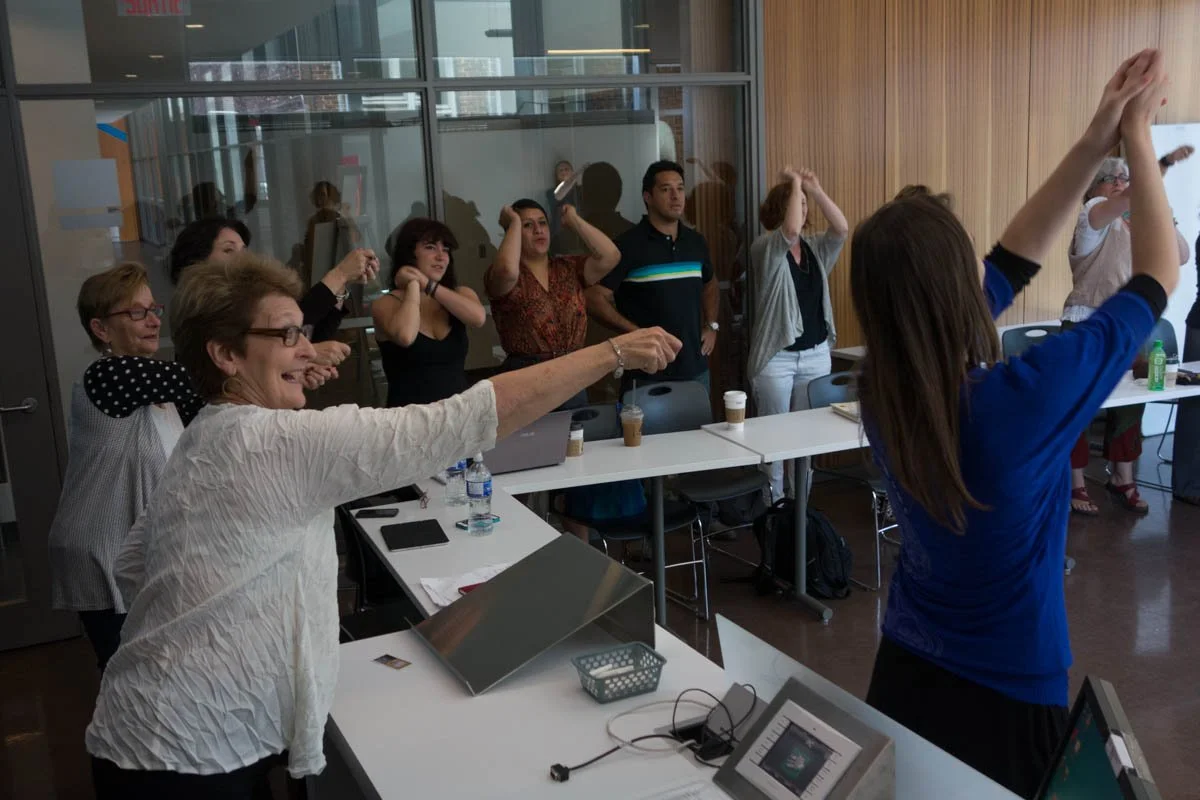
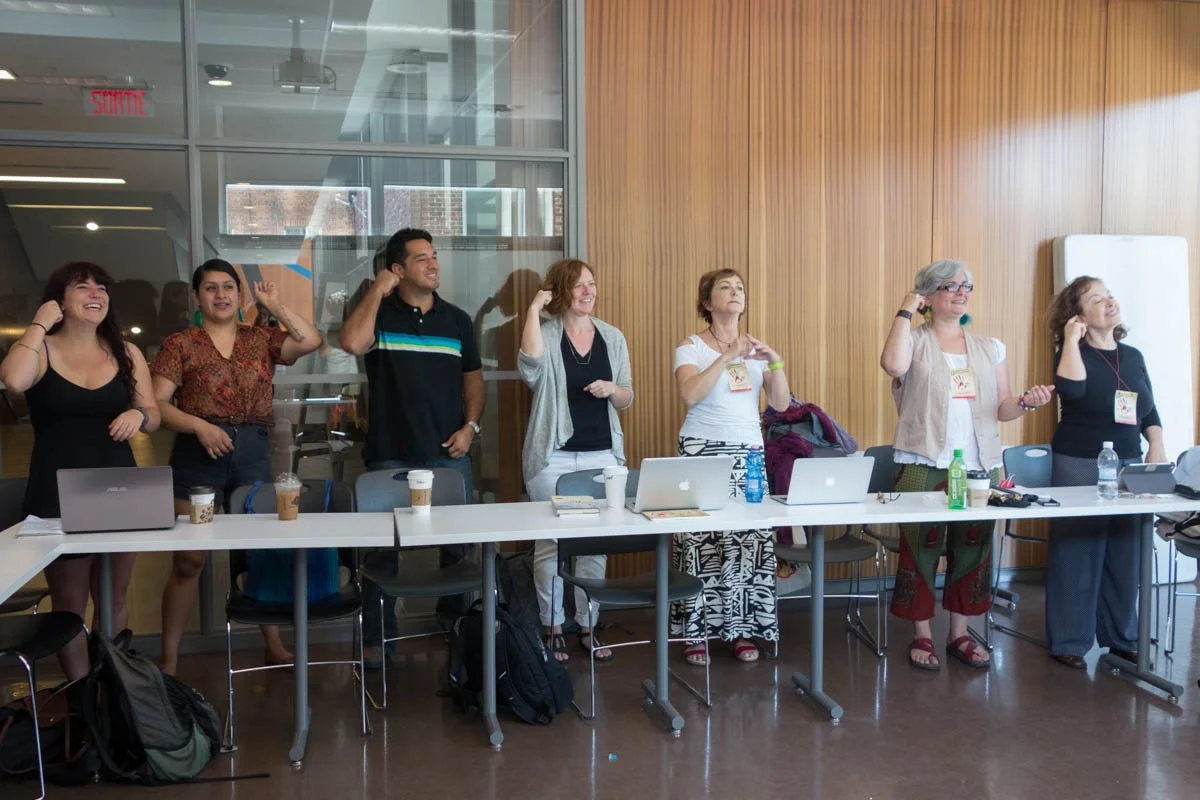
We spent each of the sessions on a particular topic arising from the participants’ interests. Beforehand we circulated by internet brief background readings for each session and for the group. Each session we had a warm up exercise in order to create a collectivity that could think and be in presence together Then, each participant presented a 6 minute presentation that ended with questions for a 3 minute discussion. Each session concluded with an extended 45 minute discussion.
Some notes about our discussions:
As said in the call, the group discussed about the role women in the circulation, recovery, reshaping and mobilization of memory.
Some of the most important issues that emerged during our work was COLLABORATION. Collaboration was seen in different levels: between women that had suffered violence, but also between women artists and/or activists and/or researchers with women that had survived to violent pasts. Women’s memory practices may enable transnational memory networks, both at a local and global dimension.
We also considered posthumous collaboration, as a way to connect the living and the death. Some of the case studies discussed evidenced how the dead spoke to us through their traces. In a sense, when studying memory of violent pasts, all collaborations are somehow posthumous, they are about what remains and what may survive.
MEMORY was defined as a practice that sometimes allowed the cultural renewal of traditions and sometimes functioned as resistance to narratives of disposability or vulnerability. Memory practices appeared as crucial strategy of resistance for women who have endured continued forms of physical erasure (from genocides to current femicides),
Art and cultural performances recuperate and reshape memories. Memory is not just about bringing stories, is about creating a collective history. In that sense, memory is always intervening in the present creating new forms of identity and collaboration. The mobilization of memory allow different possibilities for an engagement that triggers multiple plural ways of seeing the past, challenging dominant or status quo versions of the past. The artistic work with memory activate and animate archives and by allowing them to travel and migrate, they create networks of connectivity that challenge the monumentalization of memory.
One of the crucial concepts raised was that of POSITIONALITY: were are we respect to past violence or slow ongoing violence of neoliberalism? What kind of memory work advances political engagement and responsibility?
When coping with trauma and horror embedded pasts, memory practices become critical to render visible the violence. Memory practices as studied by the group articulate different forms of visibility and invisibility. Art and cultural memory practices enable/encourage/make possible different forms of efficacy, mobilizing action for the future in different levels.
Efficacy may be considered from different perspectives, as a political efficacy that mobilizes social change, but also as a communicative efficacy that by contagion, empathetic connection and affect circulation create collective identities and networks and may subtly transform materials and perceptions. The group discussed to what extent the circulation of affect alone may cause social change.
Another issue discussed in the group was the distinction between empathy, identification and solidarity (between people and networks). We could realize how in acts of scholarship and artistic creation there are various uses of empathy, distance, identification, alienation, solidarity and witnessing. Each of them portrait different sorts of efficacy
When discussing about efficacy we questioned ethical issues regarding for instance the risk of appropriation of artists of painful memories and again the question of positionality: were are we, what is our political and ethical engagement regarding past or present violence?
The different case studies displayed a range of memory practices in different SCALES. From micropractices and intimate memory actions to larger actions, sometimes even monumental actions. All of these cases advanced different sorts of efficacy.
The type of efficacy of these practices relate to the media considered as different ways to address memory: the human body, images, sounds, voices, writing. Analyzing these various media we could better understand how memory is transmitted across bodies and generations.
The body appeared in several presentations as a living dynamic archive, both in the generation that suffered violence and in the later generations. Bodies serve to mobilize the horror that cannot be said and also allows us to learn about other’s experiences when we were not there. The body always transmit, so the relation between memory and body is complex and dynamic: memory of the body / memory in the body / the body as memory. One of the critical aspects specially when working with testimonies was the continuity of presence that prefigured the importance of being there, present and presenciando collaboratively.
We also discussed the potentiality of images as mobilizing devices. Images are powerful transmitters/creators of memory and this is something that mass media seem to understand well since they banalize images as a political strategies. Other than the images the sound and voice are also power media to mobilize memories. The voice for instance immediately mark the presence of who’s speaking. Literature, theatre, photography, internet all portray different ways to approach to memories.
By the end of the work group we highlighted the importance of hope. The mobilization of memory always seem to have a hope component, the desire to share, to render visible and to share experiences to enable us to respond to past and present slow violence.
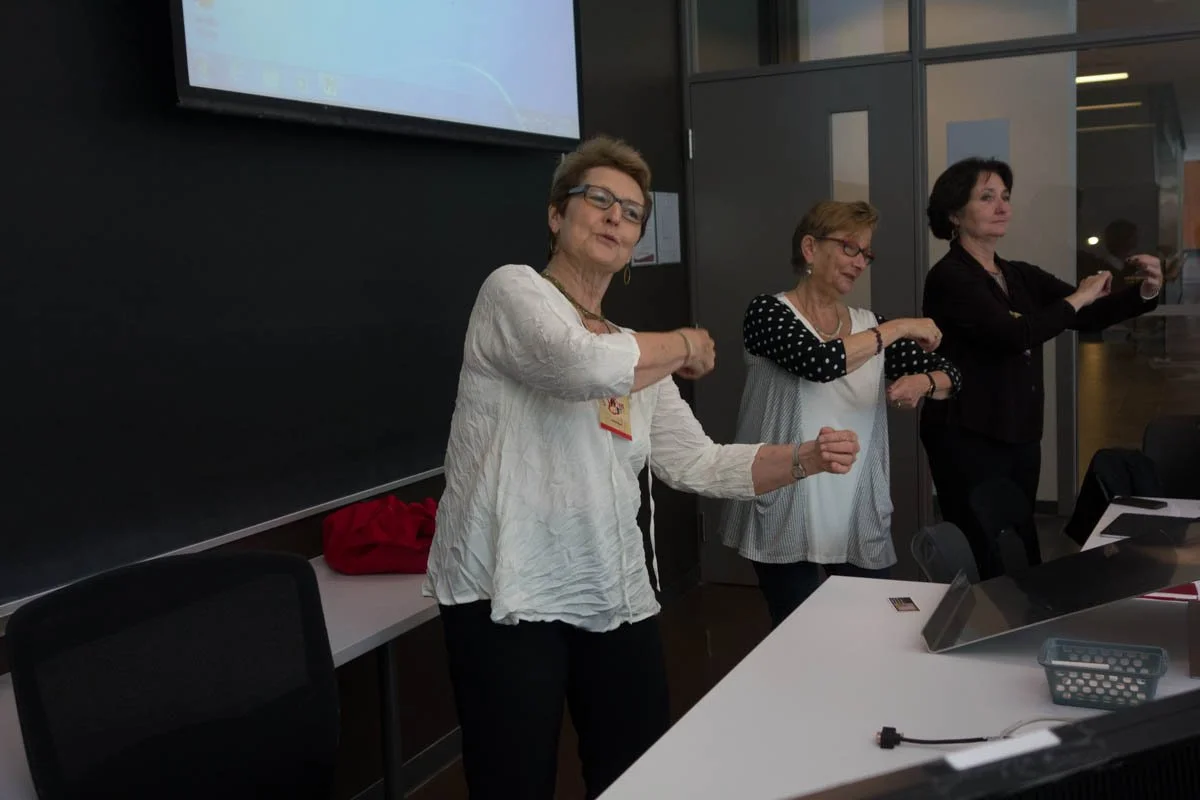
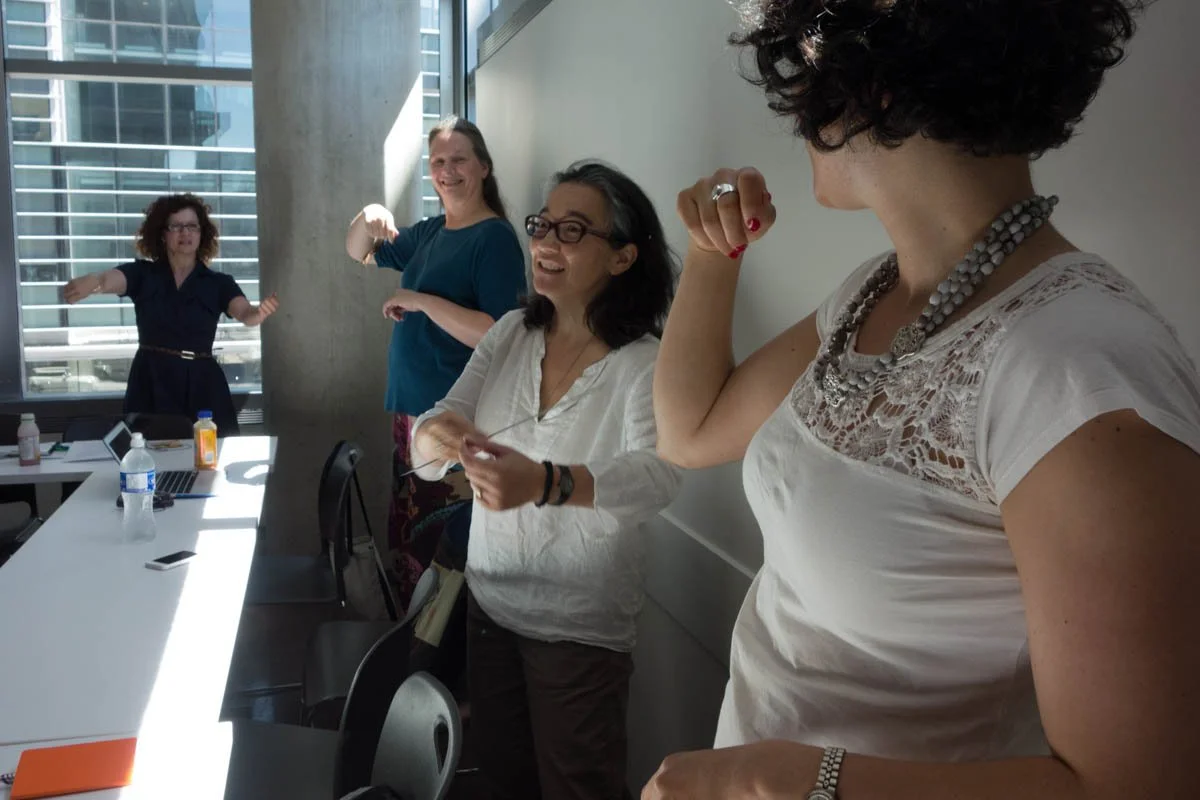
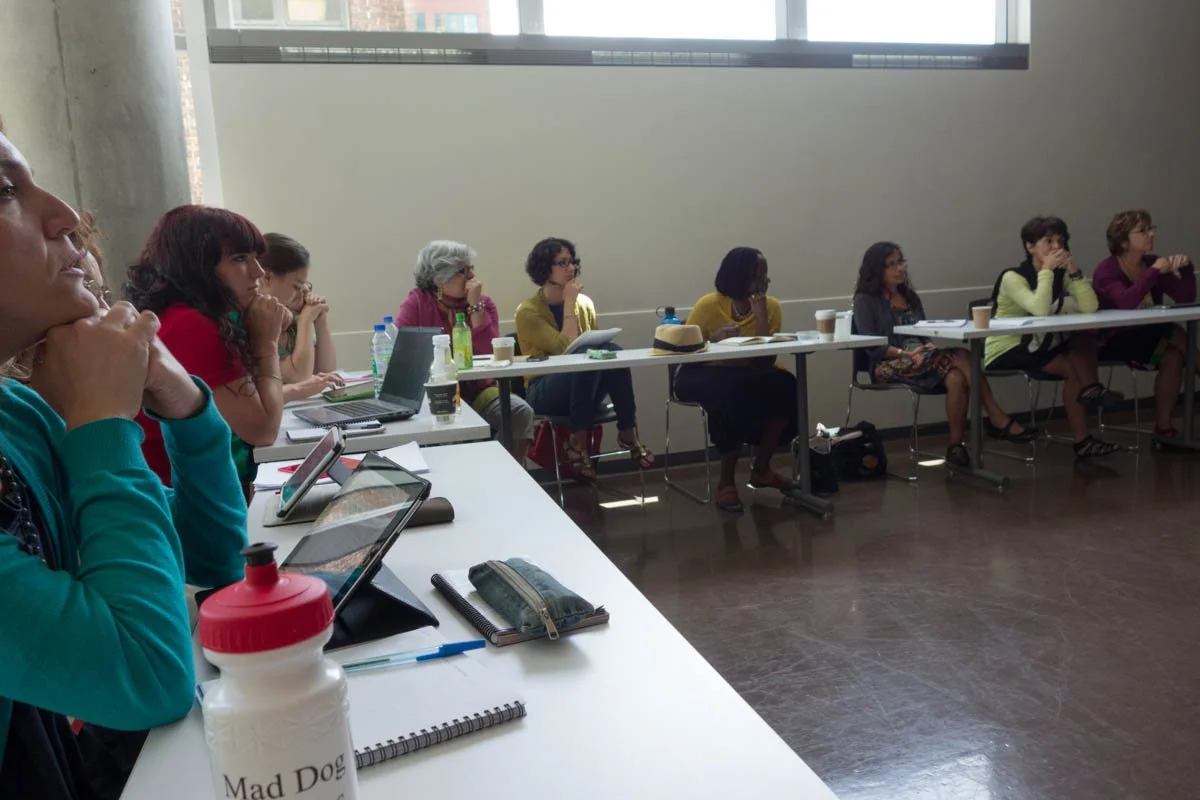
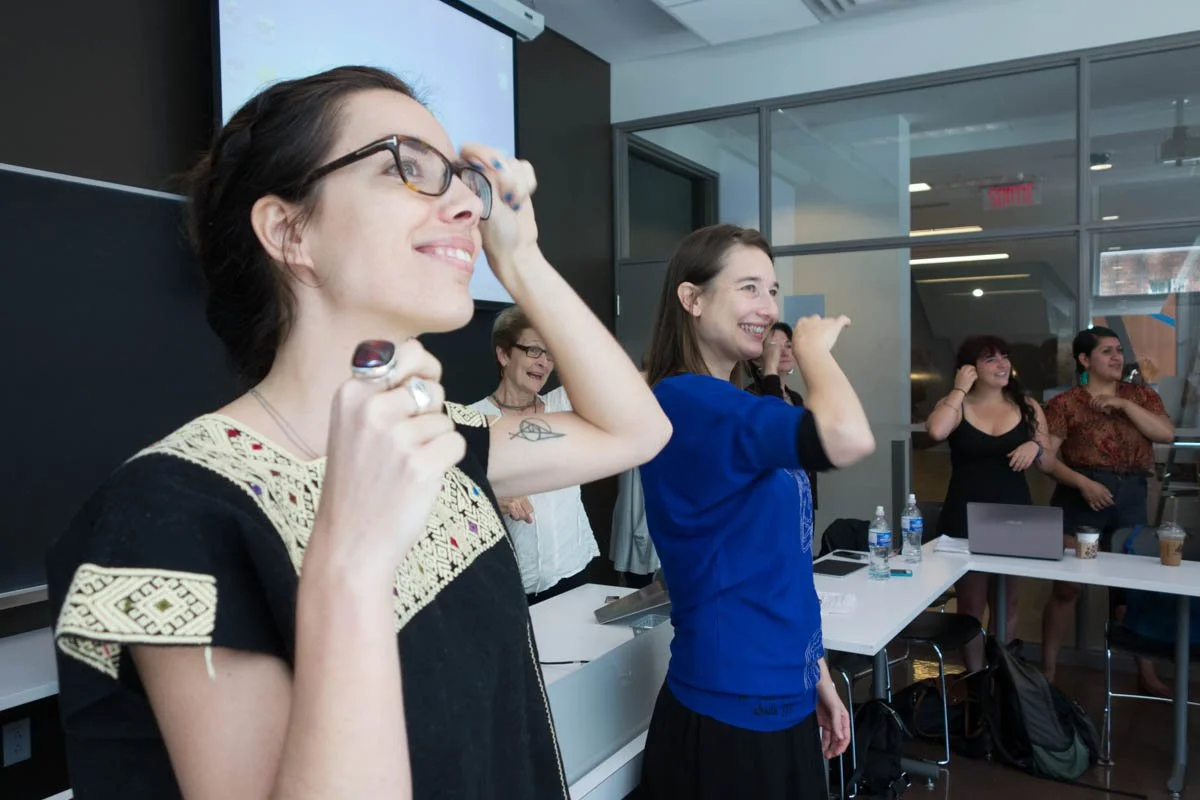
Photos from the Women Mobilizing Memory Workshop II at the 2014 Hemispheric Institute Encuentro held in Montreal, June 21–28.
Memory for the Future: Collaborative Witnessing in Post- Dictatorship Chile
In December 2013, a transnational group of scholars, artists, and activists came together at Columbia’s Global Center in Santiago de Chile to reflect on the manifold ways in which cultural memory of the Pinochet dictatorship has been and can be mobilized in the service of different visions for Chile’s social and political future.
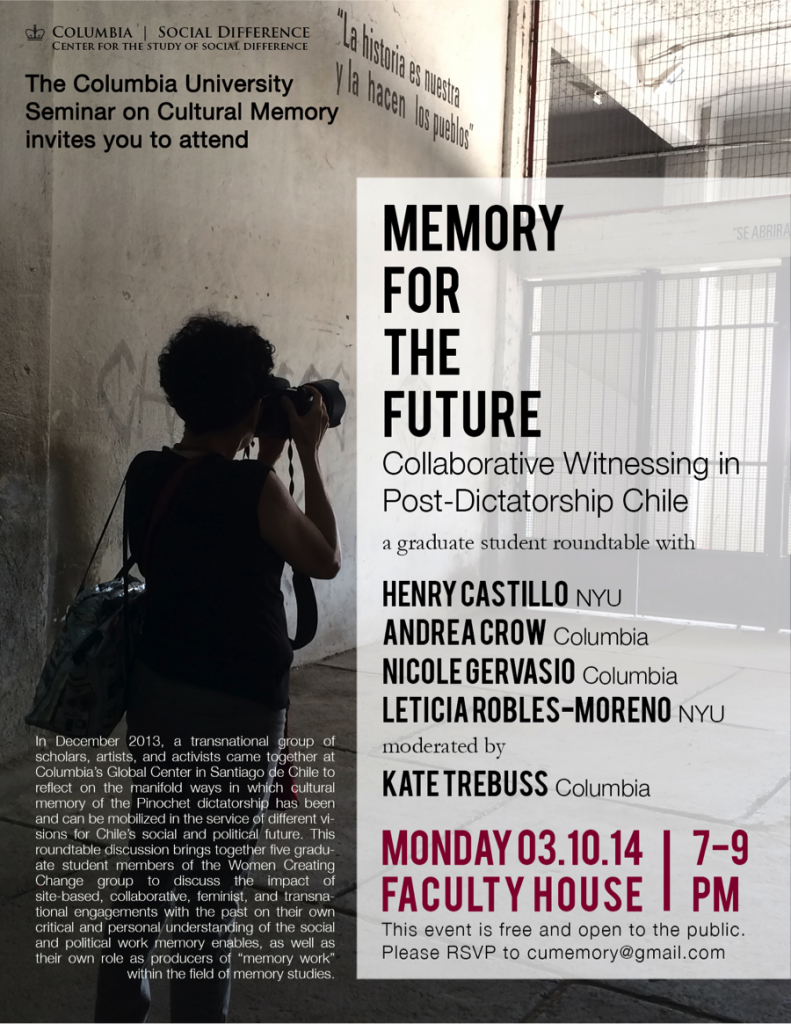
This “workshop,” sponsored by Columbia University’s Center for the Study of Social Difference’s “Women Creating Change: Mobilizing Memory” project, incited all members of the group to think not only about the politics and performances of memory in Chile and beyond, but also about their own scholarly practices and methods for engaging with sites of memory and the complex connective histories of which such spaces are a part.
This roundtable discussion brought together five graduate student members of the Women Creating Change group to discuss the impact of site-based, collaborative, feminist, and transnational engagements with the past on their own critical and personal understanding of the social and political work memory enables, as well as their own role as producers of “memory work” within the field of memory studies.
Graduate student roundtable discussion with:
Henry Castillo (NYU)
Andrea Crow (Columbia)
Nicole Gervasio (Columbia)
Leticia Robles-Moreno (NYU)
and moderated by Kate Trebuss (Columbia)