
What is a feminist jail and why shouldn’t we fall for it?
By Nia Paz-Diaz
On November 13th, the Center for the Study of Social Difference hosted an event for abolitionists, activists, and academics interested in dismantling the concept of "feminist" jails. The event, How to Abolish Prisons: Gender as Analytic, featured three speakers with varied expertise in abolitionist work: Dr. Sarah Haley, a historian at Columbia University who specializes in carceral history; Rachel Herzing, the executive director of the Center for Political Education; and Romarilyn Ralston, the executive director of Project Rebound, which supports formerly incarcerated students across the California State University system. The following piece builds on the discussion initiated at the event.
What is a “feminist” jail? Can a jail ever be truly “feminist”? Campaigns for gender-responsive jails have risen significantly in the US, as advocates wish to improve the lives of women inmates while incarcerated. The campaigns call for a placid environment, betterment programs to increase employability, and less male guards. In various cases, these campaigns are attempting to construct entirely new jails. Abolitionist feminists reject these campaigns: although the lived realities of women inmates is deleterious and cruel, using such reforms to justify new jails is deceptive and continues the violence of the carceral state.
As the terms feminism and abolition become increasingly popular, and campaigns for gender-responsive jails arise, abolitionist feminist scholars remain committed to untangling the concepts to provide a clear framework on enacting liberation for all incarcerated people (Davis, 2022). Feminism, per definition, is the fundamental right of individuals – especially women and gender minorities – to control their own bodies, identities, lives, opportunities, and resources free from patriarchal control. Feminism centers the ideals of autonomy and self-determination. Thus, jails are inherently incompatible with feminism: incarceration redacts an individual’s autonomy and economic independence, ultimately subjecting them to a future with decreased opportunities and resources. Incarceration strips women of their right to control their own bodies, which are often subject – in most cases, violently – to decisions made by others. Angela Davis writes that the very meaning of the term abolition feminism includes a relationality and an interruption – abolitionist practices are most compelling when they are also feminist, and conversely, a feminism that is also abolitionist is the most inclusive and persuasive version of feminism for these times (p. 1). Abolition and feminism are fundamentally intertwined. Therefore, any gender-responsive reform, by definition, can never be feminist.
Which begs the question – how can campaigns for feminist jails exist?
Campaigners tout these gender-responsive approaches as a means to address the realities of imprisoned women and non-binary people, their unique pathways into the system, and their differences from cis-gender men (Columbia Justice Lab, 2022). The mythical gender-responsive jail’s mission is to provide programming that stimulates trauma healing, increases community ties, and enhances post-incarceration employability. A gender-responsive jail would function independently from men's prisons, feature operational equipment suited to women and non-binary people, prioritize mental health care, and include family visitation centers. Additionally, such a facility might employ predominantly women guards and attempt to cultivate a safe physical environment for women and non-binary inmates (p. 5).
The gender-responsive approach emerged as a remedy to the violent realities that plague our carceral system. Although a harsh environment for every inmate, prisons additionally punish women and non-binary inmates through a profound failure of responding to and a neglect of gender-based needs. Prisons neglect women’s basic needs as a form of punishment, as exemplified by the lack free menstrual hygiene products, close proximity to male prisons, invasive bodily searches, plenitude of male guards, solitary confinement for women with a sexual abuse history, inadequate infrastructure for expecting or current mothers, sexual abuse by guards, etc. Thus, prison campaigners have mobilized this negligence to justify the building of new jails supposedly rooted in feminism.
Abolitionist feminists worry and fight to improve the dangerous lived realities of inmates; they know that these issues should not go unresolved. However, these negligences are being employed to increase the plethora of jails under the guise of an illusory gender-responsive jail – which will ultimately be prone to the same systemic issues as its predecessor. We have seen these campaigns in the past fail (including that of the Riker’s Island Singer Center). This leads us to the following questions which arose during our discussion: How has feminism been weaponized inadvertently (or, intentionally) to expand the carceral state? And how is this feminist rhetoric expanding jail construction campaigns in New York City?
In 2022, New Yorkers (including social workers, prison labs, and reformist activists) campaigned for a new jail, named the Women’s Center for Justice, to be built in Harlem (Columbia Justice Lab, 2022). Campaigners argued the jail would be rooted in gender-responsive approaches, such as detaining inmates closer to their communities, detaining women separate from male inmates, and implementing strategies that address the underlying issues driving women and gender-expansive people into the system (p. 3). Some popular feminists even uplifted this campaign (Rayman, 2022). Campaigners contended the Women’s Center would be significantly less expensive to build than other jails. They estimated the cost to build the Women’s Center for Justice at $200 million dollars (p.4). The campaign failed to acknowledge that $200 million could otherwise be put towards developing Harlem’s community resources, low-income housing, accessible mental health services, and other preventive measures to help young women. The city might have rejected spending money allocated for a new jail into such community investments. However, focusing activist efforts into a new jail before such rejection is craven. By honing in on the construction of and implementation of a new jail in Harlem, the activists lacked the focus on the systemic roots of incarceration. $200 million in community investments would shrink the need for prisons in the first place, and deserve the advocacy, effort, and time wasted on a campaign for an entirely new carceral institution. The Women’s Center hasn’t been approved to be built.
Long before the Women’s Center for Justice, New York City officials utilized the gender responsive approach in the 1980s to campaign for the Rose M. Singer Center at Riker’s Island. Campaigners advertised a ‘pleasant jail’ where women could renew themselves through economic training and live in comfort (NYC Department of Correction) – appeasing the general public by illustrating that women would be taken care of while in prison. The Rose M. Singer Center was framed as an 800-bed state-of-the-art facility with yellow, blue, mauve and rose-colored walls, featuring a 25-bed ‘nursery’ and job training programs in horticulture, sewing and culinary arts (NYC Department of Correction). However, the campaign did not include critical gender-responsive measures such as pregnancy liaison programs or women guards. The shallow modifications did not substantially address the issues women face in jails.
As time has passed, the Singer Center has confirmed the brutal inadequacy of gender-responsive jails: multiple women at the Center were sexually and physically assaulted over the years by correctional officers (Hamilton, 2015), have reported unsanitary and unsafe conditions during a global pandemic (Singer, 2020), and have had no access to betterment programming or drug abuse rehabilitation (White, 2020). Even Rose Singer’s family has stated that they wish for the removal of her name from the abusive center (Singer, 2020). Meanwhile, the cost to build the Singer Center was over $100 million tax dollars in 1988 (NYC Department of Correction).
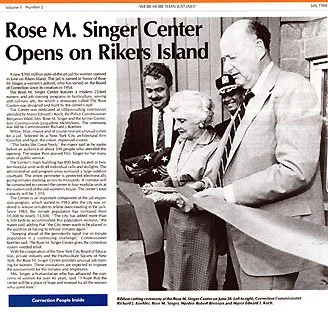
News about the Rose M. Singer Center Opening on Rikers (NYC Department of Correction.)
The cycle of prison reform and its inevitable failure runs throughout New York City's carceral history. Rikers Island was built to replace the infamous Welfare Island. Over a century ago, prison reformers criticized and unveiled the violent, unsanitary facilities of Welfare Island which housed the city jail, mental health facilities, and what officials deemed “the city’s destitute” (Shanahan, 2017). In 1927, the State Commission of Correction released a report denouncing the penitentiary for its ‘deplorable’ conditions. The report stated “the cells are small, poorly ventilated, and without modern sanitary conveniences” (Shanahan, 2017). The same issues persisted, millions of dollars later, after relocating to a new island. Rikers is closing and and plans are for it to be replaced by a new Kew Gardens facility — which would be attached to a men's prison — at an estimated cost of $261 million. The Kew Gardens facility is what the Women’s Center for Justice is attempting to replace (The Women's Center for Justice, p.4). The ignorant cycle continues – at the cost of human lives and tax dollars. Both plans, in Dr. Haley’s words, are a “radical shrinking of imagination and possibility.”
It is not just new jails that are taking on the gender-responsive mantle. Some existing jails have also begun implementing aspects of gender-responsive strategies: for instance, Los Angeles's largest women's jail recently initiated a gender-responsive staff training, implemented a pregnancy liaison program, and modified the physical environment to improve safety (Olson, 2019). Although gender responsiveness is a necessary stopgap, we must remember that this reform is not enough. No jail has successfully initiated a complete, comprehensive gender-responsive approach; instead, jails select a few, simple elements tobeguilingly demonstrate their dedication to the spiritual and physical rehabilitation of their women inmates. Although the Los Angeles jail was advertised as a pioneer jail for adopting these gender-responsive measures, it was marked by ample negligence that threatened women’s safety: lack of private spaces for women, lack of information about their individual needs, lack of permanent funding for the gender-responsive approaches, etc. (p. 440). In addition, the modifications were legally required: the jail was mandated to address these failures and provide access to renewal programs under Title 15 of the California Code of Regulations – but still failed (p. 441).
Although a gender-responsive jail might appear as a symbol of progress and betterment for women inmates, this reformist approach inevitably upholds and expands the carceral system and its profits by rendering prisons more palatable, all the while, worsening conditions in impacted communities. Once incarcerated, women’s lives are fundamentally disrupted. They lose their jobs, are unable to take care of their children and family members, and suffer mental health crises due to violent conditions. Incarceration itself is a root cause of unemployability and lack of parental care – rendering any prison job training and/or family care program futile. By stripping women from their employment and families, prisons are diminishing any chance of economic growth and family care for renewal.
Dr. Haley remarked during the discussion, “the history of prison is entangled with the history of reform; the history of penitentiary as one of ‘betterment’ and ‘enlightenment’ … we have seen the proof that prisons are violent – and no amount of mauve paint changes that.” Violent conditions are forced upon non-violent women: the majority of incarcerated women have extremely short stays for low-level, non-violent crimes. In 2022, the national average stay for women was 19 days, with about 93,000 women in jail on a given day, compared to 36 days for men (Kenney, 2022). The average jail stay for women within L.A. county jails is just under 2 months (Hare, 2016). In New York City, the mean jail stay was 26 days in 2019, while the median length of stay is 4 days (Tomasack, 2021). According to the latest available national data, 32% of women in jail are incarcerated for property offenses, 29% for drug offenses, and 21% for public order offenses (Swavola, 2016, p. 9). Thus, women endure profoundly traumatic conditions for non-violent crimes If the city’s objective was to uplift women and maintain their employability, they would implement proactive strategies that prevent abounding women from entering the carceral system in the first place.
As we look to the future, abolitionists have shown us that radical imagination and action for the future is possible. Haley, Herzing, and Ralston’s work exemplify the myriad of creative pathways for an abolitionist future. Dr. Haley has been involved in the fight against the Women’s Center for Justice in Harlem, where community organizing has already shifted the terrain of what's possible. A coalition of Harlem residents, Barnard and Columbia students, and academics successfully campaigned to replace the jail with a plan for low-income housing. Their fight exists on the principle of building communities instead of cages. Yet, the fight continues. The city has since shifted toward a cooperative housing model that would serve middle-income residents, not the low-income New Yorkers the community fought for. Organizations like Defend Harlem remain mobilized, pushing to ensure the city honors its commitment to affordable housing. This fight illustrates a crucial abolitionist lesson: dismantling the carceral state requires the fight against building prisons, and also vigilantly ensuring that what replaces prisons serves those most harmed by incarceration.
Herzing's coalition, Building Community, Not Prisons, is fighting to stop two prisons from being built through imaginative strategies. The coalition is challenging the proposed Letcher prison in Kentucky on environmental grounds. The coalition partnered with the Appalachian Rekindling Project, a women-led Indigenous organization, and raised funds to purchase land on the proposed prison site with the goal of re-matriating it to Indigenous stewardship. Herzing’s work exemplifies self-determination in practice, by uplifting marginalized communities to reclaim land and resources from the carceral state and build their own futures.
As abolitionist feminists, we do not ask that these gender responsive reforms be ignored – we understand that the lived realities of women inmates is pressing and dangerous. These small changes can surely alter the day to day of an inmate. However, we will not allow these shallow reforms to be the end goal, and subsequently further the carceral state’s construction and proliferation. As Davis notes, “Discovering and in fact embracing this ambiguous terrain located in the space between necessary responses to immediate needs and collective and radical demands for structural and ultimately revolutionary change is a hallmark of abolition feminism” (p.2). The work is ongoing, and the future remains contested — but another world is imaginable and is actively being constructed.
Citations
Eagle, S. (2020, April 27). OPINION: No one belongs on Rikers Island. Ever. Queens Daily Eagle.https://queenseagle.com/all/opinion-no-one-belongs-on-rikers-island-ever
Hamilton, C. (2019). 2 women sue city over alleged sexual abuse at Rikers—POLITICO.https://www.politico.com/states/new-york/city-hall/story/2015/05/2-women-sue-city-over-alleged-sexual-abuse-at-rikers-022279
Kenney, J. L., & Dolliver, M. J. (2022). Time to Bail out: Examining Gender Differences in the Length of Pretrial Detention Using Survival Analysis. The Justice System Journal, 43(2), 203–217.
Law, V., & Nalebuff, R. (2023, March 29). Prisons Use Menstruation as a Form of Punishment. TIME.https://time.com/6265653/prison-menstruation-punishment/
Norton, J. S., Jack. (2017, December 6). A Jail to End All Jails. Urban Omnibus.http://urbanomnibus.net/2017/12/jail-end-jails/
NYC Department of Correction. (1988). 1988: Rose M. Singer & Her Rikers Jail.https://www.correctionhistory.org/html/searches/cnwsrosie.html
Rose, B. H., Lisa. (2016, September 22). Pop. 17,049: Welcome to America’s largest jail. CNN.https://www.cnn.com/2016/09/22/us/lisa-ling-this-is-life-la-county-jail-by-the-numbers
Singer, S. (2020, May 12). Opinion | The Women’s Jail at Rikers Island Is Named for My Grandmother. She Would Not Be Proud. The New York Times.https://www.nytimes.com/2020/05/12/opinion/womens-jail-rikers-island-covid.html
Swavola, E., Riley, K., & Subramanian, R. (2016). Overlooked: Women and Jails in an Era of Reform. Vera Institute of Justice.chrome-extension://efaidnbmnnnibpcajpcglclefindmkaj/https://vera-institute.files.svdcdn.com/production/downloads/publications/overlooked-women-and-jails-report-updated.pdf?dm=1568746265
The Women’s Center for Justice. (2022). The Women’s Center for Justice: A Nation-Leading Approach on Women & Gender-Expansive People in Jail. Columbia Justice Lab.https://justicelab.columbia.edu/sites/default/files/content/Womens%20Center%20for%20Justice%20Report%205.18.2022.pdf
Tomasack, S., Scrivener, L., Bond, E., & Chauhan, P. (2021). Women in New York City Jails, 1995-2019. Data Collaborative for Justice.chrome-extension://efaidnbmnnnibpcajpcglclefindmkaj/https://datacollaborativeforjustice.org/wp-content/uploads/2021/07/2021_07_09_DOC_Women_Analysis_FINAL.pdf
Valdovinos Olson, M., & Amendola, K. L. (2021). Promoting Health, Safety, and Wellness in Los Angeles County Jails: A Process Evaluation of Gender Responsive Programing for Incarcerated Women. Women & Criminal Justice, 31(6), 422–444.https://doi.org/10.1080/08974454.2019.1700874