Seeds of Diaspora
‘Seeds of Diaspora’ will convene an interdisciplinary group of academics and practitioners. Together, we will select a short list (5-8) of non-cultivated plants found in New York City, and consider how they each embody native and non-native landscape imaginaries.
Project Co-Directors: Lynnette Widder & Ralph Ghoche
Project Coordinator: Fern Thompsett
‘Seeds of Diaspora’ will convene an interdisciplinary group of academics and practitioners. Together, we will select a short list (5-8) of non-cultivated plants found in New York City, and consider how they each embody native and non-native landscape imaginaries. We will link each plant and its botanical descriptors to maps, images, practices, and texts that communicate ecological, herbalist, culinary, agricultural, literary, artistic, anthropological, and other cultural traditions. In an era of fraught nationalism, mass migrations and climate change, as the boundaries between ecosystems and society are constantly reconfigured, we will emphasize the potential of plants to connect and to describe cultural landscapes past, present, and future.
Past Events
Seeds from a Seed's Perspective: A Lecture & Discussion with Eric Sanderson
Insights on the Movement of Plant Propagules by Indigenous People, Other People, and Others in the Landscape that became New York (Welikia)
Eric Sanderson has been working for nearly twenty-five years to understand the historical ecology of New York City, deriving insights relevant to conservation, urban planning, resilience, and epistemological issues, such as: what does it mean to be a New Yorker? How do you get here? How do you get away? Here we take the seed’s perspective on these questions and examine the processes by which we can understand the historical landscape before New York, what it meant for seeds and their movement, and how those movements changed in a landscape long stewarded by the Indigenous Lenape people to one controlled by the Dutch and English settlers to the our modern American metropolis.
Register here
News
Image credit: Lynnette Widder
Fellows
Ralph Ghoche is a nineteenth-century architecture and urbanism historian and Assistant Professor in the Department of Architecture at Barnard College, Columbia University.
Fern Thompsett is a PhD candidate in the Department of Anthropology at Columbia University. Her dissertation research explores the Anti-Civilization Movement, an anarchist environmental movement that coheres around an anti-colonial, anti-capitalist critique of mass agriculture.
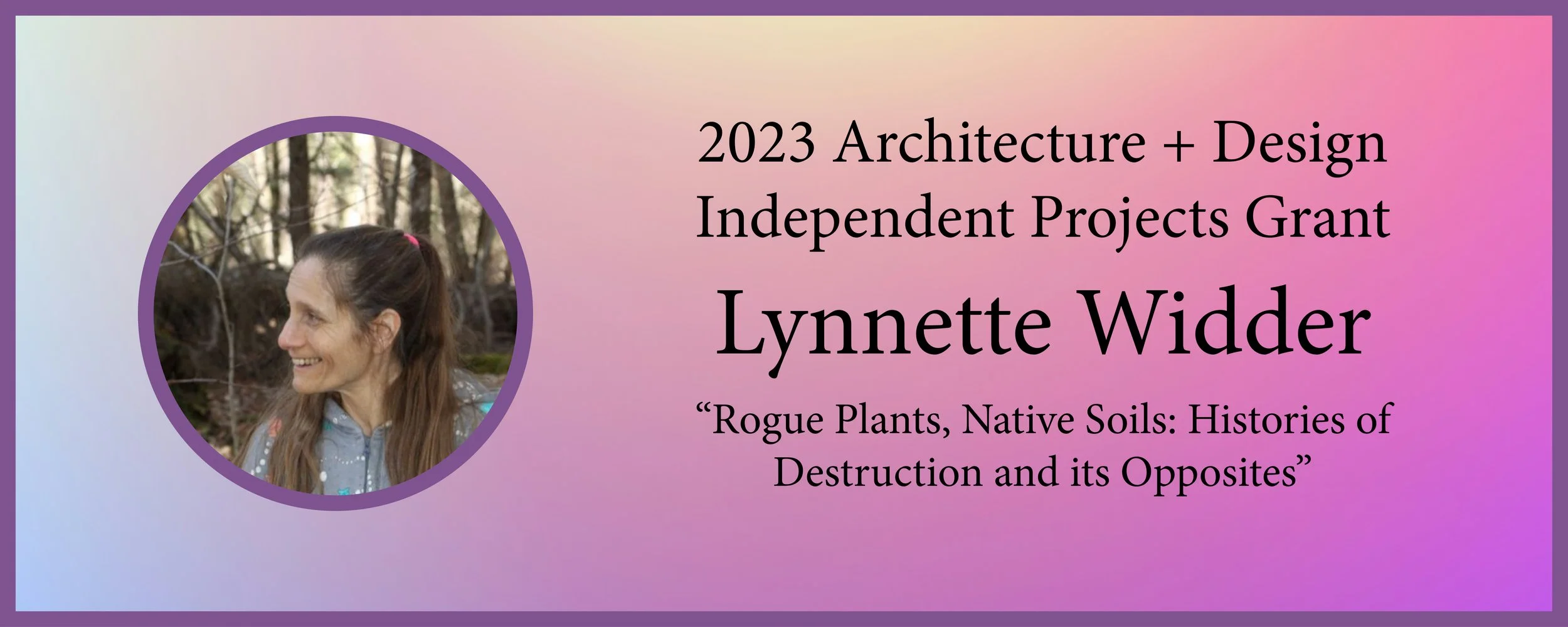
Lynnette Widder works on sustainable, resilient and equitable built environment practice. Her architectural work has been featured in the New York Times, on HGTV and in other US, European, Asian and Australian publications; and currently focuses on low-embodied energy, low-carbon renovation of Modernist buildings, including an award-winning renovation of Kaneji Domoto's 1949-50 Lurie House.