
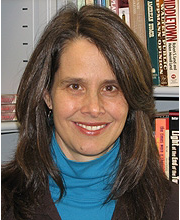
Kirsten Swinth
Associate Professor of History, Fordham University
My research interests center on the social and cultural history of the U.S. since World War II, but I have also written on the Gilded Age and Progressive Eras. My focus is the intersections among gender, cultural, and labor and economic history. I have a strong background in U.S. visual and popular culture as well, and have recently been teaching the history of American photography. My training is in American Studies and I rely on an interdisciplinary approach in my work.
Kirsten Swinth
Associate Professor of History, Fordham University

My research interests center on the social and cultural history of the U.S. since World War II, but I have also written on the Gilded Age and Progressive Eras. My focus is the intersections among gender, cultural, and labor and economic history. I have a strong background in U.S. visual and popular culture as well, and have recently been teaching the history of American photography. My training is in American Studies and I rely on an interdisciplinary approach in my work.
I am currently at work on The Rise of the Working Family: The Reshaping of Care and Competition in Postindustrial America. This book traces the rise of the working family in the second half of the twentieth century. The Rise of the Working Family thus reshapes historians’ understandings of postwar American history by providing an integrated narrative of two of the most fundamental historical changes of the last fifty years—simultaneous gender and economic revolutions.
The key to unlocking the rise of the working family is the working mother. Historians understand the unskilled male industrial worker to be the emblem of industrial capitalism; they have yet to understand how the working mother is the emblem of the postindustrial order. With the new service economy, working mothers moved front and center. They dominated popular conceptions of the labor force and occupied growing sectors of the economy, particularly the expanding “care” sector. I show the roots of—and cultural politics behind—many common catchphrases for the nation’s new social and economic reality: supermom, second shift, the balancing act, juggling, mommy wars, and mommy track.
My earlier scholarship explored gender, culture, and labor in the art world at the turn of the century. In Painting Professionals: Women Artists and the Development of Modern American Art, 1870-1930 (2001), I traced the careers of two generations of American women artists who flooded the art world starting in the 1870s. I explored the significance of culture to social reform with an edited document collection, “How Did Settlement Workers at Greenwich House Promote the Arts as Integral to a Shared Social Life?,” for Women and Social Movements in the United States, 1600-2000 (2006).
My work has been featured on CNN.com, The Christian Science Monitor, the Huffington Post, and on public radio’s “To the Point.” I lecture regularly on the women’s movement, postwar America, and the Gilded Age and Progressive Eras.
Working Group Affiliation

Nafeesa Syeed
Media Fellow, Religion and the Global Framing of Gender Violence
Nafeesa Syeed is an award-winning multimedia journalist with a decade of full-time experience on four continents in spot news and enterprise reporting, editing and producing. She works as a National Security Reporter for Bloomberg News based in Washington, D.C. Nafeesa has held positions at the Dubai Bureau and Al Jazeera America. She holds an M.A. in Comparative Literature from The School of Oriental and African Studies, University of London and a B.A. in Arabic and Government from Georgetown University.
Nafeesa Syeed
Media Fellow, Religion and the Global Framing of Gender Violence
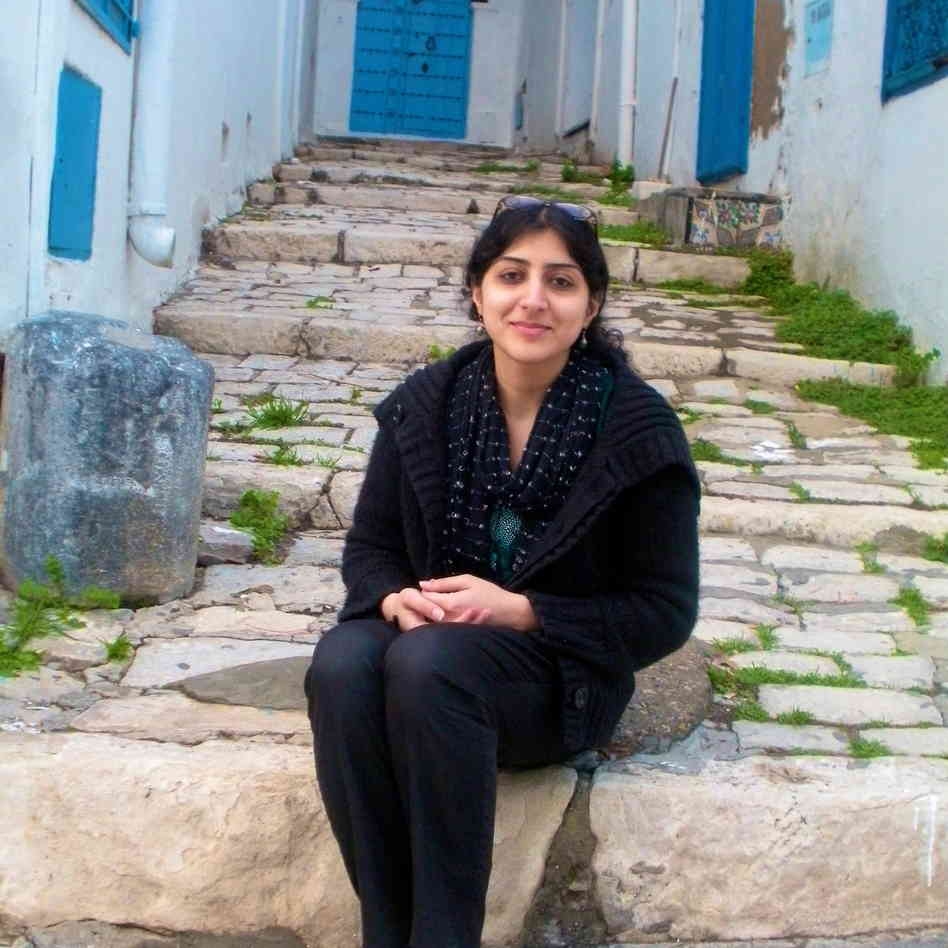
Nafeesa Syeed is an award-winning multimedia journalist with a decade of full-time experience on four continents in spot news and enterprise reporting, editing and producing. She works as a National Security Reporter for Bloomberg News based in Washington, D.C. Nafeesa has held positions at the Dubai Bureau and Al Jazeera America. She holds an M.A. in Comparative Literature from The School of Oriental and African Studies, University of London and a B.A. in Arabic and Government from Georgetown University.
Working Group Affiliation
Religion and the Global Reframing of Gender Violence, Media Fellow
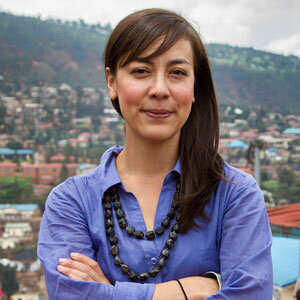
Delia Duong Ba Wendel
Assistant Professor of Urban Studies, the School of Architecture and Planning, Massachusetts Institute of Technology
Delia Duong Ba Wendel is an Assistant Professor of Urban Studies in the School of Architecture and Planning at the Massachusetts Institute of Technology, and co-editor of Spatializing Politics, an anthology of essays on power and place (2015). Her book manuscript Rwanda’s Genocide Heritage is a spatial history of genocide memory that accounts for how a past gains presence, is authorized, and persists as a form of sociopolitical regulation.
Delia Duong Ba Wendel
Assistant Professor, Urban Studies, the School of Architecture and Planning, Massachusetts Institute of Technology

Delia Duong Ba Wendel is an Assistant Professor of Urban Studies in the School of Architecture and Planning at the Massachusetts Institute of Technology, and co-editor of Spatializing Politics, an anthology of essays on power and place (2015). Her book manuscript Rwanda’s Genocide Heritage is a spatial history of genocide memory that accounts for how a past gains presence, is authorized, and persists as a form of sociopolitical regulation. Her book manuscript The Ethics of Stability explores post-genocide peacebuilding as a socio-spatial endeavor defined and challenged in the design of homes, settlements, and civic space. Her research engages how communities recover and rebuild after conflict.
Working Group Affiliation
Insurgent Domesticities, Co-Director