
On the University in/and Crisis
By the University in/and Crisis Working Group
The following piece reflect on and extends the critical conversations and discussions that occurred in the meetings and public events of the University in/and Crisis working group in fall 2025.
We inaugurated our University in/and Crisis working group on September 17 with a talk by Dylan Rodríguez on Frantz Fanon’s work and insurgent intellectual practices at the Harlem School of the Arts with a response by Ezekiel Dixon-Román. Anchored to the archive as a first site of exploration, the talk drew from Fanon’s framework for understanding colonialism as a problem of species in order to situate modern counterinsurgency warfare within the colonial, plantation time-space. Because the colonial ruler is a perpetual outsider, the goal of countersinsurgency warfare is to “vindicate and legitimize the existence of a colonizing species.” As a struggle for restoring legitimacy, Rodríguez argued counterinsurgency warfare must take on an experimental edge, always ready to abandon and update previous strategies to repair any fissures in its project for legitimacy; a legitimacy that requires constantly updating and reworking the racializing assemblages that perpetually disappear the Indigenous in order to naturalize settler ownership over the land and violently capture the Black body as fungible. Through these relationships of domination, the white settler is able to produce racialized differences that become encoded into categories of citizenship and humanity that shape who gets access to the university. As an epistemological authority, the university, thus, emerges as a key steward of power tasked with producing, reproducing, and ensuring the cohesiveness of a counterinsurgent narrative.
As Robin D. G. Kelley argues in his article “The Responsibility of Intellectuals in the Age of Fascism and Genocide,” published in the Boston Review’s Summer 2025 issue, the university is part of a larger assemblage of institutions tasked with creating the “intellectual scaffolding” to legitimize the white supremacist nation-state project. In the case of normalizing and reproducing the genocide in Gaza, Kelley points us towards organizations such as the Anti-Defamation League, Canary Mission, The David Horowitz Freedom Center, and the Heritage Foundation, which mobilize the labels of antisemite, communist, terrorist, and Hamas-supporter to not just undermine any critiques of the Zionist project but simultaneously ensure the continuation and completion of the genocide in Gaza. It’s important to note that both Rodríguez and Kelley repeatedly remind us to not lose sight of the material, embodied stakes of this counterinsurgent intellectual work, to refrain from abstracting the carnage and violence it enables, what Rodríguez means when he speaks of ‘lexical warfare’ and the shifting terrains of counterinsurgency. Rodríguez locates the theoretical underpinnings of lexical warfare in a Black feminist tradition, specifically citing Hortense Spillers’ 1987 essay “Mama’s Baby, Papa’s Maybe: An American Grammar Book.” In a clear continuation from her 1982 paper “Interstices: A Small Drama of Words,” Spillers lays out the process through which the Black enslaved body is captured, unmade, ungendered, and reduced to mere flesh for the white gaze’s consumption, ultimately, allowing for the Black female body to become a blank slate on which all racial and gendered anxieties are worked out. She offers up the myriad arbitrary identifications assigned to Black women to critique the conditions of articulation, the possibility of uncovering a self beneath the layers of prescribed meanings attached to Black womanhood. Rodríguez mobilizes this text as an example of lexical warfare, such that the very language used to define, categorize, and know Black womanhood through porntroping and dismemberment enacts a permanent war against the Black subject in order to maintain the sociopolitical order of racial capitalism.
For Rodríguez, lexical warfare addresses the ways “language itself actually forms the conceptual and institutional terrain on which war is waged” (Millennials Are Killing Capitalism Live!, 2025). Crucially distinct from the strategic mobilization of certain words in the weaponization of language, lexical warfare contends with the structural narratives organizing what counts as a livable and grievable life. As long as Palestinians can be construed as ‘terrorists,’ ‘antisemites,’ and, as the Israeli Defense Minister Yoav Gallant once proclaimed, ‘human animals’ (Karanth, 2023), Israel can justify and enact its genocidal campaign of colonial expansion. Consequently, university administrators in the United States’ imperial core investing in the war, can absolve themselves from any accountability while still profiting off of death and destruction by claiming genocide to be much more nuanced than one might think. And, ultimately, invert the claim of semantic violence by charging students calling for divestment as antisemites. In the swift move through which Barnard and Columbia have formally equated anti-zionism to antisemitism by incorporating the International Holocaust Remembrance Alliance (IHRA) definition of antisemitism into policy (Columbia University Office of Public Affairs, 2025; Davis, 2025), we are made aware of the power language has in normalizing and justifying carnage.
If we stay with Spillers (1987) in that “We might concede, at the very least, that sticks and bricks might break our bones, but words will most certainly kill us,” we must not lose sight of the embodied dimension of language. Speaking to an audience of scholars, students, faculty, and community members, Rodríguez’s concept of lexical warfare asked audience members to reflect on their attachments, citational practices, investments, and complicities via the university. The tricky part, however, is seeing past the university’s experiments into social justice and its institutionalization. What Roderick Ferguson captures in The Reorder of Things (2012) by attuning us to the ways the institutionalization of minority discourse through the development of ethnic, africana, and gender studies departments served as a means of regulating and commodifying insurgent speech to further the institution’s accumulative, governing purposes, ultimately, limiting minority claims to a model of social recognition rather than questioning the conditions of recognition itself.
Rodríguez offers the logic of, what he calls, the liberal counterinsurgency bloc, as a comfortable orientation in the university centered around social justice insofar as it does not materially disrupt the status quo. He gets to the experimental, creative quality of current university-level counterinsurgency efforts that find some sort of resolution in the fact that the Columbia “Contemporary Civilizations” core class that all undergraduates must take has students read “The Haitian Declaration of Independence, 1804,” Du Bois’s The Souls of Black Folk, Fanon’s The Wretched of the Earth, Foucault’s Discipline and Punish, and the Combahee River Collective’s “A Black Feminist Statement” whilst the university simultaneously funds racial-colonial projects near and far, whilst it simultaneously calls the NYPD on its Black and brown students and displaces Harlem residents from their homes (“Contemporary Civilization”). The core class/university teaches them about anti-colonial struggle elsewhere expecting them not to find their praxis along the way. Rodríguez lists 5 premises guiding the liberal counterinsurgency bloc: 1. Compulsory operational pacifism: “ selective condemnation or disavow[al] of insurgent force destruction or violence in confrontation with oppressive power,” 2. The infantilization of violent or destructive political activities, making no attempt to critically theorize their motives and potential, opting for automatically categorizing them as rash and immature, 3. Emphasizing the political and affective necessity of so-called winnable victories, which is tied to the imperative to be realistic, when an abolitionist perspective is always already world-shattering and world-making, 4. Exclusive/nearly exclusive concentration on reforming, transforming, and/or fractionally seizing state power: assumes the state and its institutions as the primary terrain for transforming oppressive relations of power, and ultimately, affords it legitimacy, and 5. An avoidance and opposition to autonomous extralegal and insurrectionist activities, experiments, and praxis.
One need not look far to recognize the experimental quality of counterinsurgent work at the university in the rash implementation of novel governance and disciplinary structures that frequently contradict themselves or belie the whole set of implications that come along with. Often ignoring and overriding existing governance structures, a lack of transparency further envelops these strategies: allowing Columbia to silently update the University Event Policy and Student Group Event Policy and Procedure web pages seventeen days before suspending the chapter of Students for Justice in Palestine and Jewish Voice for Peace back in November 2023 (Huddleston, 2023); or the Board of Trustees to retroactively change the Rules process twice, on July 23 and August 13, 2025, without consulting faculty and students and without even communicating such change had taken place, in ways that critically transformed the stakes of ongoing disciplinary proceedings that had been initiated in May (Bordoff, 2025). In a way, this unpredictability is terrifying: in the blink of an eye the rights of students, staff, and faculty can be annulled. However, it also beckons us: if they can act unpredictably, so should we. A call Rodríguez heeds at the end of his presentation: “What happens when we enter a time and place of being that the counterinsurgency machine and in particular the liberal and social justice machine, can no longer infiltrate, repress, extract, or domesticate because all they can detect is the smoke.” Rodríguez’s prompt continues to replay in the minds of students like our working group assistant who is applying to graduate school and attempting to define the parameters of their relationship to the university. Knowing well how blurry that line can get the deeper you invest yourself in these institutions, they are attempting to find the breathing room, the fugitive undercommons born out of and kept alive by Black study that continues to find ways to subvert the university’s mission, steal its resources, and produce insurgent knowledge. An underground site of collective resistance that Harney and Moten (2013) describe as “being in but not of” the university (p. 26). What embodiments and affects proliferate in the undercommons—finding creative new ways to keep an insurgent front running, to clog up the machinery of counterinsurgency or, at the very least, expose its cracks? How do the undercommons persist and escape capture today? Our working group’s public programming arrived at that question through its second event’s focus on the conceptual site of the experiment—inviting us to think about the ways insurgent aesthetic practices, particularly within a radical, abolitionist Black tradition, resist and disrupt the scripts given to us by institutions.
If Rodríguez beckoned us to think critically about the ways academia captures insurgent potential, Saul Williams’ performance and conversation with Dr. Shana Redmond offered Black cultural production as a site of evading capture. Hosted at the Schomburg Center for Research in Black Culture, our second event began with Williams performing a selection of his poetry, partially aided by a small, dog-eared book to re-mind himself. It’s worthwhile to mention the shifting crowds that attended each event, the first being immensely populated by students anxiously seeking some living room within the institution and the second drawing artists and film enthusiasts eager to discuss the process of creation. Our ability to bring these two contingencies together around the central concern of the university in/and crisis demonstrates both the importance of reckoning with the communities outside the university, and in the case of Columbia displaced and neglected by the institution, and the potential an engagement with the arts holds in imagining alternative futures.
We were particularly moved by Williams’ recitation of “Bloodletting,” and how the room almost seemed to levitate for a few moments as audience members inched towards the edge of their seats, holding their breath. The practice of bloodletting, originating in ancient Egypt and reworked by Hippocrates in connection to his theory of humors, involves the extraction of blood from the body to purify and heal ailments and illnesses. In the poem, bloodletting emerges in the context of the afterlives of slavery and colonialism as a sacrificial ritual by which the settler colonial nation-state ‘purifies’ itself through violence enacted on the bodies of Black and Indigenous peoples. Williams turns a critical eye towards the taken-for-granted, unnamed narrator of settler hegemony by repeatedly asking:
Where is that voice from nowhere, that
god of Abraham?
Can he be heard over the gunfire, the
whiz of passing missiles
The crash of buildings, the cries of
children
The crack of bones, the shriek of sirens?
Or is that His mighty voice?
In these lines, bloodletting is encountered in the religious framework of an all-seeing God and the evangelizing, civilizing project of settler colonialism. Williams invokes the sensorial life of empire—the sonic ensemble of apocalypse and self-fulfilling crisis—to implode the unnamed subject, the taken-for-granted lexicon of Western civilization’s origin story. By attuning us to the soundtrack of destruction accompanying the end of empire, Williams breaks open the assumed innocence and moral ground upon which the patriarchal, racial-colonial sociopolitical order comes to be. Embodying a preacher-like demeanor, Williams continues:
Your angry God craving the sacrifice of early generations' sons degenerate
Your holy books written in red ink on burning sands
Your prayers between rounds do no more than
fasten the fate of your children to the hammered truth of your trigger
A truth that mushrooms its darkened cloud over the rest of us
So that we too bear witness to the short-lived fate
of a civilization that worships a male God
Your weapons are phallic, all of them
By imploding the figure of a benefactory God and absolution amidst the destruction of entire lifeworlds, Williams is drawing attention to the inevitable collapse of racial capitalism and its inability to resolve and appropriate the accumulated excesses it produces. Invoking the figure of the child of settler colonialism brings to mind the reactionary insistence upon protecting the elusive figure of ‘the children’ often evoked in the holy war against gender ideology and critical race theory, which is determining the bounds of what types of knowledge are allowed to proliferate in educational institutions today. The way Williams plays with the very symbols that make up the racial-colonial lexicon, including its phallic guns, places his work within a Black cultural tradition that is framed by racial-colonial violence and its scripts but is ultimately subversive to it. And thus, Williams concludes:
We have exited your coliseum and are encircling your box-office
demanding our families back, our cultures back
our rituals back, our gods back
so that we may return them to their proper source
The source of life, the source of creation
Our mothers womb, the great goddess
We will cut through the barbwire hangers and chastity belts
We will climb in and incubate our spirits to the winter
We will wait through the degenerate course of your repeated history
We will wait for the past to die
To experience the weight of the room when Williams finished uttering these closing lines, his voice growing louder and louder with every ‘we’ witnessing the spectacular end of the racial-colonial project, was enrapturing. In a move that collapses past, present, and future, Williams models the experimental temporal orientation of liberation. We return to Spillers, as we often do, and Saidiya Hartman’s “The Belly of the World” in Williams’ call for re-appropriation centered around the figure of the mother.
The second half of the evening convened Saul Williams in conversation with Dr. Shana Redmond as they moved together through the art of resistance. Conjuring the spirits of Paul Robeson, Assata Shakur, and D’Angelo, and dedicating McFadden & Whitehead’s “Aint No Stopping Us Now” to Shakur, the conversation insisted upon the ceremonial, revolutionary potential of music. As Williams recalled the first time he ever cried to music when studying abroad in Brazil, to the rhythm of the drums animating a Brazilian samba narrating a story of Afro-Brazilian resistance, he called on the audience to recall too the affective links made possible at the site of collective artistic expression. He also spoke about his work in the 2025 film Sinners, directed by Ryan Coogler, and, specifically, the scene towards the middle of the movie in which the protagonist preacher boy Sammie summons the spirits of past and future Black music through his blues performance. Some of us recalled watching the movie on opening weekend at the Magic Johnson theatre in Harlem, which was packed, and finding ourselves perplexed when Williams mentioned that that scene had almost been cut by studio executives who claimed white audiences did not respond well to it during test screenings. That it was drawn out and far too speculative—why would a techno DJ and a Delta blues player and a ballet dancer and girls twerking and African tribal dancers and an electric guitar solo find themselves in the same place, at the same time? That it went over their heads. What happens when we enter a time and place of being that the counterinsurgency machine and in particular the liberal and social justice machine, can no longer infiltrate, repress, extract, or domesticate because all they can detect is the smoke? Here is where we locate the meeting of our first two public events: through the relationship between the archive and the experiment. An insurgent experiment that rejects the premise of the official, institutionalized archive and instead builds upon and activates histories of resistance and embodied expression. A relationship that makes clear the stakes of insurgent aesthetic expression in Audre Lorde’s (1984) reminder that poetry is not a luxury:
for there are no new ideas. There are only new ways of making them felt, of examining what our ideas really mean (feel like) on Sunday morning at 7 AM, after brunch, during wild love, making war, giving birth; while we suffer old longings, battle the old warnings and fears of being silent and impotent and alone, while tasting our new possibilities and strengths (32).
Across both events and both speakers, we struggle to see clear distinctions between our conceptual sites. We see the archive leaking onto the experiment leaking onto the lexicon, a third conceptual site we are currently exploring. And we each stand, conducting our own archival projects, attempting to find our lexicons of resistance. What do we make of this assemblage in regards to the university in crisis?
We convened our final event of the fall semester—our first closed group meeting— following our two public events, circling back to the question of the university through the works of Robyn Kelley, Jacques Rancière, and Fred Moten & Stefano Harney. For those who attended the first two events, this was our return to the belly of the beast, ‘tapping’ back into the institution and its infrastructures of surveillance, which determines who and what can enter the ever-encroached upon space of Columbia. The Gordon Institute graciously hosted us in their suite at Teachers College, a critical example of an undercommons committed to disruption in its fugitive study of racial-colonial power structures in urban education. With an understanding of our role as scholars and faculty within these institutions in mind and the compelling ways the folks at the Gordon Institute are not just verbalizing these relationships but doing something about it, our conversation moved from the responsibility of the intellectual in times of fascism to the concrete steps and projects we could undertake to take accountability for our investments in an institution that displaces, dispossesses, and funds settler colonial projects. Along the way, however, the stakes of an abolitionist project became clearer, attending to Moten & Harney’s (2013) understanding of abolition as “not so much the abolition of prisons but the abolition of a society that could have prisons, that could have slavery, that could have the wage, and therefore not abolition as the elimination of anything but abolition as the founding of a new society” (42). Knowing that true revolutionary action cannot and will not come out of the university, we also recognize that radical work has always already been occurring outside the university, outside the North Atlantic world. Participants shared accounts of their shifting relationships to the institution as they seek scholarly pursuits outside the university. We discussed the compounding crises and attacks on different dimensions of the university, understanding that despite escalating attacks on trans and queer people, the university has never been a home to them. Similarly, there is a Black radical tradition of being in but not of the university, channeling its resources into fugitive missions, that endures. How then, do we navigate the fact we are still physically present in the university and that we, or at least most of us, will have the privilege of continuing to do so? What do we owe students, staff, and our community members?
Perhaps it's a matter of understanding that the university as we know it has always been in crisis, caught up in the crises of racial capitalism and settler colonialism. What would happen if rather than finding ways to subdue the crisis and do the work of counterinsurgency, we listen to what it’s trying to tell us, we lean into crisis. Janet Roitman critically examines the ways the language of crisis is mobilized in narrative constructions as a means of accessing a presumed historical truth and, in doing so, produces a particular temporal orientation towards time. Crisis assumes a before and after of crisis and thus “a moral demand for a difference between the past and future such that prognosis and the very apprehension of history are defined by the negative occupation of an immanent world: what went wrong?” (2012) Abigail Boggs et al. (2019) explore the particular rhetorical pull of invoking crisis within the context of the university—a present trend recognized not just in the naming of our working group but formalized by the House Committee’s April 2024 investigation on Columbia University titled “Columbia in Crisis.” In “Abolitionist University Studies: An Invitation,” the authors invoke a Black abolitionist tradition to critique critical university studies’ use of a crisis consensus as means of acknowledging the current shortcomings of the university while still contending with the possibility of returning to the fantasy of the pure, post-WWII democratizing university (5). By reckoning with the U.S academy’s historical investment and foundational participation within racial-colonial regimes of accumulation—how the midcentury expansion of the university “was underwritten by militarized funding priorities, nationalist agenda, and an incorporative project of counterinsurgency" (5)—Boggs et al. invite us to resist the crisis' invitation to return to business as usual.
Ultimately, what emerged from our conversations on the responsibilities of the intellectual during times of intersecting crises, was a renewed attention to the student-teacher relationship, what the university owes to the Harlem community, and how we can make the breathing space to dream together about what lies beyond the institution and its logics. Inspired by the alternative modes of knowledge-production that arose in the encampments and the necessity of including community members in the greater Harlem community in conversations of what the university should be, the group is moving forward in the spring semester with a student symposium and a community town hall.
Citations
Boggs, A., Meyerhoff, E., Mitchell, N., & Schwartz-Weinstein, Z. (2019, August 28). Abolitionist university studies: An invitation. Abolition Journal. https://abolitionjournal.org/abolitionist-university-studies-an-invitation/
Bordoff, M. (2025, October 22). Columbia quietly changes rules governing protests and discipline for first time in 10 years. Columbia Daily Spectator. https://www.columbiaspectator.com/news/2025/10/22/columbia-quietly-changes-rules-governing-protests-and-discipline-for-first-time-in-10-years/
Columbia University Office of Public Affairs. (2025, August 4). Understanding how we incorporate the IHRA definition of antisemitism. Columbia University Communications. https://communications.news.columbia.edu/news/understanding-how-we-incorporate-ihra-definition-antisemitism
Coogler, R. (Director). (2025). Sinners [Film]. Warner Bros. Pictures.
Davis, S. (2025, July 7). Barnard to hire Title VI coordinator, prohibit negotiations with protest groups, offer free classes at JTS as part of antisemitism lawsuit settlement. Columbia Spectator. https://www.columbiaspectator.com/news/2025/07/07/barnard-to-hire-title-vi-coordinator-prohibit-negotiations-with-protest-groups-offer-free-classes-at-jts-as-part-of-antisemitism-lawsuit-settlement/
Ferguson, R. A. (2012). The reorder of things: The university and its pedagogies of minority difference. University of Minnesota Press.
Harney, S., & Moten, F. (2013). The undercommons: Fugitive planning & black study. Minor Compositions.
Hartman, S. (2016). The belly of the world: A note on Black women’s labors. Souls, 18(1), 166–173.
Huddleston, S. (2023, November 17). Columbia updated its event policy webpages. Seventeen days later it suspended SJP and JVP. Columbia Daily Spectator. https://www.columbiaspectator.com/news/2023/11/17/columbia-updated-its-event-policy-webpages-seventeen-days-later-it-suspended-sjp-and-jvp/
Karanth, S. (2023, October 9). Israeli defense minister announces siege on Gaza to fight “human animals.” HuffPost. https://www.huffpost.com/entry/israel-defense-minister-human-animals-gaza-palestine_n_6524220ae4b09f4b8d412e0a
Kelley, R. D. G. (2025). The responsibility of intellectuals in the age of fascism and genocide. Boston Review.
Lorde, A. (1984). Sister outsider: Essays and speeches. Crossing Press.
Millennials Are Killing Capitalism Live!. (2025, June 13). Dylan Rodríguez on Lexical Warfare & Counterinsurgency [Video]. YouTube. https://www.youtube.com/watch?v=I7XMGrYtMSI
Roitman, J. (2012). Crisis. In Political concepts: A critical lexicon (No. 1). https://www.politicalconcepts.org/roitman-crisis/
Spillers, H. J. (1982, April 24). Interstices: A small drama of words [Conference presentation]. Scholar and the Feminist IX: Toward a Politics of Sexuality, Barnard College, New York, NY, United States.
Spillers, H. J. (1987). Mama’s baby, papa’s maybe: An American grammar book. Diacritics, 17(2), 64–81.
U.S. Congress, House Committee on Education and the Workforce. (2024, April 17). Columbia in crisis: Columbia University’s response to antisemitism [Hearing]. Congress.gov (Library of Congress). https://www.congress.gov/event/118th-congress/house-event/116973
Williams, S. (2003). Bloodletting. In Said the shotgun to the head. MTV Books.
What is a feminist jail and why shouldn’t we fall for it?
Think piece on CSSD event How to Abolish Prisons: Gender an Analytic.
By Nia Paz-Diaz
On November 13th, the Center for the Study of Social Difference hosted an event for abolitionists, activists, and academics interested in dismantling the concept of "feminist" jails. The event, How to Abolish Prisons: Gender as Analytic, featured three speakers with varied expertise in abolitionist work: Dr. Sarah Haley, a historian at Columbia University who specializes in carceral history; Rachel Herzing, the executive director of the Center for Political Education; and Romarilyn Ralston, the executive director of Project Rebound, which supports formerly incarcerated students across the California State University system. The following piece builds on the discussion initiated at the event.
What is a “feminist” jail? Can a jail ever be truly “feminist”? Campaigns for gender-responsive jails have risen significantly in the US, as advocates wish to improve the lives of women inmates while incarcerated. The campaigns call for a placid environment, betterment programs to increase employability, and less male guards. In various cases, these campaigns are attempting to construct entirely new jails. Abolitionist feminists reject these campaigns: although the lived realities of women inmates is deleterious and cruel, using such reforms to justify new jails is deceptive and continues the violence of the carceral state.
As the terms feminism and abolition become increasingly popular, and campaigns for gender-responsive jails arise, abolitionist feminist scholars remain committed to untangling the concepts to provide a clear framework on enacting liberation for all incarcerated people (Davis, 2022). Feminism, per definition, is the fundamental right of individuals – especially women and gender minorities – to control their own bodies, identities, lives, opportunities, and resources free from patriarchal control. Feminism centers the ideals of autonomy and self-determination. Thus, jails are inherently incompatible with feminism: incarceration redacts an individual’s autonomy and economic independence, ultimately subjecting them to a future with decreased opportunities and resources. Incarceration strips women of their right to control their own bodies, which are often subject – in most cases, violently – to decisions made by others. Angela Davis writes that the very meaning of the term abolition feminism includes a relationality and an interruption – abolitionist practices are most compelling when they are also feminist, and conversely, a feminism that is also abolitionist is the most inclusive and persuasive version of feminism for these times (p. 1). Abolition and feminism are fundamentally intertwined. Therefore, any gender-responsive reform, by definition, can never be feminist.
Which begs the question – how can campaigns for feminist jails exist?
Campaigners tout these gender-responsive approaches as a means to address the realities of imprisoned women and non-binary people, their unique pathways into the system, and their differences from cis-gender men (Columbia Justice Lab, 2022). The mythical gender-responsive jail’s mission is to provide programming that stimulates trauma healing, increases community ties, and enhances post-incarceration employability. A gender-responsive jail would function independently from men's prisons, feature operational equipment suited to women and non-binary people, prioritize mental health care, and include family visitation centers. Additionally, such a facility might employ predominantly women guards and attempt to cultivate a safe physical environment for women and non-binary inmates (p. 5).
The gender-responsive approach emerged as a remedy to the violent realities that plague our carceral system. Although a harsh environment for every inmate, prisons additionally punish women and non-binary inmates through a profound failure of responding to and a neglect of gender-based needs. Prisons neglect women’s basic needs as a form of punishment, as exemplified by the lack free menstrual hygiene products, close proximity to male prisons, invasive bodily searches, plenitude of male guards, solitary confinement for women with a sexual abuse history, inadequate infrastructure for expecting or current mothers, sexual abuse by guards, etc. Thus, prison campaigners have mobilized this negligence to justify the building of new jails supposedly rooted in feminism.
Abolitionist feminists worry and fight to improve the dangerous lived realities of inmates; they know that these issues should not go unresolved. However, these negligences are being employed to increase the plethora of jails under the guise of an illusory gender-responsive jail – which will ultimately be prone to the same systemic issues as its predecessor. We have seen these campaigns in the past fail (including that of the Riker’s Island Singer Center). This leads us to the following questions which arose during our discussion: How has feminism been weaponized inadvertently (or, intentionally) to expand the carceral state? And how is this feminist rhetoric expanding jail construction campaigns in New York City?
In 2022, New Yorkers (including social workers, prison labs, and reformist activists) campaigned for a new jail, named the Women’s Center for Justice, to be built in Harlem (Columbia Justice Lab, 2022). Campaigners argued the jail would be rooted in gender-responsive approaches, such as detaining inmates closer to their communities, detaining women separate from male inmates, and implementing strategies that address the underlying issues driving women and gender-expansive people into the system (p. 3). Some popular feminists even uplifted this campaign (Rayman, 2022). Campaigners contended the Women’s Center would be significantly less expensive to build than other jails. They estimated the cost to build the Women’s Center for Justice at $200 million dollars (p.4). The campaign failed to acknowledge that $200 million could otherwise be put towards developing Harlem’s community resources, low-income housing, accessible mental health services, and other preventive measures to help young women. The city might have rejected spending money allocated for a new jail into such community investments. However, focusing activist efforts into a new jail before such rejection is craven. By honing in on the construction of and implementation of a new jail in Harlem, the activists lacked the focus on the systemic roots of incarceration. $200 million in community investments would shrink the need for prisons in the first place, and deserve the advocacy, effort, and time wasted on a campaign for an entirely new carceral institution. The Women’s Center hasn’t been approved to be built.
Long before the Women’s Center for Justice, New York City officials utilized the gender responsive approach in the 1980s to campaign for the Rose M. Singer Center at Riker’s Island. Campaigners advertised a ‘pleasant jail’ where women could renew themselves through economic training and live in comfort (NYC Department of Correction) – appeasing the general public by illustrating that women would be taken care of while in prison. The Rose M. Singer Center was framed as an 800-bed state-of-the-art facility with yellow, blue, mauve and rose-colored walls, featuring a 25-bed ‘nursery’ and job training programs in horticulture, sewing and culinary arts (NYC Department of Correction). However, the campaign did not include critical gender-responsive measures such as pregnancy liaison programs or women guards. The shallow modifications did not substantially address the issues women face in jails.
As time has passed, the Singer Center has confirmed the brutal inadequacy of gender-responsive jails: multiple women at the Center were sexually and physically assaulted over the years by correctional officers (Hamilton, 2015), have reported unsanitary and unsafe conditions during a global pandemic (Singer, 2020), and have had no access to betterment programming or drug abuse rehabilitation (White, 2020). Even Rose Singer’s family has stated that they wish for the removal of her name from the abusive center (Singer, 2020). Meanwhile, the cost to build the Singer Center was over $100 million tax dollars in 1988 (NYC Department of Correction).
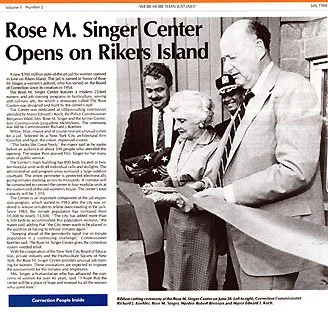
News about the Rose M. Singer Center Opening on Rikers (NYC Department of Correction.)
The cycle of prison reform and its inevitable failure runs throughout New York City's carceral history. Rikers Island was built to replace the infamous Welfare Island. Over a century ago, prison reformers criticized and unveiled the violent, unsanitary facilities of Welfare Island which housed the city jail, mental health facilities, and what officials deemed “the city’s destitute” (Shanahan, 2017). In 1927, the State Commission of Correction released a report denouncing the penitentiary for its ‘deplorable’ conditions. The report stated “the cells are small, poorly ventilated, and without modern sanitary conveniences” (Shanahan, 2017). The same issues persisted, millions of dollars later, after relocating to a new island. Rikers is closing and and plans are for it to be replaced by a new Kew Gardens facility — which would be attached to a men's prison — at an estimated cost of $261 million. The Kew Gardens facility is what the Women’s Center for Justice is attempting to replace (The Women's Center for Justice, p.4). The ignorant cycle continues – at the cost of human lives and tax dollars. Both plans, in Dr. Haley’s words, are a “radical shrinking of imagination and possibility.”
It is not just new jails that are taking on the gender-responsive mantle. Some existing jails have also begun implementing aspects of gender-responsive strategies: for instance, Los Angeles's largest women's jail recently initiated a gender-responsive staff training, implemented a pregnancy liaison program, and modified the physical environment to improve safety (Olson, 2019). Although gender responsiveness is a necessary stopgap, we must remember that this reform is not enough. No jail has successfully initiated a complete, comprehensive gender-responsive approach; instead, jails select a few, simple elements tobeguilingly demonstrate their dedication to the spiritual and physical rehabilitation of their women inmates. Although the Los Angeles jail was advertised as a pioneer jail for adopting these gender-responsive measures, it was marked by ample negligence that threatened women’s safety: lack of private spaces for women, lack of information about their individual needs, lack of permanent funding for the gender-responsive approaches, etc. (p. 440). In addition, the modifications were legally required: the jail was mandated to address these failures and provide access to renewal programs under Title 15 of the California Code of Regulations – but still failed (p. 441).
Although a gender-responsive jail might appear as a symbol of progress and betterment for women inmates, this reformist approach inevitably upholds and expands the carceral system and its profits by rendering prisons more palatable, all the while, worsening conditions in impacted communities. Once incarcerated, women’s lives are fundamentally disrupted. They lose their jobs, are unable to take care of their children and family members, and suffer mental health crises due to violent conditions. Incarceration itself is a root cause of unemployability and lack of parental care – rendering any prison job training and/or family care program futile. By stripping women from their employment and families, prisons are diminishing any chance of economic growth and family care for renewal.
Dr. Haley remarked during the discussion, “the history of prison is entangled with the history of reform; the history of penitentiary as one of ‘betterment’ and ‘enlightenment’ … we have seen the proof that prisons are violent – and no amount of mauve paint changes that.” Violent conditions are forced upon non-violent women: the majority of incarcerated women have extremely short stays for low-level, non-violent crimes. In 2022, the national average stay for women was 19 days, with about 93,000 women in jail on a given day, compared to 36 days for men (Kenney, 2022). The average jail stay for women within L.A. county jails is just under 2 months (Hare, 2016). In New York City, the mean jail stay was 26 days in 2019, while the median length of stay is 4 days (Tomasack, 2021). According to the latest available national data, 32% of women in jail are incarcerated for property offenses, 29% for drug offenses, and 21% for public order offenses (Swavola, 2016, p. 9). Thus, women endure profoundly traumatic conditions for non-violent crimes If the city’s objective was to uplift women and maintain their employability, they would implement proactive strategies that prevent abounding women from entering the carceral system in the first place.
As we look to the future, abolitionists have shown us that radical imagination and action for the future is possible. Haley, Herzing, and Ralston’s work exemplify the myriad of creative pathways for an abolitionist future. Dr. Haley has been involved in the fight against the Women’s Center for Justice in Harlem, where community organizing has already shifted the terrain of what's possible. A coalition of Harlem residents, Barnard and Columbia students, and academics successfully campaigned to replace the jail with a plan for low-income housing. Their fight exists on the principle of building communities instead of cages. Yet, the fight continues. The city has since shifted toward a cooperative housing model that would serve middle-income residents, not the low-income New Yorkers the community fought for. Organizations like Defend Harlem remain mobilized, pushing to ensure the city honors its commitment to affordable housing. This fight illustrates a crucial abolitionist lesson: dismantling the carceral state requires the fight against building prisons, and also vigilantly ensuring that what replaces prisons serves those most harmed by incarceration.
Herzing's coalition, Building Community, Not Prisons, is fighting to stop two prisons from being built through imaginative strategies. The coalition is challenging the proposed Letcher prison in Kentucky on environmental grounds. The coalition partnered with the Appalachian Rekindling Project, a women-led Indigenous organization, and raised funds to purchase land on the proposed prison site with the goal of re-matriating it to Indigenous stewardship. Herzing’s work exemplifies self-determination in practice, by uplifting marginalized communities to reclaim land and resources from the carceral state and build their own futures.
As abolitionist feminists, we do not ask that these gender responsive reforms be ignored – we understand that the lived realities of women inmates is pressing and dangerous. These small changes can surely alter the day to day of an inmate. However, we will not allow these shallow reforms to be the end goal, and subsequently further the carceral state’s construction and proliferation. As Davis notes, “Discovering and in fact embracing this ambiguous terrain located in the space between necessary responses to immediate needs and collective and radical demands for structural and ultimately revolutionary change is a hallmark of abolition feminism” (p.2). The work is ongoing, and the future remains contested — but another world is imaginable and is actively being constructed.
Citations
Eagle, S. (2020, April 27). OPINION: No one belongs on Rikers Island. Ever. Queens Daily Eagle.https://queenseagle.com/all/opinion-no-one-belongs-on-rikers-island-ever
Hamilton, C. (2019). 2 women sue city over alleged sexual abuse at Rikers—POLITICO.https://www.politico.com/states/new-york/city-hall/story/2015/05/2-women-sue-city-over-alleged-sexual-abuse-at-rikers-022279
Kenney, J. L., & Dolliver, M. J. (2022). Time to Bail out: Examining Gender Differences in the Length of Pretrial Detention Using Survival Analysis. The Justice System Journal, 43(2), 203–217.
Law, V., & Nalebuff, R. (2023, March 29). Prisons Use Menstruation as a Form of Punishment. TIME.https://time.com/6265653/prison-menstruation-punishment/
Norton, J. S., Jack. (2017, December 6). A Jail to End All Jails. Urban Omnibus.http://urbanomnibus.net/2017/12/jail-end-jails/
NYC Department of Correction. (1988). 1988: Rose M. Singer & Her Rikers Jail.https://www.correctionhistory.org/html/searches/cnwsrosie.html
Rose, B. H., Lisa. (2016, September 22). Pop. 17,049: Welcome to America’s largest jail. CNN.https://www.cnn.com/2016/09/22/us/lisa-ling-this-is-life-la-county-jail-by-the-numbers
Singer, S. (2020, May 12). Opinion | The Women’s Jail at Rikers Island Is Named for My Grandmother. She Would Not Be Proud. The New York Times.https://www.nytimes.com/2020/05/12/opinion/womens-jail-rikers-island-covid.html
Swavola, E., Riley, K., & Subramanian, R. (2016). Overlooked: Women and Jails in an Era of Reform. Vera Institute of Justice.chrome-extension://efaidnbmnnnibpcajpcglclefindmkaj/https://vera-institute.files.svdcdn.com/production/downloads/publications/overlooked-women-and-jails-report-updated.pdf?dm=1568746265
The Women’s Center for Justice. (2022). The Women’s Center for Justice: A Nation-Leading Approach on Women & Gender-Expansive People in Jail. Columbia Justice Lab.https://justicelab.columbia.edu/sites/default/files/content/Womens%20Center%20for%20Justice%20Report%205.18.2022.pdf
Tomasack, S., Scrivener, L., Bond, E., & Chauhan, P. (2021). Women in New York City Jails, 1995-2019. Data Collaborative for Justice.chrome-extension://efaidnbmnnnibpcajpcglclefindmkaj/https://datacollaborativeforjustice.org/wp-content/uploads/2021/07/2021_07_09_DOC_Women_Analysis_FINAL.pdf
Valdovinos Olson, M., & Amendola, K. L. (2021). Promoting Health, Safety, and Wellness in Los Angeles County Jails: A Process Evaluation of Gender Responsive Programing for Incarcerated Women. Women & Criminal Justice, 31(6), 422–444.https://doi.org/10.1080/08974454.2019.1700874
Harlem: Stories of Repression and Resistance Walk led by Asad Dandia
Thursday, October 9th 5:00 - 7:00pm
Please join us for a guided walk through Harlem to learn about the neighborhood’s role in the movement against systemic injustice, specifically, police violence.
Harlem: Stories of Repression and Resistance considers the history of repressive policing in the neighborhood and organizing in response. The walk will cover historical events from the 1930s to the present, visiting the sites of flashpoints such as: the 1935, 1943, 1957, and 1964 uprisings against and challenges to police brutality; the civil rights movement and the FBI’s Counterintelligence program (COINTELPRO) aimed at its suppression; Black Power bookstores that doubled as Black activism hubs in the 1960s and 1970s; Mayor Rudi Giuliani-era aggressive enforcement policies like stop-and-frisk, which were guided by the conservative Manhattan Institute’s ’broken windows theory’; and the surveillance of Muslims especially post- 9/11. As such, the walk will give a deeper appreciation of not just oppressive structures but also the role of this urban village in advancing a people’s self-determination and social solidarity. Afterwards, there will be an opportunity for attendees to speak informally with the guide and each other over Somali chai. Register here.
Harlem: Stories of Repression and Resistance is part of CSSD's yearlong program Countering the Carceral State, which explores interconnections between the crises of disciplinary enforcement central to American power at home and abroad. The walk is co-sponsored by the Columbia Oral History MA Program and co-presented as part of their Thursday Evening Event Series, which in 2025-2026 explores the relationships between place, memory, and oral history through a series of site-specific oral history events.
Asad Dandia is a Brooklyn-born public historian, lecturer, and tour guide. As an undergraduate, he founded a mutual aid organization to feed his community, which was infiltrated by an NYPD informant, pushing him to join an ACLU-led lawsuit challenging police surveillance of NYC's Muslim communities. The lawsuit resulted in successful policy change that brought civil rights protections for all New Yorkers. Currently, he operates New York Narratives, a walking tour project that advances new perspectives on the city by highlighting erased, underrepresented, and forgotten community stories. He also lectures at CUNY and is a tour guide at the Museum of the City of New York. He holds a master's degree in Islamic Studies from Columbia University.
Location Details:
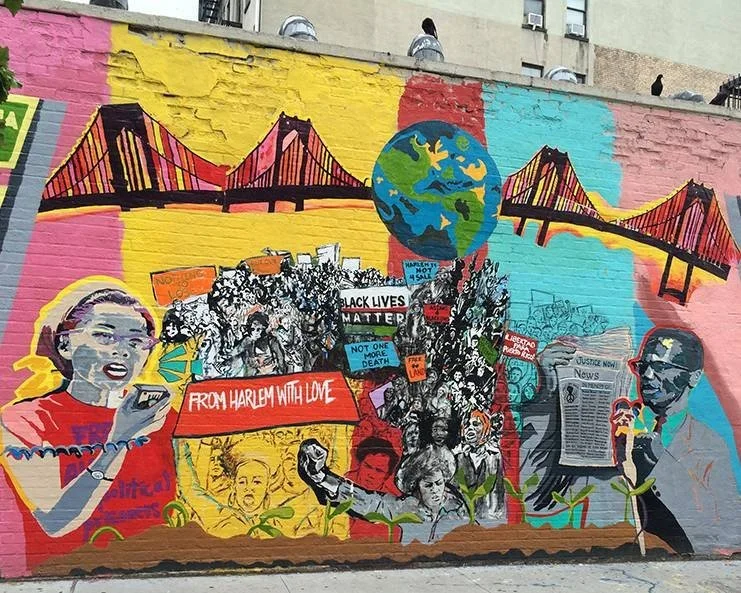
We will meet at the mural “From Harlem with Love: a Mural for Yuri and Malcolm” on West 125th Street & Old Broadway, New York, NY 10027
Directions: The 1 train to 125th street and walk over to the mural
Location Link: https://maps.app.goo.gl/otubSsMLaUnuamiC6?g_st=ipc.
In Defiance: Launch Party
An arts and culture celebration, inspired by the legacy of Malcolm X, was hosted by the Center for the Study of Social Difference at Columbia University at The Malcolm X & Dr. Betty Shabazz Memorial and Educational Center to kick off the yearlong program Countering the Carceral State.
Inspired by Malcolm X's internationalist insights and in line with CSSD's thematic focus in 2025-2026 on crisis, the program explored interconnections between the crises of disciplinary enforcement central to American power at home and abroad. Program events probed continuities between policing, racial profiling, and police militarization; the prison industrial complex; immigrant detention; forever wars in the Middle East and Central Asia; and the transformation of war zones like Gaza into technological testbeds.
Event Overview
The event began at 5:30 PM on Friday, September 12th with some pre-event tour and opening drinks. The drinks reception was accompanied by a guided tour of the historic Malcolm X & Dr. Betty Shabazz Memorial and Educational Center.
The tour was then followed by with framing remarks and a screening of a video essay, From the Ruins: A Prelude, by renowned scholar and curator Sohail Daulatzai (UC Irvine). From the Ruins: A Prelude is a reckoning with the histories of radical internationalism that Malcolm X demands and a portal into the tensions between the catastrophic and the quotidian, here and there, then and now.
The evening was capped off with an live concert featuring the acclaimed duo of Vijay Iyer and Wadada Leo Smith performing their album Defiant Life.
This event was co-sponsored by the Department of Music, and was in collaboration with the Institute for Research in African American Studies and the African American and African Diaspora Studies Department at Columbia University.
Two New Working Groups at CSSD Launching Fall 2025
Two new working groups, coming from a highly competitive selection process, will be launching at the Center for the Study of Social Difference (CSSD) in the 2025-2026 academic year. CSSD projects address gender, race, sexuality, and other forms of inequality to foster ethical and progressive social change.
Black Archipelago
Black Archipelago considers critically and recasts responsibly narratives about how the production of Black space is foundational to imaginative Black placemaking, self-actualization, and ways to catalogue future and existing spaces. The Black Archipelago also describes both Black people’s shared encounters with white supremacy as well as, more crucially, how Black people stay connected to each other, to place and to notions of blackness. Black Archipelago seeks to advance collaborations and, hopefully, methodologies grappling with the many threads of domination and insurgent innovation constituting historical patterns of the Black experience.
A Black archipelago is an answer to the question of how to think about enduring crises and enduring people in the Black World. This framework allows us to pay closer attention to how scholars, activists, and artists engage the poetics and materiality of Black life to explore ideas about repair, inequality, resistance, and liberation.
Project Directors:
Brandi T. Summers, Associate professor of African American and African Diaspora Studies, Columbia University
N. D. B. Connolly, Associate Professor of History, Johns Hopkins University
University and Crisis
Conceived in response to recent developments at Columbia University and Barnard College and in line with CSSD’s new thematic focus on crisis, the working group is engaged in a year-long series of reading meetings and public programs to explore the state of the university today and how we got here.
Rather than approaching the current crisis moment as an aberration, the group aims to contextualize it within longer histories of the university and its entanglement with wider socioeconomic and political structures. Focused on four conceptual figures and sites, “the archive,” “the experiment,” “the student,” and “the lexicon,” the group engages with critical university studies scholarship to think through universities’ entanglements with colonialism, slavery, and their afterlives; the role of the university in reproducing socio-economic inequalities; the precaritization of academic labor and its impact on academic freedom; the securitization of campuses; financialization, performance metrics, and branding for the neoliberal university; affirmative action, diversity, and the tokenization of difference/administrative co-opting of ethnic and gender studies; and universities as real estate developers with massive displacement effects.
This group is supported via CSSD’s partnership with the Barnard Center for Research on Women (BCRW), and the Edmund W. Gordon Institute for Advanced Study (Gordon Institute) at Teachers College.
Project Directors:
C. Riley Snorton, Professor of English and Comparative Literature and ISSG, Columbia University
Anupama Rao, Professor of History and MESAAS, Barnard College
This Enemy Institution: (Black) Study and the Insurrection Imperative
Thursday, September 18 · 5:30 - 7:30pm EDT
Please join us for a guided discussion with pre-circulated readings led by Dr. Dylan Rodriguez on counterinsurgency.
This Enemy Institution is a guided discussion that explores how deep intellectual study can initiate insurrection against counterinsurgency in the 21st century.
When the regimes of civil/human rights, liberal freedom, (social) justice, and “humanity” ostensibly “fail,” the archive of Civilizational warfare expands. This is happening in real-time: there is an acceleration of counterinsurgency projects, formed in a contentious scramble across state and extra-state venues, incorporating universities, humanitarian and philanthropic organizations, and capitalized social justice movements. The deadly inadequacies and alleged institutional betrayals of rights/freedom/justice/humanitarian (and related) regimes thus indicate neither political failure nor systemic dysfunction—appraisals that indicate a reformist imperative—but instead reveal the expansion of a 21st century Counterinsurgency Machine. Logics of neutralization, extermination, discipline, and empowerment shape this ensemble, which targets anti-Civilizational streams of liberationist activity and thriving. To analyze and confront this machine is to coordinate, study, and strategically theorize an insurrection imperative.
Register for the discussion here.
Readings for the guided discussion will be circulated by email to event registrants. Afterwards, please join us for cookies, snacks, and refreshments in the church garden.
This Enemy Institution is the first event in the Center for the Study of Social Difference’s yearlong program Countering the Carceral State, which explores interconnections between the crises of disciplinary enforcement central to American power at home and abroad.
Dylan Rodríguez is a parent, teacher, scholar, organizer and collaborator. He is employed as a Distinguished Professor at the University of California, Riverside where he has worked since 2001. Dylan was elected President of the American Studies Association in 2020-2021 and in 2020 was named to the inaugural class of Freedom Scholars. Since 2021, he has served as Co-Director of the Center for Ideas and Society, where he created the Decolonizing Humanism(?) programming stream. Since the late-1990s, Dylan has participated as a founding member of organizations like Critical Resistance, Abolition Collective, Critical Ethnic Studies Association, Cops Off Campus, Scholars for Social Justice, and the UCR Department of Black Study, among others. His most recent book is White Reconstruction: Domestic Warfare and the Logic of Racial Genocide (Fordham University Press, 2021), which won the 2022 Frantz Fanon Book Award from the Caribbean Philosophical Association.
Reading List (links will be provided via email):
Robert L. Allen, “Personal Reflections on the Road to Black Awakening in Capitalist America,” p. 118-122. (5 pages)
Dylan Rodríguez, Forced Passages, Chapter 1, “Domestic War Zones and the Extremities of Power: Conceptualizing the U.S. Prison Regime,” p. 39-74. (35 pages)
Dylan Rodríguez, “On University Abolition,” pp. 367-374. (8 pages)
United States Joint Chiefs of Staff, Joint Publication 3-24: Counterinsurgency (2018), “Executive Summary,” p. Ix-xxi. (12 pages)
The Heritage Foundation, Mandate for Leadership, 2025: The Conservative Promise, (a.k.a. “Project 2025”), 2023:
Kevin D. Roberts, “Foreword: A Promise to America,” p. 29-46;
“Section One: Taking the Reins of Government,” introduction, p. 47-49;
Lindsey M. Burke, “Ch. 11, Department of Education,” “Mission” and “Overview,” (25 pages)
Freedom and Insurgence: Recalling Fanon
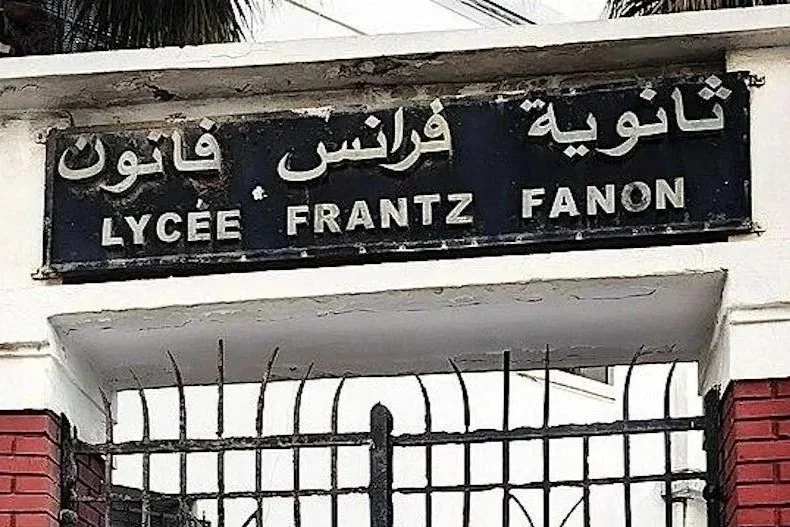
Dylan Rodríguez and Ezekiel Dixon-Román discuss insurgent educational and archival practices.
Organized on the occasion of the centennial of the decolonial thinker Frantz Fanon, Freedom and Insurgence brings together Dylan Rodríguez and Ezekiel Dixon-Román for a conversation about capacious and generative approaches to mass intellectuality. The speakers approach the global legacies of Fanon’s thought on ‘archives of the possible,’ which illuminate approaches to the problem of democratic education and the crisis of the university in our times.
Wednesday, September 17 · 5:30 - 7:30pm EDT
The event features:
A talk by Dylan Rodríguez (Distinguished Professor in the Department of Media and Cultural Studies and the Department of Black Study at UC Riverside and winner of the 2022 Frantz Fanon Award for Outstanding Book in Caribbean Thought).
A response by Ezekiel Dixon-Román (Professor of Critical Race, Media, and Educational Studies at Teachers College, Columbia University).
A Q&A with the audience.
Freedom and Insurgence launches a new faculty working group on the university and/in crisis directed by C. Riley Snorton (Columbia) and Anupama Rao (Barnard), and spearheaded by the Center for the Study of Social Difference, the Barnard Center for Research on Women, and the Edmund Gordon Institute for Advanced Study. Focused on four conceptual figures and sites, “the archive,” “the experiment,” “the student,” and “the lexicon,” the group engages with critical university studies scholarship to think through education’s entanglements with wider inequitable structures and forces.
This event is free and open to the public. Registration is required.
Center for Science and Society: Call for Applications: Co-Production of Knowledge Grants
Call for Applications: Co-Production of Knowledge Grants
Due October 27
How can the power and resources in research be redistributed from academia to local communities? Funds will support research projects led by community-based nonprofit organizations with support from a Columbia University student, faculty, or staff member. Awards of up to $10,000 are available.
An informational webinar will be held June 25 from 12-1pm et. Registration is required.
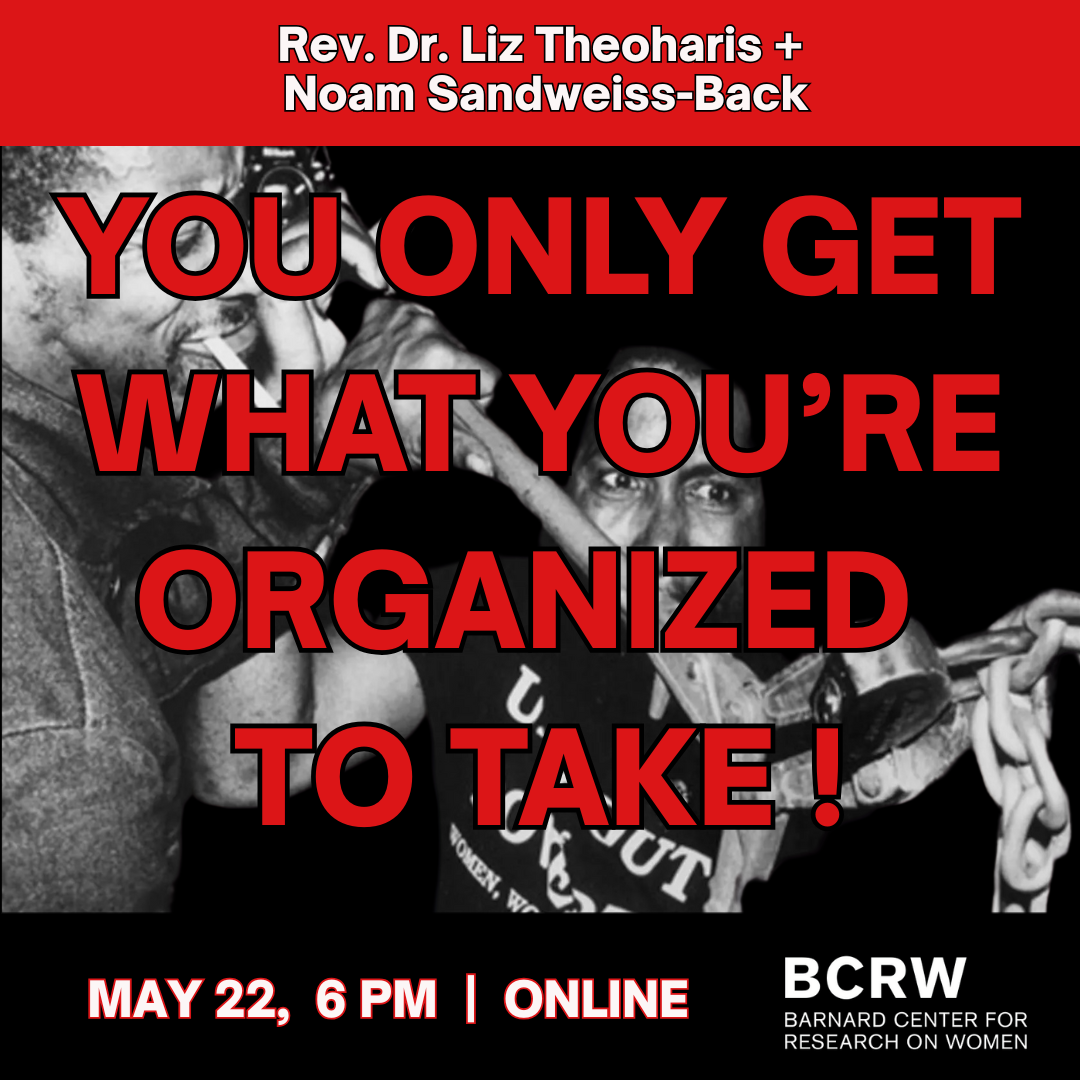
Upcoming Barnard Center for Research on Women (BCRW) Event: You Only Get What You’re Organized to Take
You Only Get What You’re Organized to Take
May 22, 2025
6-7:30pm
Online
Event Description
As one of the nation’s leading anti-poverty organizers and moral voices, Rev. Dr. Liz Theoharis explores the largely untold history of poor people’s movements in the United States and traces her own journey through some of the most significant anti-poverty struggles of the past thirty years. In You Only Get What You’re Organized to Take: Lessons from the Movement to End Poverty (Beacon Press, 2025), Theoharis and co-author Noam Sandweiss-Back give credit to the people leading the movement to end poverty, including multiracial groups of homeless people, mothers on welfare, farmworkers, coal miners, veterans, unemployed workers, students, and artists.
Drawing from personal experience, history, religion, political strategy, and more, Theoharis and Sandweiss-Back argue that American poverty will not end because of the goodwill of the powerful or through the charitable actions of well-meaning people alone. It will happen through a mass movement to end poverty, open to all, and led by the poor.
The book is a passionate reminder that poor people are not condemned to be subjects of history, but have always been agents of transformative change, and can be once again. Indeed, to reorient our society around the needs of everyone and reinvigorate the promise of democracy, the poor can and must become the architects of a new America.
Debashree Mukherjee Awarded 2025 ACLS Fellowship
Awards Recognize Excellence in Humanities and Social Sciences Research
We are proud to announce that Debashree Mukherjee has been awarded a 2025 ACLS Fellowship from the American Council of Learned Societies (ACLS). The longest running program at the organization, ACLS Fellowships support outstanding scholarship in the humanities and social sciences.
After four years of restricting ACLS Fellowships to early-career scholars due to the impact of COVID-19, the 2024 competition was re-opened to scholars across all career stages. Professor Mukherjee has been recognized as one of 62 outstanding scholars from a pool of over 2,300 applicants through a multi-stage peer review process.
Mukherjee’s research project, Tropical Machines, explores nineteenth-century media experiments in penal colonies and sugar islands such as the Andamans, Mauritius, and Fiji, to argue that the machines that are considered emblematic of Western modernity were in fact forged in the “dark” tropics.
“ACLS is grateful that we are in a position to continue to fund this vital research that advances our understanding of human societies and cultures,” said ACLS Vice President James Shulman. “Representing many different fields of study—including African diaspora studies, art history, English, gender studies, musicology, philosophy, religious studies, and more—this year’s fellows demonstrate the importance of foundational humanistic inquiry in helping us to understand a wide range of questions concerning our collective and varied histories, narratives, creations, and beliefs.”
The ACLS Fellowship Program is funded primarily by the ACLS endowment, which has benefited from the generous support of esteemed funders, institutional members, and individual donors since our founding in 1919.
Upcoming Event with the Barnard Center for Research on Women (BCRW): Missionary Women and the Imperial Roots of White Evangelical Feminism
Missionary Women and the Imperial Roots of White Evangelical Feminism
Gale Kenny, author of Christian Imperial Feminism: White Protestant Women and the Consecration of Empire
April 22, 2025
Lunchtime Lecture
12-1pm, BCRW Conference Room (Milstein 614)
Amidst the global instability of the early twentieth century, white Christian American women embraced the idea of an “empire of Christ” that was racially diverse, but which they believed they were uniquely qualified to manage. America’s burgeoning power, combined with women’s rising roles within the church, led to white Protestant women adopting a feminism rooted in religion and imperialism.
Gale L. Kenny examines this Christian imperial feminism from the women’s missionary movement to create a Christian world order. She shows that this Christian imperial feminism marked a break from an earlier Protestant world view that focused on moral and racial purity and in which interactions among races were inconceivable. This new approach actually prioritized issues like civil rights and racial integration, as well as the uplift of women, though the racially diverse world Christianity it aspired to was still to be rigidly hierarchically ordered, with white women retaining a privileged place as guardians. In exposing these dynamics, this book departs from recent scholarship on white evangelical nationalism to focus on the racial politics of white religious liberalism. Christian Imperial Feminism adds a necessary layer to our understanding of religion, gender, and empire.
Bio: Gale Kenny is an associate professor in the Religion Department at Barnard College. Her research and teaching focuses on gender, race, and American religion in the nineteenth and twentieth centuries. She is the author of two books, Contentious Liberties: American Abolitionists in Post-Emancipation Jamaica (University of Georgia Press) and Christian Imperial Feminism: White Protestant Women and the Consecration of Empire (NYU Press). She is currently working on a new project about race and spirituality through a history of Theosophist Katherine Tingley and her early twentieth-century Southern California commune, Lomaland.
Open to BC/CU ID holders, BCRW’s lunchtime lecture series offers scholars and writers an intimate space to discuss new works and works in progress with colleagues and students. Lunch will be provided.
Afro-Nordic Feminisms Working Group goes to University of Iceland
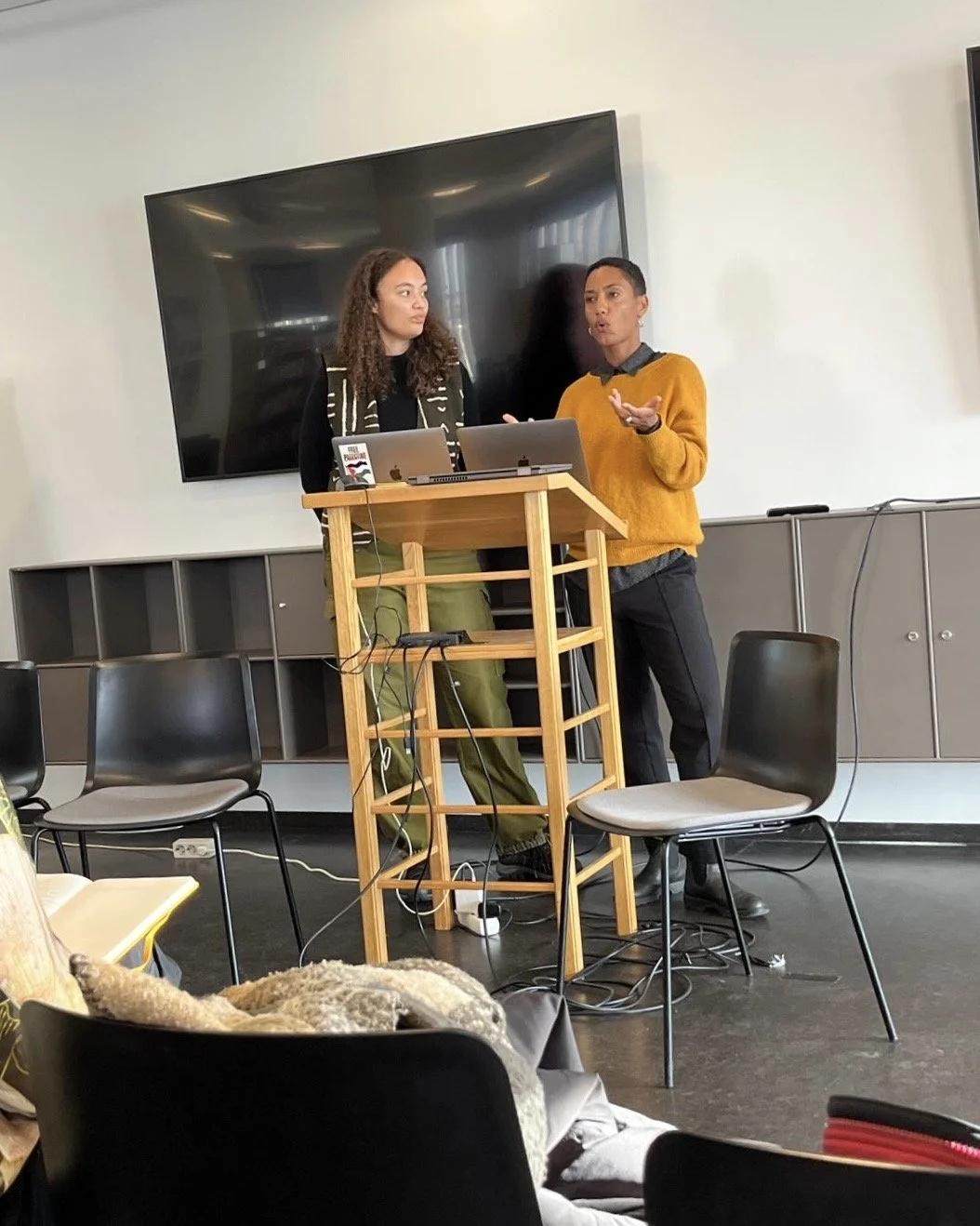
Several members of the Afro-Nordic Feminisms working group presented their research at the "Pedagogies of Reckoning" seminar at the University of Iceland. Oda-Kange Diallo and Elizabeth Lowe Hunter discussed "Pedagogies of Togetherness: Black Study and Diasporic Consciousness in the Nordic Region." Benjamin Mier-Cruz presented "Diffracting the Colonial Lens: Teaching Nordic Cinema in the United States." Ellen Nyman shared her work on "Adopting Acting Techniques," and Faith Adiele spoke on "Arrival of the Afro-Vikings: The Challenge of Decolonizing Travel Writing." The three-day seminar focused on pedagogy and colonialism in the Nordic region.
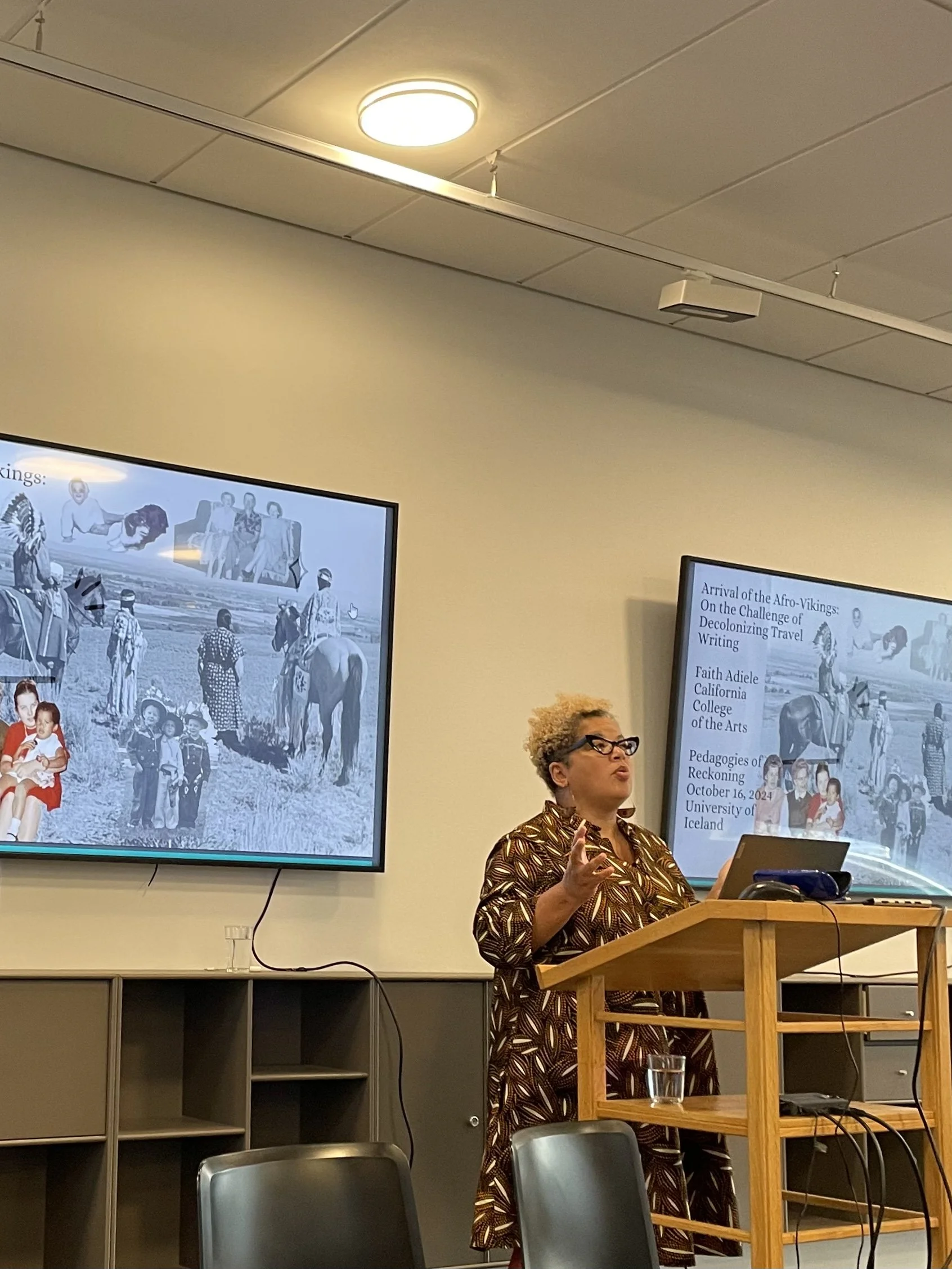
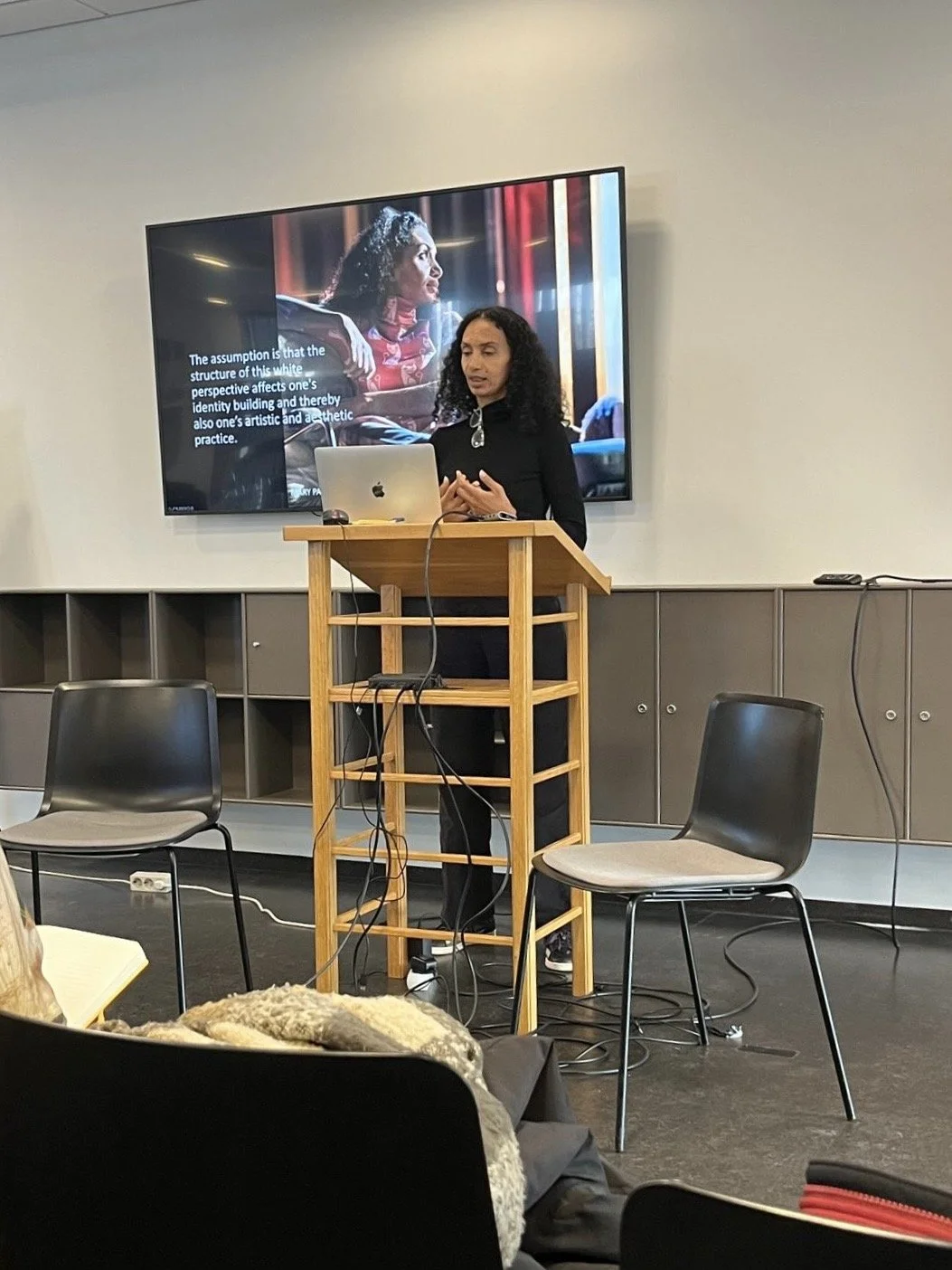
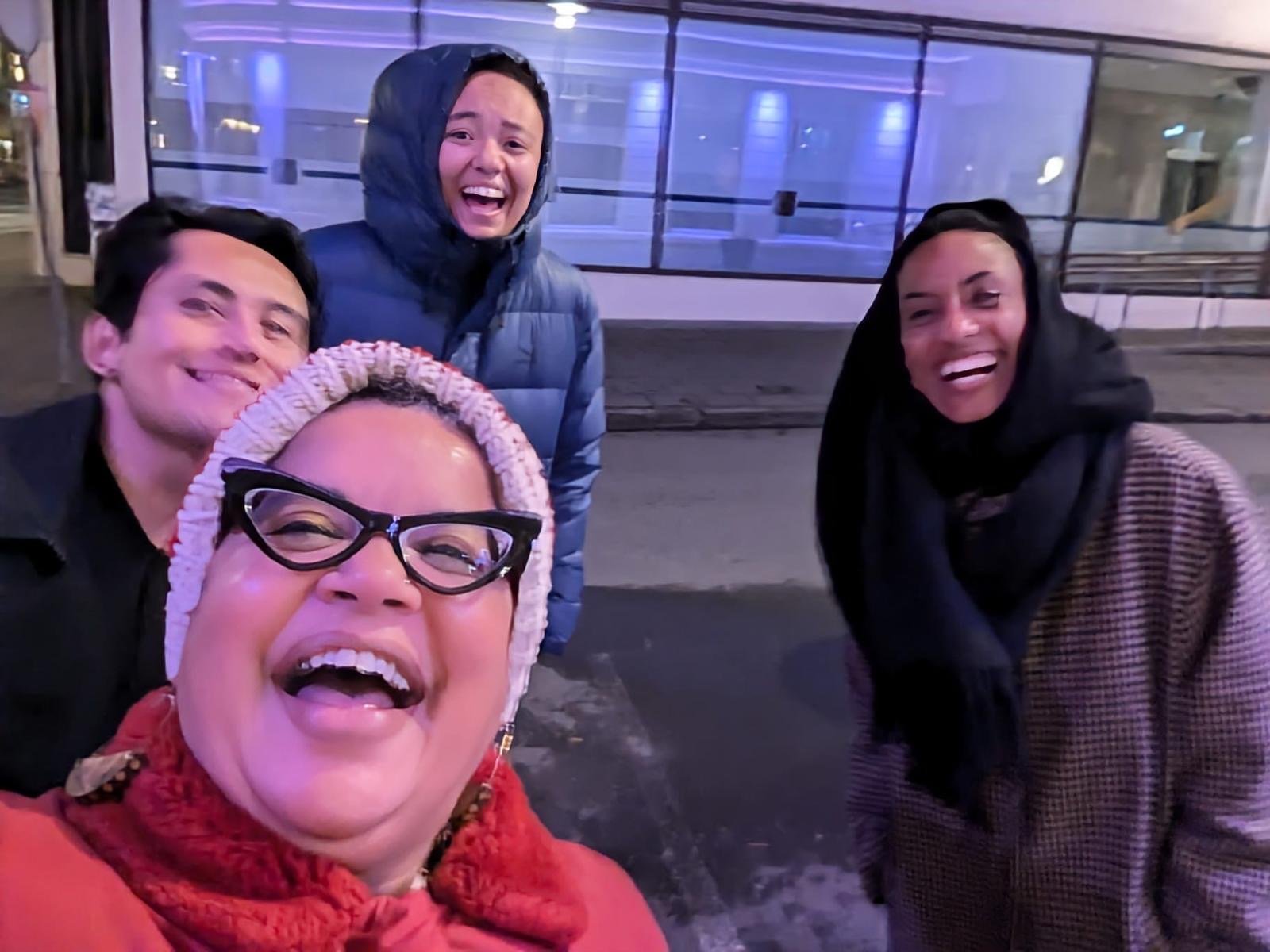
Truelove Seeds Tour: Seeds of Diaspora
On October 18th, the Seeds of Diaspora working group visited Truelove seeds, a seed farm and consolidator of heirloom seeds in Glen Mills, PA. Owen Taylor, pictured at center, described their efforts to package and distribute diaspora seeds provided by culturally diverse community gardens across the US. Unlike other commercial seed catalogues, Truelove focuses on helping these groups to sustain the cultural practices and food traditions that exist in mutuality with the seeds they preserve. In gorgeous fall weather, we toured Truelove's heritage gardens of plants from Palestine, Mexico, and Southern Africa, amongst other places, which are being propagated and harvested in direct collaboration with the diasporic communities that maintain long standing relationships with them. While there, we also met seed farmers, seed-savers and permaculture practitioners visiting from New York and New Jersey, and were able to lend a hand with processing Mexican marigolds for Day of the Dead festivities (see picture below). We are planning collaborations with Truelove seeds into the future, including organizing a public symposium/workshop on seed-saving at Columbia in the spring.

Working group members at Truelove Seeds Farm, Glen Mills, PA.

Columbia Giving Day is Here on October 1,2024! Save The Date.
Columbia Giving Day x CSSD , October 1, 2024

The Center for the Study of Social Difference creates space for faculty to address emerging issues and cultivate partnerships across the Columbia University campus, within the United States, and overseas. Our faculty members are deeply committed to advancing the boundaries of knowledge and fostering creation in their respective fields.
We could not do this work without your help. Support CSSD this Columbia Giving Day on
October 1, 2024

Transnational Black Feminisms Working Group' 23-24.
The Recent Work of Dr. Nancy Reame from the Motherhood and Technology Working Group
* Upson K. Hall MS, Shearston J, Schilling K, Yan B, Reame N, Talge N, Schertzing C, Kioumourtzoglou MA. Tampon use as a source of toxic metal exposure: Results from NHANES 2001-2004. 36th Annual Meeting of the Society for Pediatric and Perinatal Epidemiologic Research, Portland Ore, June 12-13, 2023.
* Gordián-Arroyo A, Reame N, Gutierrez J, Liu J, Ganzhorn S, Igwe KC, Laing K, Schnall R. Do correlates of white matter features differ between older men and women living with human immunodeficiency virus? Menopause. 2023 Feb 1;30(2):149-155.
CSSD Welcomes Professor Shana Redmond as our New Faculty Director
CSSD is thrilled to welcome Professor Shana L. Redmond as our new Faculty Director. Professor Redmond (she|her) is Professor of English and Comparative Literature and holds a joint position at the Center for the Study of Ethnicity & Race (CSER), one of CSSD’s five partners. A writer and interdisciplinary scholar of race, culture, and power, she is the author of Anthem: Social Movements and the Sound of Solidarity in the African Diaspora (NYU Press, 2014) and Everything Man: The Form and Function of Paul Robeson (Duke UP, 2020), which received a 2021 American Book Award from the Before Columbus Foundation with the special citation of the Walter & Lillian Lowenfels Award for Criticism. Named a “Best Book of 2020” by National Public Radio (NPR), Everything Man received multiple awards including the Irving Lowens Book Award from the Society for American Music and the Judy Tsou Critical Race Studies Award from the American Musicological Society. In addition to being co-editor of and contributor to Critical Ethnic Studies: A Reader (Duke UP, 2016), she is co-editor of the University of California Press series “Phono: Black Music and the Global Imagination.” She has published chapters, articles, and essays in outlets including The Futures of Black Radicalism, Current Musicology, Black Camera, Black Music Research Journal, Race & Class, Women & Music, and Brick: A Literary Journal as well as NPR, the BBC, Boston Review, and Mother Jones. Her work with artists and labels includes the critical liner essay to the soundtrack vinyl release for Jordan Peele’s film Us (Waxwork Records, 2019) as well as the notes for String Quartets, Nos. 1-12 by Wadada Leo Smith (TUM Records, 2022) and Nina Simone’s You’ve Got to Learn (Verve, 2023).
Professor Redmond’s current project is a forensic listening to Black life before mourning, a book she has been researching and writing this past year as a 2023 Guggenheim Fellow. Shana Redmond brings not just her academic and artistic vision to CSSD but also extensive leadership experience, most notably in her three-year presidential term with the American Studies Association (2021-2024).
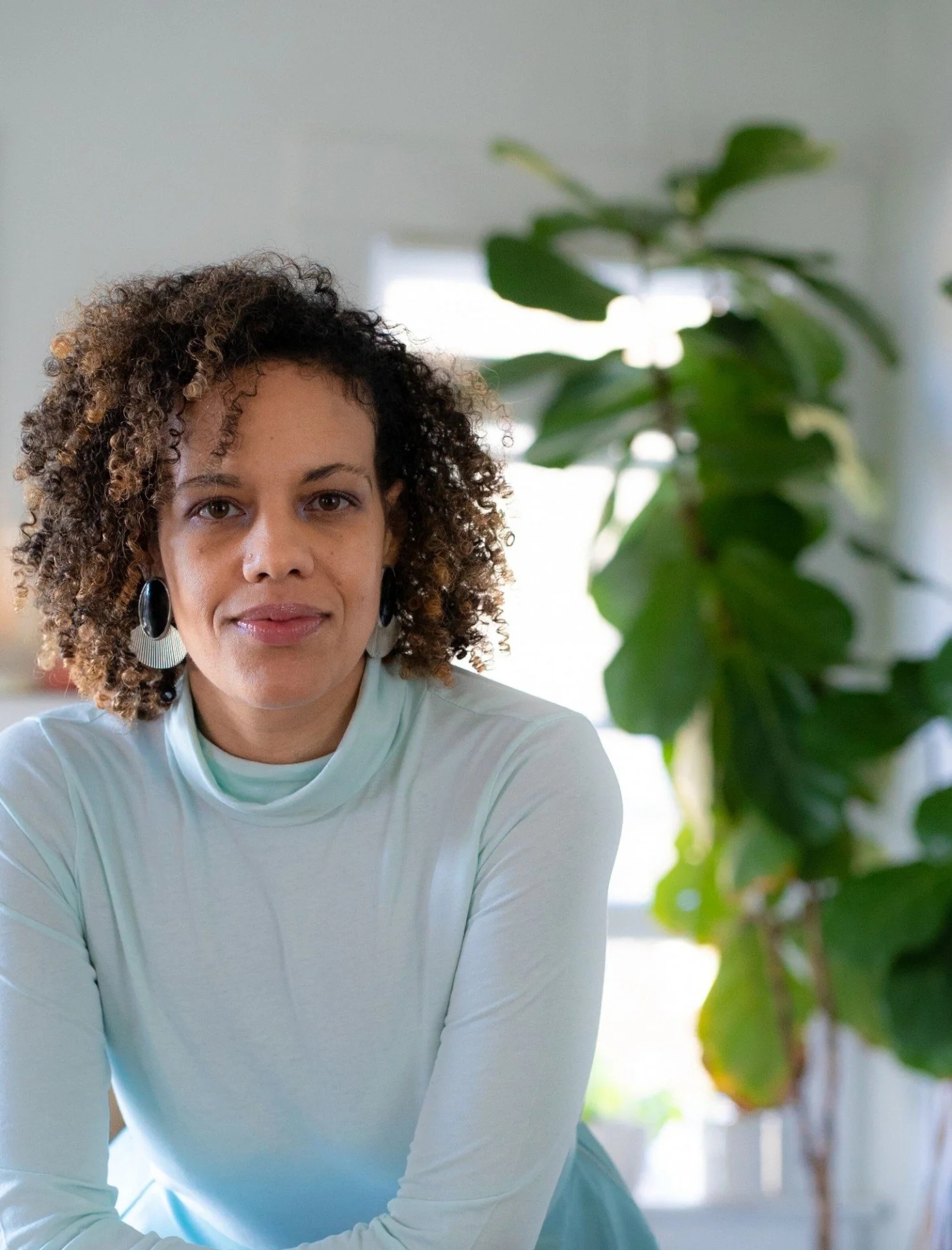
“I am deeply committed to collaborative study; I see its need and believe in its transformative potential. It is that focus on collaboration in thought within CSSD that drew me to this position and I look forward to the insights and knowledge that our working groups and programming will produce.”
- PROFESSOR SHANA L. REDMOND
Afro-Nordic Feminisms’ Successful Intervention at the Society for the Advancement of Scandinavian Studies Annual Meeting in Seattle
Members of the Afro-Nordic Feminisms Working group participated in a panel at the Society for the Advancement of Scandinavian Studies (SASS) Conference in Seattle, held this year May 9-12, 2024.
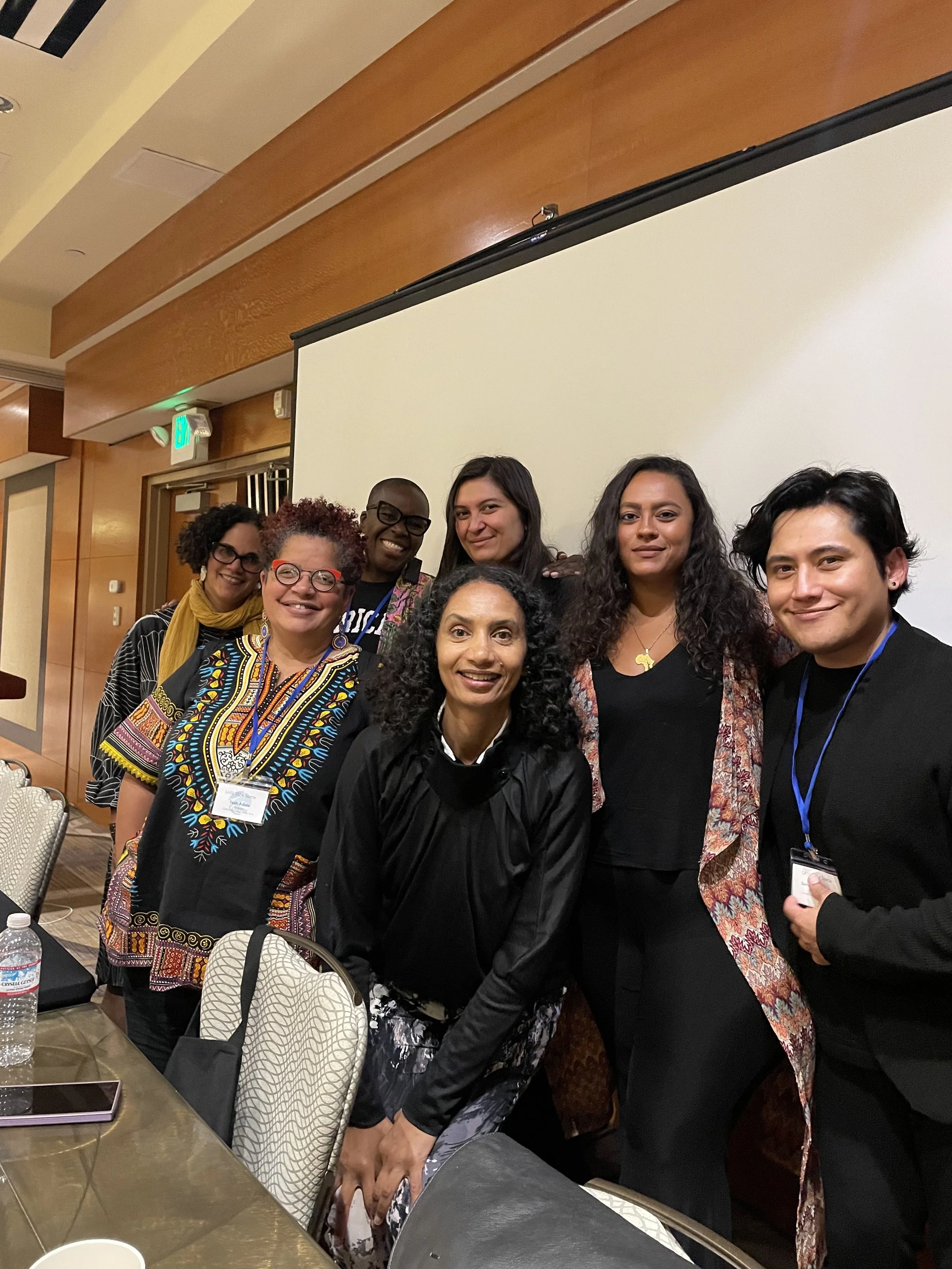
Seattle recently hosted the Society for the Advancement of Scandinavian Studies (SASS) annual meeting, where the Afro-Nordic Feminisms Working Group, with members from both the US and Scandinavia, gathered to engage in critical discussions on race, racialization, and Blackness in the Nordic countries. This meeting was notably supported by CSSD, for which Working Group members are deeply grateful.
The Working Group’s primary goal was to bring attention to issues often overlooked in these discursive spaces. This year's SASS coincided with the National Nordic Museum's exhibition "Nordic Utopia? African American Artists in the 20th Century." Our panel followed a discussion on the exhibition, sparking a meaningful conversation about the history and contemporary cultures of Blackness in the Nordics.
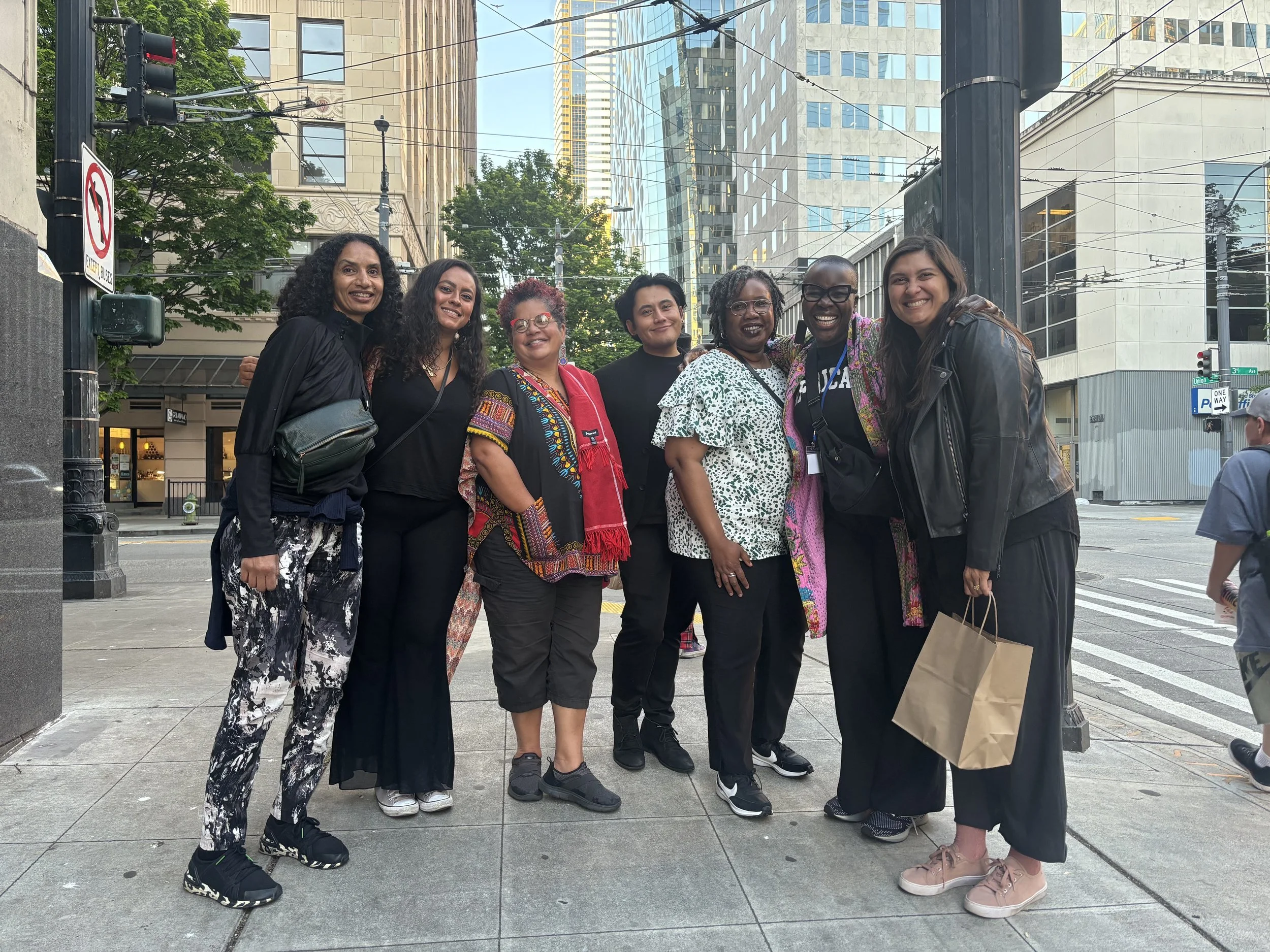
Additionally, the Afro-Nordic Feminisms had productive dialogues with indigenous scholars focusing on race and racialization in Greenland and Sápmi. These exchanges were invaluable in broadening the scope of the group’s discussions.
Looking ahead, a number of group members will attend a conference in Iceland in October, funded by the University of Iceland, to continue these very important conversations.
Overall, the meeting in Seattle was a significant success, advancing the collective understanding of members of the project and fostering deeper connections within the community.
Prepared by Monica Miller
Edited by Evan Berk
Members of the Afro-Nordic Feminisms WG Participate in Panel at the Society for the Advancement of Scandinavian Studies Conference in Seattle (May 9-12, 2024)
Members of the Afro-Nordic Feminisms Working group participated in a panel at the Society for the Advancement of Scandinavian Studies Conference in Seattle, held this year May 9-12, 2024.
The Working Group’s primary goal was to bring attention to issues often overlooked in these spaces. This year's SASS coincided with the National Nordic Museum's exhibition "Nordic Utopia? African American Artists in the 20th Century." Our panel followed a discussion on the exhibition, sparking a meaningful conversation about the history and contemporary cultures of Blackness in the Nordics.
Additionally, we had productive dialogues with indigenous scholars focusing on race and racialization in Greenland and Sápmi. These exchanges were invaluable in broadening the scope of our discussions.
Click Here to read the full blog post!
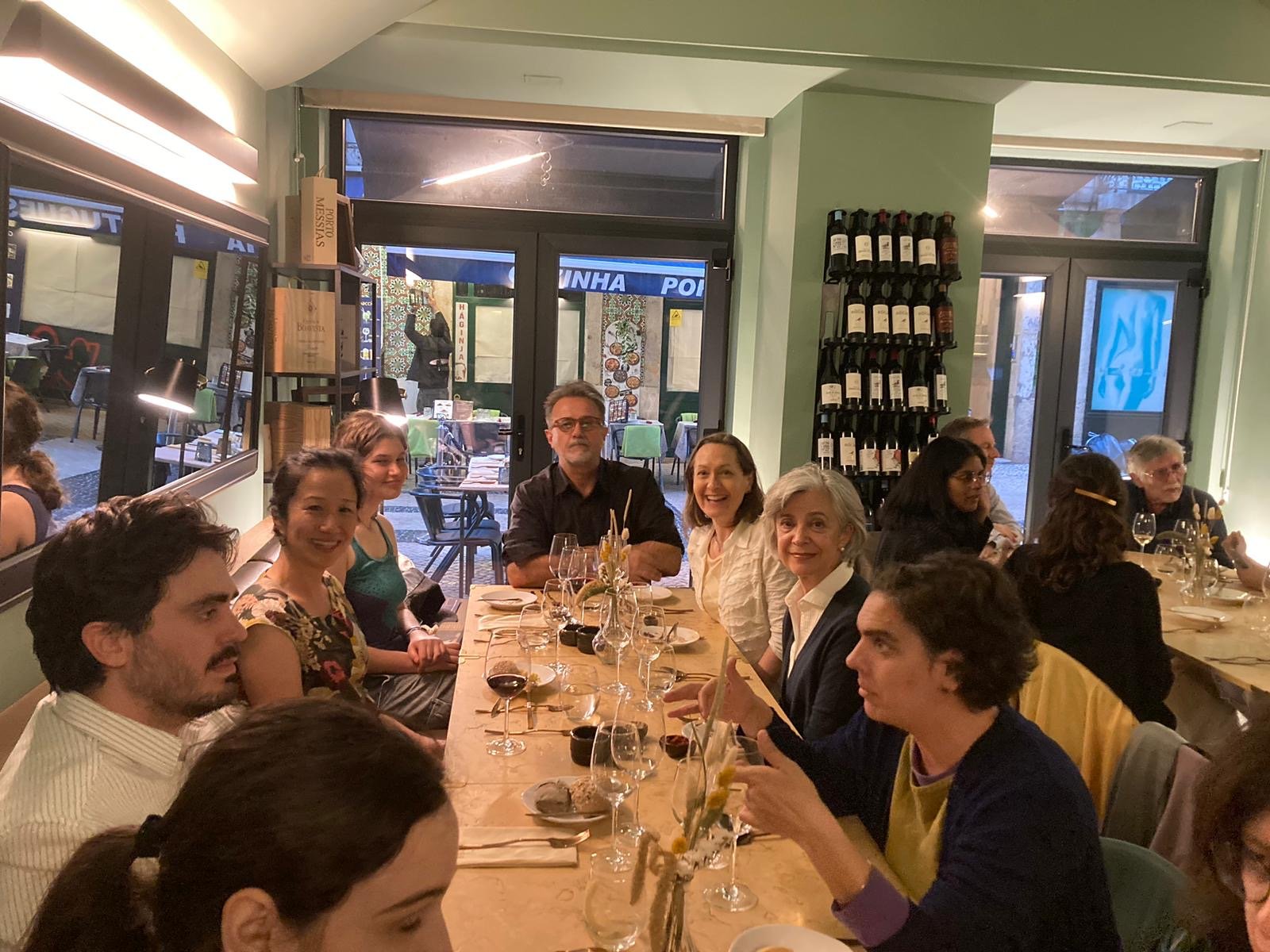
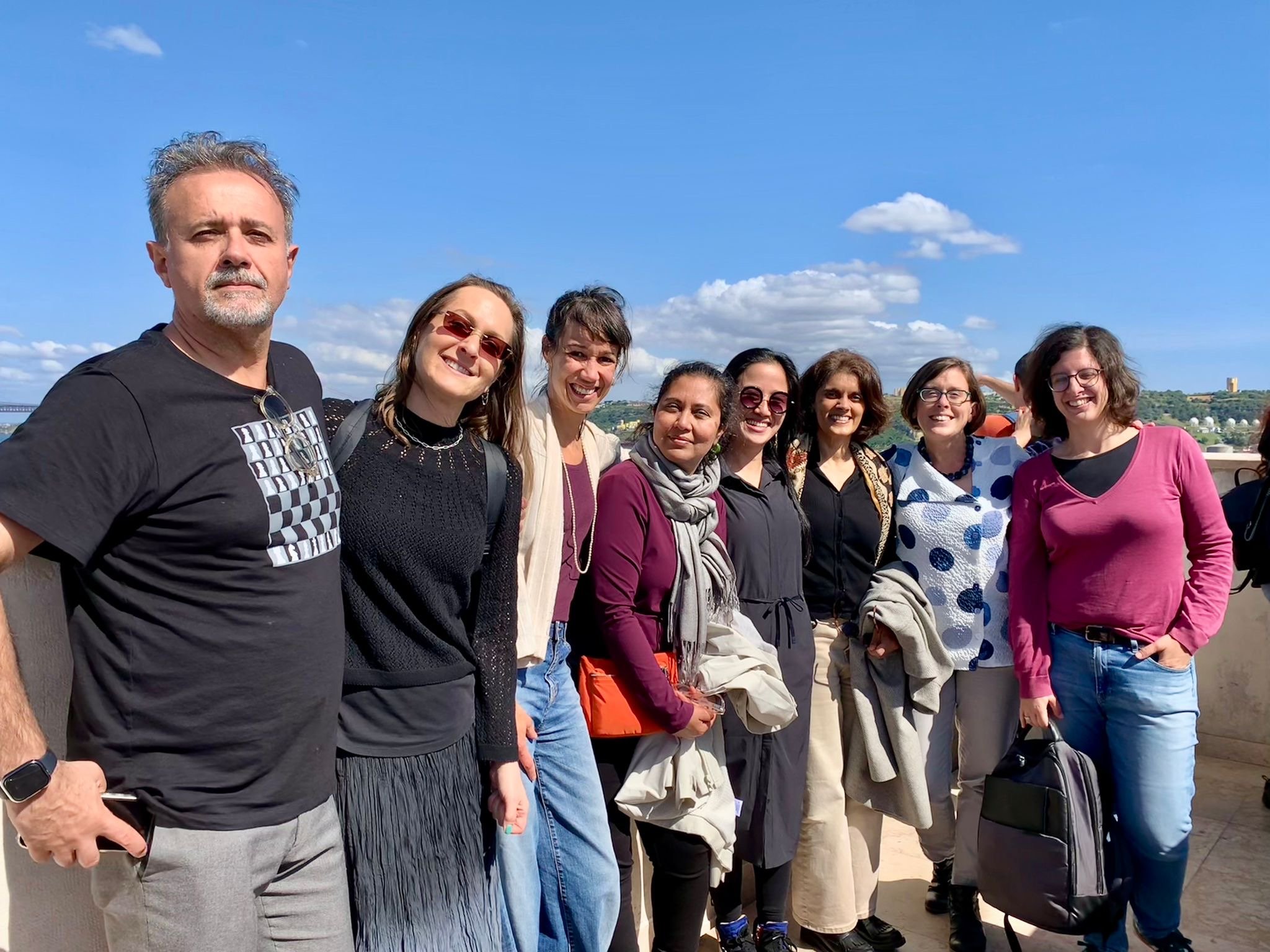
Geographies of Injustice WG Organized and Participated in "Iberian Seascapes" Conference at the University of Lisbon: (May 23-4, 2024)
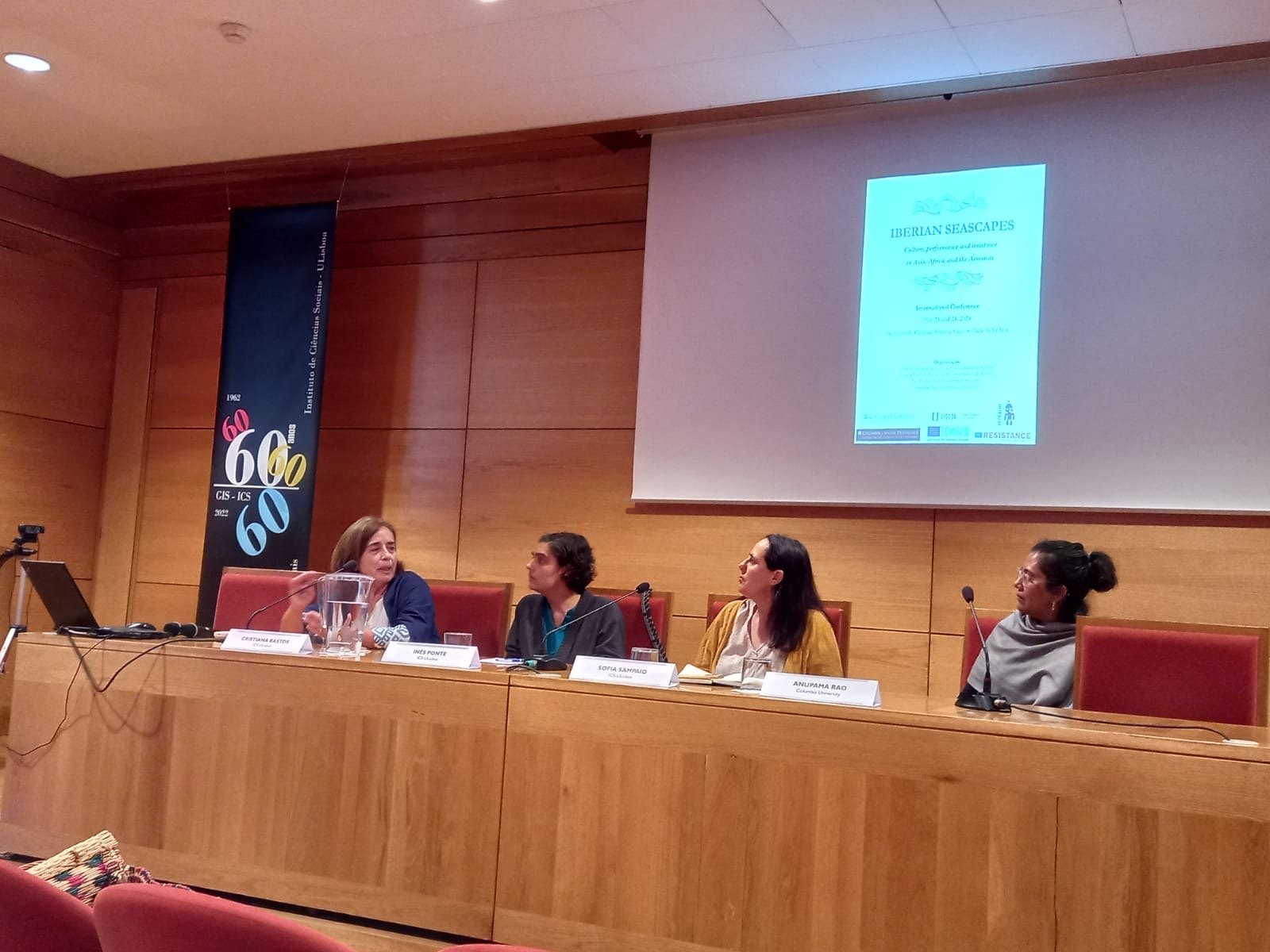
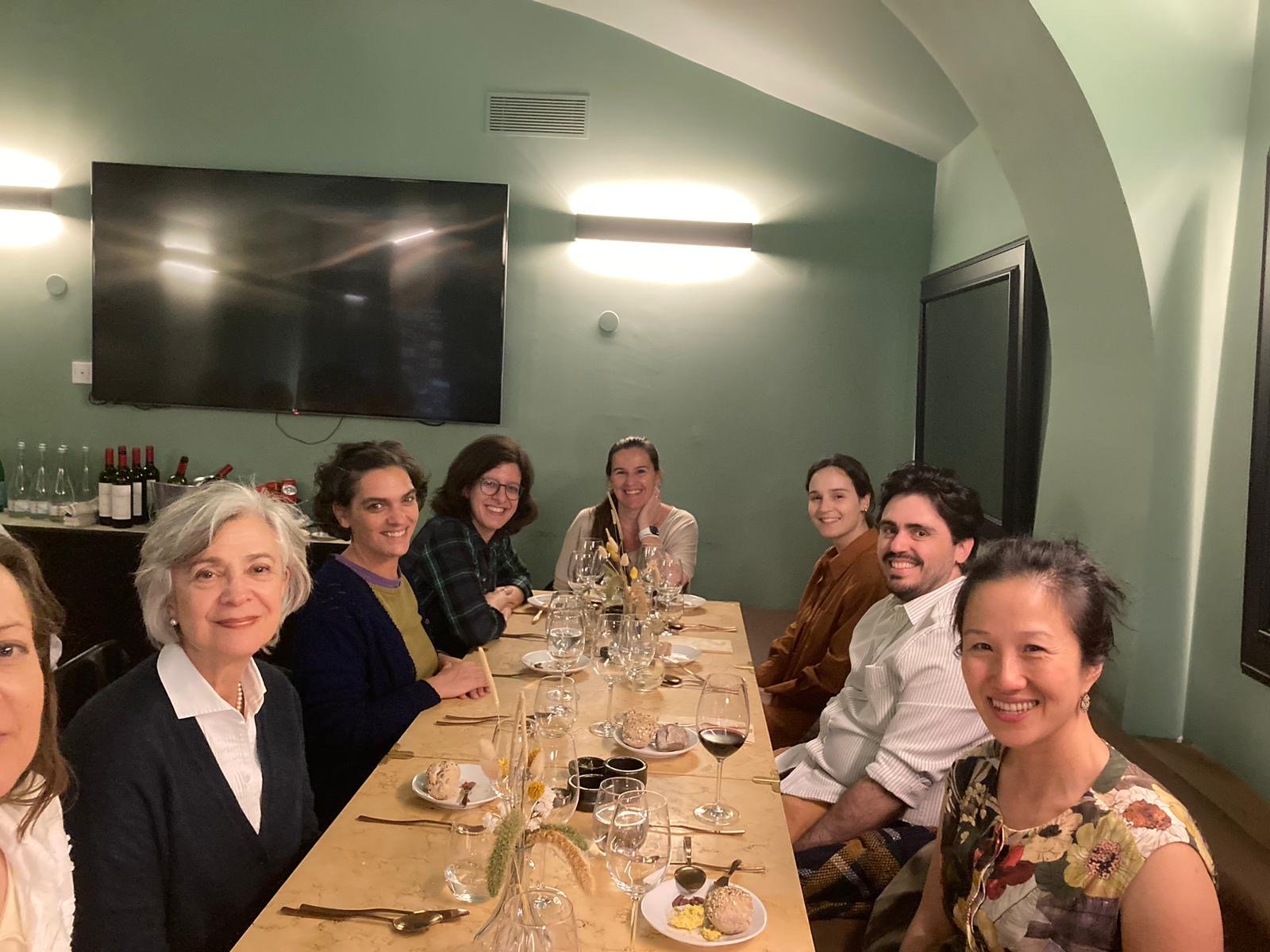
The Geographies of Injustice Working Group organized and participated in a two-day conference at the University of Lisbon (Portugal), titled “Iberian Seascapes: Culture, Performance, and Resistance in Asia, Africa, and the Americas” on May 23-4, 2024. This conference follows the tremendously successful “Iberian Soundscapes” Conference also organized by the working group in the fall of 2023.
Scholars from India, Portugal, Brazil, and the United States gathered for a two day conference to discuss themes of race, caste, law, sound, and cinema as it pertains to the "Luso-Hispanic Moment".

READ NOW! Ana Paulina Lee Interviewed for NYT Article on Music Exposing Religious Intolerance in Brazil
Brazil's Anitta faces backlash over her new music video, placing a spotlight on Brazil's religious intolerance and racism issues.
Geographies of Injustice Working Group co-director Ana Paulina Lee is interviewed by the New York Times on the situation in Brazil. Read the full article here.