
In Defiance: Launch Party
An arts and culture celebration, inspired by the legacy of Malcolm X, was hosted by the Center for the Study of Social Difference at Columbia University at The Malcolm X & Dr. Betty Shabazz Memorial and Educational Center to kick off the yearlong program Countering the Carceral State.
Inspired by Malcolm X's internationalist insights and in line with CSSD's thematic focus in 2025-2026 on crisis, the program explored interconnections between the crises of disciplinary enforcement central to American power at home and abroad. Program events probed continuities between policing, racial profiling, and police militarization; the prison industrial complex; immigrant detention; forever wars in the Middle East and Central Asia; and the transformation of war zones like Gaza into technological testbeds.
Event Overview
The event began at 5:30 PM on Friday, September 12th with some pre-event tour and opening drinks. The drinks reception was accompanied by a guided tour of the historic Malcolm X & Dr. Betty Shabazz Memorial and Educational Center.
The tour was then followed by with framing remarks and a screening of a video essay, From the Ruins: A Prelude, by renowned scholar and curator Sohail Daulatzai (UC Irvine). From the Ruins: A Prelude is a reckoning with the histories of radical internationalism that Malcolm X demands and a portal into the tensions between the catastrophic and the quotidian, here and there, then and now.
The evening was capped off with an live concert featuring the acclaimed duo of Vijay Iyer and Wadada Leo Smith performing their album Defiant Life.
This event was co-sponsored by the Department of Music, and was in collaboration with the Institute for Research in African American Studies and the African American and African Diaspora Studies Department at Columbia University.
This Enemy Institution: (Black) Study and the Insurrection Imperative
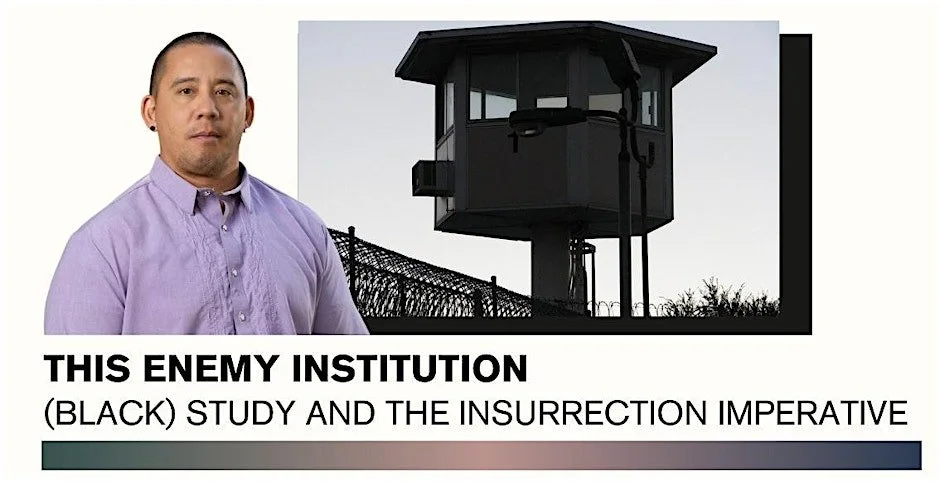
Thursday, September 18 · 5:30 - 7:30pm EDT
Please join us for a guided discussion with pre-circulated readings led by Dr. Dylan Rodriguez on counterinsurgency.
This Enemy Institution is a guided discussion that explores how deep intellectual study can initiate insurrection against counterinsurgency in the 21st century.
When the regimes of civil/human rights, liberal freedom, (social) justice, and “humanity” ostensibly “fail,” the archive of Civilizational warfare expands. This is happening in real-time: there is an acceleration of counterinsurgency projects, formed in a contentious scramble across state and extra-state venues, incorporating universities, humanitarian and philanthropic organizations, and capitalized social justice movements. The deadly inadequacies and alleged institutional betrayals of rights/freedom/justice/humanitarian (and related) regimes thus indicate neither political failure nor systemic dysfunction—appraisals that indicate a reformist imperative—but instead reveal the expansion of a 21st century Counterinsurgency Machine. Logics of neutralization, extermination, discipline, and empowerment shape this ensemble, which targets anti-Civilizational streams of liberationist activity and thriving. To analyze and confront this machine is to coordinate, study, and strategically theorize an insurrection imperative.
Register for the discussion here.
Readings for the guided discussion will be circulated by email to event registrants. Afterwards, please join us for cookies, snacks, and refreshments in the church garden.
This Enemy Institution is the first event in the Center for the Study of Social Difference’s yearlong program Countering the Carceral State, which explores interconnections between the crises of disciplinary enforcement central to American power at home and abroad.
Dylan Rodríguez is a parent, teacher, scholar, organizer and collaborator. He is employed as a Distinguished Professor at the University of California, Riverside where he has worked since 2001. Dylan was elected President of the American Studies Association in 2020-2021 and in 2020 was named to the inaugural class of Freedom Scholars. Since 2021, he has served as Co-Director of the Center for Ideas and Society, where he created the Decolonizing Humanism(?) programming stream. Since the late-1990s, Dylan has participated as a founding member of organizations like Critical Resistance, Abolition Collective, Critical Ethnic Studies Association, Cops Off Campus, Scholars for Social Justice, and the UCR Department of Black Study, among others. His most recent book is White Reconstruction: Domestic Warfare and the Logic of Racial Genocide (Fordham University Press, 2021), which won the 2022 Frantz Fanon Book Award from the Caribbean Philosophical Association.
Reading List (links will be provided via email):
Robert L. Allen, “Personal Reflections on the Road to Black Awakening in Capitalist America,” p. 118-122. (5 pages)
Dylan Rodríguez, Forced Passages, Chapter 1, “Domestic War Zones and the Extremities of Power: Conceptualizing the U.S. Prison Regime,” p. 39-74. (35 pages)
Dylan Rodríguez, “On University Abolition,” pp. 367-374. (8 pages)
United States Joint Chiefs of Staff, Joint Publication 3-24: Counterinsurgency (2018), “Executive Summary,” p. Ix-xxi. (12 pages)
The Heritage Foundation, Mandate for Leadership, 2025: The Conservative Promise, (a.k.a. “Project 2025”), 2023:
Kevin D. Roberts, “Foreword: A Promise to America,” p. 29-46;
“Section One: Taking the Reins of Government,” introduction, p. 47-49;
Lindsey M. Burke, “Ch. 11, Department of Education,” “Mission” and “Overview,” (25 pages)
Of Waves, Tides and (Feminist) Tsunamis: a Student Response to What We CAN Do When There’s Nothing To Be Done
The following was written in response to the tenth anniversary symposium of the Center for the Study of Social Difference (CSSD), held at The Forum at Columbia on September 28, 2018, by Mayte López, Graduate Teaching Fellow in the PhD Program in Latin American, Iberian, and Latino Cultures (LAILaC) at The Graduate Center, CUNY:
As I sit down to write this essay, Brett Kavanaugh has been confirmed as a Supreme Court Justice. The government of the United States, a country that welcomed me over six years ago and that I call my home, has granted Kavanaugh a lifetime appointment that allows him to rule and legislate over women’s bodies. Our bodies. A man who has been accused of sexual assault by multiple women, a man who has shown absolutely no respect for a woman’s body or will, a man-child whose only excuse for sexually assaulting a woman seems to be his incommensurate love of beer, now has the power to decide the future of legal abortion in this country and, possibly—most likely—overturn Roe vs. Wade. Lately, I’ve read multiple statements comparing Dr. Christine Blasey Ford’s testimony during the Ford-Kavanaugh hearing to that of Anita Hill. “I believe survivors. I believe Christine Blasey Ford. And I still believe Anita Hill” can be read all over my protective social media bubble, the carefully —albeit unintendedly—crafted echo chamber I’ve built for myself over years of likes, loves, and unfollows. What scares me the most about that last sentence is the fact that when it comes to Dr. Blasey Ford, it’s not a matter of belief or credibility. People—senators—believed her. Her testimony was not considered untrue. It was considered, and this is what makes my spine shiver, unimportant. What the Senate is telling this woman, and all women for that matter, is that their government doesn’t care. Politics trumps human decency, and Donald Trump trumps all of us. “A girl has no name, a woman has no government.”
In light of these events, the phrase “What we can do when there’s nothing to be done,” proposed by the Center for the Study of Social Difference at Columbia (CSSD) during their 10th Year Anniversary Conference, becomes even more meaningful. Can we do something? Is there really nothing to be done? I compose myself and recall Judith Butler’s intervention during the conference. Butler spoke about what it means to act in the midst of pessimism, and to keep that pessimism from becoming hopelessness. Radical transformation, she affirmed, starts incrementally and there is something to be said for momentum, for the continuing struggle of activism over time and with others.
So, what can we do? First, let me address—as was done during the opening remarks and throughout the conference—the problematic nature of that we. What does it mean, these days, to think about a collectivity? However problematic, and since I am especially concerned with women’s bodies today, and external decisions surrounding said bodies, I choose to embrace that we not only in that I am a woman, but in that I am that other marginalized and subjugated to the wishes (and “drinking games”) of white, rich, Ivy-league-educated men. I am also many other others, as Judith Butler’s invocation of #NiUnaMenos, the hashtag of the movement against gendered violence that has run through Latin America like a flame, reminds me. The movement was born in 2015 to protest feminicidio—the systematic killing of women— in Argentina, but the slogan actually has its origin in a poem by Mexican poet and activist Susana Chávez. The poem, written in 1995 in protest of Ciudad Juárez’s own appalling number of feminicidios, included the verse “Ni una muerta más” (Not one more [woman] dead). Chávez was a victim of feminicidio herself in 2011, and activists proposed the use of the slogan alluding to her poem to help fuel the movement.
As Butler stressed during her intervention in the conference, what’s most remarkable in these scenarios is that certain issues start to link with one another. Women, she said, are demanding the right to have abortions. Not the right to “choose,” as the time for euphemisms is now long gone. In Latin America, the debate around legal abortion is definitely making waves because of its narrative. The discussion now, stress the activists, is not whether women should abort, but whether abortion should be made safe and legal for all, as opposed to life-endangering and clandestine for the poor: women have always gotten abortions, but only some women can pay for the high costs of a covert and illegal surgery. It’s not only a women’s issue but a class issue. In Argentina, women—and men—understood this, and in August 2018 they protested and marched, took to the streets, and stood outside the Senate for hours, waiting for a vote to legalize abortion that was ultimately rejected. The protesters wore green handkerchiefs and clothing, which granted the movement the nickname “la marea verde” [The Green Tide]. After the vote was cast, la marea still stood outside the Senate, jumping up and down, repeating slogans, and dancing, only momentarily defeated: “It’s ok, we’ll win next year,” they said, while chanting “Se va a caer, se va a caer, el patriarcado se va a caer” [It’s going down, it’s going down, patriarchy is going down]. Indeed, unabashed by the results in Argentina, a few weeks later, on September 2018, another Green Tide took to the streets in Mexico —where I come from— to make very similar claims: Mexico’s own marea verde, wearing similar handkerchiefs, demands legal abortion nationwide —as it is legal in Mexico City—and for feminicidios to stop. The momentum Butler spoke of, with its multiple interlinked issues, is—it has to be—transnational and collective.
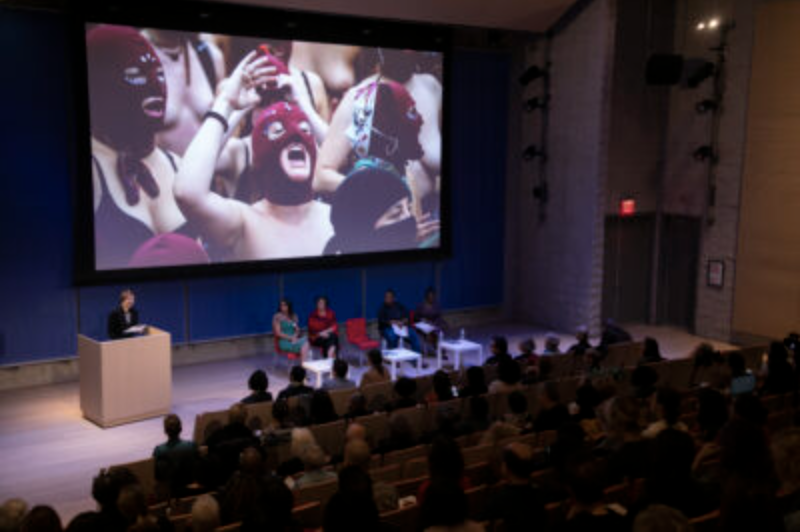
During the first panel of the CSSD Conference, Chilean performance artist and theater professor María José Contreras spoke of a “feminist tsunami,” and of the importance of the body as a preferred device to mobilize political critique. The bare chests of young women clad in personalized balaclavas, and the confirmation that these women had indeed achieved changes in the Chilean legislature, made the following speaker (as well as myself, and I would bet, many in the audience) feel like “just a woman in the world”. There was something profoundly powerful in those balaclavas, and in the women wearing them, their fists and hands raised, out in the streets making a case for their reproductive rights and against gendered violence. Their victory, their smiles, challenging our previous ideas of what was—what is— possible, seemed to imply that there is a lot we can do (when there’s nothing to be done). The fierce balaclavas, and the reference to a feminist “tsunami,” got me to thinking: how do we go from waves, to tides, to tsunamis? Movement, Butler affirmed, emerges in the course of struggle.
The Kavanaugh-Ford hearing, which had taken place on the day prior to the CSSD conference, was lingering in the air and was brought up by multiple speakers, including Butler herself, who made a brief but tension-relieving and laughter-provoking impersonation of Kavanaugh, much welcomed by the audience. A conference statement was written on the spot strongly opposing Kavanaugh’s confirmation and was projected on the huge screen of the auditorium and, at the close of the conference, we stood in front of it for a picture that recorded our strong opposition to the confirmation as students, teachers, writers, artists, and others. Standing there, with my hand up high, clenched in a fist, I felt a tinge of movement, perhaps—dare I say it—a tiny wave. Now, much like the Green Tide standing outside the Argentinian Senate, we have lost. Again. So, to quote Butler once more, what does it means to act in the midst of pessimism? And how do we keep that pessimism from becoming hopelessness? I do not have the answers but perhaps we should take a cue from the women jumping up and down in Buenos Aires after the Senate had cast a vote against their reproductive rights. Crisis, journalist Masha Gessen pointed out during the conference, is a time of opportunity. Perhaps the answer lies, as Butler suggested, in transnational collective movement emerging in the course of continued struggle. For waves and tides to become tsunamis, we must not stop moving. “Se va a caer, se va a caer, el patriarcado se va a caer”.
Contributed by Mayte López.
Introduction to “Arts of Intervention” panel featuring Ricardo Dominguez, Sama Alshaibi, Miya Masaoka, and Saidiya Hartman
The following is the prelude by Carol Becker (Dean of the School of the Arts at Columbia) to the roundtable discussion “Arts of Intervention” at the anniversary conference of the Center for the Study of Social Difference (CSSD), “What We Can Do When There’s Nothing To Be Done: Strategies for Change,” which was held on September 28, 2018 at The Forum at Columbia University, New York, New York:
The Gesture
Artists live in the world as citizen guides and witnesses, carefully charting human and social complexity. Because they pay close attention to evolving subtleties of the species and the natural environment, they have a deep commitment to reflecting and affecting the contemporary understanding of our condition. Their work often predicts what is to come, not because artists are unusually prescient but because they live intensely in the present—observing, responding, and contemplating. As a result, their work often gestures to the urgency of issues manifesting in the moment, threatening the species and the planet now and in the future. What does it mean to look closely, to listen seriously, to notice what others might not, and then to question unrelentingly what you are seeing and hearing?
As intensely as artists monitor the present reality, they also cultivate their imaginations. Therefore, they see the possibilities of potential systems of thought that do not as yet exist––the ways in which the world could be different and better for all living creatures. Thus artists tend to align with those in the progressive arena who imagine a world moving toward a greater good, one without inequity and oppression.
And because artists are deeply committed to personal freedom of expression as a basic right, they also tend to be irreverent and, at times, defiant against that which feels overly institutionalized and restrictive. Because of their commitment to the imagination, artists start with the premise that all that stands in the way of human freedom and well-being can be and should be rethought, rebuilt, and rearranged. Or, as poet Terrance Hayes writes in his poem “For Brothers of the Dragon,” “Why was the imagination invented, if not to remake?”
And as specific as art might be to a particular moment, culture, and conflict, when it goes deep enough into the uniqueness of a situation, it inevitably touches something bigger than itself that incorporates difference and moves us simultaneously to an understanding of our shared humanity. This understanding is very significant, because when we refuse to acknowledge our collective humanness, we then are able to objectify others. The more capable of objectification we are, the less likely we are to exercise compassion or understanding or to engage in humane action for all.
If successful, art is experiential, eliciting a sensorial or emotional response. Even when abstract, issue oriented, or functional, its unique form allows the work to reason with our sensibilities, to make us understand the world through our bodies as well as through our minds.
Within this framework of lived experience are the stories we tell each other about our lives. Getting to common ground—without ignoring, depleting, and denying the inevitable differences of history, culture, and ideology—is the consequence of negotiating form, something that artists understand very well. Artists are able to use technique, technology, and skill to contain this complexity of human experience, whether within the structure of a play, a novel, a poem, or a memoir; within the visual conceits of painting, sculpture, performance, installation, or intervention; within the myriad forms of musical composition, sound art, theater, dance, or the range of filmic structures; or within the new possible forms afforded by evolving digital innovation. All allow us to contain the shared depth, breadth, complexity of emotion, desire, lived lives, successes, and failures of the species. Rarely does someone create artwork to hide it in a drawer. Art for the most part is made to exist in the public sphere––to be read, heard, seen, sung, experienced, and shared with as large an audience as possible. As such, it is always a public statement made to communicate, to stir up, to elicit emotion, to provoke clear thinking, and, at times, to solve a specific problem.
Artists and designers increasingly define their process by what has been called social practice: the desire and ability to intervene in the public sphere. These practitioners have been in the vanguard of helping to make visible such issues as race, class, gender, migration, social justice, public concerns with Big Data, the reemergence of fascism, and Climate Change.
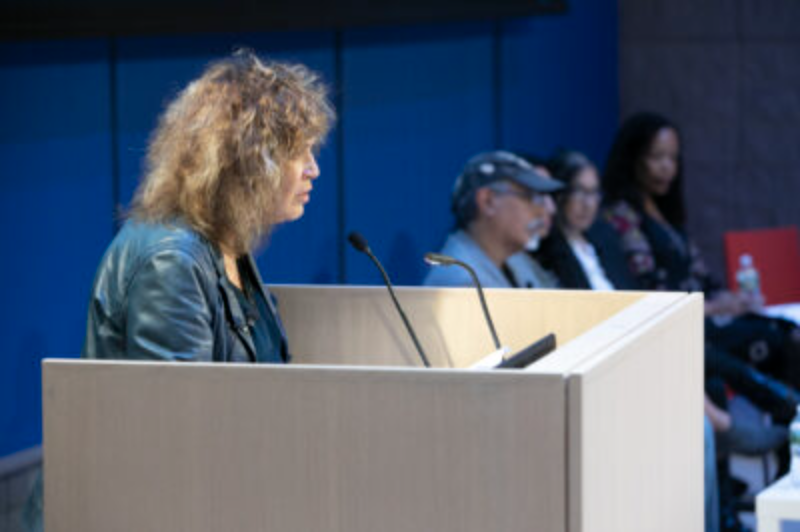
Working across forms, these four artists, writers, thinkers, and practitioners—Ricardo Dominguez, Sama Alshaibi, Miya Masaoka, and Saidiya Hartman—manifest aspects of such intentions. In their own ways, they each tackle complex social issues, utilizing advanced technologies as well as the most originary forms of narrative to situate the human voice in particular landscapes.
Thinking through art is a utopian process. Once art is in the public sphere, its ideas slowly become recognizable and acceptable, as they wait for the time when thought can manifest in action. In this sense, art, which is the result of great passion and urgency, also integrates patience and duration.
Contributed by Carol Becker
KEYWORDS PANEL DISCUSSION: "Justice" defined in legal, institutional, and environmental terms
On March 23rd, CSSD presented its 2017 Keywords Roundtable Discussion featuring panelists from various departmental homes who discussed definitions of the word “justice.” Rachel Adams, Professor of English and Comparative Literature, Columbia University and Director, Center for the Study of Social Difference introduced the group and commented on the challenges the new presidential administration presented to minority groups like people of color and the LGBT community, calling into question the U.S. government’s commitment to social problems and inequality.
Adams said that for people with disabilities, the legal definition of “justice”—the administration of fairness—posed a problem because the definition for “fairness” varies for those with disabilities. The American democratic social contract does not by nature take into account people whose bodies deviate dramatically from the norm or who might possess different capabilities for autonomy or reasoning, she said.
“Are there ways to revise that definition or are these individuals an add-on to those theories?” asked Adams, pointing out that some minority groups like the disabled need much more assistance in claiming their rights.
Adams said that while the new administration’s threats to the Affordable Care Act, Medicaid, and education all impacted justice for people with disabilities, the surge in public protests also presented problems for those individuals because of their difficulties with mobility, crowds, marching, and speaking. She concluded with a call for “activism for justice when you don’t have a body for protest.”
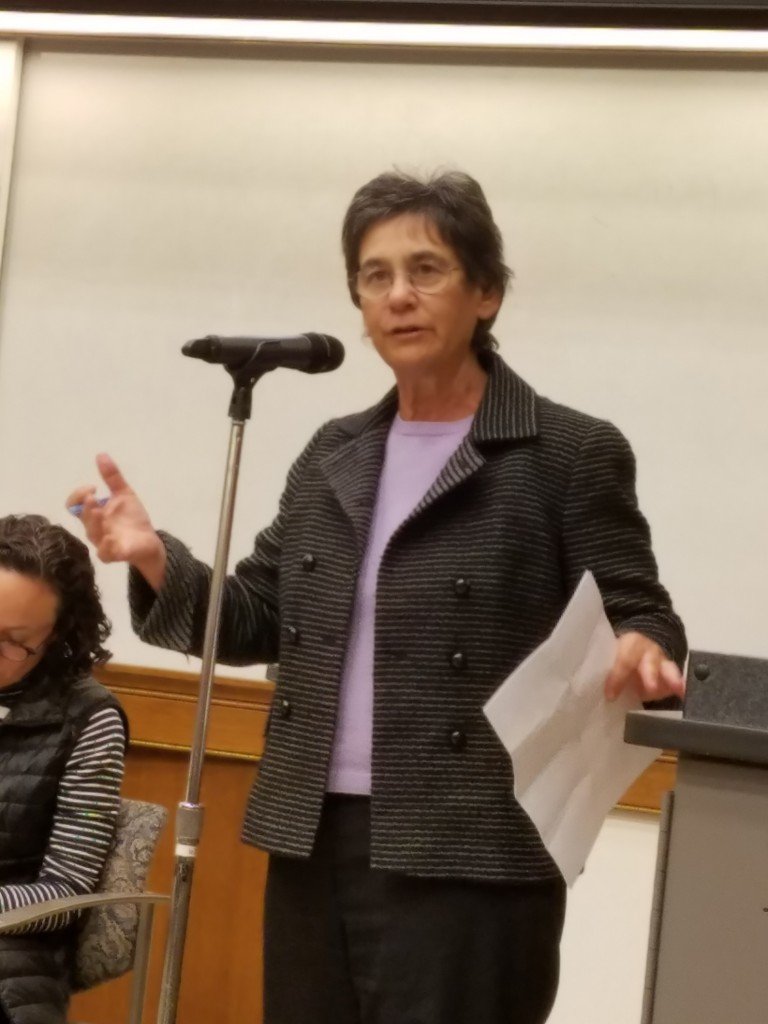
Kathryn Kolbert, Director of the Athena Center for Leadership, Barnard College, examined “justice” through the lens of U.S. constitutional law, saying that the Constitution provided “multiple and overlapping guarantees” of justice with legal protections of free speech and press; due process and equal protection; and the protection of liberty. While the Trump Administration threatens all of those freedoms, vigilance against incursions against them by any governmental agent is always necessary, she said.
Kolbert said there were four prerequisites that underpin the notion of American justice and all of them are currently being challenged. First, the system of governmental checks and balances keeps political powers in the three branches separate so they won’t unduly influence the administration of justice. “Today they are totally out of alignment,” said Kolbert, citing the Republican domination of the House and Senate as an example.
Kolbert said civil debate was the second guarantee of justice and that the lack of it in current U.S. politics was problematic. Freedom of speech and the press were also crucial measures that were in danger, according to Kolbert, who claimed that “Americans are totally divided over what facts are and over a common set of measurements for determining what is effective,” she said.
The fourth prerequisite for justice that Kolbert cited was access, which is currently being undermined by the huge income disparities within our society. “The gap between the haves and have nots is now so pronounced that one’s access to freedom and institutions of civil society are defined solely by one’s economic status,” she said, citing healthcare as a classic example.
Carla Shedd, Assistant Professor of Sociology, Columbia University presented herself as an urban sociologist who is intrigued by the power public institutions have over people’s lives.
Shedd described the awesome power within the concept of parens patriae—the legal framework through which the state acts as the surrogate parent for its citizens and through which governmental actors are allowed to intervene in the lives of individuals (particularly those in juvenile court) and their families with the ultimate goal of building better citizens.
She also explained the phrase “carceral continuum” a term she uses to describe the expanding systems of social control and punishment that are experienced at different levels of severity according to one’s social status. She said her work explored how societal structures such as neighborhoods, schools, and courts unjustly shape the trajectory of young people’s lives.
“Steeped in the language of justice, and often in the name of protecting America’s poor and vulnerable, the nurturing arm of the state may also operate like an instrument of punishment,” said Shedd. She explained that the institutions mentioned earlier are often used to distribute criminal justice unequally, with racially subordinated groups receiving a disproportionate amount of the carceral system’s punishments.
Jennifer Wenzel, Associate Professor of English and Comparative Literature and Middle Eastern, South Asian, and African Studies, Columbia University, discussed her work on justice in relation to the environment and climate.
“Environmental justice…is concerned primarily with environmental racism and the toxic burdens borne disproportionately by racialized minorities,” said Wenzel, explaining that current theorists posit the socially marginalized as receiving few environmental benefits like natural resources but receiving more environmental burdens like pollution. The case is similar with climate change, in which the industrialized Global North is responsible for the production of most of the greenhouse gases on the planet but the most severe effects of climate change are felt in the Global South, she said.
Even in the very definition of environmental justice, hegemonic values and conceptualizations of nature also inform the discussion. Thus, mainstream environmental movements in the Northern hemisphere set the norms, eclipsing the actual, specific environmental concerns of those who are suffering environmental fallout in the Global South.
In conclusion, Wenzel called for an "environmentalism of the poor" that would demand a healthy environment for everyone, not just the poor, and said that “One of my concerns as a scholar-citizen is that this newfound interest in geological stratification threatens to displace attention to social stratification.” Overwhelming concerns about future dystopias that currently dominate mainstream dialogues could displace a more practical focus on present injustices and inequalities affecting people now, she said.
Photos from the roundtable discussion are available here.
Contributed by Terry Roethlein, Communications Manager
DISCUSSION: Keyword: Justice — Interdisciplinary Conversation on Thursday, March 23!
On Thursday, March 23, 2017 from 4:30 – 6:30 p.m., CSSD and the Women's, Gender, and Sexuality Studies Council will co-host a Keywords: Interdisciplinary Roundtable Conversation on the keyword “Justice” in Butler Library 203, Columbia University.
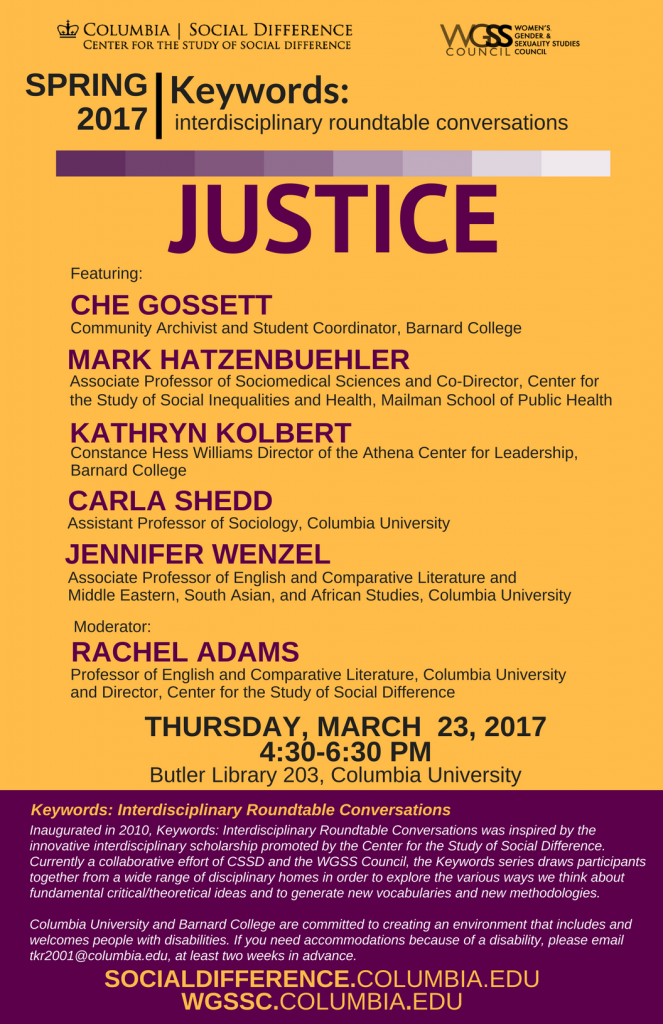
Keywords programs draw participants together from a wide range of disciplinary homes in order to explore the various ways we think about fundamental critical/theoretical ideas and to generate new vocabularies and new methodologies.
This year's program features:
Che Gossett
Community Archivist and Student Coordinator, Barnard College
Mark Hatzenbuehler
Associate Professor of Sociomedical Sciences and CoDirector, Center for the Study of Social Inequalities and Health, Mailman School of Public Health
Kathryn Kolbert
Constance Hess Williams Director of the Athena Center for Leadership, Barnard College
Carla Shedd
Assistant Professor of Sociology, Columbia University
Jennifer Wenzel
Associate Professor of English and Comparative Literature and
Middle Eastern, South Asian, and African Studies, Columbia University
Rachel Adams (moderator)
Professor of English and Comparative Literature, Columbia University and Director, Center for the Study of Social Difference
CSSD Call for Proposals for Fall 2017 Projects Extended to March 20
CSSD’S deadline for proposal submissions for 2017 projects has been extended to Monday, March 20th. Proposals may be submitted for consideration by any Columbia or Barnard faculty member(s) whose project aligns with the mission of CSSD.
Proposals must be for a new project to begin in 2017. Proposals may be submitted for consideration by any Columbia or Barnard faculty member(s) whose project aligns with the mission of CSSD, although preference will be given to faculty affiliated with one or more of CSSD’s member centers and institutes. Submission deadline is March 20, 2017. Read the full CFP here.
Laura Ciolkowski Discusses Rape Culture and "Locker Room Talk" on WFUV Podcast "Issues Tank"
Laura Ciolkowski, Associate Director of the Center for the Study of Social Difference and Adjunct Associate Professor of English and Comparative Literature at Columbia University, was interviewed on the WFUV podcast "Issues Tank" on the subject of rape culture and "locker room talk."
Following the outcry over then-presidential hopeful Donald Trump's reference to past sexually predatory and misogynist comments as "locker room talk," the podcast episode featured interviews with male and female athletes on what conversations really happen in locker rooms and discussion with Ciolkowski about "gendered language" in general.
Ciolkowski said the current conversation about "locker room talk" needs to focus less on inherent gender differences between men and women in relation to language -- she repudiates the popular model of "men are from Mars, women are from Venus" -- and more about social power dynamics.
"When we talk about gendered language we should be talking about status and power" rather than some sort of "hard-wired" male and female difference, said Ciolkowski. Gendered language always expresses differences in status rather than simply biology or Nature, she said.
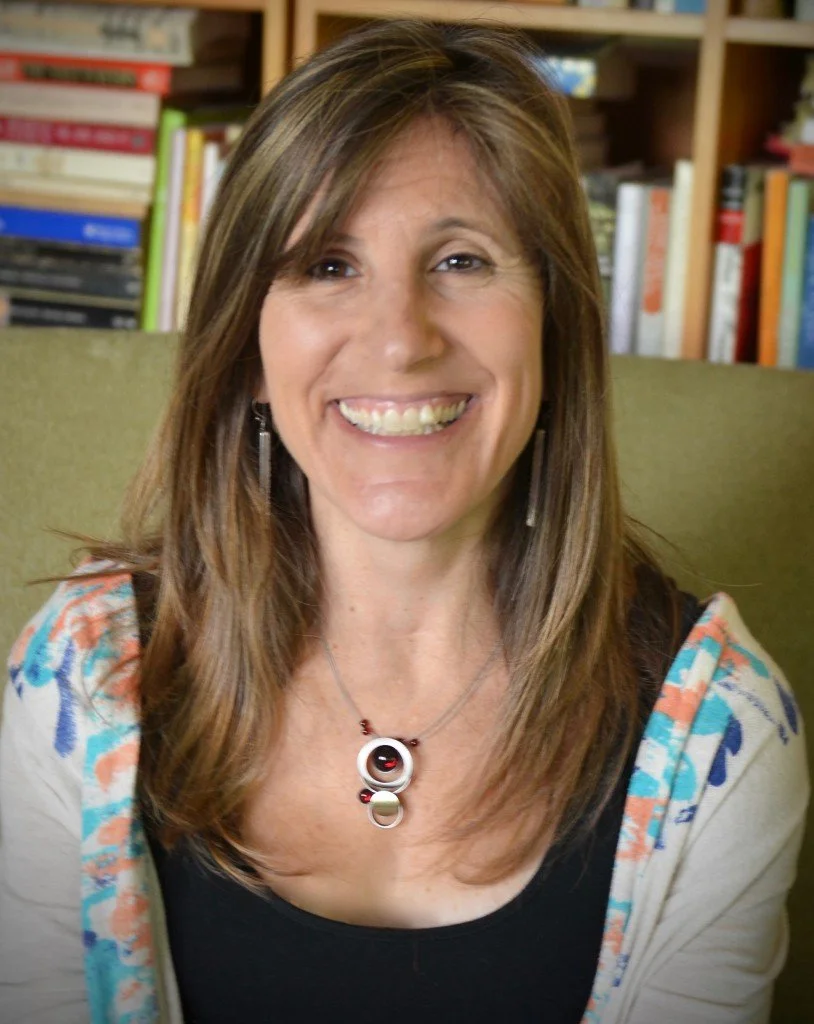
Such differences in status often work in the service of rape culture, which Ciolkowski defines as the trivializing and normalizing of sexual violence (“boys will be boys,” “locker room talk”) and the objectification and devaluation of women. Ciolkowski believes that the increased frequency of discussions about “locker room talk” in the news cycle and the popular media means "We are forced to see and think about in a much more nuanced way what work this language is doing" and are being given even more opportunities to "push back against it."
Hear the full podcast here.
Laura Ciolkowski's Rape Culture Syllabus in Public Books
Laura Ciolkowski, Associate Director of the Center for the Study of Social Difference and Adjunct Associate Professor of English and Comparative Literature at Columbia University, published her Rape Culture Syllabus in the October 15th issue of Public Books.
Rape culture, the trivializing of sexual violence and the tendency to blame victims while exonerating or excusing assailants, also refers to the racial disparities in arrests and sentencing of accused rapists, according to the piece. Published in the wake of the public furor that arose in connection to the sexually predatory and misogynist comments of then-presidential hopeful Donald Trump, the Rape Culture Syllabus has been circulating widely on social media and republished on a range of sites, including Melissa Harris-Perry's Anna Julia Cooper Center and Feminist Wire.

Photograph: Florida supporters of Donald Trump, 2016. By mollyesque / Instagram
"The syllabus was indeed one of our most viewed and shared articles of the past few months. It circulated widely on Facebook and Twitter, and generated lots of appreciative comments," said Liz Maynes-Aminzade, Digital Director at Public Books.
The thirteen-week syllabus covers subjects as far-reaching as the history of gender-based violence in the United States and the politics of rape, to toxic masculinity and racial and state violence. "What would the conversation around sexual assault, police bias, and the legal system look like if investigators, police officers, and judges read deeply into the literature on sexuality, racial justice, violence, and power?" wrote Ciolkowski.
Read the full rape culture syllabus here.
Katherine Franke Writes about #BlackLivesMatter and the Question of Palestinian Genocide
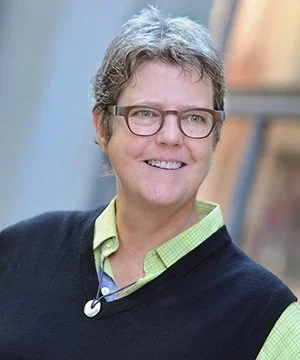
Katherine Franke, CSSD Faculty Fellow and Professor of Law and Director, Center for the Study of Law and Culture, Columbia Law School, blogged on The Nakba Files about #BlackLivesMatter and the question of genocide in Palestine.
According to Franke, the Movement for Black Lives has criticized the U.S. government for providing military aid to Israel, saying "The U.S. justifies and advances the global war on terror via its alliance with Israel and is complicit in the genocide taking place against the Palestinian people.”
In response, critics accused authors of the statement and its supporters of antisemitism in connection to their use of the word "genocide" with respect to Israel.
Franke explained that the term “genocide” has particular relevance in this context: “Genocide can be applied to the destruction of a people or a national group as a viable group, and that can be both with their being driven from a land or the rendering of their language no longer legal, or just the destruction of their national identity.”
Read the full post here.
CSSD Co-sponsors Dissent Issue Launch Concerning the Feminist Movement's Response to Trump Presidency

Dissent magazine’s editors and contributors are gathering Tuesday, November 22, 6:30 p.m. at The New School for an issue launch focused on the challenges feminists will face under a Trump presidency, and how feminist movements can fight back.
One contributor to the discussion is Premilla Nadasen, Associate Professor of History at Barnard College and co-director of CSSD's working group on Social Justice After the Welfare State.
Others speaking are Dawn Foster, Ann Snitow, and Sarah Leonard. Dawn Foster is a London-based writer on politics, social affairs, and economics, and the author of Lean Out (Repeater, 2016). Ann Snitow, a co-founder of the Network of East-West Women, is a professor of Literature and was the Director of Gender Studies from 2006 to 2012 at The New School. Her most recent book is The Feminism of Uncertainty: A Gender Diary (Duke University Press, 2015). Sarah Leonard is a senior editor at the Nation and co-editor of The Future We Want: Radical Ideas for a New Century (Macmillan, 2016). She is a contributing editor to Dissent and the New Inquiry.
A flyer for the event says "A virulent misogynist is now president of the United States. He has bragged about sexually assaulting women, threatened to repeal abortion rights, and will refuse to protect transgender individuals from discrimination. His proposals to ban immigrants, reject refugees he deems “terrorists,” and cut federal climate spending will have serious consequences for everyone, especially women. And if he follows through on his promise to "bomb the shit" out of countries he deems his enemies, women abroad will suffer too."
The event is co-sponsored by Heilbroner Center for Capitalism Studies, The New School; CSSD; and the Institute for Research on Women, Gender and Sexuality, Columbia University.
See the Facebook event page here.
Rachel Adams Publishes Article about Japanese Massacre and Ambivalence Toward People With Disabilities
Rachel Adams, CSSD Director, Professor of English and American Studies at Columbia University, and director of the CSSD project on Precision Medicine: Ethics, Politics and Culture, recently published an article in the Independent on the universal ambivalence toward people with disabilities.
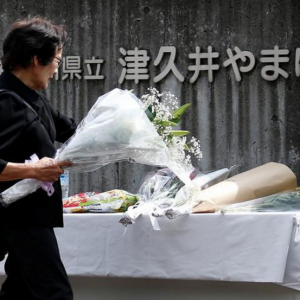
Citing the largely unacknowledged July stabbing deaths of 19 people in a home for the disabled outside of Tokyo, Adams writes that "The practice of warehousing people with disabilities sends a message that they are less than human."
According to Adams, while people with disabilities gain more rights and are increasingly more visible, they continue to face prejudice, social isolation, and violence. Stigmatization leads to institutionalization, but "In truth, disability is an aspect of ordinary experience that touches all people and all families at some point in the cycle of life," writes Adams.
Read the full article here.
Josef Sorett Interviewed about "Spirit in the Dark: A Religious History of Racial Aesthetics"
Josef Sorett, Associate Professor of Religion and African-American Studies at Columbia University and former CSSD executive committee member, was featured in an interview on the African American Intellectual History Society blog.
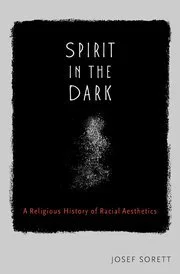
Sorett's recently published book Spirit in the Dark: A Religious History of Racial Aesthetics offers an account of the ways in which religion, especially Afro-Protestantism, remained pivotal to the ideas and aspirations of African American literature across much of the twentieth century.
The interview claims that Sorett's book "reveals religion to be an essential ingredient, albeit one that was always questioned and contested, in the forging of an African American literary tradition."
Read the interview here.
Rachel Adams Directs New CSSD Group Addressing the Ethical, Cultural, Political, and Historical Questions Around Precision Medicine
CSSD is initiating a broad-based exploration of questions raised by precision medicine—an emerging approach for disease treatment and prevention that takes into account individual variability in genes, environment, and lifestyle for each person—in such fields as law, ethics, social sciences, and the humanities.
Precision Medicine: Ethics, Politics and Culture will be the first project of its kind to bring faculty from the humanities, social sciences, law, and medicine into dialogue with leading scholars from the United States and abroad to discuss how humanistic questions might enhance the understanding of the ethical, social, legal, and political implications of precision medicine research. A series of workshops and lectures will explore the mutual benefits to humanists, social scientists, researchers, and clinicians of serious interdisciplinary engagement with this emerging medical field.
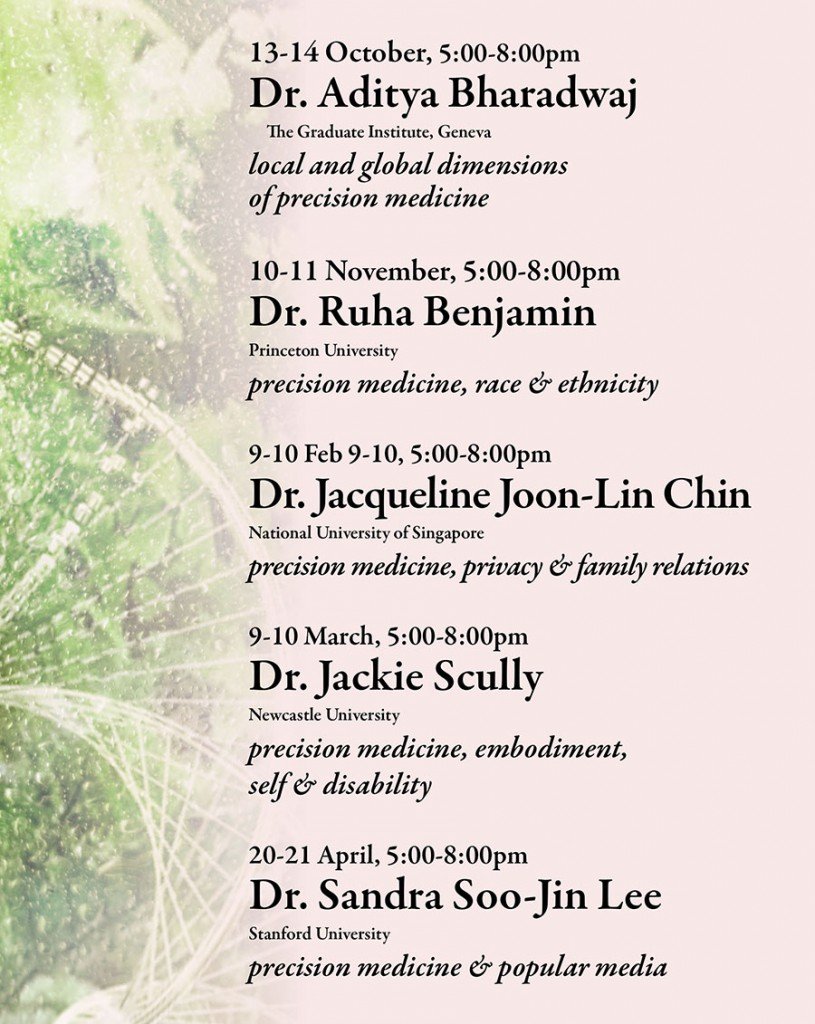
The next event, on Thursday, October 13, 2016, from 5-8 p.m. at 754 Schermerhorn Extension, is a discussion with Dr. Aditya Bharadawaj, Professor of Anthropology and the Sociology of Development at the Graduate Institute, Geneva, on "Local and Global Dimensions of Precision Medicine."
Rachel Adams, CSSD Director and Professor of English and Comparative Literature, Columbia University will direct the project with support from Columbia’s Humanities Initiative.
Topics the project plans to address include how the use of genetic information changes understandings of self, agency, health, embodiment and ability; how precision medicine might intersect with the movement for patients’ and disability rights; historical perspectives that may illuminate the development of precision medicine in the present; how cross-cultural understandings of medicine, health, and ability might contribute to Euro-American approaches to precision medicine; how precision medicine might change the ways care is given and received; how precision medicine is understood by popular media; and the benefits and drawbacks of a “big data” approach to research and treatment.
CSSD’s project is part of Columbia’s larger overall Precision Medicine Initiative, which aims to establish the university as the center for scholarship relating to precision medicine and society. In 2014 Columbia University President Lee C. Bollinger announced a University-wide initiative to address the vast potential for the diagnosis, treatment, and prevention of disease based on the genomic and other data that precision medicine provides.
CSSD Releases 2015-16 Annual Report
The Center for the Study of Social Difference recently released its annual report for 2015-16. The report announced the successful conclusion of The Future of Disabilities Studies project, The Digital Black Atlantic project, and Women Mobilizing Memory. Four new projects—Precision Medicine: Ethics, Culture, and Politics; Unpayable Debt: Capital, Violence, and the New Global Economy; Religion and the Global Framing of Gender Violence; and Reframing Gendered Violence—were established.
The report announces that projects secured funds from the Luce Foundation, the National Science Foundation, the Columbia University Humanities Initiative, and the Columbia Center for Science and Society.
View the report here.
JUST PUBLISHED: "Vulnerability in Resistance" Edited by Judith Butler and CSSD Project Members Zeynep Gambetti and Leticia Sabsay
The volume Vulnerability in Resistance, which grew out of the workshop "Rethinking Vulnerability and Resistance: Feminism and Social Change" that took place at Columbia's Global Center in Istanbul in 2013, has been published by Duke University Press. The introduction to the volume is available here, free of charge.
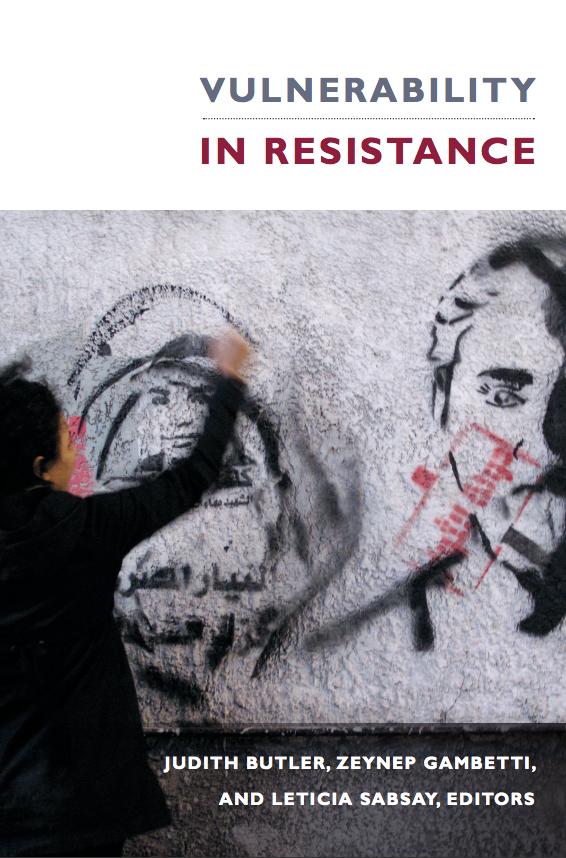
The book was edited by Judith Butler, Maxine Elliot Professor of Comparative Literature and Critical Theory at the University of California, Berkeley; Zeynep Gambetti, Associate Professor of Political Theory in the Department of Political Science and International Relations at Bogaziçi University; and Leticia Sabsay, Assistant Professor in the Gender Institute at the London School of Economics and Political Science. It contains contributions from Meltem Ahiska, Athena Athanasiou, Sarah Bracke, Judith Butler, Elsa Dorlin, Basak Ertür, Zeynep Gambetti, Rema Hammami, Marianne Hirsch, Elena Loizidou, Leticia Sabsay, Nükhet Sirman, and Elena Tzelepis.
In the introduction, the editors write that vulnerability and resistance have often been seen as opposites, with the assumption that vulnerability requires protection and the strengthening of paternalistic power at the expense of collective resistance. The book examines political movements in Turkey, Palestine, France, and the former Yugoslavia, articulating an understanding of the role of vulnerability in practices of resistance. The essays offer a feminist account of political agency and consider how vulnerability is constructed, invoked, and mobilized within neoliberal discourse, the politics of war, and resistance to authority, in LGBTQI struggles, and in the resistance to occupation and colonial violence.
"The Invisible Labor of Women's Studies": Paige West and Lila Abu-Lughod Featured in the Atlantic Magazine
Paige West, Professor of Anthropology at Barnard and Columbia and director of CSSD's project on Pacific Climate Circuits and Lila Abu-Lughod, Professor of Anthropology and Women’s and Gender Studies at Columbia and director of CSSD's project on Gender, Religion, and Law in Muslim Societies, were featured in the recent Atlantic article "The Invisible Labor of Women's Studies."

The article, on the problem of poorly resourced Women's Studies departments, investigates how many elite universities continue to assign women's studies and gender studies departments second-class status. Many times these interdisciplinary departments receive much less funding than traditional departments and have no salaried positions. Often the programs are not covered by contracts or grants so run the risk of termination.
Read the article here.
CSSD Funds New Working Group Addressing the Politics of Unpayable Debt and Its Effect on Social Mobilization
CSSD has awarded a two-year grant for $35,000 to an interdisciplinary faculty group that is developing a comparative research and public engagement project examining the emergence and impact of massive debt on vulnerable polities and populations.
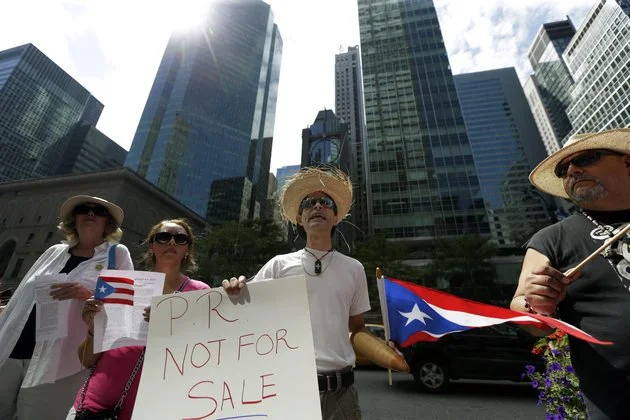
Convening in the fall of 2016, Unpayable Debt: Capital, Violence, and the New Global Economy raises critical questions about the role of debt in contemporary capitalism; the relationship between debt, migration, and violence; and the emergence of new political and cultural identities, particularly among subordinated groups. The project's members, which include scholars, filmmakers, and journalists, examine the politics of information asymmetry—a lack of data and conceptual tools—and how this might undermine social mobilization in impoverished communities, peoples, and countries.
The interdisciplinary group will compare recent and landmark cases such as Puerto Rico, Argentina, Greece, Spain, and U.S. cities like Detroit as well as other spaces that have been historically affected by debt. The project will also develop a web platform to disseminate existing information, facilitate public engagement, and increase discussion about the politics of debt.
The project’s directors are Christina Duffy Ponsa, George Welwood Murray Professor of Legal History, Columbia Law School and Frances Negrón Muntaner, Professor of English and Comparative Literature and Director, Center for the Study of Ethnicity and Race, Columbia University.
Laura Ciolkowski Teaches Literature Humanities at Women's Prison
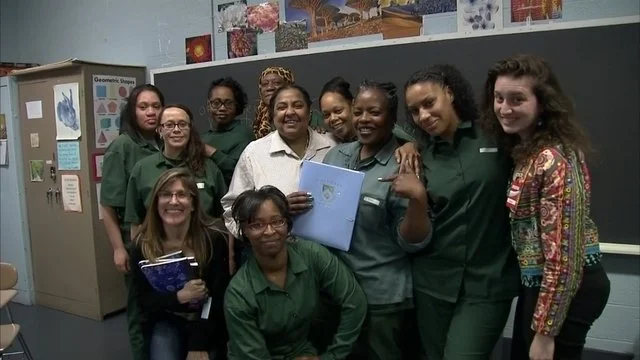
Laura Ciolkowski, CSSD Associate Director and Adjunct Associate Professor of English and Comparative Literature, Columbia University, was recently featured in a Reuters story about the literature humanities course she teaches at the Taconic Correctional Facility, a medium security women's prison in Bedford Hills, New York.
The course is offered through Columbia University's Justice-in-Education Initiative at the Center for Justice. The Justice-in-Education Initiative strives not only to make higher education available to a population that has been effectively excluded from it, but also to contribute to the growing movement to end mass incarceration.
Rachel Adams Talks to Al Jazeera about Arthur Miller's Treatment of his Disabled Son
Rachel Adams, CSSD director and Professor of English and American Studies at Columbia University, appeared on Al Jazeera to discuss American playwright Arthur Miller, who institutionalized and never publicly acknowledged his son Daniel, who has Down Syndrome.
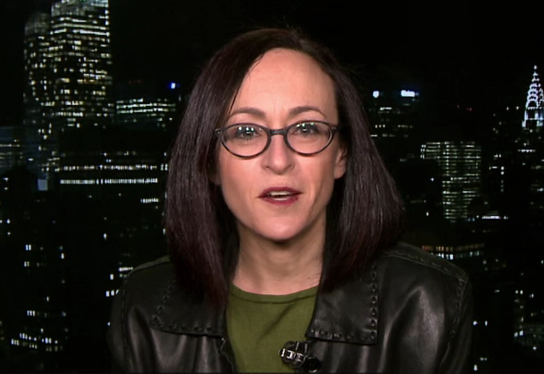
Adams, who also directs CSSD's Future of Disability Studies working group, said: "There is an irony that Miller was lionized for standing up for those who had been victimized and at the same time refusing to speak up on behalf of his son and people with disabilities like him."
Adams also discusses the changing norms around raising children with disabilities in a family environment. Read the article here.