
New Blog Post on Menstrual Health Working Group Conference in Switzerland
Purvaja Kavattur reflects on “Menstruation at Margins.”
The Menstrual Health and Gender Justice working group fellows Inga Winkler, Chris Bobel, and Nancy Reame hosted the “Menstruation at the Margins” workshop at the Fondation Brocher in Hermance, Switzerland from December 10th-13th, 2019. Research Fellow for the working group and Staff Associate at the Institute for the Study of Human Rights, Purvaja Kavattur, reflects on her experiences at the workshop in her latest post on the working group’s blog.
Kavattur writes that, focusing on the menstrual health needs of marginalized populations “reminds us that the way we ask questions may not represent the experiences of everyone, especially those at the margins,” and that we should “sharpen [our] commitment to ensure that the menstrual movement does not leave those at the margins behind.”
Read the full blog post here.
Frances Negrón-Muntaner Interviewed by Columbia Magazine
Former co-director of Unpayable Debt discusses Valor Y Cambio.
In the winter issue of Columbia Magazine, Frances Negrón-Muntaner, Executive Committee member of CSSD and former co-director of working group, Unpayable Debt, talks about the community currency project in Puerto Rico called Valor Y Cambio. The article, “A New Type of Social Currency,” highlights the goals of the project, namely “‘to get people talking about what they value in their communities, about what changes they’d like to see occur, and about how they might contribute to those changes.’”
To read the full article, click here.
Frances Negrón-Muntaner Interviewed on CUNY TV
Former co-director of CSSD working group, Unpayable Debt, talks about Valor Y Cambio.
Frances Negrón-Muntaner, Executive Committee member of CSSD and former co-director of working group, Unpayable Debt, discusses Valor Y Cambio, a community currency project in Puerto Rico, with Judith Escalona in last month’s episode of LATiNAS on CUNY TV. The program is a monthly magazine show that interviews Latinx women and their contributions to society.
To watch the full interview, click here.
CSSD Call For Proposals 2020
Submission Deadline: Friday, February 28, 2020 by 11:59pm
PROJECT GUIDELINES
Call For Proposals
Submission Deadline: Friday, February 28, 2020 by 11:59pm
The Center for the Study of Social Difference at Columbia University (CSSD) is an interdisciplinary research center supporting collaborative projects that address gender, race, sexuality, and other forms of inequality to foster ethical and progressive social change. The Center’s work has two overarching research streams: “Women Creating Change” and “Imagining Justice.” Learn more about these research streams and the projects within them at socialdifference.columbia.edu.
CSSD brings together faculty in humanities, law, social sciences, medicine and the arts, as well as artists and practitioners in the New York area and beyond, to investigate problems of social, economic, and cultural inequality. The Center’s working groups challenge the disciplinary divides among the humanities, the arts, and the social sciences by asking not only how historical categories of social difference intersect on the level of identity, but also how these categories shape institutions, modes of knowing, acts of representation, and processes of globalization. The Center creates the conditions for scholars, artists and practitioners to work collaboratively and internationally on problems of common interest and to set intellectual agendas for the future.
The Center welcomes proposals for new working groups that would begin in Fall 2020 or Fall 2021.
Who is eligible:
Please note that working groups must include, but are not limited to, Columbia and/or Barnard faculty.
**Proposals must be submitted by one or more faculty members in one of Columbia's schools and/or Barnard.**
We will also review working group proposals from graduate students with ABD status who are working in partnership with Columbia and/or Barnard faculty.
CSSD accepts proposals from all schools of Columbia and Barnard, including but not limited to Arts & Sciences, CUMC, School of the Arts, Columbia Law School, School of Journalism, and GSAPP, with preference given to groups working across schools and/or disciplines.
Most, but not all, CSSD working groups are led by two or more co-directors. At least one (co-)director must be Columbia or Barnard faculty.
CSSD seeks projects that align with the mission of “Women Creating Change” or “Imagining Justice” and favors proposals from an interdisciplinary core working group (usually 5-8 people, not all of whom need be affiliated with Columbia or Barnard). The Center encourages and facilitates international collaborations. Center support is seed money to enable working groups to get off the ground; it is the expectation of the Center that all projects will also seek additional funding.
New opportunity for one of our funded projects this cycle:
For the 2020 Call for Proposals, CSSD is pleased to announce a special opportunity, funded by the Earth Institute at Columbia University, for a working group in one of the two research streams (Women Creating Change; Imagining Justice) that focuses in some significant way on climate-related issues. All proposals will be reviewed by the CSSD Executive Committee. If you have any questions about this opportunity for climate-related working groups or would like to apply with a relevant working group proposal, please contact CSSD Director Paige West (cw2031@columbia.edu).
Amount of award:
Funding is in the amount of $35,000 over two years with the possibility of $15,000 for a third year, contingent on working group interest and the availability of Center funds.
How CSSD working groups function:
Center projects typically run for three years, but two-year projects will also be considered. Every working group proceeds in accordance to the needs of its particular research interests, but in general many groups tend to proceed as follows:
In three-year projects, year one generally concentrates on focused project development, including the consolidation of a regional and/or international working group, exploratory seminars, and guest lectures or workshops. Year two involves the most intensive intellectual work, featuring regular meetings of the working group and the active participation of fellows and affiliates. Year three is often dedicated to planning and dissemination of the project’s work through a conference, the publication of conference proceedings and/or edited collections of working group scholarship, or online publication of syllabi or other curricular materials.
Please note: CSSD does not function simply as a grant-making institution. Our active working groups create the CSSD community. Funds are administered directly by CSSD staff for the duration of the working group’s involvement with the Center, and it is expected that one (co-)director from each active working group sit on the CSSD Executive Committee. The Center works closely with its active working groups to build additional collaborations and to share additional funding opportunities.
Current and past working group projects include “Geographies of Injustice,” “Menstrual Health and Gender Justice,” “Migrant Personhood and Rights,” “Women Mobilizing Memory,” “Unpayable Debt,” “Pacific Climate Circuits,” "Precision Medicine: Ethics, Politics, and Culture," "Reframing Gendered Violence," “Bandung Humanisms,” “On the Frontlines: Nursing Leadership in Pandemics,” “The Future of Disability Studies,” and “Queer Theory: Here, Now, and Everywhere.” Please review our website for detailed descriptions of all our projects and for additional information about the Center.
Use of funds:
CSSD project support budgets may be used by project directors at their discretion. However, budgets typically include the following: Course relief for a project director (one course per year for two years, alternating in the case of co-project directors; specific terms to be negotiated by the individual project director with the director’s home department and/or center/institute); stipend for one graduate student assistant responsible for program support; working group meeting lunches and/or breakfasts; limited support for visiting scholars, public conferences and publications. Projects must include at least one public event per year and project directors must be willing to collaborate in the Center’s fundraising efforts. Project directors should be prepared to work with the Center to seek additional funding sources.
How to apply:
Project proposal narratives should not exceed five double-spaced pages and should include a project description and a detailed work plan for group meetings, public events, and the dissemination of project research. Proposal narratives should also describe a plan for soliciting and adjudicating applications for working group membership from the wider University community, as well as any anticipated curricular or pedagogical outcomes of the proposed project.
Please also include, in addition to the above:
a short CV or bio for each tentative working group member (indicate if participation has been confirmed)
proposed budget (please use provided budget template)
CSSD Director Paige West and Executive Director Catherine LaSota are available to discuss potential projects with colleagues thinking about proposing them, and sample CSSD project proposals are available by request. We encourage you to contact us in advance of submitting your proposal. Complete proposals should be directed to CSSD Executive Director Catherine LaSota (cl2866@columbia.edu), by Friday, February 28, 2020 at 11:59pm. Projects will be selected by the CSSD Executive Committee. All applicants will be notified by early April 2020.
Safwan Masri Publishes Piece on Tunsanian Democracy in The Financial Times
WCCLC member has article published on January 14, 2020.
Safwan Masri, CSSD Women Creating Change Leadership Council Member and Columbia Global Centers Executive President, published his piece, “Tunisia risks losing its standard as a democratic exemplar,” in The Financial Times, which discusses the delay in implementing a new government in Tunisia three months after “free and fair presidential and legislative elections,” using this essay article as a call to action to Tunisian leadership.
For the full piece, click here.
CSSD Welcomes 2019-2020 Media Fellows from Columbia Journalism School
CSSD introduces 2019-2020 media fellows.
The Center for the Study of Social Difference (CSSD) is pleased to announce our 2019-20 Media Fellows from the Columbia Journalism School:
Jessica Jacolbe (Arts & Culture) - Geographies of Injustice working group
Larry Madowo (Business & Economics) - Racial Capitalism working group
Amitoj Singh (Politics) - Menstrual Health and Gender Justice working group
The Media Fellow program at CSSD places students from the MA program of Columbia's J-School with active working groups at the Center. Fellows were selected via an application process in Fall 2019 and were placed with groups who are researching topics relevant to their writing and thesis work.
The MA Program at Columbia's J-School is for experienced journalists who want to go deeper into a specialized subject area, choosing from the following four areas of concentration: Arts & Culture, Business & Economics, Politics, and Science. CSSD is thrilled to contribute to the education of these journalists by providing access to working group meetings, special events, and courses via the CSSD Media Fellow program.
Frances Negrón-Muntaner interviewed for “Public Thinker” Series
Public Books features a profile on former Unpayable Debt Co-Director.
Frances Negrón-Muntaner, executive committee member of CSSD and former co-director of working group, Unpayable Debt, was recently interviewed by Public Books for their “Public Thinker” series. Negrón-Muntaner discusses Puerto Rico, the power of art and public discourse, and “decolonial joy.”
To read the profile, click here.
New book by Reframing Gendered Violence Co-Director featured in Teen Vogue and WNYC
Jennifer Hirsch and Shamus Khan discuss their book, Sexual Citizens.
Jennifer Hirsch, professor of sociomedical sciences and former co-director of CSSD working group, Reframing Gendered Violence, and Shamus Khan, professor of sociology, recently discussed their book, Sexual Citizens: A Landmark Study of Sex, Power, and Assault on Campus, in a piece in Teen Vogue and on WNYC’s All of It with Alison Stewart.
To hear their interview on WNYC, click here.
“Sexual Citizens” Named One of Esquire Magazine’s “Best Books this Winter”
New book by former Reframing Gendered Violence co-director Jennifer Hirsch and Professor Shamus Khan receives praise after it’s debut.
Jennifer Hirsch, professor of sociomedical sciences and former co-director of CSSD working group Reframing Gendered Violence, and Shamus Khan, professor of sociology, recently published their book, Sexual Citizens: A Landmark Study of Sex, Power, and Assault on Campus, a study that attempts to transform how we see and address the widespread problem of sexual assault on college campuses. Their publication was named Esquire Magazine’s “Best Books this Winter.” The magazine praises the “clear, intersectional picture of the forces breeding a campus culture that bulldozes consent.”
For more information on the book, read here.
To view Esquire’s list, read here.
Vicky Murillo’s Op-ed Featured in The New York Times
The article was published in late November of 2019, less than a month after the “resignation” of Evo Morales.
Vicky Murillo, political scientist and co-director of the CSSD working group Environmental Justice, co-authored an op-ed, “The Coup Temptation in Latin America,” which was featured in The New York Times. Her piece is a response to the aftermath of the ouster of Bolivia’s former president, Evo Morales, and argues that coups against elected governments - even populist governments with authoritarian tendencies - almost always shift countries in the less democratic directions.
For the full op-ed, read here.
CSSD Director Writes Afterword for Ethnos’s Journal of Anthropology
Paige West’s piece is entitled Translations, Palimpsests, and Politics: Environmental Anthropology Now.
Center for the Study of Social Difference (CSSD) director and former co-director of CSSD Reframing Gendered Violence and Pacific Climate Circuits working groups, Paige West, writes an afterword for Ethnos’s publication, Translations, Palimpsests, and Politics: Environmental Anthropology Now. Paige says that the issue discusses “environmental anthropology and how we write and think against attempts at universal wordings.”
To read the issue, click here.
Women Mobilizing Memory Working Group Fellow Pens Article
Nancy Kricorian publishes report read at Women Mobilizing Memory book event.
Nancy Kricorian, Center for the Study of Social Differences (CSSD) working group Women Mobilizing Memory (WMM) fellow, published a piece on The Armenian Weekly, The Name of this Place, which was read at the WMM event, Reclaiming Collective Memories in Contemporary Turkey. Her piece discusses the historical context of the occupation of Dikranagerd and her experience touring the destroyed Sur District.
For the full article, read here.
Vicky Murillo Interviews Historian Nara Milanich for Unpacking Latin America Podcast
This is the third episode of the monthly podcast, released on December 9.
Vicky Murillo, professor of Political Science and International Affairs and director of the Center for the Study of Social Difference’s (CSSD) working group Environmental Justice, Belief Systems, and Aesthetic Experiences in Latin America and the Caribbean, interviews professor and historian, Nara Milanich. Milanich talks about the shift from cultural to biological definitions of paternity thanks to DNA testing and how such testing could either be used to recover kids stolen by military dictatorships or to halt migration at the US-Mexico border. She also explains age-based violence suffered by migrant children in Central America, amongst other things.
The interview can be found on the podcast Unpacking Latin America, hosted by Vicky Murillo, discussing major themes around Latin American history, culture, and politics.
Find the full podcast interview here.
For more on the Environmental Justice, Belief Systems, and Aesthetic Experiences in Latin America and the Caribbean working group visit their project page.
Vicky Murillo is a Professor of Political Science and International Affairs at Columbia University. Her work focuses on distributive politics, electoral behavior, institutional weakness, Latin American politics, agricultural and conservation policies.
Nara Milanich is a professor of History at Barnard College. Her scholarly interests include modern Latin America, Chile, and the comparative histories of family, gender, childhood, reproduction, law, and social inequality. Professor Milanich teaches courses ranging from the Modern Latin American History survey to a comparative seminar on the Global Politics of Reproduction.
Vicky Murillo Interviews Journalist Daniel Alarcon for Unpacking Latin America Podcast
This is the second episode of the monthly podcast, released on November 11.
Vicky Murillo, professor of Political Science and International Affairs and director of the Center for the Study of Social Difference’s (CSSD) working group Environmental Justice, Belief Systems, and Aesthetic Experiences in Latin America and the Caribbean, interviews professor and journalist, Daniel Alarcón. Alarcon shares stories about his Spanish radio program and the type of Latin American stories he's working on and more in this episode.
The interview can be found on the podcast Unpacking Latin America, hosted by Vicky Murillo, discussing major themes around Latin American history, culture, and politics.
Find the full podcast interview here.
For more on the Environmental Justice, Belief Systems, and Aesthetic Experiences in Latin America and the Caribbean working group visit their project page.
Vicky Murillo is Professor of Political Science and International Affairs at Columbia University. Her work focuses on distributive politics, electoral behavior, institutional weakness, Latin American politics, agricultural and conservation policies.
Daniel Alarcon is a professor of Broadcast Journalism at the Columbia University Graduate School of Journalism. He is the creator of RADIO AMBULANTE, an award-winning Spanish-language podcast on NPR. He has also written for Harpers, The New York Magazine,The New Yorker and Etiqueta Negra and published two novels: Lost City Radio and At Night We Walk in Circles.
On the Frontlines Working Group Coordinator Highlighted by the School of General Studies
The profile on Jeremy Orloff discusses the group’s trip to West Africa, centered around their efforts to retrieve oral histories from local nurses and midwives active during the Ebola crisis.
Jeremy Orloff, post baccalaureate student in Columbia’s School of General Studies (GS) and Coordinator for the Center for the Study of Social Difference’s (CSSD) On the Frontlines: Nursing Leadership in Pandemics working group, was recently profiled by GS. The profile highlights Jeremy’s nontraditional academic background and what inspired his pursuit of a career in medicine. Jeremy’s visit to Liberia and Sierra Leone, a research trip to gather oral stories on nursing experiences during the Ebola outbreak in West Africa with the On the Frontlines group, is also explored. He explains that, “The project was my first exposure to global health, and definitely makes me think it is something that I want to do long term and incorporate into the rhythm of my career, regardless of what I do.”
To read the full profile click here.
For Orloff’s reflections on his trip to West Africa with the On the Frontlines working group visit our blog, here.
CSSD Collaboration with Columbia Global Center in Istanbul 2018-2019
CSSD projects and affiliates were featured in the Center’s most recent Annual Report.
The Columbia Global Center in Istanbul’s 2018-2019 Annual Report features project and affiliates of the Center for the Study of Social Difference. The Reframing Gendered Violence working group held four workshops in 2018 as a part of their workshop series hosted by the Istanbul Global Center. These workshops aimed to open up a critical global conversation among scholars and practicioners in order to reframe the issue of violence against women as it is currently discussed in a wide range of fields, both academic and policy-oriented. This series included “Beyond Prevalence: The Next Genderation of Campus Sexual Assault” on February 9th, “Institutionaled Violence and Gender: Innocence-Disposability-Resilience” on March 9th, “Interrogating Culture-Based Explanantions for Violence Against Women” on March 23rd, and “Turkish Students Present on Reframing Gendered Violence” on June 7th.
On September 25th, Women Mobilizing Memory (WMM) fellow and speaker at CSSD’s 10th Anniversary Symposium, Ayşe Gül Altınay, CSSD Executive Committee member and WMM co-director, Jean Howard, and director of the Queer Theory working group, Jack Halberstam, gave a talk entitled “Bridging Academia and Activism Thorugh Gender Studes.” The talk presented a critical reflection of the possibilities of doing feminism and gender studies in contemporary Turkey, with specific examples from the experiences of Sabancı University Gender and Women’s Studies Center of Excellence.
Former CSSD director and co-director of the WMM working group, Marianne Hirsch, delivered a talk entitled “Women Carrying Memory: Stateless Figures,” along with Women Mobilizing Memory co-editor Ayşe Gül Altınay and Aylin Vartanyan. This talk looked at two recent memorial projects by feminist diasporic artists Mirta Kupferminc and Wangechi Muthu, which explored the vicissitudes and vulnerabilities of exile and statelessness, and suggested that stateless memory can open up the possibility of imagining alternative relationships between contemporary subjects and citizenship, national belonging, and home, as well as alternate temporalities of becoming.
The annual report also features a photo from a WMM Memory Walk conducted in Turkey. Columbia University President Lee Bollinger, joined WWM fellow, Silvina Der-Meguerditchian, and Global Center Director and CSSD Women Creating Change Leadership Council member, Safwan Masri, for this insightful tour of Istanbul.
To view the entire 2018-2019 Annual Report from Columbia’s Global Center in Istanbul click here.
New Course in Spring 2020: “Menstruation, Gender, and Rights: Interdisciplinary Approaches”
Now open for enrollment for Columbia and Barnard students.
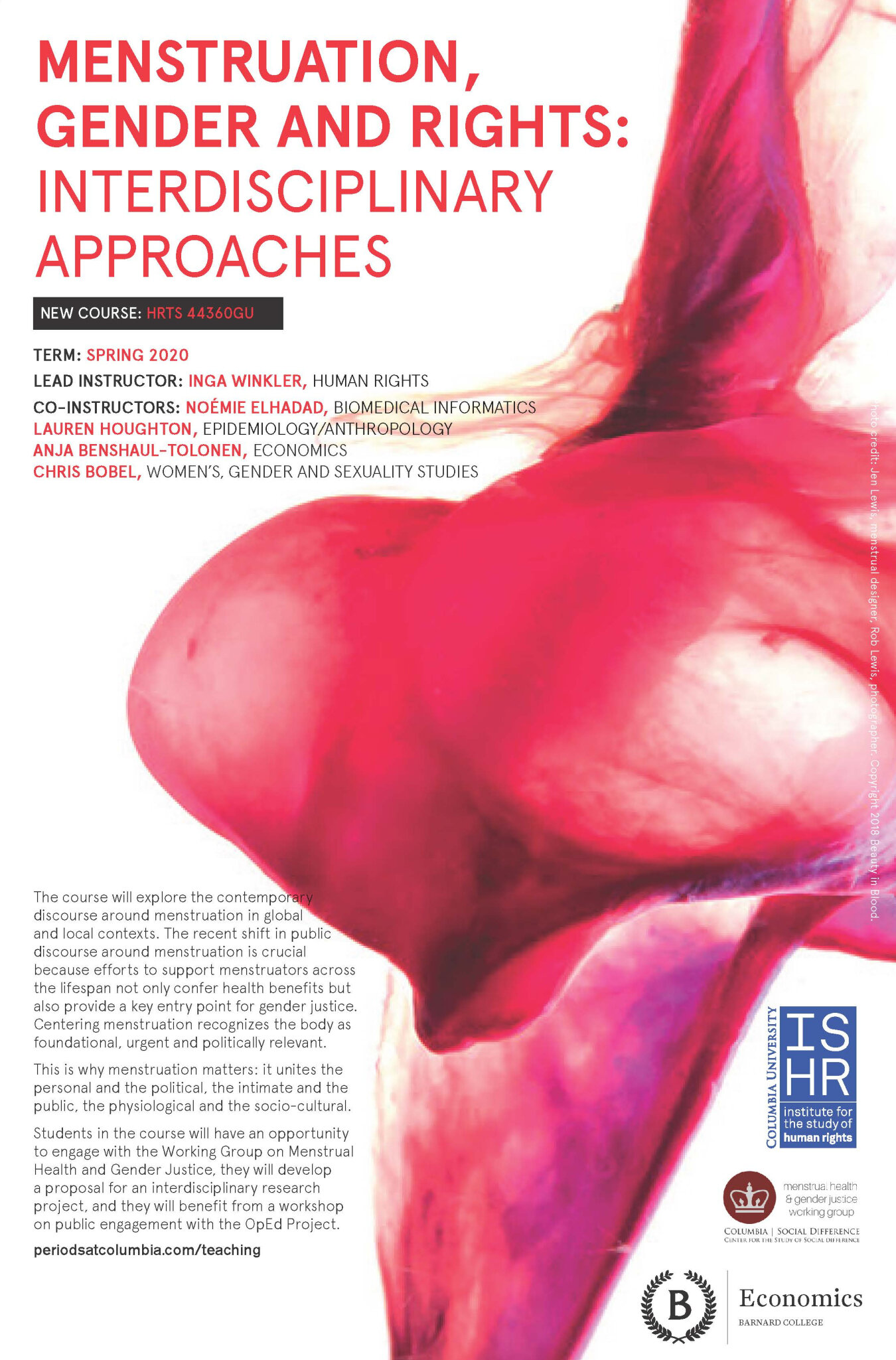
Led by the Menstrual Health and Gender Justice working group, “Menstruation, Gender, and Rights: Interdisciplinary Approaches” will explore the contemporary discourse around menstruation in global and local contexts.
Students in the course will develop a proposal for an interdisciplinary research project and engage in a workshop on public engagement with The OpEd Project.
The course will be co-taught by an interdisciplinary team of working group faculty fellows, including:
Inga Winkler, Lecturer in Human Rights
Noémie Elhadad, Associate Professor of Biomedical Informatics
Lauren Houghton, Assistant Professor of Epidemiology
Anja Tolonen, Assistant Professor of Economics, Barnard College
Chris Bobel, Professor of Women’s, Gender, and Sexuality Studies, University of Massachusetts Boston.
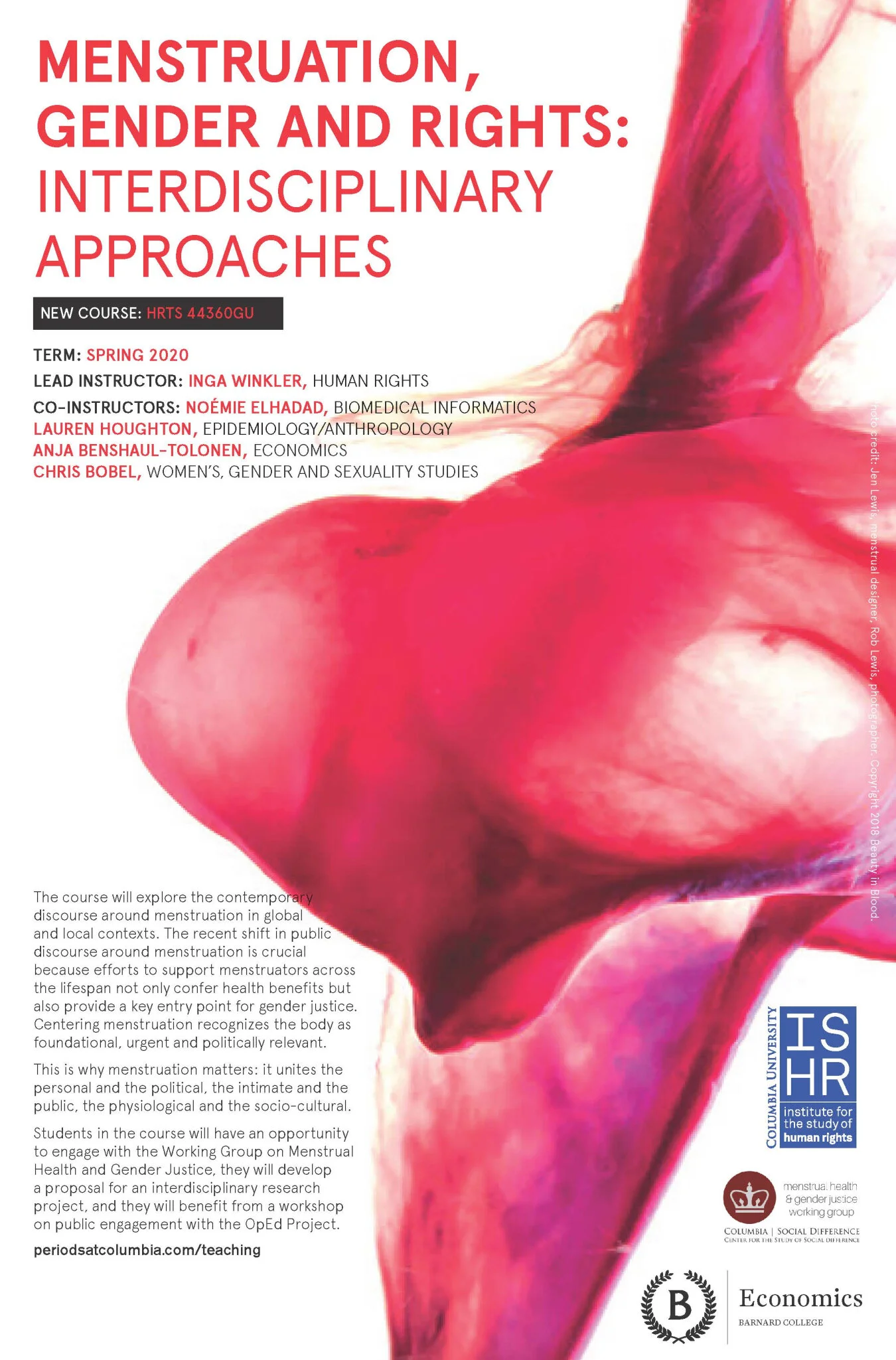
The development of this course was funded by the Columbia University Provost’s Interdisciplinary Teaching Award, which funds the creation of a new course with up to $20,000.
For a complete course description and call number, click here.
To view the course syllabus, click here.
For more on the Menstrual Health and Gender Justice working group check out their blog, like them on Facebook and follow on Twitter.
LIVESTREAM: Policy and Practice in Interdisciplinary Menstrual Health
The day-long Multifaceted Menstruation workshop took place November 22, 2019 at Barnard College.
The CSSD Menstrual Health and Gender Justice working group hosted an interdisciplinary day-long workshop entitled Multifaceted Menstruation that evaluated the current state of research on menstruation, with interest in examining whose voices are being represented, which actors shape the dominant narrative, whose voices are marginalized, what gaps in data, research, and policy exist, and how interdisciplinary collaboration may help remedy some of these gaps.
A panel discussion entitled “Policy and Practice in Interdisciplinary Menstrual Health” concluded the day.
To watch the livestream video of the panel discussion, click here.
For more information about the event, click here.
Jean Howard and Ana Paulina Lee to be Featured on Panel “A Celebration of Soft Power”
The discussion will revolve around American democracy, race, performance, and US-China relations.
CSSD Executive Committee member and former Women Mobilizing Memory co-director, Jean Howard, and co-director of the Geographies of Injustice working group, Ana Paulina Lee will be featured on the upcoming panel “A Celebration of Soft Power.” Fellow panelists will include David Henry Hwang and Denise Cruz and will address American democracy, race, performance, and US-China relations, and will be followed by an audience Q&A. The event will take place on December 3rd from 4 pm to 6 pm in Kent Hall and is free of charge.
To read more about the event, click here.
Marighella Film Screening Followed by Director Q&A
Ana Paulina Lee to discuss Brazil’s current political climate.
Join co-director of the CSSD working group Geographies of Injustice, Ana Paulina Lee, and the director of Marighella, Wagner Moura, in a discussion on censorship, race, and the current political climate in Brazil. The film is a “searing and energized portrait of one of Brazil’s most divisive historical figures, Afro-brazilian poet and politician Carlos Marighella,” and is currently banned in Brazil. Tickets are $15. The film screening will take place on Saturday, December 7th at 8:00 pm in the Teacher’s College Chapel.
To learn more about the film and ticket purchase, click here.