
Open Veins of Latin America at 55

Join us for a guided reading discussion on Open Veins of Latin America at 55 by Eduardo Galeano.
Underneath the pageantry of the U.S. semi quincentennial celebration is an unprecedented ethnic cleansing campaign on the hunt for migrants under the guise of homeland security. But the United States has only ever been able to maintain its power and influence through the imperial hemispheric dominance of Latino America and the Caribbean, its economic exploitation, looting, terrorism and mass murder. Sugar, bananas, rubber, gold, oil, and finally, cheap exploited labor continue to prop up this decaying empire. Through a series of vignettes from Eduardo Galeano’s classic Open Veins of Latin America, which turned 55 this year, this course will look to El Sur to deflate the bloated self-image of the U.S. empire. The reading of Galeano will be in conversation with offerings from Christina Heatherton and Harsha Walia.
This event is the first in our Counter-narratives at 250 reading series. This fall, The Walter Rodney / Flores Magón Library & Commons will lead two guided reading discussions centered on works whose anniversaries offer an opportunity to challenge the exclusionary logics of the United States as a settler-colonial state and examine the experiences of minoritized communities. These discussions are part of a four-session series spanning the academic year that responds to the U.S. semiquincentenial and its accompanying officially sanctioned celebratory accounts of the past. The program offers a counternarrative to these accounts through study sessions dedicated to alternative anniversaries that undertake a critical appraisal of history and historical struggles, considering the insights and strategies already available to us in navigating the horrors of the present and asking how we might carry them forward not only survive but live in complicated, meaningful ways.
The reading sessions are open to all, but registration is required; readings will be shared with all registrants in advance of each session.
Readings:
Eduardo Galeano, Open Veins of Latin America: Five Centuries of the Pillage of a Continent, “The Invisible Source of Power,” pg. 135- 170.
Christina Heatherton, Arise: Global Radicalism in the Era of the Mexican Revolution, “How to Make a Rope,” pg. 1-20.
Harsha Walia, Border & Rule: Global Migration, Capitalism, and the Rise of Racist Nationalism, “Displacement Crisis, Not Border Crisis,” pg. 19-38.
Seeds of Diaspora: a Discussion
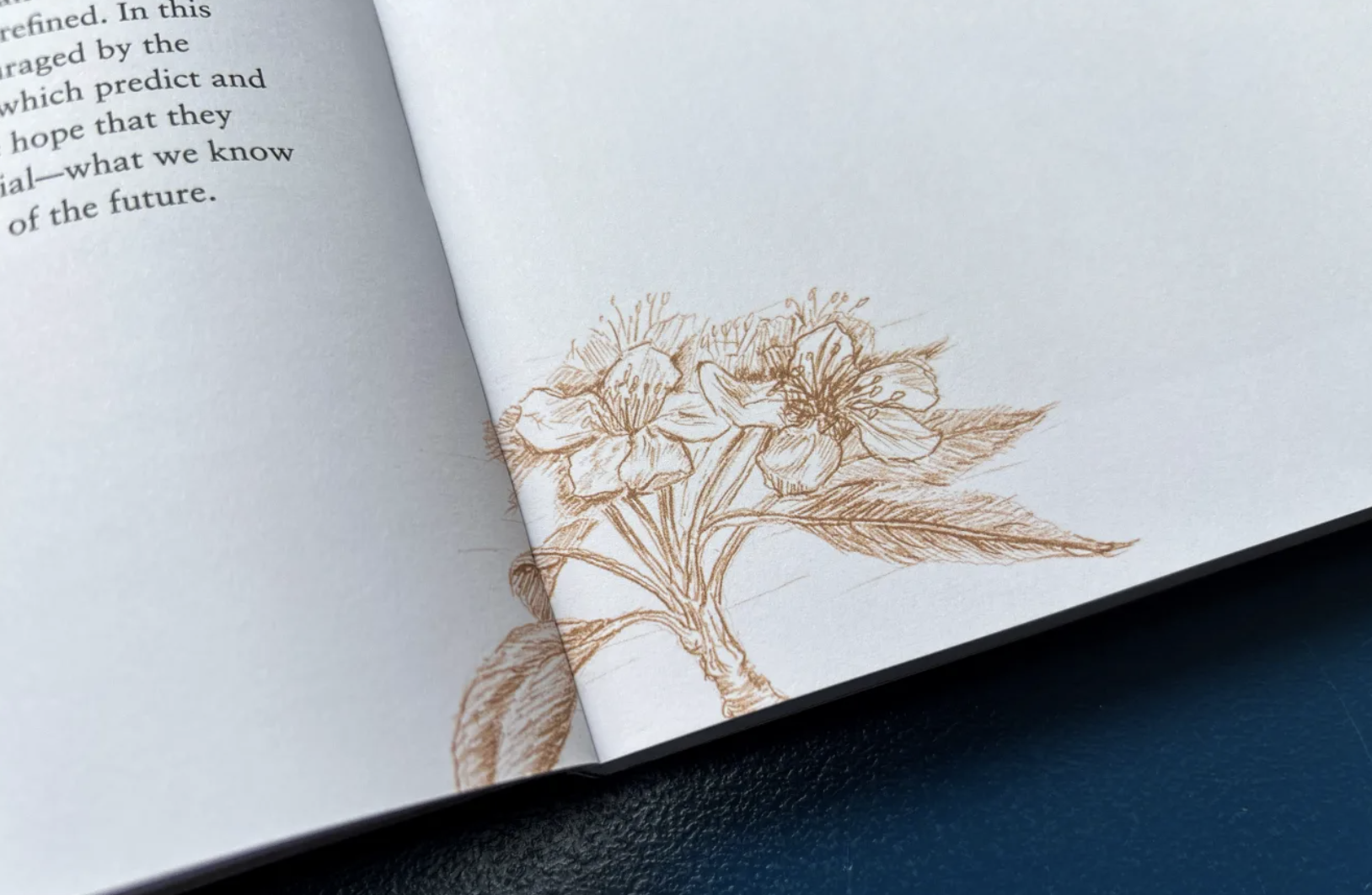
The intertwined histories of human settlement and plants amid cultural and climatic change serve as the point of orientation in the new, eclectic essay collection Seeds of Diaspora. Its works follow seeds as they bear witness to migration, resilience, and transformation. Five contributors from this collection will discuss their investigations, which consider dramatic, even if subtle, changes. The conversation will range from postwar landscapes reclaimed by plant life to cultural landscapes overwritten by city planners; seeds in glacial ice to those carried along routes of labor and exile; and trees appropriated as constituents of fictive homelands to plants as sentient beings. The contributors recognize seeds both as biological and analogical subjects, and ask how we might reconceive the relationships between human and more-than-human.
Songs in the Key of Life at 50: "Take Two" Concert
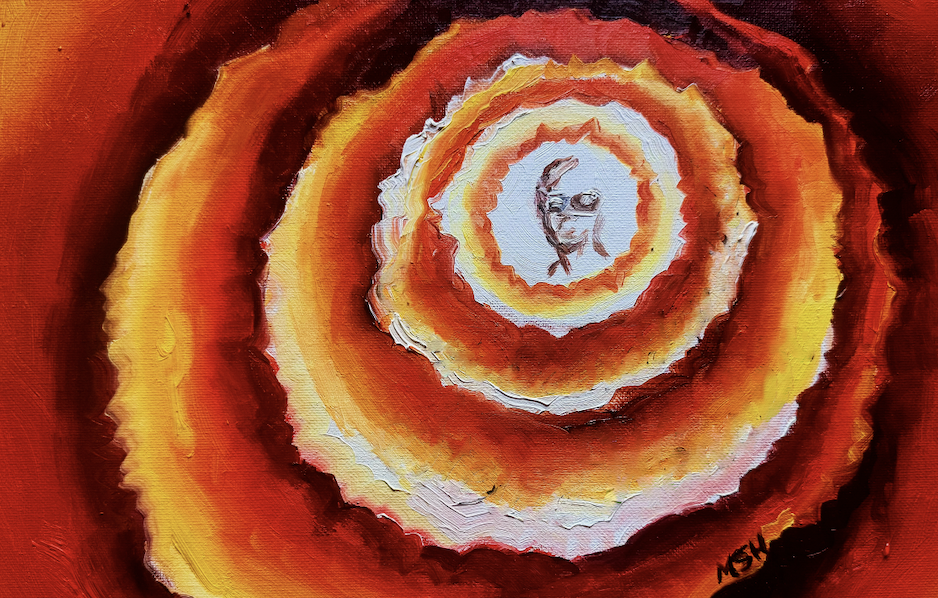
Following the symposium, CSSD is proud to co-present, along with Pique-nique and Boom Collective, a concert featuring musician Elliott Skinner. Organized as part of Pique-nique’s “Take Two” series, the concert will feature a listening session of Wonder’s album followed by a reinterpretation by Skinner. Blending soul, blues, folk, and rock, singer, songwriter, and multi-instrumentalist Elliott Skinner creates music that combines atmospheric vocals and rich instrumentation with an emphasis on personal storytelling. His work draws from the Black Radical Music Tradition, a lineage of Black artists who have used music to explore identity, confront social realities, and imagine new possibilities for freedom.
Songs in the Key of Life at 50: Symposium
Celebrating 50 Years of Stevie Wonder’s Songs in the Key of Life
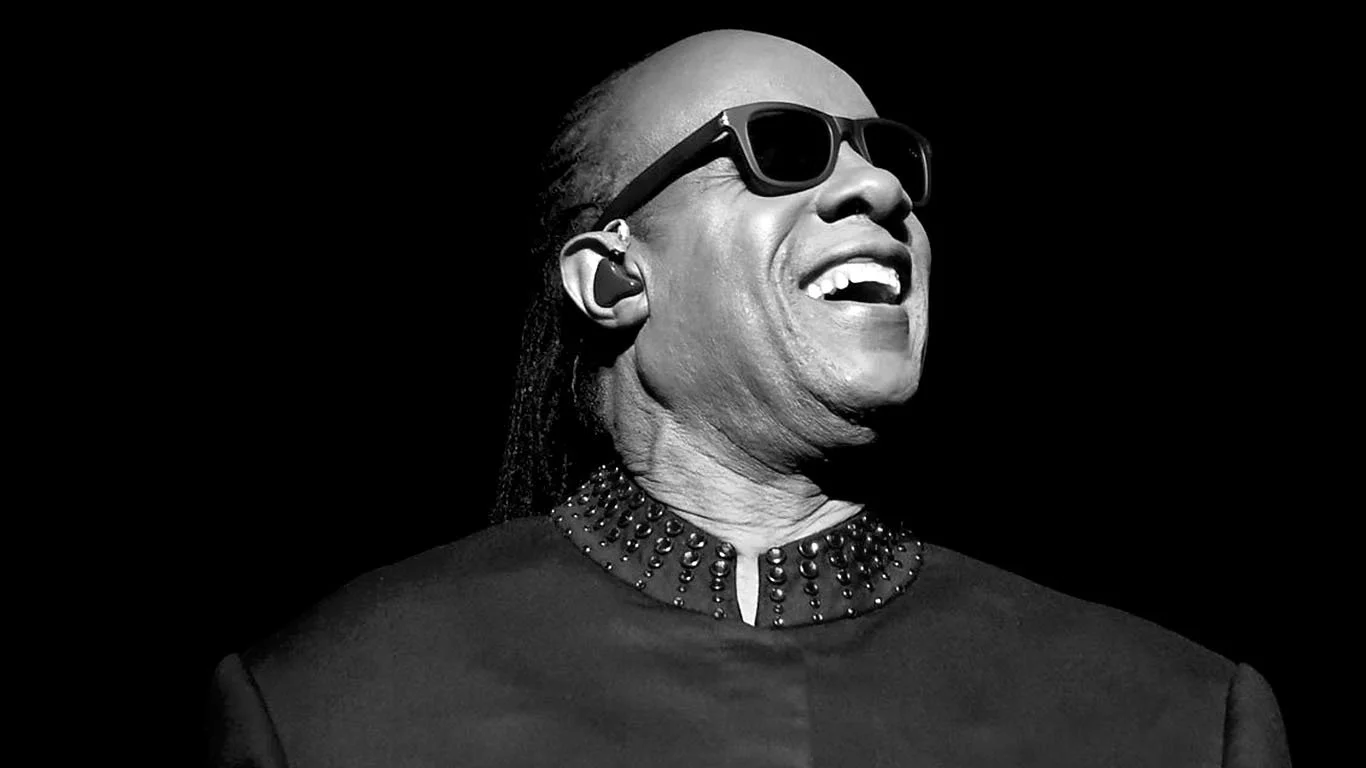
A daylong symposium bringing together scholars, critics, musicians, and composers to reflect on the album’s insights into life in the wake of civil rights and decolonial movements across the African world, and on the legacies of Wonder’s hopeful vision of a future grounded in love and shared humanity.
The City and the University: A Symposium
A symposium on student led-activism exploring the university, social difference and spatial segregation.
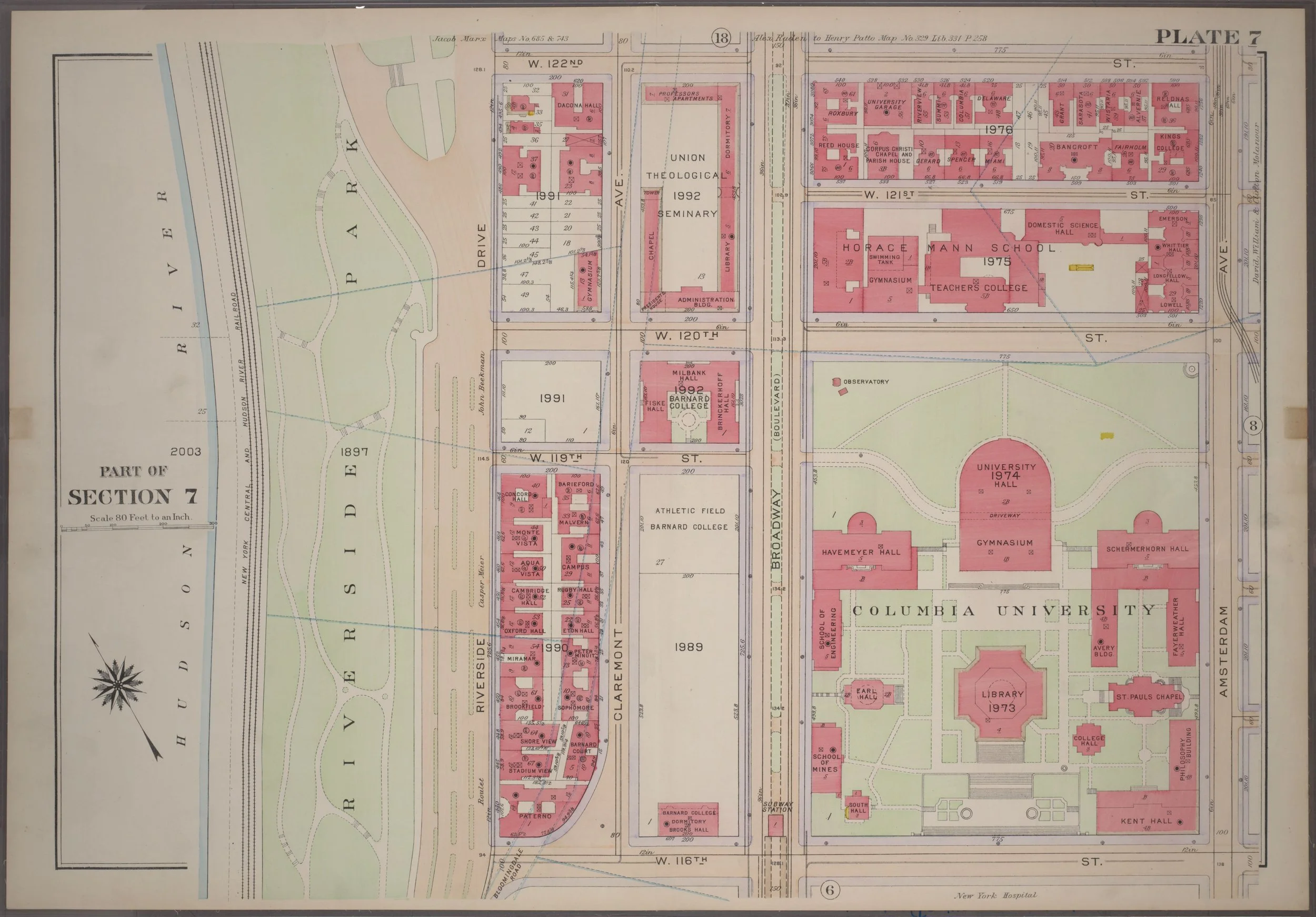
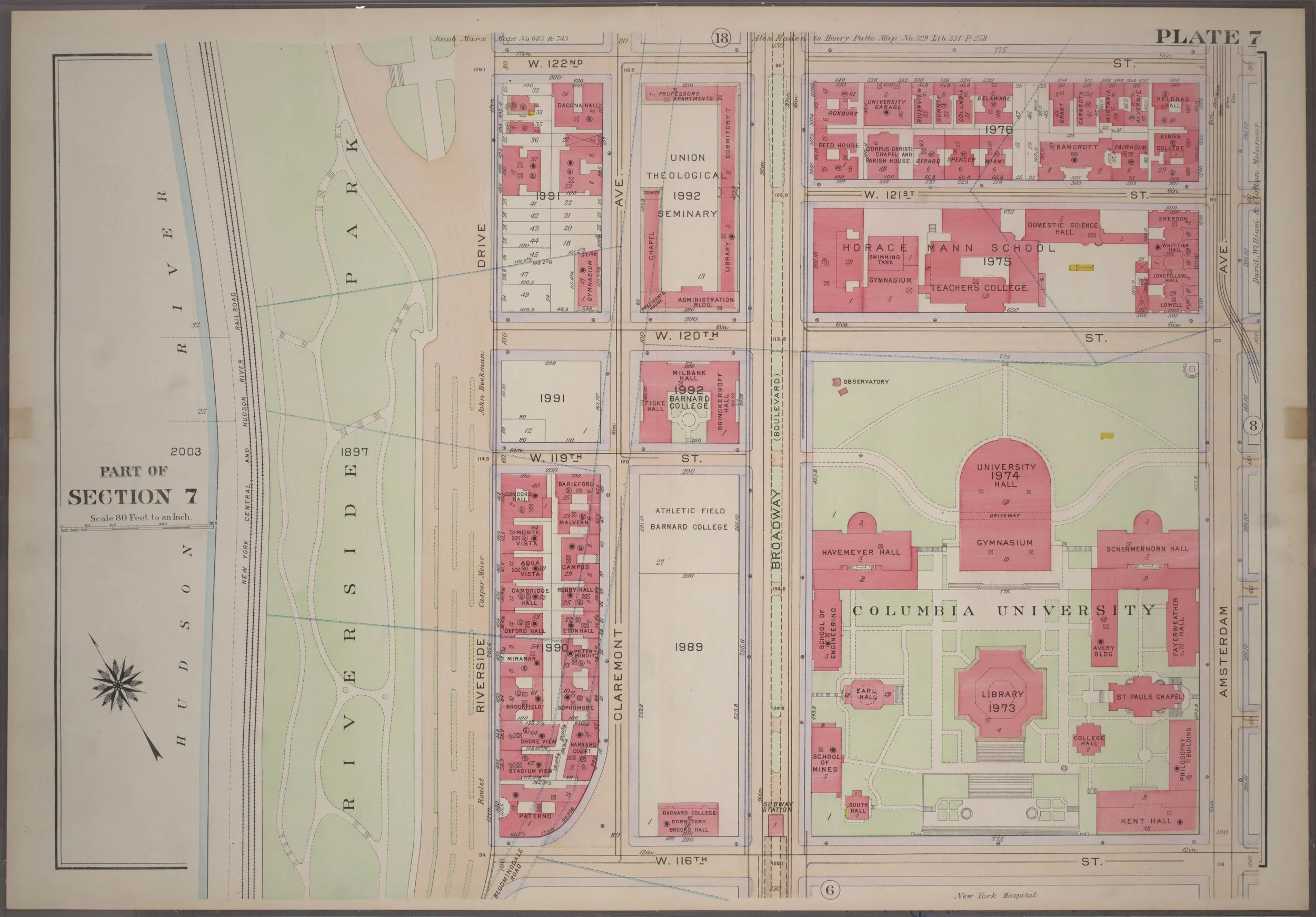
The University in/and Crisis Working Group invites you to attend a symposium featuring research and activism by students at Barnard College, Teachers College, and Columbia University. Students will present work that adopts methods drawn from the field of "critical university studies," and that draws on archives and repositories held on campus and across the Harlem neighborhood to investigate the enduring effects of social difference and spatial segregation in shaping histories of democratic education and mass intellectuality. The evening will culminate with a celebration with music and snacks.
Spearheaded by Professors Anupama Rao (Barnard College) and C. Riley Snorton (Columbia University), the University in/and Crisis Working Group probes, through reading meetings and public programs, the state of the university today and aims to contextualize it within longer histories of its entanglement with wider socioeconomic and political structures. The working group is an initiative of Columbia's Center for the Study of Social Difference, the Barnard Center for Research on Women, and the Edmund W. Gordon Institute for Advanced Study at Teachers College.
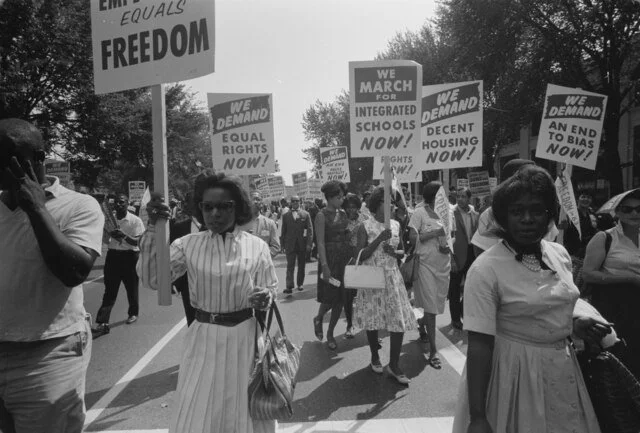
Seething with Our Presence: Method and Blackness in Law's Archive
Dylan C. Penningroth on 'Seething With Our Presence': Method and Blackness in Law's Archive
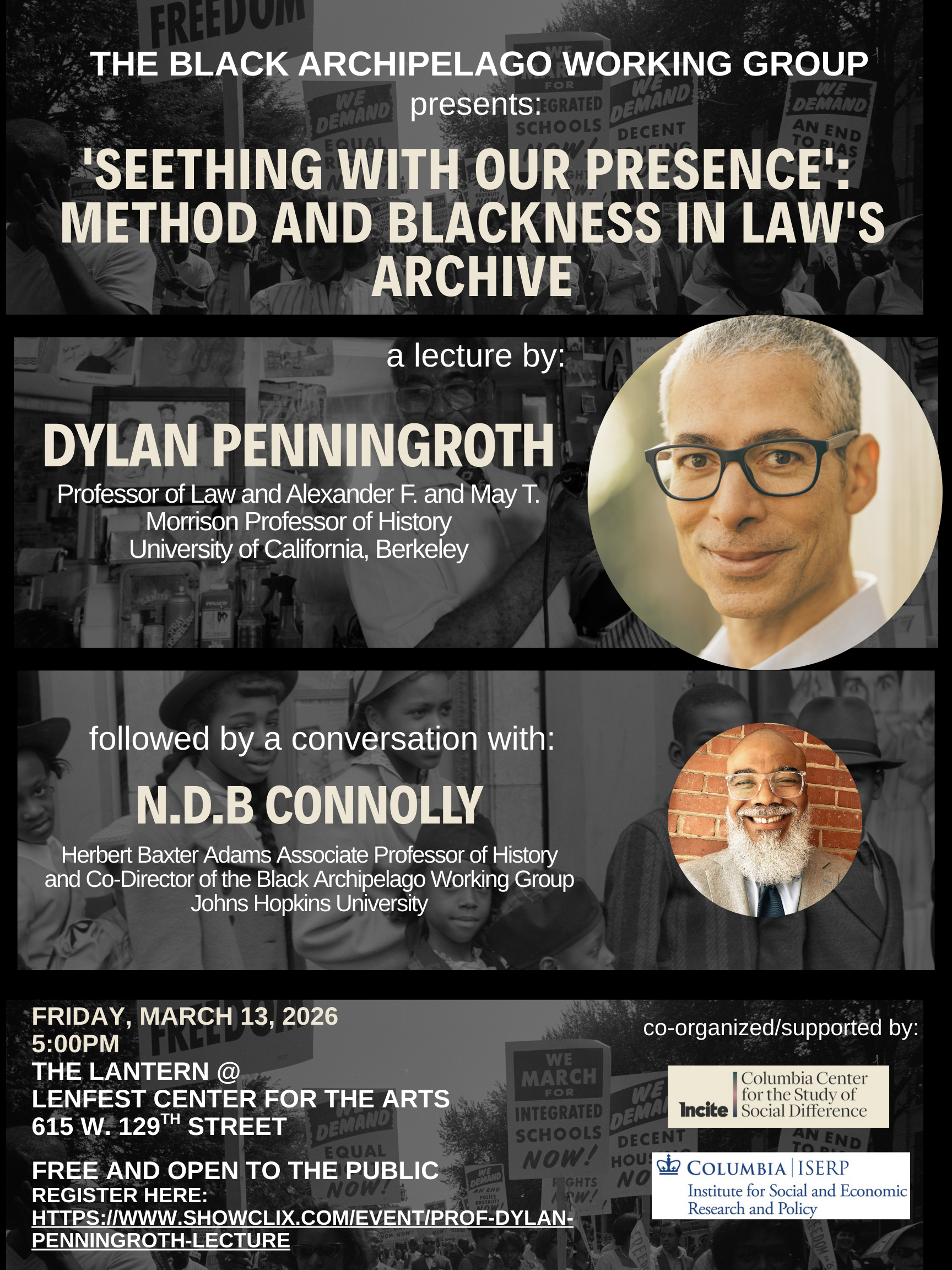
Over nearly three decades of award-winning scholarship, Prof. Dylan Penningroth has located African American civic wisdom, precarity and possibility. His methods have illuminated the transatlantic making of blackness and the often unseen struggles preceding some of our most storied freedom movements.
For this event, Prof. Penningroth will discuss the modern American legal archive and share some of the methods he has used to challenge its presumed interpretive limits. He will close the event in conversation with Prof. N.D.B. Connolly of Johns Hopkins University.
This lecture and conversation are part of the first public event organized by the Black Archipelago and the Crisis of Place working group, in collaboration with the Center for the Study of Social Difference at Columbia University, and supported by the Institute for Social and Economic Research and Policy.
, co-directed by Brandi T. Summers (Columbia University) and N.D.B. Connolly (Johns Hopkins University), is a multidisciplinary, multi-institutional collective of scholars who consider critically and recasts responsibly narratives about how the production of Black space is foundational to imaginative Black placemaking, self-actualization, and ways to catalogue future and existing spaces.
Black archipelago, for us, describes islands of affinity and belonging as well as islands of predicament. The Black Archipelago also describes both Black people’s shared encounters with white supremacy as well as, more crucially, how Black people stay connected to each other, to place and to notions of blackness. Through Black Archipelago, we seek to advance collaborations and, hopefully, methodologies grappling with the many threads of domination and insurgent innovation constituting historical patterns of the Black experience. To be sure, these patterns, regardless of capitalism’s various twists and turns, have ensured certain continuities of colonial administration and have tethered imperial cultural norms to modern-day racial and gender formations among Black people.
A Black archipelago is an answer to the question of how to think about enduring crises and enduring people in the Black World. This framework allows us to pay closer attention to how scholars, activists, and artists engage the poetics and materiality of Black life to explore ideas about repair, inequality, resistance, and liberation.

Saul Williams on Black Experimentation, Fugitive Pedagogies, and the Art of Resistance
Poet, musician, filmmaker, actor and intellectual Saul Williams discusses the relationships between aesthetic forms and political education in conversation with Dr. Shana Redmond, Director of the Center for the Study of Social Difference. Reflecting on practices of Black experimentation—in language, music, and film—this dialogue explores the various sites of enclosure and foreclosure, from the nation state to the university, that bear upon the present and what practices are necessary to enact more just futures.
This conversation is the second installment of the University in/and Crisis working group, a collaboration between the Center for the Study of Social Difference at Columbia University, the Barnard Center for Research on Women, and the Edmund W. Gordon Institute for Advanced Study at Teachers College, and is supported by The Radio in the Orchard. It is presented as part of The Schomburg Center for Research in Black Cultures's Black On Screen: A Century of Radical Visual Culture, a centennial series capturing 100 years of local and transnational Black movement work and artistic evolution on film.
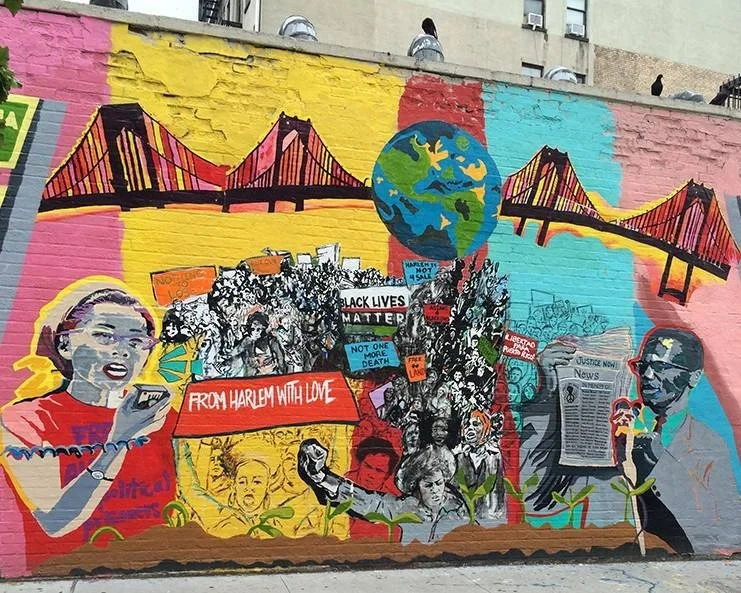
Harlem: Stories of Repression and Resistance Walk led by Asad Dandia
On this walk, we will learn about Harlem’s storied role in the movement against systemic injustice, including police violence.
This Enemy Institution: (Black) Study and the Insurrection Imperative
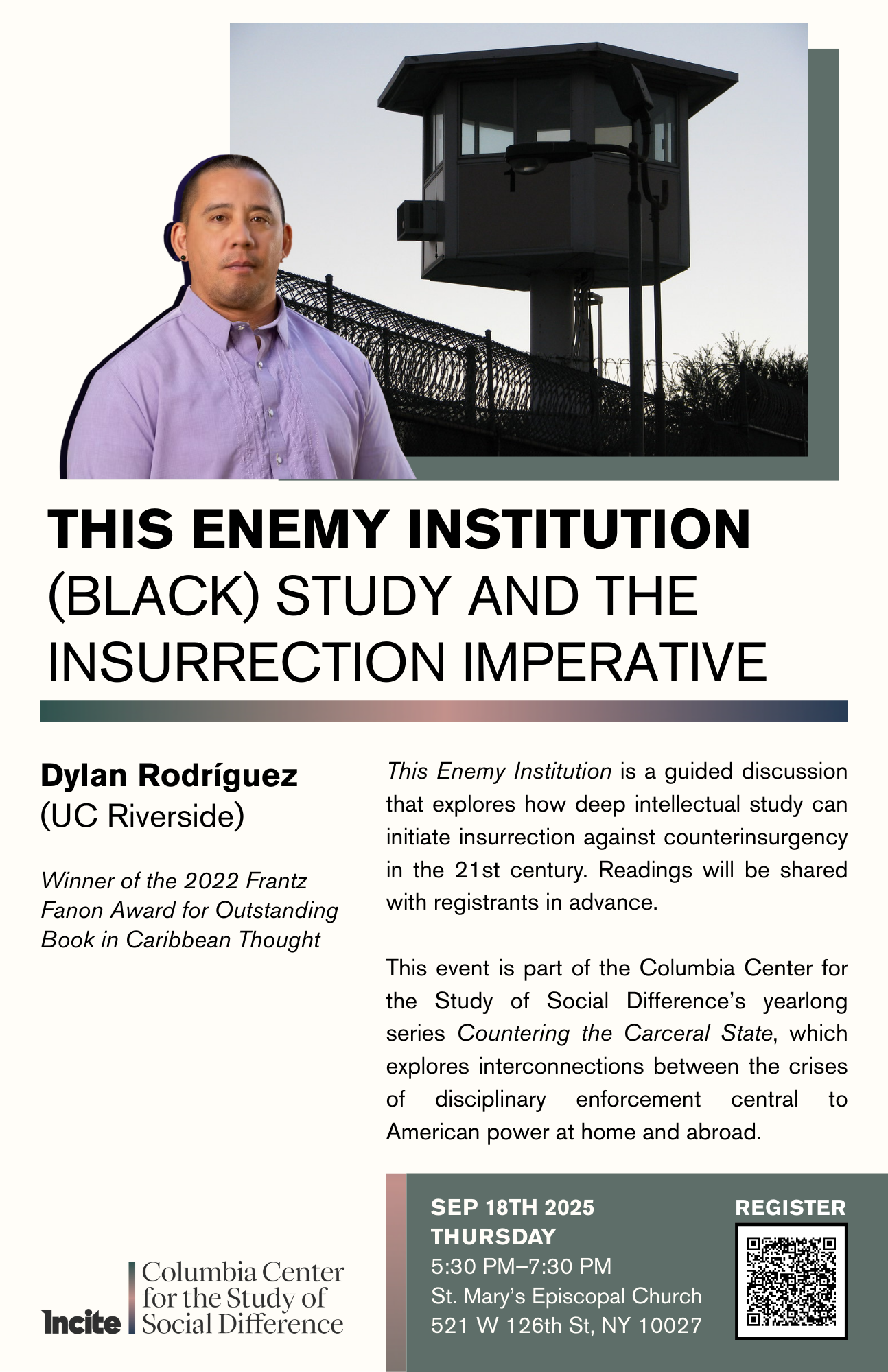
Please join us for a guided discussion that explores how deep intellectual study can initiate insurrection against counterinsurgency in the 21st century.
When the regimes of civil/human rights, liberal freedom, (social) justice, and “humanity” ostensibly “fail,” the archive of Civilizational warfare expands. This is happening in real-time: there is an acceleration of counterinsurgency projects, formed in a contentious scramble across state and extra-state venues, incorporating universities, humanitarian and philanthropic organizations, and capitalized social justice movements. The deadly inadequacies and alleged institutional betrayals of rights/freedom/justice/humanitarian (and related) regimes thus indicate neither political failure nor systemic dysfunction—appraisals that indicate a reformist imperative—but instead reveal the expansion of a 21st century Counterinsurgency Machine. Logics of neutralization, extermination, discipline, and empowerment shape this ensemble, which targets anti-Civilizational streams of liberationist activity and thriving. To analyze and confront this machine is to coordinate, study, and strategically theorize an insurrection imperative.This Enemy Institution is the first event in the Center for the Study of Social Difference’s yearlong program Countering the Carceral State, which explores interconnections between the crises of disciplinary enforcement central to American power at home and abroad.
The discussion will be followed by coffee, tea, and cookies in the church garden.
RSVP here.
Readings for the guided discussion will be circulated by email to event registrants. Additionally, the list of readings is provided below.
This Enemy Institution is the first event in the Center for the Study of Social Difference’s yearlong program Countering the Carceral State, which explores interconnections between the crises of disciplinary enforcement central to American power at home and abroad.
Reading List:
Robert L. Allen, “Personal Reflections on the Road to Black Awakening in Capitalist America,” p. 118-122. (5 pages)
Dylan Rodríguez, Forced Passages, Chapter 1, “Domestic War Zones and the Extremities of Power: Conceptualizing the U.S. Prison Regime,” p. 39-74. (35 pages)
Dylan Rodríguez, “On University Abolition,” pp. 367-374. (8 pages)
United States Joint Chiefs of Staff, Joint Publication 3-24: Counterinsurgency (2018), “Executive Summary,” p. Ix-xxi. (12 pages)
The Heritage Foundation, Mandate for Leadership, 2025: The Conservative Promise, (a.k.a. “Project 2025”), 2023:
- Kevin D. Roberts, “Foreword: A Promise to America,” p. 29-46;
- “Section One: Taking the Reins of Government,” introduction, p. 47-49;
- Lindsey M. Burke, “Ch. 11, Department of Education,” “Mission” and “Overview,” (25 pages)
Freedom and Insurgence: Recalling Fanon
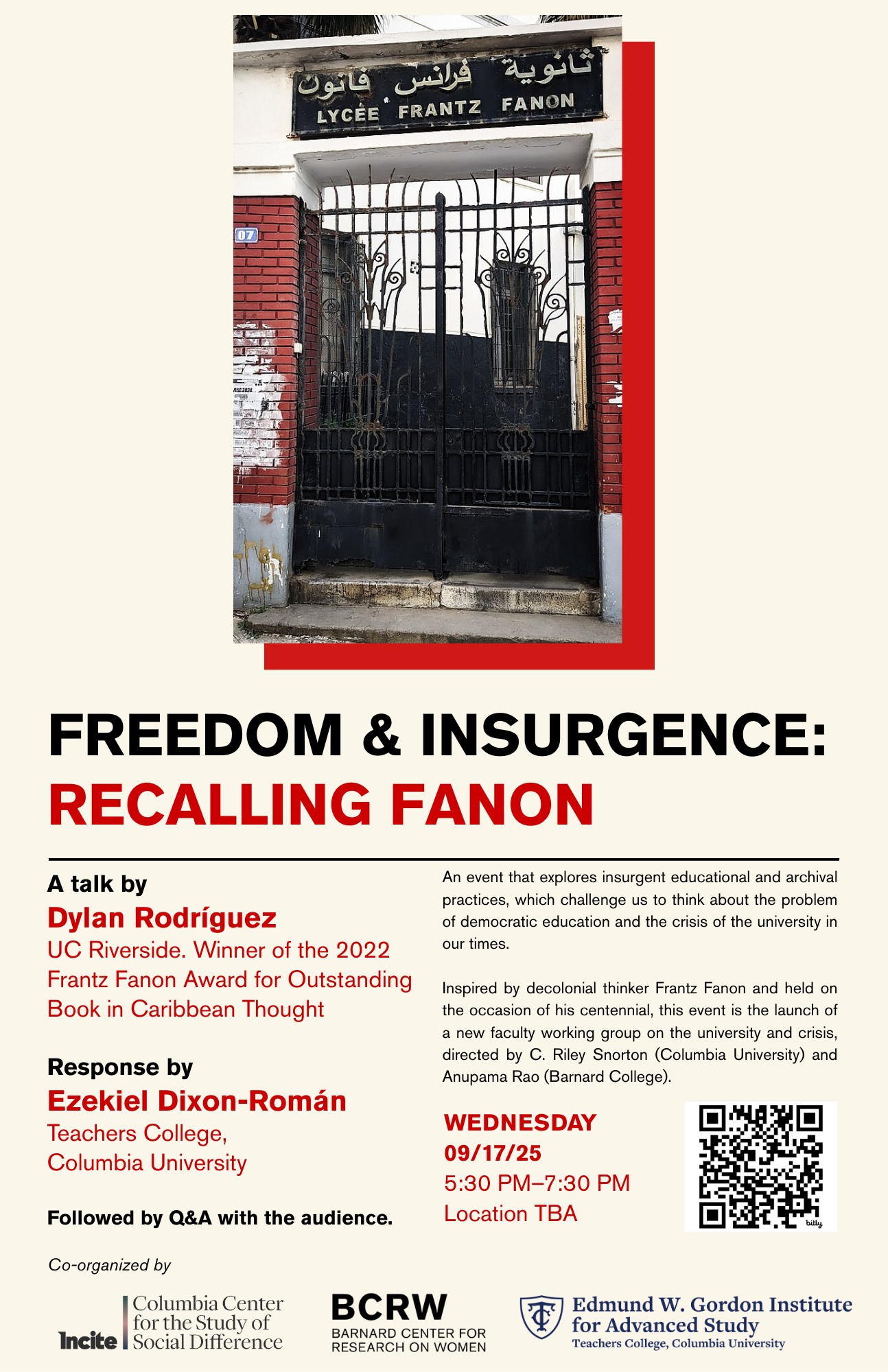
A conversation on insurgent educational and archival practices that challenge us to think about the problem of democratic education and the crisis of the university in our times.
Inspired by de-colonial thinker Frantz Fanon and held on the occasion of his centennial, this event is the launch of a new faculty working group on the university and crisis, directed by C. Riley Snorton and Anupama Rao.
The working group is co-organized by the Center for the Study of Social Difference, the Barnard Center for Research on Women, and the Edmund W. Gordon Institute for Advanced Study at Teachers College.
Location is TBD.
RSVP here.

In Defiance: Launch Party for Countering the Carceral State
Join Us for an Evening of Music and Community!
The Center for the Study of Social Difference at Columbia University invites you to celebrate the launch of our yearlong program Countering the Carceral State. Inspired by Malcolm X's internationalist insights and in line with CSSD's thematic focus in 2025-2026 on crisis, the program explores interconnections between the crises of disciplinary enforcement central to American power at home and abroad. Program events will probe continuities between policing, racial profiling, and police militarization; the prison industrial complex; immigrant detention; forever wars in the Middle East and Central Asia; and the transformation of war zones like Gaza into technological testbeds.
5:30 PM - Shabazz Center Tour and Opening Drinks
Our event will begin with a drinks reception and guided tour of the historic Malcolm X & Dr. Betty Shabazz Memorial and Educational Center.
Event seating begins at 6:15 pm.
6:30 PM - Archive Unveiling
We will then follow the tour with a Malcolm X audiovisual archive presented by renowned scholar Sohail Daulatzai (UC Irvine).
7:30 - Concert Vijay Iyer and Wadada Smith: Defiant Life
We will cap off the evening with an live concert featuring the acclaimed duo of Vijay Iyer and Wadada Leo Smith performing their album Defiant Life.
We look forward to seeing you there. Drinks and seating are first come first served. Make sure to get your ticket and arrive early to guarantee your entry.
This event is co-sponsored by the Department of Music, and is in collaboration with the Institute for Research in African American Studies and the African American and African Diaspora Studies Department at Columbia University.

Q&A Session on the Call for Proposals 2025
CSSD is excited to welcome all professors from Columbia, Barnard, Teachers College, and CUMC to attend a virtual Q&A session for our upcoming Call for Proposals in interdisciplinary research grants on this year's theme: "Crisis"
RSVP here

Seeds from a Seed's Perspective: A Lecture & Discussion with Eric Sanderson
Seeds from a Seed's Perspective: A Lecture & Discussion with Eric Sanderson
Insights on the Movement of Plant Propagules by Indigenous People, Other People, and Others in the Landscape that became New York (Welikia)
Eric Sanderson has been working for nearly twenty-five years to understand the historical ecology of New York City, deriving insights relevant to conservation, urban planning, resilience, and epistemological issues, such as: what does it mean to be a New Yorker? How do you get here? How do you get away? Here we take the seed’s perspective on these questions and examine the processes by which we can understand the historical landscape before New York, what it meant for seeds and their movement, and how those movements changed in a landscape long stewarded by the Indigenous Lenape people to one controlled by the Dutch and English settlers to the our modern American metropolis.
Register here
Extractive Media Conference

On December 13–14, Extractive Media working group is holding a conference that seeks to explore the intersection of extraction, capitalism and media. A
keynote by Martín Arboleda on Friday, December 13 at 5pm in 807 Schermerhorn will be followed by a day of panels on Saturday, December 14, with presentations from Patrick Brodie, Nadine Chan, Janna Israel, Tamara Kneese, Rosalind Morris, and Rafico Ruiz.
Limited Space Available
RSVPs to extractivemedia@columbia.edu are required.
Extractive Media Seminar
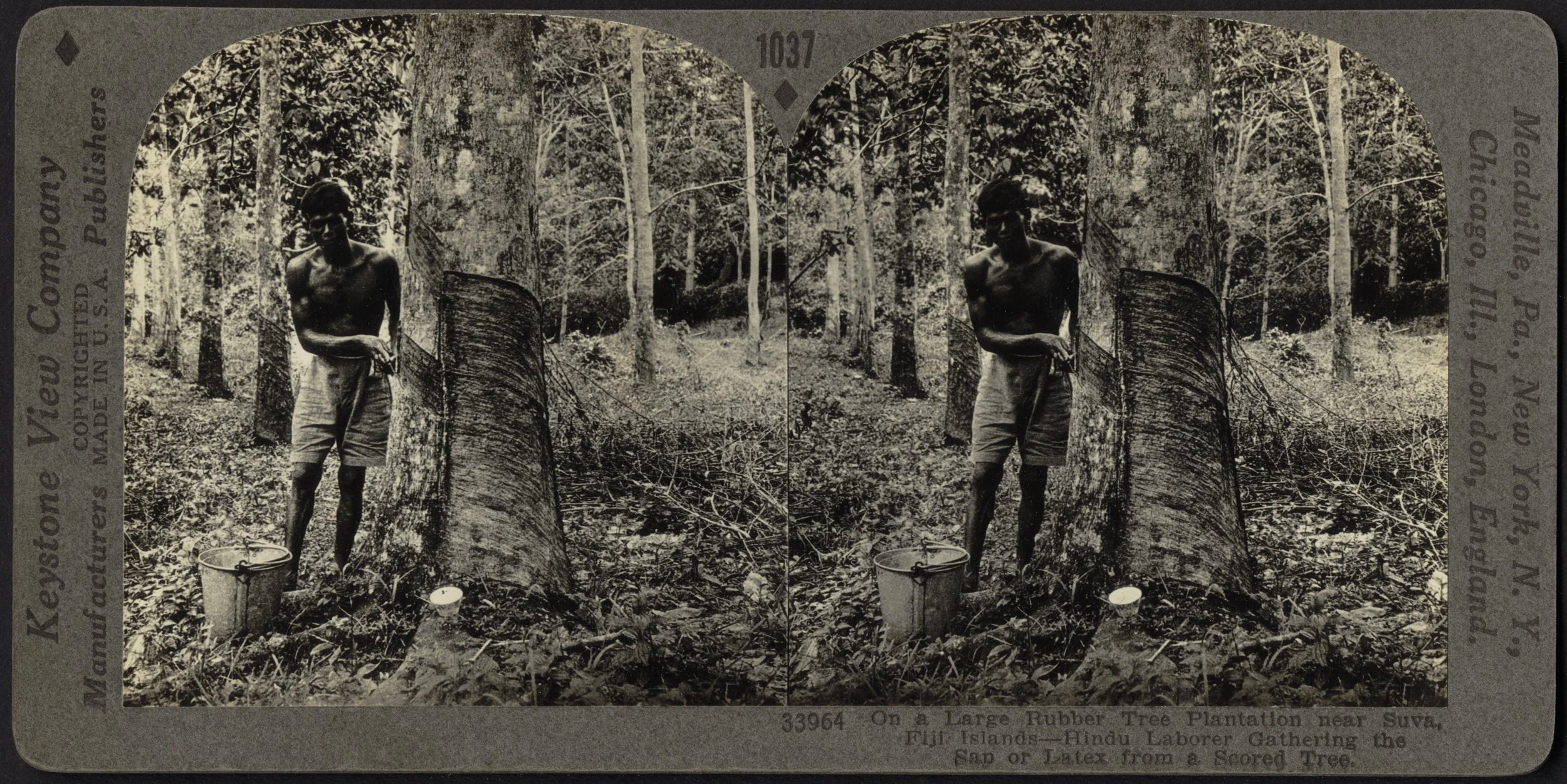
On November 11, Extractive Media Working Group is holding a seminar at 6:10 pm in Schermerhorn 934.
Professors Debashree Mukherjee, Brian Larkin, Zeynep Çelik Alexander, and Jennifer Wenzel will lead a discussion of readings related to the upcoming Extractive Media conference.
RSVPs to extractivemedia@columbia.edu are required.

Book Launch Alert: Emily Bloom’s "I Cannot Control Everything Forever"
Book Launch Alert: Emily Bloom’s "I Cannot Control Everything Forever"

"Vertical Integration: An Artist Talk" with Shaina Anand and Ashok Sukumaran, CAMP, Mumbai

On September 19, Shaina Anand and Ashok Sukumaran of the Mumbai-based studio CAMP will present an artist talk that proposes the term "vertical integration" as a means for thinking more broadly about extraction, waste, dependency, and other elements of production.

Dr. Karen O'Connell & the Gendering of "Stress"

On June 10, Dr. Karen O Connell from the University of Technology, Sydney, will join the Recovery Working Group and share her sabbatical research about the gendering of “stressˮ and how we use, or misuse, the concepts of stress and trauma to compensate women for gendered harms (especially sex discrimination and sexual harassment) or to render certain harms invisible.
Her initial reading shows that stress studies are grounded in assumptions about the inherent stress levels of various activities that donʼt match womenʼs lived experience. This work will also explore whether a compound concept such as “stressˮ can be used to encourage a more intersectional approach to harm in law.
More information on this event soon.

Iberian Seascapes
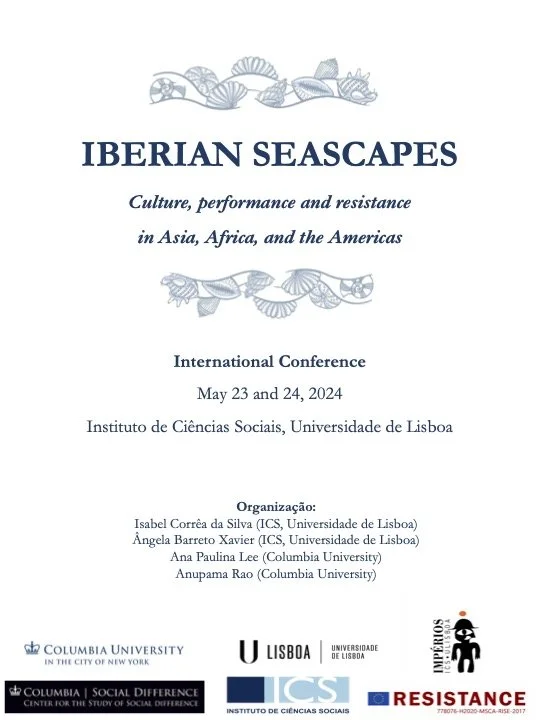
The Geographies of Injustice Working Group will be co-sponsoring and participating in the international conference, titled “Iberian Seascapes: Culture, Performance, and Resistance in Asia, Africa, and the Americas,” at the University of Lisbon on May 23-24, 2024.
Scholars from India, Portugal, Brazil, and the United States will gather for for this two-day conference to discuss themes of race, caste, law, sound, and cinema as it pertains to the "Luso-Hispanic Moment"

Camera South Asia II
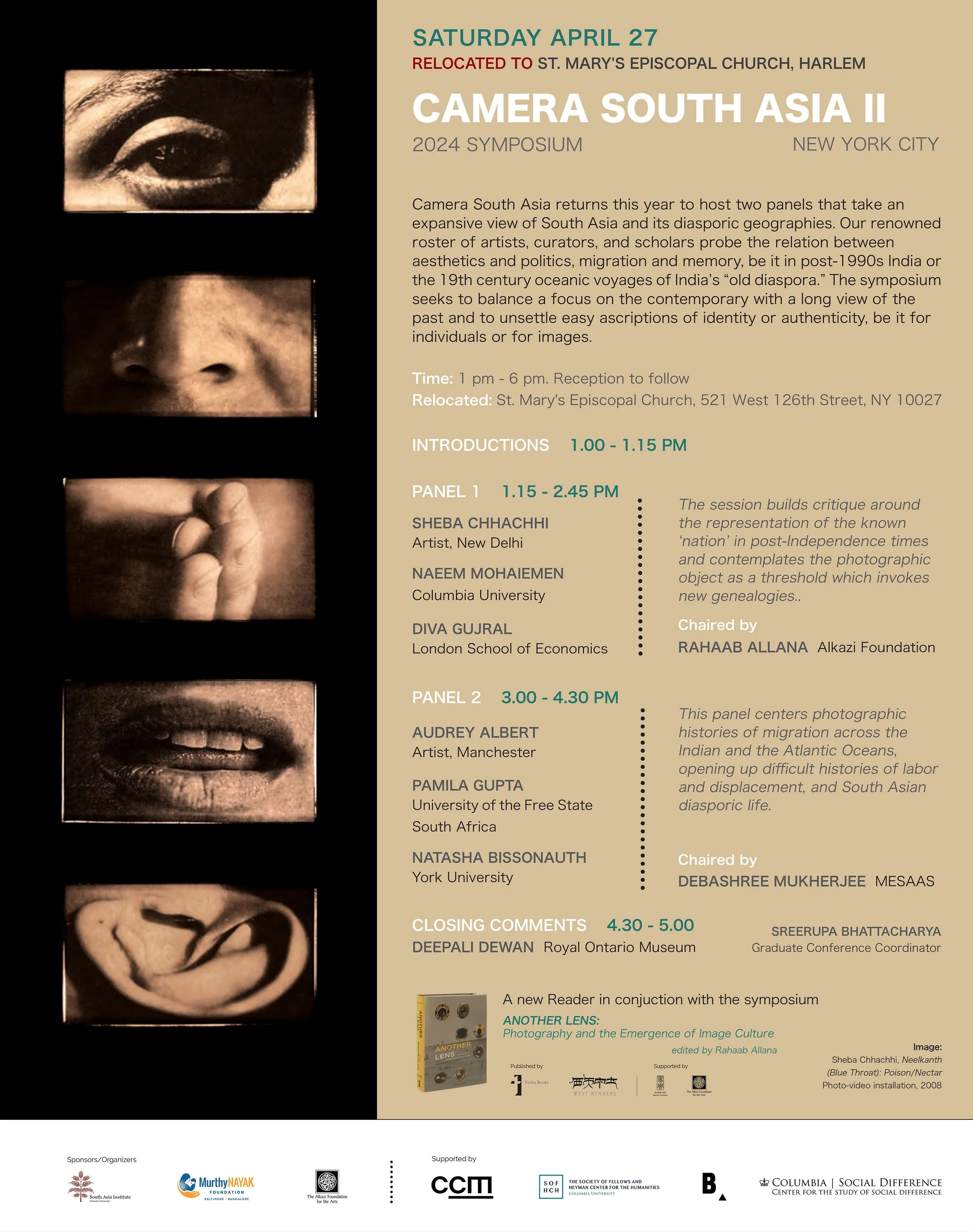
The Extractive Media Working Group at CSSD will be co-sponsoring Camera South Asia II alongside the South Asia Institute as they return this year to host a conversation that takes an expansive view of South Asia and its diasporic geographies. Our renowned roster artists, curators, and scholars probe the relation between aesthetics and politics, migration and memory, be it in post-1990s India or the 19th century oceanic voyages of the subcontinent’s “old diaspora.” Camera South Asia seeks to balance a focus on the contemporary with a long view of the past and to unsettle easy ascriptions of identity or authenticity, be it for individuals or for images.
When: Saturday, April 27
1 PM - 6 PM EDT
Where: St Mary's Episcopal Church in Harlem
SCHEDULE
1-1.15pm: Introductions
ANOTHER LENS
Panel 1: 1.15 - 2.45 pm
Moderated by Rahaab Allana (Alkazi Foundation)
The panel draws upon the scholarship of a newly published reader titled Another Lens (ed. Rahaab Allana; published by Tulika and Westheavens), as part of a series called India Since the 90s. The book and this associated panel reframe lens-based practice in India through a fresh historical perspective. The panel hopes to narrate key aspects of the transformation and redefinition of photography in the 1990s – the decade marked by economic liberalization, globalization and the embedment of digital technology that revolutionized the media sphere. The contributors critically examine normative paradigms of image production, exhibition and circulation in the areas of documentary and fine art photography, journalism, cinema, contemporary arts and the archive. They also delineate new publics, emergent patterns of viewership, shifting modes of media consumption, and the diverse, technologically enabled creative trajectories that inscribe the postcolonial imaginary within the wider orbit of South Asian image cultures.
“‘Oh what a blow that phantom gave me!’”
Sheba Chhachhi (Artist, New Delhi) via ZOOM
“Camera Silence: Harmit Singh’s War”
Naeem Mohaiemen (Columbia University)
“Photography, Nation and Narration: Thinking between the 1950s and 1970s”
Diva Gujral (London School of Economics)
Tea: 2.45 - 3.00 pm
ACROSS OCEANS
Panel 2: 3.00 - 4.30 pm
Moderated by Debashree Mukherjee (MESAAS)
The contours of South Asia go far beyond territorial and national boundaries, or Cold War-era geopolitical divisions. South Asia extends into all the diasporic spaces made by workers, traders, teachers, and artists who moved out of the Indian subcontinent by choice or by necessity. This panel centers photographic histories of migration across the Indian and the Atlantic Oceans from the late 19th century to the present. Our speakers open up difficult histories of indentured labor in the Caribbean, forced displacement in the Chagos Archipelago, and diasporic photo-entrepreneurship on the Swahili coast to initiate an important conversation in the United States on the vexed and multiple trajectories of South Asian diasporic life. Through these papers, photography announces itself as simultaneously a form of biometric surveillance, aspirational self-making, and a multi-generational site of healing.
“Matter Out of Place”
Audrey Albert (Artist, Manchester)
“Looking for, Listening to ‘Crowds’ in the Capital Art Studio Collection (Zanzibar)”
Pamila Gupta (University of the Free State, South Africa)
“Renluka Maharaj’s Coolie Iconoclasm”
Natasha Bissonauth (York University)
Closing Remarks: 4.30PM
Further resources & links:
The recent declaration by the Barnard and Columbia Chapters of the American Association of University Professors (AAUP)
The demands for boycott from the Faculty and Staff for Justice in Palestine at Barnard and Columbia.
St Mary's Episcopal Church of Harlem is ten blocks from the Morningside (main) campus, and one block from the Manhattanville campus. They have a history of providing sanctuary for undocumented youth, LGBTQ youth, and opposing the gentrification of Harlem. The priest is Reverend Dr. Mary Foulke, an abolitionist. Here is an interview with her: “[W]e’ve asked you for help, and you gave us a raid.”

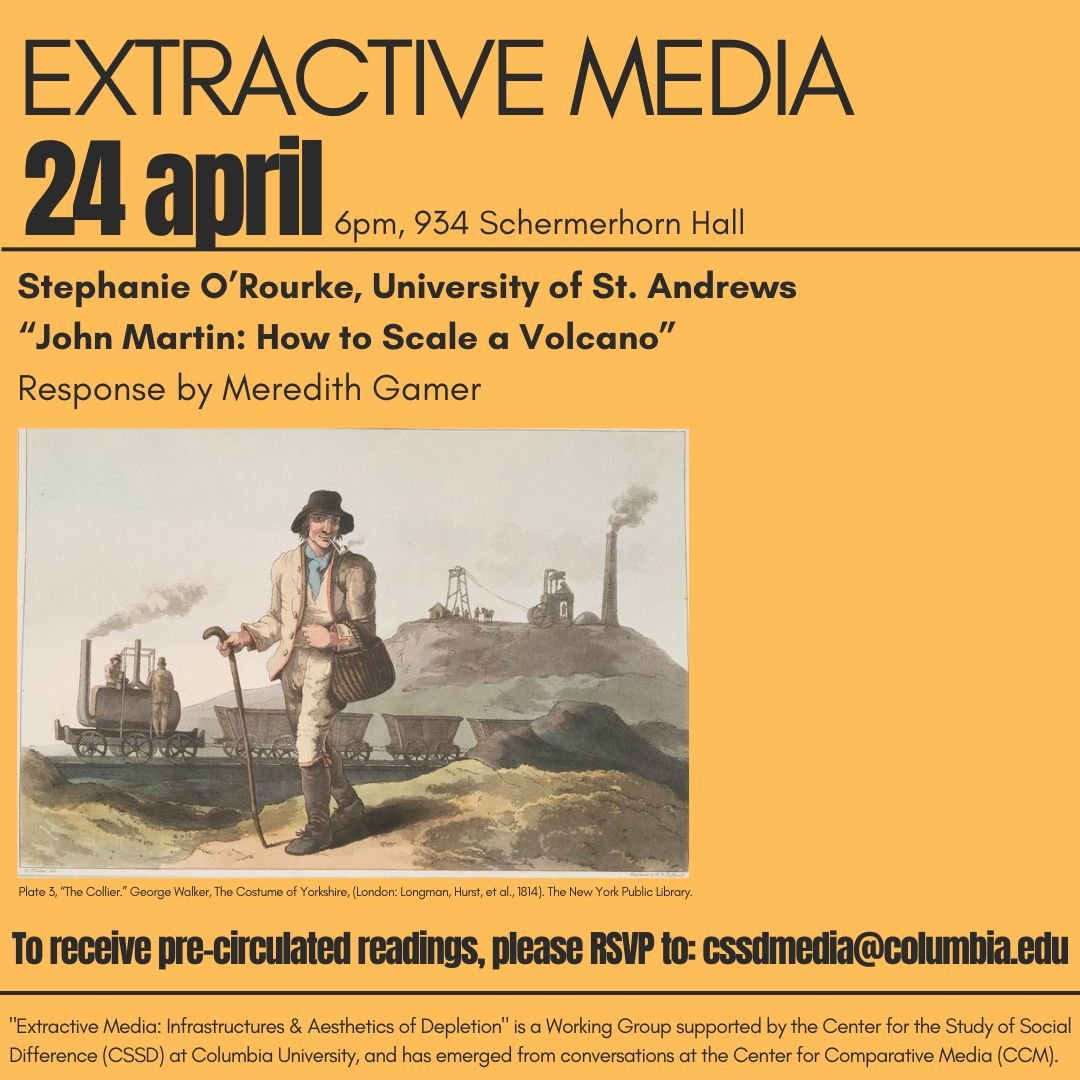
"John Martin: How to Scale a Volcano" with Professor Stephanie O'Rourke
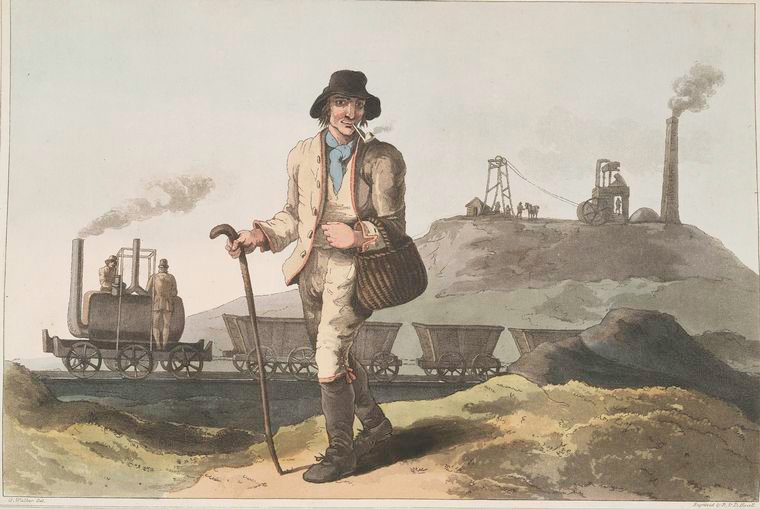
Plate 3, “The Collier.” George Walker, The Costume of Yorkshire, (London: Longman, Hurst, et al., 1814). The New York Public Library.
The Extractive Media Working Group welcomes Professor Stephanie O’Rourke for an event, titled “John Martin: How to Scale a Volcano,” on April 24, 2024.
Attendance is limited to faculty and doctoral students.
When: Wednesday, April 24, 2024
6:15 PM
Where: 934 Schermerhorn Hall, CU
Bio: Stephanie O’Rourke is a senior lecturer in Art History at the University of St Andrews. Her current book Picturing Landscape in an Age of Extraction 1780-1850 will be published in 2025 by the University of Chicago Press. Her first book, Art, Science, and the Body in Early Romanticism (Cambridge UP 2021) was awarded the British Association for Romantic Studies book prize and was supported by fellowships including from the Leverhulme Trust and the Royal Society of Edinburgh. She completed her PhD in art history at Columbia University and holds a BA from Harvard University.
Event Abstract: To what extent did landscape supply a kind of pictorial infrastructure for managing the more dangerous circulations of industrial extraction in early 19th-century Britain? The desired in-flow of natural resources like timber, coal, and water to industrial centers coincided with the rapidly escalating out-flow of threatening substances like pyrotechnic energy, noxious gases, and sewage. The artist John Martin was at pains to manage these flows in both his engineering projects and the scalar keys produced for his large-scale spectacular paintings.
This paper looks first to widespread fears about coal mining explosions and later to the urban infrastructure of water and waste to reveal how British artists encountered an environment characterized by new crises in the transit of water and waste. I examine a range of pictorial and metapictorial techniques Martin developed for responding to this crisis, including an appeal to scale effects. In early and mid-nineteenth-century Britain, scale was becoming a significant tool for British imperial governance and was likewise used to conceptualize economic exchanges, energy systems, and other complex, sometimes invisible forms of relationality animating European industrial extraction.
[Nb. The paper is a draft chapter for a book manuscript that examines how European artists addressed the emergence of a new and essentially extractive way of treating and conceptualizing the natural world at the turn of the nineteenth century.]
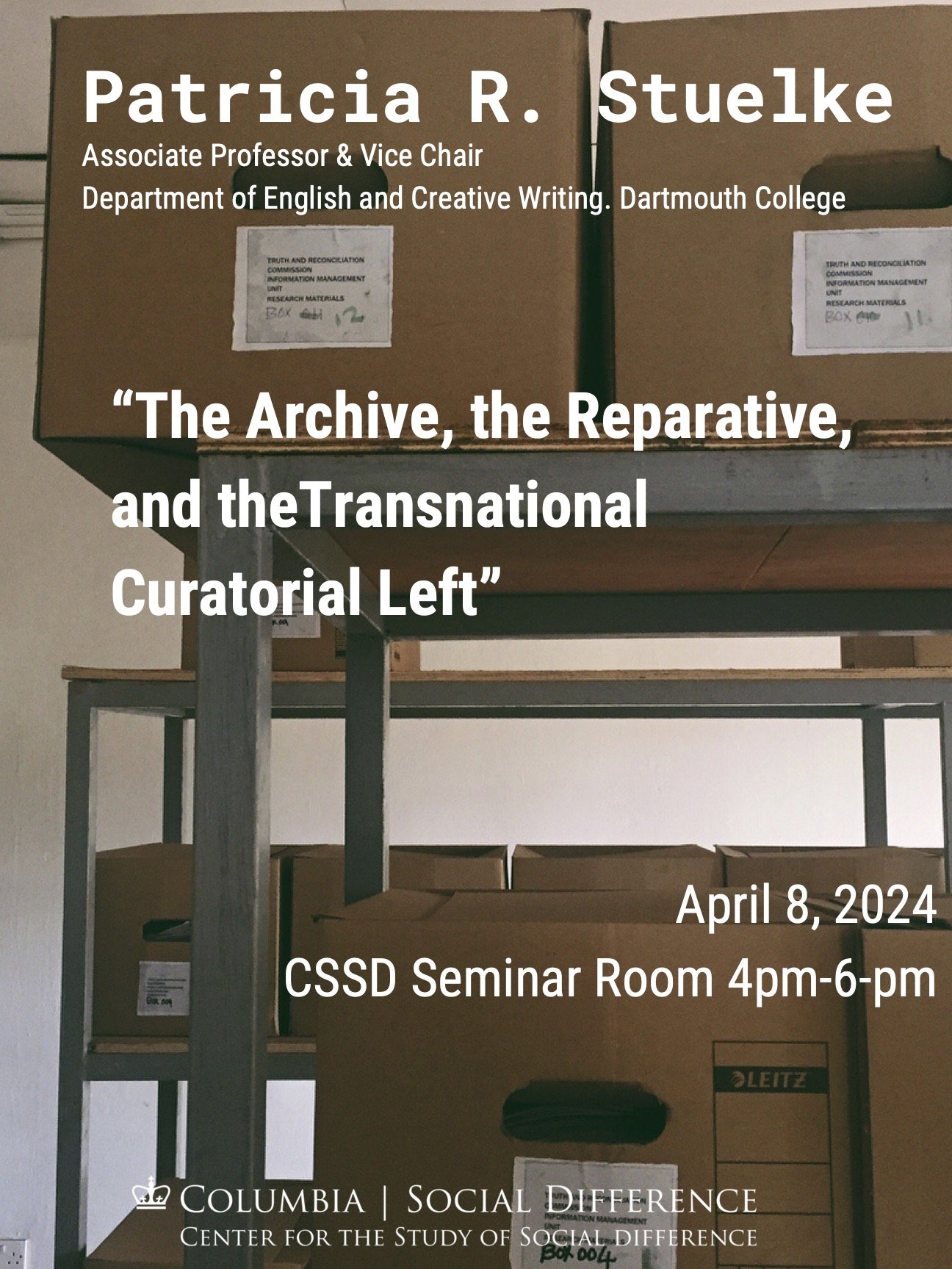
The Archive, the Reparative, and the Transnational Curatorial Left
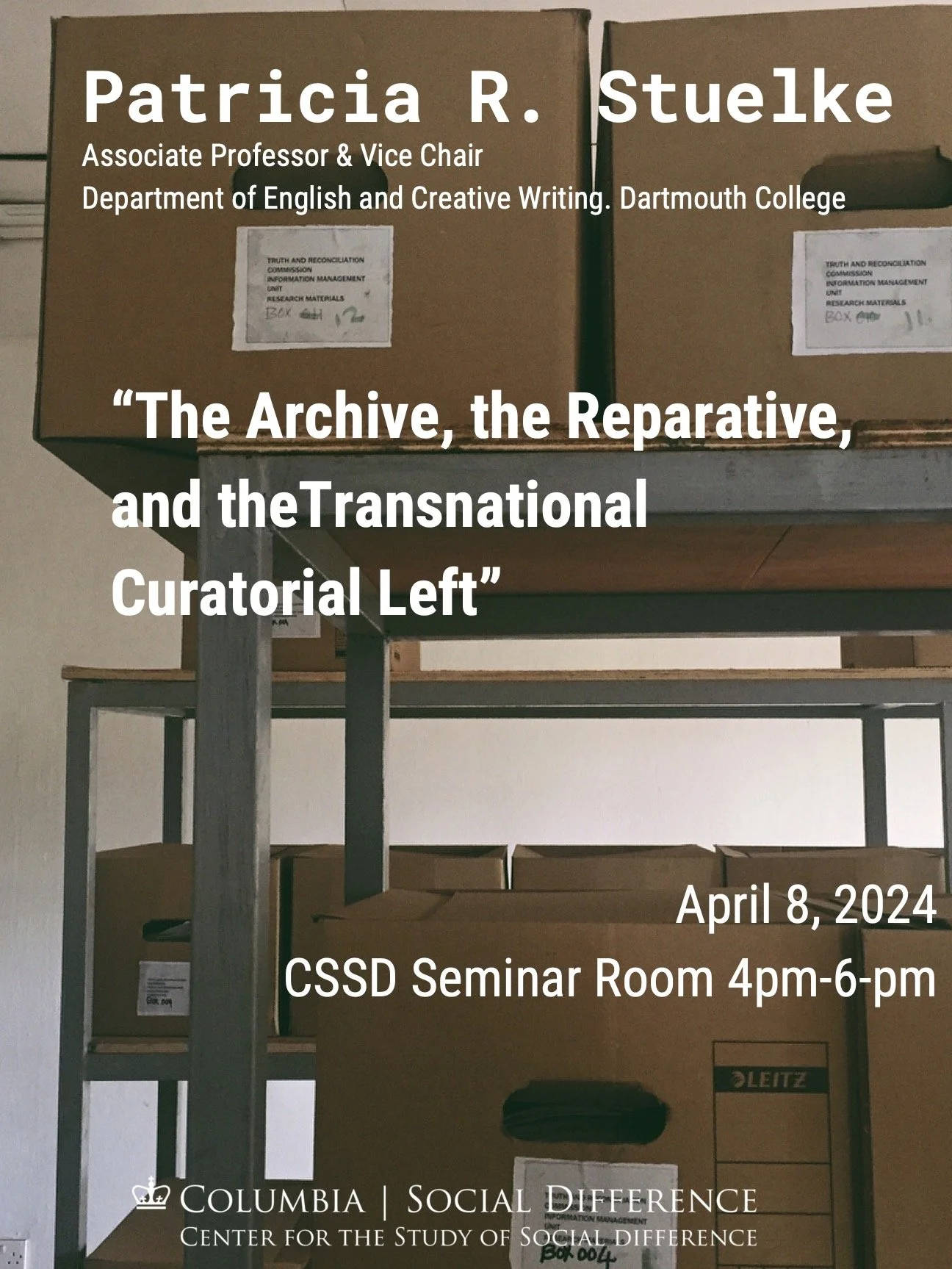
The Recovery Working Group will be hosting Professor Patricia R. Stuelke, Associate Professor and Vice Chair of the Department of English and Creative Writing at Dartmouth College, on April 8, 2024 for a seminar titled “The Archive, the Reparative, and the Transnational Curatorial Left.”
When: April 8, 2024
4-6 PM
Where: CSSD Seminar Room
752 Schermerhorn Extension, CU
Attendance for this event is limited to Working Group members and invited guests.

The 49th Annual Scholar and Feminist Conference: Anti-Colonialism, Black Radicalism, and Transnational Feminism
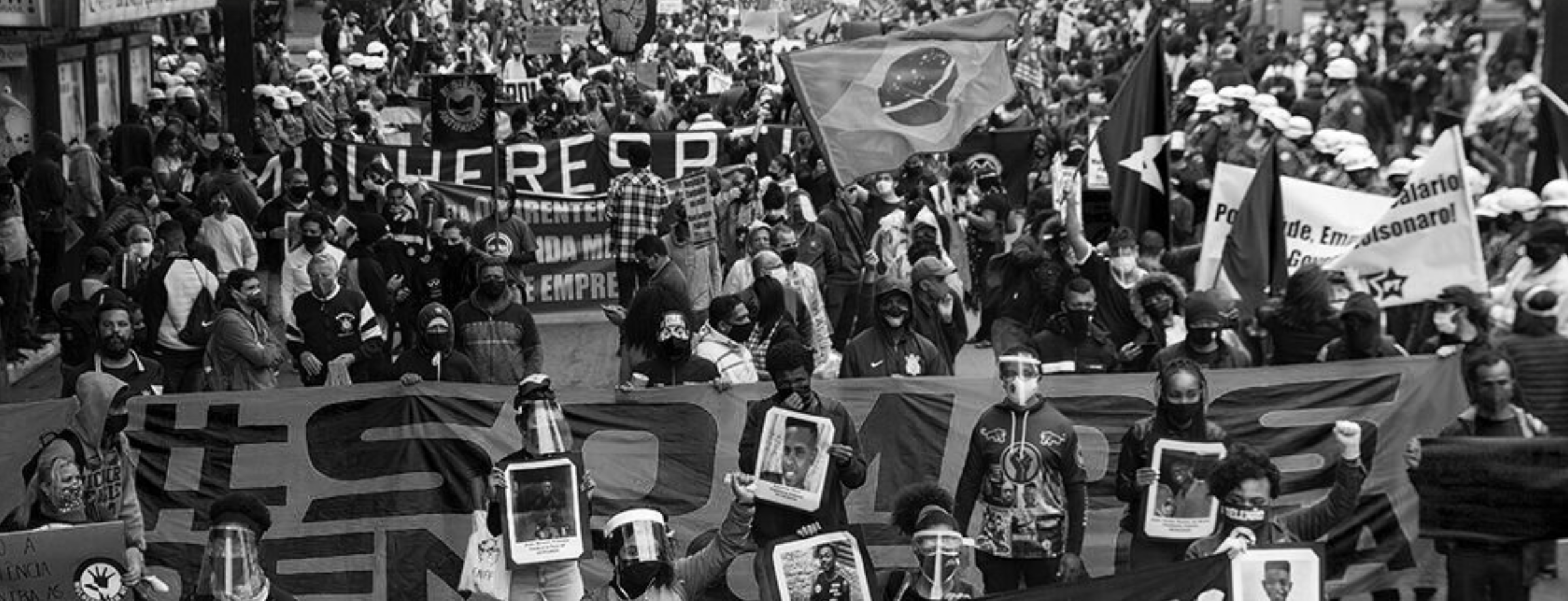
When: Friday, March 22, 3-5 PM & Saturday, March 23, 9:30 AM - 6 PM.
Where: Event Oval, Diana Center, Barnard College
Conference Summary:
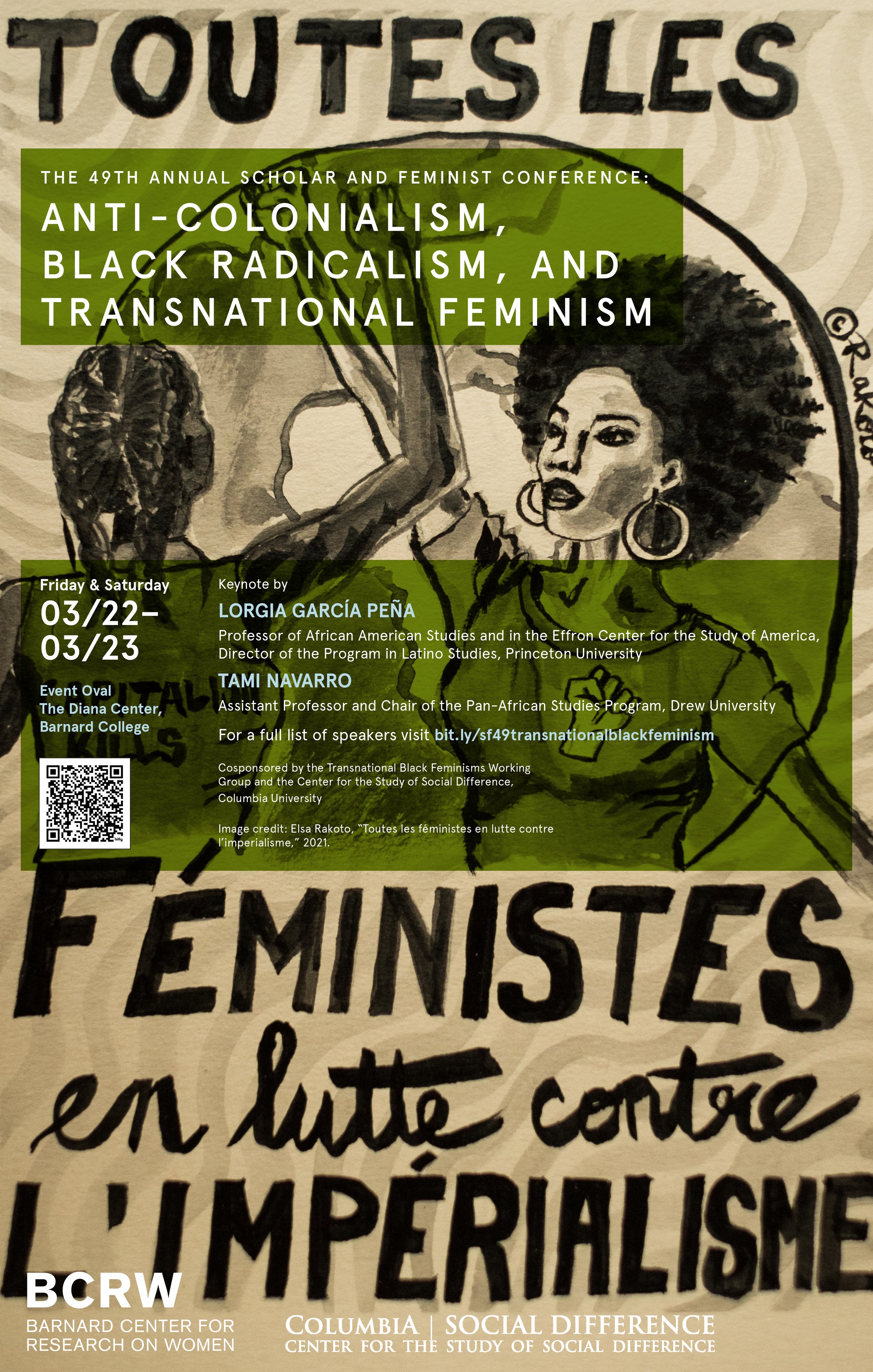
The Barnard Center for Research on Women and the Center for the Study of Social Difference’s Transnational Black Feminisms Working Group present the 49th annual Scholar and Feminist Conference. The conference will explore transnational Black feminism in the context of “third world” liberatory movements since the 1940s. At the height of struggles for anti-colonial independence in the African subcontinent and diasporic communities during the 1960s and 1970s, the praxis of Black feminist alliances proved to be foundational to global anti-racist and anti-imperial radicalism. We aim to consider how Black feminist solidarity was forged across a broader geopolitical frame that includes the Indian, Atlantic and Pacific Oceans, strengthening local mobilizations and generating new transnational liberatory possibilities. We will also chronicle the evolution of transnational Black feminism since then, and how the shift from ant-colonialism to neoliberalism impacted the radical possibilities embedded in attempts at self-determination and collaboration across geographic divides.
Conference Schedule:
Friday, March 22
3:00 p.m. | Welcome by Janet Jakobsen (Co-Director, Barnard Center for Research on Women and Claire Tow Professor of Women's, Gender, and Sexuality Studies, Barnard College)
3:30-5 p.m. | Marxism and Transnational Black Feminist Liberation
Charisse Burden-Stelly (Associate Professor of History and African American Studies, Wayne State University)
Dayo Gore (Associate Professor, Department of African American Studies, Georgetown University)
Robyn Spencer-Antoine (Associate Professor of History and African American Studies, Wayne State University)
Keeanga-Yamahtta Taylor (Hughes-Rogers Professor of African American Studies, Princeton University)
Moderated by Premilla Nadasen (Co-Director of BCRW and Ann Whitney Olin Professor of History, Barnard College)
Saturday, March 23
9:30 a.m. | Welcome by Janet Jakobsen (Co-Director, Barnard Center for Research on Women and Claire Tow Professor of Women's, Gender, and Sexuality Studies, Barnard College) and Premilla Nadasen (Co-Director of BCRW and Ann Whitney Olin Professor of History, Barnard College)
10-11:30 a.m. | Black Women and Anti-Colonialism 1940s-1980s
Lynette Jackson (Associate Professor of Gender and Women’s Studies and Black Studies, University of Illinois-Chicago)
Laurie Lambert (Associate Professor of African and African American Studies, Barnard College)
Paula Marie Seniors (Associate Professor of Africana Studies in the Department of Religion and Culture, Virginia Tech)
Moderated by Imaobong Umoren (Associate Professor of International History, London School of Economics)
11:45 a.m. - 1 p.m. | Lunch
1-2:30 p.m. | The Colonial Legacy, Gender, and Economic Empowerment
Yolande Bouka (Assistant Professor of Political Studies, Queen’s University)
Jennifer Fish (Professor of Women’s and Gender Studies, Old Dominion University)
Natasha Lightfoot (Associate Professor of History, Columbia University)
Keisha-Khan Perry (Presidential Penn Compact Associate Professor of Africana Studies, University of Pennsylvania)
Moderated by Tami Navarro (Assistant Professor and Chair of the Africana Studies Department, Drew University)
2:45 - 4:15 p.m. | Intellectual and Activist Interventions in Contemporary Movements
Layla Brown (Assistant Professor of Cultural Anthropology & Africana Studies, Northeastern University)
Tao Leigh Goffe (Associate Professor of Africana, Puerto Rican, and Latino Studies, Hunter College)
Zifeng Liu (Postdoctoral Scholar in the Africana Research Center, Pennsylvania State University)
Gabriella Muasya (PhD Student in the Department of Educational Anthropology and Educational Psychology, Danish School of Education)
Moderated by Tami Navarro (Assistant Professor and Chair of the Africana Studies Department, Drew University)
4:30 - 6 p.m. | Keynote
Lorgia García Peña (Professor of African American Studies and in the Effron Center for the Study of America, Director of the Program in Latino Studies, Princeton University)
Tami Navarro (Assistant Professor and Chair of the Africana Studies Department, Drew University)
Co-Sponsors
This conference is cosponsored by Barnard Center for Research on Women (BCRW) the Transnational Black Feminisms Working Group and the Center for the Study of Social Difference, Columbia University.
Accessibility
Visit the BCRW event page for information on accessibility.

Sensitive Subjects: Vulnerability, Care, and Chronic Illness
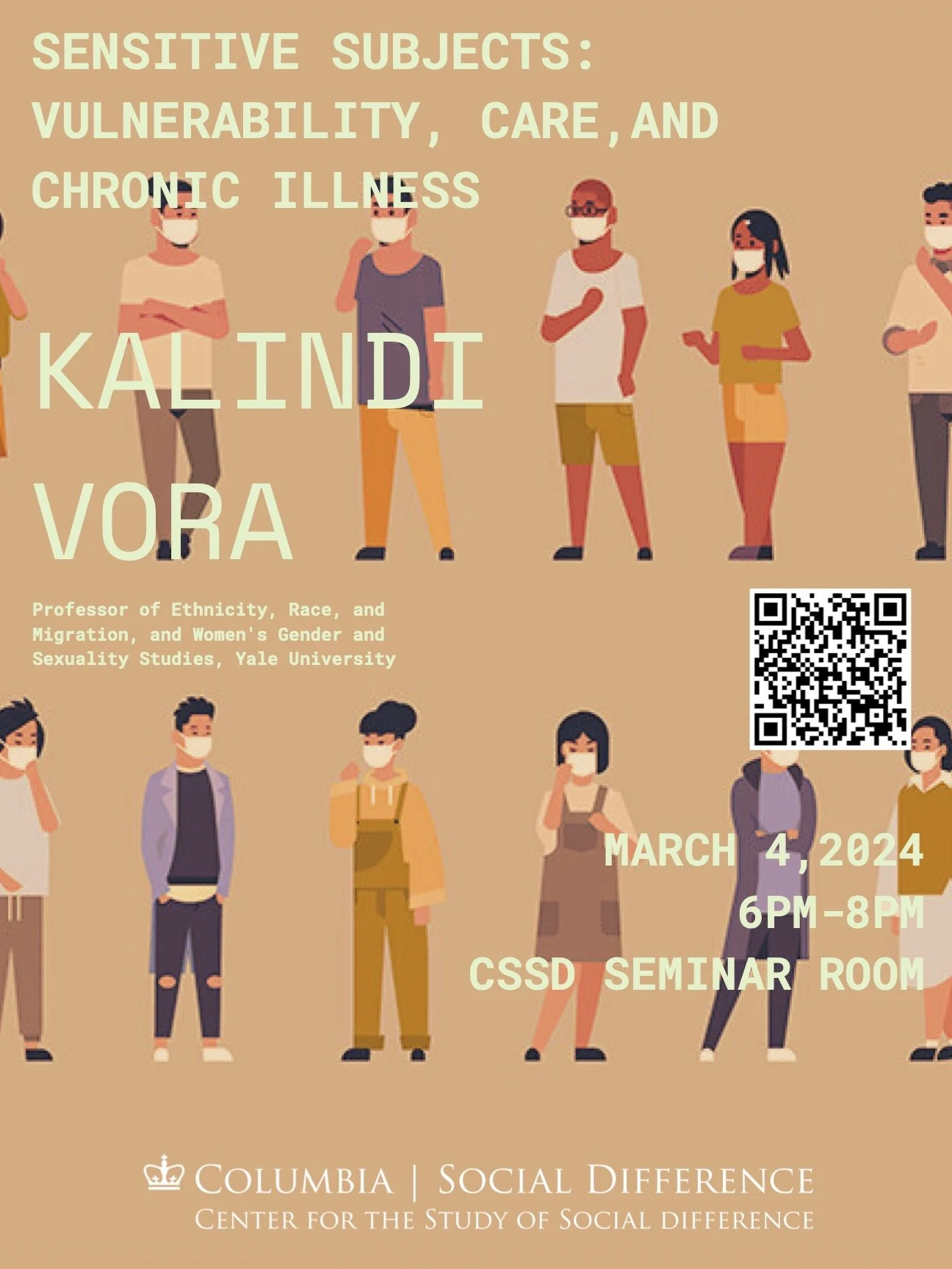
The Recovery Working Group welcomes Kalindi Vora, Professor of Ethnicity, Race, and Migration, and Women’s Gender and Sexuality Studies at Yale University, to discuss her new research project on autoimmunity as a way to get at chronicity, or the enduring conditions from which there is no recovery and which highlight the shortfalls of conventional medicine as a modality of care.
When: March 4, 2024
6-8 PM
Where: Schermerhorn Extension, Room 752
Description: This talk presents ethnographic evidence that attention to sensitivity, in both patients and health care providers, can amplify the valuable knowledge people with chronic illness have about health, care, and medicine that physicians may not.
Sensitivity is often equated with weakness in the United States. However, like the tiny lungs of the canary in the coal mine, which take on atmospheric gasses at many times the rate of humans, sensitivity can be a harbinger of what is to come for everyone else. The canary served as a warning of a toxic environment. Sensitive humans indicate what kind of social, environmental and medical conditions may eventually become unlivable for everyone else as well. Their knowledge can also include information for how to change our shared health environment for the better. Medicine, both conventional and alternative practices, is trying to keep up with unprecedented numbers of chronically ill patients. Many people are engaging in their own research and self-treatment and sharing their experience with communities online. In these practices online we see another side of the story of America’s shrinking state support for healthcare. We also see how the lure of ever-present internet advice, both information and misinformation, has changed our experiences of diagnosis and care.
This event is open to all Recovery Working Group Members and invited guests.
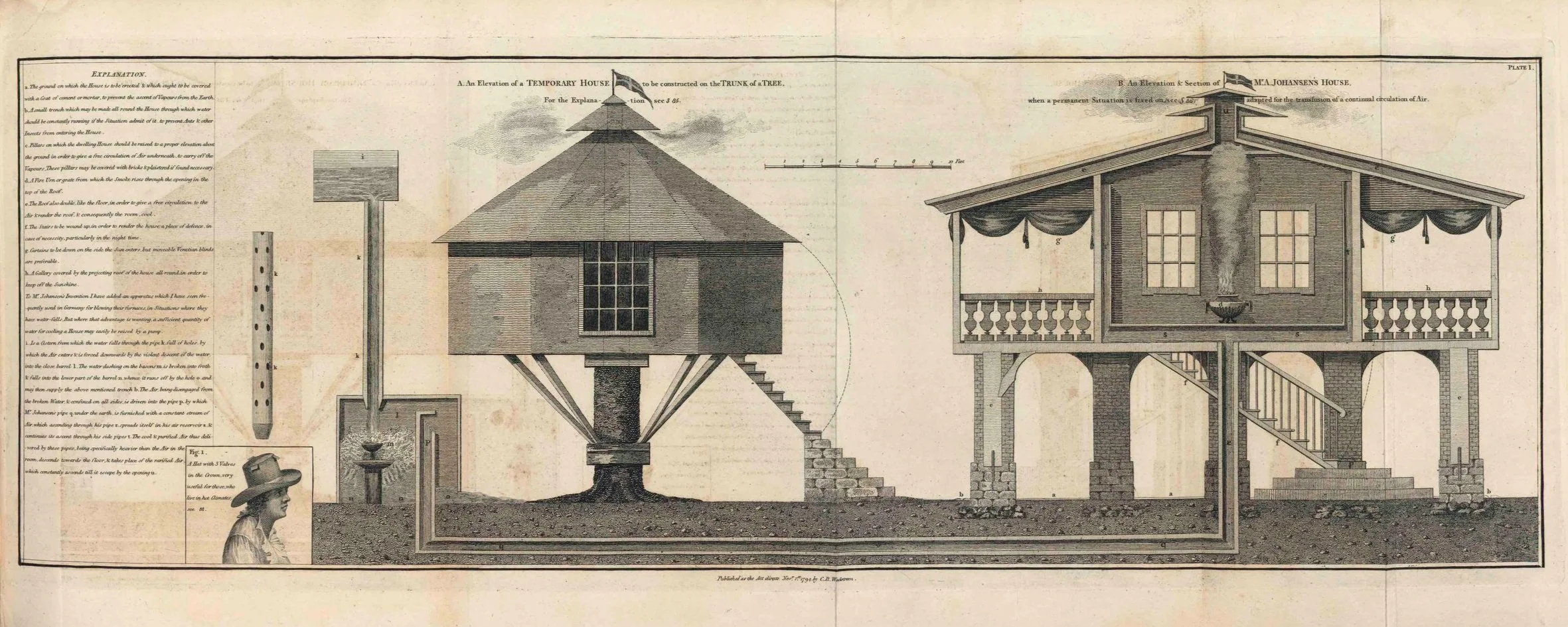
Seminar with Eleanor Johnson & Jonah Rowen
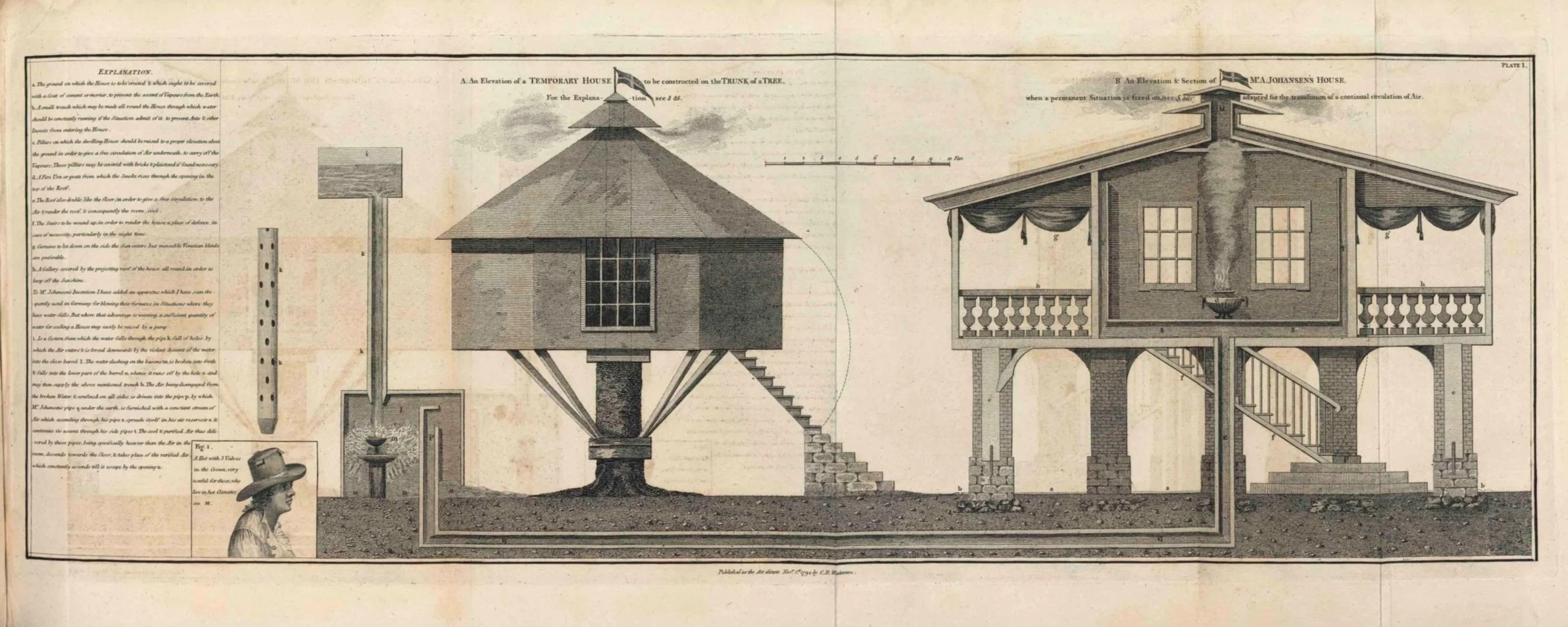
Plate 1, “The Colonial House,” from Carl Bernhard Wadström, An Essay on Colonization (1794)
The Extractive Media Working Group will be hosting scholars Eleanor Johnson and Jonah Rowen on March 4, 2024, to discuss their recent work.
When: 6 PM
March 4, 2024
Where: Schermerhorn Hall, Room 934, Columbia University
Followed by a Reception in the Stronach Center.
Speakers:
Eleanor Johnson is Associate Professor in the Department of English and Comparative Literature. Her first book, Practicing Literary Theory in the Middle Ages (Chicago, 2013), explored the relationship between aesthetic experience and ethical learning in medieval culture. Her second book, Staging Contemplation: Vernacular Theology in Middle English Prose, Verse, and Drama (Chicago, 2018), analyzed how literary works strove to embody a feeling of union with God for medieval audiences. Her third book, Waste and the Wasters (Chicago, 2023), examines medieval ecosystemic thought and suggests how thinking with medieval ecological theory might shed light on our own environmental crises, policies, and attitudes. She is currently completing a book on the history of feminist law, religion, and film in America in the 1970s, and writing another on the history of feminism and horror in western culture.
Jonah Rowen is an architectural historian whose work concerns the British Atlantic World during the late era of enslavement and abolition. Taking into account the labor and materials necessary for buildings' production, his research focuses on intersections between the aesthetic, technical, and economic dimensions of architecture, often through close analysis of drawings and other visual forms. He is developing a book project on nineteenth-century Anglo-Caribbean colonial exchanges and buildings design and production, figured as technologies of risk management and security.
Readings:
Introduction, chapters 1, 2, and 4 from Eleanor Johnson, Waste and Wasters (University of Chicago Press, 2023)
Rowen Abstract
From its inception in 1792, the Sierra Leone Company was a profit-generating venture. For the company's Evangelical abolitionist investors, the capacity to produce wealth constituted the measure of worth. Yet the profits they intended to harvest from the freed Black American migrants whom they sponsored to establish a colony on the Western African coast were not just for profit's sake. Rather, they would demonstrate free Black people's self-sufficiency: a living rebuttal to white British enslavers' fabrications of benevolent enslavement. The model city that the Company's directors envisioned required physical infrastructure, so on the town's founding, they loaded a ship with components for prefabricated buildings for the settlers to assemble, laying out plans for a gridded, “ordered” town.
The Sierra Leone Company was a coalition of entrepreneurs, philanthropists, and reformed enslavers united by anti-slavery and religious zealotry—proclaimed a three-pronged mission: Trade; Cultivation (including buildings); and Civilization. Britain’s first permanent African colony was to demonstrate the viability of an economically productive Black society, in territory shared with active slave traders and Indigenous African groups.
Under enslavement, productivity presupposed coercion, but gradual liberalization initiatives like abolition and adoption of wage labor incentives facilitated modes of extraction previously alien to African nodes in the British imperial apparatus. Consequent new forms of interaction and exchange transformed the Sierra Leonean landscape, physically, financially, and politically. To ensure profitability, these speculators and colonists sought security, and the means of construction they employed and configurations of space embodied that concept. By analyzing their architecture and its features for mitigating their concerns, this project draws out questions of who and what they perceived to pose threats. This future-oriented disposition aligned with the capital-intensive venture to establish this new colony: architecture’s durable presence signaled a projective, lasting engagement to cultivate territory and return its products to the metropole. By generating wealth through agriculture, the Black settlers would legitimate their standing as British subjects.

Prison Education Information Panel
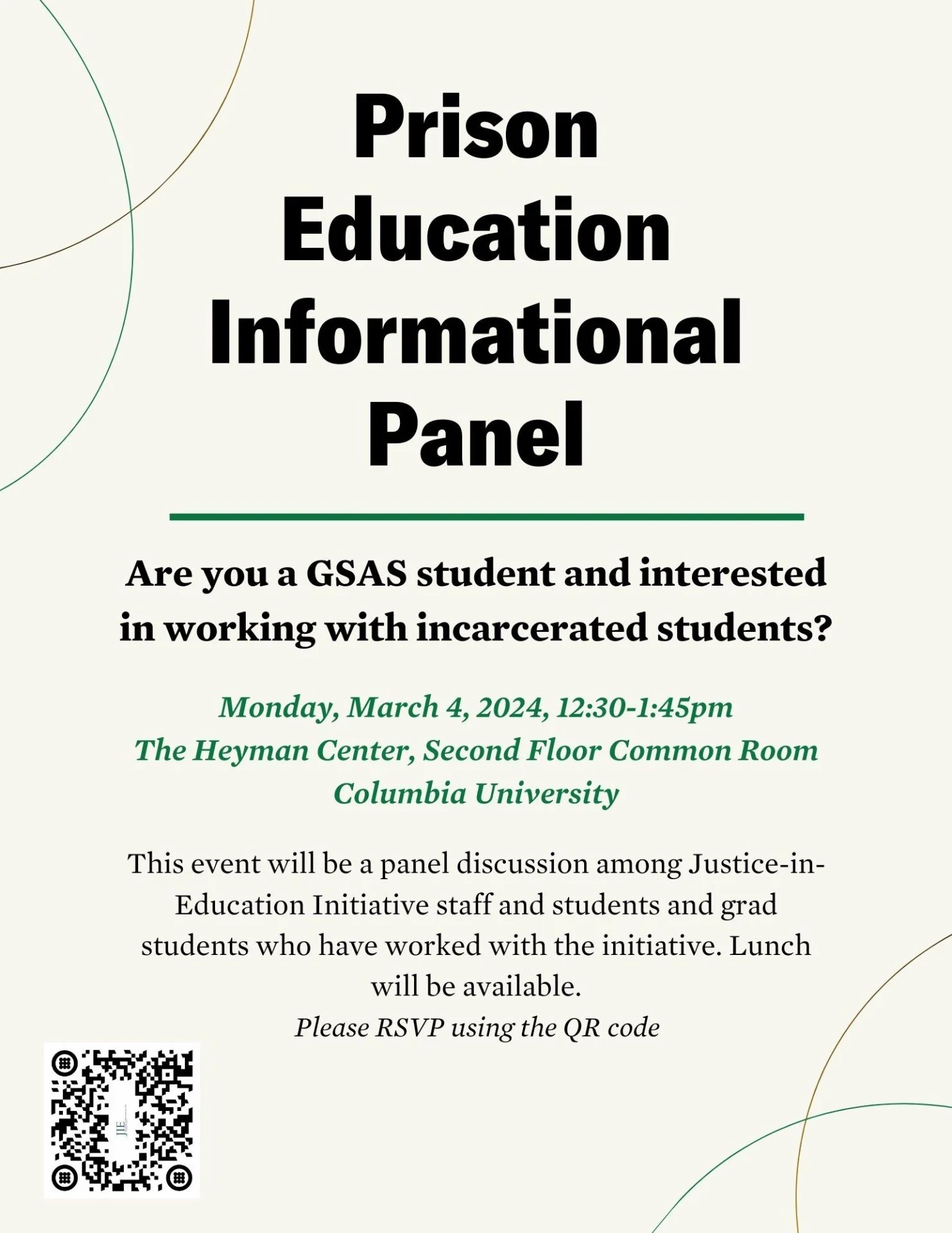
The Prison Education and Social Justice Working Group will hold an informational panel on March 4th at The Heyman Center, introducing graduate students from across Arts & Sciences to the range of paid opportunities to teach in prison contexts and support justice-impacted students through Columbia’s Justice-in-Education (JIE) Initiative.
When: Monday, March 4, 2024
12:30-1:45 PM
Where: The Heyman Center, Second Floor Common Room
Organized by Kate Suffern, who is currently Program Manager at JIE, the panel discussion among former graduate instructors (Mia Florin-Sefton and Nick Ide), students (Taylor Rae Almonte and Jennifer Berry), and JIE staff (Ivan Calaff) will allow prospective instructors to gain insight into prison education from those with first-hand experience. This event will help students from Biology, Physics, Astronomy, English, History, and more understand the nature of prison education and how they can get involved during their graduate careers.

Film Screening: Naeem Mohaiemen's Jole Dobe Na (2020)
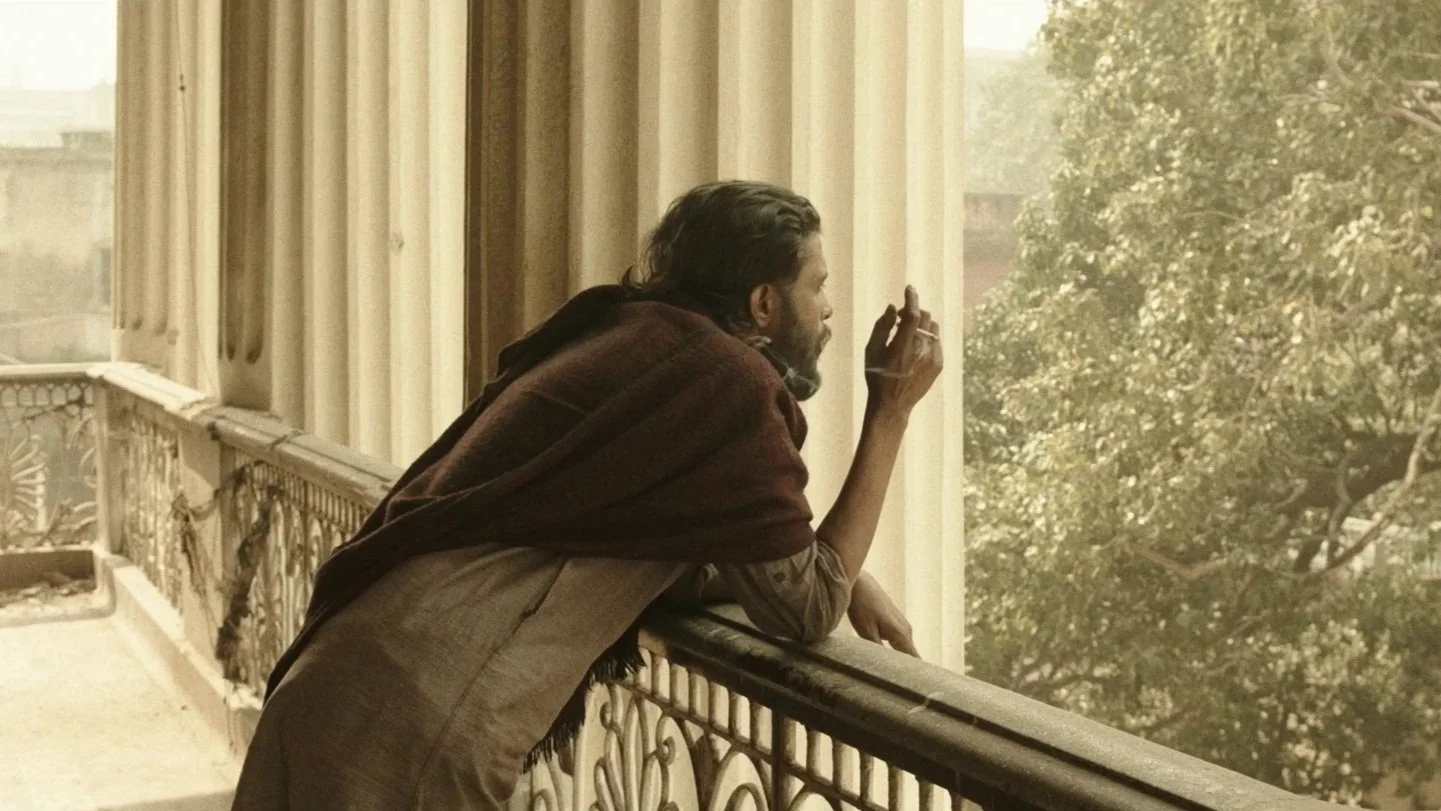
Still from Mohaiemen’s Jole Dobe Na (2020).
When: 3:30 PM
February 23, 2024
Where: Lifetime Screening Room (5th floor, Dodge Hall)
The Seeds of Diaspora Working Group is excited to announce that their February meeting, a screening of Naeem Mohaiemen's film Jole Dobe Na, is open to attendance by all CSSD affiliates!
Naeem will be in attendance for a discussion of the film after the screening, which will focus on its portrayal of plant life and feeling.
A description of the film is below:
Jole Dobe Na (Those Who Do Not Drown), 64 min, 2020
In an empty hospital in Kolkata, a man confronts protocols of blood samples, a subtly discriminatory office, regulations against bribery, and an abandoned operating theater. There are no doctors, signs of life, or residue of death. His mind is on a loop of the last weeks of his wife’s life, when a quiet argument developed between them. When is the end of medical care, whose life is it anyway? If what use is a science that can detect plant emotions, invent fingerprint technology, but fail to give dignity to the end of life.

Extraction Time

Saharan oil infrastructure, ca. 1954. Credit: Philippe de Broca.
When: 6 PM
January 25, 2024
Where: Schermerhorn 934, Columbia University
The first CSSD sponsored event to start the 2024 year, the Extractive Media working group will host Caltech Professor of Visual Culture Brian R. Jacobson on January 25th. Professor Jacobson will provide attendees with a conversation on his current work on energy, the environment, art, and film, titled “Extraction Time.”
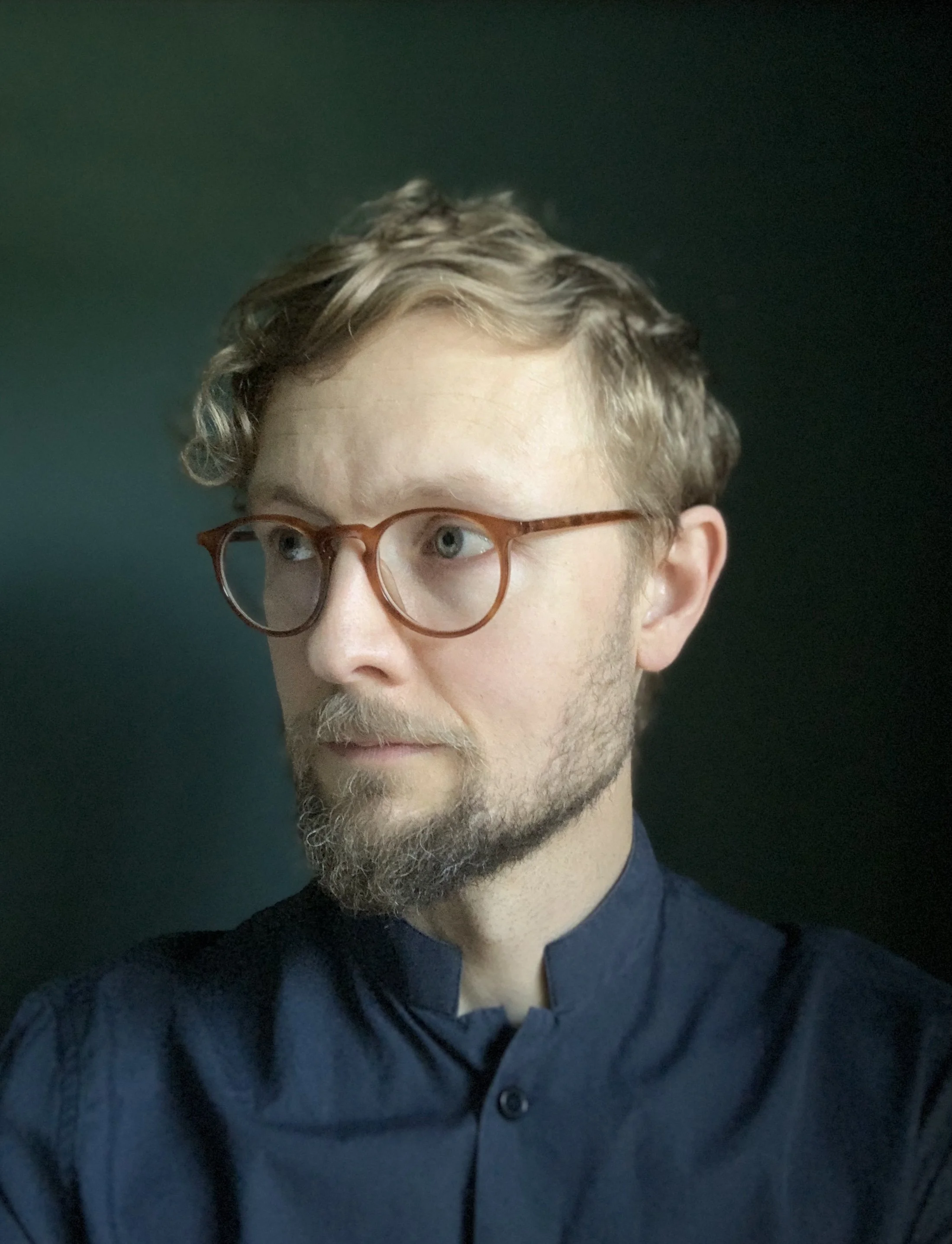
Brian R. Jacobson is Professor of Visual Culture at the California Institute of Technology and director of the Caltech-Huntington Program in Visual Culture. He is the author of Studios Before the System: Architecture, Technology, and the Emergence of Cinematic Space (Columbia University Press, 2015) and The Cinema of Extractions (Columbia UP, forthcoming in 2024) and editor of In the Studio: Visual Creation and Its Material Environments (University of California Press, 2020), winner of the Society for Cinema and Media Studies award for Best Edited Collection and the Limina Prize for Best International Cinema Studies Book. He is currently finishing a new book, The Art of Oil in France: A Global History, 1944-1975.

Book Talk - Politicizing Islam in Central Asia: From the Russian Revolution to the Afghan and Syrian Jihads
Join the Harriman Institute for a book talk with Kathleen Collins to discuss her new book, Politicizing Islam in Central Asia (Oxford University Press 2023).
When: Monday December 11th, 2023
12 PM - 1:30 PM
Where: International Affairs Building, 420 W 118th St. New York, NY 10027
Marshall D. Shulman Seminar Room 1219

Projecting Tradition Into the Future in Three Solo Works
Projecting Tradition Into the Future in Three Solo Works
Jen Shyu
When: Thursday December 7th, 2023
3 PM - 5 PM
Where: Fayerweather Hall, 1180 Amsterdam Ave. New York, NY 10027 (Room 513) or Online