
Bombay and Indian Ocean Urbanisms Workshop: Themes, Logistical Challenges, and Opportunities
Workshop Themes and Goals
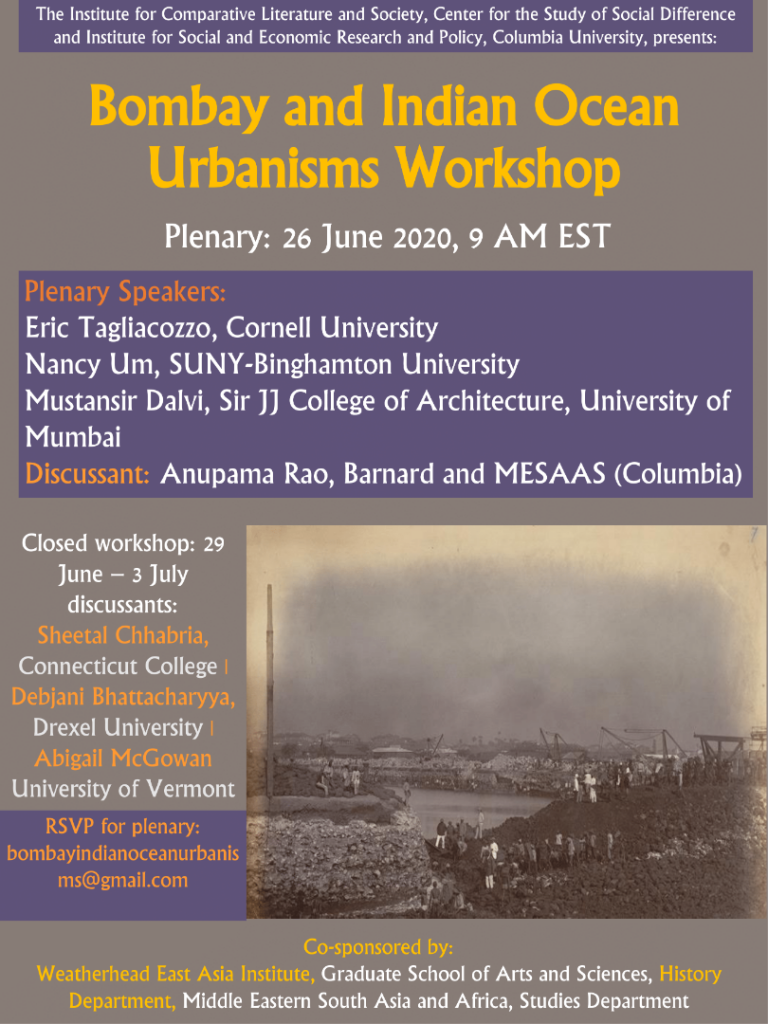
As a part of the Geographies of Injustice: Gender and the City working group we hosted our Bombay and Indian Ocean Urbanisms workshop on Zoom with four sessions spread out over a week between 26 June and 3 July, 2020. Speakers and participants joined the workshop from the US, India, Bangladesh, Hong Kong, Singapore, England, Germany, the Netherlands, South Africa, Sri Lanka, and Pakistan. The full schedule, including presenter names and paper titles, can be found here.
The workshop aimed to think about “Indian Ocean Urbanisms” as a working concept for both Indian Ocean studies and urban studies. The field of Indian Ocean studies has been shaped by studies of mercantile capital and mobility between port cities, of which Bombay has emerged as a preeminent city. Meanwhile, Bombay has become a referent in studies of cities in South Asia due to its history of activism by industrial workers and distinct forms of housing. We wanted to decenter Bombay by placing it in connective and comparative histories with other cities and thus question if we can or should consider distinct urbanisms formed by the ocean space and what can constitute the urban in the Indian Ocean.
While drawing upon the rich studies of labor, housing, and public health in Bombay, our presenters went beyond these established historiographies to consider the ocean as an agent of exchange, think through oceanic port cities comparatively, and connect Bombay with other cities such as Hong Kong, Calcutta, Rangoon, Dar es Salaam, and the seafaring towns of Gulf of Kachchh. The presenters studied connections forged across oceans that impacted functions of the cities such as real estate management, trust funds, oceanic transportations, water supply, and land surveys.
Challenges and Benefits of Moving to an Online Space
We faced some challenges in moving an in-person conference to Zoom within a span of three months, and we share our experience here in the hope that it will help others who are debating whether to host prolonged workshops online or not. We are especially grateful to Ayah Eldosougi at CSSD for making the Zoom events possible.
This workshop was originally planned as an in-person event at Columbia University on 13-14 March, 2020. Both of us graduate organizers travelled to New York from our fieldwork (and eventually got stuck in the US due to flight bans). As the airspace began to grow thin and restricted, we had to quickly cancel hotel reservations for the participants and cancel a few flights as well. Rather than cancelling the event, we decided to postpone it for a later date online because we planned to launch a longer conversation from the workshop.
We finally planned to host it on Zoom once everyone started their summer breaks. We polled availability on Doodle, and scheduled sessions in the morning in New York to accommodate as many time zones as possible. Once on Zoom, we tided over unexpected issues that one has almost begun to expect in the face of a pandemic. One of us (Sohini) had to fly back to India on an evacuation flight, and managed to host the plenary session while quarantined at a hotel in New Delhi. One of our plenary speakers, Mustansir Dalvi, recorded his speech on YouTube to ensure smooth delivery of the address amidst frequent power outages in his Mumbai neighborhood. Plenary speakers Eric Tagliacozzo and Nancy Um and discussants Debjani Bhattacharyya, Sheetal Chhabria and Abigail McGowan joined us from their homes early in the morning to accommodate those of us who were joining later in the night. In order to ensure smooth conversations, some of our discussants also sent written comments in case the internet failed in between conversations. We limited presentations to five minutes each so that we could focus more on discussions and comments. This was done keeping in mind that long lectures on Zoom have been known to cause fatigue.
Zoom also enabled more accessibility. Had it not been for Zoom, we would not have been able to reach out across so many participants in different time zones. Two of our participants who would have otherwise not managed to join us in March ended up presenting their papers on our Zoom edition. Many faculty and architects from institutions in Mumbai and other parts of Western India attended our plenary, which would have otherwise been restricted to urban history/Mumbai enthusiasts in New York. As a result, a part of our plenary talk was hosted at the Art Deco Society of Mumbai. Conversations were also more transparent and open as there were no silos that are sometimes in place at in-person conferences.
We were sharing with our audience the drafts of each paper presented, and wanted to prevent possibilities of plagiarism. In order to prevent this, as well as possible unpleasantness through the new phenomenon of Zoom bombing, we sent out password protected registration links, vetted the participants, and included people whose work had relevance to our conference. When in doubt, we checked Twitter handles or did a quick Google search. As a result, the subsequent workshops had a more limited audience, but we maintained a secure environment.
The online workshop was also an occasion for us to think about the salience of an in-person event. We missed our post-conference interpersonal conversations that often create enduring academic friendships and connections, where we draw intellectual inspirations and create the possibility of parallel collaborations. But by spreading the sessions out over a week, we also managed to avoid some fatigue that might arise from an all-day conference. Our participants were extremely engaged and enthusiastic and we hope that this online workshop has fostered an active global network of scholars and practitioners dedicated to answering questions surrounding mobility, capital, urban forms, and urban life.
Contributed by Sohini Chattopadhyay and Laura Yan, graduate organizers of the Bombay and Indian Ocean Urbanisms workshop, and Ph.D. Candidates in the History Department at Columbia University
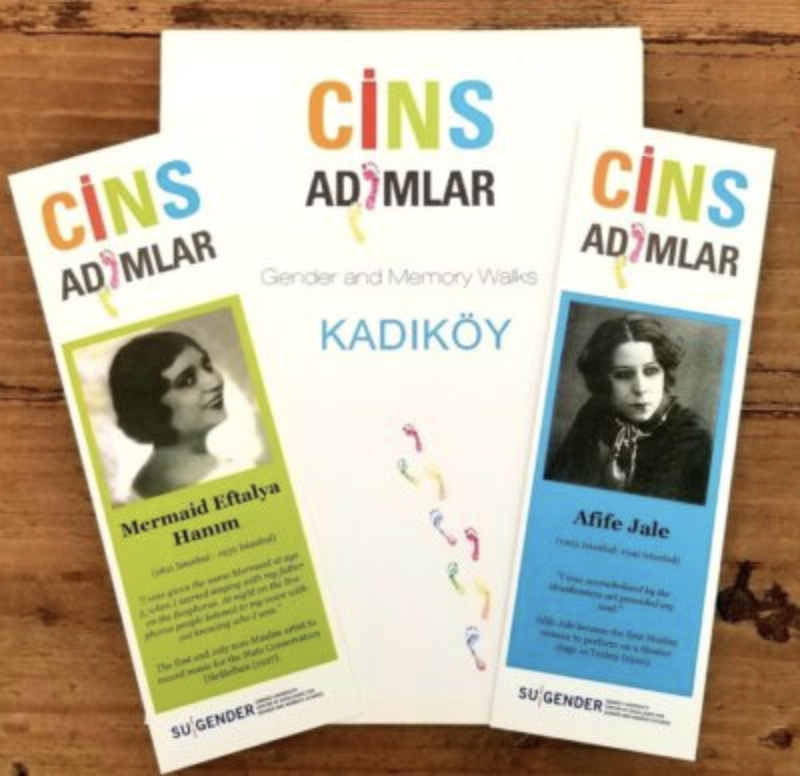
Feminist Curious Steps Through History: Illumination in Dark Times
March 8, International Women’s Day, marks a global moment when feminists walk, chant, sing, and dance together in celebration of the transformative power of solidarity and collective action. In 2020, Istanbul is witnessing a new version of this celebration in the form of a “women’s run” organized by the sports section of the Istanbul Municipality, which recently changed hands into feminist-friendly leadership. Dark times call for creative politics: with feminist marches and other forms of political demonstrations in urban public space being suppressed by the government, women will run on a feminist path! And, much to our delight, the path of this women’s run has partially been inspired by the Curious Steps: Gender and Memory Walks of Istanbul.
Curious Steps in Kadıköy (photo courtesy of Murat Germen)
Feminists inspire each other! A group of us took our first steps toward designing Istanbul’s first feminist memory walk as part of our preparation for the Women Mobilizing Memory working group meeting in September 2014. Inspired by the feminist tour of Budapest (organized by the historian Andrea Petö of Central European University); the feminist walk of Bochum (hosted by Linda Unger of the feminist archive collective ausZeiten); and the informal memory walk that Soledad Falabella offered the Women Mobilizing Memory group in Santiago, Chile, in 2013, a group of us at SU Gender (Sabancı University Gender and Women’s Studies Center of Excellence) came together to imagine what it would mean to walk the streets of Istanbul with feminist curious steps. Another source of inspiration was the Militourism festival (2004–2006), organized by an antimilitarist group of conscientious objectors (including women objectors), drawing attention to the “militarist” sites of Istanbul, Ankara, and Izmir with creative “antimilitarist” performances. With decades of feminist scholarship on women’s history writing and the amazing (online) Women’s Museum Istanbul, which brought to light the complex intersectional layers of Istanbul’s gendered history, we felt well equipped to take our first steps in exploring the possibilities of feminist and queer re-rootings in our beloved city. At a time when we felt “uprooted,” with bombs exploding and the democratic space shrinking, exploring our feminist and queer roots as resources of inspiration and empowerment, and doing so through collective walking and storytelling, felt healing and transformative.
Ebrar Nefes telling the story of Afife Jale in Kadıköy (photo courtesy of Murat Germen)
In our contribution to the volume Women Mobilizing Memory, my coauthors, Bürge Abiral, Dilara Çalışkan, and Armanc Yıldız, and I argue that a feminist city walk offers the possibility to engage in “situated feminist storytelling” for mobilizing silenced memories, on the one hand, and making visible creative mobilizations of memory, on the other. Currently organized in three Istanbul neighborhoods, Curious Steps brings together diverse groups of people for collective walks through streets and sites that come to new life with hidden women’s and LGBTI+ stories, unmarked on site but researched and creatively told by young volunteers. As such, the walks enact what Cynthia Enloe calls “feminist curiosity” in urban space with an ever-growing and ever-changing repertoire of stories that merge public and intimate archives.
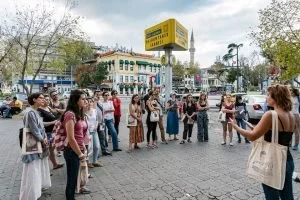
Selen Bayhan telling the story of Kınar Sıvacıyan (photo courtesy of Murat Germen)
After five years of walking in small groups, it is very exciting that we will soon be running with thousands of women to collectively witness some of these sites and stories of struggle along the path of the March 8 women’s run in the Asian neighborhood of Kadıköy. Right where the Kadıköy Women’s Run will start this March 8, we have our first Curious Steps stop in front of the State Conservatory, marking the outstanding legacy of artist Mermaid Eftalya (Atanasia Yeorgiadu, 1891–1939) who sang fifty-six of the one hundred recordings of the State Conservatory published by Columbia Records in 1927, without a single one mentioning her (Greek) name. On the other side of the State Conservatory, by the City Theater, we stop again to remember Kınar Sıvacıyan (1876–1950), one of the leading theater artists of the late-Ottoman and early-Republican period, who performed in numerous plays in the Darülbedayi (the precursor of the State Theaters) and other theaters across Istanbul. Despite her fame in the 1910s and 1920s, the Armenian actor Kınar Sıvacıyan has since been written out of all historical records, including theater history texts, while her Muslim contemporaries, such as Muhsin Ertuğrul and, later, Afife Jale, are remembered through theaters and awards named after them.

Curious Steps in Kadıköy, January 2016 (hearing Kınar Sıvacıyan’s story with a play on Afife Jale in the background)
Along the route of the Women’s Run another stop marks the Rexx Cinema, which used to house one of the oldest theaters in Kadıköy, the Apollon. This is where Afife Jale, the first Muslim woman actor to take public stage, performed her first plays. As we stop to talk about Afife Jale’s breaking all gender norms with her passion for theater and performance and facing serious challenges from her own family and the police, we also explore the intersectional layers of her struggle. In our narration, the story of Kınar Sıvacıyan’s helping Afife escape from the police, who regularly raided the theater upon receiving complaints that a Muslim woman was on stage, is a story of women’s solidarity in the background of ethnicized, patriarchal nationalism.
Another site of feminist and queer solidarity along the run is Yoğurtçu Park. Here, our Curious Steps stories focus on the significance of the park for feminist and LGBTI+ histories of activism, focusing particularly on the first march against domestic violence in 1987, after which the first women’s shelters were established, and the ongoing weekly Yoğurtçu Women’s Forum, a vibrant site of feminist debate and exchange since the Gezi protests of 2013.
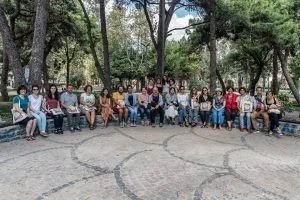
Curious Steps at Yoğurtçu Park (photo courtesy of Murat Germen)
“Even in the darkest of times,” Hannah Arendt wrote, “we have the right to expect some illumination.” These are certainly dark times for Turkey, and the planet at large. Yet it is also a time in which we are witnessing new forms of creative, life-enhancing, transformative politics everywhere. From Black Lives Matter, which has shaken up the “normalcy” of white privilege and supremacy through an intersectional lens rooted in feminist and queer politics, to the global #metoo movement that is challenging the systematic workings of masculinist privilege and from the mass demonstrations of women in India cutting across religious, ethnic and caste lines to the viral Las Tesis movement against sexual violence and impunity initiated by women in Chile, we are facing a time of revolutionary reimaginings of gender and sexuality everywhere. The Kadıköy Women’s Run is only one among many March 8 activities planned in Istanbul this year, but a particularly inspiring one in the connections it is establishing with the city’s rich history of feminist activism. When feminist activism meets imaginative memory politics, new histories are made! And, as the Women Mobilizing Memory volume shows with many inspiring examples, they are being made everywhere.
As we walk, dance and run this March 8 in Istanbul, it’s heartening to know that millions across the globe will be coming together on International Women’s Day, and throughout Women’s History Month, illuminating these dark times with feminist activism and wisdom.
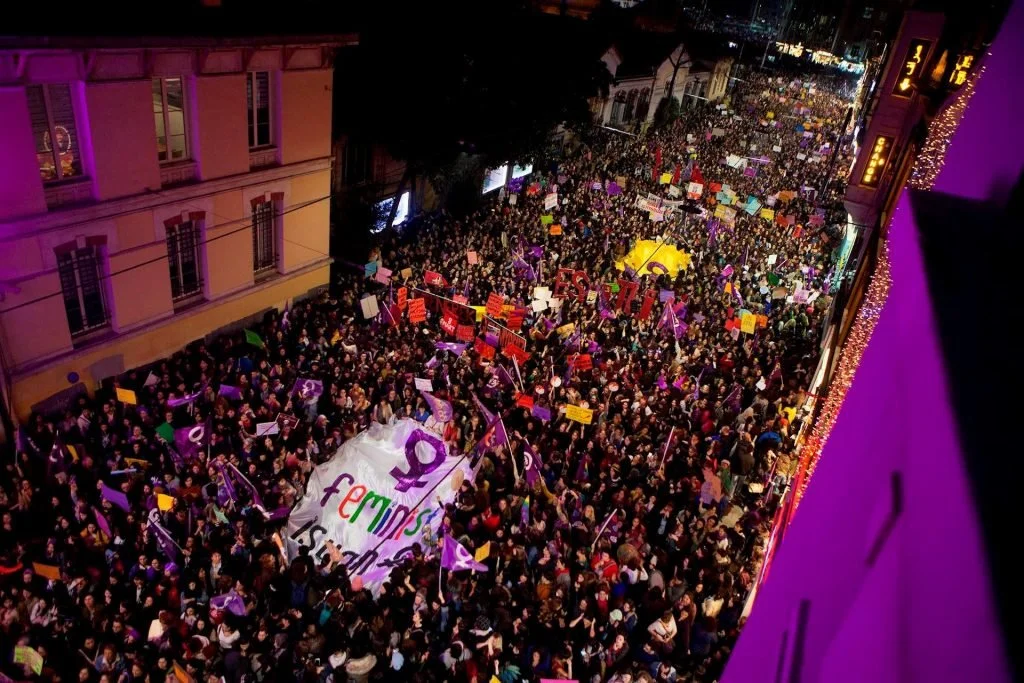
Annual Feminist Night March in Taksim, 2019.(photo courtesy of Çiğdem Üçüncü/NarPhotos)
Contributed by Ayşe Gül Altınay*, Women Mobilizing Memory working group
* Ayşe Gül Altınay is professor of anthropology at Sabancı University, former director of SU Gender (Sabancı University Gender and Women’s Studies Center of Excellence), and coeditor (with Maria Jose Contreras, Marianne Hirsch, Jean Howard, Banu Karaca, and Alisa Solomon) of Women Mobilizing Memory (Columbia University Press, 2019). The book, a transnational exploration of the intersection of feminism, history, and memory, shows how the recollection of violent histories can generate possibilities for progressive futures. It emerges from a multiyear feminist collaboration bringing together an interdisciplinary group of scholars, artists, and activists.
Note: This blog post was written before the killing of at least 36 Turkish soldiers in a massive attack near Idlib, Syria on February 28, and Turkey opening its borders soon after to allow refugees and migrants to pass, which has created a devastating humanitarian crisis at the borders and the Aegean Sea with Greek and Bulgarian authorities not allowing passage and suspending asylum applications. After the recent announcement from the Governorship of Istanbul that all political actions and demonstrations “against war” are banned until March 10th, it is not clear which March 8 activities will take place, and how they will be received by the security forces.
Shirley Sun: "Should We Be Worried About Racialization of Precision Medicine?"
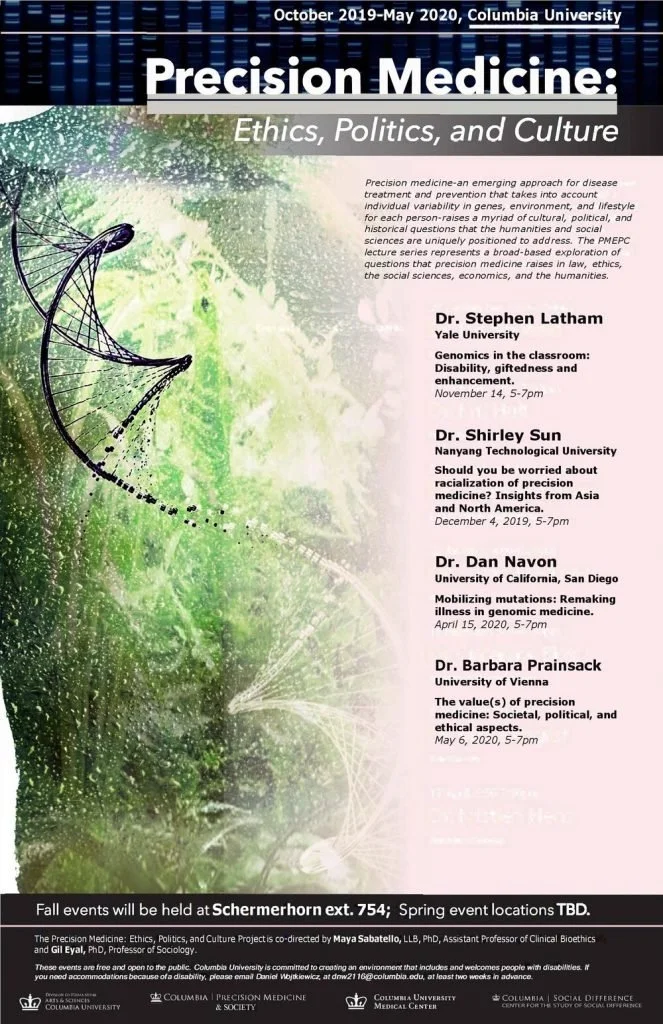
Dr. Shirley Sun, Associate Professor of Sociology with joint courtesy appointments at Lee Kong Chian School of Medicine and the School of Biological Sciences at NTU gave a presentation on December 4, 2019 hosted by the Precision Medicine: Ethics, Politics, and Culture working group on the racialization of precision medicine.
In her talk titled “Should you be worried about racialization of precision medicine? Insights from Asia and North America,” Dr. Sun gave an overview of her comparative analysis of provider perspectives on the categorization of genomics data based on race in Singapore, Canada, and the United States.
Her qualitative interviews with healthcare providers reveal the contentions and dilemmas that racialized precision medicine creates for practitioners; on the one hand providers understand that genomic data categorized by race and ethnicity is inherently faulty, and that it is at best a proxy for health behaviors. One provider called this the “poor man’s” genetic testing. On the other hand, data is delivered to these providers in a racialized format and these providers are then tasked to utilize this data to make healthcare decisions for their patients. Data categorized along ethnic and racial lines also provide useful shorthand devices to help patients understand their disease probability.
Dr. Sun warns that racialized findings of precision medicine may be especially challenging for populations that do not have access to resources. Inability to pay for cutting edge therapies or healthcare resources necessary to address disease disparities revealed by precision medicine may contribute to further health inequality among already vulnerable populations that are more likely to be ethnic and racial minority groups. Concerns from providers about patient access to resources were observed in all three sites, despite that healthcare is nationalized in Canada, for example.
The presentation concluded by opening up to questions from the audience. Among other topics, questions regarding the impact of anti-discrimination laws and the importance of provider self-identified demographics (race, ethnicity, gender) emerged. Interestingly, according to Dr. Sun, providers first and foremost identified themselves as healthcare providers before identifying with any race or ethnicity during these interviews. Second, the discussion also opened up to the concern about patients’ access to costly and rare therapies necessary to treat their genetic disorders. Physicians would anecdotally tell stories of patients who had succumbed to such high expenses that they sold their homes and other possessions to pay for treatments. This personal narrative drove home how precision medicine diagnostic abilities were more advanced than treatments, as treatments were rare and prohibitively expensive across both nationalized and privatized healthcare systems.
Approaches to Racial and Ethnic Genomic Variance
Given the importance of race and ethnicity to health in racialized societies like the United States, we see disparate approaches to how genomics are discussed in research. Seeing cancer morbidity and mortality differences among ethnoracial groups as a starting point, Peter O’Donnel and Eileen Dolan (2009) of the University of Chicago suggest “cancer pharmacoethnicity” may be a useful approach. Cancer pharmacoethnicity, according to O’Donnel and Dolan, could hold the potential to be predictive of individual drug responses based on the race or ethnic group these individuals identify with. In contrast, Nancy Krieger and colleagues (2017) of Harvard’s School of Public Health analyzed the racial disparities in estrogen-receptor negative breast cancer among Black and White American women through a socio-political lens. In this report, Krieger’s team demonstrates that it is necessary to look at race as a historically situated category that changes through time. Krieger, Jahn and Waterman illustrate how the high incidence of estrogen-receptor-negative breast cancer among Black women compared to White women can be linked to being born under the legalized discrimination of Jim Crow laws. Black women living in states that enforced Jim Crow segregation had a higher odds ratio of estrogen-receptor negative breast cancer, while White women did not show this trend. The highest incidence of this type of breast cancer was evident for Black women born before 1965. This historically situated approach highlights how racialized biologies result from social processes independent of fundamental biological differences.
Krieger, Jahn and Waterman validate a framework that examines racial disparities at the molecular level in a way that foregrounds history and social processes of racialization, and avoids suggesting that observed differences emerge from “fundamental” difference in racial biologies or genotypes.
Socially Situated Genomic Differences
Sociopolitical context is also important from a global perspective. In Cooper et al.’s article (2005) titled “An international comparative study of blood pressure in populations of European vs. African descent,” sociocultural and political impacts on health trends were again highlighted. While in the United States cardiovascular disease is indisputably a more prominent health problem among Blacks, Cooper and colleagues establish that this does not have to do with African Ancestry; in fact, Germanic populations had a higher high blood pressure incidence than any population included in their world-wide study. Through their analysis, the authors bring to the foreground the effects of place and social standing to population-level health in contrast to other research that frame disease as germane to the individuals that make up racial and ethnic populations.
Troy Duster (2003) brings the discussion in focus through his description of the divergent approaches to population-level genomic disease risk. In his comparison of responses to Tay-Sachs and sickle cell anemia genetic screening, Duster emphasizes how genomic disease risk is not simply about the disease, but also about the population it affects and the policy responses enacted. Duster describes how Tay-Sachs is a rapid-onset generative genetic disorder that is dormant in the first year and a half of a child’s life, but ultimately claims the lives of young children before the age of four. Tay-Sachs disproportionately affected Ashkenazi Jews with 22 of 30 infants born with Tay-Sachs being Ashkenazi during the 1970s (2003: 45). A community based screening program was initiated in response during this time and had the support of doctors, rabbis, and Jewish community leaders alike. This led to the great success of Tay-Sachs screening, with over 310,000 Jews screened voluntarily by 1980 for the genetic disorder. Contrastingly, sickle cell anemia screening was a “public policy disaster” and “health and medical failure” (2003: 47). Although Tay-Sachs is much deadlier, sickle cell anemia screening became mandatory. There was distrust among African Americans towards the White medical providers that came to their communities to conduct genetic screening for sickle cell. Overwhelmingly, African American communities resisted these publically funded screening efforts. Ultimately, the Black Panthers became involved in community based screening efforts, but over-reported their findings of sickle cell anemia (due to the miss-categorization of carriers of the genetic disorder who would go on to live healthy lives) and the tension and hostility between mandated screeners, the screened, and communities only intensified. Regulatory laws for the screening of sickle cell anemia were therefore contentious and medical mistrust deepened.
Overall, the contrast between the social and political response to Tay-Sachs and sickle cell anemia highlight the importance of the types of communities a genetic disorder affects, the policy response, and the baseline relationships between healthcare providers and the communities affected.
Discussion: The Lasting Presence of Racial and Ethnic Categorization
In our discussion, a PMEPC fellow raised the issue of the significance of racialized categorization as described in Rosenberg et al.’s (2002) article and in philosopher Quayshawn Spencer’s article titled “A Racial Classification for Medical Genetics” (2018). The fellow emphasized how these two works provided evidence about the concordance between racial self-identification and genomic data organized by regional ancestry. This brought up the following questions: Are these socially defined population categorizations more than proxies of health behaviors and disease probability? Are racial categories substantiated in our genes?
Upon a closer read of Rosenberg et al.’s article, the authors delineate how “self-reported ancestry can facilitate assessments of epidemiological risks but does not obviate the need to use genetic information in genetic association studies” (emphasis added; p.2381). The data analyzed in that study was collected from the HGDP-CEPH Human Genome Diversity Cell Line Panel, which is “a resource of 1063 lymphoblastoid cell lines (LCLs) from 1050 individuals in 52 world populations.” One of the major links observed by Rosenberg and colleagues was among populations who shared a language, however “linguistic similarity did not provide a general explanation for genetic groupings of populations that were relatively distant geographically” (p.2384). While Rosenberg et al. point to the use of self-reported population ancestry as a “suitable proxy” for genetic ancestry, they note that an exception to this are recently admixed groups “in which ancestry varies substantially among individuals” (p.2384).
Lastly, in his testing of philosophical premises for the use of racialized categories in genomic medicine, Spencer (2018) notes a scholarly work that claims that self-identified population samples had between 98.8% and 100% membership in the respective continental categories of “Asian,” “Black,” and “White” (p. 1020). Spencer goes on to describe how these numerical representations of self-identification with genomic population concordance do not accurately represent the relationship between these two concepts: the sample population for this particular study was of 3,224 “American” and “Taiwanese” adults and researchers deliberately excluded the “Asian” self reports from their South Asian subjects (Spencer 2018; 1020-1). Therefore, it is important to clarify in all scholarly works that although there may be links between self-identification and genomic variability, genomic data can be curated and presented in a manner that only tell one part of the larger story of disease risk probability for specific ethnic and racial populations.
As Dr. Sun highlighted during the discussion session, precision medicine is a misnomer. In fact, precision medicine could be best described as disease risk probability medicine where, based on available data genetic data (however categorized), healthcare professionals can provide disease risk probability information to individuals. As national data emerge regarding the variability of population genetics and health disease markers, perhaps a silver lining lies in that that the social determinants of health will be identified (as seen in Cooper (2005), Duster (2003), Krieger (2017) and Sun (2017)) and their effects upon populations attenuated.
Contributed by Sonia Mendoza-Grey
Do Menstrual Health and Hygiene Policies Matter? – A Human Rights Assessment
In November 2019, Kenya adopted the world’s first stand-alone policy on menstrual hygiene. India has been integrating menstrual hygiene efforts in its sanitation policies for more than 10 years. And in the United States, we are counting down the States that still tax menstrual products. – These are just some of the policy developments in the menstrual health space.
Over the next year, the Institute for the Study of Human Rights will conduct a review of policies on menstrual hygiene and health policy in India, Kenya, Senegal, and the United States. Purvaja S. Kavattur, the project researcher explains: “We are excited to work alongside in-country stakeholders to learn from their expertise and compile lessons learned to address the marginalization of menstruating bodies. We hope to explore what’s happening in terms of policy development and who benefits: Do policies matter for the lives of menstruating individuals? And do they matter for all people?”
Over the past ten years, there have been significant developments in the nascent field of menstrual health. Increasingly, countries are adopting legislative and policy frameworks on menstrual hygiene and health. Policies cover different aspects such as menstrual hygiene, de-taxing menstrual products, or ensuring provision of menstrual products to specific population groups. South Asia and Eastern Africa house two hubs for menstrual health policy action and our selected countries are at the forefront of these developments. It is, therefore, an opportune time to reflect on recent policy developments.
However, amidst growing momentum, there are risks of adopting policies that are narrow in scope and that focus on hygiene needs, infrastructure and access to products. Menstrual health also affects education, economic security, empowerment, and self-confidence. As such, there is a need for a more comprehensive understanding of menstrual health as it is shaped by menstrual stigma, healthcare access, educational attainment, as well as civic and public life, which should be addressed through policies. A more comprehensive approach that examines the social determinants of menstrual health is needed to better identify causes of marginalization, substantive foci beyond menstrual hygiene, and the subsequent policy gaps.
Inga Winkler, the project’s PI and director of CSSD working group Menstrual Health and Gender Justice, explains: “We are at a critical point. We want to move along with this momentum and continue building off the work already happening on the ground. But in doing so we want to ensure that policy developments in this emerging field are grounded in human rights principles of non-discrimination and equality, participation, and accountability. We hope to identify what levers forward policies grounded in human rights considerations to alleviate the marginalization of menstruating bodies.”
Through this review, we seek to explore whose voices, interests and needs are centered and whose are marginalized in these policies and the processes leading to their adoption, and how this influences the framing of policies both in terms of their scope and the targeted populations. We will, therefore, conduct a process-oriented review informed by human rights principles as well as substantive human rights guarantees in the four countries.
The project is funded through a grant from the Water Supply and Sanitation Collaborative Council, which has been active in supporting governments in developing policies and programs on menstrual hygiene for years.
We hope that in conducting this review, we will uncover ways policies normalize and destigmatize menstruation, shape budget allocations and service provision, and create mechanisms for accountability. We hope that our review will highlight areas of success, areas of improvements, and gaps to help create a roadmap for other governments looking into expanding their menstrual health and hygiene policies.
Contributed by Purvaja S. Kavattur, Menstrual Heath and Gender Justice working group Staff Associate
January 21, 2020