
Videos from the the 49th Scholar and Feminist Conference: Anti-Colonialism, Black Radicalism, and Transnational Feminism
On March 22-23, the Transnational Black Feminisms Working Group at CSSD and the Barnard Center for Research on Women co-sponsored the 49th Scholar and Feminist Conference: Anti-Colonialism, Black Radicalism, and Transnational Feminism.
Take some time to watch the videos below.
Many thanks to everyone who joined us, from panelists to audience members, and thanks to everyone involved in organizing and co-sponsoring a truly transformative conference.
Marxism and Transnational Black Feminist Liberation with Charisse Burden-Stelly, Dayo Gore, and Robyn Spencer-Antoine, moderated by Premilla Nadasen
Black Women and Anti-Colonialism, 1940s-1980s with Lynette Jackson, Laurie Lambert, and Paula Marie Seniors, moderated by Imaobong Umoren
The Colonial Legacy, Gender, and Economic Empowerment with Yolande Bouka, Jennifer Fish, Natasha Lightfoot, and Keisha-Khan Perry, moderated by Tami Navarro
Intellectual and Activist Interventions in Contemporary Movements, with Layla Brown, Zifeng Liu, and Gabriella Muasya, moderated by Tami Navarro
Extraction, Waste, and Security
Hannah Pivo is a member of the Extractive Media Working Group, which considers the historical role that media has played in shaping, representing, and contributing to resource extraction. The project is supported by the Center for the Study of Social Difference.
On the evening of Monday, March 4, the Extractive Media Working Group gathered to discuss work by Eleanor Johnson, Associate Professor of English and Comparative Literature at Columbia University, and architectural historian Jonah Rowen, who received his Ph.D. from Columbia University’s Graduate School of Architecture, Planning, and Preservation (GSAPP) in 2020.

Plate 1, “The Colonial House,” from Carl Bernhard Wadström, An Essay on Colonization (1794).
The conversation centered on selections from Johnson’s new book, Waste and Wasters: Poetry and Ecosystemic Thought in Medieval England (University of Chicago Press, 2023), and a working paper by Rowen, titled “‘We might have had our Lands long ago’: Construction of the Sierra Leone Colony.” Johnson’s book examines the concept of ‘waste’ in medieval poetry, contextualized within legal, theological, and other discourses, while Rowen’s paper addresses the history of construction—particularly temporary and long-term housing—with a focus on the role of architecture in establishing “security” in the colony.

The Extractive Media Working Group in conversation. Photo by author.
Extractive Media co-organizer Professor Zeynep Çelik Alexander opened the discussion by identifying themes shared by the two works, including ideas of labor, subsistence, and vacancy. Numerous additional themes arose through the course of discussion, such as scarcity, capital and fungibility, climate, temporality and the temporary, anxiety towards future, and sympathy. This was the first Extractive Media event in which two distinct works were discussed. The group found this format to be highly rewarding and worth repeating in the future.
Written by Hannah Pivo.
Watch Now! The Cunning of Gender Violence Pt. 3-3 (10/11/23) Book Launch Video Recording through BCRW
The third and final book launch event for for The Cunning of Gender Violence: Geopolitics and Feminism (Duke University Press 2023), originating out of the Religion and Global Framing of Gender Violence Working Group.
This third event was hosted by the Barnard Center for Research on Women, and a video recording of the event, as well as transcripts and more, are available through their website here.
Listen Today! The Cunning of Gender Violence Book Launch Pt. 2-3 (9/14/23) Audio Recording Available Now
Visit the Audio section of our Media tab, or click on the hyperlink, to check out the audio recording from the (9-14-23) Book Launch for The Cunning of Gender Violence (Duke University Press), titled “State Violence is Gender Violence,” hosted by the UC Berkeley Center for Race and Gender.
This publication came out of the work of the Religion and the Global Framing of Gender Violence Working Group at CSSD.
Watch Now! The Cunning of Gender Violence Pt. 1-3 (9/13/23) Book Launch Event Available Here & on Youtube
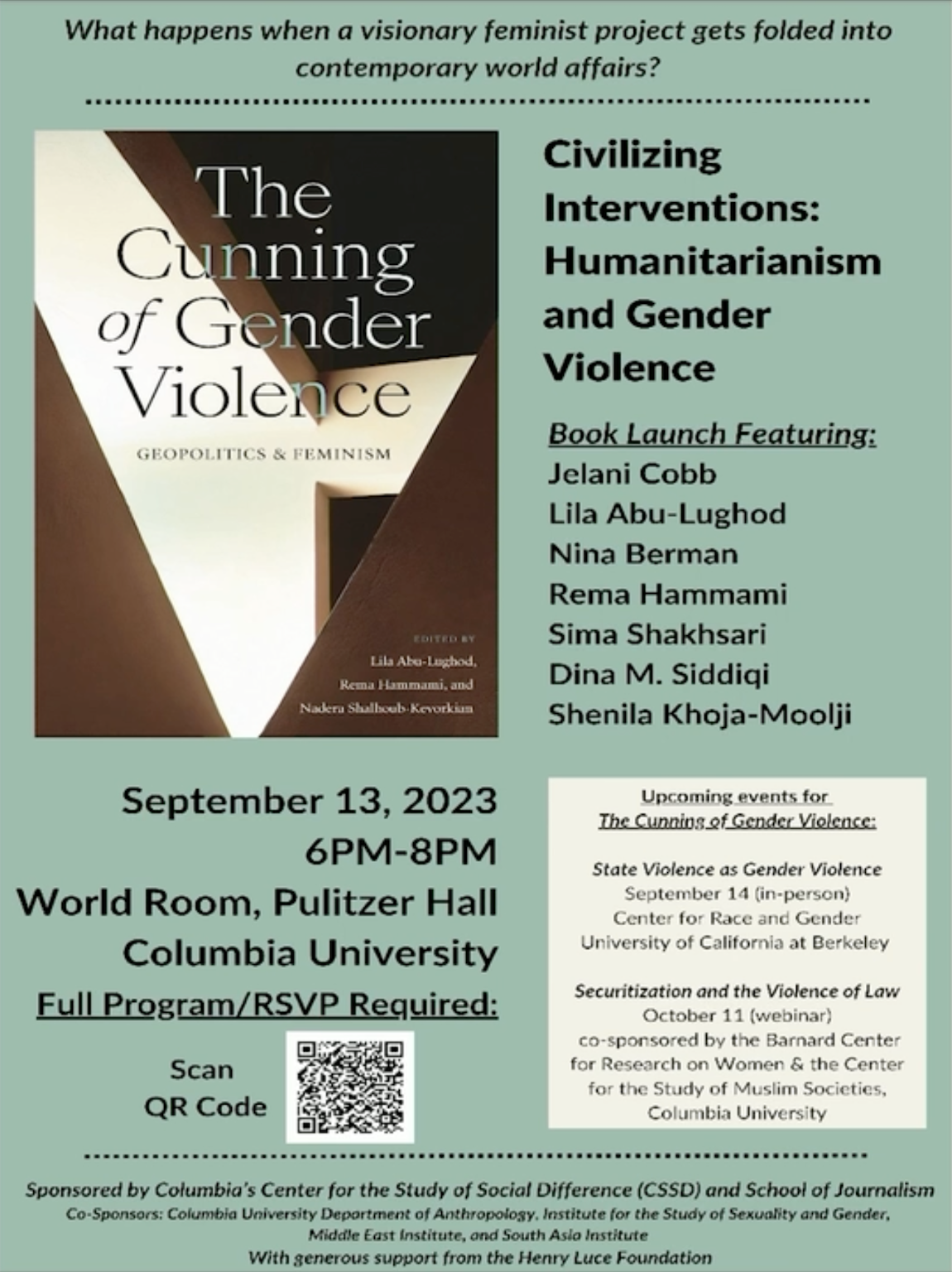
CSSD has published a recording of "Civilizing Interventions: Humanitarianism and Gender Violence," a book launch event for The Cunning of Gender Violence: Geopolitics and Feminism (Duke University Press 2023), originating from the Religion and Global Framing of Gender Violence Working Group.
This event features scholars and experts crucial to the production of this work, including Jelani Cobb, Lila Abu-Lughod, Nina Berman, Rema Hammami, Sima Shakhsari, Dina M. Siddiqi, and Shenila Khoja-Moolji. It addresses the core question: "What happens when a visionary feminist project is integrated into contemporary world affairs?"
Please click the link here to watch the video recording of this book launch, or click the Video tab in the Header under Media.
The video is also available on our YouTube channel, accessible here.
Interdisciplinary Insights Beyond the Binary: Redefining Menstruation Research with Trans Inclusivity in Mind
This article is based on an interview originally conducted in Spring 2023 by former CSSD Staff Member Tomoki Fukui, Ph.D., with the Menstrual Health and Gender Justice Working Group.
Late March 2023:
I have just returned from teaching, dumping the various paraphernalia from class to get ready for a chance to speak with Lauren Houghton and Susanne Prochazka, two members of the Menstrual Health and Gender Justice (MHGJ) working group. The current news cycle is filled with reports of the American right renewing its legislative efforts to erase transgender existence, in this instance through the denial of gender-affirming healthcare.
I am feeling isolation and despair.
I am excited to speak with the interdisciplinary research team that MHGJ has created about their newest project, a preliminary study of trans women’s experiences of menstruation.
Some readers may feel confused by that description. Biological essentialism, a key facet of white supremacist ideology and central to the perpetuation of violence against transgender people, implies that only people with ovaries can menstruate. But part of what is so interesting about this study is the way it demonstrates how biological essentialism actually inhibits our understanding of biology.
As Lauren and Susanne shared with me during our interview, we erase an entire spectrum of experiences from view — whether those of cisgender girls and women who do not menstruate, transgender men and non-binary people who do, or whether we misinterpret the cultural worlds in which menstruation is taking place — because we assume that a universal institution called “sex/gender” exists that makes experiences of gender the same across time and space.
When we gender things like hormones, genitalia, reproductive capacities, work, appearance, and so on, it becomes difficult to actually ask questions about how all of these material things function and interact with one another. “By being more inclusive and studying menstruation among a group that doesn’t have the bleeding part of the menstrual cycle really helps us deepen our understanding about menstruation. We’re really guided by the idea that not everyone who menstruates is a woman, and not every woman menstruates,” Lauren says.
“Our study is really just amplifying and validating the lived experience of trans women.”
Rather than assuming the expertise of scientists, the study uses rigorous interdisciplinary methods to validate and amplify knowledge already held in trans communities. Using a mix of qualitative interviews with trans women, hormonal analysis, and symptom tracking on a menstrual tracking app, it seeks to tease apart ideological assumptions that result in the “gatekeeping of the menstrual cycle and womanhood,” in Lauren’s words. “Our study is really just amplifying and validating the lived experience of trans women that they already know about in their community. It’s not that we’re discovering anything very new. The key is validation and amplification,” Suzanne says.
“All of my work has been on how science has been limited because we’ve gendered hormones.”
This study is an extremely welcome and urgent one in the context of extensive bias against considering trans women’s experiences of menstruation in scholarly literatures: Houghton and Prochazka observed that they could only find one study mentioning a trans woman’s experiences of menstruation, an article written by A.J Lowik, a non-binary researcher of trans health. The same bias is reproduced at the highest levels of public health research in the United States.
Lauren elaborates on recent work by an established research institution: “They define ‘sex’ as hormones. I don’t know where that’s validated because all of my work has been [about] how science has been limited because we’ve gendered hormones… The fact is that all these genders have all these hormones. So the fact that they’re defining sex by hormones is kind of flat-out wrong.”
Transgender studies more broadly is a marginalized field of research, and gatekeeping by cisgender researchers and medical professionals have played significant roles in its status as such. And while there have been marked improvements in recent years, there is also a need to critically evaluate its conditions of inclusion into the university: as transfeminist scholar Susan Stryker has observed, the relative absence of transfeminine scholars is striking, and Jin Haritaworn and Riley Snorton have questioned why trans inclusivity has done little to ameliorate an environment of deadly violence against Black trans women.
“Cisgender women’s health is under attack & transgender health is under attack right now. Our work that’s very inclusive is an antidote to that in a way.”
Houghton and Prochazka name interdisciplinarity as central to their ability to do justice to the complex and understudied field of menstruation research. “Cisgender women’s health is under attack and transgender health is under attack right now. Our work that’s very inclusive is an antidote to that in a way,” Lauren shares.
For her, the importance of accounting for cultural and socio-historical contexts for biological phenomena is linked to furthering science that is more ethical and rigorous: “I think biological and quantitative studies try to strip things to make them objective, but when things are very political you’re actually doing a disservice if you try to strip things of their context,” she says.
Susanne shares, “The study we’re doing is so rooted in the interdisciplinary approach of the working group. From my understanding, it’s pretty much one-of-a-kind, and I wish it was in existence in other universities—these working groups that fund and encourage studies like this.” The study grew organically out of the MHGJ working group. Through conversations and connections that emerged out of Menstruation, Gender, and Rights, a course that the working group had developed, and a conference they organized, they were able to form a well-informed research team bringing different kinds of expertise to the study of menstruation. Meeting A.J. Lowik and engaging with their research in particular was very formative.
The group hopes to create a toolkit and consulting service in the future for other researchers who want to implement mixed-methods approaches into their research. Adding to the Palgrave Handbook of Critical Menstruation Studies, university seminar on menstruation, and collaborations with the Mumbai Global Center, both the study and consulting service will be a cutting-edge contribution to interdisciplinary work in public health.
In the face of continued violence to trans communities generally and challenges to transgender rights and health in particular, the MHGJ working group's pioneering study on trans women's experiences with menstruation serves as a powerful antidote. By challenging prevailing biases and embracing inclusivity, the research not only validates the lived experiences of trans women but also demonstrates the urgent need for more interdisciplinary and inclusive approaches in scientific inquiry. As scholars and researchers navigate this complex field, the study and its future initiatives seek to pave the way for a more ethical and rigorous understanding of menstruation, transcending traditional boundaries and contributing to the advancement of critical menstruation studies.
Written by Tomoki Fukui, Ph.D.
Edited by Evan Berk