
PUBLISHED: Rebecca Jordan-Young Publishes on Current Debates Around Sex and Neuroscience in The Guardian
Rebecca Jordan-Young, Associate Professor of Women’s, Gender and Sexuality Studies at Barnard College and past director of CSSD's working group on Science and Social Difference, recently published an article in The Guardian called "We’ve been labelled ‘anti-sex difference’ for demanding greater scientific rigour."

The article points out that "At a time when both science and feminism are under attack, there are welcome signs that neuroscience is showing new openness to critiques of research into sex differences." Despite this robust debate within the scientific community and its accompanying challenge to existing assumptions, "misplaced fears of the effects of feminism on science potentially threaten this," she writes.
Read the article here.
Working Group Helps Produce "An Historic Victory for Women's Equality in Sport"
The International Association of Athletics Federations (IAAF) was recently forced to suspend a sporting policy that CSSD project director Rebecca Jordan-Young and her working group, Science and Social Difference, had been contesting for the past three years.
The International Court of Arbitration for Sport ruled that the onus is on the IAAF to show that naturally high testosterone levels give enough of a performance advantage to warrant the policy; the court did not find the evidence produced by IAAF at the hearing this past spring to be convincing. The IAAF has been given two years to come up with the data to support the policy, or it will be permanently voided.
“Although athletics events are divided into discrete male and female categories, sex in humans is not simply binary,” the court announced in an article in the New York Times.
This ruling does not technically affect the Olympics or other sporting federations (just track and field, governed by IAAF), but it is likely that sports organizations will suspend the policy to avoid additional challenges while they try to gather more data, according to Beck-Young.
The court ruling relied heavily on evidence that Science and Social Difference amassed from sources at Columbia and Barnard and published in Discover, New York Times, BMJ (formerly British Medical Journal), and the American Journal of Bioethics.

Katrina Karkazis, a member of the working group and a bioethicist at Stanford University, told BuzzFeed “It’s a policy that affected all women so [its] suspension is an historic victory for women’s equality in sport.”
PUBLISHED: Debating a Testosterone "Sex Gap" in Science Magazine
Rebecca Jordan-Young, director of the CSSD working group on Science and Social Difference and Tow Associate Professor and Chair of Women's, Gender & Sexuality Studies at Barnard College, has published an important article in Science magazine on the controversy and science surrounding levels of testosterone in female athletes. Jordan-Young maintains that calls to exclude women with high testosterone are not rooted in science but ultimately in social and ethical claims concerning how we understand and frame human diversity.

Read the article here.
DISCUSSION: Shoshana Magnet on Feminism, Robots, and Roaches
In early 2015 Shoshana Magnet, associate professor at the Institute of Feminist and Gender Studies at the University of Ottawa, came to speak to CSSD's working group on Science and Social Difference about her feminist analysis of recent scientific inquiry into mixed societies of robots and insects.

Magnet, co editor of the text Feminist Surveillance Studies, discussed the field of biomimetics, where entomologists, roboticists, zoologists, and engineers analyze the natural world for guidance in solving problems. One such study by an interdisciplinary team examined robot-insect societies and how those subjects' interactions shape intelligence.
The Leurre Research group examined American Cockroaches living with robots coated in cockroach pheromones, finding that the cockroaches eventually began to follow marked robots into shelters they would not have ordinarily selected on their own. Thus, robots became integrated into the decision-making process of the cockroach society.
Although the results were interesting, Magnet found that the scientists selected only male cockroaches for their study, claiming that the presence of females would produce sexual behaviors that might mar the experiment results. According to Magnet this portrayal of “compulsory heterosexuality” in insect behavior and elsewhere is erroneous, as many animals, insects, and cockroaches participate in same-sex courtship. The scientists also excluded cockroaches with disabilities from the studies, prompting Magnet to consider the greater implications of studies that are heteronormative and ableist.
Magnet grounded her research in the feminist scientific philosopher Donna Haraway’s theory that species are really webs of relationships rather than distinct entities and that scientific research should be conducted as a relationship that involves interaction. This "dance of relating," as Haraway describes it, acknowledges the impossibility of a pure form of observation. Magnet also referenced physicist Karen Barad, who claims that a truly ethical research method requires that scientists must have an ethical relationship with the objects they study and that it must be imbued with a sense of scientific responsibility.
Magnet asked "What are the ethical implications of a scientific practice that claims to be able to eliminate queers, females, and those with disabilities?" She concluded that the Leurre experiments studied animal communications only as a means to better understand and facilitate social control in diverse human societies. In the words of the scientists, "We hope these experiments will enable the possibility to control such mixed societies.”
Magnet claimed that this irresponsible approach elides the rich possibilities of studying collective decision-making and that the gendered, sexualized, and able-bodied limitations on such research foregoes conclusions that might help disabled people or non-heterosexual people. Additionally, it would be useful to consider robot-cockroach relationships as a version of queer or "chosen" family, she said. This speaks to the recognition that kinship is a social and cultural matter, rather than a biological or natural fact.
Magnet concluded with the insight that during our current era of broad-based social movements characterized by collective forms of communication, studies such as the Leurre research are troubling because they ignore the possibility of diverse, mixed societies as sites for collective action in favor of focusing on communication that seeks to control cultural change while purging bodies of difference.
Contributed by Terry Roethlein, Communications Manager, CSSD.
PUBLIC LECTURE: Beyond Masculinity: Testosterone, Sexual Desire, and Gender/Sex
Everyone knows that sexual desire and testosterone are linked because men have higher testosterone, and testosterone is tightly linked to masculinity and sexual desire - right? But what do empirical data actually say? Professor van Anders discussed findings that support decoupling testosterone from masculinity and provide insights into the nuanced ways testosterone and sexual desire are - and are not - linked in humans.
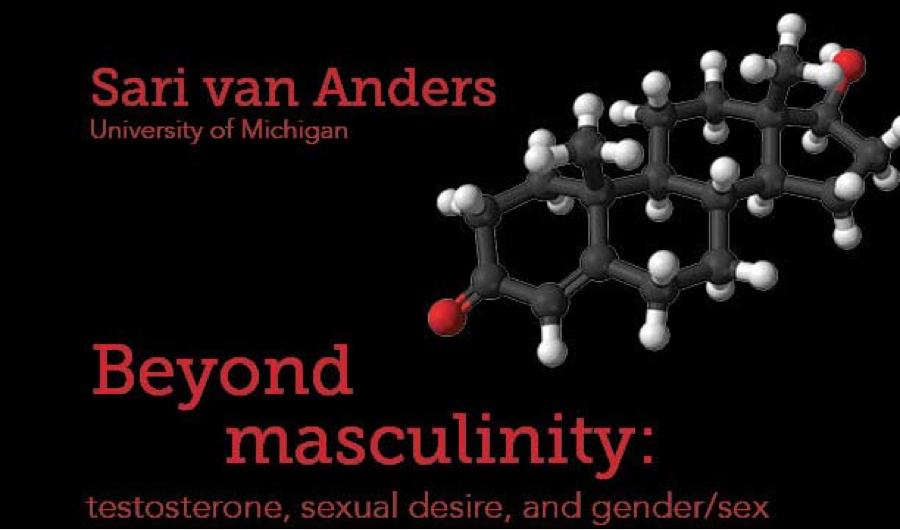
From her multi-method research program that includes experiments, correlational studies, and qualitative focus groups, she argues that social neuroendocrinology, rooted in feminist science, provides a way to ask hormonal questions that have evolution and social construction in their answers, sidesteps nature-culture debates, and separates biology from biological determinism.
This event was presented by The Science and Social Difference Working group of the Columbia University Center for the Study of Social Difference and co-sponsored by the Departments of Women’s, Gender, and Sexuality Studies and Psychology at Barnard College and the Institute for Research on Women, Gender, and Sexuality.