
New book by Reframing Gendered Violence Co-Director featured in Teen Vogue and WNYC
Jennifer Hirsch and Shamus Khan discuss their book, Sexual Citizens.
Jennifer Hirsch, professor of sociomedical sciences and former co-director of CSSD working group, Reframing Gendered Violence, and Shamus Khan, professor of sociology, recently discussed their book, Sexual Citizens: A Landmark Study of Sex, Power, and Assault on Campus, in a piece in Teen Vogue and on WNYC’s All of It with Alison Stewart.
To hear their interview on WNYC, click here.
“Sexual Citizens” Named One of Esquire Magazine’s “Best Books this Winter”
New book by former Reframing Gendered Violence co-director Jennifer Hirsch and Professor Shamus Khan receives praise after it’s debut.
Jennifer Hirsch, professor of sociomedical sciences and former co-director of CSSD working group Reframing Gendered Violence, and Shamus Khan, professor of sociology, recently published their book, Sexual Citizens: A Landmark Study of Sex, Power, and Assault on Campus, a study that attempts to transform how we see and address the widespread problem of sexual assault on college campuses. Their publication was named Esquire Magazine’s “Best Books this Winter.” The magazine praises the “clear, intersectional picture of the forces breeding a campus culture that bulldozes consent.”
For more information on the book, read here.
To view Esquire’s list, read here.
Vicky Murillo’s Op-ed Featured in The New York Times
The article was published in late November of 2019, less than a month after the “resignation” of Evo Morales.
Vicky Murillo, political scientist and co-director of the CSSD working group Environmental Justice, co-authored an op-ed, “The Coup Temptation in Latin America,” which was featured in The New York Times. Her piece is a response to the aftermath of the ouster of Bolivia’s former president, Evo Morales, and argues that coups against elected governments - even populist governments with authoritarian tendencies - almost always shift countries in the less democratic directions.
For the full op-ed, read here.
CSSD Director Writes Afterword for Ethnos’s Journal of Anthropology
Paige West’s piece is entitled Translations, Palimpsests, and Politics: Environmental Anthropology Now.
Center for the Study of Social Difference (CSSD) director and former co-director of CSSD Reframing Gendered Violence and Pacific Climate Circuits working groups, Paige West, writes an afterword for Ethnos’s publication, Translations, Palimpsests, and Politics: Environmental Anthropology Now. Paige says that the issue discusses “environmental anthropology and how we write and think against attempts at universal wordings.”
To read the issue, click here.
Women Mobilizing Memory Working Group Fellow Pens Article
Nancy Kricorian publishes report read at Women Mobilizing Memory book event.
Nancy Kricorian, Center for the Study of Social Differences (CSSD) working group Women Mobilizing Memory (WMM) fellow, published a piece on The Armenian Weekly, The Name of this Place, which was read at the WMM event, Reclaiming Collective Memories in Contemporary Turkey. Her piece discusses the historical context of the occupation of Dikranagerd and her experience touring the destroyed Sur District.
For the full article, read here.
Vicky Murillo Interviews Historian Nara Milanich for Unpacking Latin America Podcast
This is the third episode of the monthly podcast, released on December 9.
Vicky Murillo, professor of Political Science and International Affairs and director of the Center for the Study of Social Difference’s (CSSD) working group Environmental Justice, Belief Systems, and Aesthetic Experiences in Latin America and the Caribbean, interviews professor and historian, Nara Milanich. Milanich talks about the shift from cultural to biological definitions of paternity thanks to DNA testing and how such testing could either be used to recover kids stolen by military dictatorships or to halt migration at the US-Mexico border. She also explains age-based violence suffered by migrant children in Central America, amongst other things.
The interview can be found on the podcast Unpacking Latin America, hosted by Vicky Murillo, discussing major themes around Latin American history, culture, and politics.
Find the full podcast interview here.
For more on the Environmental Justice, Belief Systems, and Aesthetic Experiences in Latin America and the Caribbean working group visit their project page.
Vicky Murillo is a Professor of Political Science and International Affairs at Columbia University. Her work focuses on distributive politics, electoral behavior, institutional weakness, Latin American politics, agricultural and conservation policies.
Nara Milanich is a professor of History at Barnard College. Her scholarly interests include modern Latin America, Chile, and the comparative histories of family, gender, childhood, reproduction, law, and social inequality. Professor Milanich teaches courses ranging from the Modern Latin American History survey to a comparative seminar on the Global Politics of Reproduction.
Vicky Murillo Interviews Journalist Daniel Alarcon for Unpacking Latin America Podcast
This is the second episode of the monthly podcast, released on November 11.
Vicky Murillo, professor of Political Science and International Affairs and director of the Center for the Study of Social Difference’s (CSSD) working group Environmental Justice, Belief Systems, and Aesthetic Experiences in Latin America and the Caribbean, interviews professor and journalist, Daniel Alarcón. Alarcon shares stories about his Spanish radio program and the type of Latin American stories he's working on and more in this episode.
The interview can be found on the podcast Unpacking Latin America, hosted by Vicky Murillo, discussing major themes around Latin American history, culture, and politics.
Find the full podcast interview here.
For more on the Environmental Justice, Belief Systems, and Aesthetic Experiences in Latin America and the Caribbean working group visit their project page.
Vicky Murillo is Professor of Political Science and International Affairs at Columbia University. Her work focuses on distributive politics, electoral behavior, institutional weakness, Latin American politics, agricultural and conservation policies.
Daniel Alarcon is a professor of Broadcast Journalism at the Columbia University Graduate School of Journalism. He is the creator of RADIO AMBULANTE, an award-winning Spanish-language podcast on NPR. He has also written for Harpers, The New York Magazine,The New Yorker and Etiqueta Negra and published two novels: Lost City Radio and At Night We Walk in Circles.
On the Frontlines Working Group Coordinator Highlighted by the School of General Studies
The profile on Jeremy Orloff discusses the group’s trip to West Africa, centered around their efforts to retrieve oral histories from local nurses and midwives active during the Ebola crisis.
Jeremy Orloff, post baccalaureate student in Columbia’s School of General Studies (GS) and Coordinator for the Center for the Study of Social Difference’s (CSSD) On the Frontlines: Nursing Leadership in Pandemics working group, was recently profiled by GS. The profile highlights Jeremy’s nontraditional academic background and what inspired his pursuit of a career in medicine. Jeremy’s visit to Liberia and Sierra Leone, a research trip to gather oral stories on nursing experiences during the Ebola outbreak in West Africa with the On the Frontlines group, is also explored. He explains that, “The project was my first exposure to global health, and definitely makes me think it is something that I want to do long term and incorporate into the rhythm of my career, regardless of what I do.”
To read the full profile click here.
For Orloff’s reflections on his trip to West Africa with the On the Frontlines working group visit our blog, here.
CSSD Collaboration with Columbia Global Center in Istanbul 2018-2019
CSSD projects and affiliates were featured in the Center’s most recent Annual Report.
The Columbia Global Center in Istanbul’s 2018-2019 Annual Report features project and affiliates of the Center for the Study of Social Difference. The Reframing Gendered Violence working group held four workshops in 2018 as a part of their workshop series hosted by the Istanbul Global Center. These workshops aimed to open up a critical global conversation among scholars and practicioners in order to reframe the issue of violence against women as it is currently discussed in a wide range of fields, both academic and policy-oriented. This series included “Beyond Prevalence: The Next Genderation of Campus Sexual Assault” on February 9th, “Institutionaled Violence and Gender: Innocence-Disposability-Resilience” on March 9th, “Interrogating Culture-Based Explanantions for Violence Against Women” on March 23rd, and “Turkish Students Present on Reframing Gendered Violence” on June 7th.
On September 25th, Women Mobilizing Memory (WMM) fellow and speaker at CSSD’s 10th Anniversary Symposium, Ayşe Gül Altınay, CSSD Executive Committee member and WMM co-director, Jean Howard, and director of the Queer Theory working group, Jack Halberstam, gave a talk entitled “Bridging Academia and Activism Thorugh Gender Studes.” The talk presented a critical reflection of the possibilities of doing feminism and gender studies in contemporary Turkey, with specific examples from the experiences of Sabancı University Gender and Women’s Studies Center of Excellence.
Former CSSD director and co-director of the WMM working group, Marianne Hirsch, delivered a talk entitled “Women Carrying Memory: Stateless Figures,” along with Women Mobilizing Memory co-editor Ayşe Gül Altınay and Aylin Vartanyan. This talk looked at two recent memorial projects by feminist diasporic artists Mirta Kupferminc and Wangechi Muthu, which explored the vicissitudes and vulnerabilities of exile and statelessness, and suggested that stateless memory can open up the possibility of imagining alternative relationships between contemporary subjects and citizenship, national belonging, and home, as well as alternate temporalities of becoming.
The annual report also features a photo from a WMM Memory Walk conducted in Turkey. Columbia University President Lee Bollinger, joined WWM fellow, Silvina Der-Meguerditchian, and Global Center Director and CSSD Women Creating Change Leadership Council member, Safwan Masri, for this insightful tour of Istanbul.
To view the entire 2018-2019 Annual Report from Columbia’s Global Center in Istanbul click here.
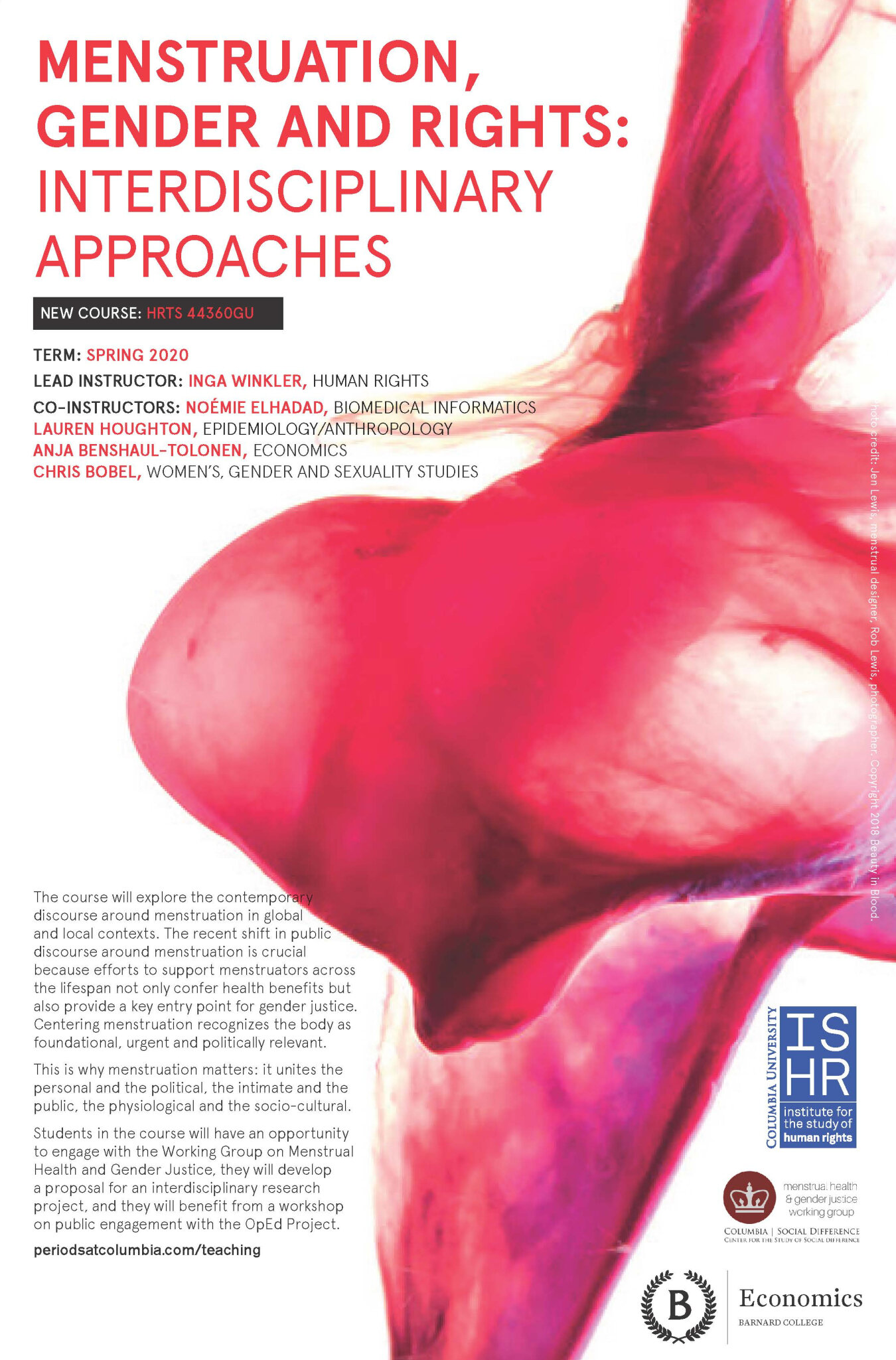
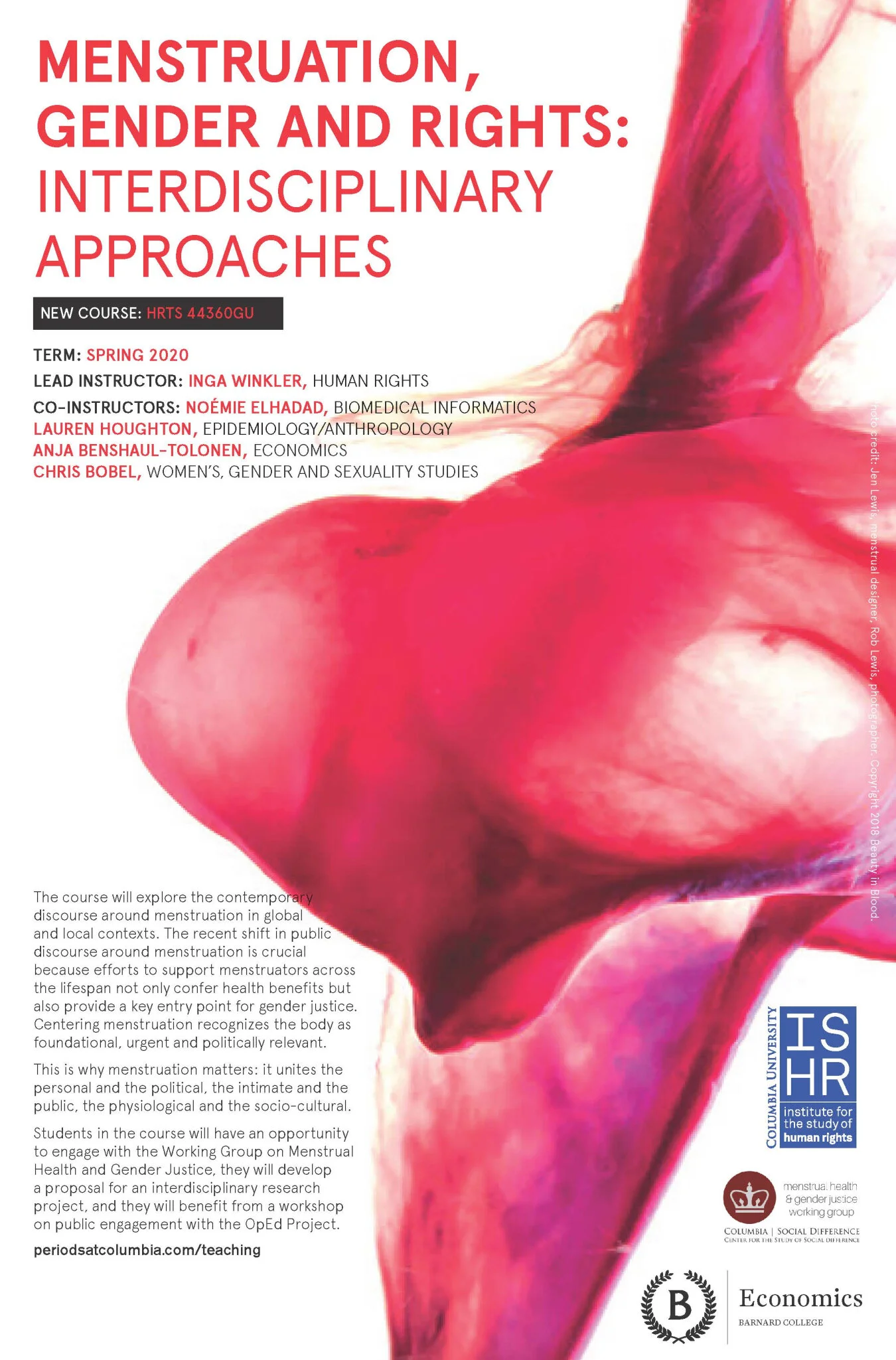
New Course in Spring 2020: “Menstruation, Gender, and Rights: Interdisciplinary Approaches”
Now open for enrollment for Columbia and Barnard students.
Led by the Menstrual Health and Gender Justice working group, “Menstruation, Gender, and Rights: Interdisciplinary Approaches” will explore the contemporary discourse around menstruation in global and local contexts.
Students in the course will develop a proposal for an interdisciplinary research project and engage in a workshop on public engagement with The OpEd Project.
The course will be co-taught by an interdisciplinary team of working group faculty fellows, including:
Inga Winkler, Lecturer in Human Rights
Noémie Elhadad, Associate Professor of Biomedical Informatics
Lauren Houghton, Assistant Professor of Epidemiology
Anja Tolonen, Assistant Professor of Economics, Barnard College
Chris Bobel, Professor of Women’s, Gender, and Sexuality Studies, University of Massachusetts Boston.
The development of this course was funded by the Columbia University Provost’s Interdisciplinary Teaching Award, which funds the creation of a new course with up to $20,000.
For a complete course description and call number, click here.
To view the course syllabus, click here.
For more on the Menstrual Health and Gender Justice working group check out their blog, like them on Facebook and follow on Twitter.
LIVESTREAM: Policy and Practice in Interdisciplinary Menstrual Health
The day-long Multifaceted Menstruation workshop took place November 22, 2019 at Barnard College.
The CSSD Menstrual Health and Gender Justice working group hosted an interdisciplinary day-long workshop entitled Multifaceted Menstruation that evaluated the current state of research on menstruation, with interest in examining whose voices are being represented, which actors shape the dominant narrative, whose voices are marginalized, what gaps in data, research, and policy exist, and how interdisciplinary collaboration may help remedy some of these gaps.
A panel discussion entitled “Policy and Practice in Interdisciplinary Menstrual Health” concluded the day.
To watch the livestream video of the panel discussion, click here.
For more information about the event, click here.
Jean Howard and Ana Paulina Lee to be Featured on Panel “A Celebration of Soft Power”
The discussion will revolve around American democracy, race, performance, and US-China relations.
CSSD Executive Committee member and former Women Mobilizing Memory co-director, Jean Howard, and co-director of the Geographies of Injustice working group, Ana Paulina Lee will be featured on the upcoming panel “A Celebration of Soft Power.” Fellow panelists will include David Henry Hwang and Denise Cruz and will address American democracy, race, performance, and US-China relations, and will be followed by an audience Q&A. The event will take place on December 3rd from 4 pm to 6 pm in Kent Hall and is free of charge.
To read more about the event, click here.
Marighella Film Screening Followed by Director Q&A
Ana Paulina Lee to discuss Brazil’s current political climate.
Join co-director of the CSSD working group Geographies of Injustice, Ana Paulina Lee, and the director of Marighella, Wagner Moura, in a discussion on censorship, race, and the current political climate in Brazil. The film is a “searing and energized portrait of one of Brazil’s most divisive historical figures, Afro-brazilian poet and politician Carlos Marighella,” and is currently banned in Brazil. Tickets are $15. The film screening will take place on Saturday, December 7th at 8:00 pm in the Teacher’s College Chapel.
To learn more about the film and ticket purchase, click here.
Ana Paulina Lee Designated Antonio Candido Prize Winner for Best Book in the Humanities
The Antonio Candido Prize is awarded annually by the Latin American Studies Association.
Ana Paulina Lee, co-director of CSSD working group Geographies of Injustice, was recognized by the Brazil Section at the Latin American Studies Association with the Antonio Candido Prize for Best Book in the Humanities for her recent book Mandarin Brazil: Race, Representation, and Memory.
To read more about the Latin American Studies Association’s Awards, click here.
For more information on Lee’s book, click here.
Unpayable Debt’s “Valor y Cambio” Project Wins NALIP Media Trailblazer Award
Frances Negrón-Muntaner will be receiving this award in early December.
CSSD Executive Committee member and former Unpayable Debt working group co-director Frances Negrón-Muntaner received the National Association of Latino Independent Producers Media Trailblazer Award for her “Valor y Cambio” project. She will receive this award at NALIP’s Diverse Women in Media Forum 2019 on December 5.
Read more about “Valor y Cambio” at their official website here.
Vicky Murillo Featured in the New York Times
The article is entitled “In Argentina Elections, Leftists Savor Victory over Incumbent.”
Vicky Murillo, co-director of the Environmental Justice, Belief Systems, and Aesthetic Experiences in Latin America and the Carribean working group and Professor of Political Science and International Affairs at Columbia University, was featured in a New York Times article analyzing the results of Argentina’s recent elections. In it, she shared her thoughts regarding the political calculations of former Argentine president Cristina Fernández de Kirchner, who recently ran for office as vice-president with Alberto Fernández at the top of the ticket.
Read the full article here.
Laura Charney Reports on Menstrual Health and Gender Justice Film Screening
The screening of Period: End of Sentence took place on September 26.
The Menstrual Health and Gender Justice Working Group hosted a film screening and critical panel on the Oscar-winning documentary, Period: End of Sentence. Grad fellow for the working group, Laura Charney, discusses the analysis and criticism of the ideas established in the film by the panelists and attendees in her latest blog post for RightsViews.
Charney writes, “Menstrual health research is often obstructed in shoddy statistics, lack of thorough qualitative data, and approaches to international development that favour implementing behavioural changes based on generalized surveys… They critiqued Period: End of Sentence on the basis of its reliance on unreliable research, perpetuation of harmful stereotypes, and iteration of a global north saviour complex.”
Read the full blog post here.
WCCLC Welcomes Jewelle Bickford
Women Creating Change Leadership Council (WCCLC) welcomes its newest member, Jewelle Bickford.
Women Creating Change Leadership Council (WCCLC) welcomes its newest member, Jewelle Bickford, Partner and Wealth and Fiduciary Advisor at Evercore Wealth Management. In addition to joining WCCLC, she is also a member of the Council on Foreign Relations and the founder of Women and Foreign Policy, the Council's task force on the role of women in economic and political development in the Middle East and Southeast Asia.
To learn more about WCCLC and its members, visit here.
Paige West Leads Essay Series Ruminating the Future of Anthropology
The essay series is entitled "From Reciprocity to Relationality: Anthropological Possibilities."
Paige West, CSSD Director and former co-director of the Pacific Climate Circuits and Reframing Gendered Violence working groups, led the publication of an essay series that brought together sixteen anthropologists to discuss the possible futures of the field of anthropology. Published on the Society for Cultural Anthropology, the essay series focused on analyzing the power dynamics of racism, elitism, sexism, and violence within the field historically and continuing into the present.
Read more about the essay series here, and her introduction here.
Anupama Rao Participates in the Columbia University Seminar on South Asia
The lecture, entitled “Marx in Maharashta? The Memoir of Dalit Communist,” took place on November 18.
This past week Geographies of Injustice working group co-director, Anupama Rao, delivered a lecture titled "Marx in Maharashta? The Memoir of Dalit Communist" as a part of the Columbia University Seminar on South Asia. Her talk focused on her soon to be published translation of the autobiography/biography of R.B. More (1903-1972), a Dalit trade unionist, labor organizer, and Ambedkarite.
Read more about her recent lecture here.