
Jack Halberstam Featured in Politics/Letters
The director of CSSD working group, Queer Theory, publishes piece entitled, “My Struggle: Confessions of a Tall, Aryan White Man – Volume 7.”
Jack Halberstam, director of CSSD working group Queer Theory and Professor of English and Gender at Columbia, recently published an essay in the quarterly journal and webzine, Politics/Letters. The essay, entitled, “My Struggle: Confessions of a Tall, Aryan White Man – Volume 7,” is on the final book of Karl Ove Knausgaard's autobiographical series.
The full piece can be read here.
To learn more about Jack Halberstam’s contributions to CSSD, see selections on ourblog,YouTube channel and theQueer Theory project page.
Frances Negron-Muntaner Interviewed about Hometown San Juan
Co-Director of the CSSD working group Unpayable Debt interviewed by Worlds Without Borders about life in San Juan and the influence the city has had on her work.
Frances Negron-Muntaner, Professor of English and Comparative Literature at Columbia as well as Co-Director of CSSD working group Unpayable Debt, was recently interviewed about her hometown San Juan in Worlds Without Borders.
In the interview she talks about the different neighborhoods of San Juan and how they all represent different sides of the city. She also discusses how the city and her memories there have influenced her work. The full feature can be read here.
CSSD Executive Committee Member Featured in NBC New York Article
Professor Claudio Lomnitz interviewed by NBC New York for a piece discussing Alfonso Cuarón’s Oscar-Nominated film “Roma.”
Professor of Anthropology Claudio Lomnitz was interviewed for an NBC New York piece examining the depiction of 1970s Mexico in Alfonso Cuarón's film Roma. Professor Lomnitz offered historical context for the film's story and discussed how Mexican society has changed in the intervening years.
"The movie is to a great extent a story about modernization," said Professor Lomnitz. "We see two rural girls come from Oaxaca who have moved to the city. They are indigenous and they speak Mixtec, but they also speak Spanish, they go to the movies, they have sex."
The movie Roma is a drama that provides a gripping glimpse of Mexican society at the cusp of great social change in the early 1970s, a time of migration, urbanization and cultural transformation.
Click here to read the full article.
Professor Claudio Lomnitz works on the history, politics and culture of Latin America, and particularly of Mexico. He has a PhD from Stanford in 1987, and his first book, Evolución de una sociedad rural (Mexico City, 1982) was a study of politics and cultural change in Tepoztlán, Mexico.
The New Yorker Publishes Book Excerpt from Professor Saidiya Hartman
The forthcoming Wayward Lives, Beautiful Experiments: Intimate Histories of Social Upheaval by former co-director of CSSD working group Engendering the Archive is set to be published February 19, 2019.
Saidiya Hartman, former co-director of CSSD working group Engendering the Archive, published in The New Yorker’s February 9, 2019 issue. The piece, “An Unnamed Girl, A Speculative History,” is an essay taken from her soon to be published book. The forthcoming Wayward Lives, Beautiful Experiments: Intimate Histories of Social Upheaval is set to be released February 19, 2019.
To read The New Yorker essay click here.
For more on Saidiya Hartman’s work at CSSD, see selections on our blog, YouTube channel and the Engendering the Archive project page.
Frances Negrón-Muntaner Publishes Article with the Hemispheric Institute
Co-director of CSSD working group Unpayable Debt: Capital, Violence, and the New Global Economy pens essay on the history of population expulsion policies in Puerto Rico.
In “The Emptying Island: Puerto Rican Expulsion in Post-Maria Time,” Unpayable Debt co-director Frances Negrón-Muntaner discusses the recent exodus of Puerto Ricans in the aftermath of Hurricane Maria and its connection to a larger process of population expulsion policies in Puerto Rico over the last 525 years.
Negrón-Muntaner argues that “colonial emptying, rather than “normal” population growth, has been the most common experience in Puerto Rico” since Christopher Columbus claimed it for Spain in 1493. She traces back more than 100 years of US policies on the island that have efficiently exported hundreds of thousands of Puerto Ricans to the US mainland, highlighting the social, economic, and political implications of this “emptying island.”
Click here to read the article.
Frances Negrón-Muntaner is a filmmaker, writer, curator, scholar and professor at Columbia University, where she is also the founding curator of the Latino Arts and Activism Archive.
CSSD Welcomes Ayah Eldosougi, Program Coordinator
Join us in welcoming Ayah Eldosougi to the full-time staff of CSSD!
We are thrilled to announce that the Center for the Study of Social Difference has a new full-time staff member. Ayah Eldosougi, who has been invaluable at CSSD as a part-time temporary employee since last September, is now on board as full-time CSSD Program Coordinator.
Ayah played a key role in prepping for our Sep 28th anniversary symposium and in managing volunteer staff for our two-day Vernacular Photography event with the Walther Collection in October. She has been crucial in the smooth operation of several other events and especially of financial operations at CSSD in the past few months.
As Program Coordinator, Ayah will be working with us on event planning, working group communications, publicity and social media, and the management of our work study team, among other projects.
Click here to read Ayah’s bio!
Farah Jasmine Griffin Leads the New African American and African Diaspora Studies Department
Co-director of CSSD working group Toward an Intellectual History of Black Women chairs Columbia’s newly created department.
This past winter, Columbia University’s Board of Trustees voted unanimously to create the African American and African Diaspora Studies Department.
Farrah J. Griffin, co-director of CSSD working group Toward an Intellectual History of Black Women and director of CSSD affiliate Institute for Research in African-American Studies, will lead the department as its first chair.
The development of the new department is the latest growth spurt in a scholarly interpretation of the black experience that began at Columbia in the early 20th century. According to Griffin, “the study of black life, in the western hemisphere in particular, is something that Columbia has been engaging in, and has been at the forefront of, since Zora Neale Hurston began her work here.” Griffin believes the new department will bring a fresh approach to the discipline at a crucial moment for race relations and black identity in our society.
Click here to read more.
Click here to learn more about the newly created African American and African Diaspora Studies Department.
Frances Negron Muntaner Launches Social Currency Project in Puerto Rico
The Valor y Cambio project is a response to the current economic crisis faced by the Caribbean island.
Unpayable Debt working group co-director Professor Frances Negron Muntaner, along with artist Sarabel Santos-Negron have created the social currency project Valor y Cambio set to launch in Puerto Rico. The project promotes the values of solidarity, equity, justice and creativity through the development of notes bearing the faces of different figures chosen for their commitment to a more fair Puerto Rico.
The creation of this social currency harkens back to discussions prompted at Unpayable Debt’s Reimagining Money workshop last October, where participants were asked to create their own forms of social currency.
To read the full article on the Valor y Cambio project click here
For more about the project visit the project website.
For coverage of the Unpayable Debt workshop visit our blog and twitter repcaps of the event.
Reframing Gendered Violence Working Group Hosts Public Workshop on Transgender Violence
The two-day Reframing Transgender Violence workshop featured scholars, activists, attorneys, and graduate students working across issues of transgender violence and justice.
Held on Thursday, January 24th and Friday, January 25th, and organized by Reframing Gendered Violence working group co-director Professor Kendall Thomas, the Reframing Transgender Violence workshop served as space for presenters to share their various work on the topic and interact with audience members through discussion. Speakers at the workshop included Catherine Clune-Taylor, Asli Zengin, Chinyere Ezie, Chase Strangio, Sergio Suiama, Joss Taylor Greene, C. Riley Snorton and Christina B. Hanhardt.
For a recap of the workshop visit our blog.
A full-length video of the workshop will be made available to the public in the hope of continuing the conversation.
Tey Meadow Interviewed in a Recent Piece for The Atlantic
Queer Theory: Here, Now, and Everywhere faculty fellow featured in an article on young trans children
Queer Theory: Here, Now, and Everywhere working group faculty fellow Tey Meadow was quoted in a recent piece for The Atlantic on new research findings which demonstrate strong self-knowledge and identity sense of young trans children.
The study by Kristina Olson, a psychologist at the University of Washington, tracked the health and well-being of 85 gender-nonconforming participants, ages 3 to 12, showing, in two separate ways, that those who go on to transition do so because they already have a strong sense of their identity.
According to Professor Meadow, parents contribute greatly to developing this strong self-knowledge and identity in young trans children. Parents are the ultimate arbiters of a child’s access to transition, and they make decisions “in a culture that encourages parents to look for every possible alternative to transness,” says Meadow.
Click here to read the full article.
Tey Meadow is Assistant Professor of Sociology at Columbia. She is the author of Trans Kids: Being Gendered in the Twenty-First Century, and the coeditor of Other Please Specify: Queer Methods in Sociology.
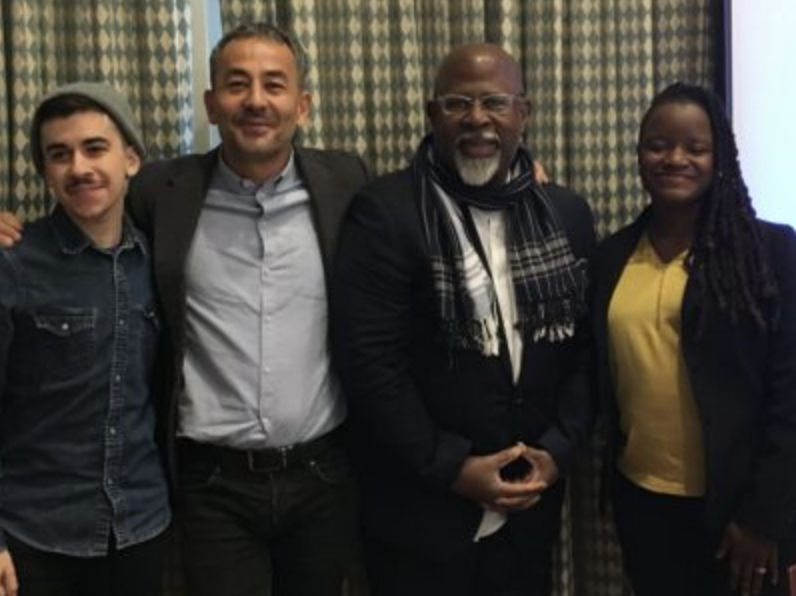
Reframing Transgender Violence: Notes from a Two-Day Workshop
On January 24-25, 2019, the Center for the Study of Social Difference presented its final scheduled public workshop in the first iteration of its Reframing Gendered Violence working group. Reframing Transgender Violence was organized by Nash Professor of Law Kendall Thomas and featured scholars, activists, attorneys, and graduate students working across issues of transgender violence and justice.
Audience members filled the Jerome Greene Annex at Columbia Law School to hear these speakers give 20 minute presentations and to interact with them in lengthy Q&A discussions, in what was designed as an informal workshop setting to give space to explore the variety of topics being covered. A full video of the proceedings will be made available to the public, and it is the hope of Professor Thomas that these conversations can continue with possible publication of the speakers’ comments, as well.
Beyond Accepted Tendencies of Normative Genders
Jennifer Boylan, the Anna Quindlen Writer in Residence at Barnard College, opened our workshops on January 24th by moderating a discussion between Asli Zengin (Louise Lamphere Visiting Assistant Professor in Anthropology and the Pembroke Center at Brown) and Catherine Clune-Taylor (Postdoc in the Program in Gender and Sexuality Studies at Princeton) regarding how we approach the idea of violence against transgender people. Zengin challenged us to see violence as another way of looking at social relations rather than as a binary of perpetrator and victim. Clune-Taylor agreed “about violence as a kind of social relation,” but stated that she also sees “something in terms of how individual bodies are mined for data production” as a form of violence. Zengin emphasized that Turkey, like North America, is quite heterogeneous, and that in both places visibility comes at the cost of more violence. Clune-Taylor avoids intersecting discussions of gender and race because “often there is a distinction made between how intersex communities/conditions are approached in North America (i.e., white populations) and how they are approached in racialized “other” communities,” with the latter often viewed as backward, less advanced.
Both Zengin and Clune-Taylor worked to give us a sense that many in this field are working much more capaciously than simply considering accepted tendencies of normative genders. Our speakers discussed the concept of gender for a person as a trajectory that changes over time and emphasized the problem of intersex children having a gender assigned to them at birth.
Limits of the Law and Extra-legal Structures for Survival
We began day two of our workshops on Jan 25th with two of Professor Thomas’s former “Law and Sexuality” seminar students from 2009-10, Sergio Suiama (Federal Prosecutor in Rio de Janeiro) and Chinyere Ezie (Lawyer at the Center for Constitutional Rights), in conversation with Chase Strangio (Staff Attorney with the ACLU’s LGBT & HIV Project). These speakers led a conversation on the uses and limits of the legal framework for addressing issues of transgender violence, and issues of advocacy and activism for transgender people.
Suiama led the discussion with a presentation on transgender violence in Brazil, which has the highest incidences of violence against transgender people, including 868 murders between 2008 and 2016. He warned of increased danger for the transgender community after recent elections, despite 53 transgender candidates running for office in 2018. Suiama shared an especially powerful and disturbing video clip in which Damares Regina Alves, an evangelical pastor and Minister of Human Rights, Family and Women under new President Jair Bolsonaro, calls for “no ideological indoctrination in the classroom” and declares girls princesses and boys princes.
Ezie and Strangio had a conversation that brought the problems of existing systems to the fore, with Ezie blaming a “social structure that accepts colonialism as a basis of civilization.” Strangio asked us what it means to look at societal and government structures that have been designed to maintain inequality in the US and elsewhere, citing the example of the US as having a criminal justice system that deals with interpersonal violence by perpetuating state violence (e.g., the state’s ability to incarcerate bodies for the purpose of “protecting” other bodies). Ezie emphasized that people are too often forced to tell stories that are not their own but rather the easy story to tell, again looking to the treatment of intersex children as an example. How would it be, Ezie challenged us, if we were forced to identify our race on our birth certificate in the same way we are forced to choose a gender?
Professor Thomas pointed out that all three speakers were expressing a critique of trans legalism, yet, he said, “you are all, in some way, state agents, relying on state work to minimize trans injustice.” Strangio agreed, with the addition, “if you’re teaching at a law school, you’re an agent of the state” just as “we are also agents of the state if we’ve gone to law school.” For this reason, Strangio emphasized the importance of his work with international activists, looking at the survival structures that people set up, and how the state is encroaching on them. Strangio left us with the question, “How can we make it apparent and disrupt the ways the state is preventing our survival, our extra-legal structures for survival?”
The Limits of Current Critical Methods
Professor Thomas moderated our second discussion of the day, with Christina Hanhardt (Associate Professor of American Studies, University of Maryland-College Park) and C. Riley Snorton (Professor of English and Gender and Sexuality, University of Chicago).
Hanhardt led off with a history of transgender violence, while Snorton asked us to put a “temporal emphasis on history’s own terms” and to understand the ongoing struggle in the present by imaging a future where Black Lives Matter and Trans Lives Matter matter to everyone.
Just as the first discussion of the day looked at the limits of using the legal system to address trans violence, this discussion addressed the limits of current critical trans methods. Hanhardt reminded us that there is often a place of putting things/people in categories of good vs bad and challenged us to look at how our sets of knowledge are made in our academic disciplines and categories. Snorton asked us to look more closely at politics of solidarity and stated, “when we only look at trans violence as murder,” we ignore other areas of vulnerability for trans people that have to do with relations to other ways of living, including slow death through the “impossibility of trans lives.”
The Critical Nature of Continuing this Work
Our final discussion of the two-day workshop was led by a presentation on incarceration of transgender people by Joss Taylor Greene, a doctoral candidate in the Department of Sociology at Columbia University. Greene posited that there is a panic about disruption of sexuality identity categories in places like prisons and women’s colleges, tying in many themes covered by previous speakers, including the usefulness and the challenges of opacity with dealing with systems of structural violence.
Greene’s interlocutor Jack Halberstam (Professor of English and Gender and Sexuality Studies, Columbia University) concluded our two days by addressing the question whether we should we separate “queer” and “trans” studies. He suggested that we not, as, after all, these “populations are simultaneously produced by regimes.”
Workshop organizer Professor Thomas emphasized the fittingness of ending our discussions with a dissertation project, as a testament to the “critical nature of continuing this work” on the reframing of transgender violence.
Contributed by Catherine LaSota, Associate Director of the Center for the Study of Social Difference
Menstrual Health and Gender Justice faculty fellow interviewed by public health podcast
Chris Bobel discusses public health field and the increasing attention on menstruation in the latest episode of Case Confirmed
Menstrual Health and Gender Justice working group faculty fellow Chris Bobel talks about the public health field and the increasing attention on menstruation in the latest episode of Case Confirmed, a monthly public health podcast series.
In the episode, “Public Health Has Its Period,” Bobel explores the connections between menstrual taboo, public health campaigns, capitalism, and embodiment.
Click here to listen to the episode.
Chris Bobel is Associate Professor of Women’s, Gender & Sexuality Studies at the University of Massachusetts Boston where she teaches courses on Gender & the Body, Feminist Theory, Feminist Research Methods, Women in US Social Movements and Feminist Activism.
Case Confirmed is a monthly public health podcast series that features interviews with top public health experts from around the world.
The Nation features piece from Keeanga-Yamahtta Taylor
A speaker from the Center for the Study of Social Difference’s anniversary symposium writes about the 2019 Women’s March.
Keeanga-Yamahtta Taylor, Princeton professor in the department of African American studies and speaker at CSSD’s ten year anniversary symposium, discussed mass movements in relation to the third anniversary of the Women’s March in a recent article for The Nation. The article discusses the recent divisions in the organization of the Women’s March and their underlying tensions.
The Nation article is linked here.
A full length video of Keeanga-Yamahtta Taylor’s participation in the CSSD anniversary symposium can be found here along with all other panels from the symposium on our YouTube channel.
Rebecca Traister pens “Don’t Give Up on the Women’s March” in The Cut
A panelist at the Women Creating Change five year anniversary, Traister discusses the most recent Women’s March in a new article.
Good and Mad author and panelist at the Women Creating Change five year anniversary celebration and roundtable event, Rebecca Traister addressed the continuity of the Women’s March in a recent article for The Cut.
The full article can be found here.
For a review of the Women Creating Change anniversary click here.
Introducing Inga Winkler, Director of Menstrual Health Working Group
Inga Winkler, Lecturer at the Institute for the Study of Human Rights and Director of Undergraduate Studies for the Human Rights Program at Columbia University, was featured on the recently launched blog periodsatcolumbia.com.
Inga Winkler, Lecturer at the Institute for the Study of Human Rights and Director of Undergraduate Studies for the Human Rights Program at Columbia University, was interviewed for the blog periodsatcolumbia.com, which was recently launched to highlight the achievements of Menstrual Health and Gender Justice, one of the newest Center for the Study of Social Difference working groups
In the interview, Dr. Winkler discusses how the Menstrual Health and Gender Justice working group is bringing an interdisciplinary perspective to the study of menstrual health, as well as the long term goals of the working group. She said part of their work involves broadening the discussion to include societal norms and stereotypes surrounding menstruation. You can read the full blog post here.
Menstrual Health and Gender Justice working group launches new blog, Periodsatcolumbia.com
The Center for the Study of Social Difference (CSSD) working group Menstrual Health and Gender Justice launches a new blog.
CSSD working group Menstrual Health and Gender Justice launches a new blog.
The site will feature news, events, research, publications, and reflections by working group members and others in the field of menstrual health and gender justice.
The Menstrual Health and Gender Justice working group seeks to further the nascent field of menstrual studies. The working group puts particular emphasis on critically evaluating the current state of research, advocacy and programming, with interest in examining whose voices are being represented in the field, which actors shape the dominant narrative, whose voices are marginalized, what the gaps are, and how interdisciplinary collaboration might help remedy some of these gaps.
Click here to access the blog.
Pedagogies of Dignity Working Group Hosts Workshop at Lenfest
On September 30th the CSSD working group Pedagogies of Dignity held a workshop bringing together formerly incarcerated students, educators, and activists to discuss prison education.
On September 30, 2018 the CSSD working group Pedagogies of Dignity supported a workshop at Columbia’s Lenfest Center for the Arts, the second such workshop of the Center for New Narratives in Philosophy. The workshop brought together formerly incarcerated students, academics, prison educators, and activists to discuss the benefits of prison education as well as challenges associated with it. The event was hosted by Christia Mercer, Gustave M. Berner Professor of philosophy at Columbia University and Project Director of the working group.
The Pedagogies of Dignity working group has been working with educational staff at the Brooklyn Metropolitan Detention Center (MDC) to organize a series of mini-courses available to men of the MDC. These courses have been attended by over 140 men since February. A full recap of the September 30th workshop can be read here on the CSSD blog.
The Pedagogy of Dignity: Prison Education, Part 2 Event Recap
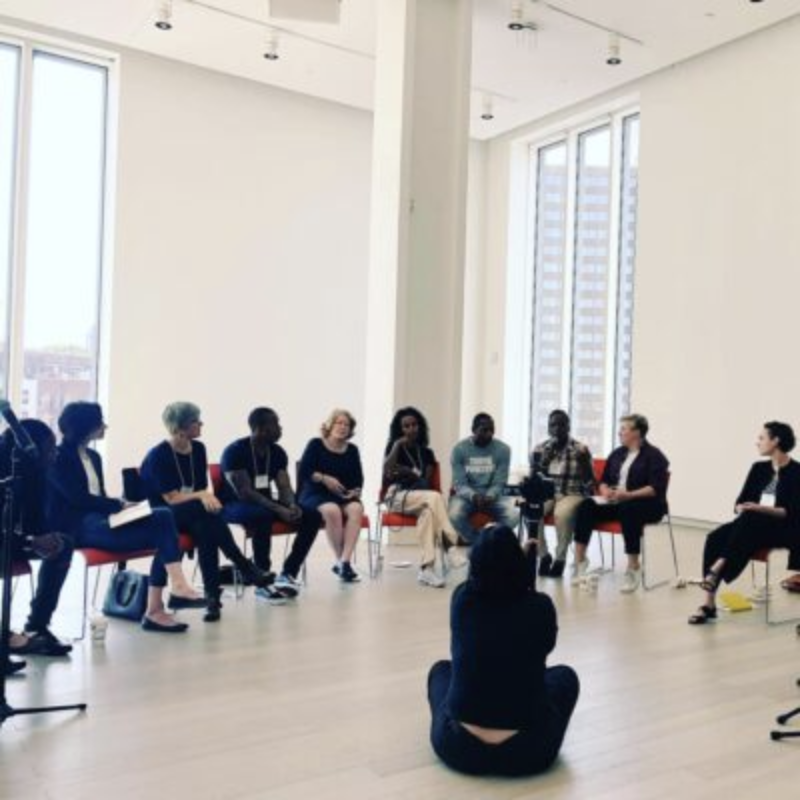
On Sunday September 30th 2018, the Center for New Narratives in Philosophy at Columbia University hosted its second Pedagogy of Dignity workshop at Columbia’s Lenfest Center for the Arts, in connection with the Pedagogies of Dignity working group at the Center for the Study of Social Difference. The workshop brought together 40 formerly incarcerated students, academics, prison educators, activists, undergraduates, and postgraduates, to discuss the benefits and challenges of prison education, present our pedagogical ideas, and prepare participants to teach in Brooklyn Metropolitan Detention Center (MDC).
Working with the educational staff at MDC, we have organized a series of mini-courses that are available to the men of MDC, regardless of educational background. Since February, over 140 incarcerated men have attended our courses. Each class is a combination of serious ideas, Theatre of the Oppressed exercises, and skill development. The mini-course program has been an enormous success. Our classes are over-enrolled and the MDC staff is eager for more courses.
Professor Christia Mercer hosted the event, Morgaine Gooding-Silverwood led Theatre of the Oppressed exercises and mock classes, and the award-winning documentary film maker, Jac Gares, filmed as part of her upcoming documentary on our Pedagogy of Dignity work, with videographer Isaac Scott. (The video is available here.)
Participants
In attendance were special guests including:
● Jennifer Lackey, the Director of the Northwestern Prison Education Program and the Wayne and Elizabeth Jones Professor of Philosophy at Northwestern University, who regularly teaches college-level courses at Stateville Correctional Center and in Division 10 of the Cook County Department of Corrections;
● Formerly incarcerated students Syretta Wright, Miranda McConniughey, Isaac Scott, Aisha Elliot, and Jarrell Daniels;
● Staff members from Metropolitan Detention Center: Michelle Gantt (Education Supervisor at the Metropolitan Detention, federal prison), Jason Murray, and Ciara Pemberton;
● Brooklyn Public Defender and Columbia Philosophy alumna Susannah Karlsson;
● Columbia Philosophy Graduate Students;
● Columbia and Barnard Undergraduate Students;
● Columbia Faculty from Philosophy, Political Science, Law, Religion, History, English and Comparative Literature; and
● Faculty from other universities, including David Velleman from NYU.
Background
The issue that our Pedagogy of Dignity approach seeks to address is that many people – even well-intending volunteer teachers – assume that teaching in prison is like normal teaching, but with challenges. We reject this assumption. At the Pedagogy of Dignity workshop, we debated, analyzed, and tweaked our pedagogical approach that members of our group first developed at Taconic Correctional Facility and honed at Brooklyn Metropolitan Detention Center fall 2017.
The first idea underpinning our Pedagogy of Dignity is that the harsh realities of incarceration render less suitable the traditional classroom pedagogy according to which instructors transmit their knowledge to (mostly) passive learners. It has been our experience that incarcerated people -- the vast majority of whom have been gravely underserved in schools -- are best served when classroom work is broken up with improvisational exercises that employ Theatre of the Oppressed methods. Nearly 80% of incarcerated women suffered 1 physical abuse as children and 33% have survived rape. Roughly 75% of incarcerated people are functionally illiterate. Such students deserve an enlivened classroom experience that breaks down hierarchies and creates an environment that enables self-expression and its accompanying self- affirmation. 2
The second idea grounding our Pedagogy of Dignity is that incarcerated students do not need saving. Although prison culture forces inhabitants to endure oppressive rules and suffer injustices, imprisoned students are eager to take full advantage of the opportunities offered them and extremely resilient in supporting one another in doing so. Too many volunteer instructors have, what activists in our group call, “a savior complex.” In the words of one of our collaborators, Isaac Scott (formerly incarcerated artist, activist): “volunteers often see themselves as responsible to save their incarcerated students” in a way that “can cause more harm than good.” Instead of seeing incarcerated students as people who need saving, Scott insists that students be allowed “to empower themselves so as to restore their own self-image.” The main goal of our pedagogy is to create an environment in which students’ experiences and perspectives are respected and highlighted so that students can enrich their own sense of agency, discover that their experiences count as knowledge, and empower themselves. Theater of the Oppressed techniques were originally designed exactly to increase participants’ agency and accompanying sense of self-worth and dignity.
1 Developed by Augusto Boal, Theatre of the Oppressed includes “improvisation and other techniques to break down hierarchies and promote social and political change.” Boal’s goal was “to explore, show, analyze and transform the reality in which the participants are living.” 2 The lawyer of one of our students sent a letter in which he wrote: “I think [name of student] won’t mind me telling you that your course has significantly added meaning and purpose to his life in federal prison.”
Our Teaching in MDC
A subset of our group developed the Pedagogy of Dignity over four years of teaching in Taconic Correctional Facility and then had the opportunity to experiment with it in the Brooklyn Metropolitan Detention Center (MDC), which is a federal maximum security jail. Our course has been considered a huge success both by the students and by the educational staff at MDC. During a ceremony at the end of one semester, organized by Dr. Michelle Gantt (MDC, Director of Education), one student said: “I thought my brain had stopped working and would never work again. The reading, discussing, and [improvisational] work we’ve done, it’s proven to me that my brain still works. I’m ready to use it more.”
Dr. Gantt was so pleased by the course, some of which she observed, and by the student response, that she approached us to create a special program in MDC. Working in close collaboration with MDC staff, we have instituted a series of 4-week courses that have been made available to anyone in MDC, whether or not they have a high school degree. In an extraordinary gesture of trust, MDC has allowed us to train volunteers and escort them into this maximum-security prison without the normal rigorous screening. Each class has been a combination of serious ideas and texts, Theatre of the Oppressed exercises, and skill-development.
The Pedagogy of Dignity Workshop
At the workshop, Professor Christia Mercer and justice educator, activist, and theater artist Morgaine Gooding-Silverwood introduced the day, giving an overview of the MDC program, the Pedagogy of Dignity, and Theatre of the Oppressed exercises. Gooding-Silverwood said, “The purpose is to teach university professors to be more human and relaxed and nuanced in their approach to education in prison.” The approach is a means of raising professors’ awareness about the fact that there is no structure for rehabilitation for incarcerated students, that students in the classroom have a lot to teach professors, the importance of professors allowing themselves to be intellectually vulnerable in the prison classroom and open to learning from the students.
Theatre of the Oppressed is a form of community theatre created by Augusto Boal in Brazil based on the idea that anyone can be an actor, but also provides the foundation for important philosophical and social discussions. Theatre of the Oppressed is important because it encourages us to fail and to make mistakes. For example, one of the exercises “Name Gumbo” is where people switch names as they introduce themselves, and carry on their new name when they introduce themselves to the next person. It teaches us that we don’t listen very well.
Formerly incarcerated students Isaac Scott, Aisha Elliot, Syretta Wright, Miranda McConniughey, and Jarrell Daniels, and Brooklyn Public Defender Susannah Karlsson discussed the challenges, benefits, and goals of incarceration and education. Formerly incarcerated student Jarrell Daniels explains, “For us, education is the only way for us to come out of the mud, or as we say, the trenches... Unfortunately when we were raised in our communities we didn’t look at education as a tool that would lift us up out of the trenches.”
Morgaine Gooding-Silverwood and Aisha Elliott lead a discussion with experienced MDC educators about the challenges and goals for educators. The main goals include helping students to find intellectual joy and excitement in a difficult place, promoting self-respect and dignity, and discovering power in education. Other goals include developing skills in discussing, reading, essay writing, and note taking.
The challenges include how to create a classroom without hierarchy, and to encourage students to share in the education process. Students’ knowledge and their knowledge of self has been devalued in the space in which they have been forced to exist. That’s why in every class, there is a teacher plus an intern. Christia Mercer explains, “The professor is the brain, or as I like to say, the ‘brainy heart’, and the intern is the heart, or the ‘hearty brains’ so to speak.” The intern, or assistant, is responsible for helping with group work, as well as to be an emotional bridge between the instructor and the students. For example, as Morgaine Gooding-Silverwood notes, assistants ask questions when students might be too nervous to ask, and break down the barriers and walls to create trust in the classroom.
Other challenges include how to get professors to feel comfortable, confident, and to use their voices to engage with students and themselves on a human level. Gooding-Silverwood says, “It is very easy when you’re in an ivory tower to be all about your books and your writing and not about face to face interaction with people. In prison that is the entirety of what our classes are. We can’t bring in huge textbooks for people to look at. You can’t come and lecture for an hour because it’s not going to get through to people. You have to be able to have an interactive classroom discussion and dialogue.”
The day was interspersed with Theatre of the Oppressed exercises, including Image of a Word (where participants use their body to express a word) and a Slow Motion Race (where the last person to reach the finish line wins). We ended the day with mock classes and brainstormed about attaining our goals. After the workshop, the speakers and key participants went to Dinosaur BBQ for a debrief and working group dinner.
The event was sponsored by Center for the Study of Social Difference and the Lenfest Center for the Arts at Columbia donated space for the event.
Next Steps
We are continuing our MDC program, teaching 4-week courses with 20 students in each course. In Spring 2019, we will host another working group meeting to review our progress and goals.
Professor Lydia Liu Writes Review in Artform
Co-director of working group Bandung Humanisms, Lydia Liu, discusses contemporary Chinese artist Xu Bing’s exhibition “Thought and Method”
Wun Tsun Tam Professor in the Humanities, and co-director of the CSSD Bandung Humanisms working group, Lydia Liu describes artist Xu Bing’s Beijing retrospective multimedia exhibition as both “transformative” and “executed with disciplined craftsmanship”. She goes on to write that, “The tension between sensory stimulation and intellectual rigor is one of the works' strongest animating forces, leading to a sequence of revelations about the place of 'truth' in moments of suspended sensory certainties."
Professor Liu’s review can be found here.
More on “Xu Bing: Thought and Method” can be read here.
Student Reflects on Max Haiven’s New Book and the Updated Caribbean Syllabus
Columbia College student Arianna Scott reflects on a recent event held by CSSD working group Unpayable Debt.
On October 10th the CSSD working group, Unpayable Debt, held an event to launch Max Haiven’s new book, Art After Money, Money After Art, as well as the second edition of the Caribbean Debt Syllabus.
Following the event, Columbia College student Arianna Faria Scott wrote a reflection in which she shares the impression made on her by Haiven’s ideas. In addition, she shares her perspective on debt in the Caribbean drawing on her experience in Guyana growing up in a family descended from indentured laborers. Her full reflection can be read here on the CSSD blog.