
Women Creating Change Celebrates 5th Anniversary
The Women Creating Change program at the Center for the Study of Social Difference celebrated five momentous years on Thursday, September 27th at the Penn Club, NYC.
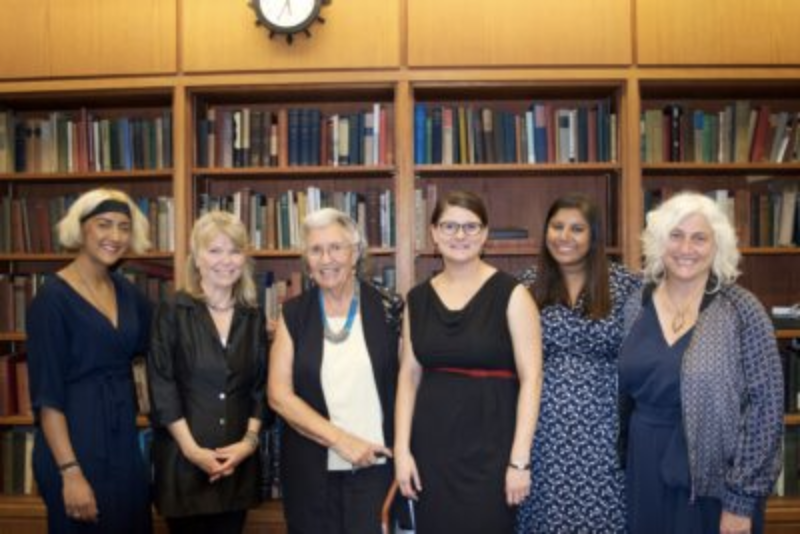
The Women Creating Change program at the Center for the Study of Social Difference celebrated five momentous years on Thursday, September 27th at the Penn Club, NYC. Speakers included President Lee C. Bollinger, A’Lelia Bundles, Rebecca Traister, Nina Berman, Aly Neel, Margo Jefferson. The focus of the event was on Telling Women’s Stories and Creating Change. The group discussed current events as well as stories of abuse and resistance.
Click here to read more.
Click here to view photos from the event.
Of Waves, Tides and (Feminist) Tsunamis: a Student Response to What We CAN Do When There’s Nothing To Be Done
The following was written in response to the tenth anniversary symposium of the Center for the Study of Social Difference (CSSD), held at The Forum at Columbia on September 28, 2018, by Mayte López, Graduate Teaching Fellow in the PhD Program in Latin American, Iberian, and Latino Cultures (LAILaC) at The Graduate Center, CUNY:
As I sit down to write this essay, Brett Kavanaugh has been confirmed as a Supreme Court Justice. The government of the United States, a country that welcomed me over six years ago and that I call my home, has granted Kavanaugh a lifetime appointment that allows him to rule and legislate over women’s bodies. Our bodies. A man who has been accused of sexual assault by multiple women, a man who has shown absolutely no respect for a woman’s body or will, a man-child whose only excuse for sexually assaulting a woman seems to be his incommensurate love of beer, now has the power to decide the future of legal abortion in this country and, possibly—most likely—overturn Roe vs. Wade. Lately, I’ve read multiple statements comparing Dr. Christine Blasey Ford’s testimony during the Ford-Kavanaugh hearing to that of Anita Hill. “I believe survivors. I believe Christine Blasey Ford. And I still believe Anita Hill” can be read all over my protective social media bubble, the carefully —albeit unintendedly—crafted echo chamber I’ve built for myself over years of likes, loves, and unfollows. What scares me the most about that last sentence is the fact that when it comes to Dr. Blasey Ford, it’s not a matter of belief or credibility. People—senators—believed her. Her testimony was not considered untrue. It was considered, and this is what makes my spine shiver, unimportant. What the Senate is telling this woman, and all women for that matter, is that their government doesn’t care. Politics trumps human decency, and Donald Trump trumps all of us. “A girl has no name, a woman has no government.”
In light of these events, the phrase “What we can do when there’s nothing to be done,” proposed by the Center for the Study of Social Difference at Columbia (CSSD) during their 10th Year Anniversary Conference, becomes even more meaningful. Can we do something? Is there really nothing to be done? I compose myself and recall Judith Butler’s intervention during the conference. Butler spoke about what it means to act in the midst of pessimism, and to keep that pessimism from becoming hopelessness. Radical transformation, she affirmed, starts incrementally and there is something to be said for momentum, for the continuing struggle of activism over time and with others.
So, what can we do? First, let me address—as was done during the opening remarks and throughout the conference—the problematic nature of that we. What does it mean, these days, to think about a collectivity? However problematic, and since I am especially concerned with women’s bodies today, and external decisions surrounding said bodies, I choose to embrace that we not only in that I am a woman, but in that I am that other marginalized and subjugated to the wishes (and “drinking games”) of white, rich, Ivy-league-educated men. I am also many other others, as Judith Butler’s invocation of #NiUnaMenos, the hashtag of the movement against gendered violence that has run through Latin America like a flame, reminds me. The movement was born in 2015 to protest feminicidio—the systematic killing of women— in Argentina, but the slogan actually has its origin in a poem by Mexican poet and activist Susana Chávez. The poem, written in 1995 in protest of Ciudad Juárez’s own appalling number of feminicidios, included the verse “Ni una muerta más” (Not one more [woman] dead). Chávez was a victim of feminicidio herself in 2011, and activists proposed the use of the slogan alluding to her poem to help fuel the movement.
As Butler stressed during her intervention in the conference, what’s most remarkable in these scenarios is that certain issues start to link with one another. Women, she said, are demanding the right to have abortions. Not the right to “choose,” as the time for euphemisms is now long gone. In Latin America, the debate around legal abortion is definitely making waves because of its narrative. The discussion now, stress the activists, is not whether women should abort, but whether abortion should be made safe and legal for all, as opposed to life-endangering and clandestine for the poor: women have always gotten abortions, but only some women can pay for the high costs of a covert and illegal surgery. It’s not only a women’s issue but a class issue. In Argentina, women—and men—understood this, and in August 2018 they protested and marched, took to the streets, and stood outside the Senate for hours, waiting for a vote to legalize abortion that was ultimately rejected. The protesters wore green handkerchiefs and clothing, which granted the movement the nickname “la marea verde” [The Green Tide]. After the vote was cast, la marea still stood outside the Senate, jumping up and down, repeating slogans, and dancing, only momentarily defeated: “It’s ok, we’ll win next year,” they said, while chanting “Se va a caer, se va a caer, el patriarcado se va a caer” [It’s going down, it’s going down, patriarchy is going down]. Indeed, unabashed by the results in Argentina, a few weeks later, on September 2018, another Green Tide took to the streets in Mexico —where I come from— to make very similar claims: Mexico’s own marea verde, wearing similar handkerchiefs, demands legal abortion nationwide —as it is legal in Mexico City—and for feminicidios to stop. The momentum Butler spoke of, with its multiple interlinked issues, is—it has to be—transnational and collective.
During the first panel of the CSSD Conference, Chilean performance artist and theater professor María José Contreras spoke of a “feminist tsunami,” and of the importance of the body as a preferred device to mobilize political critique. The bare chests of young women clad in personalized balaclavas, and the confirmation that these women had indeed achieved changes in the Chilean legislature, made the following speaker (as well as myself, and I would bet, many in the audience) feel like “just a woman in the world”. There was something profoundly powerful in those balaclavas, and in the women wearing them, their fists and hands raised, out in the streets making a case for their reproductive rights and against gendered violence. Their victory, their smiles, challenging our previous ideas of what was—what is— possible, seemed to imply that there is a lot we can do (when there’s nothing to be done). The fierce balaclavas, and the reference to a feminist “tsunami,” got me to thinking: how do we go from waves, to tides, to tsunamis? Movement, Butler affirmed, emerges in the course of struggle.
The Kavanaugh-Ford hearing, which had taken place on the day prior to the CSSD conference, was lingering in the air and was brought up by multiple speakers, including Butler herself, who made a brief but tension-relieving and laughter-provoking impersonation of Kavanaugh, much welcomed by the audience. A conference statement was written on the spot strongly opposing Kavanaugh’s confirmation and was projected on the huge screen of the auditorium and, at the close of the conference, we stood in front of it for a picture that recorded our strong opposition to the confirmation as students, teachers, writers, artists, and others. Standing there, with my hand up high, clenched in a fist, I felt a tinge of movement, perhaps—dare I say it—a tiny wave. Now, much like the Green Tide standing outside the Argentinian Senate, we have lost. Again. So, to quote Butler once more, what does it means to act in the midst of pessimism? And how do we keep that pessimism from becoming hopelessness? I do not have the answers but perhaps we should take a cue from the women jumping up and down in Buenos Aires after the Senate had cast a vote against their reproductive rights. Crisis, journalist Masha Gessen pointed out during the conference, is a time of opportunity. Perhaps the answer lies, as Butler suggested, in transnational collective movement emerging in the course of continued struggle. For waves and tides to become tsunamis, we must not stop moving. “Se va a caer, se va a caer, el patriarcado se va a caer”.
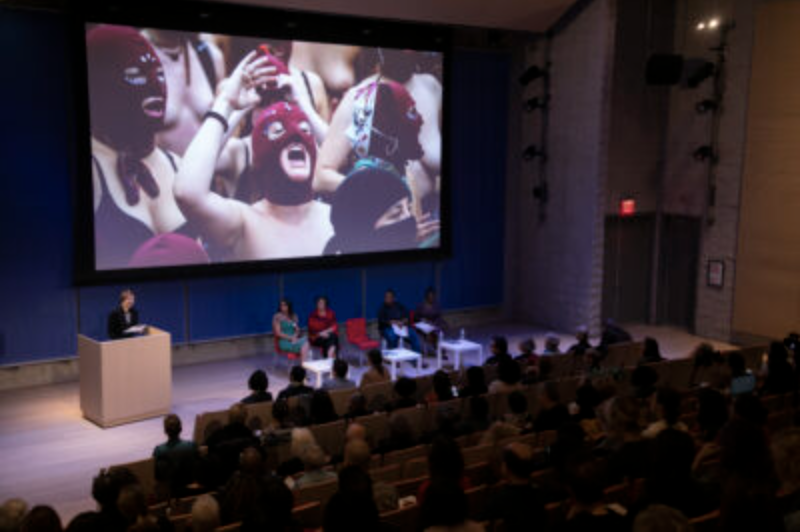
Contributed by Mayte López.
Introduction to “Arts of Intervention” panel featuring Ricardo Dominguez, Sama Alshaibi, Miya Masaoka, and Saidiya Hartman
The following is the prelude by Carol Becker (Dean of the School of the Arts at Columbia) to the roundtable discussion “Arts of Intervention” at the anniversary conference of the Center for the Study of Social Difference (CSSD), “What We Can Do When There’s Nothing To Be Done: Strategies for Change,” which was held on September 28, 2018 at The Forum at Columbia University, New York, New York:
The Gesture
Artists live in the world as citizen guides and witnesses, carefully charting human and social complexity. Because they pay close attention to evolving subtleties of the species and the natural environment, they have a deep commitment to reflecting and affecting the contemporary understanding of our condition. Their work often predicts what is to come, not because artists are unusually prescient but because they live intensely in the present—observing, responding, and contemplating. As a result, their work often gestures to the urgency of issues manifesting in the moment, threatening the species and the planet now and in the future. What does it mean to look closely, to listen seriously, to notice what others might not, and then to question unrelentingly what you are seeing and hearing?
As intensely as artists monitor the present reality, they also cultivate their imaginations. Therefore, they see the possibilities of potential systems of thought that do not as yet exist––the ways in which the world could be different and better for all living creatures. Thus artists tend to align with those in the progressive arena who imagine a world moving toward a greater good, one without inequity and oppression.
And because artists are deeply committed to personal freedom of expression as a basic right, they also tend to be irreverent and, at times, defiant against that which feels overly institutionalized and restrictive. Because of their commitment to the imagination, artists start with the premise that all that stands in the way of human freedom and well-being can be and should be rethought, rebuilt, and rearranged. Or, as poet Terrance Hayes writes in his poem “For Brothers of the Dragon,” “Why was the imagination invented, if not to remake?”
And as specific as art might be to a particular moment, culture, and conflict, when it goes deep enough into the uniqueness of a situation, it inevitably touches something bigger than itself that incorporates difference and moves us simultaneously to an understanding of our shared humanity. This understanding is very significant, because when we refuse to acknowledge our collective humanness, we then are able to objectify others. The more capable of objectification we are, the less likely we are to exercise compassion or understanding or to engage in humane action for all.
If successful, art is experiential, eliciting a sensorial or emotional response. Even when abstract, issue oriented, or functional, its unique form allows the work to reason with our sensibilities, to make us understand the world through our bodies as well as through our minds.
Within this framework of lived experience are the stories we tell each other about our lives. Getting to common ground—without ignoring, depleting, and denying the inevitable differences of history, culture, and ideology—is the consequence of negotiating form, something that artists understand very well. Artists are able to use technique, technology, and skill to contain this complexity of human experience, whether within the structure of a play, a novel, a poem, or a memoir; within the visual conceits of painting, sculpture, performance, installation, or intervention; within the myriad forms of musical composition, sound art, theater, dance, or the range of filmic structures; or within the new possible forms afforded by evolving digital innovation. All allow us to contain the shared depth, breadth, complexity of emotion, desire, lived lives, successes, and failures of the species. Rarely does someone create artwork to hide it in a drawer. Art for the most part is made to exist in the public sphere––to be read, heard, seen, sung, experienced, and shared with as large an audience as possible. As such, it is always a public statement made to communicate, to stir up, to elicit emotion, to provoke clear thinking, and, at times, to solve a specific problem.
Artists and designers increasingly define their process by what has been called social practice: the desire and ability to intervene in the public sphere. These practitioners have been in the vanguard of helping to make visible such issues as race, class, gender, migration, social justice, public concerns with Big Data, the reemergence of fascism, and Climate Change.
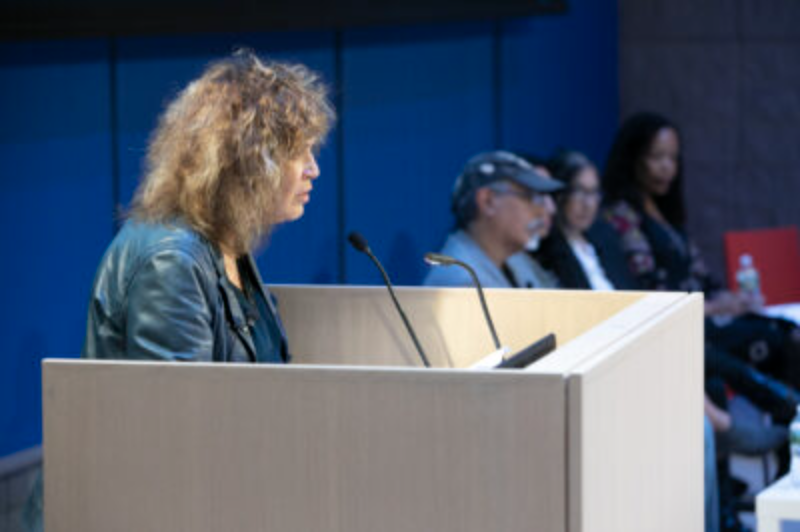
Working across forms, these four artists, writers, thinkers, and practitioners—Ricardo Dominguez, Sama Alshaibi, Miya Masaoka, and Saidiya Hartman—manifest aspects of such intentions. In their own ways, they each tackle complex social issues, utilizing advanced technologies as well as the most originary forms of narrative to situate the human voice in particular landscapes.
Thinking through art is a utopian process. Once art is in the public sphere, its ideas slowly become recognizable and acceptable, as they wait for the time when thought can manifest in action. In this sense, art, which is the result of great passion and urgency, also integrates patience and duration.
Contributed by Carol Becker
Professor Mae Ngai featured in The Washington Post
Mae Ngai co-authored a piece in The Washington Post on how a proposed policy by the Trump administration might affect impoverished immigration populations.
Historian Mae Ngai joined with other three historians to co-author a piece for The Washington Post on how Trump administration policies may punish immigrants for making use of social services such as food stamps, Medicaid, CHIP, and energy assistance programs.
If approved, the new policy would effectively deter legal immigrants from using public benefits for which they are eligible, lest they later be denied a green card or be removed.
Professor Mae Ngai moderated the “Crossing Borders: Refugees, Migrants, Stateless Lives” panel at the CSSD anniversary symposium.
Click here to read the article.
Professor Frances Negrón-Muntaner speaks with NPR
Frances Negrón-Muntaner co-director of the working group Unpayable Debt and Professor of English and Comparative Literature at Columbia University, spoke with NPR One year after Hurricane Maria made landfall in Puerto Rico.
Frances Negrón-Muntaner co-director of the working group Unpayable Debt and Professor of English and Comparative Literature at Columbia University, spoke with NPR One year after Hurricane Maria made landfall in Puerto Rico.
As rebuilding efforts continue, they discuss how identity has changed on the island and explore questions of status, economic resilience and activism at the ground level.
Click here to listen to the interview.
A Student Response to What We CAN Do When There’s Nothing To Be Done
Mayte López, PhD student in Latin American, Iberian, and Latino Cultures at The Graduate Center, CUNY, writes a response to the tenth anniversary symposium of the Center for the Study of Social Difference (CSSD).
Mayte López, Graduate Teaching Fellow in the PhD Program in Latin American, Iberian, and Latino Cultures (LAILaC) at The Graduate Center, CUNY, writes a response to the CSSD tenth anniversary symposium “What We Can Do When There’s Nothing To Be Done,” for the Center for the Study of Social Difference (CSSD) online blog.
Lopez reflects on recent events and how the phrase “What we can do when there’s nothing to be done,” proposed by the Center for the Study of Social Difference (CSSD) during our 10th Year Anniversary Conference becomes even more meaningful in the current political climate.
Click here to read the full post.
Professor Frances Negrón-Muntaner publishes an article called "Our Fellow Americans" in Dissent Magazine
Co-director of CSSD working group Unpayable Debt questions terminology use in the aftermath of Hurricane Maria.
Co-director of CSSD working group Unpayable Debt questions terminology use in the aftermath of Hurricane Maria.
Professor Frances Negrón-Muntaner, co-director of CSSD working group Unpayable Debt publishes an article, titled “Our Fellow Americans,” examining why calling Puerto Ricans “Americans” will not save them from the current challenges they face. Her article discusses the rhetorical explosion of the use of the phrase “our fellow Americans” to refer to Puerto Ricans in the aftermath of Hurricane Maria and raises the question of why the sudden adoption of this phrase.
Click here to read the article.
CSSD Recognizes the 61st Birthday of Imprisoned Activist Osman Kavala
Participants and attendees gathered at the conclusion of CSSD’s anniversary symposium to send wishes to Anadolu Kültür Executive Board Chair and activist Osman Kavala.
Attendees of the anniversary symposium of the Center for the Study of Social Difference (What We CAN Do When There’s Nothing To Be Done) were among artists, activists, journalists and family members in Istanbul and London wishing imprisoned Turkish activist Osman Kavala a happy birthday on September 28, 2018. Kavala, the Executive Board Chair of Anadolu Kültür, referred to as the Soros of Turkey, has been incarcerated in Turkey since the first of November last year after being arrested in October of 2017 at İstanbul Atatürk Airport. His arrest has garnered international indignation, with many calling for his immediate release.
CSSD symposium audience members, panelists, and organizers alike stood below a picture and birthday message of Kavala that read, “Osman Kavala has taught us what we can do when there’s nothing to be done.” This was in addition to participant support of a statement entitled #WhatWeCanDo released at the close of the conference listing the resolutions of the symposium to advance social justice.
Read more about birthday greetings sent to Osman Kavala here.
Professor Bernard Harcourt Co-Signs Letter to the US Senate
Professor Bernard Harcourt joins over 2,400 law professors around the country opposing Kavanaugh’s confirmation.
Professor Bernard Harcourt was one of 2,400 law professors to have signed on to a letter to the US Senate saying that Supreme Court nominee Brett M. Kavanaugh displayed a lack of judicial restraint at his Senate hearing.
Harcourt was quoted in a number of venues, including the Wall Street Journal and the Washington Post, commenting on the letter, stating that Brett Kavanaugh "did not display the impartiality and judicial temperament requisite to sit on the highest court of our land."
Professor Bernard Harcourt moderated the “Facing the Present, Imagining the Future” panel at the Center for the Study of Social Difference anniversary symposium.
Rebecca Traister featured in New York Times Sunday Review
Panelist from the fifth anniversary celebration of Women Creating Change at the Center for the Study of Social Difference publishes feature in advance of release of her book Good and Mad: The Revolutionary Power of Women’s Anger.
“Fury Is a Political Weapon,” an Opinion piece by Rebecca Traister, is featured on the front page of the September 30, 2018 print New York Times Sunday Review. The full article can be read here.
Rebecca Traister, whose new book Good and Mad: The Revolutionary Power of Women’s Anger will be published by Simon & Schuster on October 2, 2018, was panelist at the 5th anniversary celebration of Women Creating Change at the Center for the Study of Social Difference last Thursday evening.
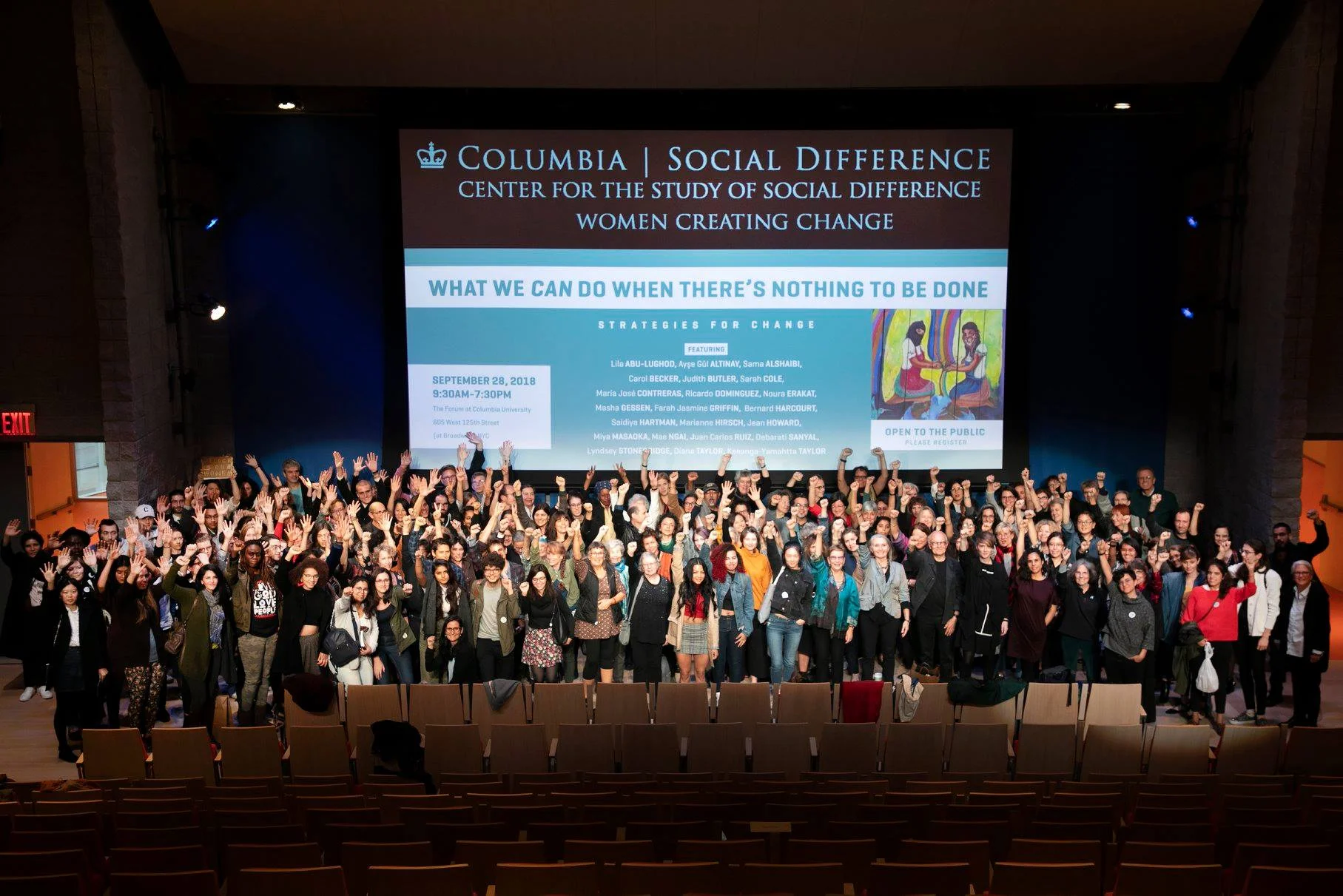
Statement released by participants and attendees of the CSSD anniversary symposium
At the close of What We CAN Do When There’s Nothing To Be Done on September 28, 2018, conference members released a statement and group photo.
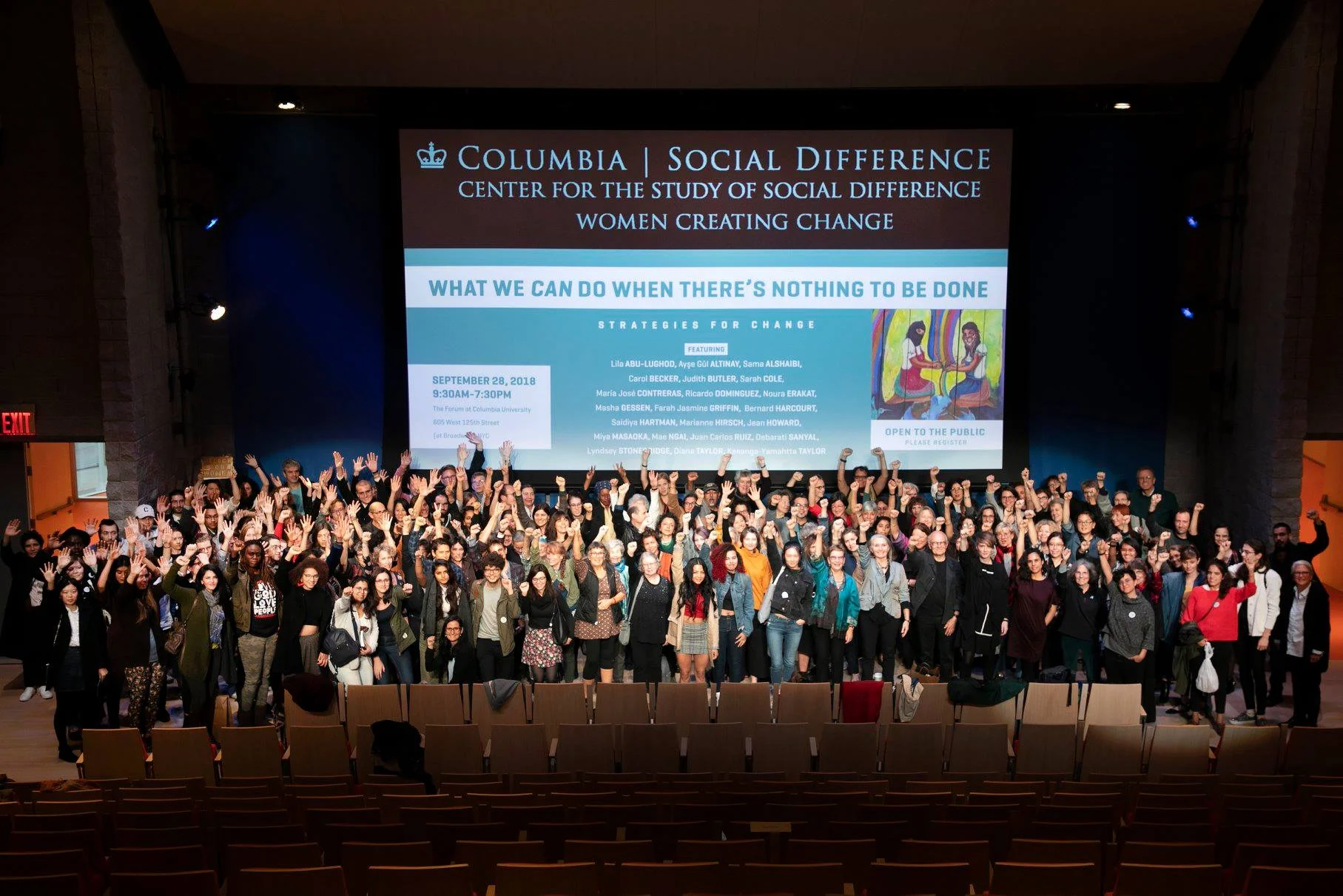
September 28, 2018 at What We CAN Do When There’s Nothing To Be Done: Strategies For Change
#WhatWeCanDo
A Conference Statement
September 28, 2018
We – several hundred students, teachers, writers, artists, activists, scholars, community members, privileged and disempowered alike— gathered together today to think, reflect, and act on the theme of “What We Can Do When There’s Nothing To Be Done,” for the tenth-year anniversary symposium of the Center for the Study of Social Difference at Columbia University.
We spent the day together critically thinking about what we can do to advance social justice through various forms of intellectual work, artistic creation, political action and modes of protest.
All the while, we have felt outraged at the political developments in this country, just outside these walls.
We protest the disrespect and disregard for women displayed by Republican men on the Senate Judiciary Committee and by the current administration more generally.
We strongly oppose the possible confirmation of Judge Brett Kavanaugh to the Supreme Court.
We are horrified by the structures that promote a man accused of violently assaulting women and who supports policies that violate the rights of so many people. Judge Kavanaugh’s confirmation hearings raised many red flags about his suitability for the court, ranging from his incomplete financial disclosures to the extreme partisanship unbefitting a judge and the egregious lack of judicial temperament he displayed.
We are heartened that the confirmation vote has been delayed and we demand that the FBI investigation be unhurried, unbiased, and thorough.
We pledge to act to oppose his confirmation.
We are committed to justice for all.
#WhatWeCanDo
Five principles emerged from our conference discussions, and we pledge to carry these with us beyond the privileged bounds of the space we occupied on Friday. This is both a call to action and a reminder that action can be taken:
1. We CAN do something, even when there seems to be nothing to be done.
2. If capable, we can and should utilize our privilege and the spaces we occupy to facilitate resistance, even in the face of presumed hopelessness or pessimism (the two are not to be conflated).
3. We acknowledge the power of small gestures to lead to acts – to lead to movements.
4. We will “resist temptation to return things to normal.”
5. “To change the world we must also be changed.”
Premilla Nadasen elected next President of the NWSA
CSSD co-director of Social Justice After the Welfare State and Faculty Fellow of Geographies of Injustice, Premilla Nadasen, was elected next President of the National Women's Studies Association (NWSA).
Premilla Nadasen, Faculty Fellow with Geographies of Injustice and a co-director of Social Justice After the Welfare State, was elected next President of the National Women's Studies Association (NWSA).
As President of the NWSA Governing Council, Dr. Nadasen will take office in November 2018 and serve for two years. The NWSA Governing Council serves as the Board of Directors for the organization and meets twice annually: in June and November.
Established in 1977, the National Women's Studies Association has as one of its primary objectives promoting and supporting the production and dissemination of knowledge about women and gender through teaching, learning, research and service in academic and other settings.
Jennifer Hirsch Featured in Teen Vogue
Reframing Gendered Violence co-director Jennifer Hirsch featured in an article in Teen Vogue discussing study on sexual education and its impact on how some college students practice consent.
A study by Reframing Gendered Violence co-director Jennifer Hirsch exploring the difference between how many straight, cisgender students are taught to give and get consent through a college-mandated "Yes Means Yes" training course is featured in an article on Teen Vogue.
The study titled “Social Dimensions of Sexual Consent Among Cisgender Heterosexual College Students: Insights From Ethnographic Research” reveals a social gray area — one in which young people are having consensual sex, but don't necessarily practice it in the way they were taught.
Click here to read the article.
Click here to read the study by Hirsch and her co-authors.
LIVESTREAM: MENSTRUATION IS HAVING ITS MOMENT – HOW CAN SCHOLARS ENGAGE?
New CSSD Working Group, Menstrual Health & Gender Justice holds launch panel September 20, 2018 .
The first event from the new CSSD Working Group on Menstrual Health and Gender Justice brought together experts on menstrual health – established and emerging scholars as well as practitioners. While research on menstruation is not new, the current momentum creates new opportunities.
The event was facilitated by CSSD Menstrual Health & Gender Justice Working Group Director, Inga Winkler. Speakers included Nancy Reame of Columbia University Medical Center; Chris Bobel, Associate Professor of Women's, Gender, and Sexuality Studies at the University of Massachusetts Boston; Norma Swenson, Founder of Our Bodies, Ourselves; Trisha Maharaj, Graduate Student in Human Rights Studies at Columbia University; Sylvia Wong of the United Nations Population Fund.
To watch the livestream video of the event, click here.
For more information about the event, click here.
Menstrual Health and Gender Justice Working Group Launches with Expert Panel
The Center for the Study of Social Difference and the Institute for the Study of Human Rights sponsored the launch of a new CSSD working group: Menstrual Health and Gender Justice.
On September 20, 2018, the Center for the Study Social Difference and the Institute for the Study of Human Rights sponsored the launch of a new CSSD working group: Menstrual Health and Gender Justice.
Inga Winkler, the director of the new working group, led five panelists and experts in the field in discussing the methods, opportunities, and risks involved in generating sustainable, evidence-based outcomes and in challenging common misconceptions of menstruation.
Panelists provided insights into how the working group can address and engage with the recent surge in public interest surrounding menstruation in their research.
Click here to read more.
Menstrual Health and Gender Justice Working Group Launches with Expert Panel: Menstruation is Having its Moment – How Can Scholars Engage?
On September 20, 2018, the Center for the Study of Social Difference (CSSD) and the Institute for the Study of Human Rights sponsored the launch of a new CSSD working group: Menstrual Health and Gender Justice. The event featured an expert panel addressing some of the most pressing questions related to menstrual health.
Panelists provided insights into how the working group can address and engage with the recent surge in public interest surrounding menstruation in their research.
The panel brought together various perspectives: established scholars and new voices, birds-eye views on ongoing developments and insights from communities, socio-medical and cultural perspectives on menstruation. Inga Winkler, the director of the working group, led five panelists and experts in the field in discussing the methods, opportunities, and risks involved in generating sustainable, evidence-based outcomes and in challenging common misconceptions of menstruation. Both the panelists and attendees of the launch event offered professional and personal perspectives on the current menstrual movement, its history and significance, and the potential ways in which the working group can contribute to meaningful, inclusive change.
Nancy Reame from the Columbia School of Nursing challenged the idea that menstruation is only now having its moment and drew our attention to research and advocacy on the Toxic Shock Syndrome outbreak in the 1980s.
Norma Swenson, one of the co-founders of Our Bodies, Ourselves, provided advice on how to develop the current moment into a long-term movement for women’s health.
Vanessa Paranjothy, an Obama Foundation Scholar and co-founder of Freedom Cups stressed the importance of listening to women and following their lead when working with communities.
Trisha Maharaj, a graduate student in Human Rights Studies, shared research on attitudes towards menstruation amongst Hindu women in Trinidad. She challenged the conventional wisdom that cultural and religious practices often contribute to stigma based on her findings that women in Trinidad do not perceive them as stigmatizing.
Chris Bobel from UMass Boston cautioned us that the menstrual health space is driven by assertions and assumptions that are not yet properly explored. She witnesses a heavy focus on providing products to the detriment of addressing underlying issues of institutionalized and embodied shame about menstruation.
Among the diverse perspectives present, the panel agreed that several issues are integral for moving the discussion on menstrual health forward, including: (1) promoting menstrual literacy and body literacy; (2) supporting scholarship aimed to fill knowledge gaps; (3) addressing stigma associated with menstruation; and (4) involving and encouraging collaboration with diverse groups, sectors, and movements. Moving forward, the Menstrual Health and Gender Justice working group will engage in critically evaluating existing developments in the field of menstrual studies, contributing to the body of research and sharing knowledge.
If you would like to get updates and news from the Menstrual Health and Gender Justice Working Group, please email Michelle at mc4225@columbia.edu.
Contributed by Sydney Amoakoh, Michelle Chouinard and Inga Winkler.
Rachel Adams Reviews Three New Memoirs
Rachel Adams, co-director of the Precision Medicine working group, has reviewed three memoirs on illness and recovery.
Rachel Adams, co-director of the Precision Medicine working group and Professor of English and Comparative Literature at Columbia, has reviewed three new memoirs on illness and recovery in an article entitled, “Who is Sick and Who is Well.” It appeared in the publication Public Books and was commissioned by Nicholas Dames.
The full article can be read here.
Andreas Huyssen Interviewed in Politika
Andreas Huyssen, faculty fellow of the working group Women Mobilizing Memory, spoke with Politika about memory studies.
Andreas Huyssen, faculty fellow of the working group Women Mobilizing Memory and Villard Professor Emeritus of German and Comparative Literature at Columbia University, was interviewed in Politika for an article entitled “State of the art in memory studies.” In the interview Huyssen discusses the present debate on memory and how the field of memory studies has evolved. The impact that digital technologies and social media has had on the field is addressed as well.
The full interview can be read here.
Gayatri Spivak Featured in the New York Times
Gayatri Spivak, co-director of the working group The Rural-Urban Interface, published an article entitled “Who Is Afraid of Shahidul Alam?” in which she speaks about the photojournalist’s imprisonment.
Gayatri Spivak, co-director of the working group The Rural-Urban Interface: Gender and Poverty in Ghana and Kenya, Statistics and Stories, and University Professor at Columbia, was featured in the New York Times with an article entitled, “Who Is Afraid of Shahidul Alam?” In the article she talks about the imprisonment of the Bangladeshi photojournalist and the country’s drift towards autocracy.
In addition, she recently delivered the Jean-Paul Sartre Memorial Lecture, “How Can we use Marx Today?” at the Asian Development Research Institute in Patna, India.
Farah Jasmine Griffin Speaks about Aretha Franklin’s Legacy
Farah Jasmine Griffin, co-director of the working group Toward an Intellectual History of Black Women, spoke with DemocracyNow! and The Nation about Aretha Franklin’s legacy.
Farah Jasmine Griffin, co-director or working group Toward an Intellectual History of Black Women and William B. Ransford Professor of English & Comparative Literature, spoke with DemocracyNow! And The Nation about Aretha Franklin’s role in the history of music and her involvement in fighting for Angela Davis’s freedom in 1970.