
Professor Cinnamon Bloss Speaks with Precision Medicine Working Group
Professor Bloss of UC San Diego gave a talk on how bioethics must adapt to the rise of Precision Medicine.
Professor Cinnamon Bloss, Associate Professor of Psychiatry at UC San Diego, gave a talk to the Precision Medicine: Ethics, Politics and Culture working group on February 15, 2018. In her presentation she focused on the challenges that stem from the rise of technological innovation and the spread of the practice of Precision Medicine. In particular, she examined how the field of bioethics must adapt in terms privacy for patients and how this will affect trust and patient participation. A complete recap of her talk, written by Precision Medicine graduate fellow Moran Levy, can be found here on the blog of the Center for the Study of Social Difference.
Cinnamon Bloss: "Consumers, Citizens, and Crowds in the Age of Precision Medicine"
Professor Cinnamon Bloss (UC San Diego) gave a fascinating talk for the Precision Medicine: Ethics, Politics and Culture working group at the Center for the Study of Social Difference on February 15, 2018.
At the center of her talk was the problem of diffusion of medical innovation. This problem is not a new one. There is longstanding research on processes of adoption of innovation. Physicians as well as patients have historically hesitated to experiment with innovative technologies, and issues of privacy and trust have persisted. Inequality and distributive injustice has also traditionally been a problem as it is often wealthy individuals who enjoy innovative technologies long before they become standard therapies. A few historical examples are Serum treatment for pneumonia in the 1920s, Arsenic treatment for syphilis in the 1930s, Chemotherapy for varied cancer in the 1960s, and Experimental HIV treatment in the 1980s.
Professor Bloss engages with these complex and longstanding questions in her research in relation to Precision Medicine (PM). Her work addresses the considerable bioethical challenges that come with the rise of new technological innovation and practices of PM. And her analysis spans three analytical levels: individual, systemic, and societal.
What is remarkable and important about Professor Bloss’s work is that while many researchers take for granted that issues such as “privacy,” “trust,” and “participation” are challenges to PM, Professor Bloss adopts a critical perspective in trying to understand what those terms even mean in the arena of PM.
Instead of taking concepts from bioethics as given, she builds on previous work to empirically investigate the current bioethical dilemmas of PM. Her work is oriented to empirically understand the various norms, expectations and challenges entangled in the notion of “privacy” for patients. In what specific ways does ‘privacy’ affect trust and patient participation? And what are the current expectation of patients from PM?
Professor Bloss also attempts to understand the specific views of physicians towards PM and the specific gaps common to both clinical practice and PM. What motivates practitioners to turn to PM, and what obstacles prevent the diffusion of new technologies? On point of consideration is that transformation in the position of the FDA towards distribution of direct to consumer test results is especially important in shaping the current climate.
The significance of this research is in emphasizing that new technologies of PM transform the traditional concerns and problems for researchers, doctors, regulators and patients. We must continue to follow the evolution of notions and practices of ‘privacy’, ‘trust’, ‘regulation’ or ‘protection’ to understand current events.
In this context, Professor Bloss’s work on Direct to Consumer (DTC) strategies in PM is especially important, as it shows how the field of bioethics and its fundamental challenges are being transformed in a new healthcare economy.
In her research, Professor Bloss examines the American Gut Project to try and understand both new strategies for raising money for research (with the decrease in availability of public funding for research) and new models of patient consumerism. What drives Americans to participate in microbiome research? Which demographics are most likely to participate? What types of result do Americans expect? What if our ability to interpret the data and articulate its clinical implications is very limited? Are participants only interested in recognitions for their contribution to research or do they expect the data to help them manage their health proactively? And what will happen when we are able to interpret results and link microbiome profiles to clinical risks? Among other legal and ethical challenges, we might consider: would we have to report such results to employers and insurers?
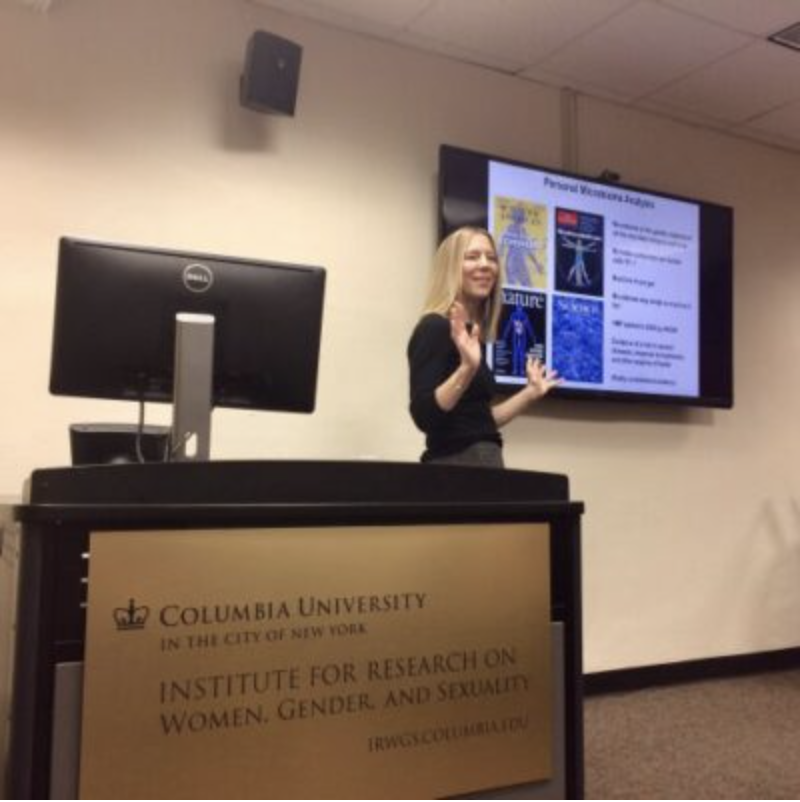
Professor Bloss’s work opens up new avenues in understanding the new healthcare economy based on DTC and PM and their unique challenges. We are grateful that she so kindly and expertly discussed these topics with our PMEPC graduate fellows and the public at large.
Contributed by Moran Levy
Los Angeles Central Library hosts exhibits inspired by the work of Marianne Hirsch
The Los Angeles Central Library is currently hosting two exhibits inspired by the work of CSSD Director Marianne Hirsch, both examining the generational trauma of the Armenian Genocide. The main exhibit, entitled “Nonlinear Histories”, is co-curated by Isin Önol, member of the Working Group for the CSSD Project Women Mobilizing Memory.
The Los Angeles Central Library is currently hosting two exhibits inspired by the work of CSSD Director Marianne Hirsch, both examining the generational trauma of the Armenian Genocide. The main exhibit, entitled “Nonlinear Histories”, is co-curated by Isin Önol, member of the Working Group for the CSSD Project Women Mobilizing Memory (for which Hirsch served as Co-Director), and features the work of fellow Working Group member Silvina Der Meguerditchian. The exhibit is inspired by Hirsch’s groundbreaking work on postmemory, and is the first exhibit to use postmemory as a framework for examining the Armenian Genocide. In addition to “Nonlinear Histories”, a second exhibit, “Prosperity, Loss, and Survival: A Photographic Journey from the Dildilian Family Archive”, is also being displayed at the library.
As part of the exhibit, Silvina Der Meguerditchian contributed “Treasures”, a work constructed from 130 pages of health remedies composed by the artist’s great-grandmother, a genocide survivor. Der Meguerditchian’s piece aims to provide “a space to reflect and see because lots of second and third generations were silenced by trauma, but our grand kids can now articulate a lot of things”.
In addition to serving as inspiration for the exhibit, Hirsch delivered its opening lecture, entitled “Forty Days and More: Connective Histories.” The exhibit, which opened on March 17, runs through May 6.
CSSD Project Director Jack Halberstam Co-Curates Conference at Stedelijk Museum
Professor Jack Halberstam, director of the CSSD project Queer Theory: Here, Now, and Everywhere, recently co-curated a conference and festival at the Stedelijk Museum in Amsterdam.
Professor Jack Halberstam, director of the CSSD project Queer Theory: Here, Now, and Everywhere, recently co-curated a conference and festival at the Stedelijk Museum in Amsterdam. The conference, titled Hold Me Now - Feel and Touch in an Unreal World, was held from March 21-24 2018, and co-curated by Karen Archey, Rizvana Bradley, and Mark Paterson.
Consisting of four single-day “discursive, and at times perforative” programs, each curated by one of the four curators, the conference aimed to examine the ways in which touch operates in contemporary “technologically mediated, dematerialized digital cultures”, further examining touch “in artistic, philosophical, and political terms to conceive how the haptic is thought and experienced in life, art and design, and theory.”
In addition to serving as a CSSD project director and member of the CSSD Executive Committee, Halberstam is also Professor of Women’s, Gender, and Sexuality Studies and English and Comparative Literature at Columbia University.

Jean Howard Delivers the Dean Family Lecture at Wake Forest University
CSSD project director Jean Howard gave the Dean Family Lecture at Wake Forest University on "Edward Bond's Bingo: Shakespeare Revisited."
CSSD project director Jean Howard gave the Dean Family Lecture at Wake Forest University on "Edward Bond's Bingo: Shakespeare Revisited."
Professor Howard also led a seminar at the Shakespeare Association of America in Los Angeles on "Shakespeare and Marx Now."
Jean Howard is a renowned Shakespeare scholar and has written many books and essays on early modern literature, Shakespeare, feminist studies, and theater history. She is a co-director for the CSSD projects Engendering the Archive, Women Mobilizing Memory, and Reframing Gendered Violence.
The Dean Family Speaker Series is hosted by The Department of English at Wake Forest University and brings nationally and internationally-recognized scholars to campus. It encourages critical conversations and dialogue related to the study of English.
Jack Halberstam Receives a Columbia-PSL Global Humanities Grant
Director of CSSD working group Queer Theory: Here, Now, and Everywhere receives grant for Paris conference on gender and sexuality studies.
Jack Halberstam, director of the CSSD working group Queer Theory: Here, Now, and Everywhere, has received a Columbia-PSL global humanities grant to organize a transnational conference on sexuality and gender theory. The conference, which will take place at Reid Hall in Paris, will address the need to overcome a singular model of gender through cross-cultural interchange and collaboration. The goal is to start a conversation about setting a new path for queer studies, in which ideas flow between cultures and a global model of sexuality studies is displaced by one characterized by diversity of thought.
Lila Abu-Lughod Delivers Geertz Commemorative Lecture at Princeton University
Lila Abu-Lughod, former director of CSSD and co-director of CSSD projects Gender, Religion and Law in Muslim Societies, Reframing Gendered Violence, and Religion and the Global Framing of Gender Violence, delivered the Clifford Geertz Commemorative Lecture at Princeton University on February 22, 2018.
Lila Abu-Lughod, former director of CSSD and co-director of CSSD projects Gender, Religion and Law in Muslim Societies, Reframing Gendered Violence, and Religion and the Global Framing of Gender Violence, delivered the Clifford Geertz Commemorative Lecture at Princeton University on February 22, 2018.
Abu-Lughod’s lecture, “Settler Colonialism Observed: Palestine's Alter-natives”, examined “Palestine’s apparent political impasses” in light of “the current ferment in critical indigenous and native studies about settler colonialism in places like Australia and North America.” Considering “questions about how to judge the efflorescence of recent Palestinian cultural projects like the new Palestinian Museum”, Abu-Lughod argues that the concept of settler colonialism, “however contested and even problematic”, remains a potent force that can “generate comparisons and solidarities that burst open exhausted political imaginations and bring together the political, material, and moral.”
In addition to serving as director, project co-director, and executive committee member at CSSD, Abu-Lughod is Joseph L. Buttenwieser Professor of Social Science in the Department of Anthropology at Columbia University, a former director and current executive committee member of the Columbia Institute for Research on Women, Gender, & Sexuality, and former director of the Columbia Middle East Institute.

CSSD Project Co-Director Frances Negrón-Muntaner Publishes “Blackout: What Darkness Illuminated in Puerto Rico”
Frances Negrón-Muntaner, Co-Director of the CSSD Project Unpayable Debt: Capital, Violence, and the New Global Economy, recently published the essay “Blackout: What Darkness Illuminated in Puerto Rico” in both English and Italian as part of the exhibit “Blackout: Allora & Calzadilla” at the Maxxi Museum in Rome.
Frances Negrón-Muntaner, Co-Director of the CSSD Project Unpayable Debt: Capital, Violence, and the New Global Economy, recently published the essay “Blackout: What Darkness Illuminated in Puerto Rico” in both English and Italian as part of the exhibit “Blackout: Allora & Calzadilla” at the Maxxi Museum in Rome. Negrón-Muntaner’s essay additionally appeared in Politics/Letters.
Negrón-Muntaner’s essay points out that the aftermath of Hurricane Maria “revealed how the United States systematically dispossesses Puerto Rico”, arguing further that “in a world where the powerful routinely enact predatory acts under the brightest of lights, [the blackout following the hurricane] can serve to illuminate the unknown, clarify what has been obscured, ignite revolt, and, like in the theater, end one scene and begin anew.”
In addition to serving as a CSSD Project Co-Director and Executive Committee member, Negrón-Muntaner is Professor of English and Comparative Literature at Columbia and Former Director of the Center for the Study of Ethnicity and Race.
CSSD Project Co-Director Kevin Fellezs to Give Two Lectures in China
Kevin Fellezs, Co-Director of the CSSD Project Pacific Climate Circuits: Moving beyond Science, Technology, Engineering, and Economics, will give two upcoming lectures in China, entitled “Fusion, Then…And Now: Thoughts on the Persistence of the Broken Middle”.
Kevin Fellezs, Co-Director of the CSSD Project Pacific Climate Circuits: Moving beyond Science, Technology, Engineering, and Economics, will give two upcoming lectures in China, entitled “Fusion, Then…And Now: Thoughts on the Persistence of the Broken Middle”. Fellezs will speak at two eminent musical conservatories in China: the Central Conservatory of Music in Beijing (widely considered the most prestigious in the country) and the Tianjin Conservatory of Music in Tianjin.
In addition to serving as a CSSD Project Co-Director and Executive Committee member, Fellezs is Assistant Professor of Music and African American Studies in the Department of Music, with a joint appointment with the Institute for Research in African-American Studies.
RGFGV announces second Media Fellowship Competition
CSSD Project Religion and the Global Framing of Gender Violence announces its second Media Fellowship Competition.
CSSD Project Religion and the Global Framing of Gender Violence announces its second Media Fellowship Competition. The second of two reporting grants hosted by the project, this cycle will focus on South Asia. Previous Media Fellows were: Yasmin el Rifae, Nafeesa Syeed, and Samira Shackle.
The full announcement is available here.
Co-Director of CSSD project Social Justice After the Welfare State, Alice Kessler-Harris, is featured in a NYTimes article
Alice Kessler-Harris is featured in a NYTimes article on workplace power dynamics and the slow progress for women in traditionally 'masculine' fields. CSSD will host a book event with Kessler-Harris on April 4, 2018.
Alice Kessler-Harris is featured in a NYTimes article on workplace power dynamics and the slow progress for women in traditionally 'masculine' fields.
Kessler-Harris discusses the problems with characterizing certain jobs as ‘manly’ and the negative implications these have for women employed in these sectors.
Click here to read the article.
Alice Kessler-Harris is a co-director of CSSD project Social Justice after the Welfare State. She is also co-editor of the book “Democracy and the Welfare State: The Two Wests in the Age of Austerity,”
CSSD is hosting a book launch event for Democracy and the Welfare State: The Two Wests in the Age of Austerity on April 4, 2018.
Blog Post Now Available for CSSD Precision Medicine Event The Genomic Revolution, Genetics Counselors, and “Doing Ethics”
On January 22, CSSD/PM&S project Precision Medicine: Ethics, Politics, and Culture welcomed Dr. Susan Markens (CUNY-Lehman College) for its first talk of the semester, titled The Genomic Revolution, Genetics Counselors, and Doing Ethics.
On January 22, CSSD/PM&S project Precision Medicine: Ethics, Politics, and Culture welcomed Dr. Susan Markens (CUNY-Lehman College) for its first talk of the semester, titled The Genomic Revolution, Genetics Counselors, and Doing Ethics.
Dr. Markens' talk presented data primarily derived from forty-two qualitative interviews and was based on her research about the perspectives of genetic counselors towards the increasing availability and use of genetic science and testing.
The Precision Medicine lecture series represents a broad-based exploration of questions that precision medicine raises in law, ethics, the social sciences, economics, and the humanities.
Click here to read more about Dr. Markens talk on ethics and genetic counseling.
Essay Conceived in IRWGS seminar inspired by CSSD Project is Published in the New York Times Modern Love Column
Columbia University senior Bindu Bansinath wrote the first version of the newest Modern Love essay in the IRWGS undergraduate seminar Narrating Rape, taught by CSSD Director Marianne Hirsch.
Columbia University senior Bindu Bansinath wrote the first version of the newest Modern Love essay in the IRWGS undergraduate seminar Narrating Rape, taught by CSSD Director Marianne Hirsch.
Bansinath's essay “How ‘Lolita’ Freed Me From My Own Humbert” has been published today online and will be in this Sunday's print version of the New York Times as part of their popular Modern Love essay series. Her essay tells the story of a young woman’s struggle with abuse and her journey to reclaim her voice.
The Narrating Rape course is one of the outcomes of the Reframing Gendered Violence project at CSSD, part of the Women Creating Change initiative.
Dr. Susan Markens talks about ethics and genetic counseling with the CSSD/PM&S Precision Medicine group
On January 22, 2018, the Precision Medicine: Ethics, Politics, and Culture CSSD/PM&S working group welcomed Dr. Susan Markens (CUNY-Lehman College) for its first talk of the semester, titled The Genomic Revolution, Genetic Counselors, and “Doing Ethics.” Dr. Markens presented her qualitative findings based on her research about the perspectives of genetic counselors towards the increasing availability and use of genetic science and testing.
Dr. Markens focuses on studying how the new advances in genetic science are translated and perceived, particularly from the point of view of genetic counselors. She presented the following questions during her talk: 1) What are the perspectives of genetic counselors on ethical issues emerging from recent advances in genetic technology? and 2) What do they consider to be their goals and professional responsibilities?
The talk presented data primarily derived from forty-two qualitative interviews, the vast majority of which were with board certified genetic counselors. Additional supporting materials drew from attendance at professional conferences, webinars, and talks, and also newspapers and other publications.
Genetic Counseling as a Profession
Historian Alexandra Minna Stern defined the birth and development of the genetic counseling profession as a "quiet revolution,” in particular starting after the establishment of the first degree in genetic counseling at Sarah Lawrence College in 1969 and later of a certification exam in 1981. By the end of 2017, the United States had a total of 37 accredited programs and over 4,000 certified genetic counselors.
Previously, genetic counselors primarily worked in prenatal counseling and pediatrics, and their role is now expanding to topics related to cancer and multiple overlapping areas. Cancer counseling has grown alongside the scientific advances in the last decades, becoming more and more popular in an industry setting. Genetic counselors play a pivotal role in terms of translating information for patients, having both a background in the sciences and other psychosocial aspects. "Non-directedness" is considered to be among the tenets of the profession, but not without controversy, given professional's different existing approaches, fields of expertise, and perspectives. Nonetheless, patient autonomy always remains as the cardinal value.
In Dr. Markens’s interviews, many genetic counselors highlighted the uniqueness of their profession: one interviewee noted that "most other professions will recommend we just tell them what is available" alongside "benefits, limitations, and risks,” whereas genetic counselors describe themselves as providers of information, allowing patients to make decisions in an informed way. From a patient-centered perspective, their agenda consists in learning information about their patients, providing them information about genetic testing, and answering any questions that may arise.
Advances in and Impact of Genetic Testing and Knowledge: Views of Genetic Counselors
Overall, genetic counselors are enthusiastic about the advances in genetic science, calling it “positive,” “very exciting,” and “important.” In describing their motivation in pursuing their profession, one interviewee mentioned “empower patients to understand more about decisions” as one of their primary goals. At the same time, genetic counselors are aware of the complications introduced by such overwhelming “availability of information;” it is “frequently anxiety provoking,” leading to a “long line of testing,” “ambiguous results,” and “limited information.” As the stress behind “knowing the little things” accumulates, it “takes the fun out of pregnancy.”
Dr. Markens points to genetic counselors' nuanced understanding of pros and cons as “reflective ambivalence.” Where is the line between giving the “right amount” of information, and “just too much?” In being part of the process, genetic counselors see both sides of the coin, mentioning episodes in which they regretted providing additional information in talking with their patients. “Maybe we are testing too much given what we know right now,” commented one interviewee.
Dr. Markens reports genetic counselors pointing to the need to have solid justifications prior to ordering tests. There is a tendency to “just go ahead and test,” and some interviewees observed that it feels they are just ordering tests without thinking about it. As results come back with incidental findings, genetic counselors find themselves wishing they had not ordered as many tests. Often, results are unclear: “that level of uncertainty for people can be jarring. And for me as a clinician, I don’t like it either,” since it's “really hard to provide any level of reassurance to a patient.” All interviewees firmly confirmed that they are not “anti-testing,” but they expressed their efforts to grapple with the implications of their work.
The Role of Genetic Counselors in Private Industry
In highlighting the interaction between genetic counselors and the private industry for genetic tests, Dr. Markens introduced themes that highlighted 1) the role private industry plays in bringing genetic tests to market for consumers, 2) the impact that industry has had on consumers’ perceptions and choices for testing, 3) the interplay between academic channels of communication and clinical genetic counselors, 4) the implications of being a genetic counselor in the industry, and 5) how the growth in the private genetic testing industry impacts the expectations of both consumers and genetic counselors.
The impact of private industry upon the availability of testing for non-professionals has been of growing concern among genetic counselors. Specifically, there is a disparity between informed testing, with limited knowledge, and making informed choices for testing. The genetic counselors note that this ill-informed movement is driven by the industry's push for testing among all consumers (“there is a lot of push to get it [genetic tests] out there”). This has led to the transformation of genetic testing as a “part of the routine care” instead of an option under circumstances where the results would be informative for medical decisions.
Dr. Markens highlights how this push from the genetic testing industry has not been unidirectional, but rather has been in response to a growing demand from lay consumers. This interplay between the growing industry and consumer demand has been expressed in interactions between consumers and genetic counselors. The counselors, limited in number, have been inundated with demands for testing, often without consult; as one counselor notes “people want to do all this genetic testing without genetic counseling, and they maybe don’t really know how it could impact them emotionally and financially.” Due to the limited number of genetic counselors available, questions regarding how to inform all potential consumers and how to educate providers have come up in these interviews. The disparity between the need for clinical genetic counselors and the demand, as noted by the interviewees, is made more substantial by the rising demand for the counselors in industry.
In attending professional conference and webinars targeted for genetic counselors, Dr. Markens presented her observations about how the private industry interacts with counselors in these settings. Unlike other social science conferences, Dr. Markens noted that the resources allocated for the professional conference where genetic counselors would be present were primarily funded by private industry. Additionally, she observed that the drivers of research in the area of genetic testing was often from private industry groups and funded by pharmaceutical and testing companies instead of academic researchers.
Building from her observation at professional conferences and narratives collected through interviews, Dr. Markens highlights the implications of being a genetic counselor in private industry. Specifically, the increased demand from private industry has led to the creation of something akin to a pipeline between genetic counselors in training and industry jobs. Although not the initial goal of many counselors in training, “people are getting hired right away, and clinical positions are open because they are going into industry.” Dr. Markens notes that this has led to the creation of a significant paucity of clinical genetic counselors and the narratives from other genetic counselors has mirrored this, noting that the private industry counselors offer their services for counseling when there are not enough counselors available. This exchange brought up concerns about the conflict of interest between parties, where the industry counselor’s alliance may be to the company and not the consumer. In contrast to these perspectives by clinical genetic counselors, those counselors in industry see their role as being essential to be able to inform and change the industry practices from within.
In bridging the lessons learned across these narratives, Dr. Markens presented her findings on how to manage the expectations of all those involved in the genetic testing process. There was a resounding agreement across interviews that there is a need to ground the field in the research and actuality of what we know and do not know. Building from the perspectives on the growth of knowledge about genetics and genetic testing, there is a real need to “manage our expectations of what the testing is going to give us.” This has been most notably impacting the process of informed consent, specifically, seeking to clarify what it is that the consumer would want to know about the process and potential outcomes. Dr. Markens highlighted a “need to change our focus from the definition of ethical principles in their abstract form to looking at their practical application,” such that the realities of testing are no longer a hypothetical scenario, but rather a reality that is present every day in the lives of genetic counselors.
Follow Up Questions and Discussions
At the close of Dr. Markens’s presentation, the audience, representing a diverse group of practitioners, scientists, and members of the larger academic community, was left with many thoughts and questions. In this discussion were encompassed questions about the future of the field and how those still in training can be a part of the movement to revitalize the core precepts of genetic counseling. There was a call for more diversity in the gender and race of genetic counselors and a clarity in the training provided to instill confidence in counselors to inform not only the consumer, but also others within the medical profession.
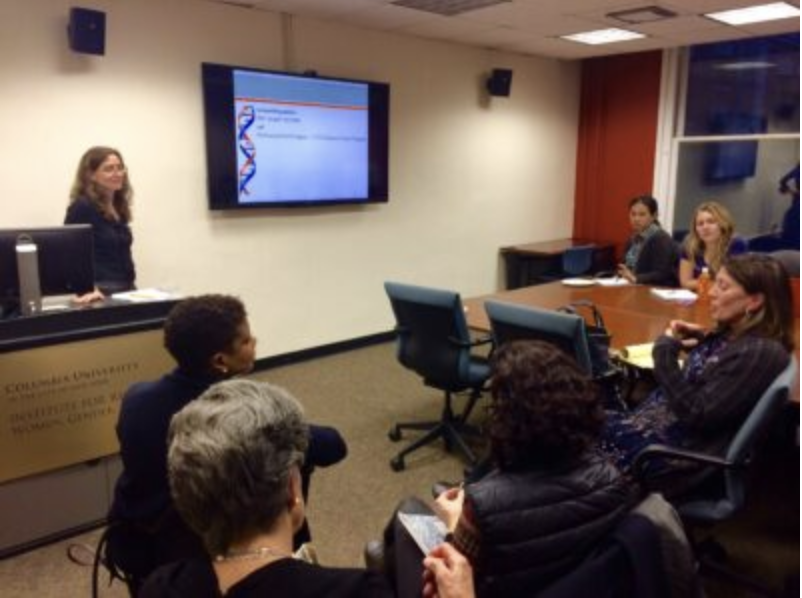
Some way in which these changes are currently being implemented involve genetic counselors being the ones to sign-off on the types of tests that can be requested as well as providing training and intervention to physicians to better inform them of the choices they have for requesting tests. In reflection, the overall tone and temperament of those in the room was of hope and a willingness to be creators of change in this field.
Contributed by Natalia Romano Spica and Amar Mandavia
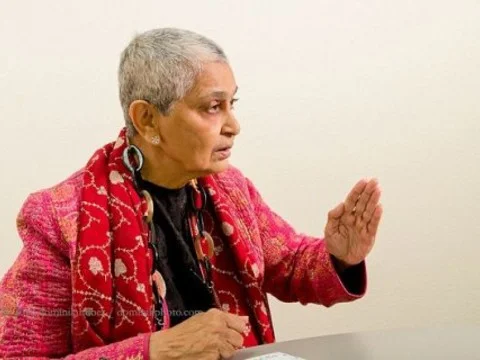
Gayatri Chakravorty Spivak Delivers Keynote Lecture at Dhaka Art Summit
Gayatri Chakravorty Spivak, co-director of the CSSD project The Rural-Urban Interface: Gender and Poverty in Ghana and Kenya, recently delivered the keynote lecture at the 2018 Dhaka Art Summit.
Gayatri Chakravorty Spivak, co-director of the CSSD project The Rural-Urban Interface: Gender and Poverty in Ghana and Kenya, recently delivered the keynote lecture at the 2018 Dhaka Art Summit. Professor Spivak’s keynote address “addressed the precarious situation of the Rohingya people in relation to Indigeneity in the world today, with a special emphasis on the languages of the Bengal region.”
Professor Spivak’s keynote lecture received news coverage in the Dhaka Tribune, and is available to watch online in full here.
Gayatri Chakravorty Spivak is co-director of the CSSD project The Rural-Urban Interface: Gender and Poverty in Kenya and Ghana, Statistics and Stories. Spivak is also University Professor of Humanities at Columbia University and a founding member of CSSD affiliate the Institute for Comparative Literature and Society.
CSSD project Gender & The Global Slum featured at the inaugural “She Opened The Door” Conference
CSSD executive committee members Anupama Rao and Ana Paulina Lee presented research from the CSSD working group Gender and the Global Slum at the inaugural She Opened the Door: Columbia University Women's Conference.
CSSD executive committee members Anupama Rao and Ana Paulina Lee presented research from the CSSD working group Gender and the Global Slum at the inaugural She Opened the Door: Columbia University Women's Conference.
On February 9-11, 2018, more than 1,000 alumni and students convened at She Opened the Door for a weekend of celebrating, learning from, and expanding horizons with fellow Columbia alumnae who are making a difference in our world.
Rao and Lee were among a distinguished group of faculty from Columbia and Barnard to present fascinating, new research in TED-type talks and describe how their findings can impact women in various key ways. Their talk discussed how women in international urban slums address the urgent problems of poverty and social exclusion.
Notable Columbia alumnae speakers at the conference included Supreme Court Associate Justice Ruth Bader Ginsburg ’59LAW, Poppy Harlow ‘05CC, Abigail Disney ’87, ‘94GSAS, A’Lelia Bundles ’76JRN, Claire Shipman ‘86CC, ‘94SIPA, and more.
“She Opened the Door” is a tribute to Winifred Edgerton Merrill. She was the first woman to receive a degree from Columbia University, opening the door for women to gain admission to Columbia's graduate and professional Schools at a time when co-education for women was under heavy debate.
CSSD project Gender & the Global Slum looks at the social hazards of urban informality and its disproportionate effects on women.
Click here to watch the conversation with Justice Ginsburg.

Anupama Rao and Ana Paulina Lee at the conference
Alice Kessler-Harris named to the Board of Governors of the Edward M. Kennedy Prize
CSSD Project Co-Director Alice Kessler-Harris has been named to the Board of Governors of the Edward M. Kennedy Prize for Drama Inspired by American History.
CSSD Project Co-Director Alice Kessler-Harris has been named to the Board of Governors of the Edward M. Kennedy Prize for Drama Inspired by American History. The prize, established in honor of the late senator, awards $100,000 to “a new play or musical that enlists theater’s power to explore the past of the United States, to participate meaningfully in the great issues of our day through public conversation, grounded in historical understanding.” Kessler-Harris joins fellow CSSD Project Co-Director Jean Howard on the Board of Governors.
Kessler-Harris was Co-Director of CSSD Project Social Justice After the Welfare State, and is both R. Gordon Hoxie Professor Emerita of American History and Professor Emerita at the Institute for Research on Women, Gender, and Sexuality at Columbia University. CSSD eagerly looks forward to hosting a panel, “Democracy After the Welfare State”, in honor of the publication of Democracy and the Welfare State: The Two Wests in the Age of Austerity, edited by Kessler-Harris and Maurizio Vaudagna.
Jack Halberstam comments on RuPaul’s Drag Race in The New York Times Magazine
CSSD Project Director Jack Halberstam spoke with New York Times staff writer Jenna Wortham for “Is RuPaul’s Drag Race the Most Radical Show on TV?”, published in the January 28th, 2018 edition of The New York Times Magazine.
CSSD Project Director Jack Halberstam spoke with New York Times staff writer Jenna Wortham for “Is RuPaul’s Drag Race the Most Radical Show on TV?”, published in the January 28th, 2018 edition of The New York Times Magazine.
Halberstam spoke about issues of gender, representation, and power dynamics in RuPaul’s Drag Race, pointing out that “there’s no ‘RuPaul’s Drag Kings...we still have this idea that femininity is malleable, and masculinity is a protected domain of real power and privilege. It is not transferable or attainable. The public has no appetite for artificial masculinity.”
Halberstam is the Project Director of CSSD’s Queer Theory: Here, Now, and Everywhere, a working group created to “discuss, debate and investigate the politics of sexuality and gender in a global frame.” Halberstam is also Professor of Women’s, Gender, and Sexuality Studies and English and Comparative Literature at Columbia University.
New Yorker article about the work of Jennifer Hirsch on the SHIFT project at Columbia
The work of Jennifer Hirsch, co-director of the CSSD project Reframing Gendered Violence, is featured in an article by New Yorker staff writer Jia Tolentino. This work was discussed at the October 5, 2017 CSSD event Beyond Prevalence.
Jia Tolentino has published an article entitled "Safer Spaces" in the February 12 & 19, 2018 print issue of New Yorker magazine. In this article, Tolentino highlights the work of Jennifer Hirsch, co-director of CSSD project Reframing Gendered Violence (RGV), on the SHIFT program at Columbia. SHIFT is a comprehensive research project that examines the many factors that shape sexual health and sexual violence for undergrads at Columbia.
You can read the full New Yorker article online here.
In October 2017, Professor Hirsch convened a panel discussion called Beyond Prevalence: The Next Generation of Research on Campus Sexual Assault, as part of the RGV project at CSSD. A video of that event can be found on the CSSD YouTube channel here.
RGFGV Media Fellows Yasmin El-Rifae and Samira Shackle Publish Articles on TheNation.com and ProspectMagazine.co.uk
CSSD Project Religion and the Global Framing of Gender Violence held an international competition and selected three Media Fellows to receive reporting grants. They joined the project, supported by the Henry Luce Foundation, and did research in the Middle East to produce innovative media stories.
CSSD Project Religion and the Global Framing of Gender Violence held an international competition and selected three Media Fellows to receive reporting grants. They joined the project, supported by the Henry Luce Foundation, and did research in the Middle East to produce innovative media stories.
Yasmin El-Rifae describes her experience with a volunteer feminist group resisting sexual violence that formed during the Egyptian Revolution. Her article ‘What the Egyptian Revolution Can Offer #MeToo’, highlights the way Egyptian activists are using self-organized, direct, and offensive tactics to fight sexual violence. In this era of the #MeToo movement, El-Rifae urges her readers to move towards a feminist praxis that creates global and systemic change and to look to Egyptian feminists for direction.
In her article ‘The Bureaucracy of Isis’, Samira Shackle looks at the dilemmas involved in the quest for restorative justice in Mosul post-ISIS. Focusing on the experience of refugee women, she reframes dominant narratives about religion and gender-based violence. Shackle’s interviews with family members of ISIS collaborators and victims of ISIS violence uncover how women suffer violence at the hands of family, the state, and ultimately how much human suffering has been created by imperialist interventions in Iraq.