
Women’s Heart Disease Awareness Working Group Launches App
New CSSD co-directors Dr. Natalie Bello and Dr. Sonia Tolani have launched the “Love My Heart” app to raise awareness of heart disease in women.
Co-directors of the CSSD working group Women’s Heart Disease Awareness, Dr. Natalie Bello and Dr. Sonia Tolani, have created the “Love My Heart” app in an effort to raise awareness of and prevent heart disease in women. The app lets women understand their risk of heart disease using a series of 12 questions.
Based on their individual risk factors the app helps users develop strategies to increase their heart health such as ways to fit in more exercise and eat better. The overall goal of this initiative is to spark a conversation between women and their health care providers.
You can read more about the “Love My Heart” app here.
The application can be downloaded on the Apple store here.
Be sure to check out more from the Women’s Heart Disease Awareness working group by following them on Instagram, Twitter and Facebook.
Statement of Support for Ayse Gül Altinay from CSSD & WCC
Our colleague Ayse Gül Altinay, Professor of Anthropology and Director of the Gender and Women’s Studies Center at Sabanci University in Istanbul, Turkey, was sentenced to 25 months in prison earlier this week.
Our colleague Ayse Gül Altinay, Professor of Anthropology and Director of the Gender and Women’s Studies Center at Sabanci University in Istanbul, Turkey, was sentenced to 25 months in prison earlier this week. She is one of over 2200 Academics for Peace who three years ago signed a statement “We will not be a party to this crime” appealing for an end to violent state-sponsored persecution of Kurdish citizens of Turkey. The investigation in Istanbul has covered only the first 1200 signatories so far, but it might be extended to the second 1000 as well. In this, her fourth, judicial hearing, Altinay was charged with “willingly and knowingly supporting a terrorist organization as a non-member.” The court's charge and thus the sentencing have no merit.
Ayse Gül Altinay has been a Faculty Fellow of Columbia’s Center for the Study of Social Difference since 2013. She is a co-organizer of the Working Group on “Women Mobilizing Memory” and a co-editor of the forthcoming Women Mobilizing Memory volume (Columbia University Press, 2019). Last September, she was also an invited speaker at the Center’s tenth anniversary conference “What We Can Do When There’s Nothing To be Done.” Her collaborative project “Curious Steps”— a gender-memory walk through Istanbul – spurred other such memory walks in additional sites including Harlem. Ayse Gül Altinay’s contributions to the Center’s work have been immeasurable: her feminist commitment to nonviolent protest and to transformative activism; her sharp insights into the workings of power and militarism and her determination to fight them; her fierce hopefulness combined with personal kindness, warmth and radiance have been an inspiration to all of us fortunate to be working with her.
In the spirit of collaboration and solidarity that Ayse Gül Altinay represents, it is important to point out that she is not alone in this struggle. Hers is one of a large number of cases receiving 25-month sentences that cannot be commuted. These cases, hers included, are in the process of being appealed. Some shorter sentences have been commuted, and many other colleagues are awaiting court dates over the next months. This is the time to speak out forcefully on all of their behalf and on behalf of freedom of expression and academic freedom.
On May 21st, 2019, Ayse Gül Altinay made the following statement to the court:
Every individual, every family living in this geography has suffered from past wars, migrations and experiences of violence. In terms of the cycle of violence that trauma studies alerts us to, we live in a challenging, vulnerable geography.
Yet, what we make of these past experiences of pain is up to us...
Are we going to turn our pain into more violence, hate, pain and injustice, or into steps that multiply life, beauty, love, peace and justice?
This is the main question that shapes my work and my life.
I firmly believe that we all have new steps we can take towards healing the traumas that have been transmitted from one generation to the other, and to break out of the cycles of violence that we are living through.
We, at CSSD and Columbia Global Freedom of Expression stand in solidarity and admiration for Ayse Gül Altinay and all of our academic colleagues who are being persecuted for their courage to speak out against violent aggression. The injustice of these sentences cannot be tolerated.
Statement of Support for Ayse Gül Altinay from the Columbia University Center for the Study of Social Difference and Women Creating Change
Our colleague Ayse Gül Altinay, Professor of Anthropology and Director of the Gender and Women’s Studies Center at Sabanci University in Istanbul, Turkey, was sentenced to 25 months in prison earlier this week. She is one of over 2200 Academics for Peace who three years ago signed a statement “We will not be a party to this crime” appealing for an end to violent state-sponsored persecution of Kurdish citizens of Turkey. The investigation in Istanbul has covered only the first 1200 signatories so far, but it might be extended to the second 1000 as well. In this, her fourth, judicial hearing, Altinay was charged with “willingly and knowingly supporting a terrorist organization as a non-member.” The court's charge and thus the sentencing have no merit.
Ayse Gül Altinay has been a Faculty Fellow of Columbia’s Center for the Study of Social Difference since 2013. She is a co-organizer of the Working Group on “Women Mobilizing Memory” and a co-editor of the forthcoming Women Mobilizing Memory volume (Columbia University Press, 2019). Last September, she was also an invited speaker at the Center’s tenth anniversary conference “What We Can Do When There’s Nothing To be Done.” Her collaborative project “Curious Steps”— a gender-memory walk through Istanbul – spurred other such memory walks in additional sites including Harlem. Ayse Gül Altinay’s contributions to the Center’s work have been immeasurable: her feminist commitment to nonviolent protest and to transformative activism; her sharp insights into the workings of power and militarism and her determination to fight them; her fierce hopefulness combined with personal kindness, warmth and radiance have been an inspiration to all of us fortunate to be working with her.
In the spirit of collaboration and solidarity that Ayse Gül Altinay represents, it is important to point out that she is not alone in this struggle. Hers is one of a large number of cases receiving 25-month sentences that cannot be commuted. These cases, hers included, are in the process of being appealed. Some shorter sentences have been commuted, and many other colleagues are awaiting court dates over the next months. This is the time to speak out forcefully on all of their behalf and on behalf of freedom of expression and academic freedom.
On May 21st, 2019, Ayse Gül Altinay made the following statement to the court:
Every individual, every family living in this geography has suffered from past wars, migrations and experiences of violence. In terms of the cycle of violence that trauma studies alerts us to, we live in a challenging, vulnerable geography.
Yet, what we make of these past experiences of pain is up to us...
Are we going to turn our pain into more violence, hate, pain and injustice, or into steps that multiply life, beauty, love, peace and justice?
This is the main question that shapes my work and my life.
I firmly believe that we all have new steps we can take towards healing the traumas that have been transmitted from one generation to the other, and to break out of the cycles of violence that we are living through.
We, at CSSD and Columbia Global Freedom of Expression stand in solidarity and admiration for Ayse Gül Altinay and all of our academic colleagues who are being persecuted for their courage to speak out against violent aggression. The injustice of these sentences cannot be tolerated.

“Reframing Gender Violence Globally” Students Complete Course with Presentations
Professor Lila Abu-Lughod’s course that came out of working group Reframing Gendered Violence came to an end this week.
CSSD working group Reframing Gendered Violence launched a course entitled, “Reframing Gender Violence Globally,” in the spring 2019 semester. It was taught by Joseph L. Buttenwieser Professor of Social Science Lila Abu-Lughod, co-director of the Reframing Gendered Violence working group. The course came to an end this week with student presentations.
The full course description can be read here.

Farrah Jasmine Griffin featured in Kennedy Center program on the Great Migration
Co-director of CSSD working group Toward an Intellectual History of Black Women takes the stage at the “Two Wings: The Music of Black America in Migration” concert at the Kennedy Center
Professor Farrah J. Griffin co-director of CSSD working group Toward an Intellectual History of Black Women and chairwoman of Columbia University’s new African American and African Diaspora Studies department read a selection from her book “Who Set You Flowin’?” as part of the program “Two Wings: The Music of Black America in Migration" at the Kennedy Center.
“Two Wings: The Music of Black America in Migration" tells the story of the historic Great Migration when millions of black Americans fled the South of the 20th century through music and the spoken word.
The concert, produced and presented by Jason Moran, the Kennedy Center’s artistic director for jazz, and his wife, mezzo-soprano Alicia Hall Moran, was commissioned by Carnegie Hall for their “Migrations: The Making of America,” its New York City-based festival exploring people’s movements across America.
Farrah Jasmine Griffin is the chairwoman of Columbia University’s African American and African Diaspora Studies department and the William B. Ransford Professor of English & Comparative Literature and African-American Studies, Columbia University.
Racial Capitalism Co-Directors Awarded HWPI grant
Jordan Camp, Christina Heatherton and Manu Vimalassery awarded a Humanities War and Peace Initiative grant.
The co-directors of CSSD working group Racial Capitalism, Jordan Camp, Christina Heatherton and Manu Vimalassery, have been awarded a Humanities War and Peace Initiative (HWPI) grant by Columbia University Faculty of Arts and Sciences.
The HWPI will support a broad range of activities, including individual scholarship, new scholarly collaborations, projects and events within existing interdisciplinary and collaborative structures, teaching, community outreach and programming, performance and exhibition, and ongoing dialogue in other forms. Generously supported by President Bollinger, this initiative aims to encourage creative thinking about the critical topic of war, with an ultimate goal of perpetuating a more peaceful world.
More information about the HWPI grant can be found here.
CSSD working group director featured on the Dean’s Table podcast
Professor Farrah Jasmine Griffin chats with Fredrick Harris, Dean of Social Sciences at Columbia University, on his podcast.
Farrah J Griffin, Professor and chair of the University’s new Department of African American and African Diaspora Studies, was recently featured on Episode 4 of The Dean’s Table with Dean Harris from the School of Social Sciences. Professor Griffin previously directed CSSD working group Toward an Intellectual History of Black Women and CSSD affiliate Institute for Research in African-American Studies.
Professor Griffin joins Dean Harris to discuss her scholarly trajectory into African-American studies, her research on the Black Migration and Harlem of the 1940s, and the establishment of the new Department of African-American and African Diaspora Studies at Columbia.
Click here to listen!
Professor Farrah J. Griffin is the William B. Ransford Professor of English & Comparative Literature and African-American Studies at Columbia, and the chair of the University’s new Department of African American and African Diaspora Studies. Professor Griffin is a scholar and author of African American literature, music, history and politics.
The Dean's Table is the latest initiative of Dean Fredrick Harris, Dean of Social Sciences, Columbia University. This series features the lives, work, and imagination of scholars from across Columbia's social science disciplines.
Religion and the Global Reframing of Gender Violence (RGFGV) convene major international workshop
CSSD working group RGFGV hosts twenty-five scholars, journalists, lawyers and activists for a two day intensive workshop of collaborative research sharing and brainstorming at Columbia University in New York City
On September 7 and 8 2018, CSSD working group Religion and the Global Reframing of Gender Violence (RGFGV) convened the Global Governance of the Intimate conference, a major international workshop. This conference was the second in a series of international workshops that opened with workshop in Amman a year earlier, hosted at the Columbia Global Center | Middle East, Amman.
Participants and organizers who had presented at the Amman workshop opened the first session with an overview of how the three conceptual domains that had organized the earlier work of the project intersected with the new scholarship being presented.
Click here to read the full conference report.
Video from the conference is available here.
The RGFGV project seeks to track and analyze the growing prominence of the global agenda against “violence against women” (VAW) and “gender-based violence” (GBV), whether in international law and global governance, practical interventions, or international media coverage.
The RGFGV project is supported by a grant from the Henry Luce Foundation and is co-directed by Lila Abu-Lughod, Rema Hammami, Janet Jakobsen and Nadera Shalhoub-Kevorkian.
RGFGV Conference Report on “Global Governance of the Intimate”
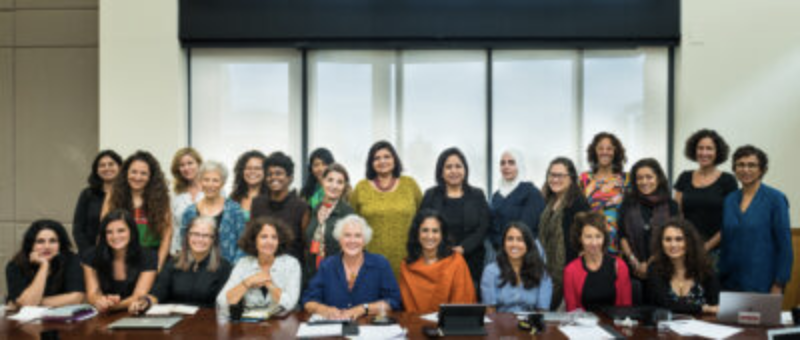
The project on Religion and the Global Reframing of Gender Violence (RGFGV) convened a major international workshop on September 7-8, 2018. Global Governance of the Intimate was the second in a series of international workshops that opened with workshop in Amman a year earlier, hosted at the Columbia Global Center | Middle East, Amman. A group of twenty-five scholars, journalists, lawyers and activists met for two intensive days of collaborative research sharing and brainstorming at Columbia University in New York City.
The RGFGV project seeks to track and analyze the growing prominence of the global agenda against “violence against women” (VAW) and “gender-based violence” (GBV), whether in international law and global governance, practical interventions, or international media coverage. Participants and organizers who had presented at the Amman workshop opened the first session with an overview of how the three conceptual domains that had organized the earlier work of the project intersected with the new scholarship being presented. The key themes were: Narratives and the Framing of VAW/GBV, Alternative Trajectories and Experiences, and Governance and Resource Distribution.
Urgent questions that had emerged under the theme of Narratives and Framing of VAW/GBV had included the following: How do certain aspects of social life become labeled VAW or GBV? What actors or phenomena get highlighted under these rubrics, and which disappear? Do these narratives racialize religion or culture? Leti Volpp had examined how the insertion of “honor killings” in both versions of the U.S. Executive Orders now referred to as the “Muslim travel ban” worked to frame VAW/GBV in terms of religious difference and has implicated GBV in national governance. Sara Ababneh’s presentation at the New York workshop expanded this discussion by analyzing how intimate violence was portrayed differently in Jordan and the U.S..
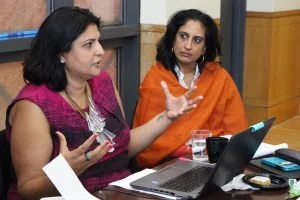
Although co-director Nadera Shalhoub-Kevorkian was unable to attend the NYC workshop, Rema Hammami gave some background on her previous contribution on the everydayness of state violence as experienced by Palestinian school girls in occupied East Jerusalem. She had shown how the dominant frames of GBV are unable to recognize either the gendered violence of colonial rule or the sexualization of everyday surveillance. Nadje Al-Ali’s work picked up on these questions of how to analyze gender based violence in the Middle East, exploring dilemmas and tensions she has faced as a feminist scholar and activist researching VAW/GBV, whether in her previous work in Iraq or her new work on the Kurdish women’s movement and queer feminist activism in Lebanon.
Shahla Talabi, whose earlier contribution to the Amman workshop had been a sensitive analysis of the specific inflections of rape narratives in the cases of three former Iranian women political prisoners discussed Zahra Ali’s presentation on feminist mobilization in Iraq. In the current Iraqi context, she showed how Islam is used by both religious and secular forces to undermine feminist demands.
The kinds of questions posed under the theme of Governance and Resource Distribution related to how the anti-VAW/GBV agendas have been implicated in practices of governance and governmentality and in particular the networks through which GBV/VAW have emerged as key to global, national and local agendas. Hammami summarized the paper she had presented in Amman on the distributional effects of the global GBV agenda. She had studied “humanitarian GBV” in Gaza, detailing the ways that local women’s NGOs, starved for resources, get both channeled to narrow and redefine their work and yet attempt to contest the logics of the humanitarian apparatus through everyday means of offering basic support to women. Hammami was well-positioned to comment on Aditi Suri von Czechowski’s study of the language of care and the pedagogy of human rights in the Nyarugusu Congolese refugee camp in Tanzania. Based on extensive ethnographic research in the camp, she showed how the GBV apparatus and the framework of humanitarian care seek to push responsibility for their predicaments onto refugee women themselves through insisting that they repudiate “harmful traditional practices,” as they acquire knowledge about human rights and consciousness about the definitions of domestic violence.
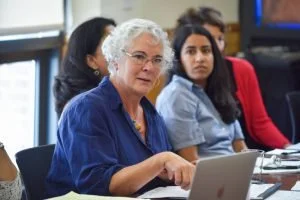
In her overview of the previous workshop in Amman, Lila Abu-Lughod described her own contribution on the latest phase of a politicized process of blaming religion for violence. She had examined the puzzling embrace by women’s rights advocates of initiatives on Countering Violent Extremism (CVE). The ways these initiatives link violence with Islam and Muslims was further elaborated in this workshop by Vasuki Nesiah, whose paper explored the convergence of a number of governance projects – countering violent extremism, international conflict feminism focused on VAW/GBV, and international criminal law – in the then ongoing International Criminal Court case of Al Hassan Mohamed of Mali.
Five themes structured the NYC workshop panels: (1) Narratives and Framing of VAW/GBV, (2) Feminist Dilemmas in Framing GBV, (3) Challenges of Media, (4) Governance and Activism, and (5) Dilemmas of GBV activism on the Ground. The work presented was based on research in and on a range of countries in the Middle East and South Asia, including Pakistan, Iraq, Jordan, India, Tanzania, Syria and Mali. As at the previous workshop, a crucial thread that ran through the work presented at the Global Governance of the Intimate: the politicized link being made between religious extremism, political Islam and GBV, a connection exploited in the U.S. “Muslim Ban” that singled out so-called “honor killings,” as Volpp had argued. Important questions were raised in this workshop: Is violence more legible when religion is present? What mobilizes feminists to do something about it? How do we understand the ways that religion may be linked to personal violence while taking seriously the sociopolitical and historical contexts? Is only the violence of individuals who can be associated with groups and nations to which the U.S. is hostile be considered responsible for gender based violence? Since refugee women must frame their experiences with sexual violence in terms that meet requirements for asylum and care, how are their experiences reshaped to align with the hegemonic rhetoric shared by international media and humanitarian organizations?
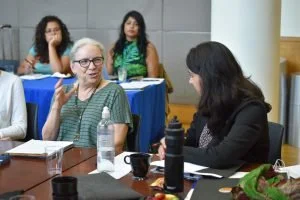
Given the key role of religion in these narratives that frame GBV in the South Asian and Middle Eastern contexts in which the participants work, Janet Jakobsen’s contributions as a scholar of religion was especially useful to the discussion as it laid a framework for understanding how to better think about religion, and to be critical of the ways religion and terrorism have become co-constituted categories as part of a complex network of political relations. The goal, Jakobsen argued, is not to remove religion when we talk about violence but how to think differently about the ways in which religion comes to interact with GBV.
The challenges posed by various forms of media and visual representations of violence by and against Muslims loomed large for the journalists, activists, and scholars participating in the workshop. Ababneh analyzed media portrayals of honor killings in American media outlets. She argued, as did Urooj Arshad, an activist and director of International LGBTQ Youth Health and Rights Programs at Advocates for Youth, that discourse on intimate partner violence and violence against LGBTQs in the U.S. are constructed as non-cultural, unmotivated by Christianity, and unrelated to the motivations attributed to “honor killings.” These contrasting constructions reflect the hypocrisies of Orientalist discourses. As the columnist Rafia Zakaria concurred, negative behaviors of racialized actors are blamed on culture and religion.
Nina Berman, an award-winning photo-journalist at Columbia’s School of Journalism gave remarkable evidence of this through her presentation on representations of gender-based violence and conflict rape by major U.S. and European magazines, focusing particularly on depictions of the sexual violence of Boko Haram. Berman examined the media layouts used in visualizing conflict rape and noted the double standards that regulate the work of white reporters who venture abroad to document the experiences of non-white rape survivors for American/European audiences versus those who document domestic stories of rape. Understatement and anonymity are the standards now. What are the implications of this type of reporting that highlights brown and black perpetrators and elides sexual violence in U.S. contexts?
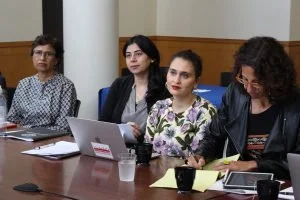
Media representations were also the focus of two of the papers on South Asia. Shenila Khoja-Moolji traced media representation of the murdered Pakistani social media celebrity Qandeel, known for her sexually provocative videos. Inderpal Grewal looked to media to interrogate the historical and contemporary consumption of “communal violence” by consumer citizens and the affects associated with “lynchings” of Muslim men.
Samira Shackle, one of the three Media Fellows selected for the second phase of the RGFGV project, presented the list of “how to report on GBV” that she had developed from Hammami’s suggestions at the previous workshop in Amman. One goal of reporting is to let women tell their stories on their own terms, yet the stories they tell must be critically analyzed insofar as women learn how to frame their experiences with gender based or sexual violence to meet requirements for asylum or appeal for aid and care. This mediation of stories was clear from Rupal Oza’s study of rape accusations and cases in the police stations and courts of rural Haryana. Accused of false rape claims, individual women’s helplessness and their accusers’ class status were crucial to the outcomes. Maryam Saleh, The Intercept reporter echoed Shackle’s warnings on how to report on GBV, taking issue with the ways journalists have represented the conflict in Syria and offered stories of Syrian refugee women without historical and political contexts.
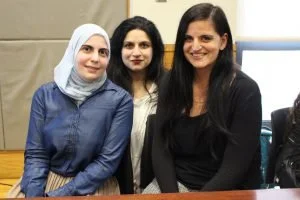
Confronting Orientalist assumptions about the relationship between religion, culture, and violence, those involved in the Global Governance of the Intimate addressed through regional case studies the way the neoliberal human rights framework and the hegemonic discourse about culture and religion as sources of women’s oppression distract attention from forms of systemic violence, whether geopolitical or economic that should be viewed as part of GBV or VAW. The participants outlined the need for feminists to challenge the premises of CVE and a-historical media coverage of GBV as well as to interrogate the apparatuses of transnational governance that construct certain issues—such as “child marriage” in Bangladesh--as urgent problems while ignoring other sources of violence and suffering in the often deadly situations in which people are living gendered lives around the globe. Engaging with the assumptions and policies that have underwritten the unprecedented public concern about VAW/GBV, the scholars, activists, lawyers and journalists brought their perspectives to the unfolding dynamics of these agendas within international governance, local communities, humanitarian aid, and legal activism in varied sites in the Middle East and South Asia, including among immigrants in the U.S. Shagufta Shah from the Arab-American Family Support Center and Urooj Arshad working on LGBTQ rights and violence in the U.S. faced challenges similar to those that confront critical journalists and feminist scholars when they attempt to address fraught issues of gender and violence in Muslim-majority and minority countries.
The contributions and discussions underlined how the well-worn frames of Islamic violence, culture, and patriarchy remain central in the production of a variety of problematic projects directly or indirectly tied to the global anti-gender violence agenda. The participants were struck by the variety of projects operating at different levels and across different domains (national, geopolitical, local, legal, popular cultural, developmental, and humanitarian) that bring together gender, violence, and Islam together in often unexpected ways. The comparative analyses of South Asia and the Middle East were illuminating: in many cases there are strong parallels, while in others, historical and political context worked to produce much more specific configurations of the broader issues
The next step for the project is the preparation of an edited volume that will bring together papers prepared for this and past workshops. The book will include the rich and varied treatments of the central themes that have emerged for the project across contexts in the two regions or at a broader level concerning Muslims. Some focus on the larger geopolitical projects—including new iterations or emergent configurations of the war on terror. Others address the GBV agenda as part of the emerging arsenal within the politics of populist nationalism. A number address the themes within the context of developmental or humanitarian governmentalities and in relation to NGOs and local activisms. Yet others use detailed analysis of local sites and located experiences of violence in order to challenge or confound the assumptions of the dominant frames of feminist concerns with violence. The collection will offer new thinking that will provide resources for challenging this powerful and often destructive truth regime.
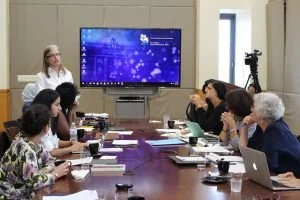
The RGFGV project is supported by a grant from the Henry Luce Foundation and is co-directed by Lila Abu-Lughod, Rema Hammami, Janet Jakobsen and Nadera Shalhoub-Kevorkian.
Prepared by Laela Shallal and Lila Abu-Lughod
Menstrual Health Working Group Publishes Report on Developments at the UN
Working group director Inga Winkler and working group fellow Sydney Amoakah co-authored a recent piece in Impakter on how menstruation has been spotlighted at the UN in the last year and where we can go from here.
CSSD working group Menstrual Health and Gender Justice has published a report in Impakter highlighting the work the UN has done related to menstruation in the past year and what more is left to do. The publication was co-authored by Menstrual Health working group director and Lecturer in Human Rights at Columbia University, Inga Winkler, and Sydney Amoakoh, Human Rights MA candidate and working group fellow.
In the article they address the key role governments play in advancing the discussion around menstrual health, noting that they are are uniquely positioned to normalize discussions on menstruation in the international community and amongst their own populations. The need for continued collaboration between different groups and sectors was also highlighted.
Read the full report here.
For more from the Menstrual Health and Gender Justice working group visit their blog.
Menstrual Health Working Group Fellow Participates in the UN 63rd Session of the Commission on the Status of Women
Lauren Houghton took part in an all female panel on menstruation entitled, “Access to Menstrual Health as a Public Service: The Lived Experiences of Women and Girls.”
Lauren Houghton, Assistant Professor of Epidemiology and fellow in CSSD working group Menstrual Health and Gender Justice, participated in the panel “Access to Menstrual Health as a Public Service: The Lived Experiences of Women and Girls.” The event took place as part of the 63rd Session of the Commission on the Status of Women (CSW). The panel stressed the importance of looking at the many menstruating women and girls who belong to marginalized groups, and their lived experiences with menstruation both in and outside of the home.
During the event Dr. Lauren Houghton gave insight on exactly how States and other actors can go about achieving change through the social normalization of menstruation. She stressed that policy-makers should avoid viewing providing menstruation products as quick fixes to more complex menstrual health issues.
A full recap of the panel can be found on the Menstrual Health working group blog.
Anupama Rao Delivers Franke Lecture at Yale
Co-Director of CSSD working group Geographies of Injustice, gave a talk entitled “Social Abstraction, Historical Comparison: Thinking Caste, Race, and Gender in the Time Capital.”
Anupama Rao, Associate Professor of History at Barnard and co-director of CSSD working groups Geographies of Injustice and Reframing Gendered Violence, delivered a talk entitled “Social Abstraction, Historical Comparison: Thinking Caste, Race, and Gender in the Time Capital” at Yale University. It was part of the Franke Lecture Series.
Anupama’s work explores the relationship of caste and political culture. Her book The Caste Question theorized caste subalternity, with specific focus on the role of anti-caste thought (and its thinkers) in producing alternative genealogies of political subject-formation.
You can read more about the lecture and her work here.
Unpayable Debt working group co-director Delivers Keynote Lecture
Frances Negron-Muntaner gave a lecture entitled “The ‘Valor y Cambio’ Project: Practicing Art, Narrative and Just Economies in Puerto Rico,” at the Pratt Institute’s Digital Spatialities Workshop.
Frances Negron-Muntaner, Professor of English and Comparative Literature at Columbia and co-Director of CSSD working group Unpayable Debt, delivered the keynote lecture at Pratt’s March 26 Digital Spatialities workshop. The event brought together scholars pursuing research on social media phenomena within the US and globally.
Frances’ keynote was entitled “The ‘Valor y Cambio’ Project: Practicing Art, Narrative and Just Economies in Puerto Rico,” and was inspired by her current community currency project in Puerto Rico, and her extensive experience as an activist, writer, filmmaker, curator, and educator.
You can read more about the workshop here.
For more on the social currency project “Valor y Cambio,” click here.
Check out photos from the Unpayable Debt working group’s closing conference here.
J.C. Salyer Honored by Arab-American Family Support Center
J.C. Salyer, former co-director of CSSD working group Pacific Climate Circuits, was recognized for his dedication to Brooklyn’s Arab-American community and his work to strengthen cross-cultural ties.
J.C. Salyer, Assistant Professor of Human Rights at Barnard and former co-director of CSSD working group Pacific Climate Circuits, was honored by the Arab-American Family Support Center as well as by the Office of the Brooklyn Borough President Eric L. Adams. Professor Salyer is also co-director of the new CSSD working group Migrant Personhood and Rights: Crises of Recognition to be launched in the September of 2019.
His dedication to Brooklyn’s Arab-American community and his work to strengthen cross-cultural ties was recognized during the annual Arab-American Heritage Celebration at Brooklyn Borough Hall on Thursday, April 4th.
The full press release can be read here.
For more on the Pacific Climate Circuits working group check out their webpage.
Stay tuned for more on new working group Migrant Personhood and Rights, launching September 2020!
J.C. Salyer is an anthropologist and a lawyer whose work focuses on law and society, immigration law, and social justice. He is also the staff attorney for the Arab-American Family Support Center, a community-based organization in Brooklyn, and runs the organization’s immigration clinic. His current research focuses on migration, disruption, and displacement related to climate change in the southwestern Pacific.
Rachel Adams named as 2019 John Simon Guggenheim Fellow
Former CSSD Director Rachel Adams selected for the 2019 Guggenheim Fellowships
On April 9, 2019, the Board of Trustees of the John Simon Guggenheim Memorial Foundation approved the awarding of Guggenheim Fellowships to a diverse group of 168 scholars, artists, writers, and scientists. Appointed on the basis of prior achievement and exceptional promise, the successful candidates were chosen from a group of almost 3,000 applicants in the Foundation’s ninety-fifth competition.
Rachel Adams, former CSSD Director and co-director of CSSD working group, Precision Medicine: Ethics, Politics and Culture, was among 168 scholars, artists, writers, and scientists in United States and Canada selected for the 2019 Guggenheim Fellowships.
CSSD sends a heartfelt congratulation to Rachel Adams on the award of this prestigious Fellowship.
Since its establishment in 1925, the John Simon Guggenheim Memorial Foundation has granted more than $360 million in Fellowships to over 18,000 individuals, among whom are scores of Nobel laureates, Fields Medalists, poets laureate, members of the various national academies, and winners of the Pulitzer Prize, Turing Award, National Book Award, and other significant, internationally recognized honors.
Chris Bobel Discusses Menstruation with The Washington Post
CSSD working group Menstrual Health fellow addresses the flaws in current menstrual health programs in a recent article.
Chris Bobel, Associate Professor of Women and Gender studies at University of Massachusetts Boston and fellow in the CSSD working group Menstrual Health and Gender Justice, talked with The Washington Post about what more needs to be done to improve menstrual health programs. The conversation centered around the information in her new book, The Managed Body: Developing Girls & Menstrual Health in the Global South.
She addresses the need to look beyond menstrual products as the sole approach to menstrual health education as we expand the discussion surrounding periods to include topics such as ways to combat stigma and necessary cultural shifts.
The full article can be read here.
Join the Menstrual Health working group in welcoming Chris Bobel for a book talk on her recently released book The Managed Body: Developing Girls & Menstrual Health in the Global South.
Menstrual Health Working Group Fellow Debunks Menstruation Myths in NPR
Chris Bobel spoke with NPR about her recent book The Managed Body: Developing Girls & Menstrual Health in the Global South.
Chris Bobel, Associate Professor of Women and Gender studies at the University of Massachusetts Boston and fellow in the CSSD working group Menstrual Health and Gender Justice, recently spoke with NPR about her new book, The Managed Body, as well as common myths surrounding menstruation.
In the article she discusses the stigma and negativity related to periods in low and middle income countries as well as how well-meaning activists are misguided by misconceptions about menstrual health.
RGFGV Co-director Delivers Lecture at the University of Alberta
Professor Lila Abu-Lughod delivers lecture for distinguished series on human rights at the University of Alberta
On February 4, former CSSD director and co-director of Religion and the Global Framing of Gender Violence (RGFGV) working group, Professor Lila Abu-Lughod delivered a lecture at the University of Alberta Visiting Lectureship in Human Rights series. Professor Abu-Lughod's talk entitled, "Is the War on Muslims a War on Rights?” questions the use of military invasions in the name of defending Muslim women’s rights and how proliferating security measures for surveillance and management of Muslims in the name of protecting human life have confronted those who value the ideals of human rights with troubling questions.
Lila Abu-Lughod is the Joseph L. Buttenwieser Professor of Social Science at Columbia University where she teaches anthropology and gender studies. A leading voice in the debates about culture, gender, Islam, and global feminist politics, her award-winning books and articles have been translated into 14 languages.
The University of Alberta Visiting Lectureship in Human Rights is envisioned as one of the preeminent annual events held at the University. Individuals or organizations that have made an outstanding contribution in the field of human rights and human rights protection are invited to deliver a major public lecture in Edmonton.
CSSD Director presents keynote address at Norwalk Community College
Professor Marianne Hirsch will be the keynote speaker at the 22nd annual Academic Festival hosted by Norwalk Community College.
On Wednesday, April 3, Center for the Study of Social Difference Director and William Peterfield Trent Professor of English and Comparative Literature, Marianne Hirsch will give the keynote address at the 22nd annual Academic Festival at Norwalk Community College.
This year’s conference theme is Postmemory: Hidden Trauma, Healing Narratives, a topic very familiar to Professor Hirsch whose work combines feminist theory with memory studies, particularly the transmission of memories of violence across generations. Professor Hirsch’s keynote lecture, "Postmemory for the Future," will be presented at 10am in the East Campus PepsiCo Theater at Norwalk Community College.
Click here to learn more.
Marianne Hirsch is a co-director of the Women Mobilizing Memory working group, William Peterfield Trent Professor of English and Comparative Literature at Columbia University and a Professor in the Institute for Research on Women, Gender, and Sexuality. She is a member of the American Academy of Arts and Sciences and a former President of the Modern Language Association of America.
Women Creating Change Hosts Corporate Feminism & Its Discontents Round Table
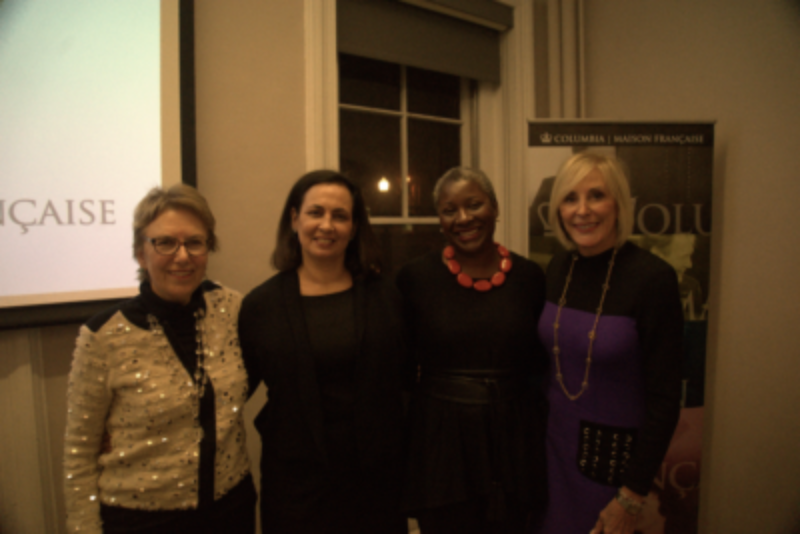
On Wednesday March 13, 2019, days after International Women’s Day, Women Creating Change at the Center for the Study of Social Difference hosted a roundtable discussion to explore the successes and limitations of policies to promote diversity and inclusion in the corporate sector. Held at Maison Francaise, the “Corporate Feminism & Its Discontents” roundtable included notable speakers such as Janice Ellig, Chief Executive Officer of the Ellig Group, Professor Yasmine Ergas, lecturer and director of the Specialization on Gender and Public Policy at the School of International and Public Affairs, Melissa Fisher, a cultural anthropologist who writes on finance, feminism, and the workplace, and Katherine Phillips, the Paul Calello Professor of Leadership and Ethics at Columbia Business School.
The interdisciplinary panel was introduced by Women Creating Change Leadership Council (WCCLC) Chair Ann Kaplan, Chair and founder of Circle Financial Group. Moderator of the roundtable, Janice Ellig, started off the conversation by detailing her first hand experiences in corporate America and how these experiences inform her belief that a shift toward gender parity needs to happen from the top. She also recognized the impact of women leaders like Diana Taylor, new WCCLC member, who has served as a leader on the issue of women entering into the corporate world and the necessity for such committed leadership to promote and advance the rights of women in the corporate field.
Through an interdisciplinary look at both the progress and regress in the field, the “Corporate Feminism & Its Discontents” roundtable discussed the achievements made by women in the corporate sector in recent years, and shed light on the existing gender and racial disparities in the sector, especially in its higher echelons, which remain significant in the United States and Europe.
As the conversation progressed, Professor Phillips discussed the ways in which most organizations were not designed to have women be apart of them in addition to findings that nevertheless demonstrate that firms with more women in leadership positions perform better. She cited her own research, which confirms the benefit of having different people working together and how such diversity creates higher levels of productivity. However, she acknowledged that despite growing evidence, many are still not convinced, exemplified by research that shows men are less likely to help women in management positions. explains how women’s knowledge isnt fully utilized, another barrier women face in their careers
During her presentation, Melissa Fisher addressed the critique of corporate feminism as not addressing race and class. She questioned how the relationships between capitalism and feminism work themselves out in everyday life and cites different dimensions that need to be looked at and pushed: equity, social imagination, and forging alliances. Fisher ended by highlighting the benefits of looking at feminism as an assemblage, both mobile and connective in order to mobilize it in novel ways. She concluded with optimism in the way labor is bridging boundaries and translating domains.
Professor Ergas expanded the conversation further by discussing the motherhood penalty on pay scales for women in the workplace. She explained that the context of the corporation is just as important as what is taking place within the corporation in terms of gender change. Additionally, she noted how global leaders and politics continue to marginalize women and how policies continue to push women into the sphere of the home and away from the workplace. “We need a huge collective conversation that prompts us all to think about feminism,” Professor Ergas urged. She also highlighted the necessity of pushing back against those, such as oppressive leaders and gender traditionalists, who view the glass as too full by insisting against further progress towards gender equality. Encouragingly however she proclaimed that “The best thing about the backlash is the backlash to the backlash.”