
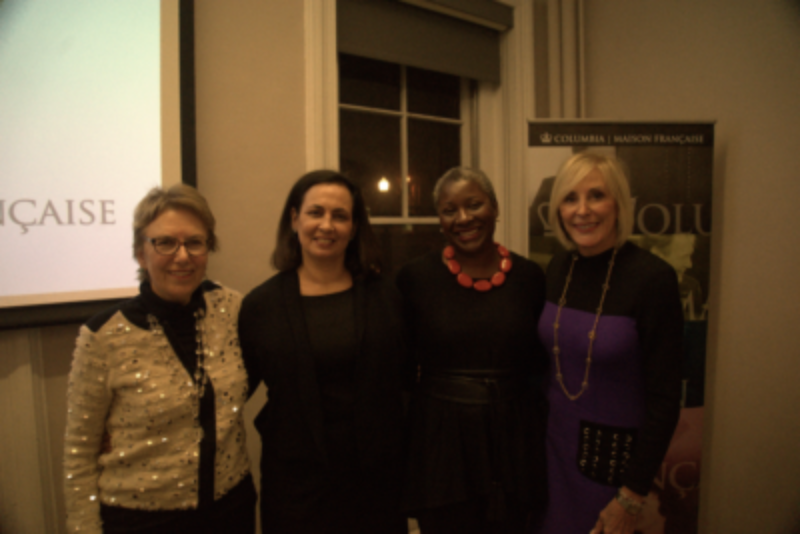
Women Creating Change Hosts Corporate Feminism & Its Discontents Round Table
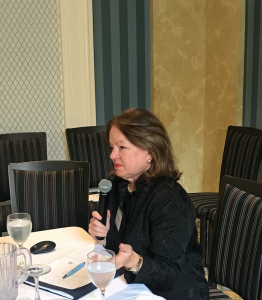
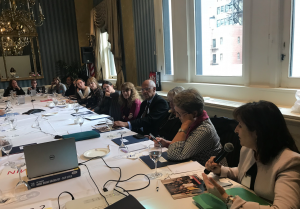
On Wednesday March 13, 2019, days after International Women’s Day, Women Creating Change at the Center for the Study of Social Difference hosted a roundtable discussion to explore the successes and limitations of policies to promote diversity and inclusion in the corporate sector. Held at Maison Francaise, the “Corporate Feminism & Its Discontents” roundtable included notable speakers such as Janice Ellig, Chief Executive Officer of the Ellig Group, Professor Yasmine Ergas, lecturer and director of the Specialization on Gender and Public Policy at the School of International and Public Affairs, Melissa Fisher, a cultural anthropologist who writes on finance, feminism, and the workplace, and Katherine Phillips, the Paul Calello Professor of Leadership and Ethics at Columbia Business School.
The interdisciplinary panel was introduced by Women Creating Change Leadership Council (WCCLC) Chair Ann Kaplan, Chair and founder of Circle Financial Group. Moderator of the roundtable, Janice Ellig, started off the conversation by detailing her first hand experiences in corporate America and how these experiences inform her belief that a shift toward gender parity needs to happen from the top. She also recognized the impact of women leaders like Diana Taylor, new WCCLC member, who has served as a leader on the issue of women entering into the corporate world and the necessity for such committed leadership to promote and advance the rights of women in the corporate field.
Through an interdisciplinary look at both the progress and regress in the field, the “Corporate Feminism & Its Discontents” roundtable discussed the achievements made by women in the corporate sector in recent years, and shed light on the existing gender and racial disparities in the sector, especially in its higher echelons, which remain significant in the United States and Europe.
As the conversation progressed, Professor Phillips discussed the ways in which most organizations were not designed to have women be apart of them in addition to findings that nevertheless demonstrate that firms with more women in leadership positions perform better. She cited her own research, which confirms the benefit of having different people working together and how such diversity creates higher levels of productivity. However, she acknowledged that despite growing evidence, many are still not convinced, exemplified by research that shows men are less likely to help women in management positions. explains how women’s knowledge isnt fully utilized, another barrier women face in their careers
During her presentation, Melissa Fisher addressed the critique of corporate feminism as not addressing race and class. She questioned how the relationships between capitalism and feminism work themselves out in everyday life and cites different dimensions that need to be looked at and pushed: equity, social imagination, and forging alliances. Fisher ended by highlighting the benefits of looking at feminism as an assemblage, both mobile and connective in order to mobilize it in novel ways. She concluded with optimism in the way labor is bridging boundaries and translating domains.
Professor Ergas expanded the conversation further by discussing the motherhood penalty on pay scales for women in the workplace. She explained that the context of the corporation is just as important as what is taking place within the corporation in terms of gender change. Additionally, she noted how global leaders and politics continue to marginalize women and how policies continue to push women into the sphere of the home and away from the workplace. “We need a huge collective conversation that prompts us all to think about feminism,” Professor Ergas urged. She also highlighted the necessity of pushing back against those, such as oppressive leaders and gender traditionalists, who view the glass as too full by insisting against further progress towards gender equality. Encouragingly however she proclaimed that “The best thing about the backlash is the backlash to the backlash.”
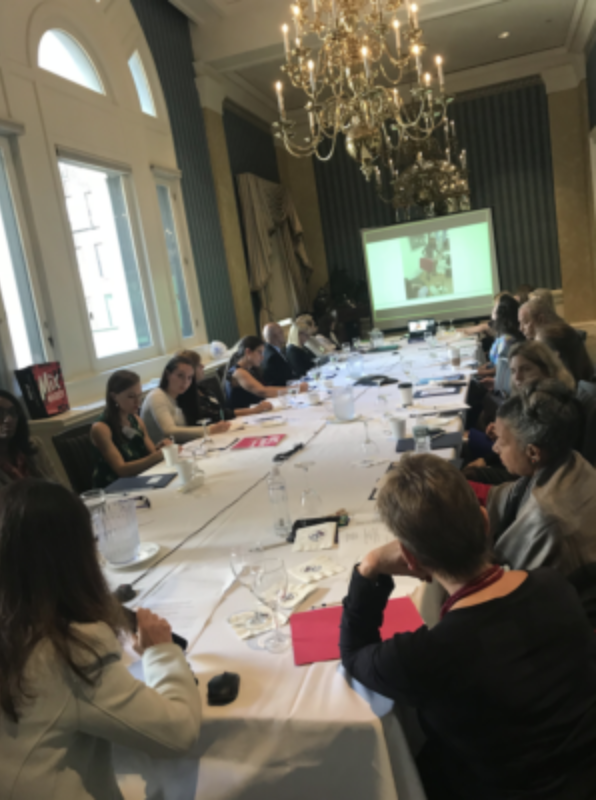
First Women Creating Change Leadership Council Meeting of the 2018 - 2019 Academic Year
In advance of the Center for the Study of Social Difference’s (CSSD) Women Creating Change(WCC) five year anniversary roundtable on Thursday September 27th, the Women Creating Change Leadership Council (WCCLC) convened to review progress and discuss next steps. The WCCLC provides a critical link between the University’s faculty-led projects and global business, academic, and civil society. It is comprised of individuals who are preeminent in the fields of business, law, government, nonprofit, social activism, and academia.
Present at the September 27th meeting were WCCLC Chair Ann Kaplan and fellow council members Annette Anthony, A’Lelia Bundles, Georgina Cullman, Melissa Fisher, Lois Perelson-Gross, Safwan Masri, Cynthia Moses-Manocherian, Alyson Neel, Philippa Portnoy, Samia Salfiti,Isobel Coleman, Jacki Zehner, and Davia Temin. Council Members Deborah Jackson and Selena Soo took part via telephone. CSSD Executive committee members who took part in the meeting included Director Marianne Hirsch, co-founder Jean Howard, Director of Development and External Relations Meera Ananth as well as Project Directors Victoria Rosner, Jennifer Dohrn, Wilmot James, and FrancesNegrón-Muntaner. Additional participants included Carolyn Ferguson, Robin Wiessman and Aly Zehner.
Professor Hirsch highlighted the significance of CSSD as a unique space of intellectual collaboration among the many schools within Columbia University that traditionally do not often work together.
The group reviewed the efforts of WCC working groups On the Frontlines: Nursing Leadership in Pandemics and Unpayable Debt: Capital, Violence and the New Global Economy. Members from On the Frontlines discussed their work with nurses as it relates to the Global Health Security Agenda and how female leaders are upscaling detection, prevention and response to health catastrophes. Professor Negrón-Muntaner, co-director of Unpayable Debt focused on, on-the ground activism, how women are affected by debt and how they are making changes in their communities.
Also addressed at the meeting were stories of impact. For example the Unpayable Debt working group has facilitated the creation of the Caribbean Syllabus, which provides a list of resources for teaching and learning about the current economic crisis in the Caribbean. This syllabus has seen thousands of downloads from across the world and has recently had its second edition #NoMoreDebt: Caribbean Syllabus released. Feminist educator and member of the working group Women Mobilizing Memory, Nicole Gervasio shared stories and insights from her participation that have influenced her methods of teaching and community building in the classroom.
Attendees concluded the meeting with a consensus on the importance and power of women’s narratives.
Currently the working groups sponsored by CSSD under the Women Creating Change idea-stream include Menstrual Health and Gender Justice, Geographies of Injustice: Gender and the City, On the Frontlines: Nursing Leadership in Pandemics, Religion and the Global Framing of Gender Violence (RGFGV), and Reframing Gendered Violence (RGV). Active working groups related to Imagining Justice, the second of CSSD’s overarching research themes, are Pedagogies of Dignity, Racial Capitalism, Queer Theory: Here, Now and Everywhere, Precision Medicine: Ethics, Politics and Culture and Unpayable Debt: Capital, Violence and the New Global Economy.
Contributed by Ayah Eldosougi
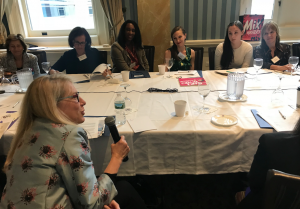
Women Creating Change (WCC) Celebrates Fifth Anniversary
This September marked not only the ten year anniversary of the Center for the Study of Social Difference (CSSD) but, the five year anniversary of CSSD’s project Women Creating Change (WCC), one of two streams of research and galvanization that engages distinguished feminist scholars from diverse fields throughout Columbia University who focus on contemporary global problems affecting women and on the roles women play in addressing these problems.
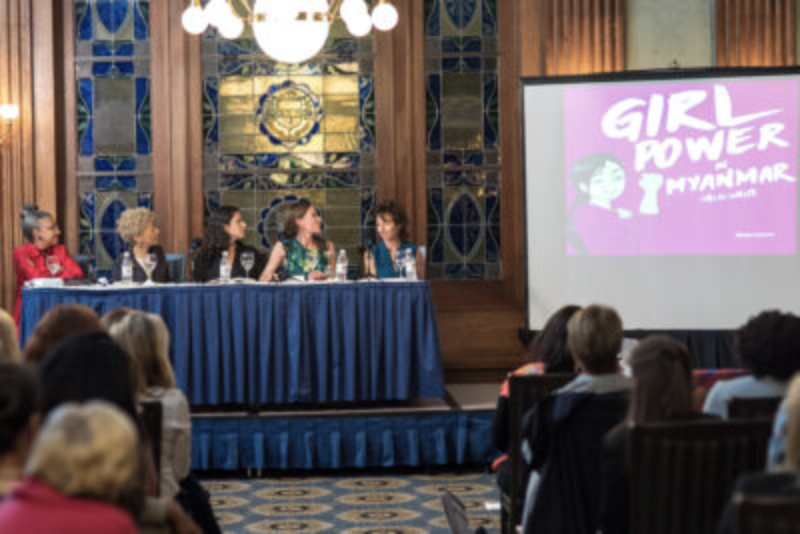
The roundtable event, Telling Women’s Stories: Creating Change, convened in celebration of WCC’s anniversary, took place on Thursday September 27th at the Columbia Club (Penn Club) in midtown Manhattan. It was moderated by WCC Leadership Council member and Columbia University trustee, A’Lelia Bundles and featured journalists and writers, Nina Berman, Margo Jefferson, Aly Neel and Rebecca Traister.
The night began with introductory remarks by Columbia President Lee C. Bollinger, a steadfast supporter of CSSD and WCC and CSSD’s Director Marianne Hirsch. Ann Kaplan, Chair of the Women Creating Change Leadership Council (WCCLC), was honored for her ardent support of CSSD and WCC.
Echoed throughout the night were the stories of women, with the acknowledgment of the power of what speaker Aly Neel referred to as, hyperlocal stories, personal oral histories of women, (particularly subaltern women) and the work these narratives do to disrupt the norm. Neel also emphasized the necessity of activating the youth toward action with accessible stories, which served as the catalyst for her recent endeavor, Girl Power, a children's book about pioneering women throughout Myanmar history.
Building off of the idea of hyperlocal stories, Nina Berman, documentary photographer and journalist, emphasized the importance of collaborative storytelling when telling stories around sexual violence and trauma. Traister, the author of the recently released book Good and Mad: The Revolutionary Power of Women’s Anger addressed both the costs and necessity of first person testimonies by women and the anger many women are feeling. Pulitzer Prize winning author and journalist Margo Jefferson’s delved into the power dynamics at play for women in telling their stories.
In the wake of Dr. Christine Blasey Ford’s testimony of sexual assault allegations against now Supreme Court justice Brett Kavanaugh, the roundtable served as a sort of catharsis for many in the room as both Hirsch and Bundles remarked in their comments. The conversation also converged around themes of female anger, solidarity and evoked the #MeToo movement and Anita Hill.
Currently the working groups sponsored by CSSD under the Women Creating Change idea-stream include Menstrual Health and Gender Justice, Geographies of Injustice: Gender and the City, On the Frontlines: Nursing Leadership in Pandemics, Religion and the Global Framing of Gender Violence (RGFGV), and Reframing Gendered Violence (RGV).
See photos from the event here.
Contributed by Ayah Eldosougi
DISCUSSION: Is Gender Violence Governable? A Panel on International Feminist Regulation
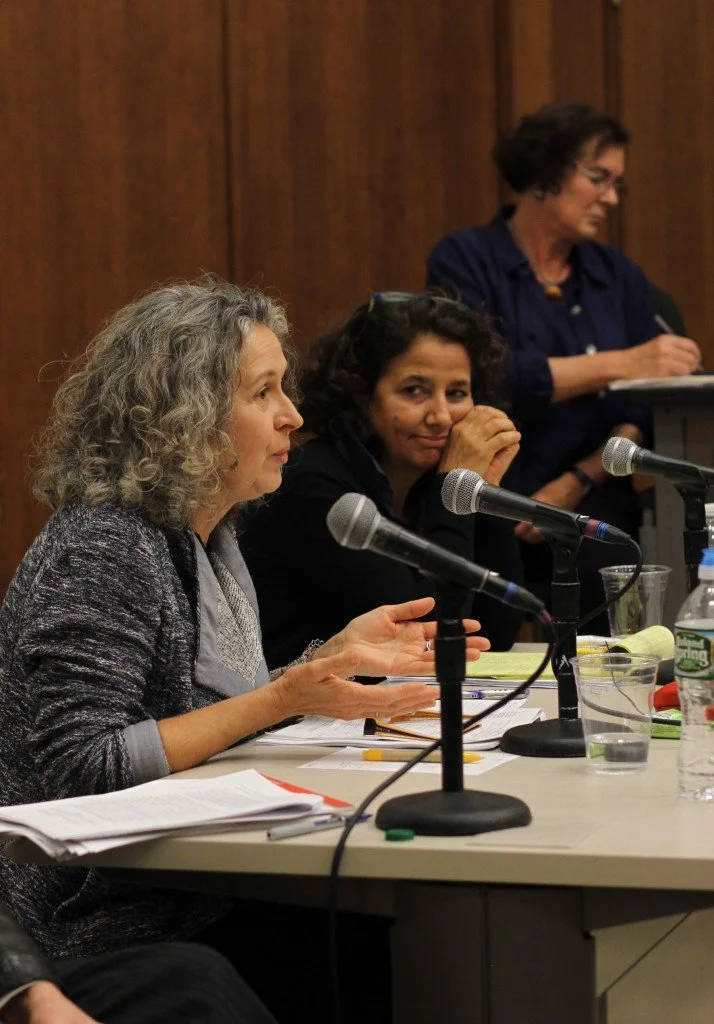
“Over the last few decades Violence Against Women (VAW) and, increasingly, Gender Based Violence (GBV), have come to prominence as sites for activism,” explained Lila Abu-Lughod, Joseph L. Buttenwieser Professor of Social Science and Co-Director of the CSSD project on “Religion and the Global Framing of Gender Violence.”
In her introductory remarks to “Is Gender Violence Governable? A Panel on International Feminist Regulation,” Abu-Lughod asked “ How can we engage critically with the terms, assumptions, funding streams, policies, and politics that have underwritten this unprecedented outpouring of attention? What is left out when problems both in war and in peace are framed in particular ways that become a kind of common sense? And whose interests are served by such framings?”
The event at Columbia University offered compelling responses to many of Abu-Lughod’s questions. Inaugurating a two-year initiative on Reframing Gendered Violence headed up by the Women Creating Change project at the Center for the Study of Social Difference, the discussion was co-sponsored by the Dean of the Humanities, the Columbia Global Centers, and the Henry Luce Foundation.
Dubravka Žarkov, Professor of Gender, Conflict & Development at the International Institute of Social Studies at The Hague, opened with a paper entitled “Feminist Politics, War Rapes, and Global Governance.” “What is ‘gender,’ and what does it mean in relation to wars and armed conflicts?” Žarkov asked audience members as a lead-in to her critique of Western feminism’s vexed treatment of war crimes and gendered violence.
Tracing the historical elevation of war rape to the position of ultimate violence against women, Žarkov worried that UN resolutions such as 1325 (2000) have enabled the resurgence of colonialist narratives about victims and savages. “Can we really claim that all this injustice is perpetuated against our will?” she challenged her listeners.
Rema Hammami, Professor of Anthropology at Birzeit University, discussed related themes in fieldwork conducted in the West Bank and Gaza Strip. Like Žarkov, Hammami interrogated the effects of UN Resolution 1325. In Palestine, she explained, the resolution encouraged practices of data collection and statistical analysis that disproportionately revealed forms of violence enacted against women, while obscuring the more pervasive violence of settler colonialism.
Janet Halley, Royall Professor of Law at Harvard University opened a Q & A sesssion by highlighting Žarkov’s and Hammami’s shared insistence on bringing feminist critical capacities to bear on the relatively new involvement of feminists in systems of international law and governance. She fielded insightful questions on topics ranging from methods of data collection to the misleading packaging of gender equality initiatives as projects on Violence Against Women.
The conversation continues on Thursday, November 3, with presentations by Professors Dina Siddiqi and Nacira Guénif-Souilamas on “Framing Religion and Gender Violence: Beyond the Muslim Question.”
See photos from the discussion here.
Contributed by Liza McIntosh
ROUNDTABLE: Women Mobilizing Memory "Keywords"
Vulnerability. Reaction. Privilege. Heritage. Utopia. What associations do these “keywords” evoke? What concepts do they represent? How are these ideas used by scholars, or put into practice by activists? What kinds of work can we do with a keyword, what conversations can keywords unlock?
These were some of the questions asked at a recent roundtable discussion by Women Mobilizing Memory, a CSSD working group exploring issues of memory, witnessing, testimony, and trauma from a cross-cultural feminist perspective. For this project, students in graduate programs at Sabancı University (Istanbul), Columbia University, and New York University teamed up in pairs, selected their keywords, and finally presented the fruits of their collaboration in the form of a roundtable at the Columbia campus in New York.
Reflecting on the circumstances in which their discussion took place, Alyssa Greene (Columbia) and Armanc Yıldız (Sabancı University) considered the keyword privilege, acknowledging the immense institutional privilege that enabled the roundtable, and by extension their own critical examination of the word “privilege” itself. Their presentation urged a consideration of how privilege can easily be forgotten by those who benefit from it. The duo did not necessarily condemn privilege, but noted that it was an “unevenly distributed” resource, creating all kinds of differences between those it touches and those it does not. These differences can silence certain conversations, but they can also produce other kinds—like Greene and Yıldız’s reflections on how privilege made their conversation possible.
In a similar vein, the keyword reaction sparked thoughts on the role of the environment where groups like Women Mobilizing Memory do their work. Dilara Çalışkan (Sabancı) and Andrea Crow (Columbia) suggested that a “critical attention to historic and economic forces” is necessary. For example, how does the physical location of this roundtable at Columbia University, or the fact of it being conducted in English, shape the kind of work being done? “Reaction” can be an emotional response that tells us something about how we relate to the ideas, people, and circumstances that surround us. In a feminist perspective, reactions can be a revealing part of academic work.
The issue of translation, both literal and figurative, came up in the work of Nicole Gervasio (Columbia) and Bürge Abiral (Sabancı) on vulnerability. There is no precise translation of “vulnerability” in Turkish. The Turkish equivalent would mean something like “weakness” or “exposure to the possibility of being harmed.” Their co-written paper pointed out that vulnerability has become “not just a keyword, but a keystone” in the #blacklivesmatter movement: the practice of “die-ins” works as a deliberate public display of vulnerability. Vulnerability can be leveraged as a form of strength and protest, yet vulnerability can also be misappropriated by perpetrators of violence to justify their actions.
A common feature of the five keywords is that they have widely varying meanings that depend on context. Such was the case with utopia, analyzed by R. Ertug Altinay (NYU) and Pınar Ensari (Sabancı). The pair cautioned against an association of utopia with liberal ideals and progressive politics. Utopia has a dark side, too: utopia produces difference and exclusion—what is a utopian vision for the group envisioning it can easily become dystopian for other groups. With heritage as well, chosen by Henry Castillo (NYU) and Leticia Robles-Moreno (NYU), perspective matters immensely. The pair emphasized a distinction between official and unofficial forms of heritage. One is sanctioned by state and government while the other is constructed within the local environment of a specific community. Castillo provocatively asserted that heritage, in this latter sense, is the memory of individuals and communities—not an object or material possession. Yet it is embodied, too: Robles-Moreno continued the discussion by suggesting that the female body can transmit heritage biologically and symbolically through generation.
Contributed by Grace Delmolino, PhD Candidate in Italian/ICLS and 2014-15 IRWGS Graduate Fellow
CALL FOR PROJECTS: Women Creating Change
Women Creating Change (WCC) invites proposals for a new working group project that would begin in 2015. WCC will provide seed money of $45,000 over three years to working groups of scholars and practitioners whose projects are consistent with the mission of the Center (socialdifference.columbia.edu) and the specific goals of Women Creating Change (womencreatingchange.columbia.edu). Submission Deadline: Monday, March 2, 2015.
Call For Proposals
Women Creating Change (WCC) is a global research initiative of the Center for the Study of Social Difference, an advanced study center at Columbia University that supports scholarship on global issues of gender, race, ethnicity, and sexuality. WCC invites proposals for a new project that would begin in 2015. WCC will provide seed money of $45,000 over three years to working groups of scholars and practitioners whose projects are consistent with the mission of the Center (socialdifference.columbia.edu) and the specific goals of Women Creating Change (womencreatingchange.columbia.edu).
Women Creating Change
WCC engages distinguished feminist scholars from across Columbia to focus on contemporary global problems affecting women and on women’s roles in addressing those problems. It also engages with broader networks committed to raising awareness of these issues, on campus and beyond. The innovative research program and working group model of WCC draws on the scholarly depth and global perspectives that animate the Center for the Study of Social Difference and the Columbia Global Centers. However varied in topic and regional location, all WCC projects involve multiple partners, at Columbia and beyond. They focus on changing the terms in which significant global problems affecting women are being addressed.
Of necessity, the work of WCC is interdisciplinary as well as comparative and transnational. It seeks to build on the rich resources and global perspective afforded both by Columbia’s faculty and its expanding network of Global Centers, insisting on deep knowledge of the history, the languages, and the cultures of the regions with which we engage.
WCC has developed a unique working group structure of close intellectual collaboration and exchange over multi-year periods. WCC seed grants are intended to support the development of such working groups. Under the broad umbrella of WCC, individual working groups led by Columbia and Barnard faculty work on a particular problem or issue in collaboration with scholars, artists, activists and policymakers in specific regions of the world where Columbia’s Global Centers are located (currently, Beijing, Mumbai, Amman, Paris, Nairobi, Istanbul, Santiago, and Rio de Janeiro).
Project Proposals
Proposals may be submitted for consideration by any Columbia or Barnard faculty member(s) whose project aligns with the aims of CSSD and WCC, although preference will be given to faculty affiliated with one or more of CSSD’s five member centers and institutes. WCC seeks projects that are global and interdisciplinary in nature and favors proposals from an already-constituted core working group (typically 5-8 people) that closely links its work to one or more of Columbia’s Global Centers. (http://globalcenters.columbia.edu/). Each WCC working group should be composed of junior and senior scholars and practitioners from the U.S. and abroad, and should reach across multiple geographic regions, fields of study, specialization and expertise. For a list of current WCC projects, please see our website (womencreatingchange.columbia.edu).
WCC projects are expected to run for three years. Year 1 might concentrate on focused project development, including the constitution of an international working group that would convene exploratory seminars or workshops. Year 2 involves the most intensive intellectual work, featuring regular meetings of the working group and the active participation of international and regional fellows and affiliates, whether face-to-face or through videoconferencing using CSSD’s seminar room (752 Schermerhorn Extension). Fundraising efforts to develop and extend the project should begin early in Year 2. Year 3 is dedicated to post-project planning and dissemination of the project’s work through whatever means seem most appropriate to the working group. Examples might be conferences, the publication and/or translation of conference proceedings and/or edited collections of working group scholarship, or online publication of policy papers, curricular materials, or individual scholarship. Outside funding could support the continuation and development of the working group’s activities.
WCC project support budgets may be used by Project Directors at their discretion. However, budgets typically include the following: Course relief for a Project Director (one course per year for two years, alternating in the case of Project co-Directors); stipends for two graduate student participants and one graduate assistant responsible for program support; travel and accommodation for international workshops at Columbia’s Global Centers; support for visiting scholars or public conferences. Project Directors should be prepared to work with CSSD to seek additional funding sources.
We encourage prospective applicants to meet with WCC co-directors Jean Howard (jfh5@columbia.edu) and Marianne Hirsch (mh2349@columbia.edu) and/or WCC Associate Director Laura Ciolkowski (lec30@columbia.edu) early in the application process. Project proposals should not exceed five double-spaced pages and should include a project description, a provisional budget, a short CV for each tentative working group member, and a plan for group meetings, public events, and the dissemination of project research. Proposals should also describe a plan for soliciting and adjudicating applications for working group membership from the wider University community and beyond. Any anticipated curricular or pedagogical outcomes of the proposed project should be noted, although the absence of curricular components will not detract from the applications.
Proposals should be directed to Laura E. Ciolkowski, PhD, CSSD Associate Director (lec30@columbia.edu), by or before Monday, March 2, 2015.
Projects will be selected by the Executive Committee of the CSSD and applicants will be notified by March 30, 2015.
PUBLIC ROUNDTABLES: “Coming to Terms” with Gendered Memories of Genocide, War, and Political Repression," Istanbul, Turkey
Public Roundtables with Turkish simultaneous translations
September 17, 2014, 1:00-7:00pm
DEPO Gallery, ISTANBUL, TURKEY
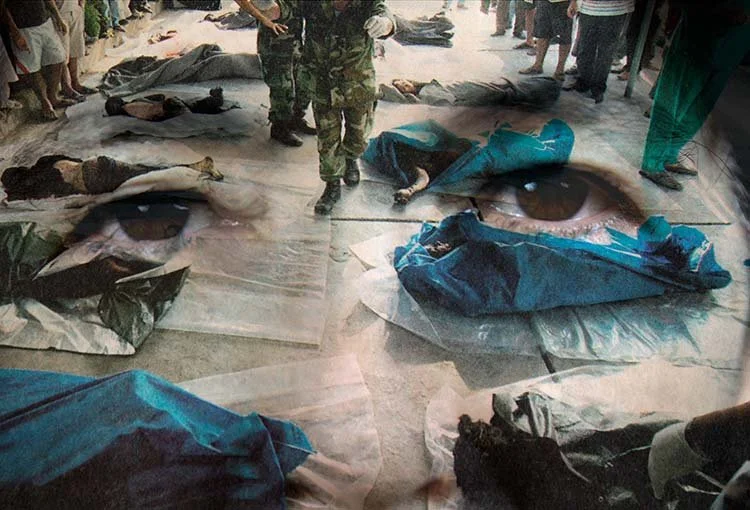
Roundtable topics and speakers:
Creating Alternative Archives, with Leyla Neyzi, Özlem Kaya, Susan Meiselas, Silvina der Meguerditchian, and Şemsa Özar
Art, Performance and Memory, with Andreas Huyssen, Alisa Solomon, Carol Becker, Diana Taylor, Maria José Contreras, and Ayşe Öncü
Gender, Memory, Activism, with Marita Sturken, Marianne Hirsch, Nükhet Sirman, Meltem Ahıska, Nancy Kricorian, and Yeşim Arat
Schedule
1:00pm-2:30pm - Creating Alternative Archives
Moderator: Şemsa Özar (Boğaziçi University and Diyarbakır Institute for Social and Political Research)
Leyla Neyzi (Faculty of Arts and Social Sciences, Sabancı University) - “Young people Speak Out: The Contribution of Oral History to Facing the Past, Reconciliation and Democratization in Turkey” Project www.gencleranlatiyor.org
Özlem Kaya (Truth Justice Memory Center, Turkey) Creating an Alternative Archive through Video Testimonies
Susan Meiselas (Photographer, Magnum Photos, USA ) – Kurdistan
Silvina Der Meguerditchian (Artist, Argentina/Germany) – Nereye? / Where to?
3:00pm-4:30pm - Art, Performance and Memory
Moderator: Ayşe Öncü (Sociology, Sabancı University, Turkey)
Andreas Huyssen (German and Comparative Literature, Columbia University, USA) - The Metamorphosis of the Museum: From Exhibitionary to Experiential Complex
Alisa Solomon (School of Journalism, Columbia University, USA) - Shoe Fetish
Carol Becker (School of the Arts, Columbia University, USA) - The Memory of Sugar
Diana Taylor (Performance Studies, Hemispheric Institute of Performance and Politics, NYU, USA) - Is Performing Testimony, Testimony?
Maria José Contreras (School of Theatre, Catholic University, Chile) – The (Im)possible Performance of Forgetfulness
5:00pm-6:30pm - Gender, Memory, Activism
Moderator: Yeşim Arat (Political Science and International Relations, Boğaziçi University, Turkey)
Marita Sturken (Media, Culture, and Communication, NYU, USA) - Architectures of Memory, Architectures of Torture, Architectures of Conflict
Marianne Hirsch (Gender Studies and Comparative Literature, Columbia University, USA) – Mobile Memories
Nükhet Sirman (Sociology, Boğaziçi University, Turkey) – How to Gender Memories of Violence?
Meltem Ahıska (Sociology, Boğaziçi University, Turkey) - Counter-movement, space, and politics: How the Saturday Mothers of Turkey make the enforced disappearances visible
Nancy Kricorian (Author and Activist USA) - Place Names and Objects: Pilgrimage as/or Resistance
About
This series of roundtables occurs in the context of a five-day workshop on “Mobilizing Memory for Action” that brings together an international group of scholars, artists, and activists to analyze the activist work memory practices can enable. The workshop is part of Columbia University’s “Women Creating Change” initiative led by the Center for the Study of Social Difference and organized in collaboration with the Columbia Global Centers. “Mobilizing Memory for Action” began in December 2013 with a workshop at the Columbia Global Centers in Chile and continues in September 2014 with activities in Istanbul hosted by Columbia Global Centers | Turkey, Sabancı University Gender and Women’s Studies Forum and DEPO Istanbul. Support has also been provided by the Blinken European Institute, Sabancı University, Hemispheric Institute of Performance and Politics, the Truth Justice Memory Center and Friedrich-Ebert-Stiftung Turkey Office. The Istanbul program consists of a workshop with 35 leading scholars, artists and activists from Turkey, the United States, Chile and other contexts; an art exhibition and catalogue; documentary screenings; theater performances and post-performance discussions; and a series of public roundtables.
For more information about the exhibit, please click here.