
Love My Heart App Featured in Article About Heart Disease in Women
The app is the brainchild of the Women's Heart Disease Awareness working group.
Dr. Natalie Bello and Dr. Sonia Tolani, project directors of the working group, launched the app in May of 2019 to raise awareness amongst women about—and to prevent—heart disease. The app “helps the user devise a plan with realistic goals to support healthy weight, healthy diet, exercise, and smoking cessation.” Read the article here.
Chris Bobel Quoted on the Topic of Menstrual Activism
Menstrual Health working group fellow appears on Equal Times.
“Shame, silence and secrecy, after all, is the root of what makes menstruation a challenge for everyone, especially those living on the margins,”says Chris Bobel, Menstrual Health and Gender Justice working group faculty fellow. Read more in Equal Times here, on the topic of menstrual dignity and justice, directly related to the CSSD working group.
Frances Negrón-Muntaner’s Art Installation and Alternative Currency Comes to East Harlem
The project will be on view at El Museo del Barrio from September 21 to 30, 2019.
CSSD Executive Committee member, and former Unpayable Debt working group co-director, Frances Negrón-Muntaner brings her interactive art installation to East Harlem for 10 days at the end of this September. Originally launched in Puerto Rico, the project was also shown in the Lower East Side before coming to El Barrio.
Born in response to the Puerto Rican debt crisis, and building on the work of the Unpayable Debt working group, the Valor y Cambio project proposes an alternative currency that, thanks to the participation of local establishments, is usable to buy products from food to museum tickets. Read more here, and visit the project’s website here.
Anupama Rao Organizes Second Annual Ambedkar Lectures
The first event of the series, on ‘Race, Caste, and American Pragmatism’, is to take place on October 17.
The Institute of Comparative Literature and Society will host the Second Annual Ambedkar Lectures, the first event of which takes place on October 17. The Ambedkar Lectures are organized by Geographies of Injustice co-director Anupama Rao.
Read more about the event here.
New Blog Post on Working Group Research Trip to West Africa
On the Frontlines Coordinator, Jeremy Orloff, reflects on recent experiences in Sierra Leone and Liberia.
On the Frontlines: Nursing Leadership in Pandemics working group Coordinator, Jeremy Orloff, reflects on his recent experiences in Freetown, Sierra Leone and Morovia, Liberia in a blog post for CSSD blog, Social Difference Online. The working group’s trip to West Africa centered around their efforts to retrieve oral histories from local nurses and midwives who had been active during the 2014-2016 Ebola crisis.
To read the full post and see pictures from the trip visit Social Difference Online.
Menstrual Health and Gender Justice Working Group Receives Teaching Award
The Provost’s Interdisciplinary Teaching Award will go toward developing a course on “Menstruation, Gender, and Rights: Interdisciplinary Approaches.”

The Menstrual Health and Gender Justice working group is one of three winners for the annual Provost’s Interdisciplinary Teaching Award, which funds the creation of a new course with up to $20,000. The course will be taught by working group Faculty Fellows Noémie Elhadad, Lauren Houghton, Anja Tolonen, Chris Bobel and Director Inga Winkler, each from different disciplines. More information on the course, “Menstruation, Gender, and Rights: Interdisciplinary Approaches,” will be made available on course listings in the coming weeks, but in the meantime, read more here.
More on the Spring 2019 Interdisciplinary Teaching Awardees can be found here.
For more on the Menstrual Health working group check out their blog, like them on Facebook and follow on Twitter.
Frances Negrón-Muntaner Gives Interviews and Writes Article on Political Dissent in Puerto Rico
CSSD Executive Committee member appears on The Takeaway, CNN en Español, and Dissent Magazine.
Professor of English and Comparative Literature, CSSD Executive Committee member, and former Unpayable Debt working group co-director Frances Negrón-Muntaner (CSER) gave two interviews, one on WNYC’s The Takeaway and another on CNN en Español, about recent protests in Puerto Rico that led to the resignation of now-former governor Ricardo Rosselló. She also wrote a piece on frustrated expectations and newfound hope in the wake of the protests for Dissent Magazine.
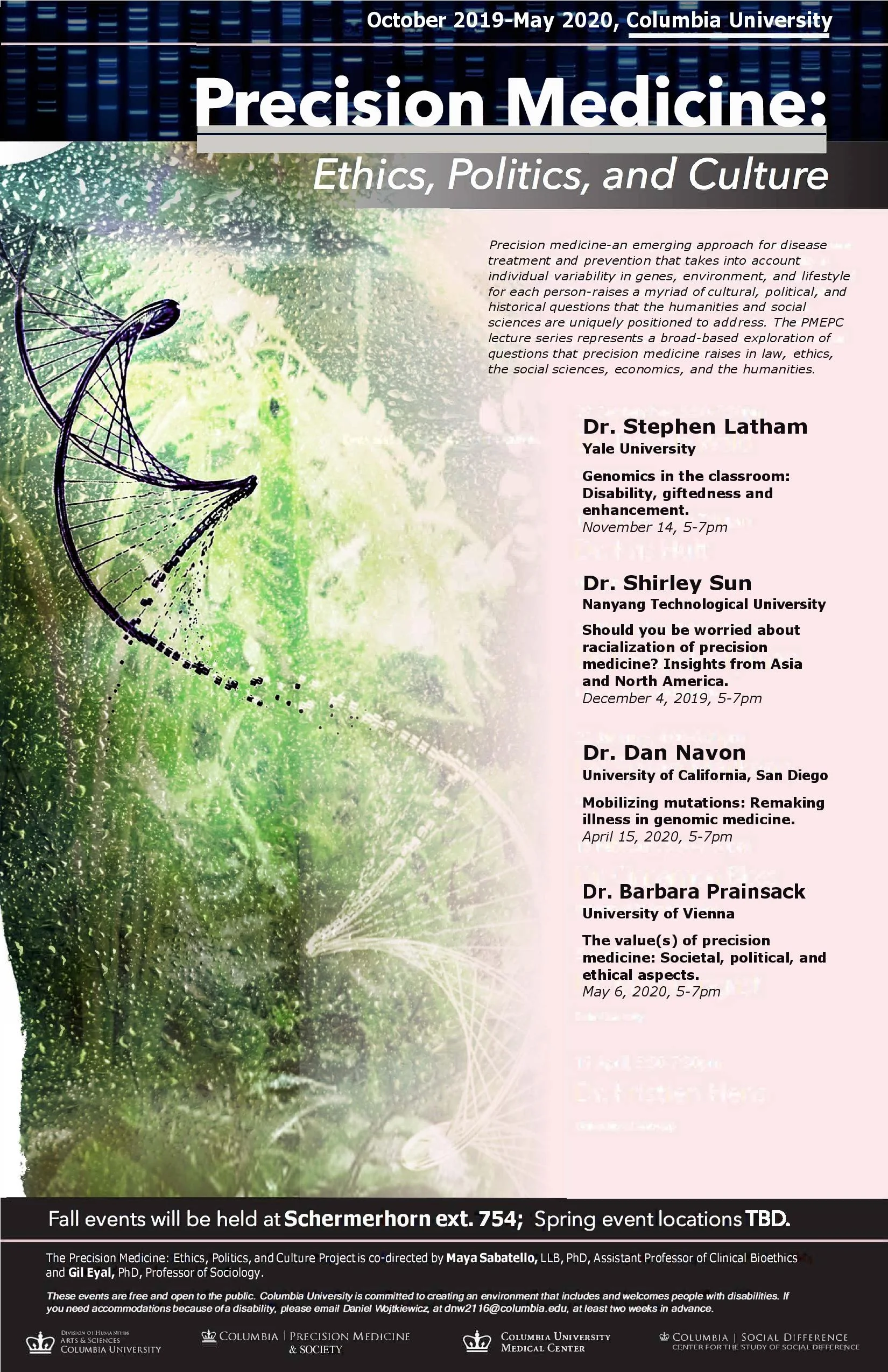
Call for Precision Medicine: Ethics, Politics, and Culture 2019-2020 Graduate Fellowship Applications
Applications due by September 23, 2019

CALL FOR APPLICATIONS
Precision Medicine: Ethics, Politics, and Culture
2019-2020 Graduate Fellowship
Columbia University’s working group on Precision Medicine: Ethics, Politics, and Culture (PMEPC) is seeking graduate fellows for the 2019-2020 academic year. Graduate students from any of Columbia’s schools whose work is related to any aspect of precision medicine are invited and encouraged to apply.
Project Description:
Precision Medicine—an emerging approach for disease treatment and prevention that takes into account individual variability in genes, environment, and lifestyle for each person—raises a myriad of cultural, political, and historical questions that the humanities are uniquely positioned to address. As part of its overall Precision Medicine Initiative, and specifically, it’s Precision Medicine & Society arm, Columbia has initiated a broad based exploration of questions that precision medicine raises in law, ethics, the social sciences, and the humanities, which establishes the University as the center for scholarship relating to precision medicine and society. The Precision Medicine: Ethics, Politics and Culture Project is the first of its kind to bring Columbia faculty from the humanities, social sciences, law, and medicine into dialogue with leading scholars from the United States and abroad to discuss how social scientific and humanistic questions might enhance our understanding of the ethical, social, legal, and political implications of precision medicine research, and to inform social scientists and humanists about evidence, evaluation, and research outcomes from serious interdisciplinary engagement with this emerging medical field.
The working group provides an excellent opportunity to engage in interdisciplinary discussion, networking, and other work related to recent developments and the future of precision medicine and society. The project is co-directed by Maya Sabatello, LLB, PhD (Columbia University Irving Medical Center) and Gil Eyal, PhD (Columbia’s Department of Sociology).
Fellowship Requirements:
Graduate fellows will be expected to attend all meetings (4 public events followed by 4 working group meetings led by visiting scholars during the academic year); read circulated materials prior to the meetings and take part in conversation; provide an oral response to one of the scheduled speakers; write a short blog about that event; assist with promotion and publicity for meetings on Columbia’s campuses; and otherwise support and facilitate the work of the group. In addition, graduate fellows will work with the PMEPC’s directors to develop a manuscript on a topic related to precision medicine and society and present on it to the working group and the Precision Medicine & Society Steering Committee.
The schedule for the public events is enclosed. The working group meetings will take place in the morning following the public event.
Fellows will receive a $2,500 stipend for the year. Only Columbia graduate students are eligible. Applicants with disabilities and applicants belonging to minority groups are encouraged to apply.
To apply, please submit your CV and a one-page letter describing your research interests, skills and how the PMEPC’s Graduate Fellowship will advance your professional trajectory to Daniel Wojtkiewicz (dnw2116@columbia.edu) by Sep. 23, 2019. Questions about this fellowship and the project more generally can be sent to the directors’, Maya and Gil as well. Successful applicants will be notified by Oct. 7, 2019.
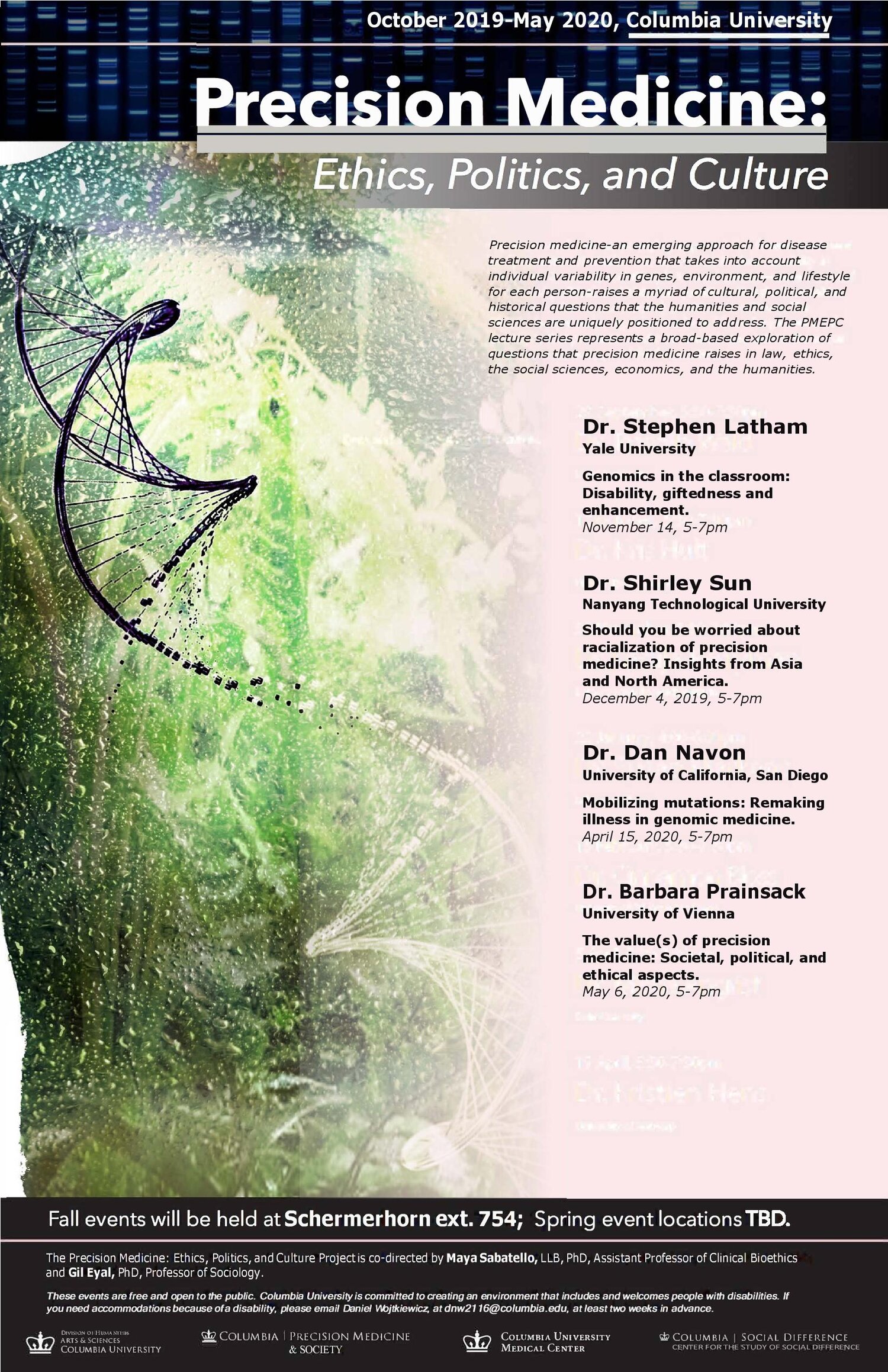
Listen to Chris Bobel on The Takeaway Podcast
Menstrual Health and Gender Justice working group fellow discusses workplace menopause policies.
Chris Bobel, Menstrual Health working group fellow and Associate Professor of Women’s, Gender and Sexuality Studies at the University of Massachusetts Boston, along with Deborah Garlick, director of Menopause in the Workplace, joined The Takeaway podcast to discuss the glaring disparity between US and UK workplace menopause policies. In both countries, women over 45 make up a significant part of the workforce. Many such women are negatively affected by physical and psychological changes of menopause while at work. Whereas no politicians have taken up this cause in the US, in the UK politicians of both major parties have begun to address the lack of policies to help menopausal women.
Find the full podcast here.
For more on the Menstrual Health and Gender Justice working group visit their blog and project page.
You can also find them on Facebook and Twitter.
Chris Bobel’s latest book is The Managed Body: Developing Girls and Menstrual Health in the Global South.
Tey Meadow Named Finalist for the 2018 C. Wright Mills Award
Queer Theory working group fellow’s book Trans Kids: Being Gendered in the Twenty-First Century up for prestigious honor.
Tey Meadow, Associate Professor of Sociology and member of CSSD working group Queer Theory, was named a finalist for the 2018 C. Wright Mills Award for her new book Trans Kids: Being Gendered in the Twenty-First Century (University of California Press, 2018). The Society for the Study of Social Problems gives out the award, established in 1964, to works that best exemplify outstanding social science research.
See the full list of finalists here.
For more on the Queer Theory working group visit their project page.
Geographies of Injustice Working Group Co-directors Awarded Funding by the Social Science Research Council
Professors Ana Paulina Lee and Anupama Rao have been announced as inaugural grantees of New Interdisciplinary Projects in the Social Sciences.
Professors Ana Paulina Lee and Anupama Rao, co-directors of the Geographies of Injustice working group, have been announced as inaugural grantees of New Interdisciplinary Projects in the Social Sciences for their project “Reconstructing Memory in Dharavi, Mumbai and Rocinha, Rio de Janeiro.”
The full announcement can be found here.
Professor Frances Negrón-Muntaner Pens Article for Dissent Magazine
Unpayable Debt co-director addresses the recent historic protests in Puerto Rico.
Frances Negron-Muntaner, Unpayable Debt working group co-director and professor of English and comparative literature at Columbia University, addresses the recent historic protests in Puerto Rico in an article for Dissent magazine. The article notes the international reach and inclusivity of the thirteen day protests that led to the resignation of Puerto Rican governor Ricardo Rosselló.
Frances Negrón-Muntaner is co-director of CSSD working group Unpayable Debt: Capital, Violence, and the New Global Economy and creator of the Puerto Rican community currency project Valor y Cambio.
To read her full article in Dissent magazine click here.

Menstrual Health and Gender Justice Working Group Call For Submissions
NYC Interdisciplinary Workshop to be held November 22, 2019. Deadline for abstracts is August 30, 2019
NYC Interdisciplinary Workshop:
Multifaceted Menstruation
Deadline for abstracts: August 30, 2019
Date of workshop: November 22, 2019
The current momentum around menstruation has drawn together scholars, activists, policymakers, health practitioners, and corporations--each differently invested in menstrual health. Over the past year, the Menstrual Health and Gender Justice Working Group has brought together Columbia University researchers across different departments interested in menstruation, encouraging individual and collaborative research that crosses disciplinary boundaries to address complex questions. This workshop hopes to broaden that reach and support, and to facilitate further interdisciplinary collaboration and networking beyond the Columbia University community.
Information for Contributors:
This one-day workshop seeks to critically evaluate the current state of research on menstruation, with interest in examining whose voices are being represented, which actors shape the dominant narrative, whose voices are marginalized, what gaps in data, research, and policy exist, and how interdisciplinary collaboration may help remedy some of these gaps. The workshop also hopes to serve as an opportunity to make connections with menstrual health researchers in the Greater New York area.
Submissions may address research in any area of Critical Menstruation Studies that engages:
Historical, socio-cultural, religious and political economic perspectives
Feminist, queer, and post-colonial theory
Science, technology, biomedical informatics, and clinical approaches
Policy and programmatic interventions
and/or explores the following topics (list is not exhaustive):
Menstrual hygiene management initiatives
The emergence and implications of FemTech
De-gendering menstruation/queering menstruation
Menstruators of diverse identities and experiences
Menstruation across the lifespan (puberty, menarche, menopause, etc)
Menstrual disorders
Menstrual health education
Menstrual activism
Data on menstruation
Submission Guidelines:
Researchers are invited to submit proposals for flash presentations (5 minutes, 3 power-point slides max.) on any of the above or other topics related to menstruation. We welcome submissions from all different disciplines, career levels, and stages of research. Please submit an abstract (300 words max.) and a brief bio (150 words max.) at this link. For any questions regarding submission guidelines, please email michelle.chouinard@columbia.edu.
We welcome submissions from all researchers in the Greater New York area. Please feel free to share this call with interested colleagues. Please note that we cannot provide travel support for the workshop.
For further information please visit the Menstrual Health and Gender Justice Working Group website and blog (https://periodsatcolumbia.com/) or contact Michelle Chouinard, Coordinator of the Menstrual Health and Gender Justice Working Group (michelle.chouinard@columbia.edu).
Unpayable Debt Co-director Appears on Latino Rebels Podcast
Frances Negron-Muntaner discusses the recent protests in Puerto Rico in conjunction with her Valor y Cambio project.
On the eighth day of on-going protests in Puerto Rico Unpayable Debt co-director, Professor Frances Negron-Muntaner, discussed the overlap between her community currency project Valor y Cambio and what has come to be called the Puerto Rican Spring on the Latino Rebels Podcast.
To hear the entire interview listen to the podcast here.
For more on Valor y Cambio click here.
Frances Negron-Muntaner is a filmmaker, writer, curator, scholar and professor at Columbia University, where she is also the founding curator of the Latino Arts and Activism Archive.
NYTimes article on the importance of the work of academics in Turkey
The work of CSSD fellow Ayse Gul Altinay, among others, is highlighted.
CSSD colleague Ayse Gül Altinay, Professor of Anthropology and Director of the Gender and Women’s Studies Center at Sabanci University in Istanbul, Turkey, was sentenced to 25 months in prison earlier this year. The important work of Ayse Gul Altinay is highlighted in a piece in The New York Times this week. Full article here.
"The work of academics has been critical to the process, piecing together more complete histories to promote understanding and basic human rights. The ongoing repression will cost future generations knowledge that is vital not only to overcoming past trauma, but also to easing the perpetuation of conflict."

CSSD Welcomes Paige West as Director
Co-director of Reframing Gendered Violence and Pacific Climate Circuits working groups appointed as Director of the Center for the Study of Social Difference
Paige West, Claire Tow Professor of Anthropology at Barnard College and Columbia University, begins her directorship of the Center for the Study of Social Difference this summer after having served as co-director of two CSSD working groups, Reframing Gendered Violence and Pacific Climate Circuits.
“I’m honored to have been selected to direct CSSD for the next few years,” says Dr. West. “The center’s goal of creating space for our community to come together to work towards scholarship that pushes our understanding of social difference in new directions and that produces social change lies at the heart of why I initially became a scholar.”
Dr. West’s broad scholarly interest is the relationship between societies and their environments. More specifically, she has written about the linkages between environmental conservation and international development, the material and symbolic ways in which the natural world is understood and produced, the aesthetics and poetics of human social relations with nature, and the creation of commodities and practices of consumption.
In addition to her academic work, Dr. West is the co-founder, and a board member, of the PNG Institute of Biological Research, a small NGO dedicated to building academic opportunities for research in Papua New Guinea by Papua New Guineans. Dr. West is also the co-founder of the Roviana Solwara Skul, a school in Papua New Guinea dedicated to teaching at the nexus of indigenous knowledge and western scientific knowledge.
Susan Meiselas’s Photography Reviewed by The New York Review of books
Famed photographic works from former Engendering the Archive and Women Mobilizing Memory working group fellow are revisited.
A recent article in The New York Review of Books highlights the work of photographer Susan Meiselas. The piece specifically chronicles photographs from Nicaragua during the 1970’s. Meiselas is a former fellow of both the Engendering the Archive and Women Mobilizing Memory working groups.
To read the complete article click here.
CSSD Working Group to Launch Course in Spring 2020
Geographies of Injustice will be launching a course entitled “Subaltern Urban Studies” taught by the working group co-directors Anupama Rao and Ana Paulina Lee.
In the spring of 2020 CSSD working group Geographies of Injustice will be launching a course entitled “Subaltern Urban Studies” taught by co-directors Anupama Rao and Ana Paulina Lee.
The course, presented in seminar format, will explore how spatial politics intersect with economic inequality and social difference (race, gender, caste, and ethnicity) to produce marginalized and stigmatized spaces such as “favelas,” “slum,” and “ghettos.” The course will be divided between the study of the colonial and the industrial city, going into topics such as public health, housing and the slum, political violence and forms of cultural production.
Anupama Rao is an Associate Professor of History as well as Associate Director for the Institute for Comparative Literature and Society.
Ana Paulina Lee is Assistant Professor of Luso-Brazilian Studies at Columbia University.
Susan Meiselas wins 2019 Deutsche Börse Photography Prize
Former Engendering the Archive and Women Mobilizing Memory working group fellow has been awarded for her socially engaged photography.
Susan Meiselas, photographer and fellow of former CSSD working groups Engendering the Archive and Women Mobilizing Memory was awarded the 2019 Deutsche Borse photography prize. Susan’s work spans five decades and covers subjects from the scattered communities of the Kurdish diaspora to the women in her Carnival Strippers series. Her engagement with the people in her photos lends her work a celebrated sense of humanity.
For more read the full feature in The Guardian here.
Valor y Cambio Project Featured in Brooklyn Public Library Podcast
The project, created by Unpayable Debt co-director Frances Negron-Muntaner was highlighted in a podcast episode discussing neighbors coming together after a storm.
Frances Negron-Muntaner, co-director of CSSD working group Unpayable Debt and Professor of English and Comparative Literature at Columbia, discussed the Valor y Cambio project on a recent episode of the Brooklyn Public Library podcast. In the show Frances talks about how the project was created following Hurricane Maria when proposals for a new library system were met a lack of enthusiasm.
In an effort to show that people in Puerto Rico both want and need community spaces and free access to information she launched the community project Valor y Cambio, which invited people to share stories about what they value. The initiative brought Puerto Ricans together and demonstrated the importance of community.
You can listen to the full podcast here.
For more on Valor y Cambio visit the website.