
Menstrual Health Working Group Fellow Participates in the UN 63rd Session of the Commission on the Status of Women
Lauren Houghton took part in an all female panel on menstruation entitled, “Access to Menstrual Health as a Public Service: The Lived Experiences of Women and Girls.”
Lauren Houghton, Assistant Professor of Epidemiology and fellow in CSSD working group Menstrual Health and Gender Justice, participated in the panel “Access to Menstrual Health as a Public Service: The Lived Experiences of Women and Girls.” The event took place as part of the 63rd Session of the Commission on the Status of Women (CSW). The panel stressed the importance of looking at the many menstruating women and girls who belong to marginalized groups, and their lived experiences with menstruation both in and outside of the home.
During the event Dr. Lauren Houghton gave insight on exactly how States and other actors can go about achieving change through the social normalization of menstruation. She stressed that policy-makers should avoid viewing providing menstruation products as quick fixes to more complex menstrual health issues.
A full recap of the panel can be found on the Menstrual Health working group blog.
Anupama Rao Delivers Franke Lecture at Yale
Co-Director of CSSD working group Geographies of Injustice, gave a talk entitled “Social Abstraction, Historical Comparison: Thinking Caste, Race, and Gender in the Time Capital.”
Anupama Rao, Associate Professor of History at Barnard and co-director of CSSD working groups Geographies of Injustice and Reframing Gendered Violence, delivered a talk entitled “Social Abstraction, Historical Comparison: Thinking Caste, Race, and Gender in the Time Capital” at Yale University. It was part of the Franke Lecture Series.
Anupama’s work explores the relationship of caste and political culture. Her book The Caste Question theorized caste subalternity, with specific focus on the role of anti-caste thought (and its thinkers) in producing alternative genealogies of political subject-formation.
You can read more about the lecture and her work here.
Unpayable Debt working group co-director Delivers Keynote Lecture
Frances Negron-Muntaner gave a lecture entitled “The ‘Valor y Cambio’ Project: Practicing Art, Narrative and Just Economies in Puerto Rico,” at the Pratt Institute’s Digital Spatialities Workshop.
Frances Negron-Muntaner, Professor of English and Comparative Literature at Columbia and co-Director of CSSD working group Unpayable Debt, delivered the keynote lecture at Pratt’s March 26 Digital Spatialities workshop. The event brought together scholars pursuing research on social media phenomena within the US and globally.
Frances’ keynote was entitled “The ‘Valor y Cambio’ Project: Practicing Art, Narrative and Just Economies in Puerto Rico,” and was inspired by her current community currency project in Puerto Rico, and her extensive experience as an activist, writer, filmmaker, curator, and educator.
You can read more about the workshop here.
For more on the social currency project “Valor y Cambio,” click here.
Check out photos from the Unpayable Debt working group’s closing conference here.
J.C. Salyer Honored by Arab-American Family Support Center
J.C. Salyer, former co-director of CSSD working group Pacific Climate Circuits, was recognized for his dedication to Brooklyn’s Arab-American community and his work to strengthen cross-cultural ties.
J.C. Salyer, Assistant Professor of Human Rights at Barnard and former co-director of CSSD working group Pacific Climate Circuits, was honored by the Arab-American Family Support Center as well as by the Office of the Brooklyn Borough President Eric L. Adams. Professor Salyer is also co-director of the new CSSD working group Migrant Personhood and Rights: Crises of Recognition to be launched in the September of 2019.
His dedication to Brooklyn’s Arab-American community and his work to strengthen cross-cultural ties was recognized during the annual Arab-American Heritage Celebration at Brooklyn Borough Hall on Thursday, April 4th.
The full press release can be read here.
For more on the Pacific Climate Circuits working group check out their webpage.
Stay tuned for more on new working group Migrant Personhood and Rights, launching September 2020!
J.C. Salyer is an anthropologist and a lawyer whose work focuses on law and society, immigration law, and social justice. He is also the staff attorney for the Arab-American Family Support Center, a community-based organization in Brooklyn, and runs the organization’s immigration clinic. His current research focuses on migration, disruption, and displacement related to climate change in the southwestern Pacific.
Rachel Adams named as 2019 John Simon Guggenheim Fellow
Former CSSD Director Rachel Adams selected for the 2019 Guggenheim Fellowships
On April 9, 2019, the Board of Trustees of the John Simon Guggenheim Memorial Foundation approved the awarding of Guggenheim Fellowships to a diverse group of 168 scholars, artists, writers, and scientists. Appointed on the basis of prior achievement and exceptional promise, the successful candidates were chosen from a group of almost 3,000 applicants in the Foundation’s ninety-fifth competition.
Rachel Adams, former CSSD Director and co-director of CSSD working group, Precision Medicine: Ethics, Politics and Culture, was among 168 scholars, artists, writers, and scientists in United States and Canada selected for the 2019 Guggenheim Fellowships.
CSSD sends a heartfelt congratulation to Rachel Adams on the award of this prestigious Fellowship.
Since its establishment in 1925, the John Simon Guggenheim Memorial Foundation has granted more than $360 million in Fellowships to over 18,000 individuals, among whom are scores of Nobel laureates, Fields Medalists, poets laureate, members of the various national academies, and winners of the Pulitzer Prize, Turing Award, National Book Award, and other significant, internationally recognized honors.
Chris Bobel Discusses Menstruation with The Washington Post
CSSD working group Menstrual Health fellow addresses the flaws in current menstrual health programs in a recent article.
Chris Bobel, Associate Professor of Women and Gender studies at University of Massachusetts Boston and fellow in the CSSD working group Menstrual Health and Gender Justice, talked with The Washington Post about what more needs to be done to improve menstrual health programs. The conversation centered around the information in her new book, The Managed Body: Developing Girls & Menstrual Health in the Global South.
She addresses the need to look beyond menstrual products as the sole approach to menstrual health education as we expand the discussion surrounding periods to include topics such as ways to combat stigma and necessary cultural shifts.
The full article can be read here.
Join the Menstrual Health working group in welcoming Chris Bobel for a book talk on her recently released book The Managed Body: Developing Girls & Menstrual Health in the Global South.
Menstrual Health Working Group Fellow Debunks Menstruation Myths in NPR
Chris Bobel spoke with NPR about her recent book The Managed Body: Developing Girls & Menstrual Health in the Global South.
Chris Bobel, Associate Professor of Women and Gender studies at the University of Massachusetts Boston and fellow in the CSSD working group Menstrual Health and Gender Justice, recently spoke with NPR about her new book, The Managed Body, as well as common myths surrounding menstruation.
In the article she discusses the stigma and negativity related to periods in low and middle income countries as well as how well-meaning activists are misguided by misconceptions about menstrual health.
RGFGV Co-director Delivers Lecture at the University of Alberta
Professor Lila Abu-Lughod delivers lecture for distinguished series on human rights at the University of Alberta
On February 4, former CSSD director and co-director of Religion and the Global Framing of Gender Violence (RGFGV) working group, Professor Lila Abu-Lughod delivered a lecture at the University of Alberta Visiting Lectureship in Human Rights series. Professor Abu-Lughod's talk entitled, "Is the War on Muslims a War on Rights?” questions the use of military invasions in the name of defending Muslim women’s rights and how proliferating security measures for surveillance and management of Muslims in the name of protecting human life have confronted those who value the ideals of human rights with troubling questions.
Lila Abu-Lughod is the Joseph L. Buttenwieser Professor of Social Science at Columbia University where she teaches anthropology and gender studies. A leading voice in the debates about culture, gender, Islam, and global feminist politics, her award-winning books and articles have been translated into 14 languages.
The University of Alberta Visiting Lectureship in Human Rights is envisioned as one of the preeminent annual events held at the University. Individuals or organizations that have made an outstanding contribution in the field of human rights and human rights protection are invited to deliver a major public lecture in Edmonton.
CSSD Director presents keynote address at Norwalk Community College
Professor Marianne Hirsch will be the keynote speaker at the 22nd annual Academic Festival hosted by Norwalk Community College.
On Wednesday, April 3, Center for the Study of Social Difference Director and William Peterfield Trent Professor of English and Comparative Literature, Marianne Hirsch will give the keynote address at the 22nd annual Academic Festival at Norwalk Community College.
This year’s conference theme is Postmemory: Hidden Trauma, Healing Narratives, a topic very familiar to Professor Hirsch whose work combines feminist theory with memory studies, particularly the transmission of memories of violence across generations. Professor Hirsch’s keynote lecture, "Postmemory for the Future," will be presented at 10am in the East Campus PepsiCo Theater at Norwalk Community College.
Click here to learn more.
Marianne Hirsch is a co-director of the Women Mobilizing Memory working group, William Peterfield Trent Professor of English and Comparative Literature at Columbia University and a Professor in the Institute for Research on Women, Gender, and Sexuality. She is a member of the American Academy of Arts and Sciences and a former President of the Modern Language Association of America.
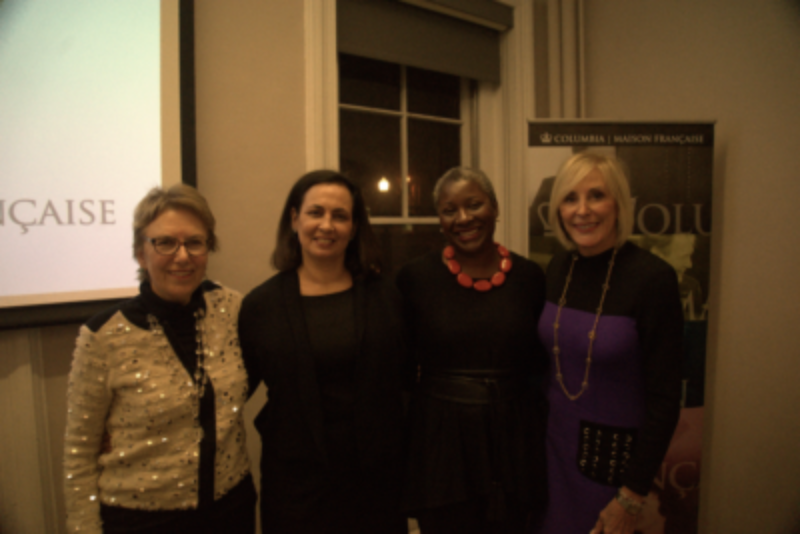
Women Creating Change Hosts Corporate Feminism & Its Discontents Round Table
On Wednesday March 13, 2019, days after International Women’s Day, Women Creating Change at the Center for the Study of Social Difference hosted a roundtable discussion to explore the successes and limitations of policies to promote diversity and inclusion in the corporate sector. Held at Maison Francaise, the “Corporate Feminism & Its Discontents” roundtable included notable speakers such as Janice Ellig, Chief Executive Officer of the Ellig Group, Professor Yasmine Ergas, lecturer and director of the Specialization on Gender and Public Policy at the School of International and Public Affairs, Melissa Fisher, a cultural anthropologist who writes on finance, feminism, and the workplace, and Katherine Phillips, the Paul Calello Professor of Leadership and Ethics at Columbia Business School.
The interdisciplinary panel was introduced by Women Creating Change Leadership Council (WCCLC) Chair Ann Kaplan, Chair and founder of Circle Financial Group. Moderator of the roundtable, Janice Ellig, started off the conversation by detailing her first hand experiences in corporate America and how these experiences inform her belief that a shift toward gender parity needs to happen from the top. She also recognized the impact of women leaders like Diana Taylor, new WCCLC member, who has served as a leader on the issue of women entering into the corporate world and the necessity for such committed leadership to promote and advance the rights of women in the corporate field.
Through an interdisciplinary look at both the progress and regress in the field, the “Corporate Feminism & Its Discontents” roundtable discussed the achievements made by women in the corporate sector in recent years, and shed light on the existing gender and racial disparities in the sector, especially in its higher echelons, which remain significant in the United States and Europe.
As the conversation progressed, Professor Phillips discussed the ways in which most organizations were not designed to have women be apart of them in addition to findings that nevertheless demonstrate that firms with more women in leadership positions perform better. She cited her own research, which confirms the benefit of having different people working together and how such diversity creates higher levels of productivity. However, she acknowledged that despite growing evidence, many are still not convinced, exemplified by research that shows men are less likely to help women in management positions. explains how women’s knowledge isnt fully utilized, another barrier women face in their careers
During her presentation, Melissa Fisher addressed the critique of corporate feminism as not addressing race and class. She questioned how the relationships between capitalism and feminism work themselves out in everyday life and cites different dimensions that need to be looked at and pushed: equity, social imagination, and forging alliances. Fisher ended by highlighting the benefits of looking at feminism as an assemblage, both mobile and connective in order to mobilize it in novel ways. She concluded with optimism in the way labor is bridging boundaries and translating domains.
Professor Ergas expanded the conversation further by discussing the motherhood penalty on pay scales for women in the workplace. She explained that the context of the corporation is just as important as what is taking place within the corporation in terms of gender change. Additionally, she noted how global leaders and politics continue to marginalize women and how policies continue to push women into the sphere of the home and away from the workplace. “We need a huge collective conversation that prompts us all to think about feminism,” Professor Ergas urged. She also highlighted the necessity of pushing back against those, such as oppressive leaders and gender traditionalists, who view the glass as too full by insisting against further progress towards gender equality. Encouragingly however she proclaimed that “The best thing about the backlash is the backlash to the backlash.”
Frances Negrón-Muntaner presents keynote lecture at 2019 GRACE Conference
Co-director of CSSD working group delivers three presentations at the 2019 Gender and Cultures of Equality (GRACE) Conference in Holland.
On March 9th, 2019, co-director of CSSD working group Unpayable Debt: Capital, Violence, and the New Global Economy, Frances Negrón-Muntaner gave a keynote speech entitled "The Valor y Cambio" Project: Art, Narrative and Decolonial Joy” at the 2019 Gender and Cultures of Equality (GRACE) Conference in Holland. In addition to her keynote presentation, professor Negrón-Muntaner delivered two presentations at the conference, which aims to systematically investigate the cultural production of gender equalities within Europe.
Click here to view the full conference schedule.
Frances Negrón-Muntaner is a filmmaker, writer, curator, scholar and professor at Columbia University, where she is also the founding curator of the Latino Arts and Activism Archive. For more on her Valor y Cambio social currency project click here.
The GRACE Conference celebrates the achievements of the GRACE Project’s work and provides opportunities to explore the themes of the GRACE research through a range of activities, including a series of public talks by GRACE researchers and other distinguished international scholars.
CSSD Director Gives Talk at Columbia Global Center
Professor Marianne Hirsch discusses “Women Carrying Memories: Stateless Figures” in Istanbul.
On March 28th, Center for the Study of Social Difference Director and William Peterfield Trent Professor of English and Comparative Literature, Marianne Hirsch addressed an audience of over 150 in Istanbul, Turkey on the subject of “Women Carrying Memory: Stateless Figures”. A co-director of the Women Mobilizing Memory working group, Professor Hirsch’s talk highlighted two recent memorial projects by feminist diasporic artists that explore the vicissitudes and vulnerabilities of exile and statelessness. The talk, which culminated in a Q&A session moderated by Ayşe Gül Altınay, Associate Professor of Anthropology at Sabancı University and Aylin Vartanyan, Lecturer at Bogazici University, was a response to the renewed monumentality of memory museums, memorials and commemorative rituals that perpetuate nationalism and ethnocentrism.
Click here to see photos from the event.
For more on Women Mobilizing Memory click here.
Farrah Jasmine Griffin featured in the Columbia Daily Spectator
Co-director of CSSD working group Toward an Intellectual History of Black Women is one of four Columbia faculty credited for the creation Columbia’s first African American and African Diaspora Studies department.
Farrah J. Griffin, co-director of CSSD working group Toward an Intellectual History of Black Women and director of CSSD affiliate Institute for Research in African-American Studies is featured in a Columbia Daily Spectator article about the recently created African American and African Diaspora Studies department.
The article highlights the decades of activism surrounding the University’s lack of dedicated scholarship to issues of race and ethnicity that led to the creation of Columbia’s first African American and African Diaspora Studies department last fall.
The article details the efforts of Griffin and three other faculty, as well as a myriad of other students and scholars, whose efforts were instrumental in pushing for change in the slow-moving world of academia.
Columbia’s Board of Trustees voted unanimously to create the new department of African American and African Diaspora Studies on Dec. 1, 2018 with Farrah J. Griffin as its first chair.
Click here to read the article.
For more on Farrah J. Griffin’s contributions to CSSD see the Toward an Intellectual History of Black Women webpage for past events, the CSSD blog for news and publications and check out our YouTube channel for how CSSD is Imagining Justice and Creating Change as well as for full-length videos from our 10th Anniversary Symposium.
Women and Migration: Responses in Art and History published on IWD
Book featuring contributions from several members of CSSD working groups published by Open Book Publishers
On International Women’s Day, Women and Migration: Responses in Art and History, a book featuring the works of several members of CSSD working groups was published by Open Book Publishers. Our working group members featured in the book are Lorie Novak, Jennifer L. Morgan, Kellie Jones, Marianne Hirsch, Gayatri Gopinath, and Deborah Willis.
The book is comprised of series of essays that chart how women’s profound and turbulent experiences of migration have been articulated in writing, photography, art and film. As a whole, the volume gives an impression of a wide range of migratory events from women’s perspectives, covering the Caribbean Diaspora, refugees and slavery through the various lenses of politics and war, love and family.
The contributors, which include academics and artists, offer both personal and critical points of view on the artistic and historical repositories of these experiences. Selfies, motherhood, violence and Hollywood all feature in this substantial treasure-trove of women’s joy and suffering, disaster and delight, place, memory and identity.
Click here to purchase, read or download.
Frances Negron-Muntaner’s Community Currency Project featured in The Manhattan Times
The co-director of the CSSD working group Unpayable Debt has launched a project to acknowledge unrecognized and unpaid services in Puerto Rico communities.
Frances Negron-Muntaner, co-director of the CSSD working group Unpayable Debt and Professor of English and Comparative Literature at Columbia, along with artist Sarabel Santos Negron, has implemented a community currency program in towns across Puerto Rico. The project, named Valor y Cambio, is part of an initiative to recognize work and services that go unacknowledged or unpaid. Individuals can get bills or pesos from ATM machines by telling a story, and these bills can in turn be used to pay for goods at participating businesses.
The bills, which come in seven denominations, feature important Puerto Rican historical figures. As the educational system in Puerto Rico does not prominently feature its own history as part of the curriculum, the initiative is also attempting to connect people to the past. The full feature on the project can be read here in The Manhattan TImes.
CSSD Executive Committee Member Featured on The Dean’s Table Podcast
Professor Claudio Lomnitz chats with Fredrick Harris, Dean of Social Sciences at Columbia University, on his podcast.
In Episode 2 of The Dean’s Table, Professor Claudio Lomnitz, former co-director of CSSD working group Borders and Boundaries, joins Dean Harris to discuss the multiple migrations of his past; his views on the role of the public intellectual; the challenges of adapting scholarship to the creative arts; and the conflict-ridden relationship between Mexico and the United States.
Click here to listen!
Professor Claudio Lomnitz works on the history, politics and culture of Latin America, and particularly of Mexico. He has a PhD from Stanford in 1987, and his first book, Evolución de una sociedad rural (Mexico City, 1982) was a study of politics and cultural change in Tepoztlán, Mexico.
The Dean's Table is the latest initiative of Dean Fredrick Harris, Dean of Social Sciences, Columbia University. This series features the lives, work, and imagination of scholars from across Columbia's social science disciplines.
RGFGV Media Fellow Published on Elle.com
Samira Shackle writes article discussing the blackmail of Pakistani women on Facebook.
Samira Shackle, Media Fellow for the CSSD working group Religion and the Global Framing of Gender Violence, published an article in Elle UK online detailing increasing harassment and blackmail faced by Pakistani women on Facebook.
The article highlights the growing number of cases of abusive ex-partners who post photos of their non-marital relationships on social media, an act that can cause serious problems for women in Pakistan, including suicide.
Click here to read the article.
Samira Shackle is one of three Media Fellows awarded reporting grants by CSSD working group Religion and the Global Framing of Gender Violence in September 2017. After participating in an international workshop with scholars and activists hosted at the Columbia Global Center in Amman, the media fellows traveled to the Middle East to research stories that could reframe understandings of the relationship between gender violence and religion.
RGFGV Media Fellow Pens article for The Intercept
Maryam Saleh writes about the ways in which Syrian women in Turkey are redefining their independence.
Maryam Saleh, Media Fellow for CSSD working group Religion and the Global Framing of Gender Violence, explores the tangible shift many Syrian women living in Turkey have experienced over the last seven years. As a result of the ongoing conflict in Syria which began in 2011, many Syrian women have found themselves having unexpectedly frank conversations about the political and cultural forces that have stymied their growth. Saleh’s article uncovers how women have been able to renegotiate their social standing and push back against patriarchal norms due to the various factors brought on by the war.
Click here to read more.
Maryam Saleh is a recipient of a media fellowship from CSSD working group Religion and the Global Framing of Gender Violence. After participating in an international workshop with scholars and activists hosted at the Columbia Global Center in Amman, the media fellows traveled to the Middle East to research stories that could reframe understandings of the relationship between gender violence and religion.
RGFGV Faculty Fellow Published on The Express Tribune
Dr. Shenilla Khoja-Moolji discusses the issue of sexual exploitation in the aid sector.
Religion and the Global Framing of Gender Violence faculty fellow Dr. Shenilla Khoja-Moolji discusses the culture of impunity that surrounds sexual violence and exploitation by foreign charities in developing countries. She draws parallels between the recent More Than Me scandal in Liberia and her home country of Pakistan to illustrate the prevalence of this issue, and provides recommendations on what must be done to prevent them from happening and ensure strict action is taken against perpetrators.
Click here to read more.
Dr. Shenilla Khoja-Moolji is a postdoctoral Fellow, in the Gender, Sexuality, and Women’s Studies department at the University of Pennsylvania. Her research problematizes the centering of girls’ education and empowerment as a solution to societal problems, especially in relation to Muslim-majority nations.
CSSD project director shares thoughts on "Period. End of Sentence." winning an Oscar
Menstrual Health and Gender Justice project director Inga Winkler writes about the significance of Period. End of Sentence. Oscar win.
We are thrilled that Period. End of Sentence. won an Oscar at last night's Academy Awards. Here are some thoughts from the Director of our CSSD working group Menstrual Health and Gender Justice:
Is there a better sign of periods finally going mainstream than a documentary about menstruation winning at the Oscars?
”Period. End of Sentence.” documents the efforts of Sneha and other women in Kathikehra in India to produce pads for their village, to improve menstrual health, and to enable women and girls to “rise and fly” as they put it.
The solutions to menstrual health certainly do not lie in pads alone. Menstruation is about so much more than blood. At the root of all challenges related to menstruation lies the stigma that surrounds it, and to change that we need more than pads to bleed on. The film shows how embarrassed girls and boys are when they are asked to speak about periods – and having a pad to hide the fact that you’re menstruating won’t change that.
Yet, the women and girls in Kathikhera show how pads can be an entry point to start a broader conversation about menstruation in Kathikehra, in Delhi, and now at the Oscars. Menstrual stigma certainly not only exists in India, and we need to have the very same conversation in the United States. We should use the current menstrual momentum to start working towards a society where menstruating women are not dismissed as ‘too emotional’ and unfit for decision-making, where health care providers take menstruators' symptoms serious and ensure a quick diagnosis for menstrual disorders, and where adolescents can see menstruation as an opportunity to engage with their body rather than something to be embarrassed about.
The women in Kathikhera find that the world is moving forward because of women, and indeed they are Women Creating Change who set an example for all of us.
-Inga Winkler, Director of CSSD working group Menstrual Health and Gender Justice