
Unpayable Debt Co-director Appears on Latino Rebels Podcast
Frances Negron-Muntaner discusses the recent protests in Puerto Rico in conjunction with her Valor y Cambio project.
On the eighth day of on-going protests in Puerto Rico Unpayable Debt co-director, Professor Frances Negron-Muntaner, discussed the overlap between her community currency project Valor y Cambio and what has come to be called the Puerto Rican Spring on the Latino Rebels Podcast.
To hear the entire interview listen to the podcast here.
For more on Valor y Cambio click here.
Frances Negron-Muntaner is a filmmaker, writer, curator, scholar and professor at Columbia University, where she is also the founding curator of the Latino Arts and Activism Archive.
NYTimes article on the importance of the work of academics in Turkey
The work of CSSD fellow Ayse Gul Altinay, among others, is highlighted.
CSSD colleague Ayse Gül Altinay, Professor of Anthropology and Director of the Gender and Women’s Studies Center at Sabanci University in Istanbul, Turkey, was sentenced to 25 months in prison earlier this year. The important work of Ayse Gul Altinay is highlighted in a piece in The New York Times this week. Full article here.
"The work of academics has been critical to the process, piecing together more complete histories to promote understanding and basic human rights. The ongoing repression will cost future generations knowledge that is vital not only to overcoming past trauma, but also to easing the perpetuation of conflict."

CSSD Welcomes Paige West as Director
Co-director of Reframing Gendered Violence and Pacific Climate Circuits working groups appointed as Director of the Center for the Study of Social Difference
Paige West, Claire Tow Professor of Anthropology at Barnard College and Columbia University, begins her directorship of the Center for the Study of Social Difference this summer after having served as co-director of two CSSD working groups, Reframing Gendered Violence and Pacific Climate Circuits.
“I’m honored to have been selected to direct CSSD for the next few years,” says Dr. West. “The center’s goal of creating space for our community to come together to work towards scholarship that pushes our understanding of social difference in new directions and that produces social change lies at the heart of why I initially became a scholar.”
Dr. West’s broad scholarly interest is the relationship between societies and their environments. More specifically, she has written about the linkages between environmental conservation and international development, the material and symbolic ways in which the natural world is understood and produced, the aesthetics and poetics of human social relations with nature, and the creation of commodities and practices of consumption.
In addition to her academic work, Dr. West is the co-founder, and a board member, of the PNG Institute of Biological Research, a small NGO dedicated to building academic opportunities for research in Papua New Guinea by Papua New Guineans. Dr. West is also the co-founder of the Roviana Solwara Skul, a school in Papua New Guinea dedicated to teaching at the nexus of indigenous knowledge and western scientific knowledge.
Susan Meiselas’s Photography Reviewed by The New York Review of books
Famed photographic works from former Engendering the Archive and Women Mobilizing Memory working group fellow are revisited.
A recent article in The New York Review of Books highlights the work of photographer Susan Meiselas. The piece specifically chronicles photographs from Nicaragua during the 1970’s. Meiselas is a former fellow of both the Engendering the Archive and Women Mobilizing Memory working groups.
To read the complete article click here.
CSSD Working Group to Launch Course in Spring 2020
Geographies of Injustice will be launching a course entitled “Subaltern Urban Studies” taught by the working group co-directors Anupama Rao and Ana Paulina Lee.
In the spring of 2020 CSSD working group Geographies of Injustice will be launching a course entitled “Subaltern Urban Studies” taught by co-directors Anupama Rao and Ana Paulina Lee.
The course, presented in seminar format, will explore how spatial politics intersect with economic inequality and social difference (race, gender, caste, and ethnicity) to produce marginalized and stigmatized spaces such as “favelas,” “slum,” and “ghettos.” The course will be divided between the study of the colonial and the industrial city, going into topics such as public health, housing and the slum, political violence and forms of cultural production.
Anupama Rao is an Associate Professor of History as well as Associate Director for the Institute for Comparative Literature and Society.
Ana Paulina Lee is Assistant Professor of Luso-Brazilian Studies at Columbia University.
Susan Meiselas wins 2019 Deutsche Börse Photography Prize
Former Engendering the Archive and Women Mobilizing Memory working group fellow has been awarded for her socially engaged photography.
Susan Meiselas, photographer and fellow of former CSSD working groups Engendering the Archive and Women Mobilizing Memory was awarded the 2019 Deutsche Borse photography prize. Susan’s work spans five decades and covers subjects from the scattered communities of the Kurdish diaspora to the women in her Carnival Strippers series. Her engagement with the people in her photos lends her work a celebrated sense of humanity.
For more read the full feature in The Guardian here.
Valor y Cambio Project Featured in Brooklyn Public Library Podcast
The project, created by Unpayable Debt co-director Frances Negron-Muntaner was highlighted in a podcast episode discussing neighbors coming together after a storm.
Frances Negron-Muntaner, co-director of CSSD working group Unpayable Debt and Professor of English and Comparative Literature at Columbia, discussed the Valor y Cambio project on a recent episode of the Brooklyn Public Library podcast. In the show Frances talks about how the project was created following Hurricane Maria when proposals for a new library system were met a lack of enthusiasm.
In an effort to show that people in Puerto Rico both want and need community spaces and free access to information she launched the community project Valor y Cambio, which invited people to share stories about what they value. The initiative brought Puerto Ricans together and demonstrated the importance of community.
You can listen to the full podcast here.
For more on Valor y Cambio visit the website.
Frances Negron-Muntaner Wins Frank Bonilla Public Intellectual Award
Co-director of the CSSD working group Unpayable Debt has won an award from the Latin American Studies Association.
Frances Negron-Muntaner, co-director of the CSSD working group Unpayable Debt and Professor of English and Comparative Literature at Columbia, has been awarded the Frank Bonilla Public Intellectual Award by the Latin American Studies Association. She was recognized by the association for her many achievements including but not limited to her recent community based project “Valor y Cambio” as well as her autobiographical film Brincando el Charco.
Frances has been named one of the “100 most influential hispanics” by Hispanic Business Magazine and was recognized as a global expert by the United Nations’ Rapid Response Media Mechanism. She will receive the award in Boston on May 26th.
Puerto Rican Community Currency Project on Display in Manhattan
The ATM used in the Valor y Cambio project was featured in the 32nd Loisaida Festival. Valor y Cambio grew from the Unpayable Debt working group.
On Sunday May 26 ,2019 the ATM used in the Valor y Cambio project in Puerto Rico was shown at the 32nd Loisaida Festival in Manhattan. The Valor y Cambio project was created by Sarabel Santos Negron, multidisciplinary artist and educator and Frances Negron-Muntaner, co-director of CSSD working group Unpayable Debt and Professor of English and Comparative Literature at Columbia.
The Valor y Cambio project is a community currency project that lasted for 9 days in Puerto Rico with the goal of to generating more interest and discussion in socially just solutions to the island’s economic challenges. Residents would obtain decorated bills that could be used at local businesses in exchange for telling stories about themselves and their values. This past weekend 200 such bills were dispensed in Manhattan from the same ATM at the Loisaida festival.
You can read the full story here on Voices of NY.
For more on the Valor y Cambio community currency project click here.
Dr. Sonia Tolani Discusses Women’s Heart Health and Risk Factors
Co-director of working group Women’s Heart Disease Awareness addresses the lack of awareness surrounding women’s risk of heart disease in an interview with Steve Adubato.
Dr. Sonia Tolani, co-director of the working group Women’s Heart Disease Awareness and Assistant Professor of Medicine at Columbia, discussed the heart disease risk factors unique to women as well as how to increase awareness of the high number of women affected by it.
In the interview she stated that half of women are unaware that heart disease is the number one killer of women and that her goal is to change that. Traditional risk factors such as diabetes and smoking are relevant for men and women but increase women's chance of developing heart disease more than men's. Additionally, there are factors such as pregnancy history that are unique to women in determining their risk.
The “Love My Heart” app was uniquely designed with women in mind, as it takes into account information relevant to them in order to suggest lifestyle changes to maintain and improve heart health. Dr. Tolani discusses how the application works and more in her interview with Steve Adubato.
Watch the full interview here.
You can download the “Love My Heart” app here.
Be sure to check out more from the Women’s Heart Disease Awareness working group by following them on Instagram, Twitter and Facebook.
Women’s Heart Disease Awareness Working Group Launches App
New CSSD co-directors Dr. Natalie Bello and Dr. Sonia Tolani have launched the “Love My Heart” app to raise awareness of heart disease in women.
Co-directors of the CSSD working group Women’s Heart Disease Awareness, Dr. Natalie Bello and Dr. Sonia Tolani, have created the “Love My Heart” app in an effort to raise awareness of and prevent heart disease in women. The app lets women understand their risk of heart disease using a series of 12 questions.
Based on their individual risk factors the app helps users develop strategies to increase their heart health such as ways to fit in more exercise and eat better. The overall goal of this initiative is to spark a conversation between women and their health care providers.
You can read more about the “Love My Heart” app here.
The application can be downloaded on the Apple store here.
Be sure to check out more from the Women’s Heart Disease Awareness working group by following them on Instagram, Twitter and Facebook.
Statement of Support for Ayse Gül Altinay from CSSD & WCC
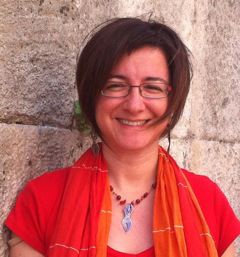
Our colleague Ayse Gül Altinay, Professor of Anthropology and Director of the Gender and Women’s Studies Center at Sabanci University in Istanbul, Turkey, was sentenced to 25 months in prison earlier this week.
Our colleague Ayse Gül Altinay, Professor of Anthropology and Director of the Gender and Women’s Studies Center at Sabanci University in Istanbul, Turkey, was sentenced to 25 months in prison earlier this week. She is one of over 2200 Academics for Peace who three years ago signed a statement “We will not be a party to this crime” appealing for an end to violent state-sponsored persecution of Kurdish citizens of Turkey. The investigation in Istanbul has covered only the first 1200 signatories so far, but it might be extended to the second 1000 as well. In this, her fourth, judicial hearing, Altinay was charged with “willingly and knowingly supporting a terrorist organization as a non-member.” The court's charge and thus the sentencing have no merit.
Ayse Gül Altinay has been a Faculty Fellow of Columbia’s Center for the Study of Social Difference since 2013. She is a co-organizer of the Working Group on “Women Mobilizing Memory” and a co-editor of the forthcoming Women Mobilizing Memory volume (Columbia University Press, 2019). Last September, she was also an invited speaker at the Center’s tenth anniversary conference “What We Can Do When There’s Nothing To be Done.” Her collaborative project “Curious Steps”— a gender-memory walk through Istanbul – spurred other such memory walks in additional sites including Harlem. Ayse Gül Altinay’s contributions to the Center’s work have been immeasurable: her feminist commitment to nonviolent protest and to transformative activism; her sharp insights into the workings of power and militarism and her determination to fight them; her fierce hopefulness combined with personal kindness, warmth and radiance have been an inspiration to all of us fortunate to be working with her.
In the spirit of collaboration and solidarity that Ayse Gül Altinay represents, it is important to point out that she is not alone in this struggle. Hers is one of a large number of cases receiving 25-month sentences that cannot be commuted. These cases, hers included, are in the process of being appealed. Some shorter sentences have been commuted, and many other colleagues are awaiting court dates over the next months. This is the time to speak out forcefully on all of their behalf and on behalf of freedom of expression and academic freedom.
On May 21st, 2019, Ayse Gül Altinay made the following statement to the court:
Every individual, every family living in this geography has suffered from past wars, migrations and experiences of violence. In terms of the cycle of violence that trauma studies alerts us to, we live in a challenging, vulnerable geography.
Yet, what we make of these past experiences of pain is up to us...
Are we going to turn our pain into more violence, hate, pain and injustice, or into steps that multiply life, beauty, love, peace and justice?
This is the main question that shapes my work and my life.
I firmly believe that we all have new steps we can take towards healing the traumas that have been transmitted from one generation to the other, and to break out of the cycles of violence that we are living through.
We, at CSSD and Columbia Global Freedom of Expression stand in solidarity and admiration for Ayse Gül Altinay and all of our academic colleagues who are being persecuted for their courage to speak out against violent aggression. The injustice of these sentences cannot be tolerated.
Statement of Support for Ayse Gül Altinay from the Columbia University Center for the Study of Social Difference and Women Creating Change
Our colleague Ayse Gül Altinay, Professor of Anthropology and Director of the Gender and Women’s Studies Center at Sabanci University in Istanbul, Turkey, was sentenced to 25 months in prison earlier this week. She is one of over 2200 Academics for Peace who three years ago signed a statement “We will not be a party to this crime” appealing for an end to violent state-sponsored persecution of Kurdish citizens of Turkey. The investigation in Istanbul has covered only the first 1200 signatories so far, but it might be extended to the second 1000 as well. In this, her fourth, judicial hearing, Altinay was charged with “willingly and knowingly supporting a terrorist organization as a non-member.” The court's charge and thus the sentencing have no merit.
Ayse Gül Altinay has been a Faculty Fellow of Columbia’s Center for the Study of Social Difference since 2013. She is a co-organizer of the Working Group on “Women Mobilizing Memory” and a co-editor of the forthcoming Women Mobilizing Memory volume (Columbia University Press, 2019). Last September, she was also an invited speaker at the Center’s tenth anniversary conference “What We Can Do When There’s Nothing To be Done.” Her collaborative project “Curious Steps”— a gender-memory walk through Istanbul – spurred other such memory walks in additional sites including Harlem. Ayse Gül Altinay’s contributions to the Center’s work have been immeasurable: her feminist commitment to nonviolent protest and to transformative activism; her sharp insights into the workings of power and militarism and her determination to fight them; her fierce hopefulness combined with personal kindness, warmth and radiance have been an inspiration to all of us fortunate to be working with her.
In the spirit of collaboration and solidarity that Ayse Gül Altinay represents, it is important to point out that she is not alone in this struggle. Hers is one of a large number of cases receiving 25-month sentences that cannot be commuted. These cases, hers included, are in the process of being appealed. Some shorter sentences have been commuted, and many other colleagues are awaiting court dates over the next months. This is the time to speak out forcefully on all of their behalf and on behalf of freedom of expression and academic freedom.
On May 21st, 2019, Ayse Gül Altinay made the following statement to the court:
Every individual, every family living in this geography has suffered from past wars, migrations and experiences of violence. In terms of the cycle of violence that trauma studies alerts us to, we live in a challenging, vulnerable geography.
Yet, what we make of these past experiences of pain is up to us...
Are we going to turn our pain into more violence, hate, pain and injustice, or into steps that multiply life, beauty, love, peace and justice?
This is the main question that shapes my work and my life.
I firmly believe that we all have new steps we can take towards healing the traumas that have been transmitted from one generation to the other, and to break out of the cycles of violence that we are living through.
We, at CSSD and Columbia Global Freedom of Expression stand in solidarity and admiration for Ayse Gül Altinay and all of our academic colleagues who are being persecuted for their courage to speak out against violent aggression. The injustice of these sentences cannot be tolerated.

“Reframing Gender Violence Globally” Students Complete Course with Presentations
Professor Lila Abu-Lughod’s course that came out of working group Reframing Gendered Violence came to an end this week.
CSSD working group Reframing Gendered Violence launched a course entitled, “Reframing Gender Violence Globally,” in the spring 2019 semester. It was taught by Joseph L. Buttenwieser Professor of Social Science Lila Abu-Lughod, co-director of the Reframing Gendered Violence working group. The course came to an end this week with student presentations.
The full course description can be read here.

Farrah Jasmine Griffin featured in Kennedy Center program on the Great Migration
Co-director of CSSD working group Toward an Intellectual History of Black Women takes the stage at the “Two Wings: The Music of Black America in Migration” concert at the Kennedy Center
Professor Farrah J. Griffin co-director of CSSD working group Toward an Intellectual History of Black Women and chairwoman of Columbia University’s new African American and African Diaspora Studies department read a selection from her book “Who Set You Flowin’?” as part of the program “Two Wings: The Music of Black America in Migration" at the Kennedy Center.
“Two Wings: The Music of Black America in Migration" tells the story of the historic Great Migration when millions of black Americans fled the South of the 20th century through music and the spoken word.
The concert, produced and presented by Jason Moran, the Kennedy Center’s artistic director for jazz, and his wife, mezzo-soprano Alicia Hall Moran, was commissioned by Carnegie Hall for their “Migrations: The Making of America,” its New York City-based festival exploring people’s movements across America.
Farrah Jasmine Griffin is the chairwoman of Columbia University’s African American and African Diaspora Studies department and the William B. Ransford Professor of English & Comparative Literature and African-American Studies, Columbia University.
Racial Capitalism Co-Directors Awarded HWPI grant
Jordan Camp, Christina Heatherton and Manu Vimalassery awarded a Humanities War and Peace Initiative grant.
The co-directors of CSSD working group Racial Capitalism, Jordan Camp, Christina Heatherton and Manu Vimalassery, have been awarded a Humanities War and Peace Initiative (HWPI) grant by Columbia University Faculty of Arts and Sciences.
The HWPI will support a broad range of activities, including individual scholarship, new scholarly collaborations, projects and events within existing interdisciplinary and collaborative structures, teaching, community outreach and programming, performance and exhibition, and ongoing dialogue in other forms. Generously supported by President Bollinger, this initiative aims to encourage creative thinking about the critical topic of war, with an ultimate goal of perpetuating a more peaceful world.
More information about the HWPI grant can be found here.
CSSD working group director featured on the Dean’s Table podcast
Professor Farrah Jasmine Griffin chats with Fredrick Harris, Dean of Social Sciences at Columbia University, on his podcast.
Farrah J Griffin, Professor and chair of the University’s new Department of African American and African Diaspora Studies, was recently featured on Episode 4 of The Dean’s Table with Dean Harris from the School of Social Sciences. Professor Griffin previously directed CSSD working group Toward an Intellectual History of Black Women and CSSD affiliate Institute for Research in African-American Studies.
Professor Griffin joins Dean Harris to discuss her scholarly trajectory into African-American studies, her research on the Black Migration and Harlem of the 1940s, and the establishment of the new Department of African-American and African Diaspora Studies at Columbia.
Click here to listen!
Professor Farrah J. Griffin is the William B. Ransford Professor of English & Comparative Literature and African-American Studies at Columbia, and the chair of the University’s new Department of African American and African Diaspora Studies. Professor Griffin is a scholar and author of African American literature, music, history and politics.
The Dean's Table is the latest initiative of Dean Fredrick Harris, Dean of Social Sciences, Columbia University. This series features the lives, work, and imagination of scholars from across Columbia's social science disciplines.
Religion and the Global Reframing of Gender Violence (RGFGV) convene major international workshop
CSSD working group RGFGV hosts twenty-five scholars, journalists, lawyers and activists for a two day intensive workshop of collaborative research sharing and brainstorming at Columbia University in New York City
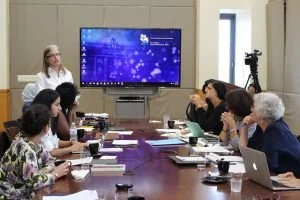
On September 7 and 8 2018, CSSD working group Religion and the Global Reframing of Gender Violence (RGFGV) convened the Global Governance of the Intimate conference, a major international workshop. This conference was the second in a series of international workshops that opened with workshop in Amman a year earlier, hosted at the Columbia Global Center | Middle East, Amman.
Participants and organizers who had presented at the Amman workshop opened the first session with an overview of how the three conceptual domains that had organized the earlier work of the project intersected with the new scholarship being presented.
Click here to read the full conference report.
Video from the conference is available here.
The RGFGV project seeks to track and analyze the growing prominence of the global agenda against “violence against women” (VAW) and “gender-based violence” (GBV), whether in international law and global governance, practical interventions, or international media coverage.
The RGFGV project is supported by a grant from the Henry Luce Foundation and is co-directed by Lila Abu-Lughod, Rema Hammami, Janet Jakobsen and Nadera Shalhoub-Kevorkian.
RGFGV Conference Report on “Global Governance of the Intimate”
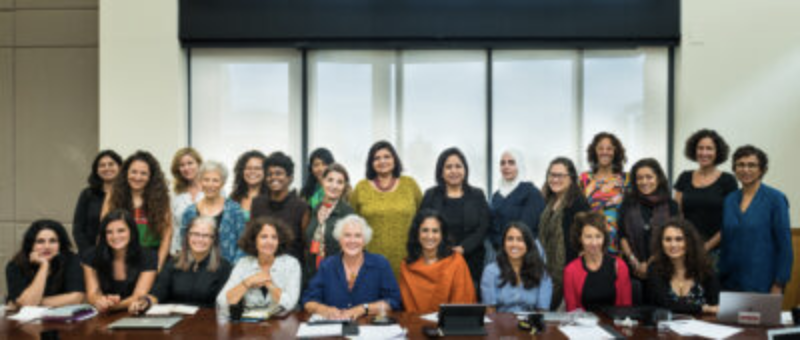
The project on Religion and the Global Reframing of Gender Violence (RGFGV) convened a major international workshop on September 7-8, 2018. Global Governance of the Intimate was the second in a series of international workshops that opened with workshop in Amman a year earlier, hosted at the Columbia Global Center | Middle East, Amman. A group of twenty-five scholars, journalists, lawyers and activists met for two intensive days of collaborative research sharing and brainstorming at Columbia University in New York City.
The RGFGV project seeks to track and analyze the growing prominence of the global agenda against “violence against women” (VAW) and “gender-based violence” (GBV), whether in international law and global governance, practical interventions, or international media coverage. Participants and organizers who had presented at the Amman workshop opened the first session with an overview of how the three conceptual domains that had organized the earlier work of the project intersected with the new scholarship being presented. The key themes were: Narratives and the Framing of VAW/GBV, Alternative Trajectories and Experiences, and Governance and Resource Distribution.
Urgent questions that had emerged under the theme of Narratives and Framing of VAW/GBV had included the following: How do certain aspects of social life become labeled VAW or GBV? What actors or phenomena get highlighted under these rubrics, and which disappear? Do these narratives racialize religion or culture? Leti Volpp had examined how the insertion of “honor killings” in both versions of the U.S. Executive Orders now referred to as the “Muslim travel ban” worked to frame VAW/GBV in terms of religious difference and has implicated GBV in national governance. Sara Ababneh’s presentation at the New York workshop expanded this discussion by analyzing how intimate violence was portrayed differently in Jordan and the U.S..
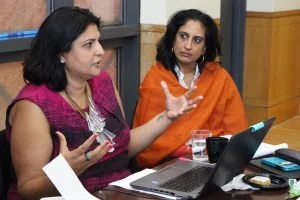
Although co-director Nadera Shalhoub-Kevorkian was unable to attend the NYC workshop, Rema Hammami gave some background on her previous contribution on the everydayness of state violence as experienced by Palestinian school girls in occupied East Jerusalem. She had shown how the dominant frames of GBV are unable to recognize either the gendered violence of colonial rule or the sexualization of everyday surveillance. Nadje Al-Ali’s work picked up on these questions of how to analyze gender based violence in the Middle East, exploring dilemmas and tensions she has faced as a feminist scholar and activist researching VAW/GBV, whether in her previous work in Iraq or her new work on the Kurdish women’s movement and queer feminist activism in Lebanon.
Shahla Talabi, whose earlier contribution to the Amman workshop had been a sensitive analysis of the specific inflections of rape narratives in the cases of three former Iranian women political prisoners discussed Zahra Ali’s presentation on feminist mobilization in Iraq. In the current Iraqi context, she showed how Islam is used by both religious and secular forces to undermine feminist demands.
The kinds of questions posed under the theme of Governance and Resource Distribution related to how the anti-VAW/GBV agendas have been implicated in practices of governance and governmentality and in particular the networks through which GBV/VAW have emerged as key to global, national and local agendas. Hammami summarized the paper she had presented in Amman on the distributional effects of the global GBV agenda. She had studied “humanitarian GBV” in Gaza, detailing the ways that local women’s NGOs, starved for resources, get both channeled to narrow and redefine their work and yet attempt to contest the logics of the humanitarian apparatus through everyday means of offering basic support to women. Hammami was well-positioned to comment on Aditi Suri von Czechowski’s study of the language of care and the pedagogy of human rights in the Nyarugusu Congolese refugee camp in Tanzania. Based on extensive ethnographic research in the camp, she showed how the GBV apparatus and the framework of humanitarian care seek to push responsibility for their predicaments onto refugee women themselves through insisting that they repudiate “harmful traditional practices,” as they acquire knowledge about human rights and consciousness about the definitions of domestic violence.
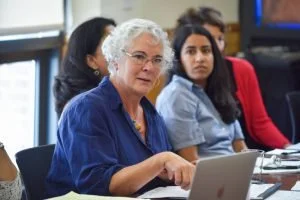
In her overview of the previous workshop in Amman, Lila Abu-Lughod described her own contribution on the latest phase of a politicized process of blaming religion for violence. She had examined the puzzling embrace by women’s rights advocates of initiatives on Countering Violent Extremism (CVE). The ways these initiatives link violence with Islam and Muslims was further elaborated in this workshop by Vasuki Nesiah, whose paper explored the convergence of a number of governance projects – countering violent extremism, international conflict feminism focused on VAW/GBV, and international criminal law – in the then ongoing International Criminal Court case of Al Hassan Mohamed of Mali.
Five themes structured the NYC workshop panels: (1) Narratives and Framing of VAW/GBV, (2) Feminist Dilemmas in Framing GBV, (3) Challenges of Media, (4) Governance and Activism, and (5) Dilemmas of GBV activism on the Ground. The work presented was based on research in and on a range of countries in the Middle East and South Asia, including Pakistan, Iraq, Jordan, India, Tanzania, Syria and Mali. As at the previous workshop, a crucial thread that ran through the work presented at the Global Governance of the Intimate: the politicized link being made between religious extremism, political Islam and GBV, a connection exploited in the U.S. “Muslim Ban” that singled out so-called “honor killings,” as Volpp had argued. Important questions were raised in this workshop: Is violence more legible when religion is present? What mobilizes feminists to do something about it? How do we understand the ways that religion may be linked to personal violence while taking seriously the sociopolitical and historical contexts? Is only the violence of individuals who can be associated with groups and nations to which the U.S. is hostile be considered responsible for gender based violence? Since refugee women must frame their experiences with sexual violence in terms that meet requirements for asylum and care, how are their experiences reshaped to align with the hegemonic rhetoric shared by international media and humanitarian organizations?
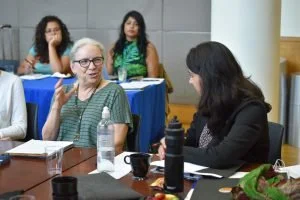
Given the key role of religion in these narratives that frame GBV in the South Asian and Middle Eastern contexts in which the participants work, Janet Jakobsen’s contributions as a scholar of religion was especially useful to the discussion as it laid a framework for understanding how to better think about religion, and to be critical of the ways religion and terrorism have become co-constituted categories as part of a complex network of political relations. The goal, Jakobsen argued, is not to remove religion when we talk about violence but how to think differently about the ways in which religion comes to interact with GBV.
The challenges posed by various forms of media and visual representations of violence by and against Muslims loomed large for the journalists, activists, and scholars participating in the workshop. Ababneh analyzed media portrayals of honor killings in American media outlets. She argued, as did Urooj Arshad, an activist and director of International LGBTQ Youth Health and Rights Programs at Advocates for Youth, that discourse on intimate partner violence and violence against LGBTQs in the U.S. are constructed as non-cultural, unmotivated by Christianity, and unrelated to the motivations attributed to “honor killings.” These contrasting constructions reflect the hypocrisies of Orientalist discourses. As the columnist Rafia Zakaria concurred, negative behaviors of racialized actors are blamed on culture and religion.
Nina Berman, an award-winning photo-journalist at Columbia’s School of Journalism gave remarkable evidence of this through her presentation on representations of gender-based violence and conflict rape by major U.S. and European magazines, focusing particularly on depictions of the sexual violence of Boko Haram. Berman examined the media layouts used in visualizing conflict rape and noted the double standards that regulate the work of white reporters who venture abroad to document the experiences of non-white rape survivors for American/European audiences versus those who document domestic stories of rape. Understatement and anonymity are the standards now. What are the implications of this type of reporting that highlights brown and black perpetrators and elides sexual violence in U.S. contexts?
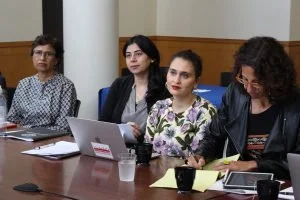
Media representations were also the focus of two of the papers on South Asia. Shenila Khoja-Moolji traced media representation of the murdered Pakistani social media celebrity Qandeel, known for her sexually provocative videos. Inderpal Grewal looked to media to interrogate the historical and contemporary consumption of “communal violence” by consumer citizens and the affects associated with “lynchings” of Muslim men.
Samira Shackle, one of the three Media Fellows selected for the second phase of the RGFGV project, presented the list of “how to report on GBV” that she had developed from Hammami’s suggestions at the previous workshop in Amman. One goal of reporting is to let women tell their stories on their own terms, yet the stories they tell must be critically analyzed insofar as women learn how to frame their experiences with gender based or sexual violence to meet requirements for asylum or appeal for aid and care. This mediation of stories was clear from Rupal Oza’s study of rape accusations and cases in the police stations and courts of rural Haryana. Accused of false rape claims, individual women’s helplessness and their accusers’ class status were crucial to the outcomes. Maryam Saleh, The Intercept reporter echoed Shackle’s warnings on how to report on GBV, taking issue with the ways journalists have represented the conflict in Syria and offered stories of Syrian refugee women without historical and political contexts.
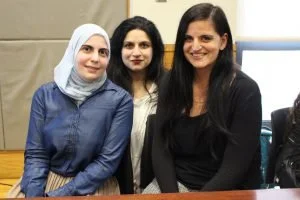
Confronting Orientalist assumptions about the relationship between religion, culture, and violence, those involved in the Global Governance of the Intimate addressed through regional case studies the way the neoliberal human rights framework and the hegemonic discourse about culture and religion as sources of women’s oppression distract attention from forms of systemic violence, whether geopolitical or economic that should be viewed as part of GBV or VAW. The participants outlined the need for feminists to challenge the premises of CVE and a-historical media coverage of GBV as well as to interrogate the apparatuses of transnational governance that construct certain issues—such as “child marriage” in Bangladesh--as urgent problems while ignoring other sources of violence and suffering in the often deadly situations in which people are living gendered lives around the globe. Engaging with the assumptions and policies that have underwritten the unprecedented public concern about VAW/GBV, the scholars, activists, lawyers and journalists brought their perspectives to the unfolding dynamics of these agendas within international governance, local communities, humanitarian aid, and legal activism in varied sites in the Middle East and South Asia, including among immigrants in the U.S. Shagufta Shah from the Arab-American Family Support Center and Urooj Arshad working on LGBTQ rights and violence in the U.S. faced challenges similar to those that confront critical journalists and feminist scholars when they attempt to address fraught issues of gender and violence in Muslim-majority and minority countries.
The contributions and discussions underlined how the well-worn frames of Islamic violence, culture, and patriarchy remain central in the production of a variety of problematic projects directly or indirectly tied to the global anti-gender violence agenda. The participants were struck by the variety of projects operating at different levels and across different domains (national, geopolitical, local, legal, popular cultural, developmental, and humanitarian) that bring together gender, violence, and Islam together in often unexpected ways. The comparative analyses of South Asia and the Middle East were illuminating: in many cases there are strong parallels, while in others, historical and political context worked to produce much more specific configurations of the broader issues
The next step for the project is the preparation of an edited volume that will bring together papers prepared for this and past workshops. The book will include the rich and varied treatments of the central themes that have emerged for the project across contexts in the two regions or at a broader level concerning Muslims. Some focus on the larger geopolitical projects—including new iterations or emergent configurations of the war on terror. Others address the GBV agenda as part of the emerging arsenal within the politics of populist nationalism. A number address the themes within the context of developmental or humanitarian governmentalities and in relation to NGOs and local activisms. Yet others use detailed analysis of local sites and located experiences of violence in order to challenge or confound the assumptions of the dominant frames of feminist concerns with violence. The collection will offer new thinking that will provide resources for challenging this powerful and often destructive truth regime.
The RGFGV project is supported by a grant from the Henry Luce Foundation and is co-directed by Lila Abu-Lughod, Rema Hammami, Janet Jakobsen and Nadera Shalhoub-Kevorkian.
Prepared by Laela Shallal and Lila Abu-Lughod
Menstrual Health Working Group Publishes Report on Developments at the UN
Working group director Inga Winkler and working group fellow Sydney Amoakah co-authored a recent piece in Impakter on how menstruation has been spotlighted at the UN in the last year and where we can go from here.
CSSD working group Menstrual Health and Gender Justice has published a report in Impakter highlighting the work the UN has done related to menstruation in the past year and what more is left to do. The publication was co-authored by Menstrual Health working group director and Lecturer in Human Rights at Columbia University, Inga Winkler, and Sydney Amoakoh, Human Rights MA candidate and working group fellow.
In the article they address the key role governments play in advancing the discussion around menstrual health, noting that they are are uniquely positioned to normalize discussions on menstruation in the international community and amongst their own populations. The need for continued collaboration between different groups and sectors was also highlighted.
Read the full report here.
For more from the Menstrual Health and Gender Justice working group visit their blog.