
Co-Director of the Black Atlantic Ecologies Working Group Interviewed by Wave Hill
Professor Jones spoke with Tiffany Jaeyeon Shin and Eileen Jeng Lynch and was part of an online Q&A event.
Vanessa Agard Jones, co-director of Black Atlantic Ecologies, spoke with Tiffany Jaeyeon Shin and Eileen Jeng Lynch at Wave Hill about a variety of topics including queer ecologies, fugitivity, toxicity, and decoloniality. Professor Jones reflected on Tiffany Jaeyeon Shin’s Sunroom Project Space exhibition M for Membrane, which explores the membrane, mystery, and magic of microbial forms, fungi, and indigenous mold.
Co-Director of Geographies of Injustice to Speak at Institute of Latin American Studies Online Event
Ana Paulina Lee is moderating “Liberating the Sacred: Afro-Brazilian Religions, Cultural Heritage, and the Law” on November 5th.
Professor Ana Paulina Lee, co-director of the Geographies of Injustice: Gender and the City working group, will be moderating a conversation with Nilce Naira Nascimento and Sergio Suiama on November 5 from 1:00 PM - 2:00 PM. Liberating the Sacred: Afro-Brazilian Religions, Cultural Heritage, and the Law is hosted by the Institute of Latin American Studies at Columbia University. Between 1889-1945, over 500 sacred objects were confiscated from Candomblé and Umbanda temples in Rio de Janeiro. For more than a century, the sacred objects were held at the building that once served as headquarters to the Department of Political and Social Order (DOPS), once the center for police administration, a prison, and a torture site, and now the headquarters for the Civil Police. In September 2020, after decades of struggle, the objects were transferred to the Museum of the Republic. This conversation revisits the history to liberate the sacred objects. Participants will discuss plans for the future of these sacred objects and address issues related to cultural belonging, law, appropriation, and heritage.
Unpayable Debt Working Group Co-director Profiled by Feminist Films in the Classroom
The journal’s dossier focuses on Professor Frances Negrón-Muntaner's teaching and research told largely through the words of several generations of former students.
The Feminist Films in the Classroom’s piece, We Learn Together: A Conversation about Feminist Film Pedagogy with Frances Negrón-Muntaner and Elisabetta Diorio, is a biographical interview about Professor Frances Negrón-Muntaner's life, teachings, and films. Professor Negrón-Muntaner, CSSD Executive Committee member and co-director of the Unpayable Debt working group, talks about some of her films such as AIDS in the Barrio (1989) and Brincando el Charco (1994). The piece also includes interviews with former students who have followed in her footsteps and relfect the impact of Professor Negrón-Muntaner’s work.
Transnational Black Feminisms Co-Director Featured in New Documentary
Premilla Nadasen was interviewed along with the late Supreme Court Justice Ruth Bader Ginsburg about the history of women’s rights and suffrage in the United States of America.
Premilla Nadasen, co-director of the Transnational Black Feminisms working group, was interviewed along with the late Supreme Court Justice Ruth Bader Ginsburg about the history of women’s rights and suffrage in the United States of America. The Nineteenth Amendment: A Woman’s Right to Vote was produced by the Annenberg Public Policy Center. The film is about women’s long, difficult struggle to win the right to vote. It’s about citizenship, the power of the vote, and why women had to change the Constitution with the 19th Amendment to get the vote.
Co-Director of the Queer Aqui Working Group interview by BBC Worldwide
Jack Halberstam spoke with BBC about the groundbreaking Hite Report, after the death of its author, Shere Hite.
The co-director of the Queer Aqui working group, Jack Halberstam, spoke with BBC Worldwide about the groundbreaking Hite Report, after the death of its author, Shere Hite. Shere Hite was a prominent feminist whose famous book, “The Hite Report: Nationwide Study of Female Sexuality" gave scientific credibility to the claims that women, especially white heterosexual women, were making about deep dissatisfaction with their domestic lives and heterosexual marriage. The book led to many discussions about the unequal relationship between women and men with regard to pleasure in a heteronormative dynamic and was an important part of the sexual revolution of the 1960s.
Former Co-Director of Pacific Climate Circuits Interviewed by El Fénix
Professor Kevin Fellezs discussed recent protests against police brutality and the Black Lives Matter movement in the United States.
Professor Kevin Fellez, director of Studies on the Diaspora of Afro-Americans and Africans at Columbia University and co-director of former Center for the Study of Social Difference workin group, Pacific Climate Circuits , spoke with the Chilean newspaper, El Fénix in a piece titled, "I Can't Breathe": Accounts of Anti-racist Protests in the United States about systemic racism, police brutality, and the mainstream rhetoric that is used to justify police brutality.
Environmental Justice Working Group Co-Director Quoted in the Financial Times
Professor Vicky Murrillo discussed recent developments in Argentinian politics.
Victoria Murrillo, Environmental Justice working group co-director, was quoted in the Financial Times article, Argentina’s political double act moves on to the next challenge by Benedict Mander. The article was discussed Argentina’s President Alberto Fernández and current Vice President/ Former President Cristina Fernández de Kirchner and their struggle to manage the Argentine debt, recession, inflation and negotiations with the IMF.
Director of The Future of Disability Studies, Working Group Discusses Teaching in the Age of COVID
The Columbia News interviews Professor Rachel Adams about the relevance of her course, “Comics, Health, and Embodiment”.
Former director of the Future of Disability Studies, and the Precision Medicine: Ethics Politics and Culture working groups, Rachel Adams discusses her course “Comics, Health, and Embodiment” and its new relevance in the age of COVID, with Columbia News. The class looks at graphic narratives with a focus on embodied identities such as gender, sexuality, race, and age with recent additions of more comics by people of color in response to the BLM movement and graphic narratives that deal with experiences of health, illness, and disability in light of the current pandemic.
Queer Aqui Working Group Fellow was interviewed by major News Outlets About Recent Changes to the Supreme Court
Professor of Law, Gender and Sexuality Studies Katherine Franke discussed the implications of Justice Ruth Bader Ginsburg’s death.
Queer Aqui working group fellow and Professor of Law, Gender and Sexuality, Studies Katherine Franke has been interviewed widely about the U.S. Supreme Court, the tragic death of Justice Ruth Bader Ginsburg, and the nomination of Judge Amy Coney Barret. Professor Franke has appeared in pieces for PIX 11, CNBC, Bloomberg, The New Republic, the Christian Science Monitor, and the AP.
Motherhood and Technology Co-Director Interviewed by the Consortium of Humanities Centers and Institutes
Rishi Goyal discussed his experience working in emergency medicine during the pandemic and about critical initiatives that the humanities bring to creating better healthcare.
In a piece titled, Humanities in the Emergency Room, Rishi Goyal, Columbia University Medical Center emergency department physician and co-director of the Motherhood and Technology working group, was interviewed by Jason Rozumalski of the Consortium of Humanities Centers and Institutes (CHCI) about the importance of humanities in medical science and an interdisciplinary approach to health.
Reframing Gendered Violence Working Group Fellow Published in Griffith Asia Insights
Dr. Fiona Hukula wrote an article on gender-based violence in Papua New Guinea.
In the article, Dr. Fiona Hukula, Reframing Gendered Violence working group fellow, writes about the extremely high levels of violence against women in Papua New Guinea, the normalization of domestic violence, and the recent protests against gender-based violence. Dr. Hukula also highlights some potential solutions which could reduce gender-based violence in Papua New Guinea.
Women Mobilizing Memory Working Group Co-Director Reviewed by the Los Angeles Review of Books
Marianne Hirsch's latest book, School Photos in Liquid Time: Reframing Difference, co-authored with Leo Spitzer, was reviewed in a piece titled, “The Institutional Gaze of the School.”
Marianne Hirsch, former director of the Center for the Study of Social Difference and Women Mobilizing Memory working group co-director, had her book, School Photos in Liquid Time: Reframing Difference, reviewed in a piece titled, “The Institutional Gaze of the School” by the LA Review of Books. The book explores the history of school photos and their role within the ideological state apparatuses of hegemonic socio-political systems. School Photos in Liquid Time, co-authored by Leo Spitzer, offers a closer look at this genre of vernacular photography, tracing how photography advances ideologies of social assimilation as well as those of hierarchy and exclusion.
On the Frontlines: Nursing Leadership in Pandemics Co-Director Recieves 2020 Nurses with Global Impact Award
Due to COVID-19 restrictions, Dohrn’s award will be honored at the International Nurses Day celebration in May 2021.
Jennifer Dohrn, co-director for the CSSD Working Group On the Frontlines: Nursing Leadership in Pandemics, was awarded the 2020 Nurses with Global Impact Award by Nursing with Global Impact, Inc. The award “recognizes and honors nurses in front line roles who demonstrate exemplary practice by impacting the global delivery of healthcare, celebrating their work and supporting their programs.”
To learn more, read here.
To learn about Dohrn’s work with the CSSD working group, read here.
Motherhood and Technology Co-Director Pens Piece for Columbia News
Arden Hegele’s article, What We Can Learn from the Literature of Past Pandemics, discusses how fiction can help frame our responses to the pandemic and serve as a guide for what happens next.
Arden Hegele, co-director of the CSSD Motherhood and Technology working group, in her article, What We Can Learn from the Literature of Past Pandemics pulls lessons from classics such as Oedipus Rex, The Iliad, Daniel Defoe’s The Journal of the Plague Year, and Edgar Allan Poe’s The Masque of the Red Death to help us better understand the COVID-19 epidemic.
Updates from the Religion and the Global Reframing of Gender Violence Working Group
Working group fellows have been busy writing critical work on the politics of gendered violence in fields ranging from Anthropology to Law and Public Policy.
Fellows from the working group on Religion and the Global Framing of Gender Violence have been busy writing critical work on the politics of gendered violence in fields ranging from Anthropology to Law and Public Policy. Although we have not been meeting in person, we wanted to keep the conversations going by sharing some of the Fellows’ recent scholarship and news.
Working Group Fellows
Lila Abu-Lughod, Joseph L. Buttenweiser Professor of Social Science in the Department of Anthropology and IRWGS, Columbia University, and RGFGV Project Co-Director, delivered the 2019 Inaugural Anthropology Lecture at the University of Leuven. Titled “The Courage of Truth: Making Anthropology Matter,” Professor Abu-Lughod explores Foucault’s call for the “courage of truth” to reflect on her recent work as a form of engaged anthropology, focusing on her work on gender violence and security and on the settler colonial paradigm in Palestinian studies. In 2019-20, Professor Abu-Lughod also delivered three lectures based on her work for the RGFGV project: the 21st Annual B.N. Ganguli Memorial Lecture at the Center for Developing Developing Societies in Delhi, India, titled “Gender, Violence, Security, Circuits of Power and the Muslim Question,” “Security and the Political Geographies of Gender Violence” in the NYU Liberal Studies Global Lecture Series, and a lecture at Amherst College.
Nadje Al-Ali, Robert Family Professor of International Studies and Professor of Anthropology and Middle East Studies at Brown University, co-edited a volume on Gender, Governance and Islam, to which she also contributed a chapter titled “Iraq: Gendering violence, sectarianisms and authoritarianism.” The Center for the Study of Social Difference co-sponsored the book launch, facilitated by Lila Abu-Lughod, with the editors of the volume. An interview with Deniz Kandiyoti, co-editor of Gender, Governance and Islam, can be found at Borderlines. Professor Al-Ali also published an article in Feminist Review on the challenges of discussing gender-based violence in relation to the Middle East, based on the paper she workshoped at our RGFGV confrence in New York. She co-wrote a chapter in Queer Asia (eds. Jonathan Daniel Luther and Jennifer Ung Loh) titled “Feminist and Queer Perspectives on West Asia.”
In 2019, Zahra Ali, Assistant Professor of Sociology at Rutgers, Newark, published an article for Contemporary Islam titled “Being a young British Iraqi Shii in London: exploring diasporic cultural and religious identities between Britain and Iraq.” Using ethnographic research conducted in London, Baghdad, and Najaf-Kufa, Professor Ali analyzes young British Iraqi Shiis experiences of belonging in relation to religious and cultural identities.
Qudsiya Contractor, Junior Fellow at the Max Weber Center for Advanced Cultural and Social Studies, contributed a chapter to Gender, Caste, and the Imagination of Equality, edited by Anupama Rao, titled “Muslim women, caste and the beef ban in Mumbai.” For Economic and Political Weekly, Dr. Contractor critiques recent Indian Supreme Court rulings on religious freedoms and women’s rights. She expanded on this work with an article for The Wire on the criminalization of the triple talaq, which examines the tensions between religious rights and Indian Supreme Court judgements in the pursuit of protecting women.
Janet Halley, Royall Professor of Law at Harvard Law School, co-edited Governance Feminism: Notes from the Field, and co-authored a chapter with Libby Adler titled “‘You Play, You Pay:’ Feminists and Child Support Enforcement in the United States.” Professor Halley was interviewed by the New York Times about the Trump administration rules on sexual misconduct on college campuses.
Rema Hammami, Associate Professor of Anthropology at the Institute of Women’s Studies of Birzeit University and RGFGV Project Co-Director, contributed an article to Current Anthropology titled “Destabilizing Mastery and the Machine: Palestinian Agency and Gendered Embodiment at Israeli Military Checkpoints.” She also had a chapter in Janet Halley et. al.’s Governance Feminism: Notes from the Field (2019) entitled “Follow the Numbers: Global Governmentality and the Violence Against Women Agenda in Occupied Palestine.”
Shenila Khoja-Moolji, Assistant Professor of Gender, Sexuality, and Women’s Studies at Bowdoin College, published two articles. “Death by Benevolence: Third World Girl and the Contemporary Politics of Humanitarianism” in Feminist Theory, which examines the production of the “third world girl” through menstrual health and female genital mutilation campaigns. In “Re-animating Muslim women’s auto/biographical writings: Hayat-e-Ashraf as a palimpsest of educated selves,” published in Third World Thematics, Professor Khoja-Moolji resists dominant tropes of the 19th century Indian Muslim woman as silent and uneducated by re-purposing Muslim women’s auto/biographical writings from this time.
Vasuki Nesiah, legal scholar and Associate Professor of Practice at NYU Gallatin, contributed a chapter to Janet Halley et al’s edited volume of Governance Feminism: Notes from the Field titled “Indebted: The Cruel Optimism of Leaning-In to Empowerment.” Professor Nesiah and Dina Siddiqi, RGFGV Fellow, were both panelists for the NYU Border Talks series that explored conceptual approaches to borders and mobility.
Rupal Oza, Associate Professor in the Department for Women and Gender Studies at Hunter College, CUNY, who presented at our RGFGV workshop in New York in October 2018 on her study of the increase in “false rape cases” with the National Crime Records Bureau in India, is published this as an article, “Sexual Subjectivity in Rape Narratives: Consent, Credibility, and Coercion in Rural Haryana” forthcoming in the Autumn 2020 issue of Signs: Journal of Women in Culture and Society.
Sima Shakhsari, RGFGV Fellow and Assistant Professor of Women, Gender, and Sexuality Studies at the University of Minnesota, published a book in January 2020 called The Politics of Rightful Killing: Civil Society, Gender, and Sexuality in Weblogistan. The book investigates the online and off-line network of Iranian blogs, known as Weblogistan, and analyzes the politics of civil resistance, the internet as an imperial democratization project, and hegemonic impositions of gendered, sexed, and racial subjectivities. An interview with Professor Shakhsari, as well as an excerpt from their book, can be found on Jadaliyya.
Nadera Shalhoub-Kevorkian, RGFGV project co-director and Lawrence D. Biele Chair in Law at the Faculty of Law-Institute of Criminology and the School of Social Work and Public Welfare, Hebrew University of Jerusalem and the Chair in Global Law at Queen Mary University of London, published a book, Incarcerated Childhood and the Politics of Unchilding in 2019. Professor Shalhoub-Kevorkian’s award-winning book utilizes archival, historical, and ethnographic material to examine the governance of childhood under military occupation and violations of children’s rights in Palestine. More recently, Professor Shalhoub-Kervorkian also published “Gun to Body: Mental health against unchilding” in the International Journal of Applied Psychoanalytic Studies.
Dina Siddiqi, Clinical Associate Professor at NYU in Liberal Studies, penned an article for The Daily Star on labor organizing in the Bangladesh garment industry, and the historic tensions between trade unions and national interests. Along with RGFGV Fellow Vasuki Nesiah, Professor Siddiqi was a panelist for the NYU Border Talks series that explored conceptual approaches to borders and mobility. Professor Siddiqi was also interviewed in the Huffington Post about the Shaheen Bagh protests in opposition to the Citizenship Amendment Act in India.
Aditi Surie von Czechowski, Junior Research Fellow at Churchill College, University of Cambridge, wrote an article for Cultural Anthropology called “Together in the Flesh.” Dr. Surie von Czechowski draws on her fieldwork in the Nyarugusu refugee camp in Tanzania to explore laughter as an embodied practice that “engenders togetherness in the flesh.”
Shahla Talebi, Associate Professor of Religious Studies at Arizona State University, published an article in PoLAR: Political and Legal Anthropology Review. In “Ethnography of Witnessing and Ethnography as Witnessing: Topographies of Two Court Hearings,” Professor Talebi draws on ethnographic and archival research to examine two hearings in Iranian courts involving the persecution of Iranian dissidents in the 1980s.
Leti Volpp, Robert D. and Leslie Kay Raven Professor of Law in Access to Justice, and Faculty Director of the Center for Race and Gender at the University of California Berkeley,published “Protecting the Nation from ‘Honor Killings:’ the Construction of a Problem” for Constitutional Commentary.
Dubravka Zarkov, Associate Researcher at the Radboud University Nijmegen and co-editor of the European Journal of Women’s Studies recently wrote an editorial titled, “On economy, health, and politics of the COVID-19 Pandemic” for the upcoming issue of the European Journal of Women’s Studies. Professor Zarkov also published an editorial on contemporary dissonance within global feminist movements, and an editorial on reading contemporary news stories as fairy tales, utopias, or critical dystopias.
Media Fellows
In 2018 and 2019, recipients of the CSSD media fellowship were supported to travel to the Middle East or South Asia to research stories that could reframe perspectives on the relationships between gender-based violence and religion. Since then, the fellows have published a range of editorials and articles.
Yasmin El-Rifae, an editor at Mada Masr and co-producer of the Palestine Festival of Literature, published a piece on the high rates of cesarean section births in Egypt. This article looks into the political and economic factors within the healthcare industry that contribute to the rise of c-sections, and uses personal testimony of women presented with the choice of a cesarean section.
Rafia Zakaria, author of Against White Feminism (2017) and The Upstairs Wife: An Intimate History of Pakistan (2015), wrote an analysis for Adi Magazine on the ways in which American anti-FGM (female genital mutilation) campaigns are harnessed to justify the legal exclusion of Black and brown people through ICE operations and executive orders. She wrote a New York Times book review of Hossein Kamaly’s new book, A History of Islam in 21 Women, as well as an article for The Nation on the dangers of “stay-at-home” orders for survivors of domestic violence.
Samira Shackle published an article in Elle UK detailing harassment and blackmail faced by Pakistani women online. The article outlines the limitations to global privacy standards on social media platforms, and the consequences that women may experience for reporting cybercrimes.
Maryam Saleh, a reporter with The Intercept, penned an article on the ways in which war and displacement have cultivated new circumstances for Syrian women to address patriarchy and sexual violence in innovative ways. On Their Own Terms investigates the onset of humanitarian programs that arose as a result of Syria’s ongoing conflict, and the ways in which they fulfill, or brush up against, the demands of Syrian women who are pushing for deeper political change.
Mona Sinha to be Featured Speaker in Democratic National Convention Virtual Event
This event will take place August 18th from 4PM to 6PM EST.
Mona Sinha, member of the Women Creating Change Leadership Council (WCCLC), was elected as the Board Chair of the ERA Fund for Women’s Equality. Mona will be a featured speaker in Electing Equality: The Final Push for the Equal Rights Amendment, a virtual event of the Democratic National Convention sponsored by the ERA Coalition and the Feminist Majority.
To register and learn more about this event celebrating Women’s Suffrage and the ERA, click here.
Unpayable Debt Co-Director Featured in The Takeaway Podcast
Frances Negron Muntaner discusses the “The Push for More Latino Representation.”
Frances Negron Muntaner, former co-director of the Center for the Study of Social Difference (CSSD) Unpayable Debt working group and current CSSD Executive Committee Member, is featured in The Takeaway Podcast. In this episode, Frances joins other Latinx journalists in a discussion on the efforts to diversify the newsroom and the open letter sent to the Lost Angeles Time leadership by their Latinx journalists.
To listen to this episode, click here.
To learn more about the work of the Unpayable Debt Working Group, read here.
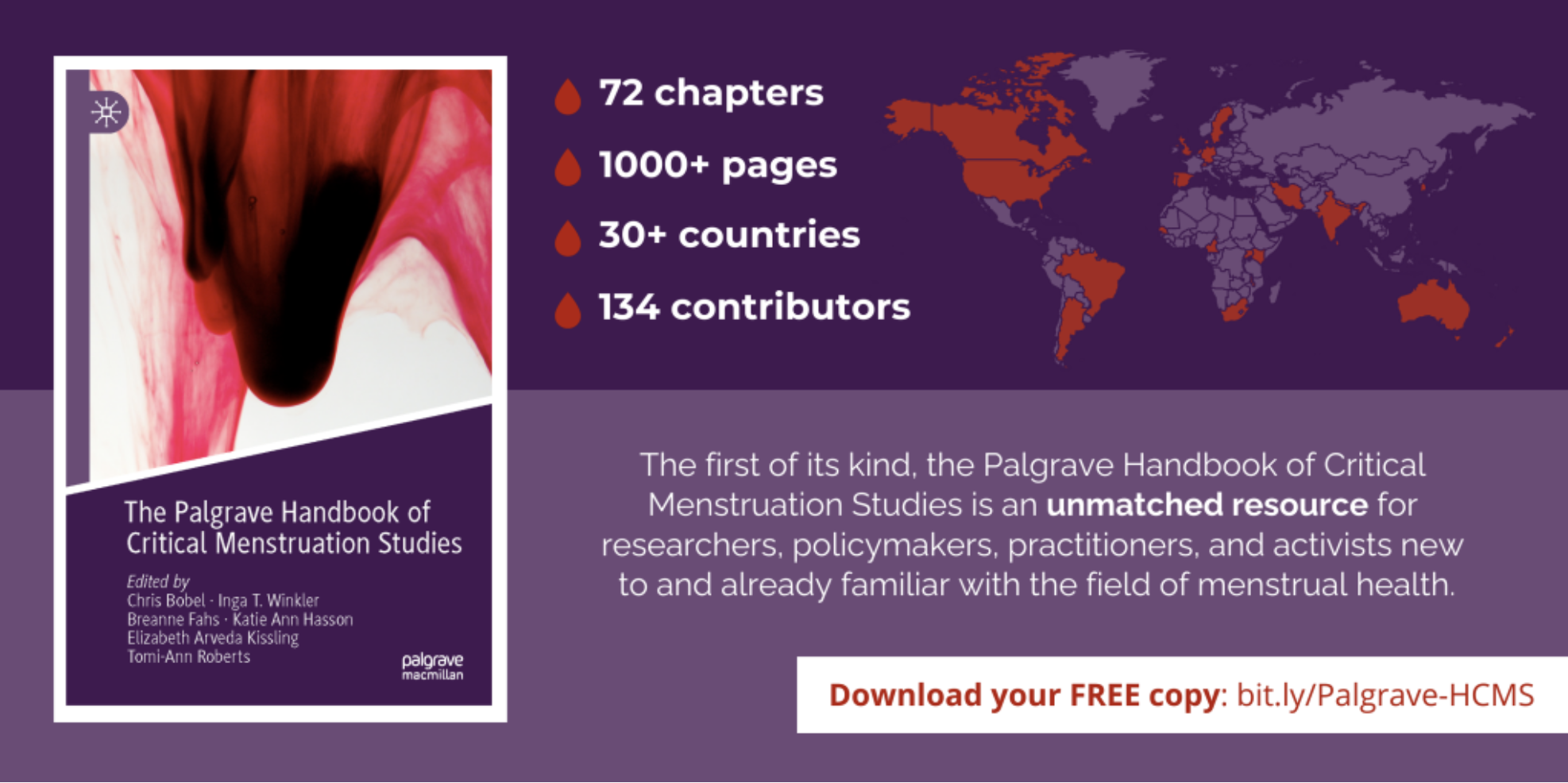
Introducing The Palgrave Handbook of Critical Menstruation Studies
It has been said so often it is now cliché—“menstruation is having its moment!” But what is this moment actually about? What are we talking about when we talk about menstruation?
The Palgrave Handbook of Critical Menstruation Studies invites the reader to explore menstruation from nearly every possible angle, including dimensions that you might not yet have considered: the historical, political, embodied, cultural, religious, social, health, economic, artistic, literary and many more. With 72 chapters on more than 1000 pages, the Handbook--the first of its kind--establishes Critical Menstruation Studies as a rich field of research.
The editors, Chris Bobel, Inga Winkler, Breanne Fahs, Katie Ann Hasson, Elizabeth Arveda Kissling, and Tomi-Ann Roberts together bring almost a century of expertise in studying menstruation. Over the last three years, they have sought out 134 contributors in more than 30 countries to address a wide range of menstrual matters in the Handbook.
DEFINING FEATURES:
Timely & Critical Scholarship: The time for this Handbook is now, at a moment when menstrual health moves from margin to center as a subject of urgent concern and enthusiastic exploration. The Handbook fills a crucial gap. It exposes myths, fallacies, and false claims. And while it advances the knowledge of the field, it acknowledges that there is a lot we don’t know yet. It is the critical companion for anyone interested in menstruation.
Deliberate Diversity: The coherence of the Handbook lies in its deliberate diversity—in content, experiences, formats, and authors representing diverse forms of knowledge and expertise. From traditional research chapters to policy and practice notes, menstrual art, personal narratives, and "Transnational Engagements" across cultures and countries, the Handbook seeks to engage a wide range of readers.
Menstruation as a Lens for Gender Justice: The Handbook establishes Critical Menstruation Studies as a robust and multifaceted category of analysis and a potent lens that reveals, complicates and unpacks inequalities across social, cultural, embodied, and historical dimensions. Through the Handbook we aim to demonstrate the richness of Critical Menstruation Studies, a field that is finally coming into its own.
Across this diverse content, the varied questions asked and answered address menstrual health over the life course from menarche to menopause:
Do you want to understand how menstrual stigma prompts us to conceal any sign of menstruation? Are you curious how stigma limits the understanding of menstruation of young people around the world and can lead to delays in reproductive health diagnosis and care?
Do you want to learn about efforts to improve menstrual education, including for men and boys, through films, apps, and other innovative means?
Have you thought about how culture shapes the experience of menstruation and how menstruators engage with religious practices in diverse ways?
Do you want to read about the first-hand experiences of trans and non-binary persons, menstruators with disabilities, menstruators with autism, migrants and refugees, girls forced into early marriage, or Dalits?
Are you curious about menstrual advocacy efforts--past and present--, the pushback activists face, and their successes, including efforts to include menstruation in national policy, in the UN Sustainable Development Goals, and in the context of human rights?
Are you among the millions of users of menstrual tracking apps and want to learn more about the role of technology, social entrepreneurs, and menstrual advertising in shaping our understanding of menstruation?
Do you want to see how menstruation is represented on Twitter, on YouTube, on TV, in films, and in visual art?
Are you interested in the unique challenges menstruators face in diverse settings such as prisons or jails, humanitarian crises and refugee camps, informal settlements, and conditions of homelessness?
The Handbook addresses all these questions and many more. But it doesn’t seek to provide definitive answers. Whether contributors address religious rituals, menstrual leave, or menstrual sex, they defy easy answers and avoid monolithic views. The Handbook invites the reader into the conversation by considering different perspectives and engaging with apparent contradictions and tensions. It aims to stimulate dialogue and further inquiry and to leverage that knowledge to effect meaningful change.
Contributed by the Menstrual Health and Gender Justice workin group
Menstrual Health Working Group Fellow Awarded for New Book
Chris Bobel has won the Sociology of Development Outstanding Book Award for The Managed Body: Developing Girls & Menstrual Health.
Chris Bobel, Associate Professor of Women’s, Gender & Sexuality Studies at the University of Massachusetts Boston and Menstrual Health and Gender Justice working group fellow, has received the Sociology of Development Outstanding Book Award for her recent book The Managed Body: Developing Girls & Menstrual Health in the Global South (2019) published by Palgrave Macmillan.
To learn more about the award click here.
For more from Menstrual Health and Gender Justice visit their blog Periods at CU.
Mona Sinha Directs Documentary on Trans Representation in Hollywood
The documentary, “Disclosure: Trans Lives on Screen,” can be streamed on Netflix.
CSSD Women Creating Change Leadership Council (WCCLC) Member Mona Sinha’s feature documentary, “Disclosure: Trans Lives on Screen,” was released on January 27th. “Disclosure” is an “unprecedented, eye-opening look at transgender depictions in film and television, revealing how Hollywood simultaneously reflects and manufactures our deepest anxieties about gender.”
To learn more about the documentary, read here.
Hear commentary from Mona about her documentary and trans representation here.
To learn more about WCCLC, read here.