
Applications now open: ZIP Code Public Humanities Fellowships
All proposals must be submitted by May 24, 2021. Applicants will be informed of decisions by June 1, 2021.
Public Humanities Fellowships for the ZIP Code Memory Project
Sponsored by the Society of Fellows and Heyman Center for the Humanities
and the Institute for Religion, Culture, and Public Life
All proposals must be submitted by May 24, 2021.
The Institute for Religion, Culture and Public Life (IRCPL) and the Society of Fellows and Heyman Center for the Humanities (SoF/Heyman) invite applications from advanced graduate students throughout the university in support of the ZIP Code Memory Project: Practices of Justice and Repair at The Center for the Study of Social Difference (CSSD). Led by Marianne Hirsch (Columbia) and Diana Taylor (NYU), The ZIP Code Memory Project seeks to find reparative ways to memorialize the devastating losses resulting from the COVID pandemic while also acknowledging its radically differential effects on different Upper New York City neighborhoods. In partnership with community, arts, religious, and academic organizations, and working across the ZIP Codes of Morningside Heights, Harlem, Washington Heights and the South Bronx, the ZCMP will gather with a group of scholars, artists, and activists to develop a series of humanities and arts practices that aim to build a sense of shared responsibility and belonging. ZCMP will comprise group meetings and discussions, reparative memory workshops, larger public roundtables and memorial events, the building of an interactive website, and a final exhibition.
Public Humanities Fellows will each work closely with one of the community, arts, or religious organizations participating in the project, as well as with a small group of participants selected by that organization.
Fellows receive a stipend of $4000. The fellowship is for 2021-2022, with the possibility of renewal.
Duties include:
Assisting with event and workshop organization
Liaising with workshop leaders and community groups about needs and goals
Assisting in writing workshop description with the community group in mind, outlining aims and requirements.
Attending all ZCMP community group activities and writing up summaries of each meeting
Working with project organizers, workshop leaders, and other PH Fellos to analyze the methods and the reparative/theoretical implications of the project
Attending ZCMP team meetings and coordinating with other PH fellows
Assisting in organizing materials for inclusion in the website
Qualifications:
Commitment to publicly engaged scholarship
Knowledge of Spanish and/or other neighborhood languages preferred
Familiarity with the participant communities preferred
Contact:
Please contact Marianne Hirsch (mh2349@columbia.edu) with any questions about the project.
Application:
A statement of interest (750 words), including qualifications for the position
1-2 page CV, including languages spoken and names and contact information of three references
Submission Guidelines:
Applications must be submitted as a single PDF document, containing Statement of Interest and CV. Label the file thus: Last Name, First Name—ZCMP Public Humanities Fellowship Send the application file as an attachment in an email to: heymanfellowships_applications@columbia.edu
All proposals must be submitted by May 24, 2021. Applicants will be informed of decisions by June 1, 2021.
ABOUT IRCPL: The Institute for Religion, Culture and Public Life supports academic research, teaching, and scholarship on the study of religion, culture, and social difference at Columbia University. In addition, it convenes academic conferences, public forums, and collaborative programming to support and extend academic and scholarly understanding of these topics, and to disseminate and distribute such new understandings to broader publics and communities.
ABOUT THE SOF/HEYMAN: Founded in 1975 to support postdoctoral research in the humanities, the Society of Fellows in the Humanities is today the Society of Fellows and Heyman Center for the Humanities--dedicated not only to fostering innovative scholarship, but also to applying the critical, reflective, and interpretive practices of the humanities to address real-world challenges. Through workshops, conferences, lectures, seminars, performances, and public humanities collaborations, the SOF/Heyman offers opportunities for faculty, postdoctoral scholars, students, artists, practitioners, and community members to participate in cross-disciplinary inquiry intent on illuminating the past, engaging the present, and imagining new ways to produce knowledge that promotes the public good.
ABOUT CSSD: The Center for the Study of Social Difference is an interdisciplinary research center supporting collaborative projects that address gender, race, sexuality, and other forms of inequality to foster ethical and progressive social change.
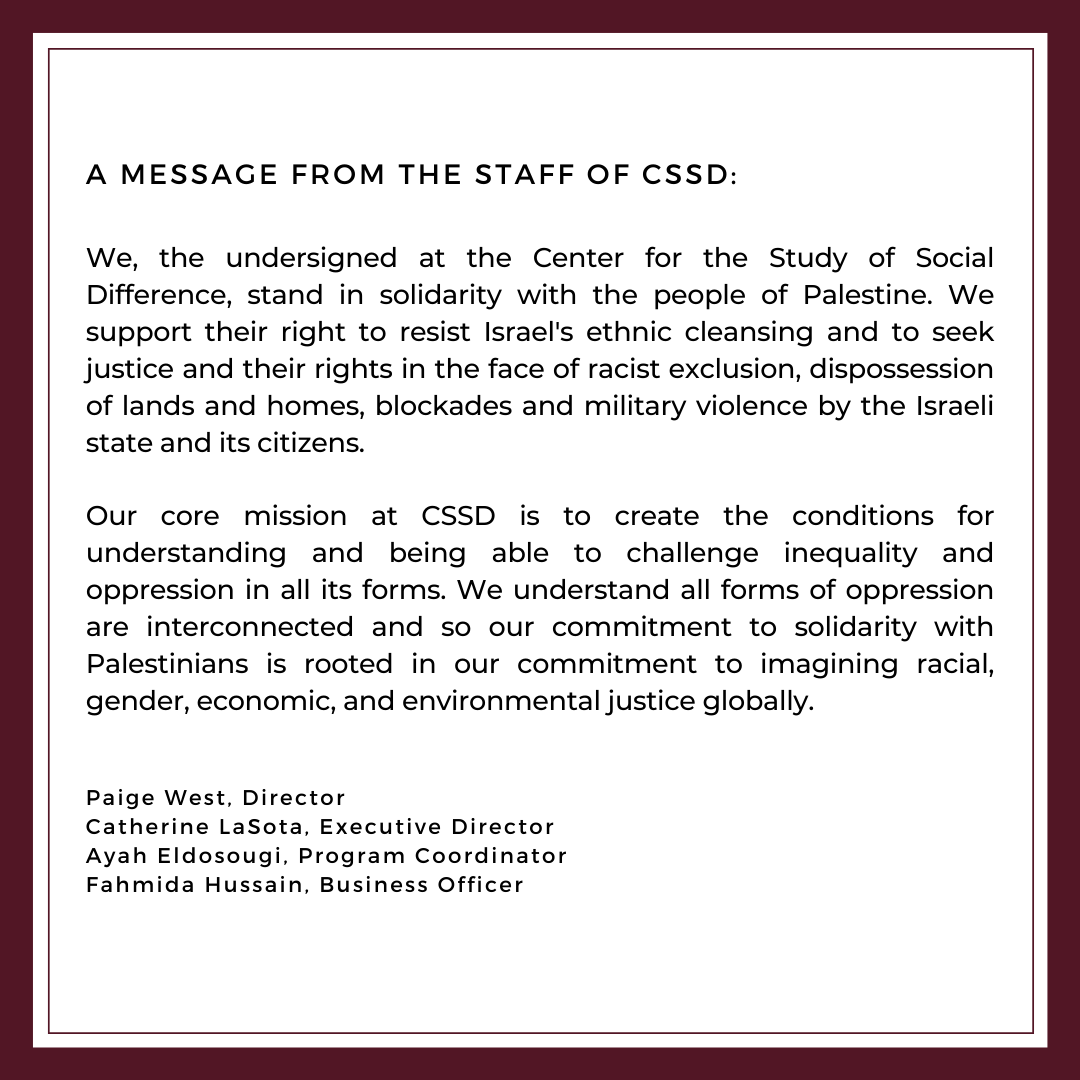
A Message from the Staff of CSSD: Solidarity with Palestine
Our core mission at CSSD is to create the conditions for understanding and being able to challenge inequality and oppression in all its forms. We understand all forms of oppression are interconnected and so our commitment to solidarity with Palestinians is rooted in our commitment to imagining racial, gender, economic, and environmental justice globally.
A Message from the Staff of CSSD: Solidarity with Palestine
We, the undersigned at the Center for the Study of Social Difference, stand in solidarity with the people of Palestine. We support their right to resist Israel's ethnic cleansing and to seek justice and their rights in the face of racist exclusion, dispossession of lands and homes, blockades and military violence by the Israeli state and its citizens.
One of our Palestinian colleagues and a long-time CSSD fellow has shared with us this important appeal from the Jerusalemite Women’s Coalition and we wanted to share it with you. A current pledge by scholars to support working and teaching about the Palestinian situation and rights has also been signed by many of those involved in CSSD’s projects.
Our core mission at CSSD is to create the conditions for understanding and being able to challenge inequality and oppression in all its forms. We understand all forms of oppression are interconnected and so our commitment to solidarity with Palestinians is rooted in our commitment to imagining racial, gender, economic, and environmental justice globally.
Paige West
Director
Catherine LaSota
Executive Director
Ayah Eldosougi
Program Coordinator
Fahmida Hussain
Business Officer
Katherine Franke in Vox
Columbia Law Professor Franke commented on new US legislation to combat anti-Asian hate crimes.
In an article on the intent and anticipated implications of the US House of Representatives bill to improve data tracking of anti-Asian hate crimes, Professor Franke told Vox: “Enhancing criminal prosecutions of and requiring greater reporting on hate crimes are interventions that take place after bias incidents have taken place. Education, public messaging — particularly from elected officials — and other community-based programs aimed at reconciliation and repair are more likely to reduce the incidence of hate crimes.” Read the full article here.
Professor Franke, Sulzbacher Professor of Law at Columbia Law School, directs the Center for Gender and Sexuality Law and is the faculty director of the Public Rights/Private Conscience Project. She is a member of the current CSSD working groups Queer Aqui and former working groups Reframing Gendered Violence and Science and Social Difference.
Kavita Sivaramakrishnan on Radio Open Source
Professor Sivaramakrishnan shared her expertise on the COVID-19 crisis in India.
Kavita Savaramakrishnan shared her historical and sociomedical expertise on the COVID-19 public health crisis in India on the Radio Open Source podcast. Listen to the full episode here.
Sivaramakrishnan is Associate Professor of Sociomedical Sciences at Columbia University’s Mailman School of Public Health, and a member of CSSD’s Insurgent Domesticities working group.
Menstrual Health and Gender Justice working group fellows publish new article
This piece is the launch of new menstrual health definition and urges action on menstrual health for all.
Fellows of the Menstrual Health and Gender Justice working group have published the recent article “Menstrual Health: A definition for policy, practice and research.” This paper was developed by a global team of experts who have defined menstrual health to advance policy, practice, and research and is the launch of a new menstrual health definition that urges action on menstrual health for all.
Billions of people around the world experience a menstrual cycle. Meeting their menstrual needs is essential for achieving health and gender equality. A growing body of activists and actors are rising to the challenge and have brought visibility to this long-marginalized topic. However, large-scale investment and coordination across sectors is needed to ensure menstrual health for all. To provide a common language and unite efforts to support the breadth of menstrual needs, a collaboration of experts have now defined menstrual health.
Published in the journal Sexual and Reproductive Health Matters, menstrual health is defined as “a state of complete physical, mental, and social well-being and not merely the absence of disease or infirmity, in relation to the menstrual cycle.” This definition is grounded in the World Health Organization (WHO) definition of health and is supplemented by a description of the requirements for achieving menstrual health over the life-course. As outlined in the definition, achieving menstrual health requires access to information about the menstrual cycle and self-care, materials, water and sanitation facilities and services to care for the body during menstruation, access to timely diagnosis, care and treatment for menstrual discomforts and disorders, a positive and respectful environment free from stigma, and the freedom to participate in all spheres of life throughout the menstrual cycle. The definition also emphasizes that whilst the majority of those who experience a menstrual cycle are women and girls, menstrual health is essential for all those who experience a menstrual cycle, regardless of their gender identity and the context in which they live.
Dr. Inga Winkler, one of the authors of the paper and a faculty member in human rights at Columbia University, explained, ” Menstrual health is at a critical junction. While gaining more traction, current efforts risk being siloed and disjointed. A shared understanding of menstrual health will help us address menstrual needs holistically to support the realization of a range of human rights.”
The expert collaboration was brought together by the Global Menstrual Collective and consulted a further 51 stakeholders to refine the definition.
Read the full article here.
Learn more about the Menstrual Health and Gender Justice working group here and on their blog Periods at Columbia.
Souleymane Bachir Diagne in Christian Science Monitor
Professor Diagne commented on the Nairobi National Museum’s new exhibit highlighting the Kenyan art stolen in the colonial era.
Professor Souleymane Bachir Diagne commented on the Nairobi National Museum’s new “Invisible Inventories” exhibit highlighting the European colonial-era theft of Kenyan art. Professor Diagne told Christan Science Monitor: “The movement is snowballing. There’s a public pressure now that wasn’t there before.”
Professor Diagne, a Senegalese philosopher and Columbia professor of Philosophy and French, was a member of CSSD’s working group Bandung Humanisms.
Vanessa Agard-Jones Lectures on Ephemera at Wesleyan University
In “Empirical Ephemera,” Professor Agard-Jones used the concept-metaphor of sand to consider how coloniality is made material.
Assistant Professor Vanessa Agard-Jones gave a lecture on “Empirical Ephemera” at Wesleyan University’s Center for the Humanities. She explored the ways that colonality is made material, and how we might use sand as a tool for thinking an ephemeral archive, empirically.
Agard-Jones is Assistant Professor of Anthropology at Columbia, co-director of CSSD’s Black Atlantic Ecologies working group, and member of the Queer Aqui and former Reframing Gendered Violence and Science and Social Difference working groups.
Meredith Gamer Lectures at Paul Mellon Centre for Studies in British Art
Assistant Professor Gamer’s two online lectures focused on the works of artist William Hogarth.
Assistant Professor Meredith Gamer participated in this year’s Yale University Paul Mellon Centre for Studies in British Art Artist in Focus Public Lecture Series. Professor Gamer’s lectures focused on two works by etching artist William Hogarth: Industry and Idleness (1747) and The Four Stages of Cruelty (1751). Assistant Professor of Art History, Gamer is a member of CSSD’s Motherhood and Technology working group.
Watch the full lectures here.
Elections to the American Academy of Arts & Sciences
Congratulations to Professors Gayatri Chakravorty Spivak and Mabel O. Wilson on joining the Academy.
Congratulations to University Professor Gayatri Chakravorty Spivak and Associate Professor Mabel O. Wilson on their election to the American Academy of Arts & Sciences.
Spivak is University Professor and Founder of the Institute for Comparative Literature and Society at Columbia, and former co-director of CSSD working group The Rural-Urban Interface: Gender and Poverty in Ghana and Kenya, Statistics and Stories.
Wilson is Associate Professor of Architecture, Graduate School of Architecture, Planning and Preservation at Columbia, and a member of former CSSD working groups Engendering the Archive and Reframing Gendered Violence.
Lila Abu-Lughod Delivered A Webinar On Gender Violence
This webinar was part of a virtual event series entitled Theory From The Margins
Anthropologist Lila Abu-Lughod, Reframing Gendered Violence working group fellow, delivered a webinar on "Gender from the Margins: The Geopolitics of Gender Violence" as part of a series hosted by the Theory from the Margins project. Professor Abu-Lughod spoke on her work, including the forthcoming collection The Cunning of Gender Violence.
Check out the Webinar Here.
Office of the Provost Mid-Career Faculty Grant
Congratulations to Spring 2021 Grant awardees Kevin Fellezs (Music), Natasha Lightfoot (History), and Camille Robcis (French, History).
We are pleased to congratulate CSSD working group members Kevin Fellezs, Natasha Lightfoot and Camille Robcis on receiving a Spring 2021 Columbia Office of the Provost Mid-Career Faculty Grant in recognition of significant contributions to their fields.
Kevin Fellezs received the grant for his work on The Love Song in Black Popular Music, 1945-2000. He is Associate Professor of Music, Ethnomusicology & African American & African Diaspora Studies and former co-director of CSSD’s Pacific Climate Circuits: Moving Beyond Science, Technology, Engineering, and Economics working group.
Assistant Professor Natasha Lightfoot received the grant for work on her project, Fugitive Cosmopolitans and the Making of the Black Atlantic. She teaches Caribbean, Atlantic World, and African Diaspora History, and was a member of CSSD’s former Digital Black Atlantic working group.
Associate Professor Camille Robcis received the grant for her forthcoming project, tentatively titled The Gender Question: Populism, National Reproduction, and the Crisis of Representation, in which she explores the protests against the so-called “theory of gender” and their conceptual links to populism. She teaches modern European intellectual history, and is a member of CSSD working group Queer Aqui.
New Social Engagement Projects at the Center for the Study of Social Difference
These new groups will build on established CSSD projects in alignment with Columbia University's Fourth Purpose.
The Center for the Study of Social Difference is proud to announce the inaugural recipients of CSSD’s Social Engagement Grants, The Zip Code Memory Project: Practices of Repair and Reconstructing History in Rocinha, Rio de Janeiro and Dharavi, Mumbai. Each of these new projects are lead by current and former CSSD working directors and to build on the work of CSSD groups, moving that work toward new forms of public engagement and partnerships, in alignment with Columbia University's Fourth Purpose. To learn more about each of these projects visit their project pages linked above.

Saidiya Hartman Receives PEN America Literary Award
Professor Hartman was announced as one of the 2021 Award Winners for her recent book, Wayward Lives, Beautiful Experiments: Intimate Histories of Riotous Black Girls, Troublesome Women, and Queer Radicals.
Saidiya Hartman Receives PEN America Literary Award
We are pleased to congratulate Saidiya Hartman, former co-director of the Gender & the Global Slum and Engendering the Archive working groups, on receiving a PEN America Literary Award for her recent book. Professor Hartman was a recipient of the PEN/John Kenneth Galbraith Award for Nonfiction for her book entitled Wayward Lives, Beautiful Experiments: Intimate Histories of Riotous Black Girls, Troublesome Women, and Queer Radicals.
Read more about her book and this special distinction here.
Kevin Fellezs in The Guardian
Professor Fellezs commented on protest songs and “freedom musics” in this polarized time
Informed by his work on the intersections of music and collective liberation, Professor Kevin Fellezs commented on “freedom musics” in The Guardian’s article on rightwing co-optations of protest songs.
Kevin Fellezs is Associate Professor of Music, Ethnomusicology & African American & African Diaspora Studies and former co-director of CSSD’s Pacific Climate Circuits: Moving Beyond Science, Technology, Engineering, and Economics working group.
CSSD Faculty Recipients of Guggenheim Fellowship
We are excited to announce that Paige West, CSSD Director, and Farah Griffin, former co-director of a Women Creating Change working group, have been named 2021 Fellows for their extraordinary and productive scholarship.
CSSD Faculty Recipients of Guggenheim Fellowship
The Center for the Study of Social Difference proudly congratulates Paige West, Director of CSSD, and Farah Jasmine Griffin, co-director of past Women Creating Change working group Toward an Intellectual History of Black Women. This follows up Paige's honor just earlier this year as one of 50 Explorers Changing the World.
We are fortunate to have the leadership of these incredible scholars at our Center. Our faculty are doing outstanding work, and it is wonderful to see them receive these well-deserved honors.
Congratulations Paige and Farah!
The full list of 2021 Guggenheim Fellows can be found here.
Anupama Rao Participates in Panel Discussion on Historian Sumit Guha’s book
The co-director of the Geographies of Injustice working group spoke about the book History and Collective Memory in South Asia, 1200–2000.
Anupama Rao, co-director of the Geographies of Injustice working group, was a discussant for a recent virtual book talk event highlighting the historian Sumit Guha’s work History and Collective Memory in South Asia, 1200–2000.
Farah Jasmine Griffin Contributes Essay to the collection Four Hundred Souls: A Community History of African America, 1619-2019
This piece by the Toward An Intellectual History Of Black Women working group director focuses on the Harlem Renaissance.
Professor Farah Jasmine Griffin, co-director of the Toward an Intellectual History of Black Women working group, contributed an essay on the Harlem Renaissance to the collection Four Hundred Souls: A Community History of African America, 1619-2019, edited by Ibram X. Kendi and Keisha N. Blain.
Professor Griffin’s essay can be found here.
Motherhood and Technology working group fellow publishes book review in Public Books
Emily Bloom wrote a review of Emma Donoghue's The Pull of the Stars.
Motherhood and Technology working group fellow, Emily Bloom wrote about gothic literature's ability to convey the claustrophobia of motherhood during a pandemic in her review of Emma Donoghue's The Pull of the Stars, in Public Books.
To learn more about the work of Motherhood and Technology and its fellows visit the working group page here.
Rachel Adams interviewed by the Spectator and Columbia News
The director of the Future of Disability Studies working group spoke about how she has updated her class for the pandemic.
Director of the Future of Disability Studies, and the Precision Medicine: Ethics Politics and Culture working groups, Rachel Adams was featured in two articles in which she discussed the ways she has updated her courses to adapt to current pandemic-related issues. She discussed her course "Comics, Health, and Embodiment" in Columbia News, and her "Advanced Topics in Medical Humanities" course in Spectator.