

Geographies of Injustice: Gender and the City
Geographies of Injustice is a working group of interdisciplinary scholars who are interested in asking how spatial politics intersects with inequality and social difference (race, caste, and ethnicity).
Project Co-Directors: Anupama Rao, Ana Paulina Lee
Project Coordinators: Ana Luiza de Abreu Claudio (2023), Iuri Bauler (2022), Sohini Chattopadhyay (2021)
Media Fellow: Jessica Jacolbe (2020)
Geographies of Injustice is a working group committed to exploring the question of subaltern urbanism and aesthetics from an explicitly South-South perspective by bringing urban studies into conversation with studies of social difference, inequality, and cultural production. We have a specific focus on representation and decolonization as they relate to subaltern urban architectural and infrastructural forms. We are particularly keen to bring studies of planning and built form into conversation with concerns about the particular vulnerabilities that minority communities face in navigating situations of urban marginalization.
Our project, “Reconstructing Memory in Rio de Janeiro’s Favelas and Mumbai’s Zhopdis” seeks to develop a template for addressing spatial politics through engagements with historical memory, music, performance, and creative survival strategies of subaltern communities. Our working group draws on the convergent yet distinct urban trajectories of Bombay/Mumbai and Rio de Janeiro, cities associated with the slum and the favela, respectively, as connected sites from which to better apprehend today’s global housing crisis. We work with community museums and grassroots organizations to develop solutions that will influence policy and sustainable urban planning. We approach self-housing settlements in Rio de Janeiro and Mumbai through connected histories of the Global South where cheap labor, urban conflict and precarious living conditions define the social life of peripheral capitalism.
News
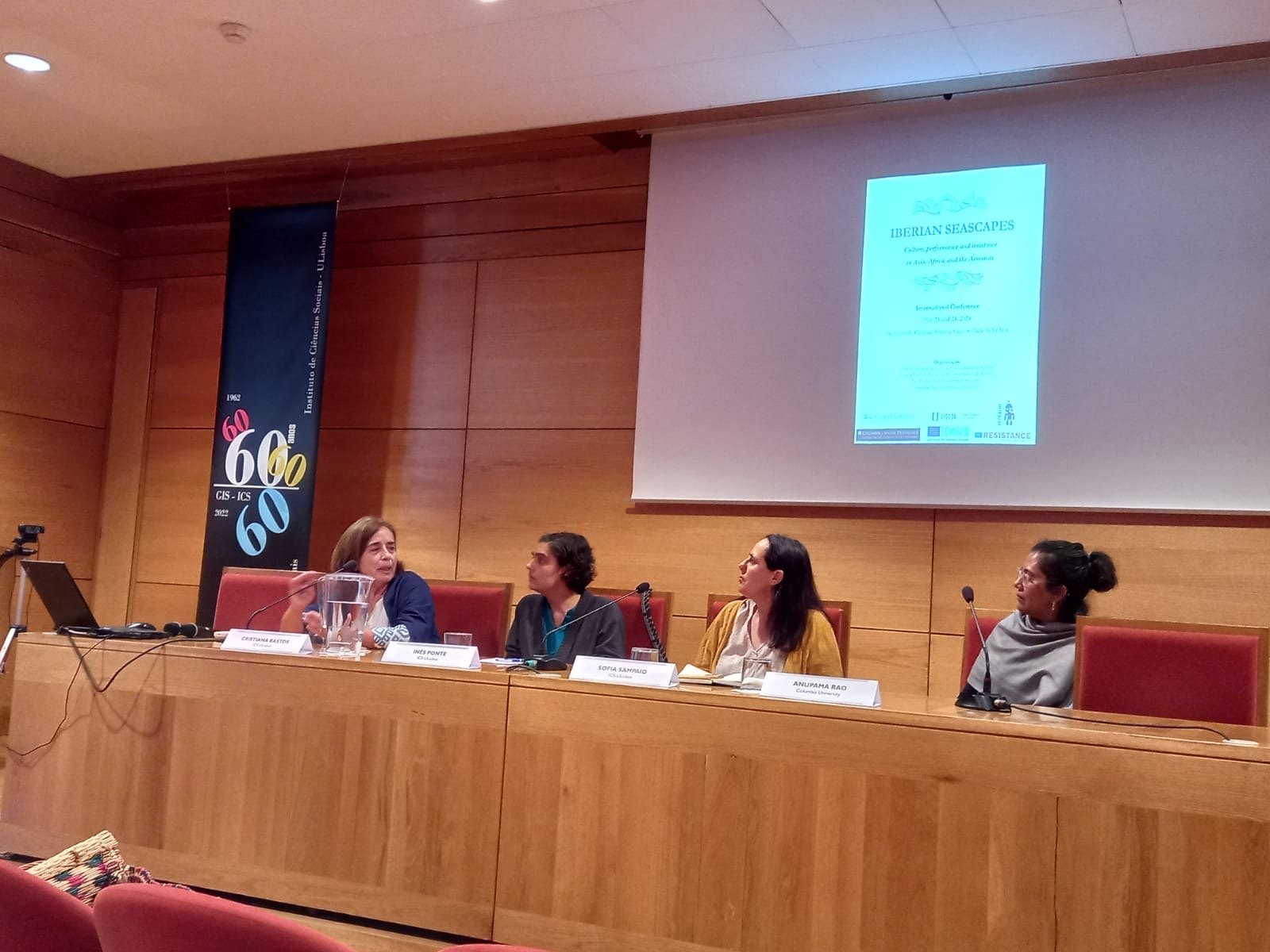
The co-director of the Geographies of Injustice working group spoke about the book History and Collective Memory in South Asia, 1200–2000.
This talk is a part of the Understanding Systemic Racism: Art and Politics series hosted by the Institute for Comparative Literature and Society at Columbia University.
As an AAWW fellow Jessica Jacolbe will report on Asian diasporic and Muslim communities in New York City.
Ana Paulina Lee is moderating “Liberating the Sacred: Afro-Brazilian Religions, Cultural Heritage, and the Law” on November 5th.
Ana Paulina Lee writes about an upcoming Dread Scott documentary on the 1811 German Coast Uprising.
The workshop was hosted by the Decolonial Collective on Migration of Objects and People at Brown University.
Publications
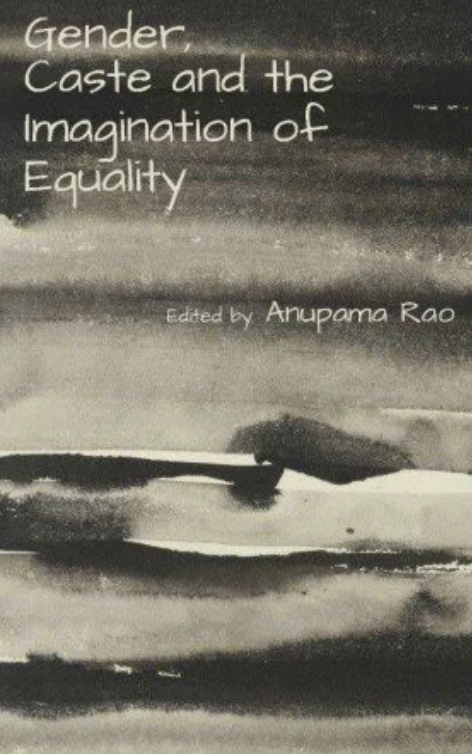
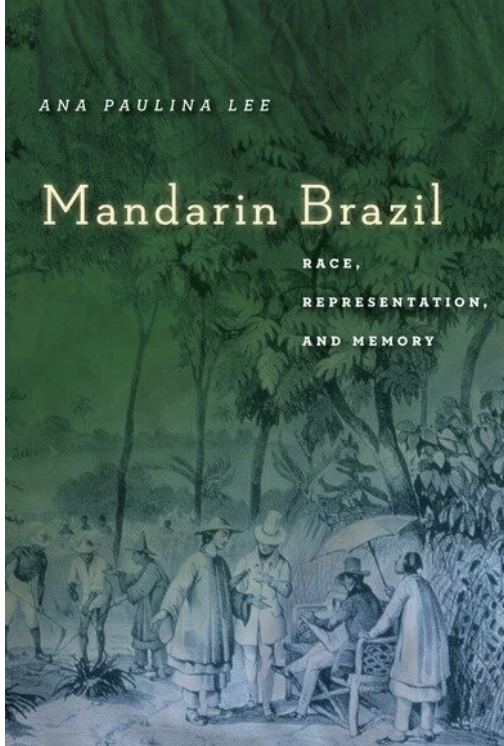

Image by Michael Alvarez from the series, "We're Out Here"
Past Events

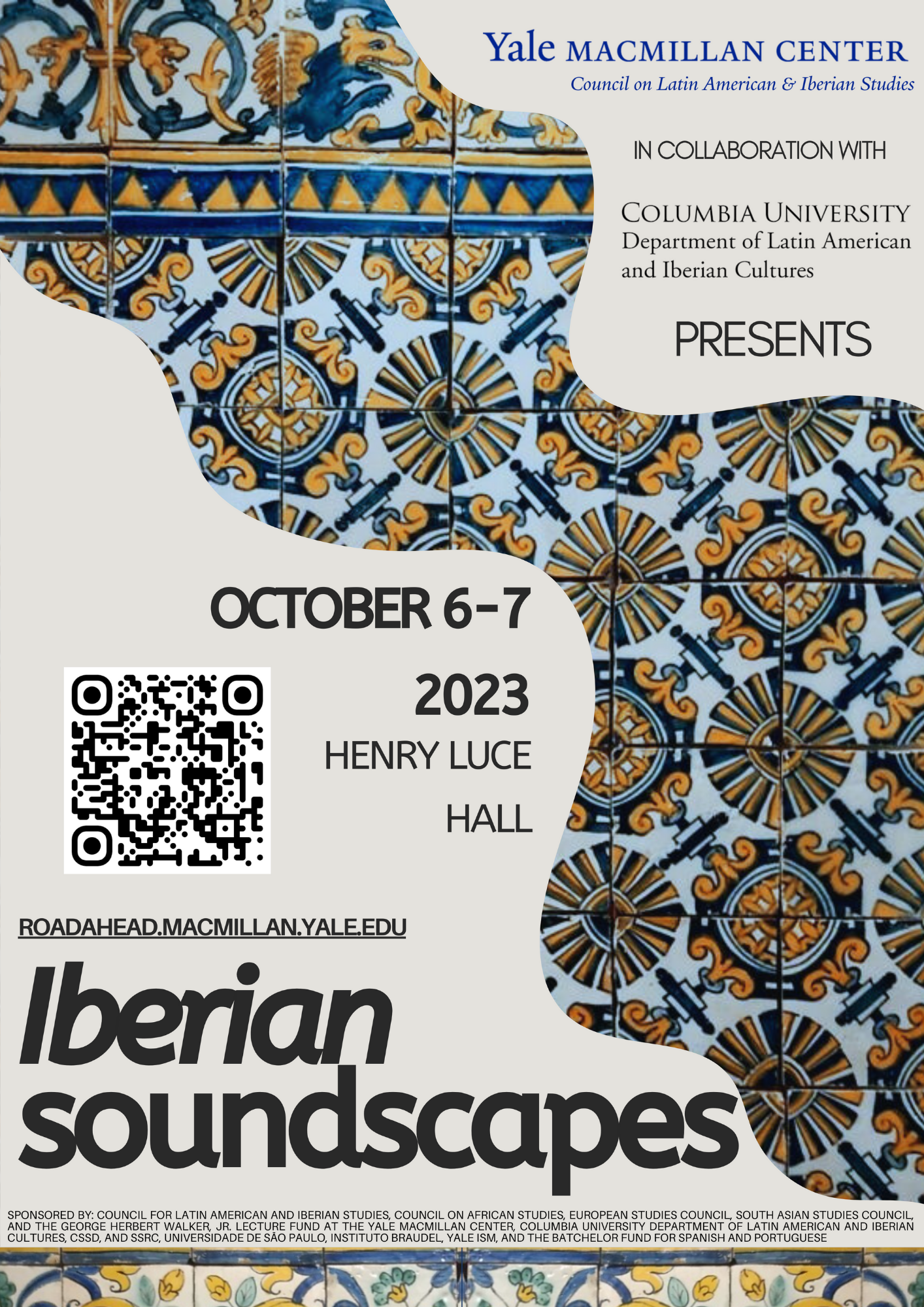

The second piece of a two-part event, the Beyond Dystopia Roundtable follows the Dry Ground Burning film screening on Friday, April 28.

This film screening is the first piece of a two-part event, and will be followed by the Beyond Dystopia Roundtable on Saturday, April 29.

WORKSHOP: Love in the Time of Hypercapitalism
Artist Talk with Paromita Vohra: Gardens of Pleasure Feminism, Desire and Doing Documentary Work in (for) South Asia

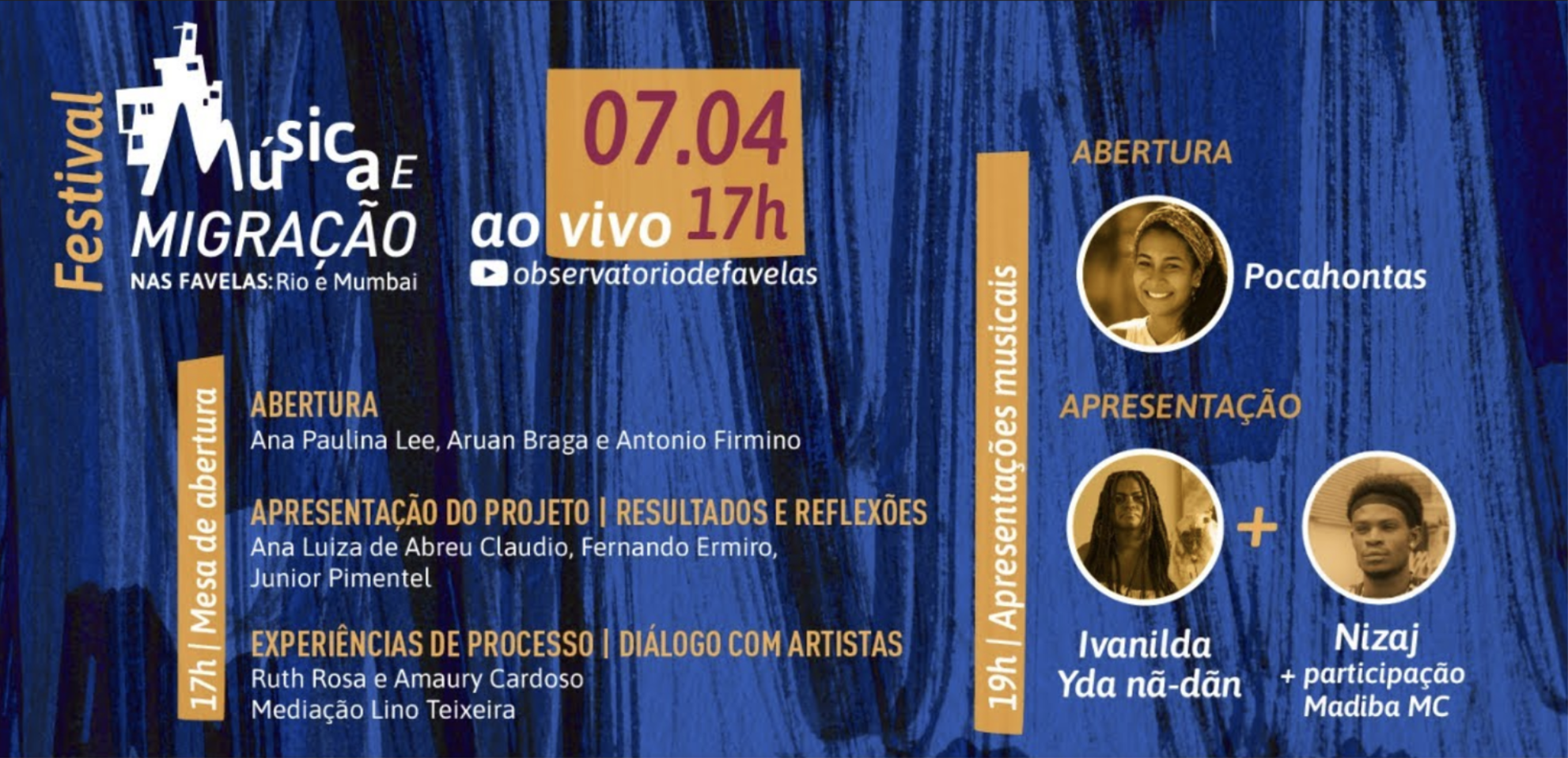
A music festival, live streamed.

A Música - Repertório de Viagens | An event with Silvio Luiz de Almeida + MC Carol.
Fellows
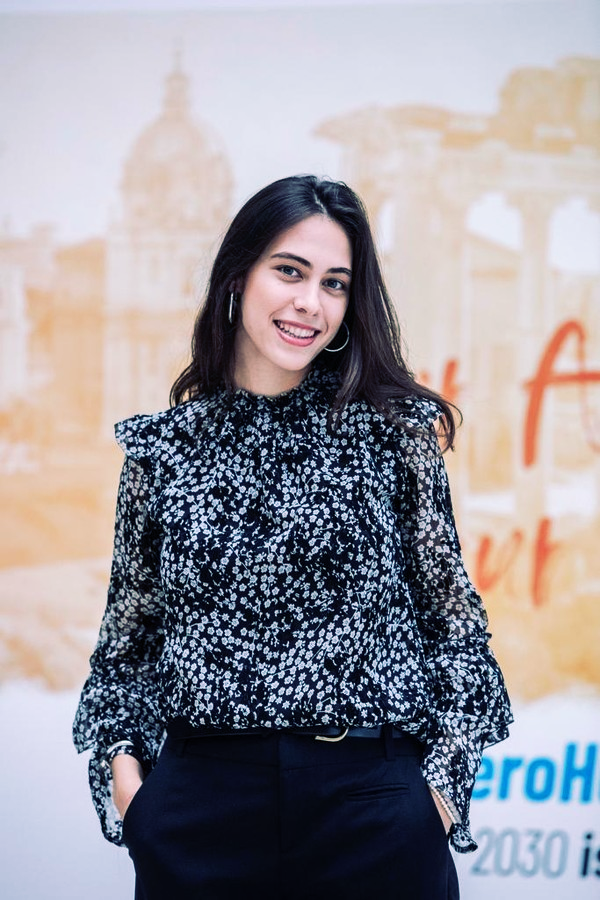
Doctoral Student, International Affairs and Journalism, Columbia University
Teresa holds a BA in International Relations from Brown University and is currently pursuing a Master of International Affairs and an MS in Journalism at Columbia University. She previously worked at the Food and Agriculture Organization of the UN (Rome), where she was responsible for the coordination and editing of high-profile publications. Among others, she edited the joint FAO-EL PAÍS publications series “The State of our Planet”. She is interested in how documentary video, photography and journalism at large can drive social action and improve public policy across geographical boundaries.
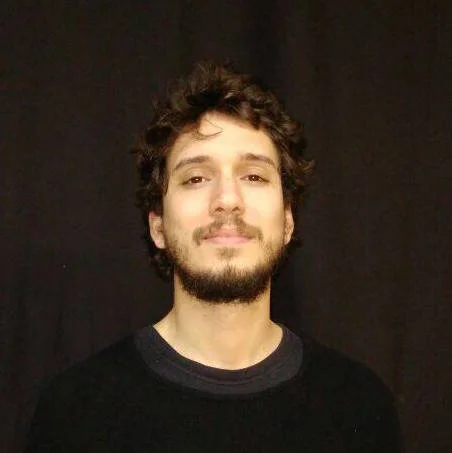
Doctoral Student, History, Columbia University
Iuri Bauler Pereira holds a B.A. in History from the Federal University of Rio Grande do Sul (UFRGS), and an M.A. and Ph.D. in History from the Federal University of Rio de Janeiro (UFRJ). His research focus on the transnational connections and geopolitical imagination of Latin American Countercultures (underground press, literature and film), Brazilian Critical Geography, and the Intellectual History of the Americas.
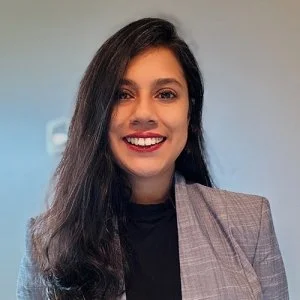
Sohini Chattopadhyay is a PhD Candidate in the History Department at Columbia University. Her dissertation focuses on the science of managing mass death in colonial cities, with a particular interest in Bombay and Calcutta among other cities in the early twentieth century.

Fellow, Social Sciences, Rural University of Rio de Janeiro
Professor at the Três Rios Institute at the Federal Rural University of Rio de Janeiro. PhD in Social Sciences (PUC / Rio). Master in Social Sciences (PPCIS / UERJ). Post-doctorate by the Department of World Language and International Studies (Morgan State University / USA).

Fellow, Sustainability, Columbia University
Over 16 years of experience as project coordinator in Information and Communication Technologies (ICTs), Sustainability, Social Responsibility, Sociocultural and Socioenvironmental Education and research. Coordination of +50 long, medium and short term projects in the areas of human rights, social memory, community media, environment, preservation of material and immaterial cultural heritage, with wide experience in complex environments such as conflict zones, isolated communities and extreme poverty.
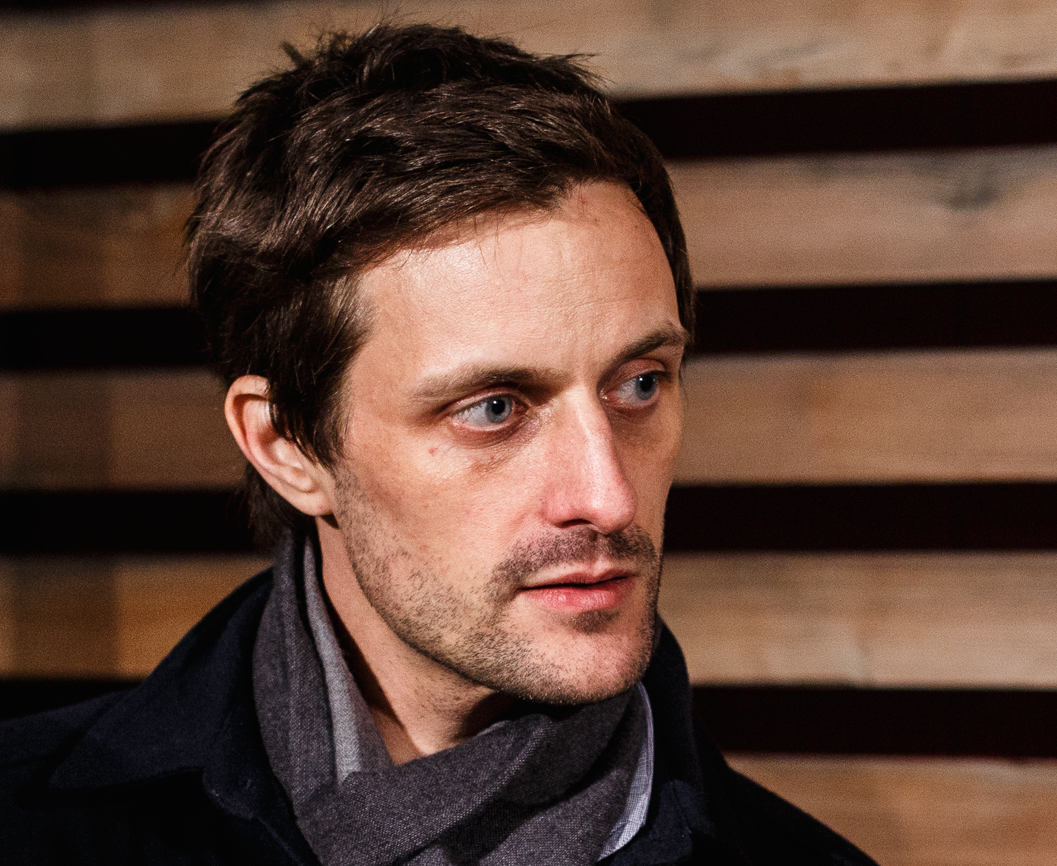
Fellow, Government and Economics, London School of Economics
Matias Echanove is co-founder of the urbz collective along with Rahul Srivastava and Geeta Mehta, which has offices in Mumbai, Geneva and Bogota. He has studied government and economics at the London School of Economics, urban planning at Columbia University, and urban information systems at the University of Tokyo.

Doctoral Student, History, Fundação Getúlio Vargas
Fernando Ermiro is a resident of Rocinha. He is currently completing a Master's degree at Fundação Getúlio Vargas.
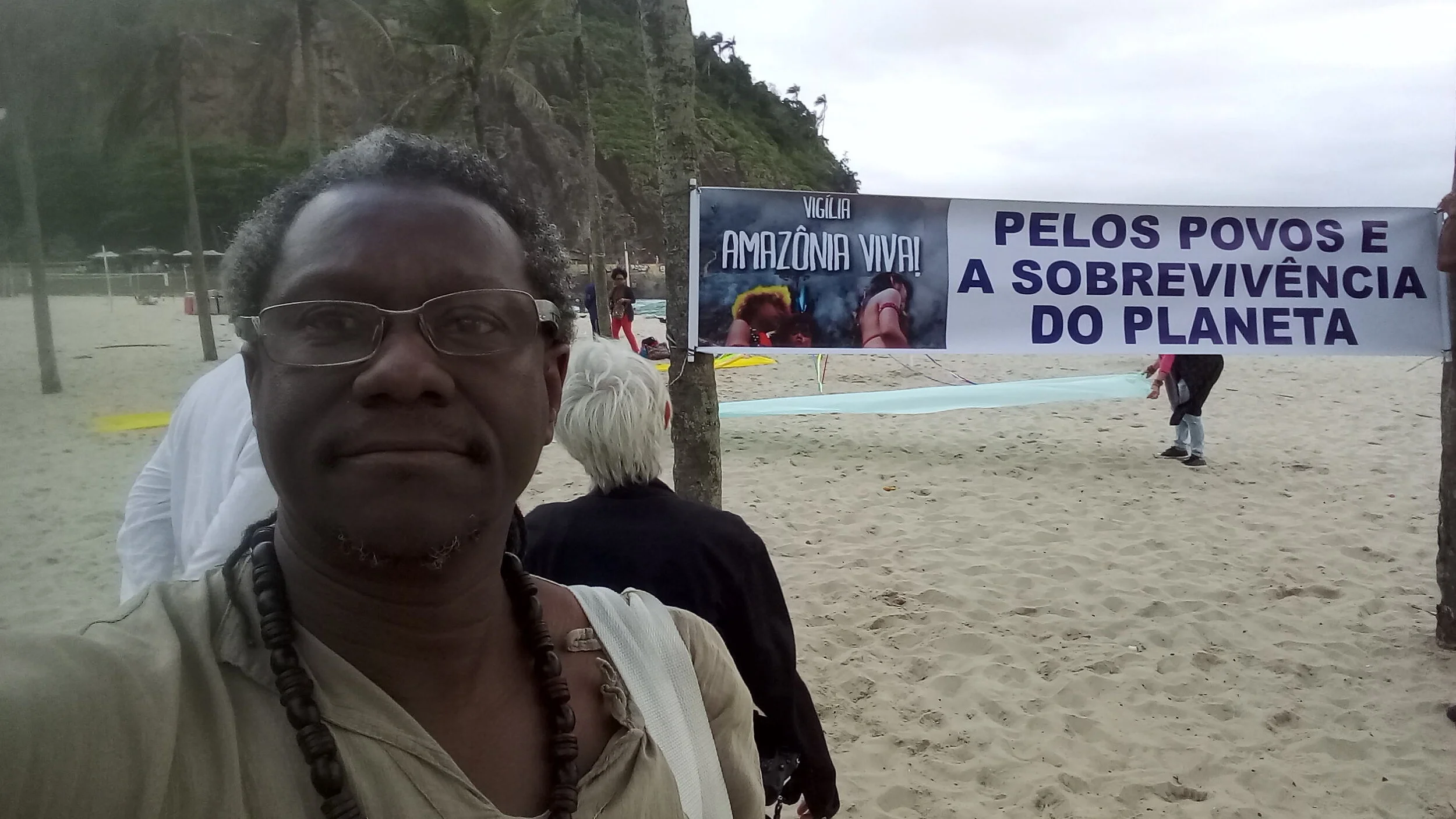
Fellow, Geographer, Social Action Padre Anchieta (ASPA)
Antonio Carlos Firmino is a founding member of the Sankofa Museum of Memory and History of Rocinha. He is a geographer, and coordinator of one of the oldest institutions of the Favela da Rocinha, the Social Action Padre Anchieta (ASPA).
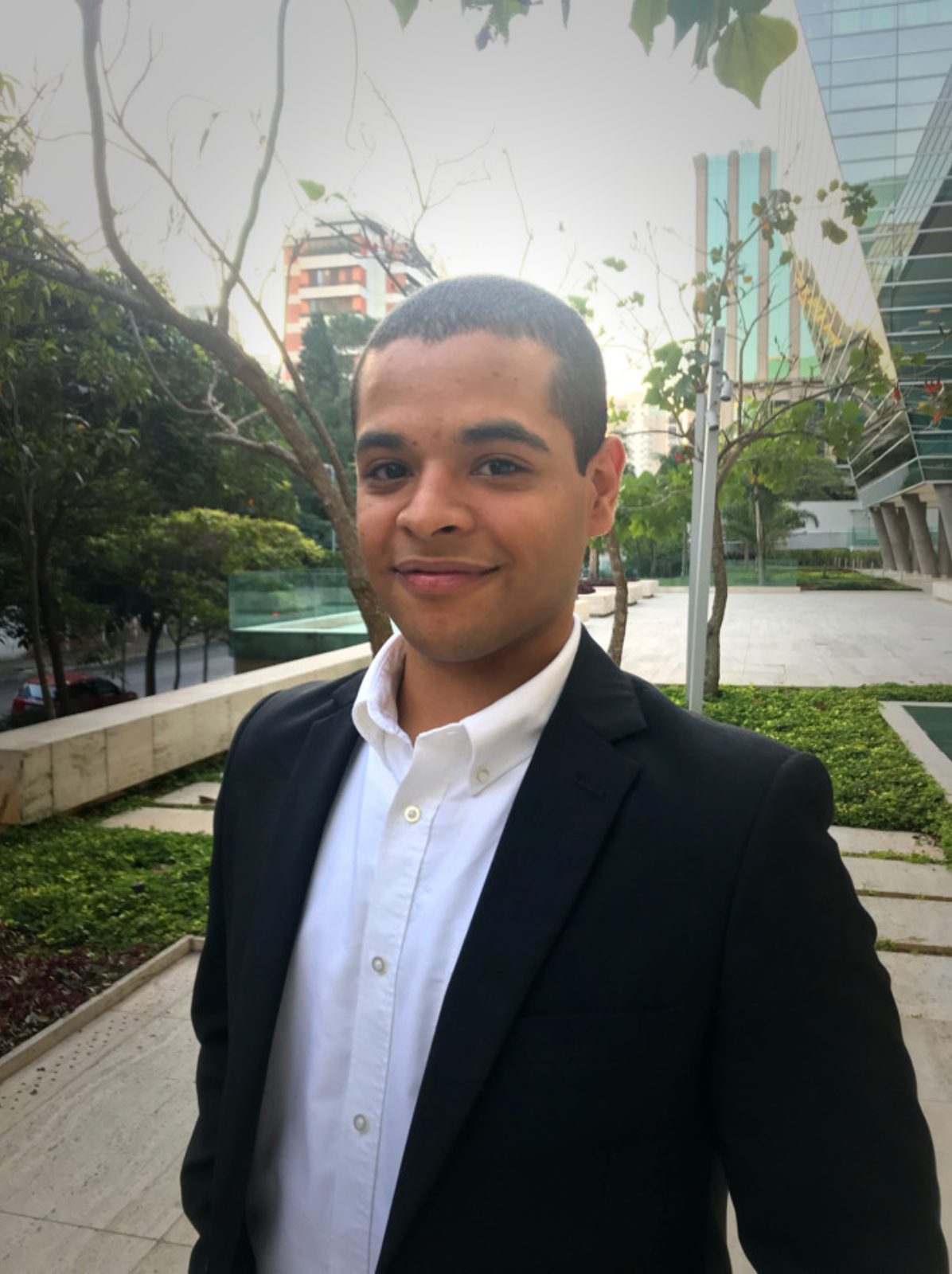
Undergraduate Student, Latin American and Caribbean Studies & Political Science, Columbia College, Columbia University
Gabriel Franco is an undergraduate student at Columbia University in the fields of Latin American & Caribbean studies and political science. His areas of focus are Brazilian slavery and race studies and public security in Brazil, especially regarding drug policy and dynamics of urban violence as part of the "war on drugs" mentality.

Jessica Jacolbe is a writer from Brooklyn whose work has been featured in Catapult, Garage Magazine, JSTOR Daily, and others.
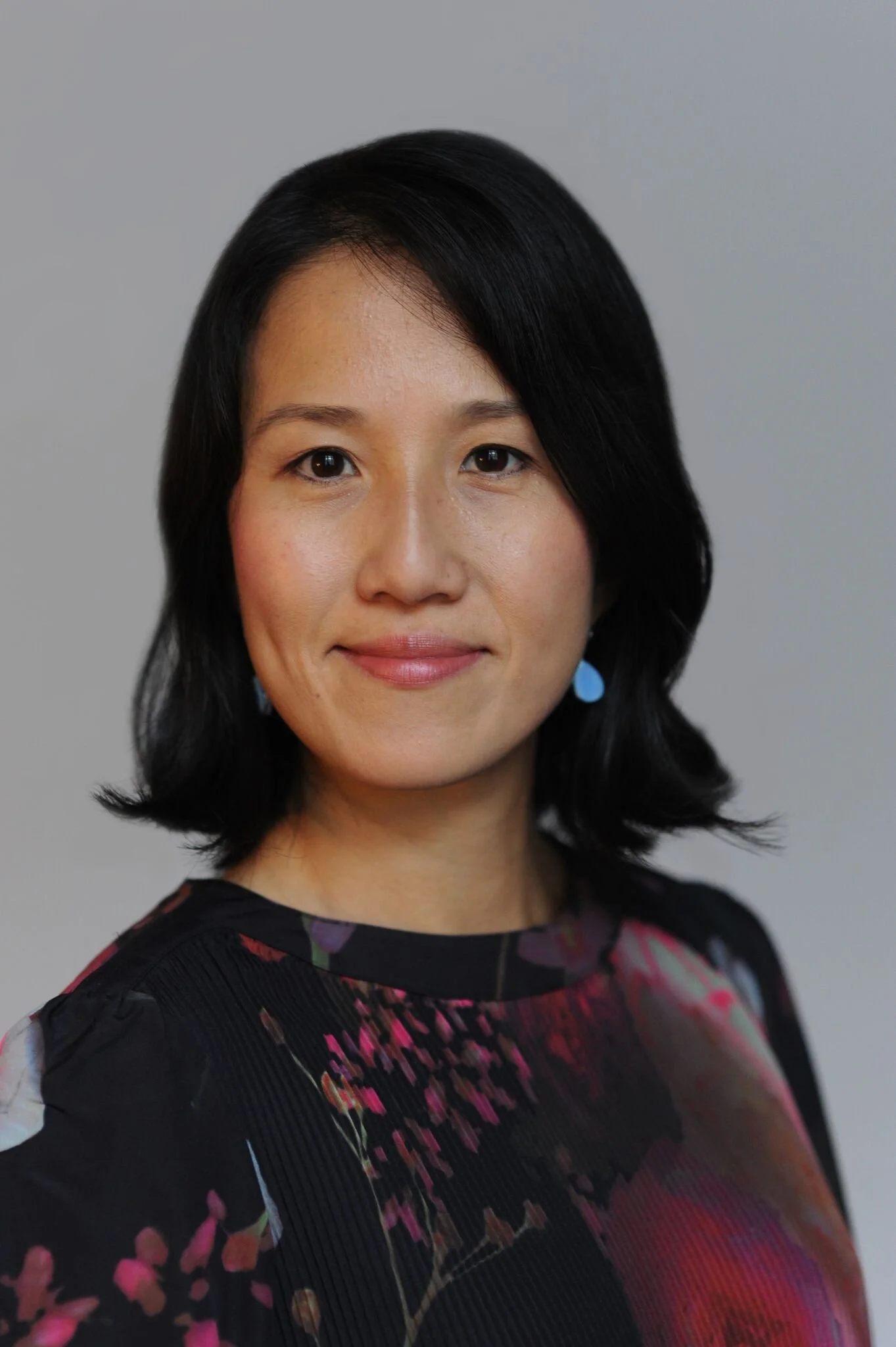
Associate Professor, Department of Latin American and Iberian Cultures, Columbia University
Ana Paulina Lee is Associate Professor of Latin American and Iberian Cultures at Columbia University. She is the author of Mandarin Brazil: Race, Representation, and Memory (Stanford University Press).
Professor, Department of Latin America and Iberian Cultures, Columbia University
Professor at the Department of Latin America and Iberian Cultures, Columbia University. She specializes in modern Latin American Culture with a focus on contemporary cultural practices. She is co-editor of The Argentina Reader: History, Culture, and Politics (2002).
Fellow, Afro-Brazilian Women and Health, 1st World Summit of Afro-descendants in Honduras
Mãe Nilce de Iansã; Project Coordinator at Ilê Omolú e Oxum- Rio de Janeiro; Coordinator of the National Network of Afro-Brazilian Women and Health; Member of the International Committee of the Organization of the 1st World Summit of Afro-descendants in Honduras, 2011; Member of the Technical Committee of Health of the Black Population.
Associate Professor, Department of History, Columbia University
Anupama Rao has research and teaching interests in the history of anti-colonialism; caste and race; historical anthropology, social theory and intellectual history, and comparative urbanism. She is Senior Editor, Comparative Studies in South Asia, Africa and the Middle East. She has served as President, Society for the Advancement of South Asian History (American Historical Association), and on the South Asia Council of the Association for Asian Studies. Her work has been supported by fellowships at the Center for Advanced Study in the Behavioral Sciences (Stanford) and the National Humanities Center (North Carolina), and by grants for the American Institute for Indian Studies, and the National Endowment for the Humanities.

Isabela Souza is a PhD student in Geography at the Fluminense Federal University (UFF), and holds a Masters in Urban and Regional Planning from the Federal University of Rio de Janeiro (UFRJ), a MBA in Project Management from Brazilian Institute of Capital Market (IBMEC - RJ) and a bachelor degree in Tourism from the Federal University of Rio de Janeiro (UNIRIO).
Rahul Srivastava is co-founder of the urbz collective along with Matias Echanove and Geeta Mehta, which has offices in Mumbai, Geneva and Bogota. He has studied Sociology and Social Anthropology at St. Xavier's College - Mumbai, Jawaharlal Nehru University - New Delhi, and Cambridge University - U.K.
Public Prosecutor, Office of Cultural Heritage in Rio de Janeiro, Brazil
Sergio Suiama is a Federal Prosecutor in Brazil and a Columbia Law LL.M. alumnus (class of 2009-2010). Also, he holds a master in World Heritage and Cultural Projects for the Development from University of Turin. Graduated from University of Sao Paulo Law School, he has worked in the Brazilian prosecution service since 2002, and at the Office of Cultural Heritage and Environment in Rio de Janeiro since 2014. Currently, he serves as well as the Ombudsperson for Human Rights in the State and coordinates the Working Group on LGBTQ’s rights at the Office of the Federal Ombudsman.
Fellow, Web Radio, Instituto Moreira Salles
Luiz Fernando Vianna is a journalist. He has written for O Globo, Folha de S. Paulo and other venues. He is the author of books on popular music, and coordinates the Batuta Radio since 2013.

On The Frontlines: Nursing Leadership in Pandemics
The working group On the Frontlines: Nursing Leadership in Pandemics seeks to understand the role of nurses as change agents in the prevention, detection and response to pandemic infectious disease outbreaks.
Project Directors: Jennifer Dohrn, Wilmot James, Victoria Rosner
Coordinators: Kurt Holuba, Mina Shah
Graduate Assistant: Lauren J. DeVaughn
The working group On the Frontlines: Nursing Leadership in Pandemics seeks to understand the role of nurses as change agents in the prevention, detection and response to pandemic infectious disease outbreaks. Although nurses are crucial to combatting pandemics, their work is often not considered when international leaders gather to discuss global health issues. This is a consequence of both the MD-centered hierarchy of medical practice and the fact that nursing remains a profession in which women – whose work is systemically undervalued -- predominate (in the US, over 90% of registered nurses are women). This is a dangerous omission, since although nurses are on the front lines of care, little is known about the range of activities they undertake beyond what may be obvious in patient care. Even key clinical innovations are often overlooked when they should be universally implemented. And there is little record of the painful choices nurses and other health professionals often make between taking care of patients and protecting themselves and their families.
This working group is necessarily inter-sectoral and inter-disciplinary. On the Frontlines draws on the work of the health science community – nursing, medicine, public health, evolutionary biology and immunology, as well as demography – to understand the changing nature of infectious diseases and how to manage and contain them. We engage the scholarship – international health regulations, international law and the doctrine of the duty to protect – that deals with the ethical character of leadership in the global health and biodefense communities and the barriers nursing leaders face in pursuing the public good. Further, to document the role of nurses, we draw on historical methods, anthropology and journalism to capture nurses’ experience in the field.
This group formed around an interest in understanding the work of nurses and midwives in the 2014 Ebola outbreak in West Africa. In response to recent events, we have expanded our scope to include a comparative study of the work of nurses and midwives in the 2020 COVID-19 outbreak. In collaboration with the Columbia Center for Oral History Research, we are conducting oral histories of COVID-19 nurses, and this effort is being jointly directed by Mary Marshall Clark and Jennifer Dohrn.
News
Due to COVID-19 restrictions, Dohrn’s award will be honored at the International Nurses Day celebration in May 2021.
Jeremy Orloff won the Change Agent Award at the first-ever Academic Prizes and Student Leadership Awards Virtual Ceremony.
Professor Dohrn’s 208 person class held signs in support of the Black Lives Matter movement.
Wilmot James will co-lead Executive Education in the Social Sciences, a new course on pandemics.
The recent On the Frontlines: Nursing Leadership in Pandemics working group webinar can now be found on the CSSD YouTube channel.
The profile on Jeremy Orloff discusses the group’s trip to West Africa, centered around their efforts to retrieve oral histories from local nurses and midwives active during the Ebola crisis.
On the Frontlines Coordinator, Jeremy Orloff, reflects on recent experiences in Sierra Leone and Liberia.
CSSD launches six new projects for the 2018-19 academic year. The projects will address gender, race, sexuality, and other forms of inequality to foster ethical and progressive social change.

Jennifer Dohrn, Eastern Cape Province, South Africa, 2006
FrontlineNurses.org
Past Events

Join us for the release of the report on the proceedings of the third colloquium of the History and Future of Planetary Threats series held on March 31, 2021. Special guest speaker Tom Frieden, report contributor Chinwe Lucia Ochu, and panelist Youssef Charif will reflect on the report’s critical lessons for crisis communications and vaccine uptake.

As the COVID-19 vaccine campaign moves worldwide, innovative approaches to vaccine campaigns are badly needed. How to build trust in vaccines among a weary, anxious and often skeptical public? Join us for a conversation among African and US policymakers, activists, nursing leaders and academics to dissect the elements of effective risk communications campaigns, with an emphasis on empowering individuals and communities to lead the charge.

You are invited to meet, listen to, and engage with frontline nurses and midwives at our launch event on Wednesday, March 10th, 2021 at 12:00 pm EST. We’ll share the website and hear from project contributors and interviewees.

Visit the On the Frontlines: Nursing Leadership in Pandemics working group page to learn more about their work and individual members. Their website FrontlineNurses.org is currently under construction and coming soon!

Presented by the Center for the Study of Social Difference working group, On the Frontlines: Nursing Leadership in Pandemics.
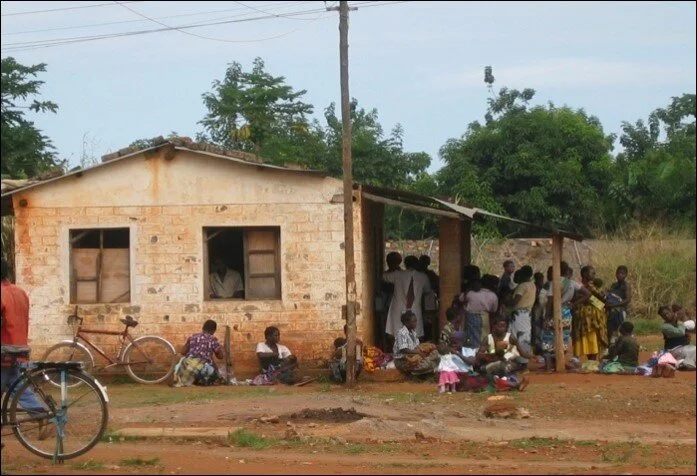
Mary Marshall Clark, director of the Center for Oral History Research at Columbia University, will lead a workshop on how to plan and conduct oral histories in communities affected by disasters and pandemics.

Fellows

Senior Research Scientist, INCITE (Interdisciplinary Center for Innovative Theory and Empirics), Director, Columbia Center for Oral History Research
In addition to being the Director of the Columbia University Center for Oral History Research in INCITE, Mary Marshall is the co-founding director of Columbia’s Oral History Master of Arts (OHMA) degree program (with Peter Bearman) created in 2008-09, the first oral history master’s program in the United States. Mary Marshall has been involved in the oral history movement since 1991, and was president of the United States Oral History Association from 2001-2002.

Associate Professor of Nursing and Assistant Dean of Global Initiatives, Nursing at Columbia University Irving Medical Center
Jennifer Dohrn is the director of the Office of Global Initiatives and an assistant professor at Columbia Nursing where she teaches community health. She oversees collaboration with Columbia Global Centers and leads the Columbia Nursing WHO Collaborative Health Center for Advanced Practice Nursing. Dohrn has worked as a nurse educator and nurse midwife for more than two decades.

Senior Research Scholar at the Institute for Social and Economic Research and Policy (ISERP), College of Arts and Sciences, Columbia University
Wilmot James is a Senior Research Scholar at the Institute for Social and Economic Research and Policy (ISERP), College of Arts and Sciences, Columbia University. An academic by background with a Ph.D. from the University of Wisconsin at Madison, he was previously a Member of Parliament (South Africa) and opposition spokesperson on health. Wilmot is the author and/or editor of 17 books that include the policy-oriented Vital Signs: Health Security in South Africa (2020), a set of essays on the public understanding of science titled Nature’s Gifts: Why we are the way we are (2010), a coedited book Biotechnology and Health: South Africa’s aspirations in health-related biotechnology (2007) and a co-edited collection of Nelson Mandela’s presidential speeches Nelson Mandela In His Own Words (2003), the latter having the distinction of containing forwards by Bill Clinton and Kofi Annan and given to the late Nelson Mandela on his 85th birthday.
Assistant Professor, Department of Epidemiology, Columbia University
Dr. Strasser is a public health professional with 30 years of experience in nursing and public health. She is the senior director for human resources for health (HRH), providing leadership, guidance and direction for the development, implementation, and assessment of programs to develop human resources for health across ICAP's portfolio of programs.

Former Technical Officer of Nursing and Midwifery, World Health Organization (WHO) Headquarters, Geneva, Switzerland
Annette Mwansa Nkowane is a nurse and a midwife from Zambia. During the Ebola outbreak, Mwansa served as the Technical Officer of Nursing and Midwifery in the World Health Organization's Health Workforce Department in Geneva.
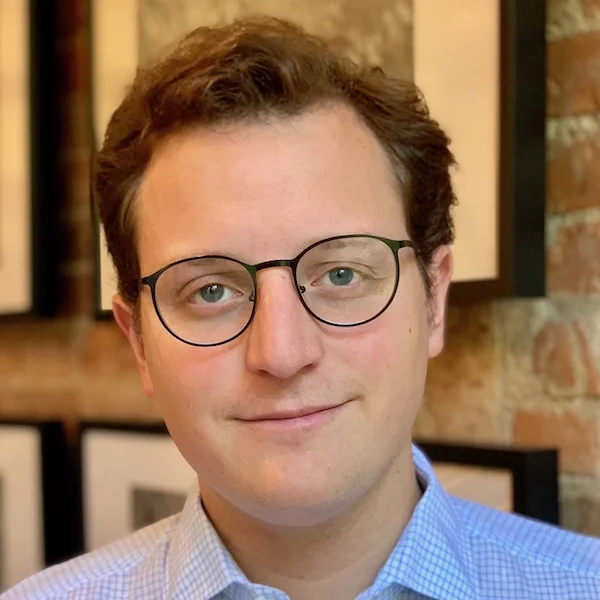
Doctoral Student, General Studies, Columbia University
Jeremy Orloff is a premed postbac student in the School of General Studies. Prior to his interest in medicine, he studied political science and history at Johns Hopkins University. He later worked in local New York City government relations. As a postbac, Jeremy has been involved in clinical research around obesity and related diseases.

Nursing and Midwifery Advisor, Seed Global Health/ Malawi
Margaret Loma Phiri is a nurse and midwife with a Masters in Nursing Education and Leadership from Teachers College, Columbia Universityx. She also holds a post – graduate diploma in Community Health from Medical University of Southern Africa (MEDUNSA) South Africa. She has held a number of leadership positions including: Regional Advisor for Nursing &Midwifery for WHO- African Region; HRH Advisor, WHO- Swaziland Country Office; Regional Capacity Building Coordinator for East- Central & Southern Africa Health Community (ECSA- Health Community) & ECSACON for SADC Region; Quality Assurance Director and Senior Lecturer in Education and Leadership for University of Malawi, Kamuzu College of Nursing – Malawi; and Maternal and Child Health Advisor WHO/ Sierra Leone during the Ebola Recovery and Transition period;
Student Associates
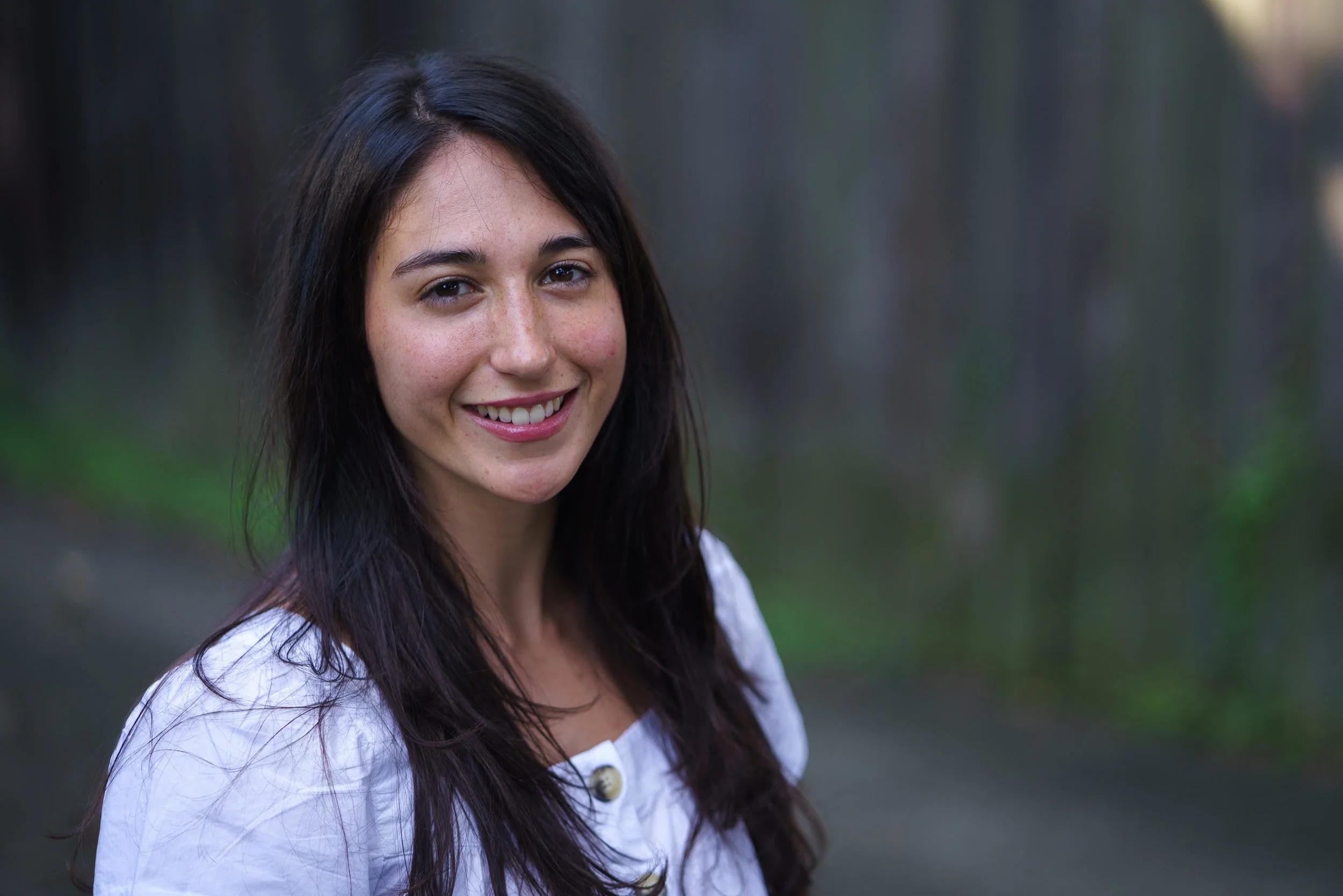
Doctoral Student, Psychology, University of Pittsburgh
Lia attended the University of Pittsburgh and graduated with a degree in psychology.

Premedical Post Baccalaureate Student, General Studies, Columbia University
Kurt Holuba is currently a premed postbac student in the School of General Studies. Previously, he attended Princeton University, earning a B.A. in Psychology. After graduation, Kurt immediately enrolled in the postbac program. He is interested in the intersection between psychology and physiology as it relates to response to stress.
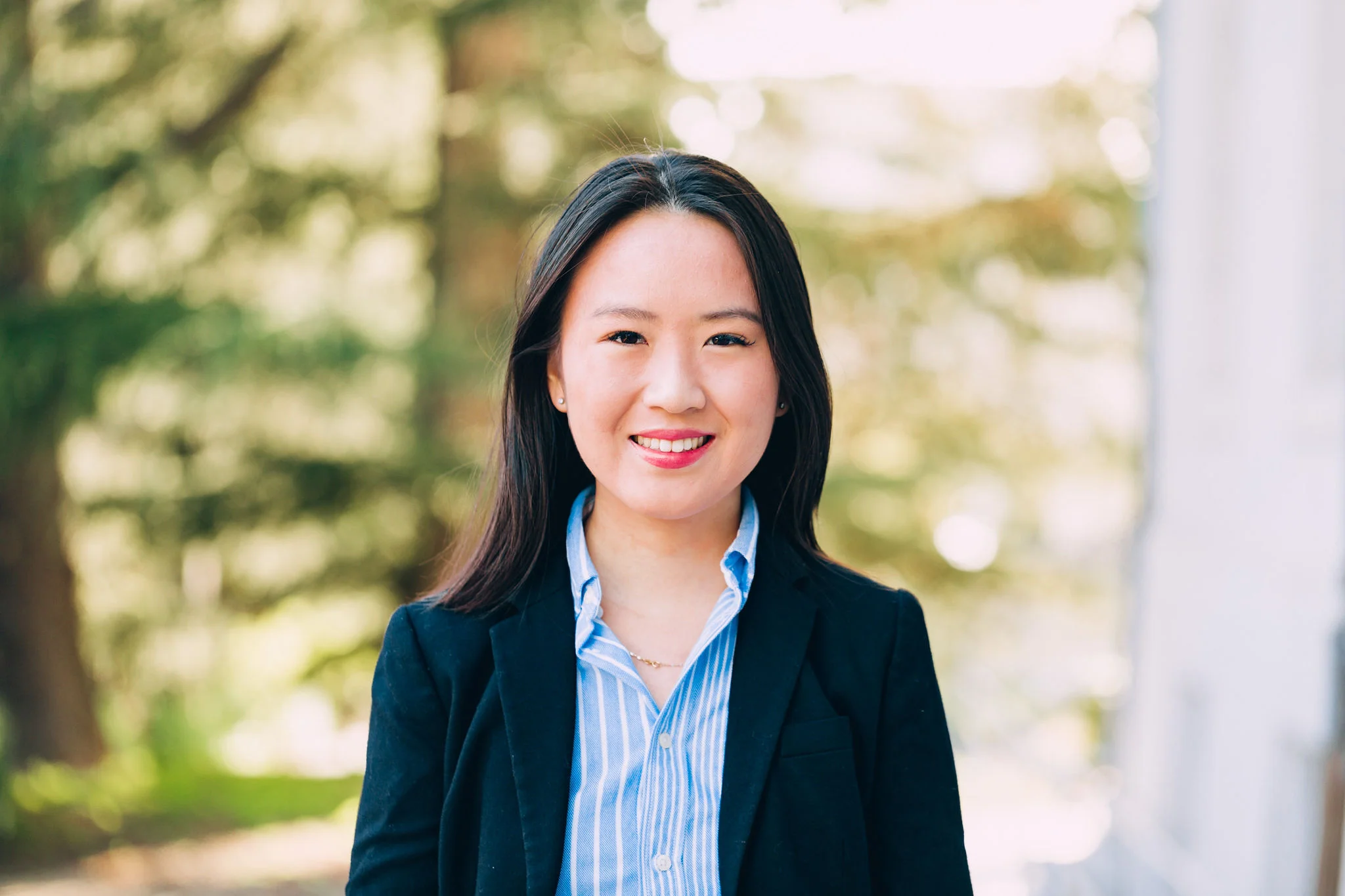
Doctoral Student, Medicine, Columbia University
Ming Pei is currently a pre-health student in the Pre-Medical Post Baccalaureate Program at Columbia University. Previously, she attended University of California, Berkeley earning a B.A. in Statistics and B.A. in Economics. She is interested in public health research and aims to make an impact on healthcare policy making.
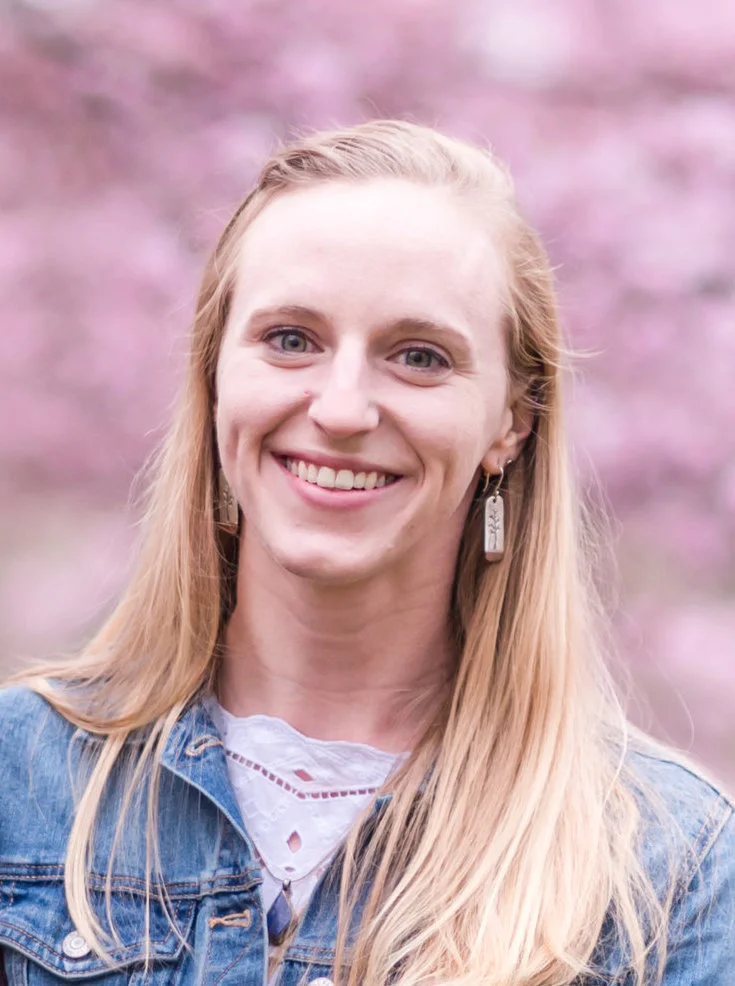
Doctoral Student, Nursing, Columbia University
Maureen Saylor is currently a student in the Master's Direct Entry program at Columbia University School of Nursing. She also graduated in May 2019 from Mailman School of Public Health with her MPH in Population and Family Health. Previously, she served as a Peace Corps Volunteer in Botswana where she primarily worked on projects related to HIV/AIDS and issues surrounding gender-based violence. She is passionate about participatory qualitative research and hopes to pursue a career in community health upon graduating from the MDE program in summer 2020.
Doctoral Student, Medicine, Columbia University
Lewis is a student associate of On the Frontlines: Nursing Leadership in Pandemics. He completed Columbia University’s post-baccalaureate pre-medical program in May 2019, and is currently in the process of applying to medical school.

Racial Capitalism
Since its first usage by antiapartheid activists in South Africa to its elaboration by political theorist, Cedric J. Robinson, racial capitalism is a concept that delineates the interlinked relationships of race and class constitute of global capitalism. The racial capitalism working group is a site of sustained collaborative research and study. Our collective work is rooted in a commitment to Black radicalism, historical materialism, feminism, and anti-imperialism.
Project Directors: Jordan T. Camp, Christina Heatherton, and Manu Karuka
Graduate Assistant: Hannah Pullen-Blasnik
Media Fellow: Larry Madowo (2020)
Since its first usage by antiapartheid activists in South Africa to its elaboration by political theorist Cedric J. Robinson, racial capitalism is a concept that delineates the interlinked relationships of race and class constitutive of global capitalism. The racial capitalism working group is a site of sustained collaborative research and study. Our collective work is rooted in a commitment to Black radicalism, historical materialism, feminism, and anti-imperialism.
The working group, directed by Jordan T. Camp, Term Assistant Professor of American Studies, Barnard College; Christina Heatherton, Assistant Professor of American Studies, Barnard College; and Manu Vimalassery, Assistant Professor of American Studies, Barnard College, theorizes the connections between exploitation and expropriation in interlinked political geographies. The “Racial Capitalism” working group will build on and also expand already existing efforts of the Barnard New Directions in American Studies (NDAS) initiative.
With members that include scholars from Barnard, Columbia, and the Center for Place, Culture, and Politics (CPCP) at the CUNY Graduate Center, as well as local scholars, graduate students, organizers, and visiting international scholars, this group seeks to ask: what visions of justice does the critique of political economy enable us to imagine, and to achieve? Through public lectures, seminars, manuscript workshops, conferences, community-based research projects, publications, exhibitions, and a digital archive, the working group seeks to gain clarity on the material and ideological links between Indigenous dispossession, racism, imperialism, and capitalist political economy.
News
Larry Madowo, Columbia Journalism 2020, has been selected as a Young Global Leader of 2020.
The Racial Capitalism working group co-director’s lecture will examine the early life of Elizabeth Catlett.
CSSD launches six new projects for the 2018-19 academic year. The projects will address gender, race, sexuality, and other forms of inequality to foster ethical and progressive social change.

Elizabeth Catlett, "Watts: Detroit: Washington: Harlem: Newark" (1970)
Past Events
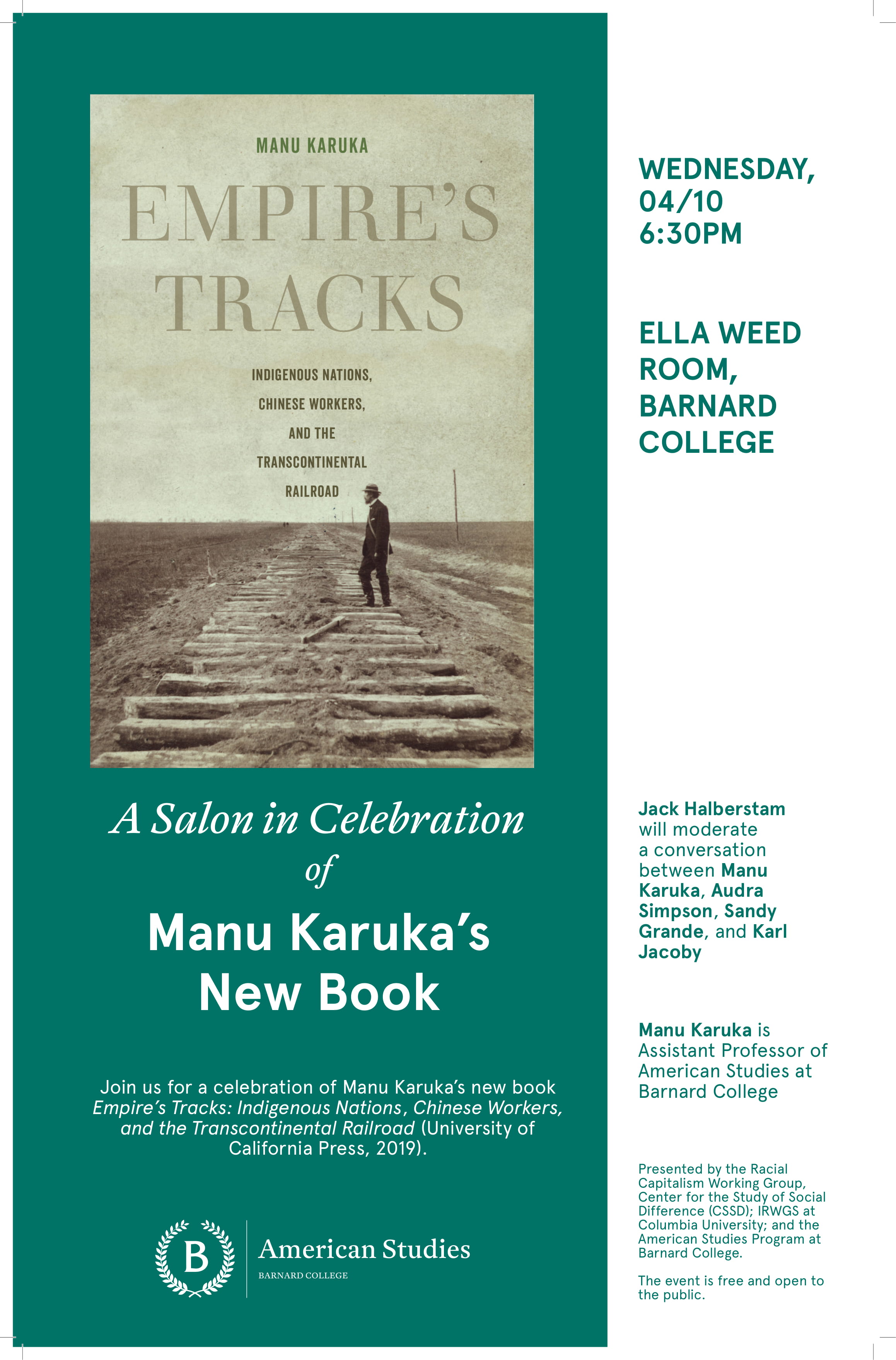


This one-day conference recovers the histories and possible futures of anti-imperialist struggle.
Publications

Queer Aqui
Queer Aqui is a CSSD working group to discuss, debate and investigate the politics of sexuality and gender in a global frame. This group builds upon a vast network of queer scholars worldwide to consider how best to resituate queer studies to respond to shifts in the meanings of family, sexual health, gendered embodiment, religion, sexual practices, gender variance, activism and sexual communities.
formerly Queer Theory: Here, Now, and Everywhere
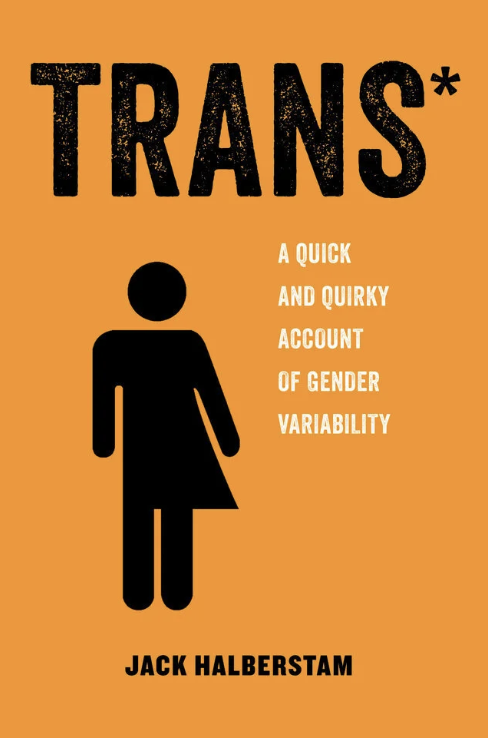
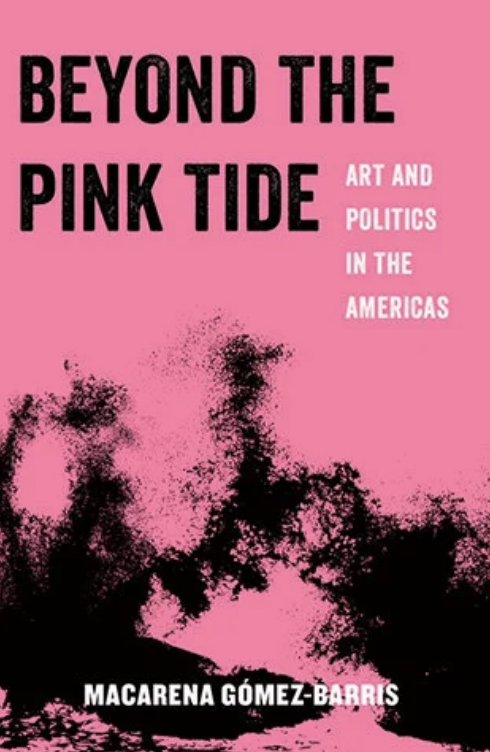
Project Co-Directors: Jack Halberstam, Macarena Gómez-Barris, Daniel Da Silva
Project Coordinator: Levi C. R. Hord
Queer Aqui is a CSSD working group to discuss, debate and investigate the politics of sexuality and gender in a global frame. This group builds upon the vast network of queer scholars here in the New York area and reaches out to groups in Beirut, Buenos Aires, Rio De Janeiro, Quito and Istanbul in order to consider how best to resituate queer studies to respond to shifts in the meanings of family, sexual health, gendered embodiment, religion, sexual practices, gender variance, activism and sexual communities worldwide. This group’s main focus is in considering the place of sexuality and gender in both the spread of global capitalism and right-wing populism and in the activist responses to these new forms of authoritarianism.
Scholars in this group have worked on neoliberalism, LGBT law, trans* issues, transnational imaginaries, queer diaspora, negative affects, art and politics, the queer decolonial, temporality and spatiality, phenomenology and much more. This is a multidisciplinary group with many transnational contacts and contexts that is committed to asking questions about the future of queer politics, the future of queer culture and the potential of new forms of solidarity, protest and queer thought.
News
Columbia Law Professor Franke commented on new US legislation to combat anti-Asian hate crimes.
In “Empirical Ephemera,” Professor Agard-Jones used the concept-metaphor of sand to consider how coloniality is made material.
Congratulations to Spring 2021 Grant awardees Kevin Fellezs (Music), Natasha Lightfoot (History), and Camille Robcis (French, History).
This piece, by the Queer Aqui working fellow, reflects on life experiences during the pandemic lockdown.
The Queer Aqui working group fellow member spoke with Vivan Ziherl at the event hosted by SVA NYC.
Elizabeth Povinelli and the Karrabing Film Collective screened a visual essay for the conference
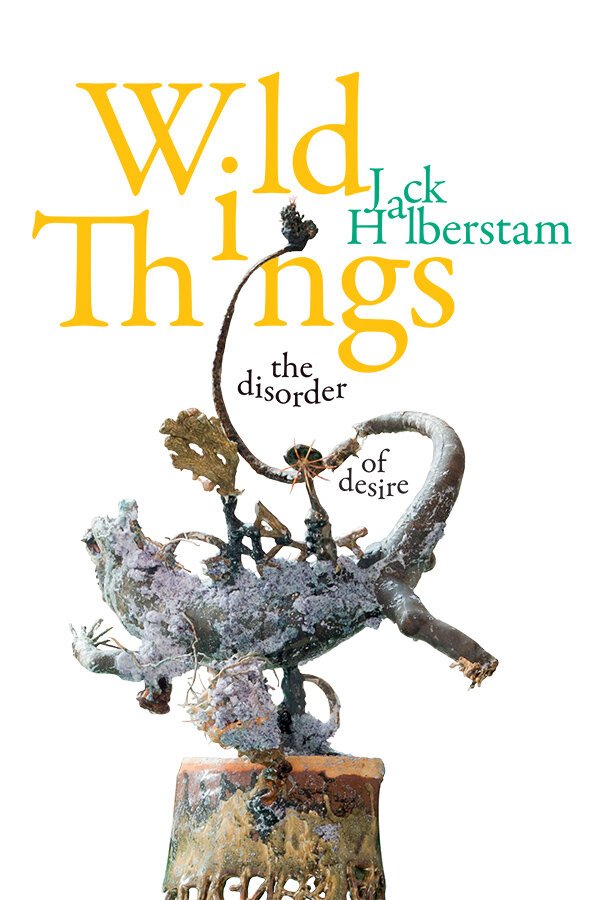
Jack Halberstam’s Wild Things: The Disorder of Desire (2020) is published by Duke University Press.
Publications

"Facial Weaponization Suite: Fag Face Mask” by Zach Blas, 2012, photo by Christopher O’Leary.
Past Events

Queer Aqui: Together in Hard Times (Queer Aqui: Juntos em Tempos Difíceis) focuses upon questions about the reliance of new right-wing populist regimes on homophobic, transphobic and misogynist ideologies



This panel will engage five emerging LGBTQ filmmakers from the Arab world in a meaningful discussion on the role of Arab queer cinema in shaping and giving voice to the Arab LGBTQ community.


Celebrate the launch of CSSD's newest working group, Queer Theory: Here, Now, and Everywhere, with the Queer Disruptions conference on March 1-2, 2018.
Fellows
Assistant Professor, Department of Anthropology, Columbia University
Vanessa Agard-Jones is Assistant Professor of Anthropology at Columbia University, where she maintains affiliations with the Institute for Research on Women, Gender and Sexuality, the Center for Science and Society, the Earth Institute, and the Department of African American and African Diaspora Studies. At its most expansive, Agard-Jones’ work asks how coloniality is made material: in social forms, in human and nonhuman bodies, and in the landscapes in which we live.
Fellow, Portuguese, Rutgers University
Daniel da Silva’s research specializes in gender, sexuality, race, performance and popular music in the Portuguese-speaking world. His forthcoming book, Trans Tessituras: Transatlantic and Transgender Luso-Afro-Brazilian Popular Music analyzes popular music iterations of transgender voices in Brazil, Portugal and Angola to show how they amplify and refigure the gendered conventions of Portuguese-language popular music genres by pulling at national and transatlantic histories of race, gender and sexuality.
Journalist, Activist, Professor, Social & Cultural Analysis, New York University
Lisa Duggan is a journalist, activist, and Professor of Social & Cultural Analysis at New York University. She is author of Sapphic Slashers: Sex, Sensationalism and American Modernity and Twilight of Equality? Neoliberalism, Cultural Politics and the Attack on Democracy, co-author with Nan Hunter of Sex Wars: Sexual Dissent and Political Culture, and co-editor with Lauren Berlant of Our Monica, Ourselves: The Clinton Affair and National Interest.
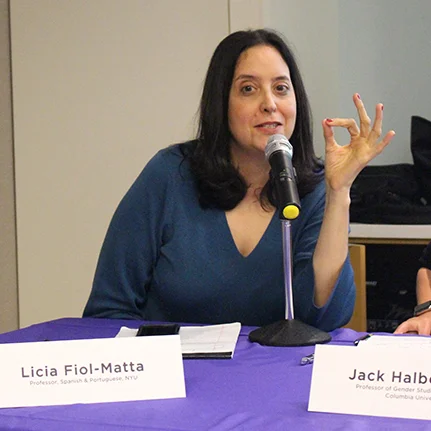
Fellow, Spanish and Portuguese, New York University
Licia Fiol-Matta is Professor of Spanish and Portuguese at New York University. She received an AB from Princeton University and a PhD from Yale University, both in Comparative Literature. Prior to joining NYU she taught at Barnard College and the City University of New York.
Ph.D. Candidate, English and Comparative Literature, Columbia University
Mia Florin-Sefton is a Ph.D. candidate and University Writing Instructor in the English & Comparative Literature Department at Columbia University, where she specializes in 20th and 21st century transatlantic anglophone literatures and culture; with a focus on how narratives of succession mediate and explicate the shifting relationship between biological and economic theories of heredity and inheritance. She is also currently at work on a project that looks at the history of sex glands and early history of hormone replacement therapy in the context of theories of racial degeneration and eugenics post-World War I.
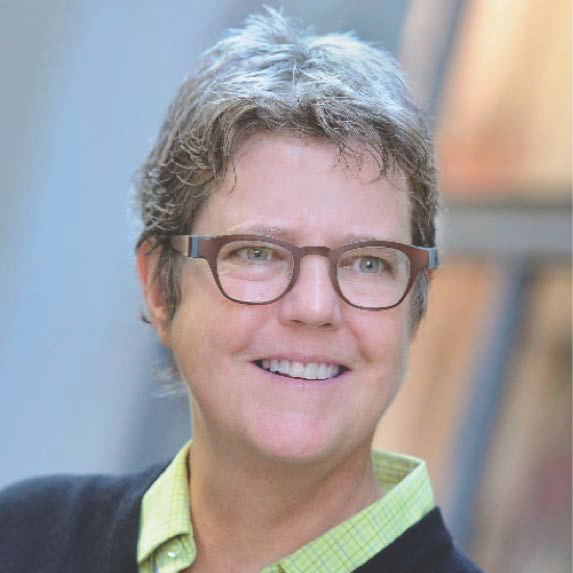
Professor, Department of Law, Columbia Law School
Katherine Franke is the Sulzbacher Professor of Law at Columbia Law School, where she also directs the Center for Gender and Sexuality Law and is the faculty director of the Public Rights/Private Conscience Project. She is a member of the Executive Committee for the Institute for Research on Women, Gender and Sexuality, a member of the Steering Committee for the Center for the Study of Social Difference, and an Affiliated Faculty member for the Center for Palestine Studies. She is among the nation's leading scholars writing on law, religion and rights, drawing from feminist, queer, and critical race theory.
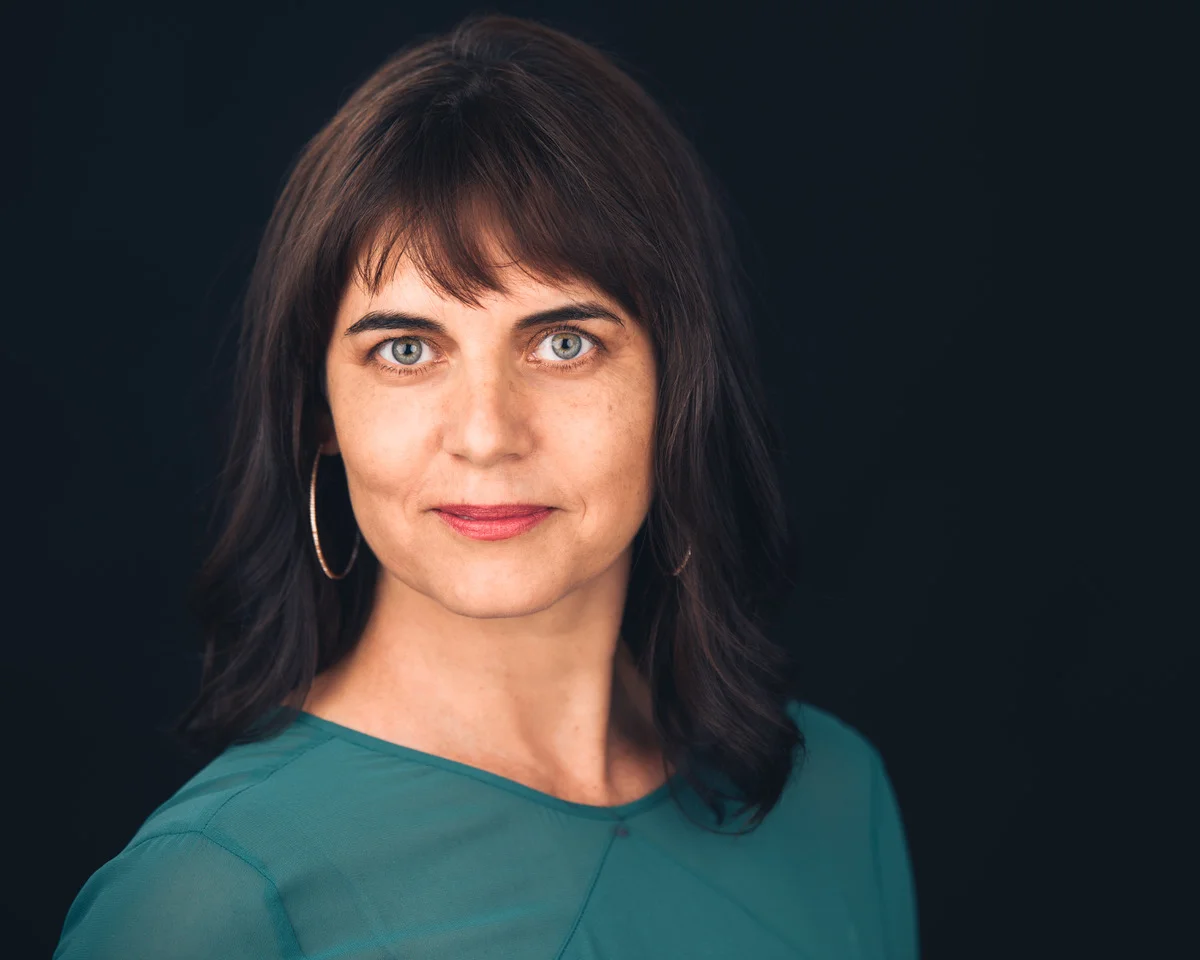
Fellow, Social Sciences and Cultural Studies at Pratt Institute
Macarena Gómez-Barris is author of Where Memory Dwells: Culture and State Violence in Chile (UC Press 2010), The Extractive Zone: Social Ecologies and Decolonial Perspectives (Duke University Press 2017), and Beyond the Pink Tide: Artistic and Political Undercurrents in the Americas (UC Press 2018). Her new book project is At the Sea’s Edge: On Coloniality and the Oceanic.
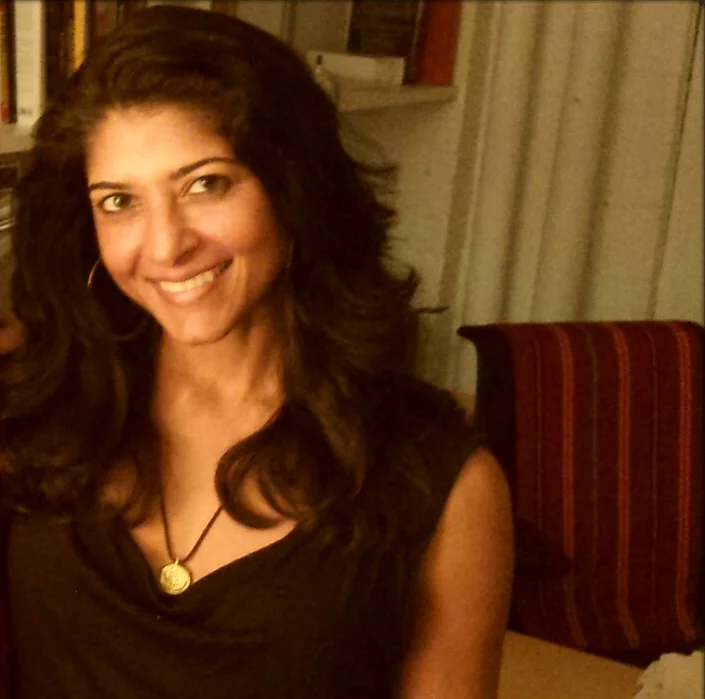
Fellow, Gender and Sexuality, New York University
Gayatri Gopinath is Associate Professor in the Department of Social and Cultural Analysis, and the Director of the Center for the Study of Gender and Sexuality at New York University. She works at the intersection of transnational feminist and queer studies, postcolonial studies, and diaspora studies, and is the author of Impossible Desires: Queer Diasporas and South Asian Public Cultures (Duke UP, 2005), and Unruly Visions: The Aesthetic Practices of Queer Diaspora (forthcoming from Duke UP in November 2018).
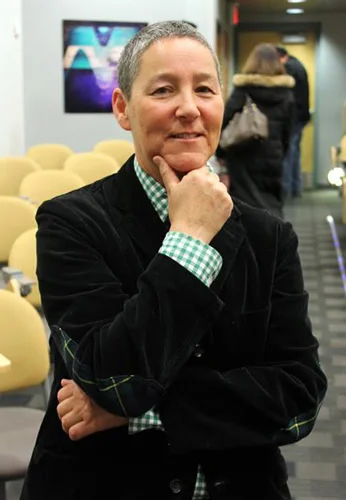
Halberstam works in the areas of popular, visual and queer culture with an emphasis on subcultures. Halberstam’s first book, Skin Shows: Gothic Horror and the Technology of Monsters (1995), was a study of popular gothic cultures of the 19th and 20th centuries and it stretched from Frankenstein to contemporary horror film. Her 1998 book, Female Masculinity (1998), made a ground breaking argument about non-male masculinity and tracked the impact of female masculinity upon hegemonic genders.
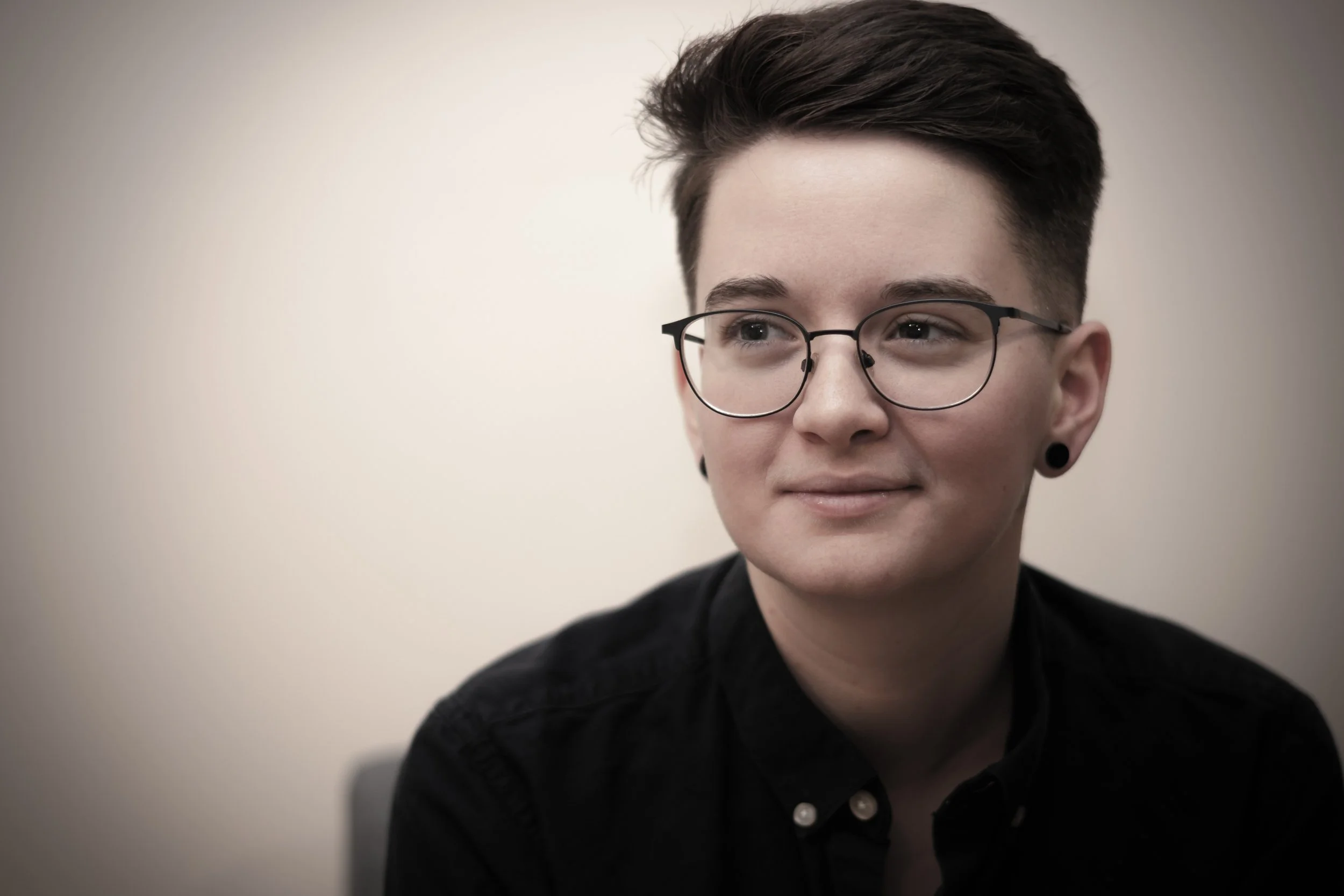
PhD Candidate, English & Comparative Literature, Columbia University
Levi C. R. Hord is a writer, scholar, and public speaker based in Lenapehoking (New York City). They are currently a Ph.D. student in the department of English & Comparative Literature at Columbia University, where they hold a Doctoral Fellowship from the Social Sciences and Humanities Research Council of Canada.
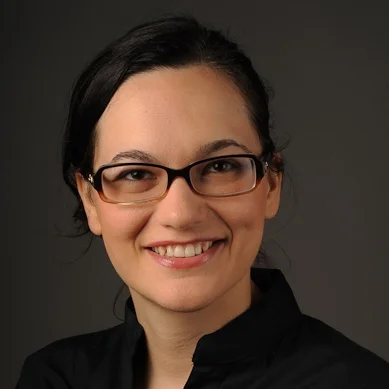
Associate Professor, Spanish & Latin American Cultures, Barnard College
Maja Horn specializes in contemporary Caribbean cultures with a focus on literature, visual and performance art, and political culture. She is the author of Masculinity after Trujillo: The Politics of Gender in Dominican Literature (University Press of Florida in 2014) and is currently completing a second monograph on queer Dominican literature, visual and performance art. She has also published on Latin American and Caribbean arts for various Dominican and U.S. art magazines and is currently serves on the editorial committee for the journal Small Axe: A Caribbean Journal of Criticism.
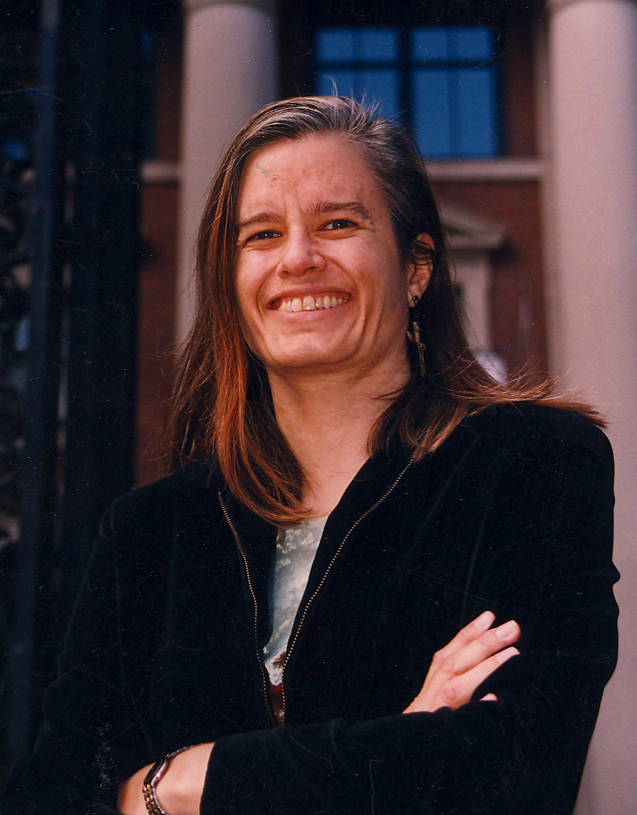
Professor, Department of Women's Gender and Sexuality Studies, Barnard College
Janet R. Jakobsen is Claire Tow Professor and Chair of Women's Gender and Sexuality Studies at Barnard College, Columbia University. She served fifteen years as Director of the Barnard Center for Research on Women (BCRW), and she has also served as Dean for Faculty Diversity and Development.

Assistant Professor, Department of Sociology, Columbia University
Tey Meadow is assistant professor of sociology at Columbia. She is the author of Trans Kids: Being Gendered in the Twenty-First Century, and the coeditor of Other Please Specify: Queer Methods in Sociology. Her work has appeared in Gender & Society, Sexualities, Contemporary Ethnography, Race & Ethnic Studies, Politics & Society and a number of edited volumes.
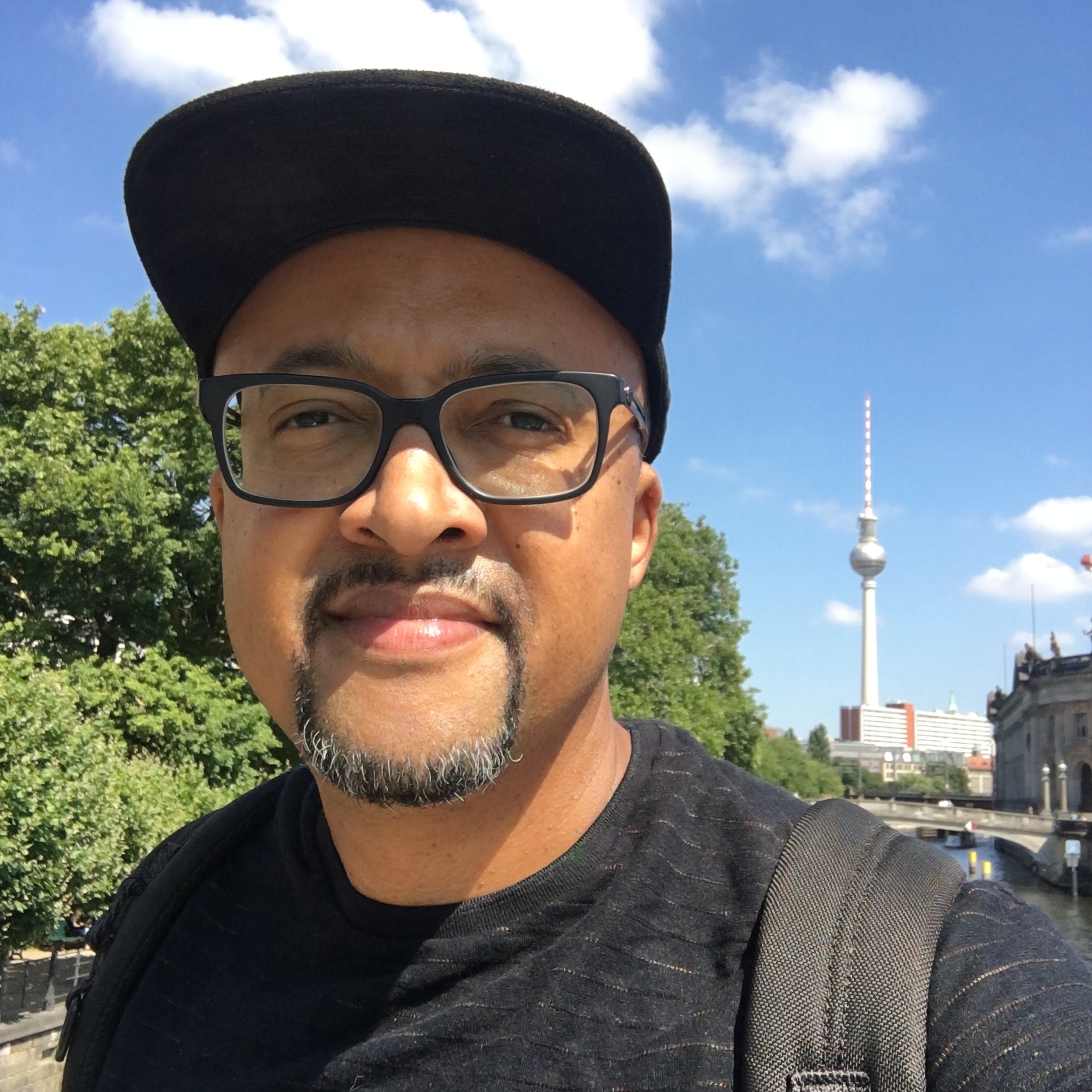
Professor, Performance Studies, Yale University
Tavia Nyong'o is a professor of performance studies at Yale University, where he teaches in the American Studies, African American Studies, Women's, Gender, & Sexuality Studies and Theater Studies programs. His books include The Amalgamation Waltz: Race, Performance, and the Ruses of Memory (2009) and Afro-Fabulations: The Queer Drama of Black Life (2018).
Associate Professor, Department of History and French, Columbia University
Camille Robcis specializes in modern European intellectual history, with a focus on nineteenth- and twentieth-century France. Her interests have circled around three issues: the historical construction of norms, the intellectual production of knowledge, and the articulation of universalism and difference in modern French history. Prior to coming to Columbia, she taught at Cornell for ten years.
PhD Candidate, Latin American and Iberian Cultures, Columbia University
Daniel S. Sáenz is a Colombian-Canadian Settler, writer, art historian, and occasional independent curator based in Lenapehoking (New York City) and Tiohtiá:ke (Montréal). He is currently a Ph.D. student and Teaching Fellow in the Department of Latin American and Iberian Cultures at Columbia University, where he holds a Doctoral Fellowship from the Social Sciences and Humanities Research Council of Canada.
Fellow, Women’s and Gender Studies, Rutgers University, New Brunswick
Kyla Schuller is Associate Professor of Women’s and Gender Studies at Rutgers University, New Brunswick and author of The Biopolitics of Feeling: Race, Sex, and Science in the Nineteenth Century (Durham, NC: Duke University Press, 2018).
Nash Professor of Law, Columbia Law School
Kendall Thomas is the Nash Professor of Law and co-founder and Director of the Center for the Study of Law and Culture. His teaching and research interests include U.S. and comparative constitutional law, human rights, legal philosophy, feminist legal theory, Critical Race Theory and Law and Sexuality. A past Visiting Professor at Stanford Law School, and Visiting Professor in American Studies and Afro-American Studies at Princeton University, Thomas has taught or lectured in France, The Netherlands, England, The Czech Republic, Germany, Haiti and South Africa. His writings have appeared in several academic journals and volumes of collected essays.
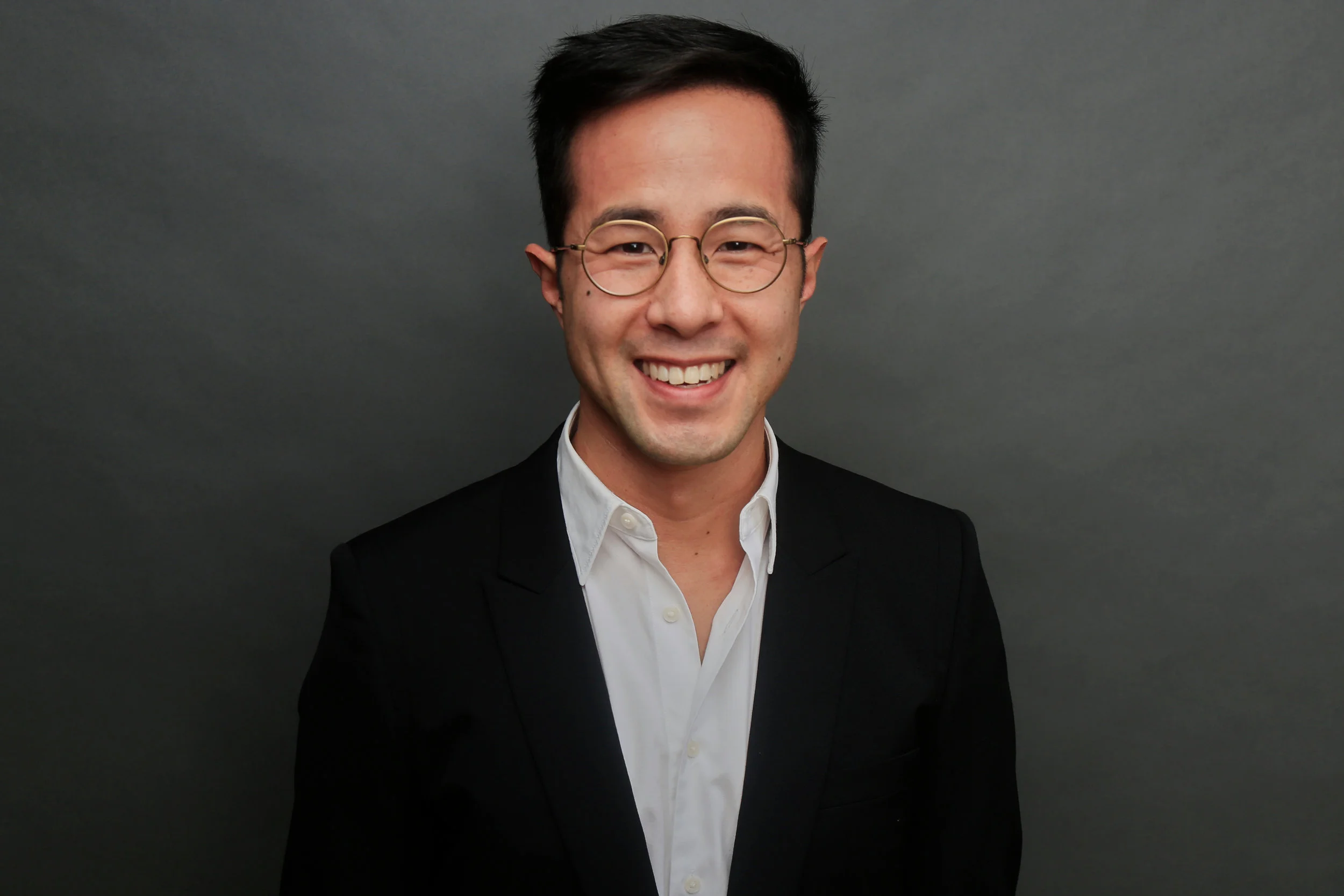
Fellow, Art & Public Policy, New York University
Hentyle Yapp is an assistant professor at New York University in the Department of Art & Public Policy. He is affiliated faculty with the Department of Performance Studies, Disability Council, and Asian/Pacific/American Institute. His research engages China, performance, disability, and queer theory.

Religion and the Global Framing of Gender Violence
Who pays the price and who benefits from the ways that religion is used to frame global understandings of Violence Against Women and gender violence? Religion and the Global Framing of Gender Violence (2016-19) aimed to reframe the conversation.
Project Directors: Lila Abu-Lughod, Rema Hammami, Janet Jakobsen, Nadera Shalhoub-Kevorkian
Over the past couple of decades, violence against women (VAW)––and more recently, the expansive term “gender-based violence” (GBV)––has come to prominence as a highly visible and powerful agenda across a range of local, national, and global domains. By embedding gender violence in a complex matrix of international norms, legal sanctions, and humanitarian aid, the anti-VAW movement has been able to achieve a powerful international “common sense” for defining, measuring, and attending to violence against women in developing countries, particularly during conflict and post-conflict situations. Here, religion is regularly linked to gendered violence. We have seen this script play out countless times. Entire religious traditions are said to promote “cultures of violence.” Women in war are then abstracted out of their local contexts. The definition of VAW is narrowed to attacks on their bodily integrity (e.g. rape), and economic, political and structural forms of violence are excluded. Ending VAW becomes casus belli; local women’s calls for safe homes, safe public spaces, and stable governments are rendered unrecognizable as anti-violence interventions.
However, despite this powerful conflation of religion and VAW for geo-political ends, the crucial question of how religion intersects with VAW/GBV has hardly begun to be considered. Why and when is “religion” invoked in global responses to VAW/GBV? What roles are attributed to religion in these dynamic processes? How are new understandings of “religion” engineered through regimes of governance? What categories of the religious become seen as credible and acceptable, and are empowered as anti-GBV actors? What falls out? Who pays a price and who benefits from the ways religion is used to frame global understandings of VAW/GBV?
Given growing concerns about the conflation of religion and VAW for geo-political ends, the time is ripe for a project that mobilizes the collective experience, expertise, and creativity of an international group of critical feminist scholars, practitioners, activists, and journalists. “Religion and the Global Framing of Gender Violence” examined the role of religion in naming, framing, and governing gendered violence. This three-year initiative was supported by a grant from the Henry Luce Foundation and was co-directed by Professor Lila Abu-Lughod (Anthropology/Institute for Research on Women, Gender, and Sexuality). Through a focus on the Middle East and South Asia, the project opened a critical global conversation with the conviction that more nuanced analyses lead both to more effective strategies for decreasing gender violence, and to more robust understandings of how certain framings of religion and violence can cloud the very diagnoses that are so essential to treating human suffering.
Project co-directors with Abu-Lughod included Professors Rema Hammami, Institute of Women’s Studies, Birzeit University; Janet Jakobsen, Department of Women’s, Gender and Sexuality Studies, Barnard College; and Nadera Shalhoub-Kevorkian, Director of the Gender Studies Program, Mada Al-Carmel, Arab Center for Applied Research.
The project is supported by a generous grant from the Henry Luce Foundation from its initiative on Religion and International Affairs.
News
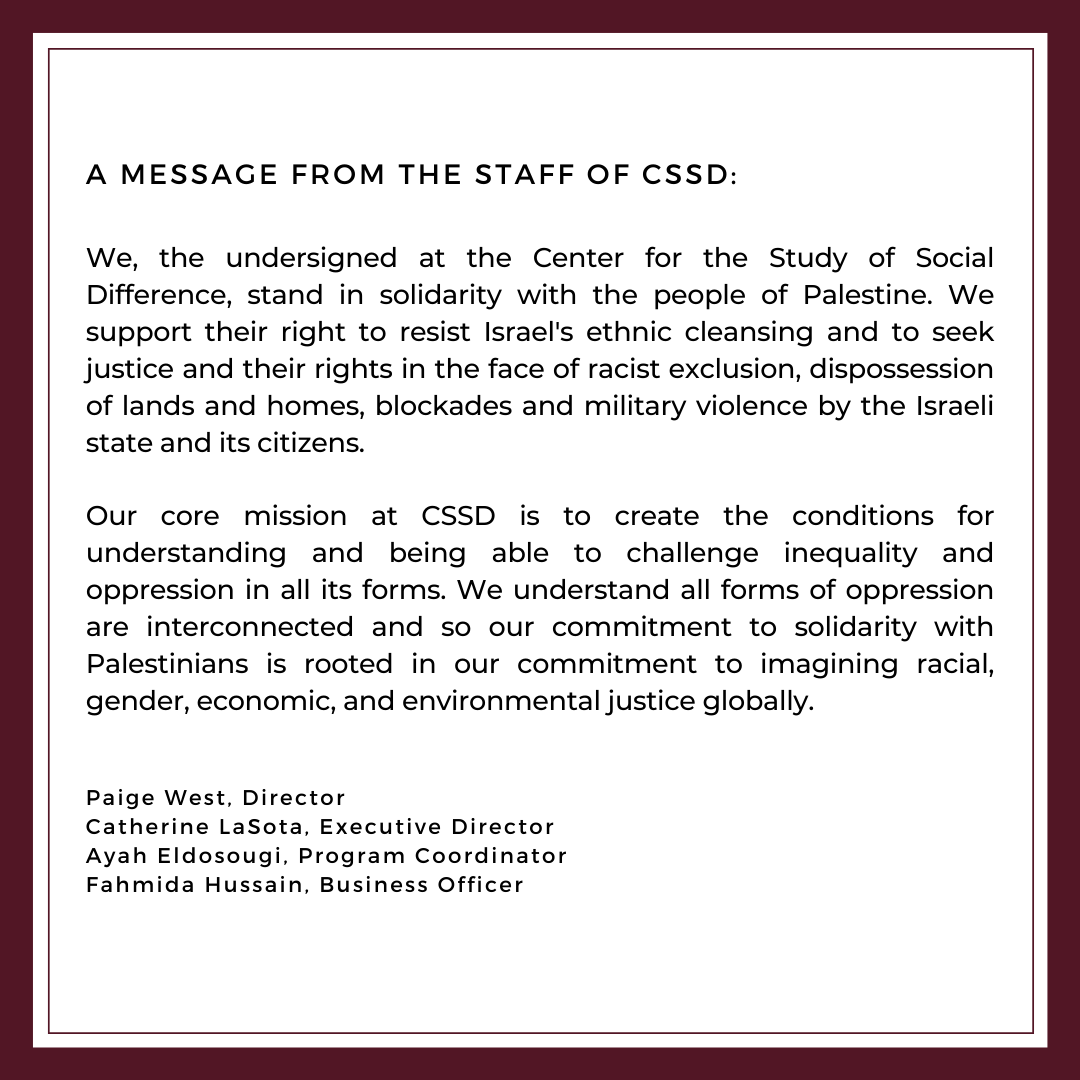
Our core mission at CSSD is to create the conditions for understanding and being able to challenge inequality and oppression in all its forms. We understand all forms of oppression are interconnected and so our commitment to solidarity with Palestinians is rooted in our commitment to imagining racial, gender, economic, and environmental justice globally.
Working group fellows have been busy writing critical work on the politics of gendered violence in fields ranging from Anthropology to Law and Public Policy.
The former Reframing Gendered Violence co-director’s Do Muslim Women Need Saving? was referenced in a review of a new book on 21 Women Across the History of Islam.
CSSD working group RGFGV hosts twenty-five scholars, journalists, lawyers and activists for a two day intensive workshop of collaborative research sharing and brainstorming at Columbia University in New York City
Professor Lila Abu-Lughod delivers lecture for distinguished series on human rights at the University of Alberta
Maryam Saleh writes about the ways in which Syrian women in Turkey are redefining their independence.
Lila Abu-Lughod, co-director of CSSD working group Religion and the Global Framing of Gender Violence, shares her thoughts on two new books in the publication Public Books.
CSSD Project Religion and the Global Framing of Gender Violence announces its second Media Fellowship Competition.

Fellows
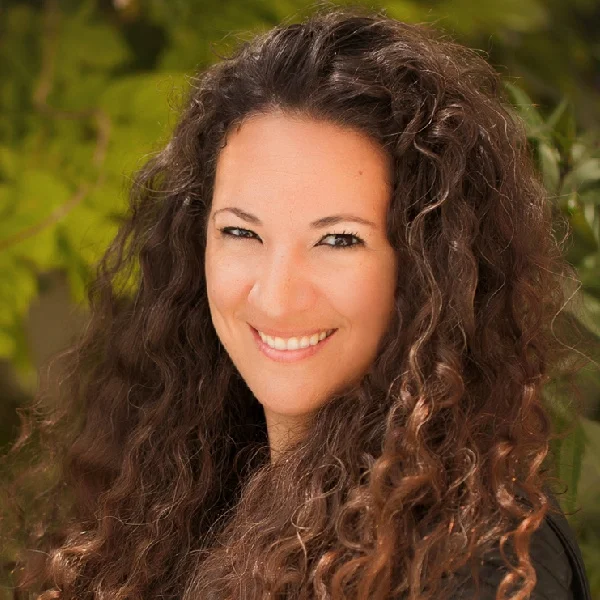
Fellow, Strategic Studies, University of Jordan
Sara Ababneh is Assistant Professor at the University of Jordan’s Center for Strategic Studies. She is the Refugee Studies Diploma and CSS Internship program coordinator, and she wrote her dissertation on female Islamists in Hamas in occupied Palestine and the Islamic Action Front in Jordan.

Fellow, Gender Studies, SOAS University of London
Nadje Al-Ali is Professor of Gender Studies at the Centre for Gender Studies (CGS), SOAS University of London. She is currently chair of CGS and head of the Doctoral School at SOAS. Her main research interests revolve around feminist activism; transnational migration and diaspora moblization; war, conflict and peace; as well as art & cultural studies; mainly with reference to Iraq, Egypt, Turkey and the Kurdish political movement.

Fellow, Language and Communication, American University of Madaba
Wafa Al-Khadra is a university professor and experienced university administrator, currently serving as Dean of Faculty of Languages and Communication at the American University of Madaba.
Fellow, Economics, Mount Holyoke College
Nissreen Haram holds a B.A. in economics from Mount Holyoke College in Massachusetts and an M.A. in Islamic Studies from McGill University in Montreal. She has had a diverse career as a Trade Policy Advisor, Law Firm Director, Children’s Museum Director, and Artisan Cheese maker. She has also been member of the Yale Law School Middle East Seminar, and its organizing committee for more than 15 years. She is actively interested in Islamic legal and intellectual history, and contemporary approaches to religious reform.
Fellow, Sociology, Rutgers
Zahra Ali is an Assistant Professor of Sociology at Rutgers, Newark. Her research explores women and gender issues in relation to Islam and the Middle East, as well as contemporary Muslim communities and Islamisms.
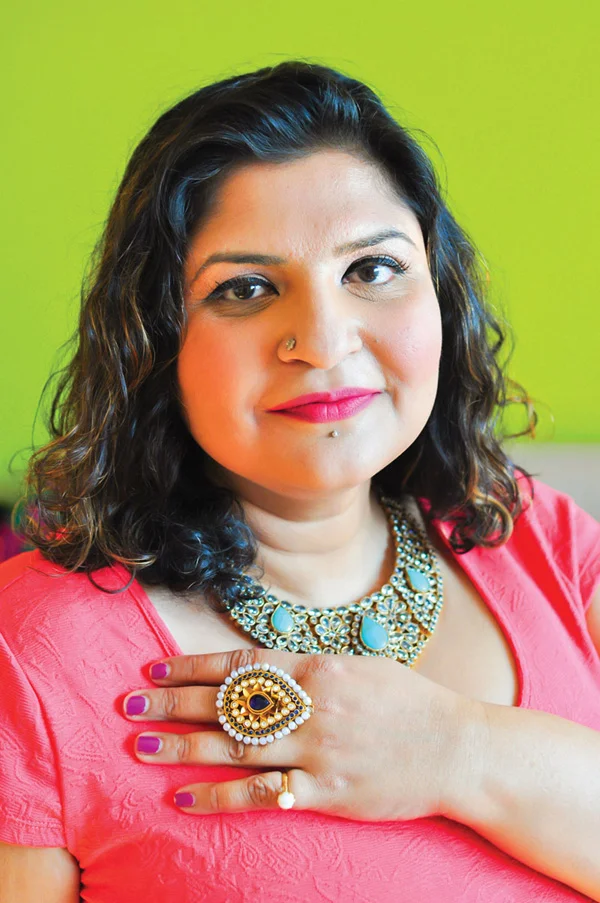
Fellow, Human Rights, International Youth Health and Rights at Advocates for Youth
Urooj Arshad is the Associate director of International Youth Health and Rights at Advocates for Youth. She manages a project of the International Division that builds the capacity of youth-driven organizations in Africa, Asia, Latin America, and the Caribbean to empower young people.
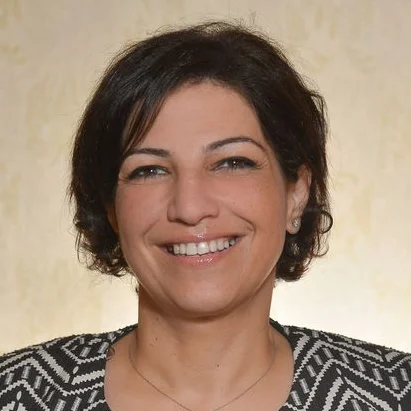
Fellow, Executive Director, Justice Center for Legal Aid in Jordan
Hadeel Aziz is the Executive Director of the Justice Center for Legal Aid in Jordan. In 2008, Hadeel pioneered free legal assistance in Jordan when she left a multi-million dollar USAID project on the rule of law to co-found the Justice Center for Legal Aid (JCLA).

Fellow, Inclusive Policies, Tata Institute of Social Sciences Centre
Qudsiya Contractor is an Assistant Professor at the Tata Institute of Social Sciences Centre for Study of Social Exclusion and Inclusive Policies, School of Research Methodology.
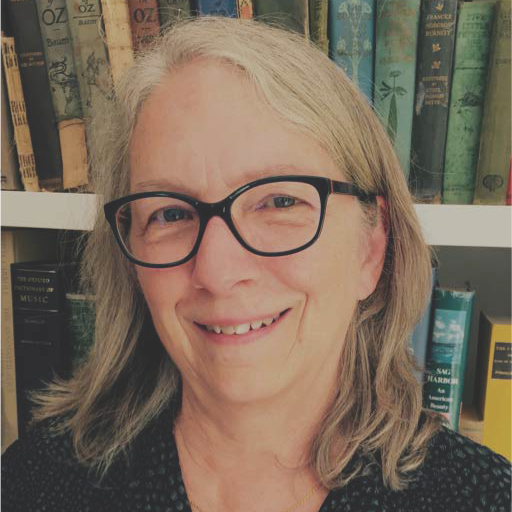
Professor, Department of Religion, Columbia University
Katherine Pratt Ewing is Professor of Religion and Director of the Institute for Religion, Culture and Public Life at Columbia University. She has carried out ethnographic fieldwork in Pakistan, Turkey, and India, and among Muslims in Europe and the United States. Her research has focused on debates among Muslims about the proper practice of Islam in the modern world, the place of Muslims within the German national imaginary, and sexualities, gender, and the body in South Asia.
Fellow, International Policy, Stanford University
Amal Ghandour is Strategy Adviser to Ruwwad al Tanmeyah, a regional community development initiative, and Special Adviser to Columbia University Global Centers, Middle East. Ghandour’s career spans two decades in the fields of research and communication. An author (About This Man Called Ali) and a blogger (Thinking Fits), Ghandour holds an MS in International Policy from Stanford University and a BSFS from Georgetown University.
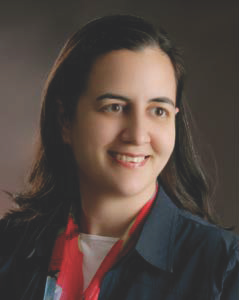
Fellow, Gender Social Fund, Jordon
Hala Ghosheh is a gender expert and development consultant, who was the Director of the five year Gender Social Fund in Jordan. She specializes in sustainable development work with focus on women and youth. Her experience includes working on policy, institutional and local community levels in several countries in the region. She has worked on program management, design, development and monitoring and evaluation, organizational gender reviews and conducting qualitative research to assess the status of women and youth in different contexts.
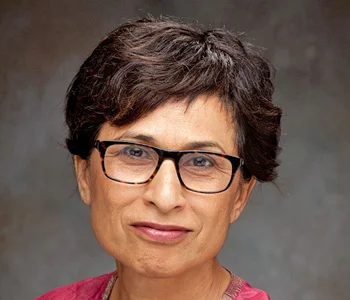
Fellow, Women's, Gender, and Sexuality Studies and American Studies, Yale University
Inderpal Grewal is Professor and Chair in the Program in Women’s, Gender, and Sexuality Studies at Yale University. She is also Professor in the Ethnicity, Race and Migration Studies Program, the South Asian Studies Council, and affiliate faculty in the American Studies Program. She is the author of Home and Harem: Nation, Gender, Empire and the Cultures of Travel(Duke University Press, 1996), Transnational America: Feminisms, Diasporas, Neoliberalisms (Duke University Press, 2005), and Saving the Security State: Exceptional Citizens in Twenty-First century America (Duke University Press, 2017).
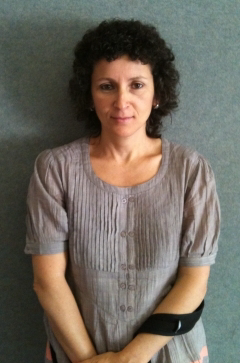
Fellow, Sociology, University of Paris 8 Vincennes-Saint-Denis
Nacira Guénif-Souilamas is Professor, University of Paris 8 Vincennes-Saint-Denis, Education Sciences Department.
She was formerly Associate Professor at the University of Paris Nord/13 and Co-Director of EXPERICE Research Center.
Guénif-Souilamas holds a Phd in Sociology from l’École des Hautes Études en Sciences Sociales in Paris and a HDR of Sciences Po Paris.
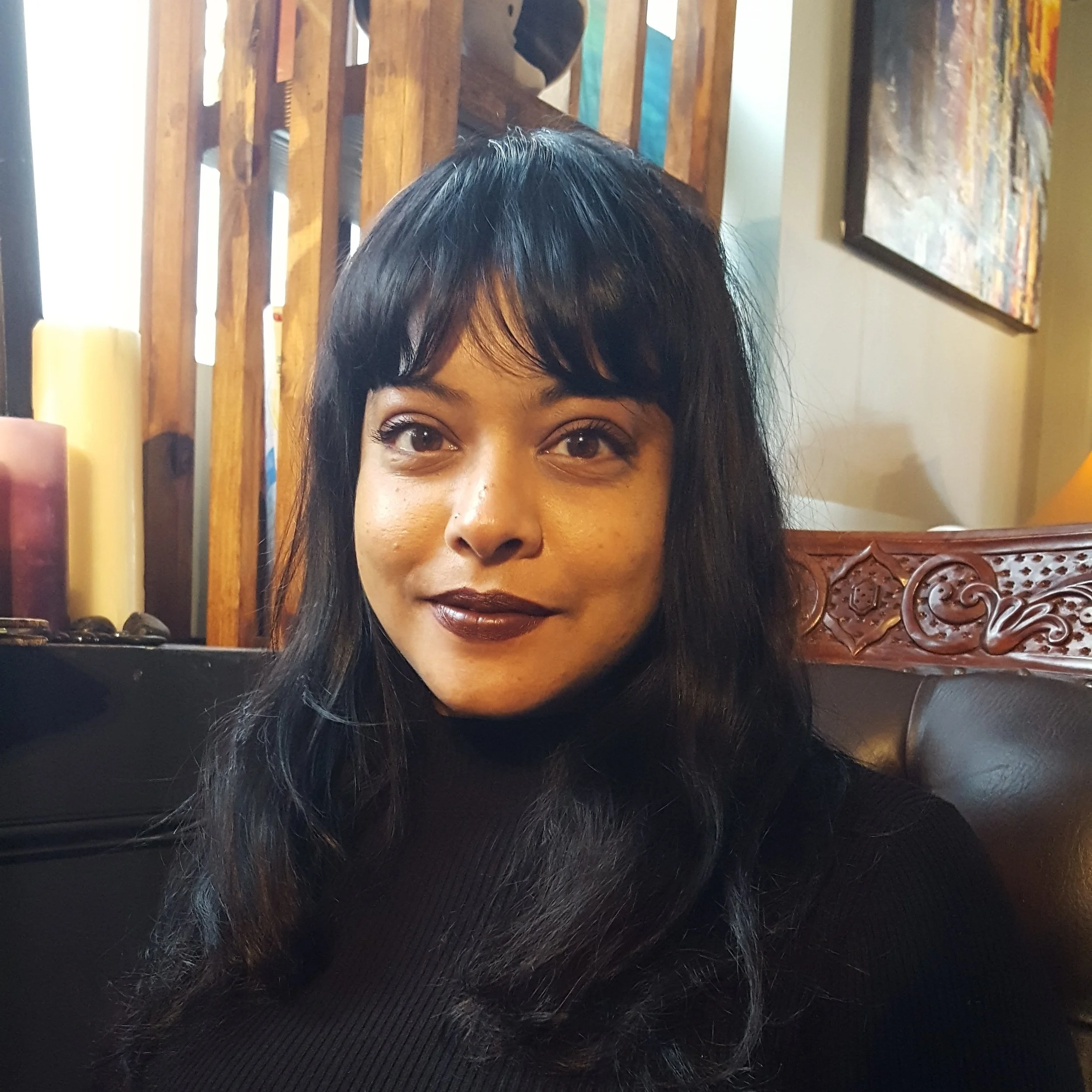
Fellow, South Asian Studies, Columbia University
Joymala Hajra divides her time between the Religion and the Global Framing of Gender Violence Project, where she is the Program Coordinator and The Institute for Religion, Culture, and Public Life, where she is the Manager of Design and Communication.
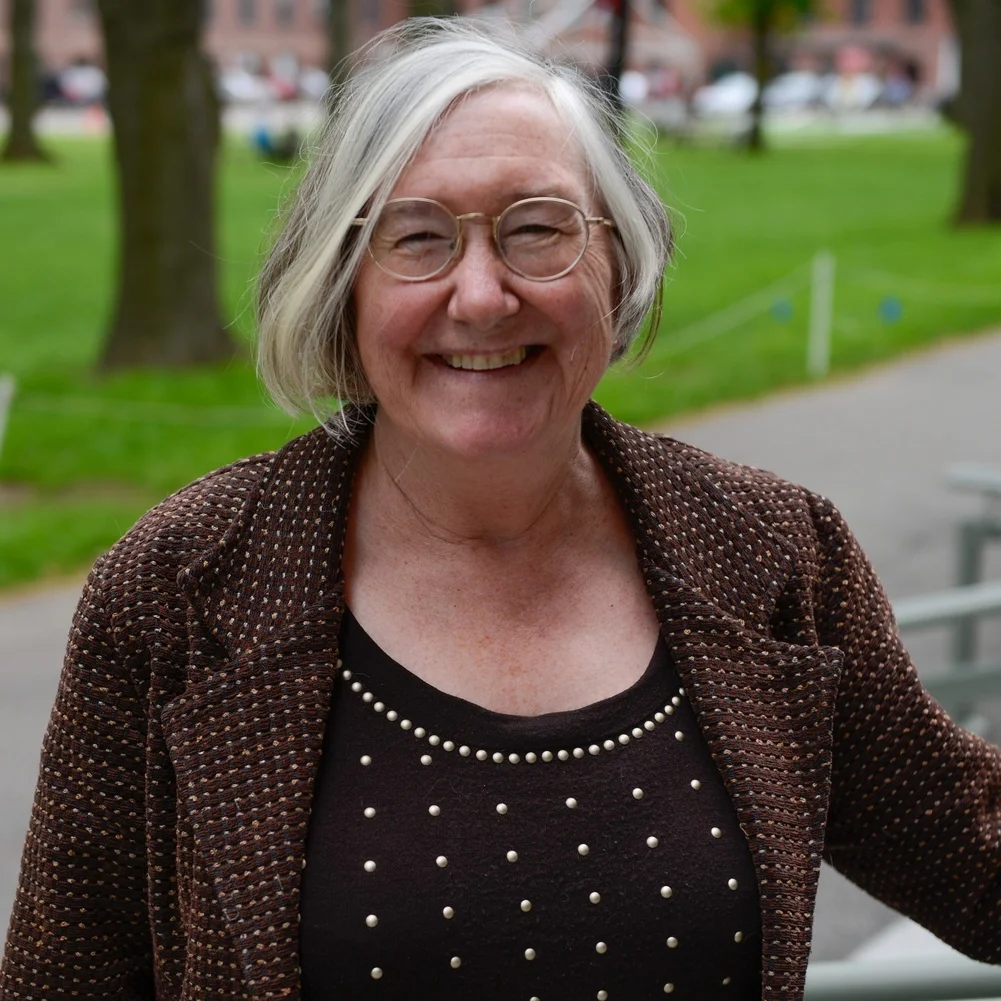
Fellow, Royall Professor of Law, Harvard Law School
Janet Halley is the Royall Professor of Law at Harvard Law School. She has a Ph.D. in English Literature from UCLA and a J.D. from Yale Law School. She has taught at Tel Aviv Buckmann School of Law and in the Law Department of the American University in Cairo. She is the author of Split Decisions: How and Why to Take a Break from Feminism (Princeton 2006), and Don’t: A Reader’s Guide to the Military’s Anti-Gay Policy (Duke 1999). With Wendy Brown, she coedited Left Legalism/Left Critique (Duke 2002), and with Andrew Parker she coedited After Sex?
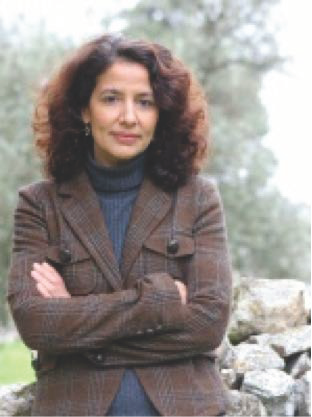
Fellow, Anthropology, Birzeit University
Rema Hammami is Associate Professor of Anthropology at the Institute of Women’s Studies, Birzeit University where she founded the graduate program in Gender and Development in 1998, the first graduate program in gender studies in the region.
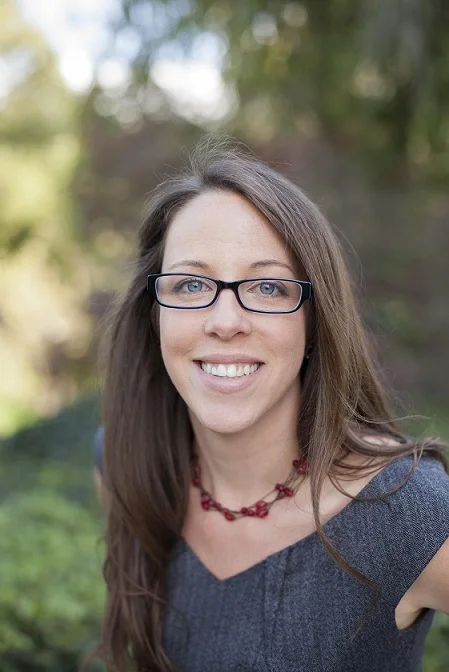
Chair and Assistant Professor, Rhetoric Studies, Whitman College
Heather Ashley Hayes is Chair and Assistant Professor of Rhetoric Studies at Whitman College. She works across the intersections of rhetorical materialism, race, violence, the global war on terror, and argument studies. Since 2013, she has delivered a number of talks and presentations including work on the revolutionary events in Egypt's Tahrir Square that ousted Hosni Mubarak in January of 2011.
Professor, Department of Women's Gender and Sexuality Studies, Barnard College
Janet R. Jakobsen is Claire Tow Professor and Chair of Women's Gender and Sexuality Studies at Barnard College, Columbia University. She served fifteen years as Director of the Barnard Center for Research on Women (BCRW), and she has also served as Dean for Faculty Diversity and Development.
Doctoral Student, Gender, Sexuality, and Women’s Studies, University of Pennsylvania
Shenila Khoji-Moolji received her doctorate in Education and additional certification in Feminist Theory from Columbia University in 2016. Her research interests include examining discourses on gender and education, and their entanglement with practices of power. Dr. Khoja-Moolji’s work problematizes the centering of girls’ education and empowerment as a solution to societal problems, especially in relation to Muslim-majority nations.
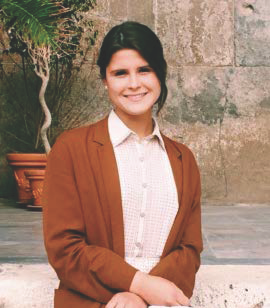
PhD Student, English and Comparative Literature, Columbia University
Liza McIntosh is a PhD student in the department of English and Comparative Literature at Columbia. She is broadly interested in the culture and texts of the Early Modern period, with a focus on questions of gender, sexuality, and nature. She received her BA from Johns Hopkins University in English and Art History.
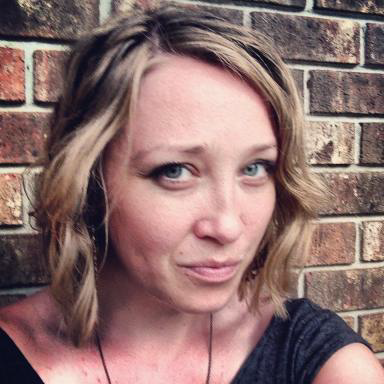
Graduate Student, Religion, Columbia University
Laura McTighe is a Ph.D. candidate in the Department of Religion at Columbia University. She comes to her doctoral studies through nearly twenty years of grassroots activism to end state violence and advance community healing. Her research examines the co-constitution of race and religion, of gender and governance, in the American and Global South today by ethnographically centering women’s geographies and archives of struggle.
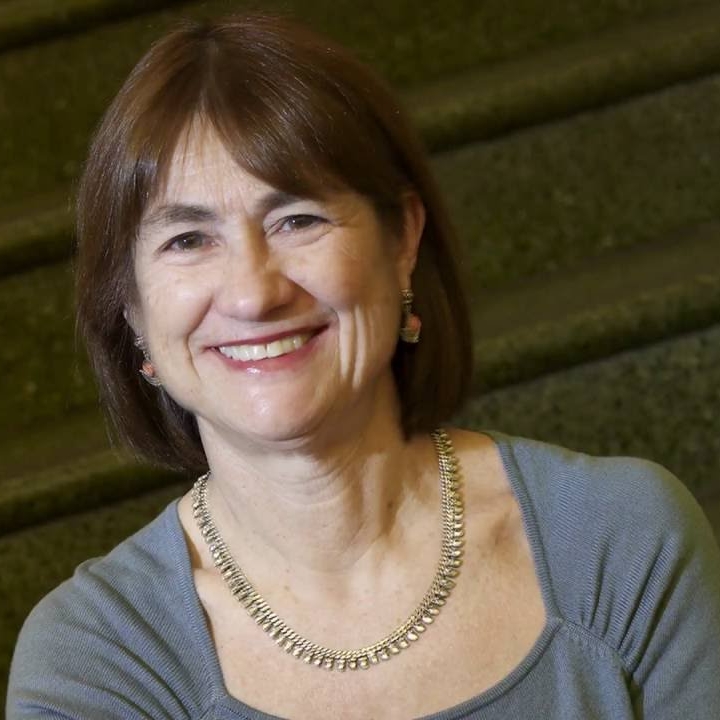
Fellow, Anthropology, New York University
Sally Engle Merry's recent books include Colonizing Hawai‘i (Princeton, 2000), Human Rights and Gender Violence (Chicago, 2006), Gender Violence: A Cultural Perspective (Blackwell, 2009) and The Practice of Human Rights, (co-edited with Mark Goodale; Cambridge, 2007). Her most recent book, The Seductions of Quantification: Measuring Human Rights, Gender Violence, and Sex Trafficking (Chicago: University of Chicago Press, 2016) examines indicators as a technology of knowledge used for human rights monitoring and global governance. She received the Hurst Prize for Colonizing Hawai‘i in 2002, the Kalven Prize for scholarly contributions to sociolegal scholarship in 2007, and theJ.I. Staley Prize for Human Rights and Gender Violence in 2010.
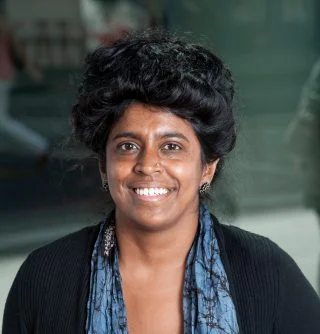
Fellow, Legal Scholar, NYU Gallatin School of Law
Vasuki Nesiah is a legal scholar with a focus on public international law at NYU Gallatin School of Law. Her main areas of research include the law and politics of international human rights and humanitarianism, with a particular focus on transitional justice.
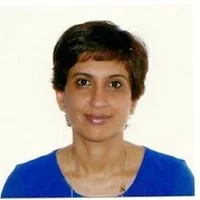
Fellow, Women and Gender Studies, Hunter College, CUNY.
Rupal Oza is an Associate Professor in the Department of Women and Gender Studies at Hunter College, CUNY. Her work focuses on political economic transformations in the global south, the geography of the right-wing politics, and the conjuncture between development and security. Her first book, The Making of Neoliberal India: Nationalism, Gender, and the Paradoxes of Globalization was published in 2006 by Routledge, New York and by Women Unlimited, India. She has several articles in peer-reviewed journals. She has written on special economic zones, the discourse of security, and Hindutva politics India. Her current project examines the relationship between sexual assault, caste, and land in Haryana, India. She is also working on a collaborative project that examines foreclosures and gentrification in New York City.
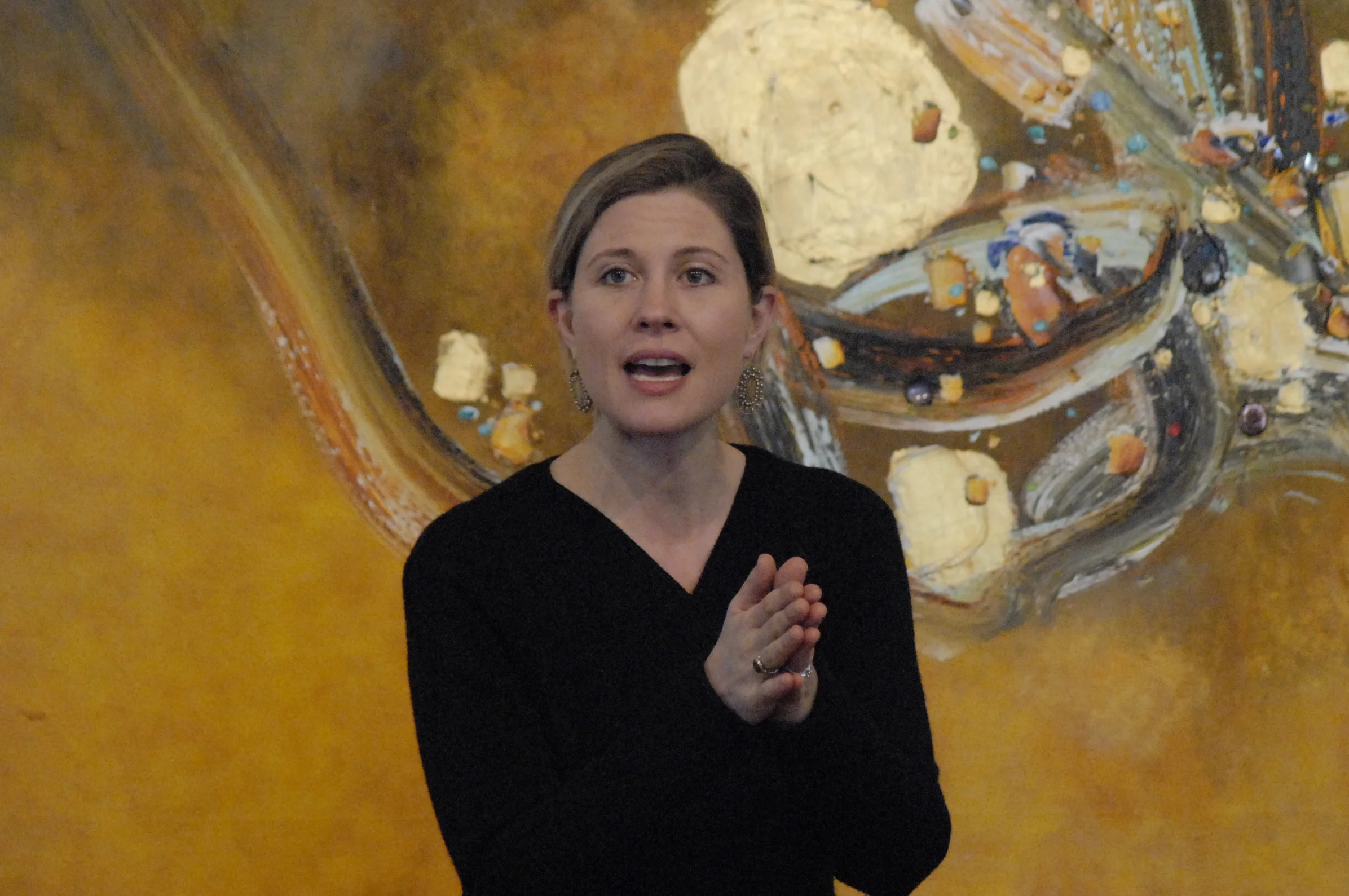
Associate Professor, Department of Islamic Studies, Columbia University
Kathryn Spellman Poots is a Visiting Associate Professor at Columbia University and Academic Program Director for the MA in Islamic Studies. She is also Associate Professor at the Aga Khan
Fellow, International Relations, Northwestern University
Maryam Saleh is an editor and reporter at The Intercept’s Washington, D.C. bureau, where she covers immigration, politics, and foreign policy. She is a graduate of Northwestern University’s Medill School of Journalism.

Fellow, Law, Sindh Muslim Law College
Shagufta Shah is an anti-violence violence advocate and counselor at the Arab-American Family Support Center (AAFSC) of New York. She joined AAFSC in 2013 as a Disaster Case Manager then promoted as Program Manager for the same project, when AAFSC operated a program to help families recover in the wake of Hurricane Sandy.

Fellow, Public Welfare, Hebrew University of Jerusalem
Nadera Shalhoub-Kevorkian is a longtime anti-violence, native Palestinian feminist activist and scholar. She is the Lawrence D. Biele Chair in Law at the Faculty of Law-Institute of Criminology and the School of Social Work and Public Welfare at the Hebrew University of Jerusalem.
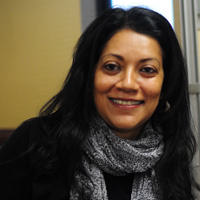
Fellow, Anthropology, BRAC University
Dina M. Siddiqi divides her time between New York and Dhaka, where she is Professor of Anthropology, BRAC University. Her publications, grounded in the study of Bangladesh, cover a broad spectrum: the global garment industry; gender justice and non-state dispute resolution systems, and the intersections of Islam, nationalism and feminist cultural politics. She is currently working on a book entitled Elusive Solidarities: “Muslim” Women and Transnational Feminism at Work. Siddiqi is on the editorial board of Routledge’s Women in Asia Publication Series, a member of the South Asia Council of the Association of Asian Studies (AAS), and on the Gender Advisory Council of the Lahore School of Management Sciences (LUMS). She is also part of the Advisory Council of the South Asian Network of Gender Activists and Trainers (SANGAT). She has extensive research experience with Bangladeshi human rights organizations, including Ain o Salish Kendra (ASK) and Bangladesh Legal and Services Trust (BLAST).
Lecturer in Anthropology and Development Studies
Mayssoun Sukarieh is co-convener of the MA degree in Political Economy of the Middle East. She received her PhD from the University of California, Berkeley, and a MA and BA from the American University of Beirut. Since then she has lectured in anthropology and development studies in universities around the Arab region (American University of Beirut; American University of Cairo) and the United States (Columbia & Brown Universities). Her research interests focus on youth, education, development and social movements in the Arab region, with a particular interest in studying the political, economic, cultural and social structures and processes that tie the region in complex and contradictory ways to the larger global political economy. Her first book, Youth Rising? The Politics of Youth in the Global Economy (co-authored with Stuart Tannock) was published earlier this year by Routledge's Critical Youth Studies series. In 2015, she was also appointed as a Fellow of the Wissenschaftszentrum Berlin für Sozialforschung.
Fellow, Anthropology, BRAC University
Dina M. Siddiqi divides her time between New York and Dhaka, where she is Professor of Anthropology, BRAC University. Her publications, grounded in the study of Bangladesh, cover a broad spectrum: the global garment industry; gender justice and non-state dispute resolution systems, and the intersections of Islam, nationalism and feminist cultural politics. She is currently working on a book entitled Elusive Solidarities: “Muslim” Women and Transnational Feminism at Work. Siddiqi is on the editorial board of Routledge’s Women in Asia Publication Series, a member of the South Asia Council of the Association of Asian Studies (AAS), and on the Gender Advisory Council of the Lahore School of Management Sciences (LUMS). She is also part of the Advisory Council of the South Asian Network of Gender Activists and Trainers (SANGAT). She has extensive research experience with Bangladeshi human rights organizations, including Ain o Salish Kendra (ASK) and Bangladesh Legal and Services Trust (BLAST).

Fellow, Sociocultural Anthropology, UC Berkeley
Shahla Talebi is a scholar of religions, 2006 Newcombe Fellow, and Associate Professor at Arizona State University. A native of Iran, she lived in Tehran during the Iranian Revolution and the Iran-Iraq War.
Fellow, Law in Access to Justice, University of California, Berkeley Law
Robert D. and Leslie Kay Raven Professor of Law in Access to Justice, University of California, Berkeley Law
Junior Research Fellow, Churchill College
Aditi Surie Von Czechowski is Junior Research Fellow at Churchill College, Cambridge. She recently received her PhD from the Department of Middle East, South Asian, and African Studies at Columbia University. Her work focuses on the intersection of humanitarianism and human rights and theories of the human.

Fellow, Social Studies, The Hague
Dubravka Žarkov is Associate Professor of Gender, Conflict and Development at the International Institute of Social Studies, The Hague. Her fields of expertise are gender and its intersections with sexuality, ethnicity and religion; violent conflict, war and militarism, including gender based sexual violence and communalism, and visual and textual representations of war, violence, and soldiering. She also works on masculinity and sexual violence in wars against men. Among her publications are: Conflict, Peace, Security and Development: Theories and Methodologies (with Helen Hintjens, 2015); Narratives of Justice in and out of the Courtroom: Former Yugoslavia and Beyond (with Marlies Glasius, 2014); Gender, Violent Conflict, and Development (2008); The Body of War: Media, Ethnicity and Gender in the Break-up of Yugoslavia (2007); and The Postwar Moment: Militaries, Masculinities and International Peacekeeping, (with Cynthia Cockburn, 2002). One of her most recent articles is on faith and feminism.
Media Fellows
Fellow, Political Science, The American University, Cairo
Yasmin El-Rifae is a writer, researcher and cultural producer. She lives in New York and Cairo. Yasmin is a Middle East and North Africa research associate at the Committee to Protect Journalists. Previously, she worked in journalism and human rights in Egypt, focusing on the struggle against sexual harassment. She holds a B.A. in Political Science from The American University of Cairo and a graduate diploma in Law from the City University in London.
Fellow, Religion and the Global Framing of Gender Violence, Columbia University
Samira Shackle is a freelance British journalist, writing mainly on politics, terrorism, and gender. Samira writes for The New Statesman, The Guardian, The Times, Vice, and many others. She has won multiple awards for her reporting and often sits on panels, generally discussing issues relating to international development, Islam, feminism, and terrorism. Samira has a B.A. in English Language and Literature from the University of Oxford.

Media Fellow, Religion and the Global Framing of Gender Violence
Nafeesa Syeed is an award-winning multimedia journalist with a decade of full-time experience on four continents in spot news and enterprise reporting, editing and producing. She works as a National Security Reporter for Bloomberg News based in Washington, D.C. Nafeesa has held positions at the Dubai Bureau and Al Jazeera America. She holds an M.A. in Comparative Literature from The School of Oriental and African Studies, University of London and a B.A. in Arabic and Government from Georgetown University.

Fellow, Writer, Columbia University
Rafia Zakaria is an author, editor and attorney. She has been a weekly columnist for DAWN, Pakistan’s largest and oldest English language daily since 2009. Her column is syndicated in newspapers all over the world through the Inter Press Service and is regularly republished in the Deccan Chronicle, The Wire India, Kathmandu Post, Sri Lanka Guardian, Korea Herald, New Straits Times and The Internazionale among others. She writes the “Alienated” column for The Baffler and has previously been a regular columnist for Al Jazeera America. She also writes regularly for Guardian Books and is a CNN Opinion contributor. Her recent New York Times Op-Ed “The Myth of Women’s Empowerment” was shared over 30K times on Facebook.
Past Events

This seminar is based on the findings of a three-year collaborative research project between feminist scholars of the Middle East and South Asia that explored these questions across a range of intersecting local, national, and global contexts, in the process uncovering the ways in which religion and racialized ethnicity, particularly “the Muslim question,” run deeply through the international governance structures of GBVAW, even when insistently disavowed.

Lila Abu-Lughod discusses how agendas to combat violence against women and gender-based violence have been taken up as tools of state sovereignty and global security.

Please join us in celebrating the recent publication of Gender, Governance and Islam, with an introduction by Lila Abu-Lughod.


A panel with Sherene Razack (Department of Gender Studies, UCLA), Nadera Shalhoub-Kevorkian (Law School, Hebrew University; International Visitor, Columbia Law School), and Miriam Ticktin (Department of Anthropology, New School University), moderated by Lila Abu-Lughod (Columbia University)

Thursday, November 3, 2016, 4:15 p.m.
203 Butler Library
“Child Marriage in the Feminist Imagination”
Dina Siddiqi, Professor of Anthropology at BRAC University, Dhaka
“Race, Religion, and Masculinity: Europe’s Obsessions”

October 13, 4:15 p.m., 203 Butler Library
"Feminist Politics, War Rapes, and Global Governance"
Dubravka Zarkov, Associate Professor of Gender, Conflict and Development at the International Institute of Social Studies, The Hague
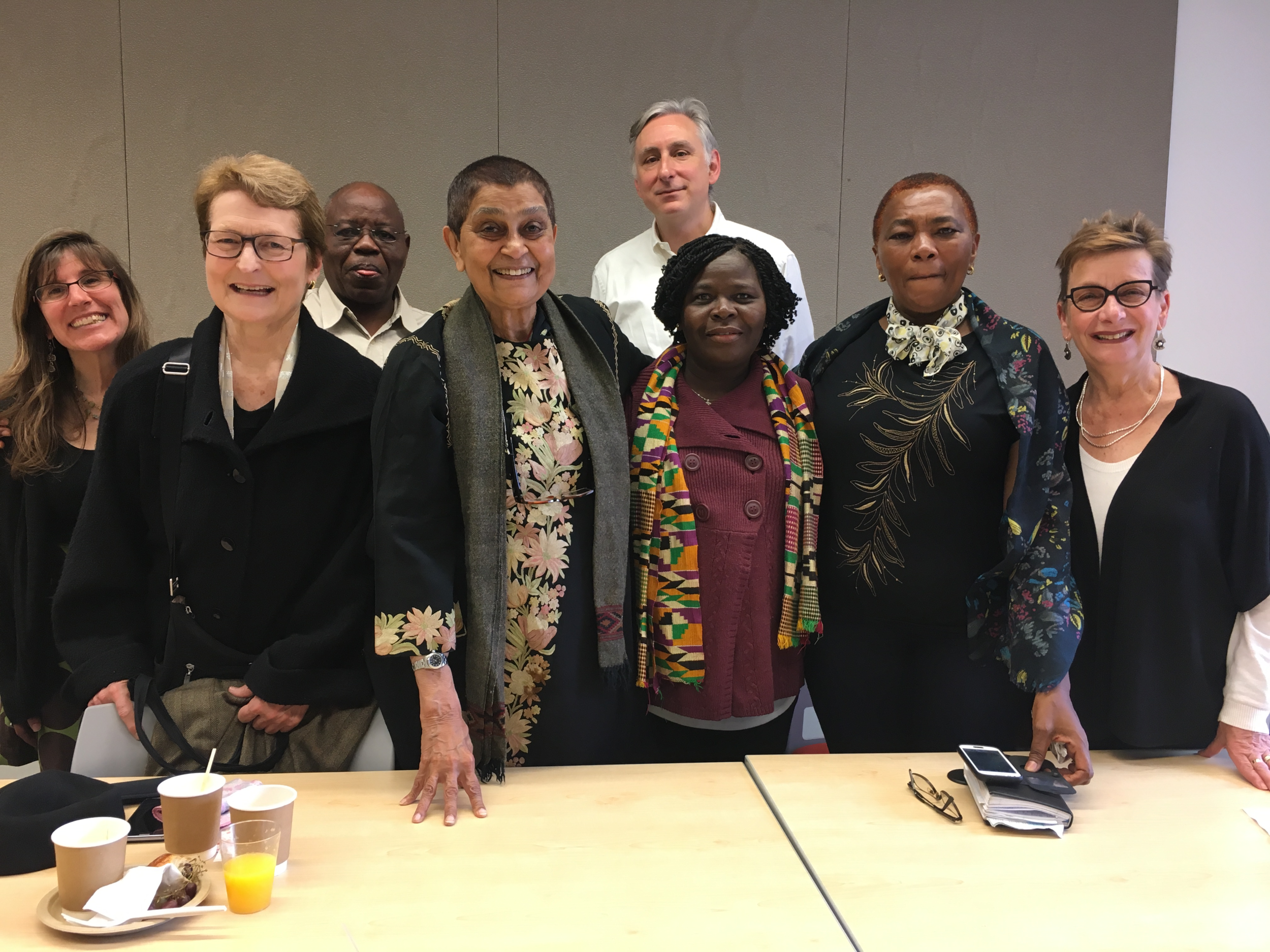
The Rural-Urban Interface: Gender and Poverty in Ghana and Kenya, Statistics and Stories
The Rural-Urban Interface (2015-18) studied migrant populations of women, youth and men in Ghana and in Kenya by combining oral histories with statistical analysis.
Project Directors: Gayatri Chakravorty Spivak, Reinhold Martin
This project, which represented the workshop phase of an interdisciplinary, regional, consortial, Africa-led research endeavor, studied the rural-urban interface in Ghana and in Kenya, concentrating on the experience of women, youth, and men who inhabit this social and physical space. The research group included colleagues at the Universities of Ghana-Legon and Nairobi as well as at Columbia and other New York-area institutions.
The rural-urban interface or continuum extends from the rural to the towns and cities of the African continent. It is quite variegated and is characterized by a complex nexus of sites, including primary and secondary sites in relationships of gain and loss, dominance and subordination, associated in different ways with rural-to-urban migration. This first phase of the project therefore attempted to situate key questions in the African context, and especially, in the rural-urban dynamics of the specific region being studied. Such questions included the interaction of space, gender, and political economy; the role of translation in interpretative social-scientific work; and the interplay of stories and statistics in knowledge making.
Workshops based on a pilot study initiated by colleagues on Ghana and/or Nairobi piad particular attention to gender relations in this space and to the feminization of poverty in migrant populations. The mix of approaches drawn from the humanities and social sciences was intended to help create productive collaborations among disciplines and among many actors, to get behind the statistics and move towards changing minds and building human capacity. As a working group, we looked at ways to combine qualitative knowledge with quantitative knowledge in a manner that highlights the real, impactful capacity of situated stories, narratives, and oral histories articulated by actual participants in these large-scale transformations, to illuminate and inflect the interpretation of other types of data that tend to dominate accounts and disproportionately inform policies. The humanities are a crucial source of knowledge of this sort, and, of language-sensitive learning techniques that are attentive to nuance and open to unexpected information or interpretations. Working with narratives, as well as statistics, yielded nuanced insights that are unavailable to more conventional approaches.
News
Congratulations to Professors Gayatri Chakravorty Spivak and Mabel O. Wilson on joining the Academy.
The New York Times art critic listed Professor Edwards’s Instagram as one of five art accounts to follow.
The discussion will revolve around American democracy, race, performance, and US-China relations.
Gayatri Spivak, co-director of the working group The Rural-Urban Interface, published an article entitled “Who Is Afraid of Shahidul Alam?” in which she speaks about the photojournalist’s imprisonment.
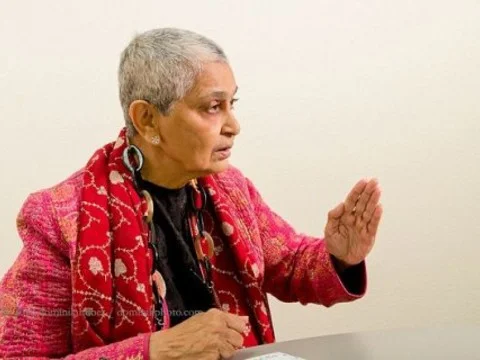
Gayatri Chakravorty Spivak, co-director of the CSSD project The Rural-Urban Interface: Gender and Poverty in Ghana and Kenya, recently delivered the keynote lecture at the 2018 Dhaka Art Summit.
CSSD project co-director Gayatri Chakravorty Spivak delivered the inaugural lecture at the International Colloquium on Creative Teaching and Learning in Higher Education, at Sullamussalam Science College, December 12, 2017.
The Modern Language Association (MLA) has awarded Gayatri Chakravorty Spivak, co-director of CSSD project The Rural-Urban Interface, the eighth MLA Award for Lifetime Scholarly Achievement.
Director of the CSSD project The Rural-Urban Interface, Gayatri Chakravorty Spivak was interviewed about the Rohengy refugee disaster for TBS eFM's "This Morning" English radio program in Seoul, Korea.

Past Events

The Center for the Study of Social Difference invites you to a conference discussing a work in progress on “The Rural-Urban Interface: Gender and Poverty in Ghana and Kenya, Statistics and Stories.”
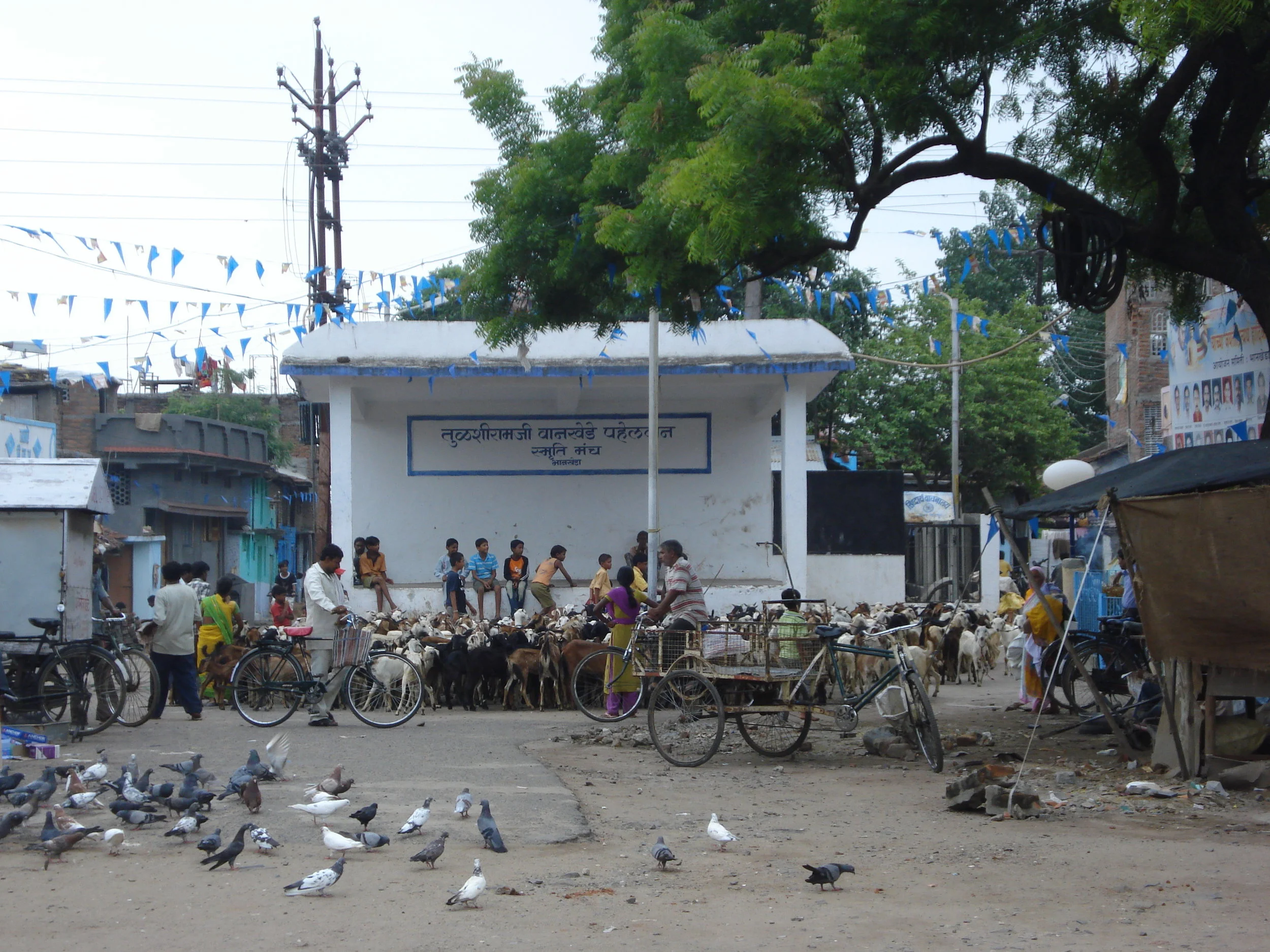
Gender and the Global Slum
How are gender relations impacted by material impoverishment and social segregation? Gender & the Global Slum (2013-17) looked at the social hazards of urban informality and its disproportionate effects on women.
Project Directors: Saidiya Hartman, Anupama Rao, Neferti Tadiar
Urbanization is a defining feature of contemporary globalization. The “megacities” of the twenty-first century are distinguished by two things: their location in the global South, and the ubiquity of informal, or “slum” housing as the primary mode of inhabitation for the majority of their urban dwellers (UNHCS Report, Challenge of Slums 2003; Mike Davis, Planet of Slums 2006). Contemporary urbanization thus presents us with a paradox: it is characterized by spectacular levels of economic growth, together with the informalization of existence.
How have informal housing and the contemporary slum become sites of global intervention, simultaneously conceived as (social) problem, and the site of social experimentation and creative, or resistant life? How are urban social relations, especially of gender, being transformed in the wake of neoliberalism, and the re-territorialization of urban space? Why do women suffer disproportionately from the social hazards of urban informality?
It is typical to attribute the persistence of slums in the global South to the culture of poverty, or as signs of corrupt or insufficient planning. Instead this project addressed the global slum as the product of a complex interplay between the political economy of urban space, and the spatialization of social difference, especially gender/sexuality. Our project addressed the contemporary “slum” as a social-spatial ensemble produced by overlapping and intersecting forces. These included: changing ideas about housing as a right vs. marketized commodity; infrapolitics, i.e., practices from electricity and water theft, to acts of defacement and violent conflict that are a response to social precarity and informalized existence; and the impact of international NGOs and the World Bank in shaping contemporary debates about slum redevelopment and rehabilitation. We located women’s growing vulnerability to new forms of intimate and extimate violence, and their reliance on illicit economies of survival and subsistence (including sex work) within broader infrastructural and policy shifts, to explore how gender is made and unmade in the context of global power.
News

Professor Hartman was announced as one of the 2021 Award Winners for her recent book, Wayward Lives, Beautiful Experiments: Intimate Histories of Riotous Black Girls, Troublesome Women, and Queer Radicals.


Gender & the Global Slum project director Anupama Rao spoke with NPR Podcast Code Switch about Caste discrimination in the United States.

CSSD executive committee members Anupama Rao and Ana Paulina Lee presented research from the CSSD working group Gender and the Global Slum at the inaugural She Opened the Door: Columbia University Women's Conference.
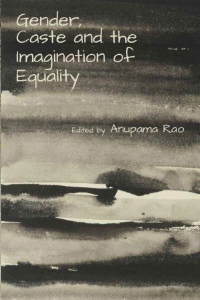
CSSD project co-director Anupama Rao has published the edited volume Gender, Caste, and the Imagination of Equality.

Anupama Rao, Associate Professor of History, Barnard College, and director of the recently completed CSSD project on Gender and the Global Slum, published an opinion piece in the New York Times on an Indian Supreme Court
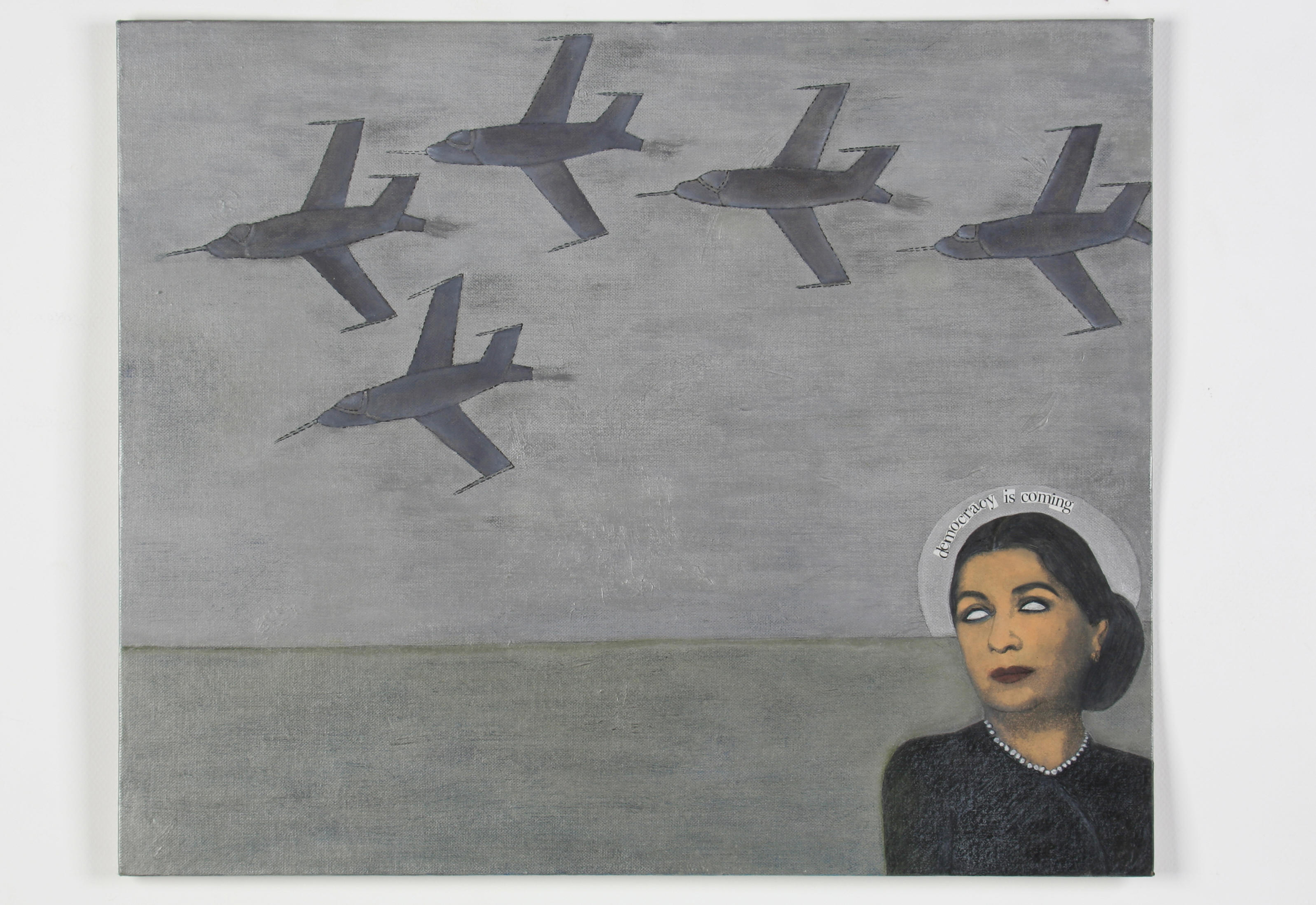
Reframing Gendered Violence
Reframing Gendered Violence (2016-19) aimed to open up a critical global dialogue among scholars and practitioners that recasts and broadens our understanding of what constitutes violence against women.
Project Directors: Lila Abu-Lughod, Kaiama Glover, Jennifer Hirsch, Marianne Hirsch, Jean Howard, Anupama Rao, Kendall Thomas, Paige West
Reframing Gendered Violence opened up a critical global conversation among scholars and practitioners that recasts the problem of violence against women as it is currently discussed in a wide range of fields, both academic and policy-oriented, including human rights, public health, journalism, law, feminist studies, literature, sociology, religious studies, anthropology, and history.
Over the past couple of decades, violence against women (VAW) and gender-based violence (GBV) have come to prominence as loci for activism throughout the world. Both VAW and GBV regularly garner international media attention and occupy a growing place in international law and global governance. Since 2000 alone there have been more than 25 UN protocols, instruments and conventions directed at its eradication or mitigation.
The working group engaged critically with the terms, the assumptions, and the policies that have underwritten this unprecedented outpouring of attention. What do different parties mean when they talk of violence against women or of gender-based violence? Is the main form of violence against women sexual in nature? Does it occur primarily in domestic settings? What is left out when the problem is framed in this way, and whose interests are served by such a framing? When invoked in the halls of the United Nations and used to shape international policy, the terms violence against women (VAW) and gender-based violence (GBV) are often assumed to have stable meanings, yet they do not.
CSSD, in collaboration with scholars, artists and activists located in the regions where Columbia has established Global Centers, examined in the most capacious way what constitutes gendered violence. The goal was to move the conversation on this crucial topic in new directions, pointing to elisions and exclusions in many common-sense understandings of these terms; deepening the ways in which we engage with the manifestations and causes of such violence; unpacking the politics through which accusations of GBV can sometimes be used to pathologize entire communities, societies or religious traditions, or to divert attention from more systemic forms of abuse such as economic, discursive, and political violence.
News
The article, “Why it’s still so hard not to drink,” discusses alcohol, power dynamics, and privilege.
Columbia Law Professor Franke commented on new US legislation to combat anti-Asian hate crimes.
In “Empirical Ephemera,” Professor Agard-Jones used the concept-metaphor of sand to consider how coloniality is made material.
Congratulations to Professors Gayatri Chakravorty Spivak and Mabel O. Wilson on joining the Academy.
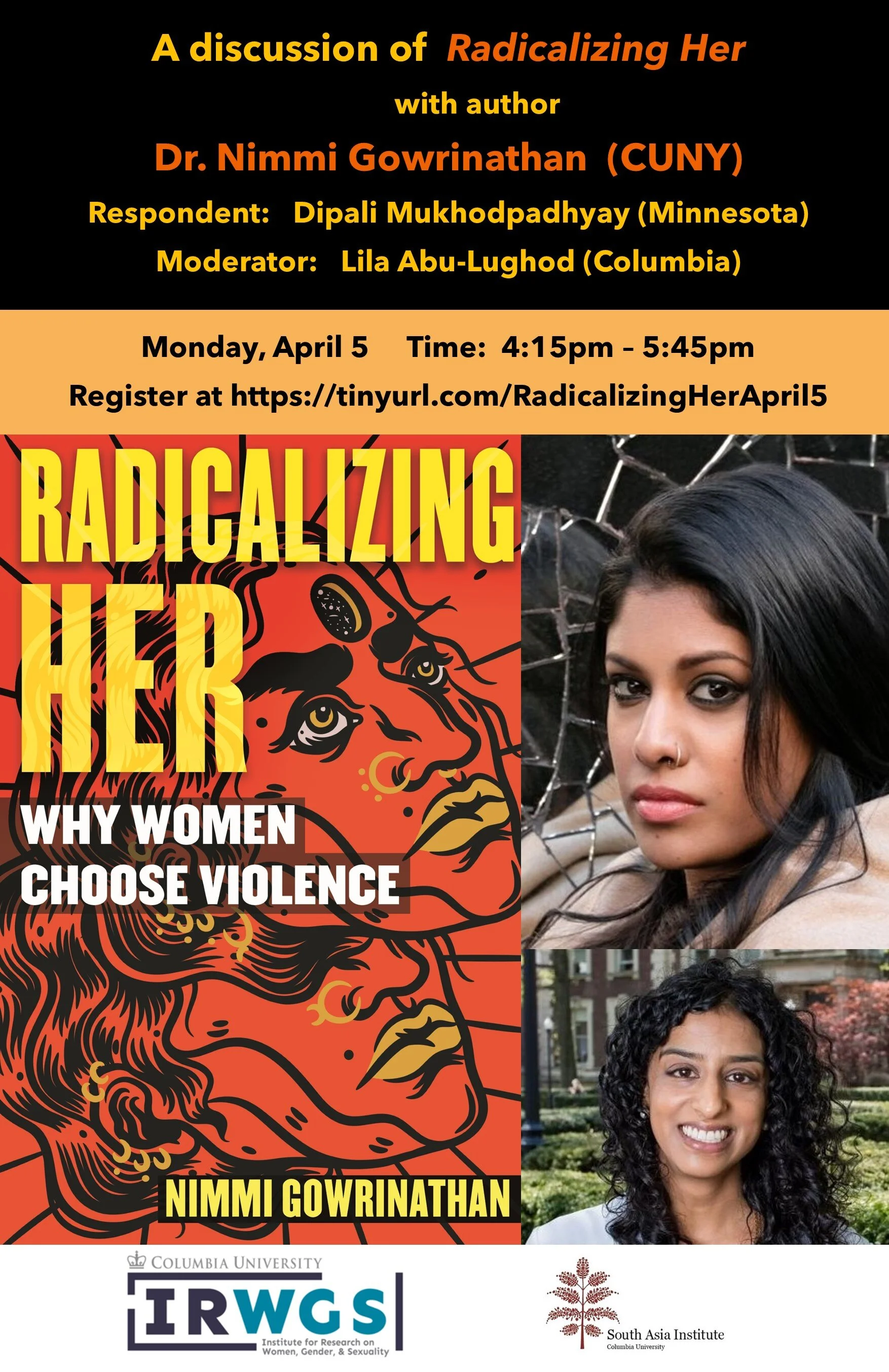
Join us Monday, April 5th for a talk moderated by Professor Lila Abu-Lughod with Dr. Nimmi Gowrinathan, author of Radicalizing Her: Why Women Choose Violence.
Professor Lila Abu-Lughod will be featured in a virtual project discussing her new book for the Religion and the Global Framing of Gender Violence working group.
Engendering the Archive Working Group Fellow spoke to the Post about the Capitol riots and racial injustice in the police responses to protesting.
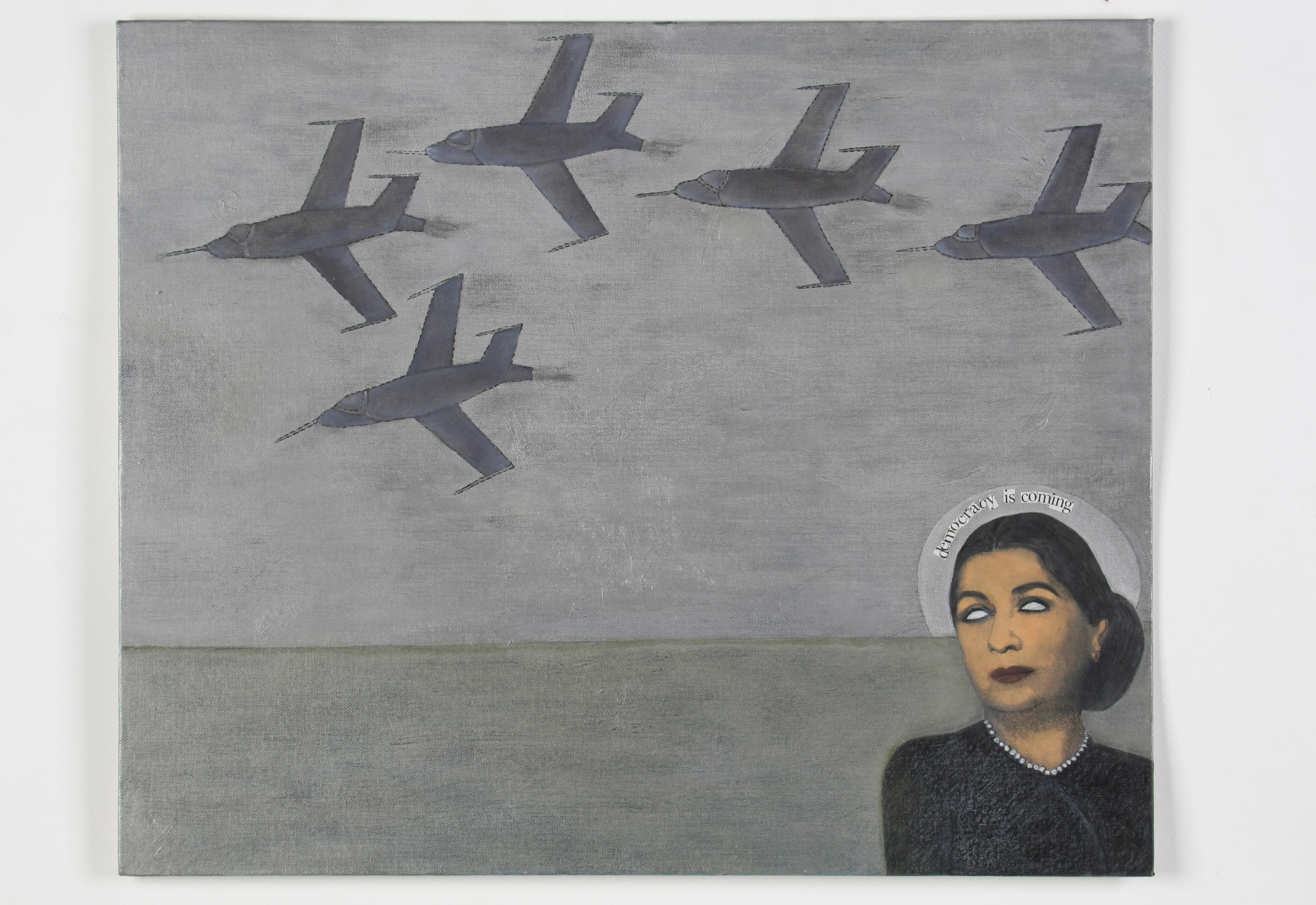
Past Events
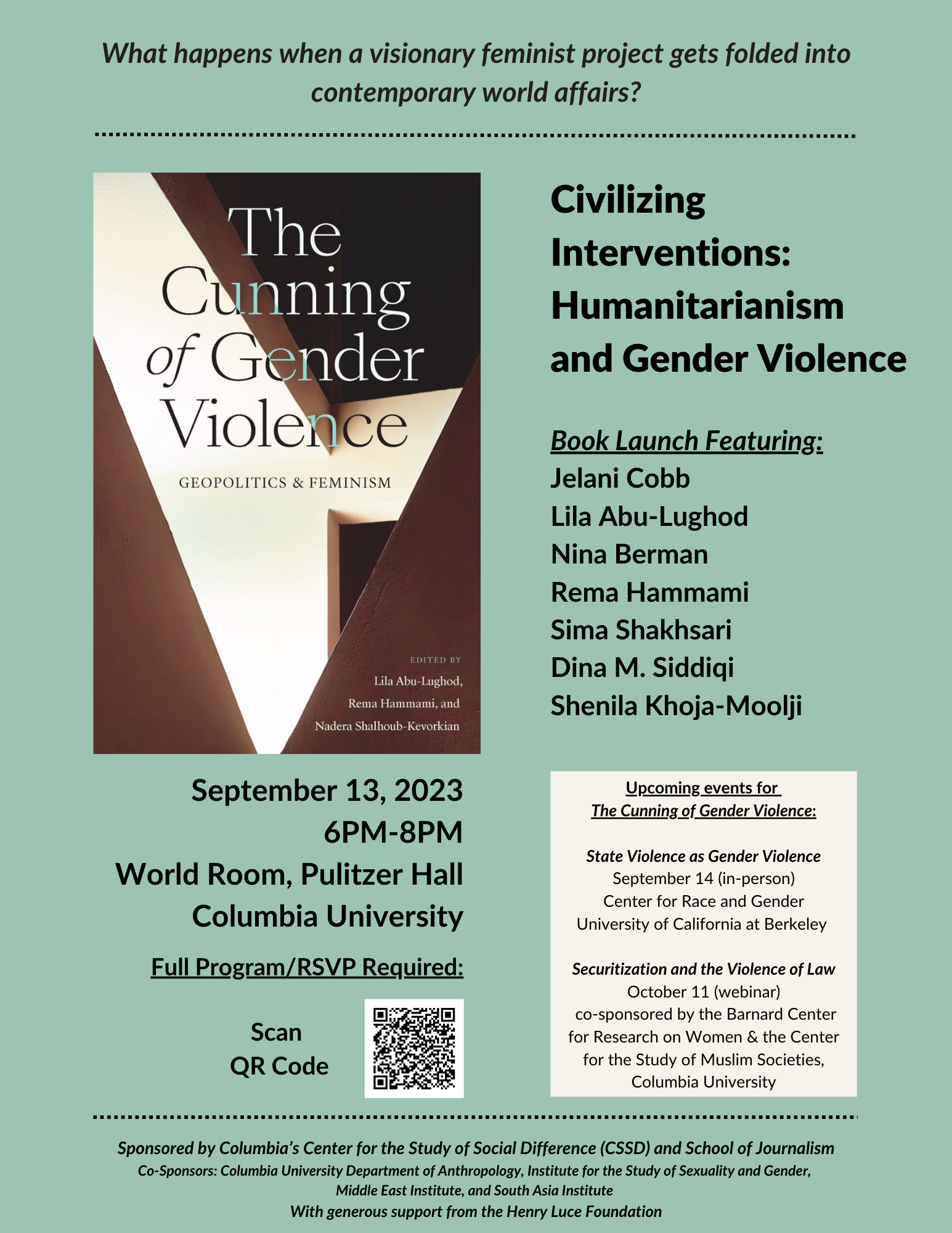

Please join us in celebrating the recent publication of Gender, Governance and Islam, with an introduction by Lila Abu-Lughod.

The pop-up exhibition “Arts of Intervention” brings together an international group of artists connected to the working group on “Women Mobilizing Memory” of Columbia University’s Center for the Study of Social Difference in the context of the Third Annual Memory Studies Association Conference in Madrid, June, 2019.


In recognition of Sexual Assault Awareness Month, CSSD working group Reframing Gendered Violence co-sponsors an interactive panel exploring lessons learned from the past 40 years in the field of sexual violence, examine the current landscape, and identify key strategies for the future.

CSSD working group Reframing Gendered Violence co-sponsors DOCUMENTARY STORYTELLING AND COLLABORATIVE PRACTICES: A conversation with photographers Nina Berman, An Autobiography of Miss Wish, and Susan Meiselas, A Room of Their Own.

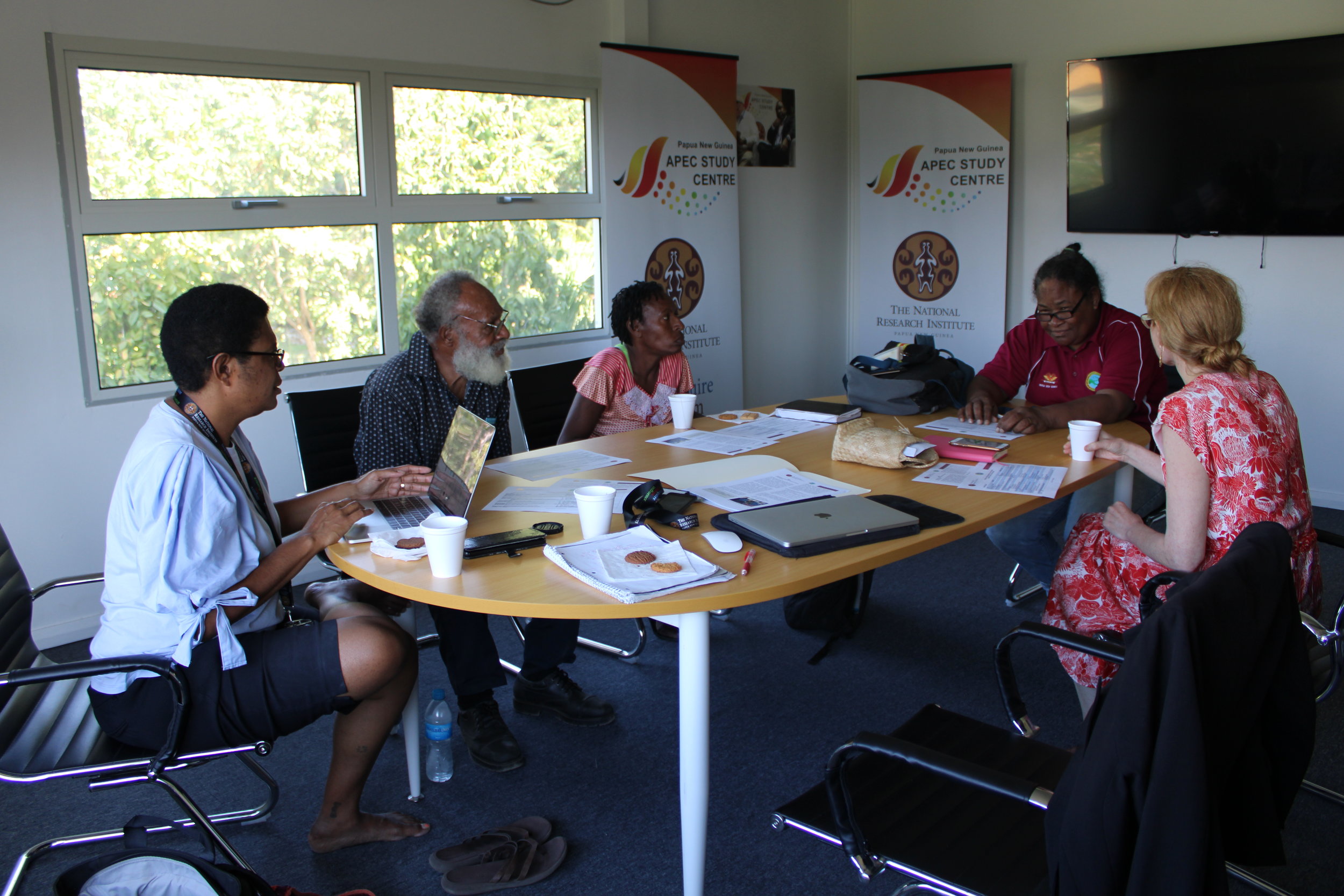
The Reframing Gendered Violence project at CSSD presents a panel discussion with Fiona Hukula (PNG National Research Institute), Mary Fairio (PNG National Research Institute), and Melissa Demian (University of St. Andrews).
Publications


Pacific Climate Circuits: Moving Beyond Science, Technology, Engineering, and Economics
Applying lenses of race, class, gender, sexuality, and inequality to the current analyses of climate change in the Pacific Region, Pacific Climate Circuits (2015-18) sought to reframe the conversation about climate change and Pacific Islanders.
Project Directors: Paige West, Kevin Fellezs, J.C. Salyer
Pacific Climate Circuits applied lenses of race, class, gender, sexuality, and inequality to the current analyses of climate change in the Pacific Region. The working group, directed by Paige West, Department Chair and Professor of Anthropology, Barnard College; Kevin Fellezs, Assistant Professor of Music and African American Studies, Columbia University; and J.C. Salyer, Term Assistant Professor of Practice, Sociology, Barnard College, examined the specific political-economic systems culpable for climate change in the region, linking them to its histories of colonialism and neoliberalism. Researchers sought solutions outside the typical hard sciences approach, instead drawing on scholarship in the arts, the humanities, and the social sciences to scrutinize the region, its environment, and its people.
News
Paige West and the Pacific Climate Circuits working group have published a new paper that is the first to be co-authored by a combination of scholars and activists from Papua New Guinea, the USA, as well as Indigenous Elders from New Ireland.
Congratulations to Spring 2021 Grant awardees Kevin Fellezs (Music), Natasha Lightfoot (History), and Camille Robcis (French, History).
Professor Fellezs commented on protest songs and “freedom musics” in this polarized time
Kevin Fellezs and Farah Jasmine Griffin will be editorial board members for this historic collaboration.
Paige West, former co-director of the Pacific Climate Circuits working group, calls attention to the relationship between biodiversity decline and colonialism.
Professor Kevin Fellezs discussed recent protests against police brutality and the Black Lives Matter movement in the United States.
Paige West’s piece is entitled Translations, Palimpsests, and Politics: Environmental Anthropology Now.
The essay series is entitled "From Reciprocity to Relationality: Anthropological Possibilities."

Past Events

CSSD working group Pacific Climate Circuits, with support from the Barnard College Department of Anthropology, presents a free film screening and Q&A with Dan Taulapapa McMullin.
Publications

Pacific Climate Circuits: Moving Beyond Science, Technology, Engineering, and Economics Working Group
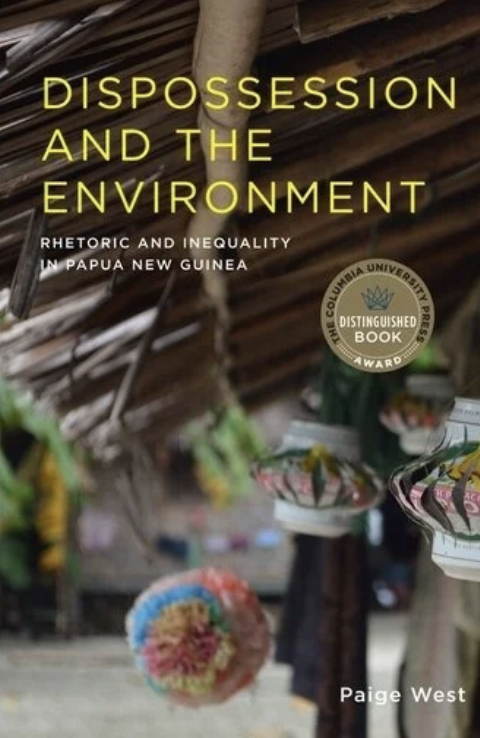
Pacific Climate Circuits: Moving Beyond Science, Technology, Engineering, and Economics Working Group

Bandung Humanisms
This interdisciplinary research project, Bandung Humanisms (2015-18), examined the workings of the progressive political, social, and cultural movement among nations of the Global South that refused to ally with either major power bloc during the cold war.
Project Directors: Stathis Gourgouris, Lydia Liu
Bandung Humanisms was an interdisciplinary research project examining the workings of Bandung Humanisms, the progressive political, social, and cultural movement among nations of the Global South that refused to ally with either major power bloc during the Cold War. The working group, a collaboration between scholars at Columbia University and the University of California, Los Angeles uncoverd the post-colonial developing world’s espousal of a radical brand of humanism and self-determination that gave rise to the Non-Aligned Movement of non-aggressor states. The working group traced the institutions, associations, writings, and artworks identified with the Bandung Humanisms movement, connecting them to current global struggles for social justice.
The diverse group of scholars included Stathis Gourgouris, Professor, Classics, Columbia University; Aamir Mufti, Professor, Comparative Literature, UCLA; and Lydia Liu, Director, Institute of Comparative Literature & Society and Wun Tsun Tam Professor in the Humanities, Department of East Asian Languages, Columbia University.
News
Professor Diagne commented on the Nairobi National Museum’s new exhibit highlighting the Kenyan art stolen in the colonial era.
Co-director of working group Bandung Humanisms, Lydia Liu, discusses contemporary Chinese artist Xu Bing’s exhibition “Thought and Method”
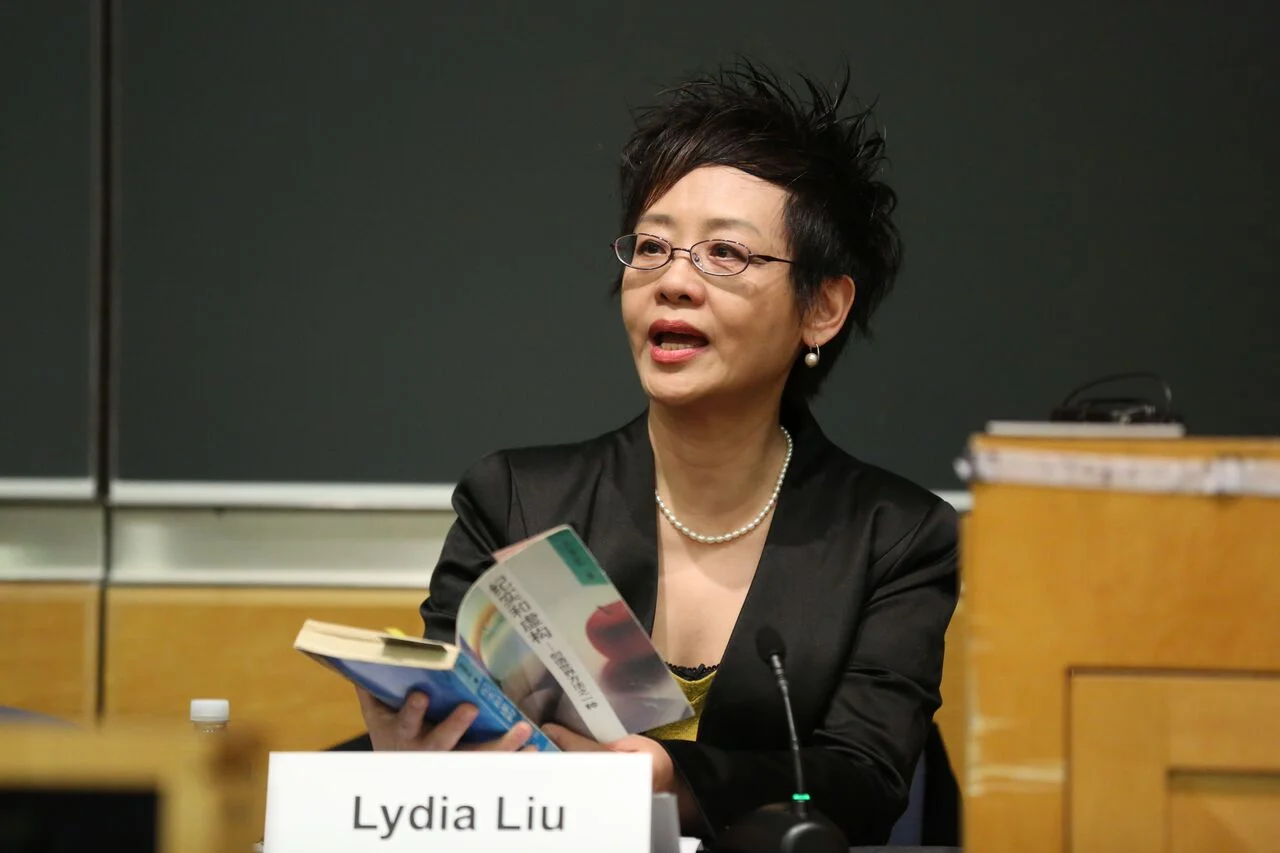
Professor Lydia H. Liu, co-director of the CSSD project Bandung Humanisms, recently collaborated on the Global Justice for Indigenous Languages Symposium.
The CSSD working group Bandung Humanisms hosted the conference “China and Africa at a Crossroads: Revisiting the Legacy of Bandung Humanisms.” Read the full blog entry on the conference here and see photos from the day.

Past Events
The Bandung Humanisms working group presents its culminating workshop, titled "The Bandung Spirit: Reflections on Afro-Asian Solidarity."

CSSD working group Bandung Humanism cosponsors "The Afro-Asian 'Silk Road' and the Rhetoric of Connected History" talk by Tamara Chin (Brown University).

CSSD Bandung Humanisms project co-sponsors: On South-South Circulations, Histories and Possibilities in the Arab World

On June 19, 2017, CSSD’s working group on Bandung Humanisms is presenting an international workshop entitled Bandung Humanisms: Towards a New Understanding of the Global South at Nanyang Technological University (NTU) in Singapore.

Rebecca Karl, Associate Professor, History, NYU
Jamie Monson, Director, African Studies, Michigan State University
Stephanie Rupp, Asssitant Professor, Anthropology, CUNY-Lehman
Barry Sautman, Professor, Division of Social Sciences, Hong Kong University of Science & Technology
Hairong Yan, Anthropologist, Department of Applied Social Sciences, Hong Kong Polytechnic University
Duncan Yoon, Assistant Professor, English, University of Alabama

Unpayable Debt: Capital, Violence, and the New Global Economy
Unpayable Debt (2016-19) was a comparative research and public engagement project about the emergence and impact of massive debt on vulnerable polities and populations.
Project Directors: Frances Negrón-Muntaner, Sarah Muir
Graduate Assistant: Laura Charney
Unpayable Debt: Capital, Violence, and the New Global Economy raised critical questions about the role of debt in contemporary capitalism; the relationship between debt, migration, and violence; and the emergence of new political and cultural identities, particularly among subordinated groups. The project's members, which included scholars, filmmakers, and journalists, examined the politics of information asymmetry—a lack of data and conceptual tools—and how this might undermine social mobilization in impoverished communities, peoples, and countries.
The interdisciplinary group compared recent and landmark cases such as Puerto Rico, Argentina, Greece, Spain, and U.S. cities like Detroit as well as other spaces that have been historically affected by debt. The project also developed a web platform to disseminate existing information, facilitate public engagement, and increase discussion about the politics of debt.
The project’s directors were Sarah Muir, Term Assistant Professor of Anthropology, Barnard College, Columbia University and Frances Negrón Muntaner, Professor of English and Comparative Literature and Director, Center for the Study of Ethnicity and Race, Columbia University.
See the press release for the working group's digital PRSyllabus explaining the Puerto Rican debt crisis.
News
The co-director of the Unpayable Debt working group spoke about the financial future of Puerto Rico.
The journal’s dossier focuses on Professor Frances Negrón-Muntaner's teaching and research told largely through the words of several generations of former students.
The event, themed “Empowered Scholarship: Engaging with the World, Connecting with Each Other,” took place on October 3 and 4.
CSSD Executive Committee member appears on The Takeaway, CNN en Español, and Dissent Magazine.
Frances Negron-Muntaner discusses the recent protests in Puerto Rico in conjunction with her Valor y Cambio project.
Past Events
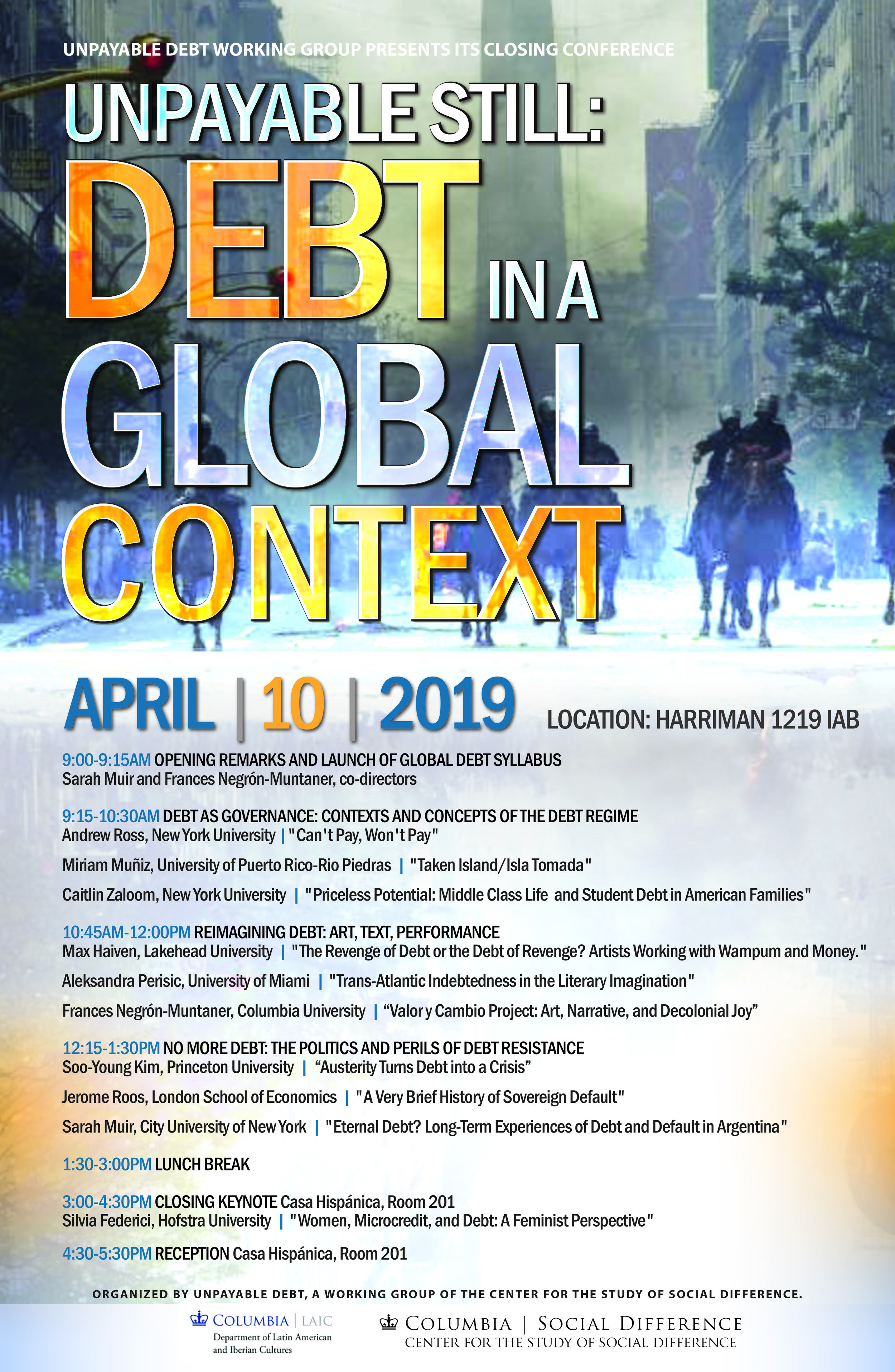


CSSD working group Unpayable Debt: Capital, Violence, and the New Global Economy presents Frontier of Debt in the Caribbean and Afro-America.
Friday, April 21
Institute for Public Knowledge
New York University
20 Cooper Square, Room 222
New York, NY
Narratives of Debt is a one-day conference presented by CSSD's working group on Unpayable Debt and the Oikos working group at NYU’s Institute for Public Knowledge. The conference focuses on the ways that people and groups h

Publications
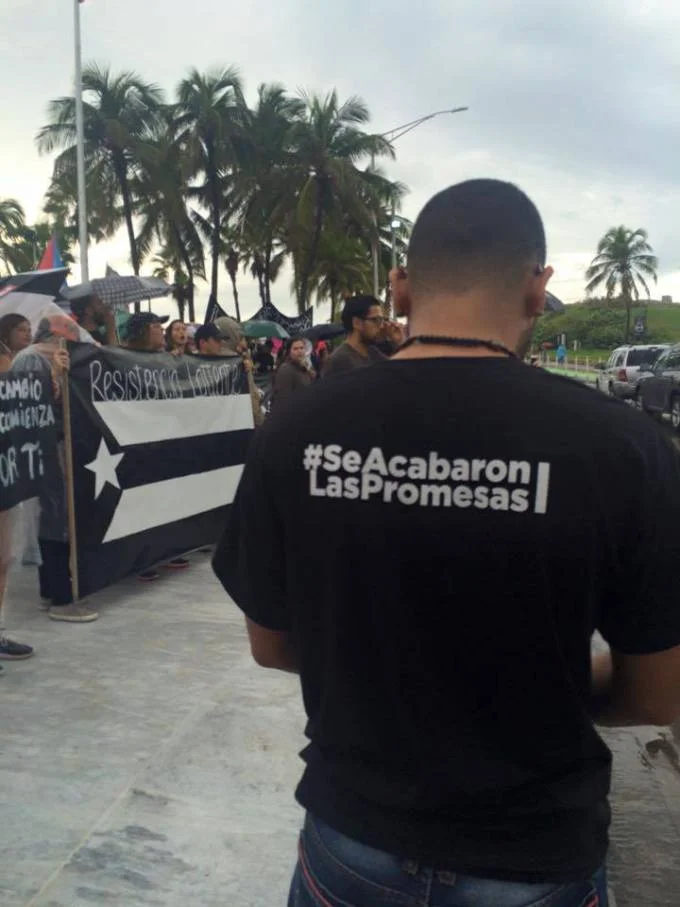
Fellows

Associate Professor of Anthropology and Caribbean Studies, Rutgers University
Yarimar Bonilla is an Assistant Professor of Anthropology and Caribbean Studies at Rutgers University.

Master’s student, Human Rights, Columbia University
Laura Charney is a Master’s student in Human Rights at Columbia University’s Institute for the Study of Human Rights. She completed her undergraduate degree in Archaeology, Anthropology, and Creative Writing at the University of Toronto.
Graduate Student, Music, Columbia University
César Colón-Montijo is a journalist and doctoral candidate in ethnomusicology at Columbia University. He obtained a Master's in anthropology and audiovisual communication from the University of Barcelona, Spain in 2005, and previously completed a B. A. in communications at the University of Puerto Rico, Río Piedras Campus in 2003. César is the editor of the Cocinando Suave: Ensayos de Salsa en Puerto Rico (2015), a landmark collection of scholarly, historical, and journalistic essays, poems, and photo-essays about the histories of salsa.

Fellow, Hispanic Languages and Literature, Stony Brook University
Lena Burgos Lafuente (PhD NYU, 2011) is Assistant Professor of Latin American Literature in the Department of Hispanic Languages and Literature, Stony Brook University. She specializes in poetry, Latin American essay writing, sound studies, and transatlantic literary crossings in the first half of the twentieth century.
Fellow, Mexican American and Latina/o Studies, University of Texas at Austin
Marisol LeBrón is an Assistant Professor in the Department of Mexican American and Latina/o Studies at the University of Texas at Austin. An interdisciplinary scholar working across American Studies and Latinx Studies, her research focuses on social inequality, policing, violence, and protest movements in Puerto Rico and its diaspora.

Professor, Center for the Study of Ethnicity and Race, Columbia University
Ed Morales is an author and journalist who has written for The Nation, The New York Times, The Los Angeles Times, Rolling Stone, the Guardian, and City Limits, among many others. He is a former Village Voice staff writer and Newsday columnist and the author of Living in Spanglish (St. Martins) and The Latin Beat (Da Capo Press), as well as the upcoming Raza Matters (Verso Press). He is currently a lecturer at Columbia University’s Center for the Study of Ethnicity and Race, and hosts a show on WBAI-FM, 99.5 Pacifica Radio.
Fellow, Linguistic Anthropology, CUNY Graduate Center
Sarah Muir's research is situated at the intersection of linguistic, political-economic, and historical anthropology and grounded in ethnographic fieldwork and archival research in Argentina. Thematically, her work examines the practical logics of economic investment, ethical evaluation, and political critique, with a particular focus on financial crisis and social class.
Professor, Department of English and Comparative Literature, Columbia University
Frances Negrón-Muntaner is a filmmaker, writer, curator, scholar and professor at Columbia University, where she is also the founding curator of the Latino Arts and Activism Archive. Among her books and publications are: Boricua Pop: Puerto Ricans and the Latinization of American Culture (CHOICE Award, 2004), The Latino Media Gap (2014), and Sovereign Acts: Contesting Colonialism in Native Nations and Latinx America (2017). Her most recent films include Small City, Big Change (2013), War for Guam (2015) and Life Outside (2016).
Doctoral Student, International Finance and Economic Policy, Columbia University
Giovanni Pagán Vélez is a student from San Juan, Puerto Rico. He is an MPA candidate at Columbia SIPA, concentrating in International Finance and Economic Policy.
Professor, Department of Legal History, Columbia Law School
Christina Duffy Ponsa is the George Welwood Murray Professor of Legal History at Columbia Law School, where she teaches constitutional law and American legal history. Professor Ponsa is the author of several articles on the constitutional law and history of American territorial expansion and empire, and co-editor of Foreign in a Domestic Sense: Puerto Rico, American Expansion, and the Constitution (Duke U. Press, 2001). Before joining the Columbia faculty in 2007, she served as a law clerk to Judge José A. Cabranes on the Second Circuit Court of Appeals and to Justice Stephen G. Breyer on the United States Supreme Court.
Fellow, Photographer, Columbia University
Huáscar Robles is an author and photographer from Caguas, Puerto Rico. He has written about the revitalization of Santurce, Puerto Rico through tax incentives and the impact of the economic crisis on the Island’s middle class.
Keywords
Keywords: Interdisciplinary Roundtable Conversations draws participants together from a wide range of disciplinary homes to explore the various ways we think about fundamental critical/theoretical ideas and to generate new vocabularies and new methodologies.
Keywords: Interdisciplinary Roundtable Conversations draws participants together from a wide range of disciplinary homes in order to explore the various ways we think about fundamental critical/theoretical ideas and to generate new vocabularies and new methodologies.
Past Events

The Center for the Study of Social Difference and the Women, Gender, and Sexuality Studies Council
The Center for the Study of Social Difference and the Women, Gender, and Sexuality Studies Council are co-hosting a spring 2016 Keywords Roundtable Discussion on t
Keywords event on "trans," featuring Jack Halberstam, Professor of American Studies and Ethnicity, Gender Studies and Comparative Literature, University of Southern California; Yvette Christiansë, Professor of English and Africana Studies, Barnard College; Jack Pula, Instructor of Psychiatry, College of Physicians & Surgeons, Columbia University and Chairperson of the Transgender Committee, Association of Gay and Lesbian Psychiatrists; and Yasmine Ergas, Co-Chair of Women's, Gender & Sexuality Studies Council, Director of Gender & Public Policy Specialization, and Lecturer in Discipline of International and Public Affairs, SIPA. Moderated by Jean Howard, George Delacorte Professor in the Humanities and Chair, Department of English and Comparative Literature, Columbia University.
Keywords event on "Vulnerability" featuring Walter Bockting, Professor of Medical Psychology (in Psychiatry and Nursing) and Co-Director, LGBT Health Initiative, Division of Gender, Sexuality, and Health, Department of Psychiatry; Katherine Ewing, Professor of Religion and Director, Center for the Study of Religion and Sexuality; Marianne Hirsch, William Peterfield Trent Professor of English and Comparative Literature and Women’s and Gender Studies and Director, Center for the Study of Social Difference; and Richard Parker, Professor of Sociomedical Sciences and Anthropology, and Director, Center for the Study of Culture, Politics, and Health; with Alondra Nelson, Professor of Sociology and Women’s and Gender Studies, Director, Institute for Research on Women, Gender, and Sexuality, and Co-Chair, Women's Gender, and Sexuality Studies Council, moderating.
Keywords event on "Intersectionality" featuring Katherine Franke, Director, Center for Gender and Sexuality Law; Neferti Tadiar, Chair, Women's Studies Department, Barnard College; Kendall Thomas, Director, Center for the Study of Law and Culture; and Laura Ciolkowski (moderator), Associate Director, Center for the Critical Analysis of Social Difference
Keywords event on "Ethnicity" featuring Mamadou Diouf, Director, Institute for African Studies; Frances Negron-Muntaner, Director, Center for the Study of Ethnicity and Race; Mae Ngai, Professor of History and Lung Family Professor of Asian American Studies; Elizabeth Povinelli, Director, Institute for Research on Women and Gender; and Marianne Hirsch (moderator), Director, Center for the Critical Analysis of Social Difference

Precision Medicine: Ethics, Politics and Culture
Precision Medicine is an emerging approach for disease treatment and prevention that takes into account individual variability in genes, environment, and lifestyle for each person. Precision Medicine: Ethics, Politics and Culture (2016-19) examines the ethical, legal, and political implications of precision medicine research.
Project Directors: Rachel Adams, Gil Eyal, Maya Sabatello
Graduate Assistant: Daniel Wojtkiewicz
Precision medicine—an emerging approach for disease treatment and prevention that takes into account individual variability in genes, environment, and lifestyle for each person—raises a myriad of cultural, political, and historical questions that the humanities and social sciences are uniquely positions to address. The PMEPC lecture series represents a broad-based exploration of questions that precision medicine raises in law, ethics, the social sciences, economics, and the humanities.
The Precision Medicine: Ethics, Politics, and Culture Project is co-directed by Rachel Adams, PhD, Professor of English; and Maya Sabatello, LLB, PhD, Assistant Professor of Clinical Bioethics. The PMEPC is co-sponsored by Columbia Precision Medicine & Society and the CSSD.
PMEPC events are free and open to the public. For more information on this project, please visit socialdifference.columbia.edu or email Daniel Wojtkiewicz at dnw2116@columbia.edu
News
The director of the Future of Disability Studies working group spoke about how she has updated her class for the pandemic.
The Director of the Precision Medicine Working Group will be discussing the science fiction film “Gattaca, on March 8th from 2:00 pm to 3:30 pm.
Sonia Mendoza-Grey reviews Dr. Shirley Sun’s discussion on the racialization of precision medicine.
Rachel Adams, co-director of the Precision Medicine working group, has reviewed three memoirs on illness and recovery.
Professor Bloss of UC San Diego gave a talk on how bioethics must adapt to the rise of Precision Medicine.
On January 22, CSSD/PM&S project Precision Medicine: Ethics, Politics, and Culture welcomed Dr. Susan Markens (CUNY-Lehman College) for its first talk of the semester, titled The Genomic Revolution, Genetics Counselors, and Doing Ethics.
On November 20, 2017, Kadija Ferryman discussed her Fairness in Precision Medicine project with the Precision Medicine: Ethics, Politics, and Culture CSSD working group
Rachel Adams, a Faculty Director of the CSSD Precision Medicine project, is taking her interdisciplinary research interests to the next level, and she is recording her progress online.

Graduate Fellows
PhD Student, Sociology, Columbia University
Larry Au is a Ph.D. candidate in sociology at Columbia University. He is broadly interested in science and technology studies, economic sociology, and political sociology. His dissertation examines the rise of precision medicine in China and the United States, focusing on the diffusion of the concept and its associated technologies, as well as the ways in which debates around ethical, legal, and social issues are constructed locally and globally. He is also interested in the recent controversies over human gene editing and the modernization of traditional medicines.
PhD Student, Epidemiology, Mailman School of Public Health, Columbia University
Diana Garofalo is a doctoral student in Epidemiology, in the school of public health. Her background in biochemistry and genetics led her to be interested in using epidemiologic methods to understand underlying biological mechanisms in human disease, especially in rare diseases. She also briefly worked at a clinical genetic testing company that screened potential parents for recessive mutations linked to severe diseases. This experience deepened her interest in exploring the technical, ethical, and scientific challenges of using genomics in medicine, with specific concern about the potential worsening of disparities in health care.
Graduate Student, Systems Biology, Columbia University
Sunny Jones is a graduate student in the Systems Biology department working with Dr. Andrea Califano. Her research involves developing algorithms for analyzing cancer genomics data with the goal of better understanding their biology as well matching patients to highly specific treatments as based on their genetics. She has previous research experience in nutrient metabolism and is currently working in conjunction with a startup to build a platform for providing optimal meals and dietary suggestions to cancer patients and survivors. In her free time she enjoys rock climbing, biking and exploring New York City.
Doctoral Student, Narrative Medicine, Columbia University
Hippocrates said, “Wherever the art of medicine is loved – there is also a love of humanity.” This quote explains her own reflections and values in life. She loves humanity, and she chose to devote her life to science and medicine because she wants to make a difference in patients’ lives, alleviate patients’ suffering, and positively influence the healthcare system of the United States and worldwide. Presently, she is a graduate student in the Program of Narrative Medicine at Columbia University.
PhD Student, Sociomedical Sciences, Mailman School of Public Health, Columbia University
Sonia Mendoza-Grey is a PhD student in the Department of Sociomedical Sciences at Mailman School of Public Health. Mendoza-Grey employs her human biology, sociology, and qualitative research training to her dissertation research that examines precision medicine implications for the Latinx population. Specifically, her work investigates how recruitment and analysis of the Latinx population shapes and informs understandings of Latinidad, and how researchers’ work with Latinx populations illuminates the assembled connections among genetics, ethnicity, and race through contemporary bioscience.
PhD Student, Sociology, Columbia University
Amy Weissenbach is a first-year PhD student in sociology at Columbia University. She is interested in the sociology of knowledge and expertise, cultural sociology, and law and society. She aims to understand dynamics among individuals and institutions shaping notions of social responsibility in tech, and in biotech in particular. She holds an MPhil in History and Philosophy of Science, Technology and Medicine from Cambridge University and a B.A. from Stanford University.
Associate Fellows
Doctoral Student, Narrative Medicine, Columbia University
Olamide Adejumo is a student of narrative medicine at Columbia University. He is a graduate of medicine and surgery from Obafemi Awolowo College of Health Sciences in Nigeria passionate about narrative care practices in medicine. His interests includes clinical care and research in Narrative Medicine, Personalized Medicine, Medical Humanities and Genetic Technologies in Disability Care.

Doctoral Student, Narrative Medicine, Columbia University
Matthew Argame is currently a graduate student in the Narrative Medicine program at Columbia University. Upon graduation, Matthew will continue on to medical school as an aspiring psychiatrist, advocating for the needs of vulnerable communities. Matthew hopes that his engagement with the Precision Medicine: Ethics, Politics, Culture program will produce interdisciplinary dialogue on improving patient care by addressing societal injustices and by bringing attention the unique needs of queer and disabled communities.

Doctoral Student, Health Promotion, Research and Practice, Columbia University
Olivia Balderes is an MPH Candidate at Mailman in the department of Sociomedical Sciences with a focus on Health Promotion, Research and Practice. She is interested in applying her Intervention Design and Evaluation background to improve community involvement within Precision Medicine programs/studies, maximize efficiency and efficacy of return of genetic results in clinical settings, and explore the determinants of genetic and general health literacy.

Doctoral Student, Global Health, Columbia University
Kayleigh Barrett is a current MPH candidate in the Department of Sociomedical Sciences, working toward a certificate in Global Health. In the last three years, she worked as a Research Scientist at the University of Washington in the Division of Allergy and Infectious Disease and was involved in a structural genomics pipeline for an early structure-based drug design projects targeting a number of pathogens. Her current interests include research ethics, infectious disease, reproductive health and medical anthropology.
PhD Student, Integrated Program in Cellular, Molecular, and Biomedical Studies, Columbia University
Christopher Cardona is a first year doctoral student in the integrated program in Cellular, Molecular, and Biomedical Studies. He is excited to learn about the multiple aspects of precision medicine and how we can begin incorporating these in scientific research. He is currently working on muscle invasive bladder cancer in mouse models and will be working on Alzheimer's next semester. Both labs use comprehensive and computational tools to identify important regulators of these processes.
Graduate Student, Narrative Medicine, Columbia University
Sarah Harvin hails from the state of Michigan, where she completed her bachelor's degree in psychology at Hope College. Sarah moved to NYC in the summer of 2018 to pursue a Master of Science in Narrative Medicine. She was attracted to the Narrative Medicine program because she recognized a unique opportunity to combine her interest in having difficult conversations surrounding racial inequalities in health care with her pursuit of a career in medicine.

Graduate Student, Narrative Medicine, Columbia University
Enajite Igho is an Nigerian American from across the river in New Jersey. She graduated from the University of Virginia with a Cognitive Science degree with a Neuroscience concentration and a Bioethics minor. She is currently pursuing a Masters in Narrative Medicine here at Columbia, and capturing storytelling as a form of healing as well as how this “teller and listener” relationship can impact the clinical encounter. She is passionate about creating space for marginalized voices to share their stories.

Graduate Student, Creative Nonfiction & Narrative Medicine, Columbia University
Yoshiko Iwai is a second-year master’s student working towards her MFA in Creative Nonfiction and MS in Narrative Medicine. She is from Kobe, Japan, and graduated from the University of Michigan with a BFA in Dance and BS in honors Neuroscience where she conducted research on Parkinson’s Disease. Currently, she is writing her MFA thesis — an essay collection exploring the vernacular around pain and mortality, drawing on memoir, research, and phenomenology. Yoshiko is also a Chair’s Fellow for the Graduate Writing Program and teaches creative writing at a correctional center in New York. In the future, she hopes to integrate narrative medicine and creative writing into medical education.
Graduate Student, Narrative Medicine, Columbia University
Guneet Kaur is originally from the Bay Area, CA and graduated from Scripps College earlier this year with a degree in Biology and Feminist, Gender, and Sexuality Studies with a concentration in race. She is currently pursuing her Masters in Narrative Medicine here at Columbia University, looking at the intersections of bioethics, social justice, and clinical practice, with an emphasis on the use of patient narrative as a means of healing. She is passionate about the intersections of social justice and medicine in caring for underserved communities- particularly conversations around chronic condition management, mental health, and reproductive health.
Doctoral Student, Narrative Medicine, Columbia University
Julia Knox is a researcher at the Columbia Mailman School of Public Health, and an M.S. Candidate in Narrative Medicine in the Columbia Department of Medical Humanities and Ethics. She is interested in the methods by which data takes narrative form in our society. The focus of her research includes exposure to environmental mixtures, maternal/paternal-child health, and transgenerational epigenetics.
Doctoral Student, Sociomedical Sciences, Mailman School of Public Health, Columbia University
Kathleen Kraus is a second year Master of Public Health student at Columbia Mailman School of Public Health in the Department of Sociomedical Sciences. Her academic focus includes chronic disease prevention and health policy. Prior to attending Mailman, Kathleen worked as an Associate at Voz Advisors (formerly MK&A), a patient advocacy relations consultancy to the pharmaceutical industry.
Doctoral Student, Narrative Medicine, Columbia University
Delilah Leibowitz is currently a graduate student studying Narrative Medicine at Columbia University. She graduated magna cum laude from the University of Southern California in 2019. She holds a B.A. in Health and the Human Sciences, with an emphasis in Internal Health. Delilah participated in several research labs throughout her undergraduate studies, ranging from studying fluoresced vasculature pathways of Zebrafish embryos to her work in understanding the relationship between blood proteins and cognitive function.
PhD Student, Biological Sciences, Columbia University
Aaron Limoges is a PhD student in the Department of Biological Sciences. His doctoral research is performed at the New York State Psychiatric Institute, where he studies cell- and circuit-level mechanisms through which stress affects cognition and mood. As a neuroscientist, Aaron wants to find new ways to merge biological and behavioral data.

Doctoral Student, Narrative Medicine, Columbia University
Penelope Lusk is a graduate student in the Narrative Medicine program at Columbia University. She holds a BA in English Literature from Bowdoin College. Born and raised in Brooklyn, New York, she currently she works as a Project Associate for the Program for Medical Education Innovations and Research at New York University. In the future, she hopes to continue working at the crossroads of medical education and the health humanities.
Doctoral Student, Genetic Counseling, Columbia University
Bree Martin is from Los Angeles, CA, and received a bachelor’s degree in psychobiology with a minor in philosophy from UCLA. She is currently pursuing a master’s degree at Columbia University in Genetic Counseling. Bree has past research experience in genetic factors in schizophrenia, and was an active member of UCLA’s Bioethics Society. She hopes to be an advocate for equitable healthcare, specifically within genetic medicine.
Graduate Student, Narrative Medicine, Columbia University
Sarah McLaughlin is a first-year graduate student in the Narrative Medicine Program at Columbia University. She is interested in prioritizing stories of marginalization in the clinical encounter, employing storytelling to better care for individuals in underserved communities, and understanding patients’ stories in the context of identity, community and society.
PhD Student, Columbia University School of Nursing
Shazia Mitha, MSN, AG-ACNP-BC, RN is a Robert Wood Johnson Future of Nursing Scholar, who is currently a second year PhD student in Nursing. She is an exceptional student, leader, clinician and scholar interested in engaging in ethical, cultural and political conversations about precision medicine to improve the next generation of health care delivery in the world. She believes that as technology and science advance towards precision in health, clinicians must engage in these conversations to ensure the ethical, cultural, and social domains of precision medicine.
Doctoral Student, Narrative Medicine, Columbia University
Katie Neimeyer is a graduate student in the Narrative Medicine program at Columbia University, where she also works as a research coordinator in the Taub Institute and Sergievsky Center on several neurogenetic studies. As an intern in the Summer Internship for Indigenous Peoples in Genomics Canada (SING Canada) 2019 program at the University of Alberta, she participated in a dialogue about Indigenous bioethics and approaches to genomic sciences. She plans on pursuing a career in genetic counseling after she completes her M.S. in Narrative Medicine.

Doctoral Student, Public Health, Columbia University
Kenia has a clinical background and is an MHA '22 graduate of the Mailman School of Public Health, Columbia University.
Doctoral Student, Precision Medicine, State University of Bangladesh
Sikder Nahidul Islam Rabbi completed his Bachelor and Master’s in clinical pharmacy and pharmacogenetics from State University of Bangladesh. In the arena of research, he has worked with clinical pharmacokinetics, drug protein binding study, pharmacogenetics, SNP genotyping, HLA research and cancer genetics, better understanding about drug activation and pharmacodynamics variation based on patient’s genetics. His research interest includes, epigenetics, proto-oncogene mutation, cancer genetics and neuroscience.

Graduate Student, Narrative Medicine, Columbia University
Leah Rosen was raised in Denver, CO and graduated from Duke University in Durham, NC. At Duke, she created her own interdisciplinary major titled "Illness and Identity" and completed that in conjunction with the standard pre-med curriculum. She would describe the "Illness and Identity" curriculum as a medical humanities approach to patient-centered care--pulling from disciplines including psychology, neuroscience, philosophy, religious studies, and biology. She is excited to pursue a degree in Narrative Medicine at Columbia and then hopefully continue onto medical school.
Graduate Student, Narrative Medicine, Columbia University
Oluwatomisin Sontan is a first-year student in the Narrative Medicine Program at Columbia University. She graduated with a bachelor's degree from Yale in Literature & Comparative Cultures and concentrated her studies in bioethics and medical humanities. She hopes to use storytelling to bridge the gap between legal, medical, and philosophical understandings to promote health justice, health equity, and ethics in the biomedical space.
Graduate Student, Narrative Medicine, Columbia University
Harini Sridhar is a graduate student of Narrative Medicine at Columbia University. She previously earned her Bachelor's in Biology, focused in Genomics, at Duke University. Harini is classically trained in Bharathanatyam, an age-old dance of India. Through movement, she has shared stories on stage exploring themes of community, environmental health, gender identity, and disability. The parallels she has drawn between the art of dance and the art of medicine has enlightened and reinforced her academic interests in the intersection of dance, mental health, and women's health.

Doctoral Student, Genomic Medicine, Columbia University
Solomon Torres currently works at the Columbia University’s Institute for Genomic Medicine as the Operations Manager for the All of Us Research Program. In the present-day where big-data and genomics are shaping the future of medical care and public health, he is interested in gaining the skills in epidemiological research methods and biostatistical analysis to contribute to the advancement of biomedical and public health research. Through the PMEPC project, he hopes to gain additional insight as to the research that will make use of the precision medicine approach to address health disparities, inequalities, and emerging diseases nationally and globally with an emphasis in Latin America.

Doctoral Student, Neuroscience, Biobehavioral Sciences, Columbia University
Glenn Wolther is a Master of Science candidate in Neuroscience within the Biobehavioral Sciences Department. His diverse research interests include the interrelated genetic, transcriptional, and proteomic changes involved with short- and long-term synaptic potentiation; ways of better integrating research in neurobiology at the molecular, cellular and systems level with cognitive and affective neuroscience and neuropsychology; and the relationship of neuroscience to the law.
Doctoral Student, Bioethics, Columbia University
Jon Zaikowski is the co-founder of CapCell Biologics, a NASA-spinout biotechnology startup developing implants to treat rare diseases. He is a graduate student in Bioethics at Columbia University, having previously graduated cum laude from Wake Forest University with a BA in History and Philosophy.
Past Events


The Precision Medicine: Ethics, Politics, and Culture Project welcomes Dr. Barbara Prainsack (University of Vienna) to give a talk on “The Value(s) of Precision Medicine: Societal, Political, and Ethical Aspects.”

The Precision Medicine: Ethics, Politics, and Culture Project welcomes Dr. Dan Navon (University of California, San Diego) to give a talk on “Mobilizing Mutations: Remaking Illness in Genomic Medicine.”

The Precision Medicine: Ethics, Politics, and Culture Project welcomes Dr. Shirley Sun (Nanyang Technological University) to give a talk on “Should You Be Worried about Racialization of Precision Medicine? Insights from Asia and North America.”
The Precision Medicine: Ethics, Politics, and Culture Project welcomes Dr. Stephen Latham (Yale University) to give a talk on “Genomics in the Classroom: Disability, Giftedness and Enhancement.”


CSSD working group Precision Medicine: Ethics, Politics and Culture presents "Ask but Don’t Tell: The Stubborn Alienation of Research Participants in the Twenty-first Century," a talk by Dr. Misha Angrist (Duke University).

CSSD working group Precision Medicine: Ethics, Politics and Culture presents Consumers, Citizens, and Crowds in the Age of Precision Medicine: a talk by Cinnamon Bloss, Ph.D (University of California, San Diego).

CSSD working group Precision Medicine: Ethics, Politics and Culture presents The Genomic Revolution, Genetic Counselors, and "Doing Ethics": a talk by Dr. Susan Markens (CUNY-Lehman College).

CSSD working group Precision Medicine: Ethics, Politics and Culture presents Fairness in Precision Medicine: a talk by Kadija Ferryman from the Data & Society Research Institute.

CSSD working group Precision Medicine: Ethics, Politics and Culture presents The Economics of Precision Medicine: Medicine and Disparities in Health: a talk by Kristopher Hult (University of Chicago).

CSSD working group Precision Medicine: Ethics, Politics and Culture presents Cells, Genes, and Stories: HeLa and the Patenting of Life: a talk by Priscilla Ward (Duke University).

Senior Research Scholar, Center for Biomedical Ethics, Stanford University
"Will Precision Medicine Be for 'All of Us'? The 'Good Citizen' in an Age of Disparity"
Precision medicine research relies on the massive collection of biospecimens, electronic health records, and other sources of behavioral and environmental data.

Jackie Leach Scully, Professor of Social Ethics and Bioethics, and Executive Director, Policy, Ethics and Life Sciences Research Centre, Newcastle University, UK will ask how are the enormous recent advances in genomic knowledge and capabilities changing the meaning of the relationship between material embodiment and our sense of self? What does that mean for our understanding of embodiment that is disabled?

Jacqueline J L Chin, Associate Professor, Centre for Biomedical Ethics, Yong Loo Lin School of Medicine, National University of Singapore presents a discussion on February 9, 2017 about "Precision Medicine, Privacy, and Family Relations."
The talk, sponsored by CSSD's project on Precision Medicine: Ethics, P
Ruha Benjamin, Assistant Professor of Sociology and African American Studies, Princeton University presents a discussion on November 10th called "Can the Subaltern Genome Code?

CSSD's Precision Medicine working group presents Aditya Bharadwaj, Research Professor, The Graduate Institute, Geneva, on "Cultivated Cures: Ethnographic Encounters with Contentious Stem Cell Regenerations in India" on October 13th, 2016 from 5-7 p.m. at 754 Schermerhorn Extension.
The lecture seeks to conceptualize how we might understand a scene of chronic and progressively pathological affliction as a site for witnessing the anatomy of a cultured and cultivated cure from within the emergent field of regenerative medicine.
CSSD’s Precision Medicine working group presents James Tabery, Adjunct Associate Professor, Pediatriacs, Internal Medicine, and Philosophy, University of Utah, on "Collins' Cohort: The Path from The Human Genome Project to the Precision Medicine Initiative" on September 15th, 2016 from 5-7 p.m.

The Digital Black Atlantic
The Digital Black Atlantic Project (2013-16) was a multi-institutional and interdisciplinary working group that came together to invent a scholarly resource and digital platform for multimedia explorations and documentations of literary texts, visual documents, sites, moments, rituals and ceremonies, monuments and memorials, performances, and material objects emerging out of and concerning the Black Atlantic world.
Project Directors: Kaiama L. Glover, David Scott
The Digital Black Atlantic Project (DBAP) was a multi-institutional and interdisciplinary working group that came together to invent a scholarly resource and digital platform for multimedia explorations and documentations of literary texts, visual documents, sites, moments, rituals and ceremonies, monuments and memorials, performances, and material objects emerging out of and concerning the Black Atlantic world. From the epic prose-poems of Aimé Césaire and Derek Walcott, to the city of New Orleans as Atlantic capital, to the explosive moment of historical convergence that was the year 1968, the rhizomatic literary, performative, historical, geographical and other paradigms of the Black Atlantic demand to be approached from as many informed disciplinary perspectives as possible. DBAP sought to place these and other perspectives in immediate and sustained dialogue with one another, building "deep texts" -- experiences of carefully curated content that allow for enriched engagements with regional cultural productions. Initial work focused on the Caribbean and its diaspora, analyzing the intersection of information technologies with fields such as American studies, gender and sexuality studies, queer studies, black studies, ethnomusicology, and communications, among others.
News
Congratulations to Spring 2021 Grant awardees Kevin Fellezs (Music), Natasha Lightfoot (History), and Camille Robcis (French, History).
The New York Times art critic listed Professor Edwards’s Instagram as one of five art accounts to follow.
David Scott, Professor of Anthropology at the Institute for Research in African American Studies, Columbia University, and former co-director of CSSD’s Digital Black Atlantic Project, received the Distinguished Editor prize from the Council of Editors of Learned Journals for his work on Small Axe: A Caribbean Journal of Criticism.
Past Events
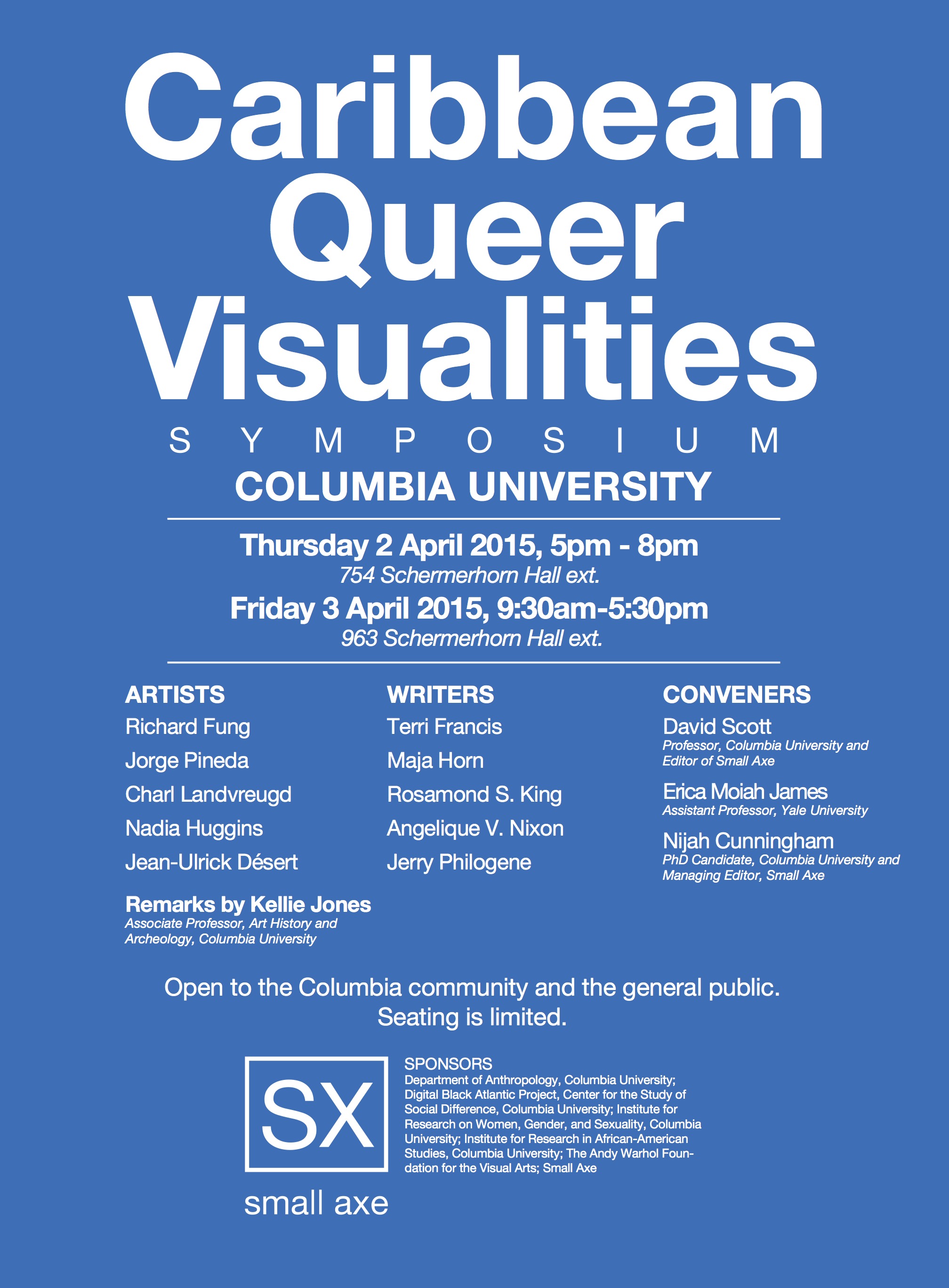
Caribbean Queer Visualities, co-sponsored by the CCSD working group the Digital Black Atlantic Project, reflects on and stimulates the production of creative and critical work that takes seriously the emergence of heterodox personal and public identities, identities that breach or subvert or evade the heteronormativities of colonial and postcolonial modes of being and self-expression.

Over the course of this afternoon of multiform panel presentations, we will engage critically with the digital as praxis, reflecting on the challenges and opportunities presented by the media technologies that evermore intensely reconfigure the social, historical, and geo-political contours of the Caribbean and its diasporas. Presenters will consider the affordances and limitations of the digital with respect to their particular methodologies – notably, representing the past, historicizing space, and telling stories.
The Caribbean Digital is a unique two-day conference presented by the Center for Social Difference's Digital Black Atlantic Project (DBAP).
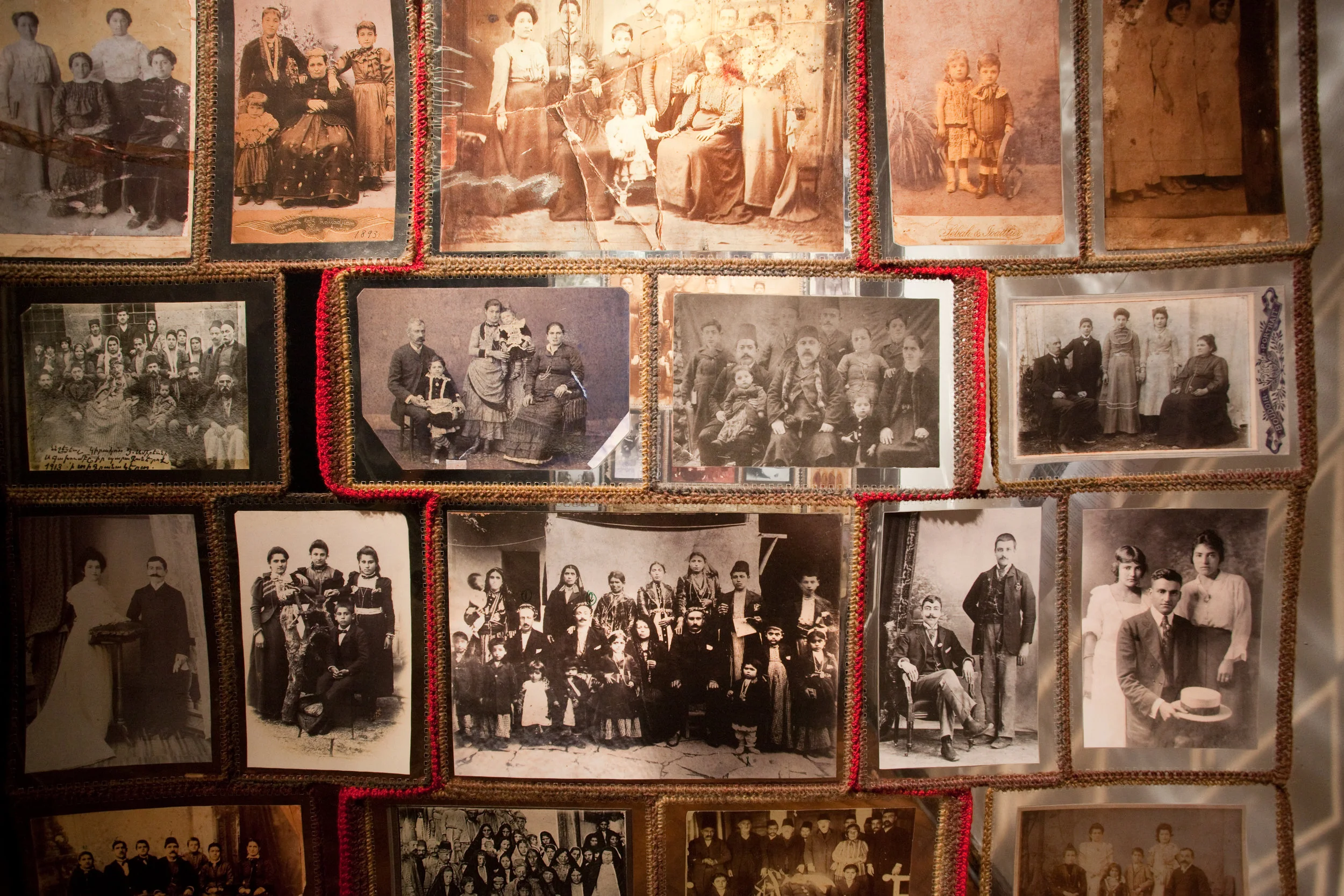
Women Mobilizing Memory
Women Mobilizing Memory (2013-20) explored the politics of memory in the aftermath of the atrocities of the twentieth and twenty-first centuries in comparative global perspective. The international working group analyzed the strategies by which women artists, scholars and activists have succeeded in mobilizing the memory of gender-based violence to promote redress, social justice, and a democratic future.
Women Mobilizing Memory, a transnational exploration of the intersection of feminism, history, and memory, shows how the recollection of violent histories can generate possibilities for progressive futures. Questioning the politics of memory-making in relation to experiences of vulnerability and violence, this wide-ranging collection asks: How can memories of violence and its afterlives be mobilized for change? What strategies can disrupt and counter public forgetting? What role do the arts play in addressing the erasure of past violence from current memory and in creating new visions for future generations?
Women Mobilizing Memory emerges from a multiyear feminist collaboration bringing together an interdisciplinary group of scholars, artists, and activists from Chile, Turkey, and the United States. The essays in this book assemble and discuss a deep archive of works that activate memory across a variety of protest cultures, ranging from seemingly minor acts of defiance to broader resistance movements. The memory practices it highlights constitute acts of repair that demand justice but do not aim at restitution. They invite the creation of alternative histories that can reconfigure painful pasts and presents. Giving voice to silenced memories and reclaiming collective memories that have been misrepresented in official narratives, Women Mobilizing Memory offers an alternative to more monumental commemorative practices. It models a new direction for memory studies and testifies to a continuing hope for an alternative future.
Women Mobilizing Memory Book Events

The Women Mobilizing Memory working group presents Reclaiming Collective Memories in Contemporary Turkey, a panel discussion and book presentation.

CSSD working group Women Mobilizing Memory will be celebrating the recent publication of their eponymous book Women Mobilizing Memory with a reception and brief presentations from some of the book’s contributors.

Editors
Ayşe Gül Altınay is professor of cultural anthropology and director of the Gender and Women’s Studies Center of Excellence at Sabancı University.
María José Contreras is a performance artist and associate professor at the Faculty of the Arts of the Universidad Católica de Chile.
Marianne Hirsch is professor of English, comparative literature, and gender studies at Columbia University.
Jean Howard is professor in the Department of English and Comparative Literature at Columbia University.
Banu Karaca is assistant professor of anthropology and a Mercator-IPC Fellow at the Istanbul Policy Center.
Alisa Solomon is professor at Columbia University’s Graduate School of Journalism, where she directs the MA Arts and Culture concentration.
Project Directors: Marianne Hirsch, Jean Howard, Diana Taylor
Bringing together artists, writers, theater practitioners, museologists, legal scholars, social activists, and scholars of memory and memorialization, “Women Mobilizing Memory” focused on the political stakes and consequences of witnessing and testimony as responses to socially imposed vulnerability and historical trauma. It probed how individual and collective testimony and performance can establish new forms of cultural memory and facilitate social repair. Using gender as an analytic lens, this project explicitly explored women's acts of witness and the gendered forms and consequences of political repression and persecution. It asked what strategies of memorialization and re-imagining are most effective in calling attention to past and present wrongs and in creating possibilities of redress.
The group studied literary texts, visual images, memorials, archives of oral history and performances in the broadest sense, including acts of protest and the work of activist groups.
Hosted by the Columbia Global Centers in Latin America: Santiago and Istanbul, Turkey, it brought together feminist artists, scholars and activists from Columbia and the New York area with colleagues from Chile and Turkey.
News
As scholars, artists and activists who are part of the transnational feminist Women Mobilizing Memory Collective sponsored by Columbia University’s Center for the Study of Social Difference, we have studied the memories of violent histories in the interests of promoting peace, social justice, and a democratic future across the globe.
Today, we call for an immediate and lasting ceasefire between Azerbaijan and Nagorno- Karabagh.
The former CSSD director and current CSSD Executive Committee member is honored for outstanding teaching by faculty.
Women Mobilizing Memory book editor, Ayşe Gül Altınay, penned the recent post Feminist Curious Steps Through History: Illumination in Dark Times for Social Difference Online.
Past Events
The Women Mobilizing Memory working group presents Reclaiming Collective Memories in Contemporary Turkey, a panel discussion and book presentation.
CSSD working group Women Mobilizing Memory will be celebrating the recent publication of their eponymous book Women Mobilizing Memory with a reception and brief presentations from some of the book’s contributors.
The pop-up exhibition “Arts of Intervention” brings together an international group of artists connected to the working group on “Women Mobilizing Memory” of Columbia University’s Center for the Study of Social Difference in the context of the Third Annual Memory Studies Association Conference in Madrid, June, 2019.
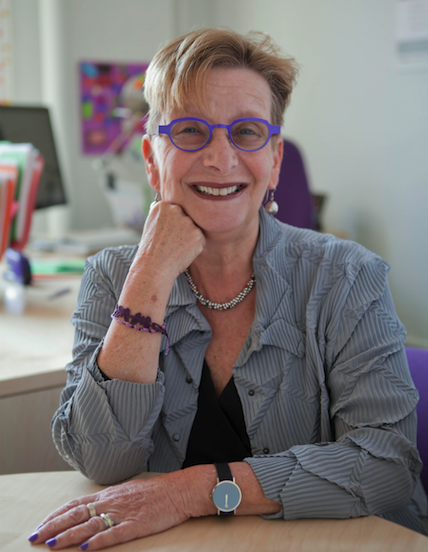
"Collaborative Archives: Connective Histories," part of the CSSD working group Women Mobilizing Memory's Collaboration and Co-Resistance project, runs at Neiman Gallery until September 18th, 2015.
The exhibition was curated by Katherine Cohn and Isin Onol and is the manifestation of multi-year collaboration of a transnational group of artists, scholars and activists from the U.S., Chile and Turkey who study the politics of memory from the unique perspective of gender and social difference.
The gallery is open Monday through Friday, 9 a.m. - 5 p.m. View the exhibit page here.
In the context of its fourth international working group meeting, Women Mobilizing Memory presents an art exhibition
"Women Mobilizing Memory," a three-year working group of Columbia’s Center for the Study of Social Difference, explores the politics of memory in the aftermath of the atrocities of the twentieth and twenty-first centuries in comparative global perspective with unique attention to the effects of social difference. Focusing on the shaping role of gender in the structures of political violence, the working group analyzes the strategies by which women artists, scholars and activists have succeeded in mobilizing the memory of gender-based violence to promote redress, social justice, and a democratic future. Looking at gendered memory politics in several sites around the world, the group has analyzed these in a broader connective context. From the fortieth anniversary of the Chilean coup, the 100th anniversary of the Armenian genocide, and cycles of violence against indigenous and minority peoples in Chile, Turkey and the United States, it has featured activist and future-oriented modes of representation and commemoration. At the same time, it probes the limits of comparative and connective approaches to memory politics. Based in the Humanities and the Arts, the group looks closely at the political efficacy of various media of memory, ranging from visual art, literature, journalism and performance to museums, memorials, and street actions. What role do these various media play in combatting the erasure of past violence from current memory and in creating new visions and new histories for future generations? The collaborations among the participants in the working group, their face-to-face as well as virtual meetings and their constructive conversations and disagreements, aim to create a space of solidarity and co-resistance that can lay the groundwork for a more hopeful future.
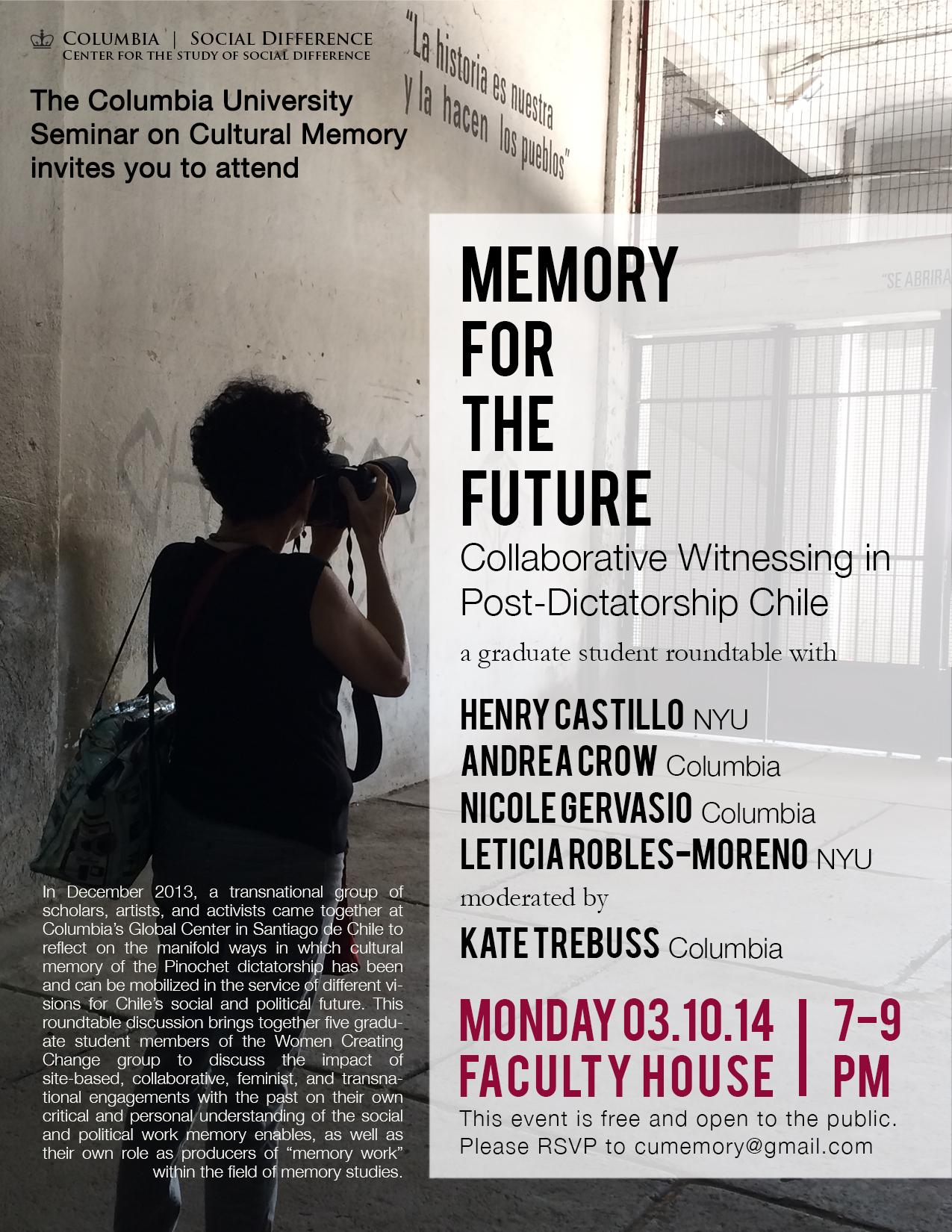
A graduate student roundtable discussion with Henry Castillo (NYU), Andrea Crow (Columbia), Nicole Gervasio (Columbia), and Leticia Robles (NYC) and moderated by Kate Trebuss (Columbia)
Publications
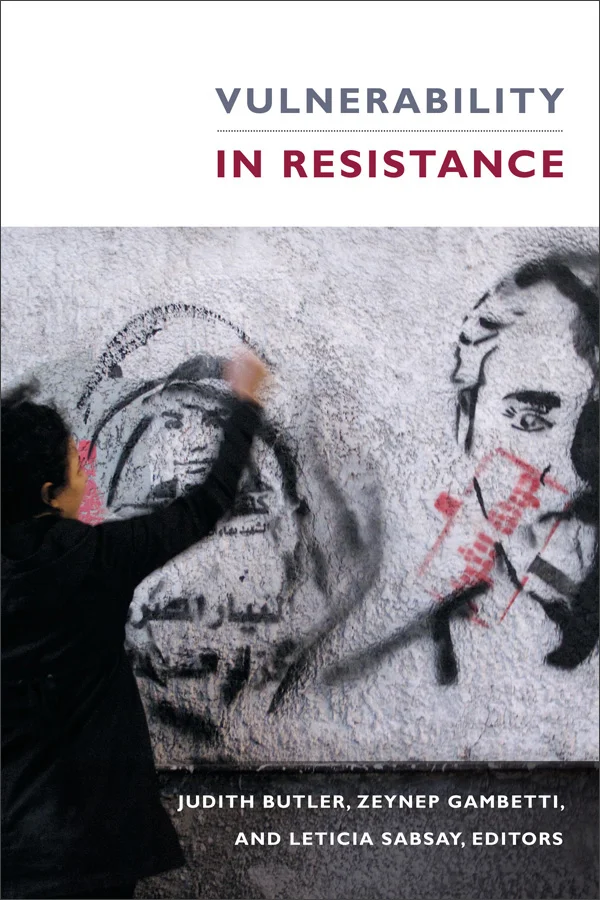
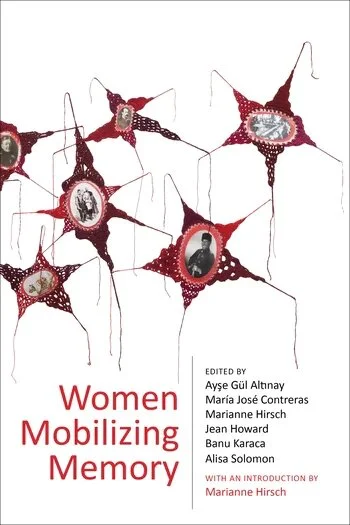
People

Doctoral Student, Cultural Studies, Sabanci University
Bürge Abiral is a PhD candidate in Anthropology at Johns Hopkins University. She received her BA from Williams College and her MA in Cultural Studies from Sabancı University, Turkey. Her research interests include human- environment relations, climate change, agriculture, political violence, and gender and sexuality. Her translation of Toward an Anthropology of Women (ed.
Fellow, Comparative Literature, Sabanci University
Hülya Adak is an Assistant Professor of Comparative Literature at Sabancı University. She has published essays on Ottoman-Turkish memoirs and biographies, national myths, gender and sexuality, and the Armenian deportations during World War I.
Fellow, Sociology, Boğaziçi University
Meltem Ahiska is Associate Professor in Sociology at Bogazici University, Istanbul. She has a PhD from the University of London.
Fellow, Anthropology, Sabancı University
Ayşe Gül Altınay is the Director of SU Gender and Associate Professor of Anthropology teaching in the Gender Studies and Cultural Studies Programs at Sabancı University. Among the programs she coordinates at SU Gender are “Curious Steps: Gender and Memory Walks of Istanbul” and “Transformative Activism: Rethinking Gender and Politics.”
Fellow, Cultural Studies, Sabancı University
Dilara Çalışkan is currently working at Sabancı University’s Gender and Women’s Studies Forum. In 2014, she graduated from Sabancı University’s Cultural Studies Master Program with a thesis titled “Queer Mothers and Daughters: The Role of Queer Kinship in the Everyday Lives of Trans Sex Worker Women in Istanbul.” Since 2010, she has been involved with Istanbul’s LGBTI Solidarity Association, which particularly focuses on human rights violations based on sexual orientation and gender identity, opposes the criminalization of sex work, and supports its recognition as work.
Doctoral Student, Cultural Studies, New York University
Henry Castillo is a doctoral student in the Department of Performance Studies at New York University. He holds a B.A. in Applied Linguistics (Honors) from the University of California--Los Angeles and an M.A. in Performance Studies form New York University. His research interests include race and ethnicity; women, gender, and sexuality; memory and "Intangible Cultural Heritage" in the Americas; Blackness in Latin America; and Afro-Colombian "heritage" practices and performance.
PhD Student
Andrea Crow is a PhD student at Columbia in the department of English and Comparative literature. Her research focuses on seventeenth-century literature and food politics as well as on academic labor and the future of the university. Her work has been published in Early Modern Women and Shakespeare Quarterly, and she has been the recipient of a grant-in-aid from the Folger Shakespeare Library to pursue her research. Andrea received a B.A. in English with a minor in Latin from Gonzaga University and an M.A.
Fellow, Art Studies, Kulturakademie Tarabya
The artist is the granddaughter of Armenian immigrants to Argentina and was born in Buenos Aires in 1967. Since 1988 she has lived in Berlin. Her artistic work deals with issues related to the burden of national identity, memory, the role of minorities in the society and the potential of a space "in between". Her work uses a very heterogeneous language (installation, video, sound installation, rugs).

Fellow. Philosophy and Political Science, Boğaziçi University
Pınar Ensari did her undergraduate study at Boğaziçi University and graduated from departments of Philosophy and Political Science and International Relations (double major program) in 2010. She finished her graduate study in the Cultural Studies MA program at Sabancı University in 2012 with a thesis titled “At the Crossroads of Eduation and Politics: Kurdish Women Studens in İstanbul”. Currently, she is working as a teaching assistant at Sabancı University, while also pursuing my studies in research areas such as ethnicity, gender, urban studies and anthropology of youth.
Fellow, Género y Cultura, Universidad de Chile.
Professor Soledad Falabella Luco is the director of ESE:O, a non-profit organization which promotes performative writing projects, and the teaching and practice of writing to empower learning communities with effective skills for local and global participation in knowledge production and circulation. She teaches feminist critical theory, performance and poetry at the Magíster en Género y Cultura, Universidad de Chile.
Fellow, Political Science & International Relations, Boğaziçi University
Zeynep Gambetti is Associate Professor of political theory at Boğazici University. She obtained her Ph. D. at the University of Paris VII in 1999. Her work focuses on collective agency, ethics, and public space. She has carried out extensive research on the transformation of the conflict between the Turkish state and the Kurdish movement, with particular emphasis on space as a vector of relationality.

PhD Candidate, English and Comparative Literature, Columbia University
Nicole Gervasio is a Ph.D. candidate in the Department of English and Comparative Literature at Columbia University. Her dissertation is on the ethics of representing mass political violence in contemporary postcolonial literature. Her work focuses on intersections between queer, postcolonial, and feminist theory in relation to themes of survival, embodiment, and trauma in literatures of the Global South. She also has a B.A. in English and Growth & Structure of Cities from Bryn Mawr College and has been the recipient of Mellon Mays, Beinecke, and Javits Fellowships.
Fellow, Performance and Politics, New York University
Marcial Godoy-Anativia is a sociocultural anthropologist and the Associate Director of the Hemispheric Institute of Performance and Politics at New York University. He is co-editor, with Zeynep Gambetti, of Rhetorics of Insecurity: Belonging and Violence in the Neoliberal Era (NYU Press, forthcoming 2013). He is also Editor, with Jill Lane, of e-misférica, the Institute's trilingual online journal. From 2000-2007, he worked in the Program on Latin America and the Caribbean and the Program on International Collaboration at the Social Science Research Council.
Fellow, History and English, Universidad de Las Américas (UDLA)
Ximena Vanessa Goecke S. is a chilean-jewish historian and a teacher of History and English, candidate to the degree of Magister in Gender and Culture in the Faculty of Humanities at Universidad de Chile. She teaches some courses in the Faculty of Education at Universidad de las Américas (UDLA) and in the English as Foreign Language area at Universidad Católica.
She participates in the research nucleus in “Body and Emotion” of the Faculty of Social Sciences at Universidad de Chile, as a member of the research section in “Body, memory and violence”.
Fellow. Theater Scholar, Pontificia Universidad Católica de Chile
Milena Grass Kleiner, translator and theater scholar, is a professor at Pontificia Universidad Católica de Chile. She holds a master's degree in Latin American Studies from Universidad de Chile and a PhD in Literature from Pontificia Universidad Católica de Chile. She has published Spanish translations of English, American, and French plays, as well as books on Chilean history and theater studies. Her main fields of research have been theater and ritual, history, and memory in post-conflict contexts.
PhD Student, Germanic Languages, Columbia University
Alyssa Greene is a Ph.D. student in the Department of Germanic Languages and the Institute for Comparative Literature and Society at Columbia University. She studies twentieth-century German and Austrian literature, with a particular emphasis on the post-Second World War era. Her research interests include memory discourses in the postwar period; migration (especially in the German-Turkish context); feminist and postcolonial criticism; the figure of the child and depictions of childhood in Cold War and post-Cold War narratives of authoritarian states.
Fellow, Sociology, Middle East Technical University
Asena Günal is an expert on history, feminism and culture and the program coordinator of Depo, a culture and arts center in Tophane, Istanbul. Depo is a space for critical debate and cultural exchange in the city center of Istanbul and the first initiative in Turkey to focus on regional collaborations among Turkey and countries in the Caucasus, the Middle East and the Balkans
Günal obtained her undergraduate degree in International Relations and her M.A. in Sociology from the Middle East Technical University, and her PhD in the History of Modern Turkey program in the Atatürk Institute, Boğaziçi University. She previously worked as an editor in İletişim Publishing House between 1998 and 2005. She is editorial secretary of the journal Toplum ve Bilim.
Actress, Historian, Teacher, Postgraduate Student PhD in Latin American Studies, Universidad de Chile
Mariana Hausdorf Andrade holds a Licenciate in Acting, Pontificia Universidad Católica de Chile 2011; Licenciate in History, Pontificia Universidad Católica de Chile, 2012; and a qualification in secondary education teaching specializing in History, Pontificia Universidad Católica de Chile, 2012.
William Peterfield Trent Professor of English and Comparative Literature and Professor of Women's, Gender, and Sexuality Studies, Columbia University
Marianne Hirsch, former Director of Columbia University's Center for the study of Social Difference is a fellow of the American Academy of Arts and Sciences and a former President of the Modern Language Association of America. She was born in Romania, and educated at Brown University where she received her BA/MA and Ph.D. degrees. Hirsch’s work combines feminist theory with memory studies, particularly the transmission of memories of violence across generations.
Villard Professor of German and Comparative Literature, Columbia University
Andreas Huyssen served as founding director of the Center for Comparative Literature and Society (1998-2003) and chaired the Department of Germanic Languages from 1986-1992 and again from 2005-2008. His research and teaching focus on 18th-20th-century German literature and culture, international modernism, Frankfurt School critical theory, postmodernism, cultural memory of historical trauma in transnational contexts, and, most recently, urban culture and globalization. He is one of the founding editors of New German Critique (1974-).

Fellow, Theater Art, Escuela De Teatro de la Universidad de Chile
Nació en Santiago, en 1980. Actriz, dramaturga y directora, es egresada de la Escuela de Teatro de la Universidad de Chile. Se suman a estos, sus estudios de Puesta en Escena y Analisis de Texto cursados en el HB Studio en Nueva York, Estados Unidos. Como actriz ha participado en el elenco de Las Troyanas de Rodrigo Pérez, Fuera de foco, dirigida por Cristián Marambio, Esa, escrita por Alejandro Moreno y Ciudadanos dirigida por Alexis Moreno.

Fellow, Comparative Literature, Sabanci University
Sibel Irzık is currently teaching comparative literature in Sabancı University. She is the author of Deconstruction and the Politics of Criticism (Garland, 1990) and the co-editor of Relocating the Fault Lines: Turkey Beyond the East-West Divide (South Atlantic Quarterly, 2003). Among her other publications are “Istanbul: The Black Book,” in The Novel, ed. Franco Moretti, Princeton U. P., 2006; “Orhan Pamuk's Snow: Re-imagining the Boundaries between East and West, Art and Politics,” in Europe and Its Boundaries, eds.
Fellow, Theatre, Universidad Católica de Chile
María Jose Contreras Lorenzini is a Chilean performance artist and scholar. She holds a Ph.D from Università di Bologna and is Associate Professor at the Theater School at Universidad Católica de Chile. She is currently a Visiting Scholar at the Hemispheric Institute of Performance and Politics at New York University. Using a wide range of formats, from massive public interventions to intimate actions of resistance, Contreras creatively explores the relation between the body and memory.

Fellow, Anthropology, Sabanci University
Banu Karaca (Ph.D. Cultural Anthropology, Graduate Center-CUNY) is a Visiting Scholar at Sabanci University's Faculty of Arts and Sciences. She is currently completing a manuscript, which examines how divergent claims regarding the civic, political and economic impact of art are mediated in the art worlds of Berlin and Istanbul.

Fellow, English Literature, Barnard College
Nancy Kricorian is the author of the novels Zabelle, Dreams of Bread and Fire, and All The Light There Was, which is set in the Armenian community of Paris during World War II. She is a widely published poet and essayist, whose work has appeared in The Antioch Review, Parnassus, In These Times, The Minnesota Review, Women’s Studies Quarterly, and other journals.

Fellow, Modern Languages and Literatures, Loyola University Chicago
Bernardita Llanos M. is Professor of Spanish Language and Literature at Loyola University Chicago. She received her PhD in Hispanic and Luso-Brasilian Literatures and Linguistics from the University of Minnesota. In 1994 she published (Re)descubrimiento y (re)conquista de América en la ilustración española, which received a publication grant from the Program of Cultural Cooperation between Spain's Ministry of Culture and U.S. universities.
Fellow, Psychology, Academy of Christian Humanism University
María Eugenia Lorenzini nació en Talca. Sicóloga de profesión, desarrolló un importante trabajo como fotógrafa, formando parte de una generación que buscó retratar el rostro gris de Chile durante la dictadura militar. En esos años trabajó como reportera gráfica en el semanario Hoy y la revista Análisis, labor gracias a la cual reunió un importante archivo fotográfico que concentró en su libro Fragmento fotográfico, arte, narración y memoria. Chile 1980-1990.
Fellow, International Relations and Women and Gender Studies, University of California
Amanda Lotspike graduated Phi Beta Kappa at the University of California, Davis with a B.A. in International Relations and Women and Gender Studies. With support from the U.S. State Department’s Gilman International Scholarship and the UC Davis President’s Fellowship, she carried out ethnographic research in Santiago, Chile in 2011, working to understand how community health promoters in popular sectors of Santiago push the ontological notions of the body within a neoliberal political economy. She is currently working as a Project Collaborator and Researcher for ESE:O.
Fellow, Visual Education, Harvard University
Susan Meiselas received her B.A. from Sarah Lawrence College and her M.A. in visual education from Harvard University. She joined Magnum Photos in 1976. She is the author of three books: Carnival Strippers, Nicaragua, and Pandora's Box and editor of five collections: Learn to See, El Salvador: The Work of 30 Photographers, Chile from Within., Kurdistan: In the Shadow of History and Encounters with the Dani. She has co-directed two films: "Living at Risk" and "Pictures from a Revolution" with Richard P.
Artist & Professor of Photography & Imaging, NYU
Lorie Novak’s photographs, installations, and Internet projects explore issues of memory and transmission, the relationship between the intimate and the public, the shifting cultural meanings of photographs, and how we can use archives to reframe the past and suggest new narratives. Her work has been in numerous exhibitions both nationally and internationally.
Curator, Oral History and Art, Elgiz Museum of Contemporary Art Istanbul
Işın Önol is a curator and writer based in New York. She has been working as an independent curator (predominantly in the USA, Austria and Turkey) since 2009. Before that, she led the Elgiz Museum of Contemporary Art Istanbul as its director and curator. (2006-2009). Her curatorial research focuses on interconnecting archival information with oral histories to create platforms for collective memory through collaborative art practices

Doctoral Student, Performance Studies, New York University
Leticia Robles-Moreno is a PhD student at New York University’s Department of Performance Studies. She received her Bachelor’s degree in Humanities with emphasis in Linguistics and Literature from the Pontificia Universidad Católica del Perú. She also holds a Master’s degree in Latin American Literature from the University of Colorado at Boulder, and has taught Spanish, Latin American culture, and Writing classes in several college levels.

Doctoral Candidate, English and Comparative Literature, Columbia University
Carina del Valle Schorske is a poet, translator, and PhD candidate in Comparative Literature. She is broadly interested in the history of psychoanalysis and other forms of psychic inquiry among artists and intellectuals of color in the Americas (Harlem, Mexico City, the Caribbean). She is currently at work on a project about Pamela Colman Smith, a turn-of-the-century Jamaican folklorist and the illustrator of the world's most widely used tarot deck.

Psychologist, Gender and Culture Studies, Universidad de Chile
Iván Smirnow received his Bachelors of Science in Psychology at the Universidad Diego Portales, and is currently pursuing a Master’s degree in Personal Coaching and Leadership from the University of Barcelona. He plans to apply to the Masters Program in Gender and Culture Studies in Latin America, Department of Philosophy and Humanities a the Universidad de Chile with a proposed thesis: “Cuerpos-hechos-por/para-el-trabajo: cuerpo, memoria y trabajo precario.”
Associate Professor, Department of Journalism, Columbia Journalism School
Alisa Solomon directs the Arts & Culture concentration in the M.A. program at the Journalism School. She came to Columbia in 2005 after nearly 20 years as a professor of English/Journalism at Baruch College-CUNY and as a professor in the Ph.D. programs in Theater and in English at the CUNY Graduate Center. In addition to contributing occasionally to The Nation, The Forward, The New York Times, and other publications, she was on staff at The Village Voice for 21 years, where she was a regular theater critic and cultural and political reporter, winning awards for stories on reproductive rights, electoral politics, women's sports, and immigration policy. Solomon's book, Re-Dressing the Canon: Essays on Theater and Gender, won the George Jean Nathan Award for Dramatic Criticism.
Visiting Professor of Oral History, Columbia
Leo Spitzer is the Vernon Professor of History Emeritus at Dartmouth College.
Professor and Chair, Department of Media, Culture, and Communication and Co-Director of the Visual Culture Program, NYU
Marita Sturken is Professor in the Department of Media, Culture, and Communication at New York University, where she teaches courses in visual culture, cultural memory, and consumerism.

Fellow, Performance and Politics, New York University
Diana Taylor is University Professor and Professor of Performance Studies and Spanish at NYU. She is the author of Theatre of Crisis: Drama and Politics in Latin America (1991), which won the Best Book Award given by New England Council on Latin American Studies and Honorable Mention in the Joe E. Callaway Prize for the Best Book on Drama; of Disappearing Acts: Spectacles of Gender and Nationalism in Argentina’s ‘Dirty War’, Duke U.P., 1997; and The Archive and the Repertoire: Performing Cultural Memory in the Americas (Duke U.P., 2003), which won the ATHE Research Award in Theatre Practice and Pedagogy and the Modern Language Association Katherine Singer Kovacs Prize for the best book in Latin American and Spanish Literatures and Culture (2004).
Fellow, Sculpture Studies, Hacettepe University Fine Arts
Aylin Tekiner (b. 1978, Nevsehir, Turkey) is a New York/Istanbul based artist and activist. She undertook her B.A. and M.A. at Hacettepe University Fine Arts, Sculpture Department in Ankara, Turkey. In 2008 she received her PhD at Ankara University, Institute of Educational Sciences, Cultural Fundamentals of Education Department. Her book "Ataturk Statues: Cult, Esthetics, and Politics" evolved from her PhD thesis and was published by Iletisim Yayinlari (Turkey) in 2010. Aylin has had solo shows and participated in the group exhibitions in Turkey and New York.

Doctoral Student, English and Comparative Literature, Columbia University
Kate Trebuss is a fourth-year doctoral student in the Department of English and Comparative Literature at Columbia University. Her dissertation, entitled "Critical Care: Medical Life Writing, Memory, and the Politics of Health," investigates how contemporary autobiographical stoies of illness and medical care facilitate the remembering and forgetting of certain histories and current conditions of violence, oppression, invisibility and inequality, as well as the connections between them.
Fellow, History, Dartmouth College
Zeynep Türkyılmaz received her Ph.D. from the Department of History at the University of California at Los Angeles (UCLA) in 2009. Her dissertation, "Anxieties of Conversion: Missionaries, State and Heterodox Communities in the Late Ottoman Empire," is based on intensive research conducted in Ottoman, British, and several American missionary archives. She was an Andrew W. Mellon Foundation Sawyer Seminar Postdoctoral at UNC-Chapel Hill between 2009-2010 and Europe in the Middle East/ The Middle East in Europe Seminar Postdoctoral Fellow at Wissenschaftskolleg zu Berlin between 2010-2011.

PhD Student, Anthropology, Harvard University
Armanc Yildiz is a PhD student in the Department of Anthropology at Harvard University. His current research interests are sexuality, race, labor, political economy, colonialism, migration, Germany, and the anthropology of Europe. He received his master’s degree (with Distinction) in International Performance Research at the University of Warwick. He has a bachelor’s degree (with Honors) in Cultural Studies with a minor on Art Theory and Criticism at Sabanci University.
Gender, Religion, and Law in Muslim Societies
Gender, Religion and Law in Muslim Societies studied the unique forms of women’s activism across the Muslim world, looking at how efforts by women to work within an explicitly religious framework in order to transform society and participate more fully in public debates have influenced state. The group explored the divergences and points of contact between the flourishing work of those termed “Islamic feminists” and those who might best be called “Islamist women,” and evaluated the academic research used to promote the social inclusion and wider political transformation of women in the Islamic world.
Project Directors: Lila Abu-Lughod, Katherine Ewing
Gender, Religion and Law in Muslim Societies was a project that studied the unique forms of women’s activism across the Muslim world, looking at how efforts by women to work within an explicitly religious framework in order to transform society and participate more fully in public debates have influenced state. The group explored the divergences and points of contact between the flourishing work of those termed “Islamic feminists” and those who might best be called “Islamist women,” and evaluated the academic research used to promote the social inclusion and wider political transformation of women in the Islamic world.
In addition to the Center for the Study of Social Difference, this project received support from the Luce Foundation through the Center for the Study of Democracy, Toleration and Religion’s project “Who’s Afraid of Sharia?”
The project presented three workshops:
Workshop I: Islamic Feminists, Islamist Women, and the Women Between
Organized by Lila Abu-Lughod, Katherine Ewing, and Anupama Rao
Over the past two decades, women’s activism has taken creative new forms across the Muslim world. Working within the frame of Islamic piety and engaging fully with the Muslim tradition, many women have been distancing themselves from the largely secular feminist projects of social reform, legal rights, or empowerment-through-development that had dominated the social field of women’s activism in most post-independence nations across the Muslim world.
Yet these efforts by women to work within an explicitly religious framework in order to transform society, refashion their roles as women, redefine their authority, and participate more fully in public debates and political fields have taken radically different paths, and influenced state policy in a number of ways. The first workshop brought together experts on gender, Islam, and various Muslim communities to explore the divergences and points of contact between the flourishing work of those who could be termed “Islamic feminists” and the locally but widely appealing work of those who might best be called “Islamist women.”
Islamic feminists are cosmopolitan educated women, often based in the West, who seek to enhance women’s rights and promote gender egalitarianism through reforms of Islamic family law and through re-interpretations of the key religious texts. They are concerned to counter “conservative” ideologies. This distinguishes them from “Islamist women,” among whom would be counted the significant numbers of women affiliated with the range of Islamist political parties operating in various countries, whether oppositional or government-affiliated.
Bringing together international scholars who work on different regions--from Europe, the Middle East, South Asia, Southeast Asia and Africa--this project examined these activist projects in light of the everyday lives of the women in between to whom they seek to appeal, paying close attention to diverse political and social contexts.
Workshop II: The Power of Women’s Islamic Education
November 8-9, 2013
Columbia University
Across the Muslim world, women are attending not just mosque study groups but new institutes for Islamic studies, Islamic universities, and seminaries. In the Western media “madrasas” are presented as incubators for fundamentalism. Islamic education is associated more with indoctrination and conservatism than enlightenment. As part of poverty alleviation and the empowerment of girls and women, the UN’s Global Education First Initiative seeks to “spur a global movement to put quality, relevant and transformative education right at the heart of the social, political and development agendas.” While this initiative recognizes “a broad spectrum of actors,” does Islamic schooling fit?
This workshop brought together scholars who have done ethnographic and historical research on women’s Islamic education in various countries to think more seriously about the types and content of these forms of schooling, the reasons why women are pursuing religious education when (secular) state education is widely available alongside it, and the social and personal impacts of these forms of education. From daily life to social relations and hierarchies; from forms of authority to the paths opened up; from intellectual skills to social capital: careful assessment is needed to appreciate the popularity of Islamic education, its political and social uses, and the ways it both empowers and limits women.
Workshop III: Debating the “Woman Question” in the New Middle East Women’s Rights, Citizenship, and Social Justice
May 3-4, 2014
Columbia Global Center \ Middle East
Organizing Committee: Lila Abu-Lughod, Hoda El Sadda, Amal Ghandour, and Safwan Masri
In light of the recent events across the Arab region, the time is opportune for a careful examination of the new opportunities and challenges facing Arab women. The Arab uprisings sought to challenge the status quo, demanding significant political and social transformation. Many women in the region hope that the “Arab Spring” will also mark a new dawn for women’s rights as well. Yet despite socio-political gains to be made by citizens in the Middle East and North Africa (MENA), women’s full citizenship rights and privileges may still fall short. Debates about women’s rights and the place of women’s rights in political and economic struggles have become contentious.
What is distinctive about all these debates about women in the Arab world, as well as women’s activism on the ground in various countries in the region, is that they have occurred from the start in a context in which the international community have insistently made women’s citizenship and rights a key symbol of the success or failure of the revolutions and the value of new political orders. How does this international interest, which itself is linked to longstanding political and economic interests in the region (including alliances with the old regimes), affect the work of Arab women activists, the political projects they seek to undertake, and even the definitions of social justice with which they can work?
This workshop brought together scholars, academics, and practitioners for a collective critical evaluation of the situation, to consider how academic research on gender and rights relates to the work of practitioners in women’s organizations, and to assess conventional arguments about what is impeding women from full entitlements of citizenship. The goal was to develop the knowledge necessary for creative and effective strategies for promoting social inclusion and wider political transformation.
The workshop was organized around three broad themes:
Bread and Dignity: Political Economies and Women’s Lives
What’s in a Constitution? Political and Legal Strategies for Citizenship and Social Justice
Who’s Afraid of Shari’a? Islamic Feminism and Islamist Governance
Past Events
This exploratory workshop, preparatory for an international conference in 2011, will examine the relationship between Islamic law and gender violence in the Muslim world from two perspectives.
A discussion amongProfessors Saba Mahmood (Anthropology, University of California at Berkeley), Lila Abu-Lughod (Anthropology and IRWAG,
Columbia) and Wael Hallaq (MEALAC Columbia) based on two precirculated papers: Mahmood's "'Secularism, Hermeneutics, and Empire" and
Abu-Lughod's "Anthropology in the Territory of Rights--Human, Islamic, and Women's."

"Gender, Rights, and the Practices of Law," Friday, October 3rd, 9:30am-3pm. Workshop (by invitation only) organized by Lila Abu-Lughod and co-sponsored by IRCPL (Institute for Religion, Culture, and Public Life) and CSSD (Center for the Study of Social Difference) to launch the CSSD working group on "Liberalism's Others."

Who's Afraid of Shari'a?: A Conversation about “War, Law and Humanitarian Intervention"October 2, 2008
Who's Afraid of Shari'a?: A Conversation about "War, Law and Humanitarian Intervention" with Naz Modirzadeh (Program on Humanitarian Policy and Conflict Research, Harvard School of Public Health) and Mahmood Mamdani (Columbia University). Moderated by Katherine Franke (Columbia Law School). Thursday, October 2nd, 4:10-6pm, 754 Schermerhorn Extension. Reception to follow.
Image: Humanitarian intervention in Afghanistan as spectacle. Carnivale in Rio de Janeiros, BBC News in Pictures 2007.
Publications
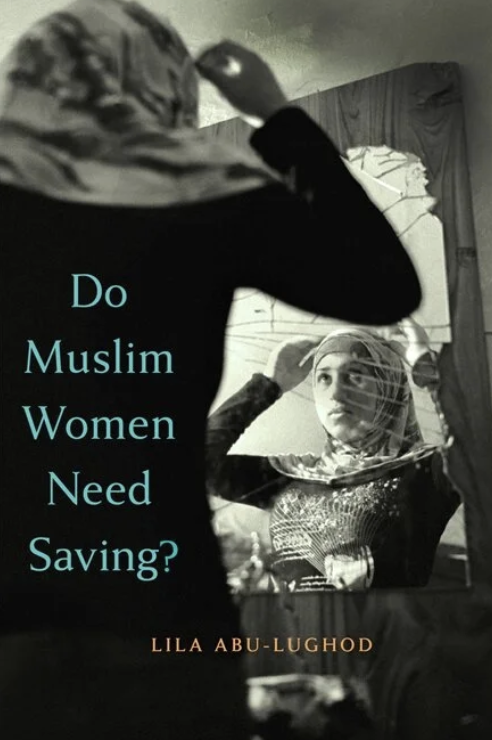

The Future of Disability Studies
The Future of Disability Studies (2013-16) engaged ethical and political questions about the beginning and end of life, prenatal testing, abortion, euthanasia, eugenics, technologies for the medical correction and “cure” of the non-normative body, disease, wartime injuries, post-traumatic stress, and healthcare, as well as the dynamics of social inclusion and/or exclusion.
Project Director: Rachel Adams
The study of disability engages some of the most pressing debates of our time, questions about the beginning and end of life, prenatal testing, abortion, euthanasia, eugenics, accommodation in schools, public transportation and the workplace, technologies for the medical correction and “cure” of the non-normative body, disease, wartime injuries, post-traumatic stress, and healthcare. These questions could not be more relevant, given that people with disabilities are the largest minority group in the United States, and that everyone who lives long enough will eventually become disabled. But beyond the numbers, the study of disability matters because it forces us to interrogate charged ethical and political questions about the meaning of aesthetics and cultural representation, bodily identity, and dynamics of social inclusion and/or exclusion.
The Future of Disability Studies approached disability as an embodied condition, a mutable historical phenomenon, and a social, political, and cultural identity; it explored some of the key debates within Disability Studies and identified new directions for the future of the field. Among other questions, this project's working group asked: How might we complicate the opposition between medical and social models of disability? What are the grounds for productive dialogue and intersection between Disability studies and Medical Humanities? How can we reconcile a commitment to the autonomy and self-representation of people with disabilities with the commitment to include people with the severest forms of intellectual and physical disability? How can Disability Studies further understand its relationship to other phenomena of embodied identity, such as race, ethnicity, and gender? How should Disability studies approach scientific developments in genetics, new reproductive technologies, augmentative communication devices, prosthetics etc.? How can the study of disability cast light on political debates over about healthcare, war, and education policy? And how is our consideration of these dynamics complicated and enhanced by putting them in historical and/or transnational perspective?
News
The director of the Future of Disability Studies working group spoke about how she has updated her class for the pandemic.
Rachel Adams, a Faculty Director of the CSSD Precision Medicine project, is taking her interdisciplinary research interests to the next level, and she is recording her progress online.

Past Events

A symposium to celebrate the 25th anniversary of the Americans with Disabilities Act, The Future of Disability Studies project, and the publication of Keywords for Disability Studies.
Pulitzer Prize-winning journalist and author Ron Suskind spoke at Columbia in March about pursuing a demanding career in investigative journalism while raising his autistic son Owen.
As part of the Heyman Center for the Humanities Disciplines Series:
Evaluation, Value, and Evidence, authors Alison Piepmeier, George Estreich, and Rachel Adams take up many of the questions raised in the November 2013 event on "Genes, Children, and Ethics" (featuring Michael Berube, Faye Ginsberg, and Rayna Rapp) in their discussion of "Parenting, Narrative, and Our Genetic Futures." Jordana Mendelson will chair.
Cosponsored by the Future of Disability Studies project.
Evan is a young man with Down Syndrome who lives with his mother in a poor, working-class town hit hard by the recent economic recession. When he unexpectedly comes into a large amount of money, Evan uses it to romantically pursue Candy, a girl from town whom he has loved since high school. Candy, now a barely-employed single mom, is facing financial debt, possible eviction, and the inability to rid herself of Russ, her abusive and volatile ex-boyfriend.
A talk by Tobin Siebers (Department of English, University of Michigan) with a response by Elizabeth Leake (Department of Italian, Columbia University)
This panel will explore the the conflicts and common ground between two fields that have often been in tension with one another. Speakers will be asked to share their insights into this tension, identifying spaces of possibility where the two might intersect/collaborate/learn from one another.
We begin our project with a panel of students, faculty, and staff who discuss the ways the university has both accommodated and excluded people with disabilities. What are some of the surprising and innovative ways that Columbia has sought to include people with disabilities in its community? Conversely, how has it managed to maintain ADA compliance, while creating an unwelcoming environment for people with disabilities? Our campus will serve as a starting place for a broader discussion about disability, access, and higher education.
Publications
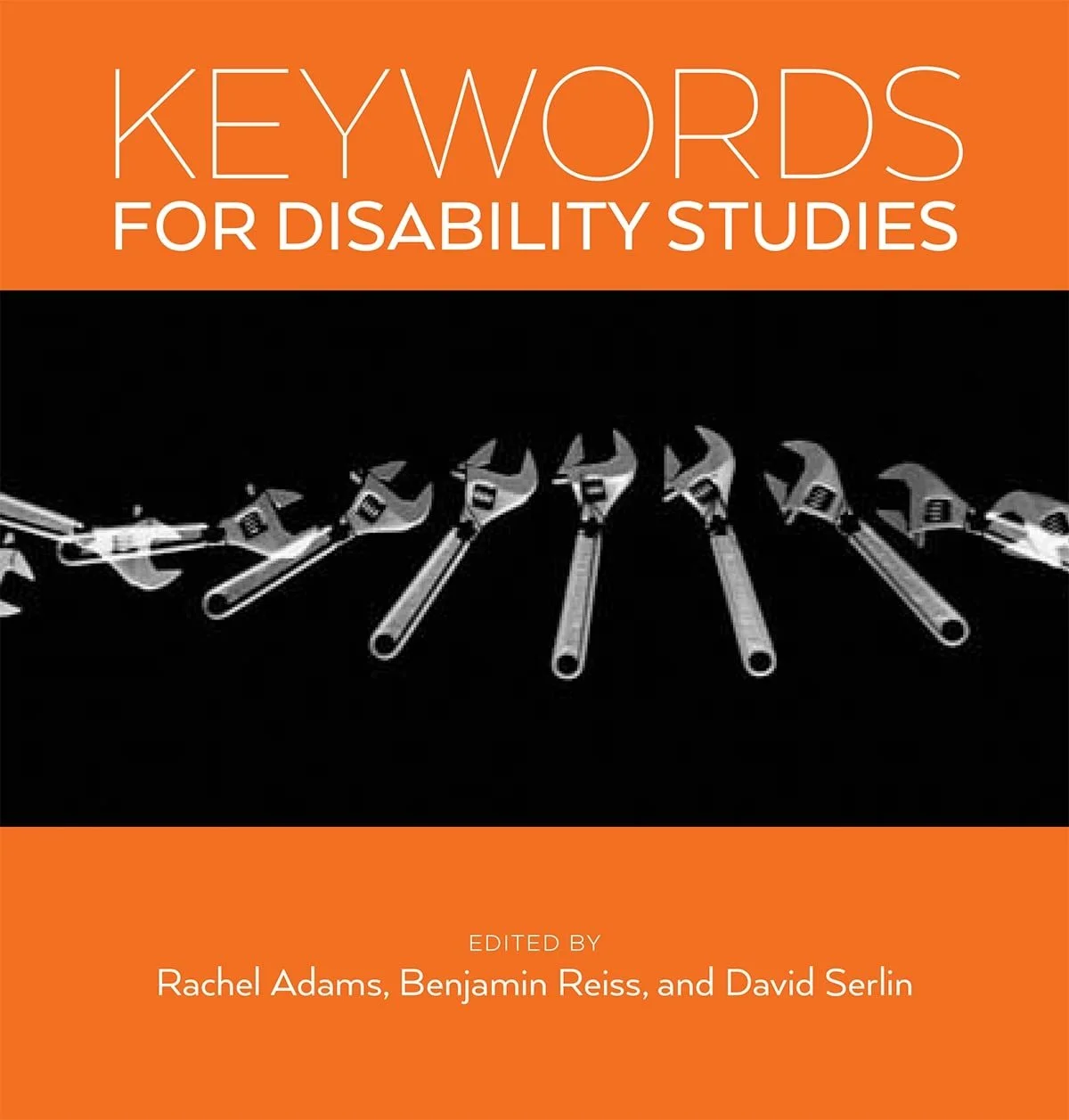
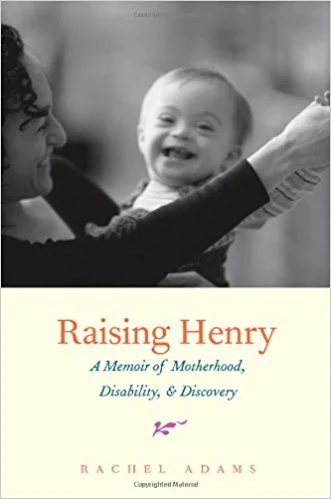
Fellows

Professor, Department of English and Comparative Literature, Columbia University
Rachel Adams is the director of the “Precision Medicine: Ethics, Politics and Culture.” She is Professor of English and American Studies at Columbia University, where she specializes in 19th- and 20th-century literatures of the United States and the Americas, media studies, theories of race, gender, and sexuality, medical humanities and disability studies.

Fellow, Theater, Brooklyn College
Margaret Araneo-Reddy is a New York-based scholar and theatre artist. She is currently a doctoral candidate at the Graduate Center, City University of New York and an Instructor of Drama at New York University. Her current research focuses on the intersection of neuropsychology and popular performance in the late nineteenth and early twentieth centuries. Using a cultural model of disability, Margaret examines the ways the small forms of cabaret and vaudeville (in Paris and New York respectively) both represent and embody neurological diversity in performance.

Professor, Department of English, Barnard College
Professor Baswell rejoins the faculty at Barnard and Columbia after a period as Professor of English and Associate Director of the Center for Medieval and Renaissance Studies at UCLA, 2001-2008. Baswell’s earliest research was in the reception and transformation of classical literature, especially narratives of empire and dynastic foundation, in the vernacular cultures of the European Middle Ages. He has approached these issues through the optic of original manuscripts, and in the light of the multilingualism of medieval France and England.
Fellow, American Studies and English, Yale University
James Berger is Senior Lecturer in American Studies and English at Yale University. He is author of After the End: Representations of Post-Apocalypse and editor of Helen Keller's The Story of My Life: The Restored Edition. He is currently completing The Disarticulate: Language, Impairment, and the Narratives of Modernity, to be published by New York University Press.

Doctoral Student, Oral History, Columbia University
Nicki Pombier Berger is an oral historian, educator, and interdisciplinary artist.
Nicki is on the faculty at The New School College of Performing Arts, where she teaches in the Drama BFA program. In collaboration with playwright Suli Holum, she is currently working as dramaturg on THE BAKKEN, an investigation of the Bakken shale, a rock formation roughly 350 million years old sitting deep below the surface of North Dakota.
PhD Student, English and Comparative Literature, Columbia University
Liz Bowen is a Ph.D. candidate in English and comparative literature who works at the intersections of 20th and 21st century American literature, disability studies, and critical animal studies. Her dissertation, “Animal Abilities: Disability, Species Difference, and Aesthetic Innovation in the Long 20th Century,” traces the intertwined deployments of disability, animality, and cognitive otherness as sites for literary experimentation, from Faulkner to the Harlem Renaissance to contemporary poetics.

Fellow, English, Hunter College
Sarah Chinn teaches nineteenth century literature at Hunter College, CUNY. Her work primarily explores questions of race, embodiment, sexuality, and gender in U.S. literature and culture, particularly in the 19th century. She is the author of Technology and the Logic of American Racism: A Cultural History of the Body as Evidence (Continuum, 2000) and The Invention of Modern Adolescence: Children of Immigrants in Turn-of-the-Century America (Rutgers University Press, 2008).

Fellow, Disability Studies, Hofstra University
G. Thomas Couser retired in 2011 from Hofstra University, where he was a professor of English and founding director of the Disability Studies Program.

Fellow, English, New York Institute of Technology
Elizabeth J. Donaldson is Associate Professor of English at New York Institute of Technology, where she teaches courses in American literature, writing, and medical humanities. She has published essays on mental illness in film, antipsychiatry in Lauren Slater’s memoirs, physiognomy and madness in Jane Eyre, teaching Melville online, and the poetry of Amy Lowell, among other subjects. She is a member of the editorial board of the Journal of Literary and Cultural Disabilities Studies and is co-editor (with Catherine J.
Fellow, Anthropology, New York University
Faye Ginsburg is David B. Kriser Professor of Anthropology at NYU where is is also Director of the Center for Media, Culture and History, Co-Director of the NYU Council for the Study of Disability, and Co-Director of the Center for Religion and Media. Prizewinning author/editor of four Her research focuses on movements for social transformation, from her early work on abortion activists, to her longstanding research on indigenous media, to her current work, with Rayna Rapp, on cultural innovation and learning disabilities.

Assistant Professor of Theater, City University of New York
Amy E. Hughes is Assistant Professor and Deputy Chair for Graduate Studies in the Department of Theater, Brooklyn College (CUNY). Her work focuses on the relationship between theater/performance and visual, print, and material culture in nineteenth-century America.

Fellow, Musicology, Brooklyn College
Stephanie Jensen-Moulton, Assistant Professor of Musicology at Brooklyn College, has published articles on women in hip-hop, the 19th-century piano prodigy "Blind Tom" Wiggins, feminist pedagogy and other topics in American music. She has presented papers and lecture-recitals at numerous national and international conferences, including IASPM Rome and national meetings of the Society for American Music and the American Musicological Society. She received the Ph.D.

Fellow, English, University of Delaware
Stephanie Kerschbaum (B.A. The Ohio State University, M.A., Ph.D. University of Wisconsin-Madison) conducts research focused on diversity issues and the teaching of writing. She is an associate professor of English at the University of Delaware where she teaches writing, rhetoric, and composition theory in the University of Delaware Writing program and special topics courses. She is a Faculty Scholar affiliated with UD’s Center for the Study of Diversity. She also teaches undergraduate courses on diversity and higher education and teaches graduate seminars in composition theory and pedagogy.

Fellow, Feminist Studies, Barnard Center for Research on Women
Ynestra King is a feminist teacher, writer and oral historian. She is an ecofeminist theorist, and a founder of Women and Life on Earth and the feminist anti-militarist movement, as well as the Committee on Women, Population and Environment. Her current work is on disability narratives and body politics, focusing particularly on women and disability. She is also at work on a memoir tentatively entitled Falling. She was previously visiting Scholar at the Barnard Center for Research on Women.
Fellow, Sociology, University of Connecticut
Laura Mauldin's research draws from the fields of medical sociology, science and technology studies (STS), and disability studies. She uses ethnographic methods to show how individual experiences are situated within institutional structures and a larger sociocultural context. All of her research is concerned with how science, technology, and medicine shape contemporary life and is based on the contention that disability – like race, class, or gender - is a political and social category. Her aim is to give voice to the experiences of individuals and families who utilize healthcare services and/or medical technologies in order to show the ambivalent qualities of technoscientific change, the politics of disability and illness, and to suggest what healthcare policies or issues need to be further researched or improved.

Sociology, The New School for Social Research
Ariel Merkel is a Sociology PhD candidate at the New School for Social Research, with a focus on disability studies. She earned her MA at NSSR in May 2011, and holds a BA (cum laude) in Cultural Anthropology from Wells College, a small women’s college in the Finger Lakes region of New York State. Upon graduation in 2005, she was awarded the Carter A. Woods Prize for her thesis, which analyzed the strategies of Kanaka Maoli (indigenous Hawaiian) activists involved in the Cultural Revitalization Movement.
Fellow, Media, Culture, and Communication, New York University
Mara Mills is Assistant Professor of Media, Culture, and Communication at New York University. She received her Ph.D.

PhD Student, American Studies, Yale University
Ittai is a Ph.D. candidate in American Studies. His dissertation is an intellectual history of intelligence and intellectual ability in 18th- and 19th-century America with a focus on popular literary texts. His other areas of expertise include the history of race, sexuality and gender studies, disability studies, and the history of capitalism. He has been a tutor for the undergraduate non-fiction writing course “Daily Themes,” a writing instructor, and an LSAT-prep tutor and instructor. His work has been published in American Quarterly and Public Books, and he has presented at the Modern and Contemporary Studies Initiative, American Studies Association and the Modern Language Association.
Fellow, English, City University of New York
Julia Miele Rodas is assistant professor of English at the City University of New York (CUNY). She teaches writing at CUNY’s Bronx Community College and is on the faculty of the Master’s program in Disability Studies at the CUNY School of Professional Studies. Her writing has appeared in Victorian Literature & Culture, Dickens Studies Annual, the Victorian Review, the Journal of Literary & Cultural Disability Studies, Disability Studies Quarterly, the Explicator, and other venues.
Fellow, Economics, Brandeis University
Harilyn Rousso is a writer, painter, educator, social worker, psychotherapist and activist who has worked in the disability rights field, with a particular emphasis on issues of women and girls with disabilities, for more than twenty-five years. She is the founder of the Networking Project for Disabled Women and Girls of the YWCA/NYC, a unique mentoring program that has been replicated widely, and the President of Disabilities Unlimited Consulting Services, which provides education and training on disability equity issues.

Fellow, English, City University of New York
Rebecca Sanchez is an Assistant Professor of English at Fordham University and a member of the MLA’s Committee on Disability Issues in the Profession. Her research interests include transatlantic modernism, Deaf and disability studies and poetics. She is currently working on a book project entitled Deafening Modernism, which analyzes the impact of communicative norms on twentieth century writing.

Fellow, Anthropology, City University of New York
Irina Carlota (Lotti) Silber received her PhD from NYU and is currently an Associate Professor of Anthropology at the City College of New York (CCNY) in the Department of Interdisciplinary Arts and Sciences, which is housed at the Center for Worker Education. She is also the Director of the MA Program in the Study of the Americas. She is the recipient of various dissertation fellowships (i.e.
Distinguished Professor of Music, CUNY Graduate Center
Joseph Straus is Distinguished Professor of Music at the Graduate Center of the City University of New York. He is the author of numerous books and articles on topics in twentieth-century music, including Twelve-Tone Music in America (2009), Introduction to Post-Tonal Theory (3rd ed., 2004), Stravinsky's Late Music (2001), The Music of Ruth Crawford Seeger (1995), and Remaking the Past: Musical Modernism and the Influence of the Tonal Tradition (1990).

Fellow, English, Fordham University
Dennis Tyler is Assistant Professor of English at Fordham University. He has published work on African American literature, disability studies, and popular culture. He is the recipient of the 2015-16 Woodrow Wilson Career Enhancement Fellowship. His current book project, Disability of Color, examines how disablement as experience and as discourse has shaped the racial subjecthood of African Americans in the nineteenth and twentieth centuries.
Doctoral Student, Art History, Hunter College
Emmanuel von Schack is a deaf art history graduate student at Hunter College; his master's thesis focuses on German artists who were veterans of the First World War and the works of art they created during and after the War. By interweaving disability theories with Foucauldian feminist and queer theories, he explores the complex relationship between masculinity and disability as conveyed in Weimar culture and art. He works as an educator at the Metropolitan Museum of Art and the Solomon R.
Fellow, Sociology, Sarah Lawrence College
Sarah Wilcox is Professor of Sociology, Sarah Lawrence College. She specializes in medical sociology, the sociology of science and knowledge, gender and sexuality, and the mass media. Her current research focuses on embodiment and biological knowledge, particularly how lay and expert knowledge intersect and when and how biological ideas become salient in embodied experience, personal identities, and popular culture.
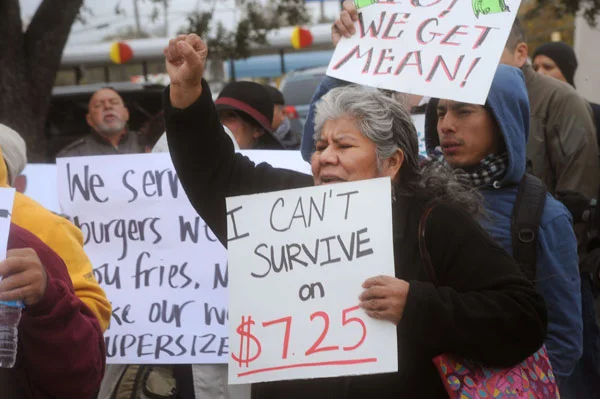
Social Justice After the Welfare State
Social Justice After the Welfare State (2013-16) explored the implications of the declining welfare state for global politics, gender and race relations, and the future of democracy, imagining alternative models of life and new ways of thinking about the politics of the present.
Project Directors: Alice Kessler-Harris, Premilla Nadasen
Social Justice After the Welfare State explored the implications of the rise of neoliberalism and declining welfare state in the US and elsewhere for American politics, gender and race relations. Some of the questions the working group set out to explore included: Is the idea of government social responsibility at a dead end? How has the role of the state shifted between the New Deal and the current era of neoliberalism? Are democratic values threatened by limits on social rights? Will we see increased emphasis on marriage, family, and individual responsibility as the source of economic support? These initial questions broke down into a variety of disturbing issues that the working group also grappled with: How have the struggles for women’s equality and racial diversity contributed to progressive social change but also masked other forms of inequality? How do we think about citizenship and rights in relation to labor migration, incarceration, education, and new reproductive technologies such as surrogacy? Will expanded benefits such as “family-friendly” policies exacerbate divisions among workers and simply create a larger pool of poorly paid labor? Or will such strategies contribute to a rethinking of the meaning of workplace justice? What about labor unions? What alternative labor organizing strategies have enhanced the political power of workers? What is the current state of social protest? Are Americans turning inward and finding individual coping mechanisms? Or are incipient movements a sign of emerging collective organization? Approaching its topic from a range of angles, the workshop cast its exploratory net on the impact of inequality on the future of American democracy.
Workshop: Shifting Notions of Social Citizenship: The “Two Wests”
June 11-13, 2014
Columbia Global Center | Paris
The workshop examined the impact of the widespread decline of the welfare state on long-standing claims to social citizenship, and consider consequences for democratic participation in Europe, and in the United States. Over the course of the twentieth century, expanding welfare states, most effectively (though differently) modeled in Western Europe, helped to guarantee economic security. In the quest for a more inclusive social citizenship, nation-states variously subsidized education, housing and family maintenance, as well as unemployment insurance, old age pensions, minimum wages, labor standards, the dole, and health care. These benefits or rights, helped to empower working people to participate in democratic governance. But the “welfare state” is now at risk, under the onslaught of a persuasive 'free market' ideology and the spread of global economies that reduce the regulatory capacities of nation-states. And so the question: Can we imagine the perpetuation of democracy in the face of a transformed welfare state? Social scientists and historians from the United States and different European countries met to explore how the decline of the welfare state will affect present and future conceptions of citizenship and political participation.
With the support of:
Interuniversity Center for European-American History and Politics (CISPEA); Department of Human Studies, University of Eastern Piedmont; Department of History, Columbia University; and the Alliance Program, Columbia University
Beyond Neoliberalism: Social Justice After the Welfare State
Saturday, April 2, 2016
Columbia University
Social Justice After the Welfare State, a workshop led by Alice Kessler-Harris and Premilla Nadasen in the Center for the Study of Social Difference (CSSD) at Columbia, hosted a daylong symposium to explore the transformation of the welfare state and social movements in the face of neoliberal challenges. The group gathered considered the implications of this transformation for the political economy of class, gender, racism, and migration. Putting scholars in conversation with activists who address the fallout of neoliberalism on the ground, the symposium assessed the past, present, and future of government social responsibility and pays special attention to social rights and social justice.
With the support of:
Women Creating Change (Center for the Study of Social Difference); Heyman Center for the Humanities, Columbia University; Department of History, Columbia University
News
CSSD co-director of Social Justice After the Welfare State and Faculty Fellow of Geographies of Injustice, Premilla Nadasen, was elected next President of the National Women's Studies Association (NWSA).
Ph.D. students from several CSSD working groups have completed their programs this year.
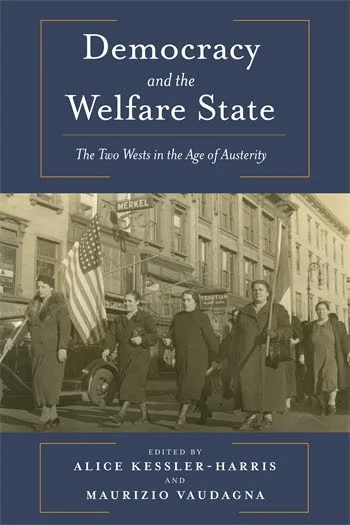
Columbia Global Centers - Paris, in partnership with Columbia University Press and Centre d'histoire de Sciences Po will host a book presentation for Democracy and the Welfare State: The Two Wests in the Age of Austerity, edited by CSSD project director Alice Kessler-Harris and Maurizio Vaudagna.
Alice Kessler-Harris is featured in a NYTimes article on workplace power dynamics and the slow progress for women in traditionally 'masculine' fields. CSSD will host a book event with Kessler-Harris on April 4, 2018.
CSSD Project Co-Director Alice Kessler-Harris has been named to the Board of Governors of the Edward M. Kennedy Prize for Drama Inspired by American History.

Past Events

Columbia University Press in partnership with the Centre d'histoire de Sciences Po presents:
“Democracy and the Welfare State: The Two Wests in the Age of Austerity,” a book presentation at the Columbia Global Centers-Paris.

The CSSD working group Social Justice After the Welfare State presents:
"Democracy after the Welfare State: a Conversation," a book launch event for Democracy and the Welfare State: The Two Wests in the Age of Austerity, edited by Alice Kessler-Harris and Maurizio Vaudagna.
REGISTRATION REQUIRED; BY INVITATION ONLY
Social Justice after the Welfare State, a workshop led by Alice Kessler-Harris and Premilla Nadasen in the Center for the Study of Social Difference (CSSD) at Columbia, hosts a daylong symposium to explore the transformation of the welfare state and social movements in the face of neoliberal challenges. We consider the implications of this transformation for the political economy of class, gender, racism, and migration.
Over the course of the twentieth century in the United States and Europe, the social bargaining process we call welfare integrated capital and labor in ways that had a profound impact on political participation and legitimacy. Examining social policy and citizenship in a comparative framework, Christian Lammert, professor for North American Politics at the John F. Kennedy Institute of the Free University of Berlin, will speak to the relationship between welfare and democracy—a question central to contemporary transatlantic debates surrounding capitalism, austerity, and inequality.
Publications

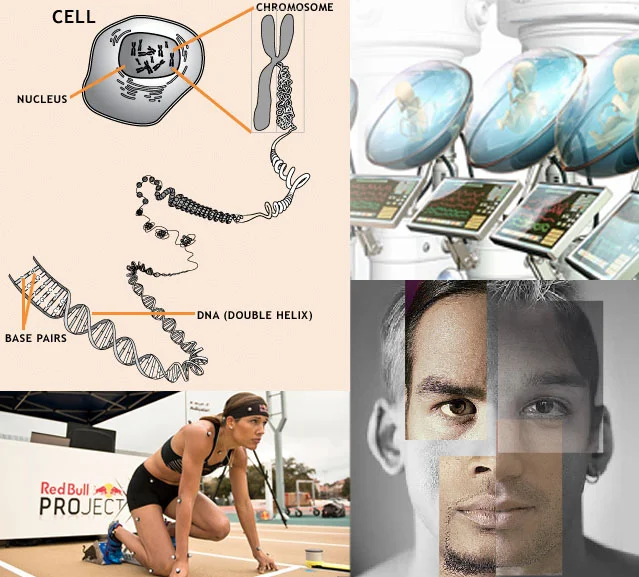
Science and Social Difference
Science and Social Difference (2013-14) considered a series of linked questions about the social, cultural, and scientific nature of the sexed and raced body. The project used the specific focus on sex-testing of elite athletes as a lab for considering larger questions related to social difference and the intersections of scientific and sociocultural perspectives on the sexed and raced body. Sex-testing provides an excellent focal point for exploring how an entangled and intersectional view of sex, gender, and other social formations might be relevant to contemporary matters of science and social policy.
Project Director: Rebecca Jordan-Young
This working group considered a series of linked questions about the social, cultural, and scientific nature of the sexed and raced body. The governing bodies for international sporting competitions (such as the International Olympic Committee) released controversial new policies on who can compete in women's events. These policies, which were meant to ensure that competitors are both "female" and "feminine enough" to compete with other women athletes, provided an excellent focal point for exploring how an entangled and intersectional view of sex, gender, and other social formations might be relevant to contemporary matters of science and social policy. This project's broader goal was to use the specific focus on sex-testing of elite athletes as a lab for considering larger questions related to social difference and the intersections of scientific and sociocultural perspectives on the sexed and raced body.
Fellows

Professor, Department of Anthropology, Barnard College
Nadia Abu El-Haj is professor in the Departments of Anthropology at Barnard College and Columbia University, and Co-Director of the Center for Palestine Studies. She is the author of Facts on the Ground: Archaeological Practice and Territorial Self-Fashioning in Israeli Society (2001), and The Genealogical Science: The Search for Jewish Origins and the Politics of Epistemology (2012), both published by the University of Chicago Press.
Assistant Professor, Department of Anthropology, Columbia University
Vanessa Agard-Jones is Assistant Professor of Anthropology at Columbia University, where she maintains affiliations with the Institute for Research on Women, Gender and Sexuality, the Center for Science and Society, the Earth Institute, and the Department of African American and African Diaspora Studies. At its most expansive, Agard-Jones’ work asks how coloniality is made material: in social forms, in human and nonhuman bodies, and in the landscapes in which we live.

Department of English, Columbia University
Trevor Corson is the author of two books, including the worldwide popular-science bestseller The Secret Life of Lobsters. His work has been anthologized in The Best American Science Writing and he was managing editor of the literary magazine Transition when it won three consecutive Alternative Press Awards for International Reporting. He has written for The Atlantic, The New York Times, and many other publications.
Professor, Department of Law, Columbia Law School
Katherine Franke is the Sulzbacher Professor of Law at Columbia Law School, where she also directs the Center for Gender and Sexuality Law and is the faculty director of the Public Rights/Private Conscience Project. She is a member of the Executive Committee for the Institute for Research on Women, Gender and Sexuality, a member of the Steering Committee for the Center for the Study of Social Difference, and an Affiliated Faculty member for the Center for Palestine Studies. She is among the nation's leading scholars writing on law, religion and rights, drawing from feminist, queer, and critical race theory.
Associate Professor, Spanish & Latin American Cultures, Barnard College
Maja Horn specializes in contemporary Caribbean cultures with a focus on literature, visual and performance art, and political culture. She is the author of Masculinity after Trujillo: The Politics of Gender in Dominican Literature (University Press of Florida in 2014) and is currently completing a second monograph on queer Dominican literature, visual and performance art. She has also published on Latin American and Caribbean arts for various Dominican and U.S. art magazines and is currently serves on the editorial committee for the journal Small Axe: A Caribbean Journal of Criticism.
Professor, Department of Women’s, Gender, and Sexuality Studies, Barnard College
Rebecca Jordan-Young is Professor and Chair of Women’s, Gender, and Sexuality Studies at Barnard College, Columbia University. A sociomedical scientist, Jordan-Young explores reciprocal relations between biomedical sciences and social hierarchies of gender, sexuality, race, and class.

Fellow, Biomedical Ethics, Stanford University
Katrina Karkazis is an anthropologist and bioethicist at the Center for Biomedical Ethics at Stanford University and a faculty affiliate in the Program for Feminist, Gender, and Sexuality Studies, also at Stanford.
Her recent work examines "gender verification" of elite female athletes. An article analyzing the latest policies was published in the American Journal of Bioethics.
Commentaries have appeared in the New York Times, The Guardian, New Scientist, and Discover.

Associate Professor, Department of Education, Barnard College
Maria S. Rivera Maulucci, Associate Professor of Education, joined the faculty of Barnard in 2004. She is a proud member of the Class of 1988 at Barnard and serves as Co-Fund Chair. Prior to coming to Barnard, Maria served as Director of the Science Professional Development Center for Region One in the Bronx. Her expertise in science pedagogy and teacher education draws on 16 years of experience teaching at the elementary, secondary, and postsecondary levels. Her interdisciplinary scholarship focuses on how teachers learn to teach for social justice and the role of language, identity, and emotions in teacher development. Professor Rivera is the Principal Investigator for the Barnard College Robert Noyce Teacher Education Scholars Program (BNTSP) funded by the National Science Foundation.

Assistant Professor, Department of Theater, Barnard College
Shayoni Mitra is an Assistant Professor of Theater at Barnard College. Professor Mitra works at the intersection of performance and politics. Her interest in political theatre stems from her years as an actor with Delhi based street theatre group Jana Natya Manch. She is currently revising toward publication her manuscript, “Contesting Capital: A History of Political Theatre in Postcolonial Delhi,” which interrogates the ever shifting, adapting expressions of political theatre under different configurations of power. It is a historical look at both proscenium and street theatre from the decade of Independence in the 1940s to the twenty first century. The manuscript covers a range of styles including folk and revolutionary singing troupes, large open-air performances, topical agit-prop plays, intimate and improvized activist pieces and feminist performances.
PhD Student, Sociomedical Sciences, Columbia University
Ronna A. Popkin is a Ph.D. Candidate in Sociomedical Sciences (SMS) with a concentration in Sociology at Columbia University. She was a Fellow in SMS's NICHD predoctoral training program in Gender, Sexuality, and Health. Her multi-disciplinary research interests span the fields of sociology, public health, science and technology studies, and gender studies, and include adolescent and young adult sexual and reproductive health, genetic risk, and women’s health in the United States. Prior to attending Columbia, Ms. Popkin worked as a community sexuality educator for Planned Parenthood of Wisconsin and lectured courses at the University of Wisconsin-Madison on sexuality education, women’s health, and the politics of fertility control. Ms. Popkin earned her M.S. in Health Education and B.S. with Honors in Women’s Studies from the University of Wisconsin-Madison.

Fellow, Anthropology, New York University
Rayna Rapp (former Rayna R. Reiter) is a professor and associate chair of anthropology at New York University, specializing in gender and health; the politics of reproduction; science, technology, and genetics; and disability in the United States and Europe. She has contributed over 80 published works to the field of anthropology, independently, as a co-author, editor, and forward-writing, including Robbie Davis-Floyd and Carolyn Sargent's Childbirth and Authoritative Knowledge. Her 1999 book, Testing Women, Testing the Fetus: the Social Impact of Amniocentesis in America, received multiple awards upon release and has been praised for providing "invaluable insights into the first generation of women who had to decide whether or not to terminate their pregnancies on the basis of amniocentesis result".
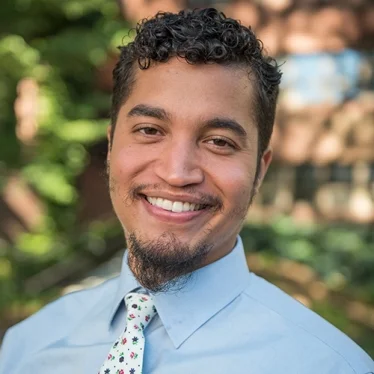
Fellow, Women’s, Gender, and Sexuality Studies, University of Cincinnati.
J.T. Roane is assistant professor of Women’s, Gender, and Sexuality Studies at the University of Cincinnati. He is also part of the University’s urban futures initiative. Roane is broadly concerned about matters of geography, sexuality, and religion in relation to Black communities. He is at work on a manuscript, Dark Agoras: Insurgent Black Social Life and the Politics of Place in Philadelphia, which historicizes multiple modes of insurgent spatial assemblage Black communities articulated in Philadelphia in the second half of the twentieth.

Fellow, Sexuality, Women's and Gender Studies, Amherst College
Sahar Sadjadi is a physician, anthropologist and assistant professor of Sexuality, Women’s and Gender studies at Amherst College. She is currently completing a book based on an ethnographic multi-sited study of the clinical practices around gender non-conforming children in the US and the revision of the psychiatric category, Gender Identity Disorder in Children.
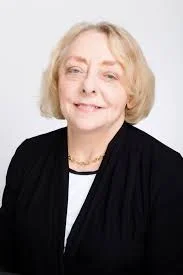
Professor, Department of Neuroscience and Psychology , Barnard College
Rae Silver is the Helene L. and Mark N. Kaplan Professor of Natural & Physical Sciences and the head of the Silver Neurobiology Laboratory. Since 1976, Professor Silver has been a member of Barnard’s faculty and has taught courses in Quantitative Reasoning, Neuroscience and Psychology. The National Science Foundation, the National Institutes of Mental Health, and National Institute of Neurological Disorders and Stroke, Air Force Office of Scientific Research, and the Office of Naval Research, are among the organizations that have supported her research.

Mailman School of Public Health and Department of Anthropology, Columbia University
Carole S. Vance, PhD, works on integrating sexuality with human rights frameworks and rights-based health interventions. She has written widely on sexuality, science, gender, and policy; policy controversies about sexual expression and imagery; and sexuality theory and research methods. For the past ten years, she has directed a program on sexuality, gender, health and human rights, which advances policy-relevant scholarship and facilitates exchange between researchers and advocates on sexual health and rights issues.
Past Events

In early 2015 Shoshana Magnet, associate professor at the Institute of Feminist and Gender Studies at the University of Ottawa, came to speak to CSSD’s working group on Science and Social Difference about her feminist analysis of recent scientific inquiry into mixed societies of robots and insects.
Magnet, co
Please join us for "Beyond masculinity: testosterone, sexual desire, and gender/sex," lecture by Sari van Anders, University of Michigan.

Borders and Boundaries
The Borders & Boundaries project re-examined current ways of thinking about global migration and sought to develop new ways of conceptualizing the sociological, historical, economic, political, aesthetic and gender-specific dimensions of human mobility and social difference. The project raised comparative questions concerning the ways in which international migrations - and border crossings of other kinds - relate to the formation and transformation of intra-societal boundaries such as race, class, gender and sexuality.
Project Directors: Claudio Lomnitz, Elizabeth Povinelli
The Borders & Boundaries project was a unique interdisciplinary working group of scholars interested in re-examining current ways of thinking about global migration and developing new ways of conceptualizing the sociological, historical, economic, political, aesthetic and gender-specific dimensions of human mobility and social difference. Borders & Boundaries had as its premise a double paradox of contemporary life: the hardening of ethnic and racial boundaries at a time when goods and information flow across national borders quite freely, and the increasingly acute focus on racial differences at a time when race as a "scientific" or descriptive social category has become conspicuously unstable. The Borders and Boundaries project raised comparative questions concerning the ways in which international migrations - and border crossings of other kinds - relate to the formation and transformation of intra-societal boundaries such as race, class, gender and sexuality. Borders & Boundaries insisted that gender/race/sexuality/class must be at the foundation of any global thought initiative and that global concerns must be at the foundation of the study of gender/race/sexuality/class.
The Borders and Boundaries Working Group focuses on the relationship between international borders and social boundaries within national societies. The working group has as its premise a double paradox of contemporary life: the hardening of ethnic and racial boundaries at a time when goods and information flow across national borders quite freely, and the racialization of social relations at a time when racial theories have an awkward relation to scientific prestige, and racial categories have become conspicuously unstable. The Borders and Boundaries Working Group seeks to explore sociological, historical, political and aesthetic dimensions of the relationship between national borders and social boundaries in a comparative context.
In order to do so, we seek to shape an international research network that is committed to comparison. The working group has initiated with an institutional platform based at CSER and CCASD at Columbia, and at the Institut de Recherche Interdisciplinaire sur les Enjeux Sociaux (IRIS) at the Ecole de Hautes Etudes en Sciences Sociales in Paris. Additional institutional sites are currently being explored in Australia, Turkey, Mexico, and Germany. The Borders and Boundaries working group’s first concern was an interrogation of the connection between racial formation and immigration in the United States and France. It is currently developing that theme, and incorporating a new field of inquiry on boundary formation and indigeneity in national societies that were founded as settler colonies. In order to achieve conceptual clarity on the subject of immigration, settlement, and race, the Borders and Boundaries working group is interested in extending attention to boundary formation in areas of the world where migration is principally internal, such as China and India. The work of the Borders and Boundaries group began in 2007, when CSER hosted a panel discussion of racism in contemporary France, and its connection to the contemporary history of race in the United States. Didier Fassin, one of the project’s initiators, has proposed a special issue of the French history journal Annales as the project’s first collective publication. CCASD and CSER will be holding a first fully-fledged conference of the Borders and Boundaries working group at Columbia in the Fall of 2008. After that meeting, we plan to work in a sustained fashion for three years, inviting speakers, faculty fellows, and visiting fellows working in a variety of sites in order to produce a robust comparative discussion.

Past Events
A conference and roundtable discussion on the connections between international borders and social boundaries in the contemporary world with a keynote address by Nina Bernstein of the New York Times on “Outlaw Generation: A Crackdown and its Consequences for Children in Illegal Immigrant Families in the United States”
